

Developers specialize in different programming languages, which often define their roles and challenges. Marketing to all developers as a single group wastes time and money. Instead, focus on targeting by programming language to reach the right audience with relevant messaging.
Key Takeaways:
- Programming languages indicate a developer's role. For example, Python is popular in data science, while Swift is for iOS development.
- Tailored ads with language-specific messaging (e.g., "For Python developers") and relevant code snippets build trust and improve engagement.
- Platforms like daily.dev Ads allow precise targeting by language and tools, helping optimize ad spend and boost ROI.
Quick Steps to Start:
- Identify your target developer segment by language (e.g., JavaScript for frontend, Python for data science).
- Use tools like daily.dev Ads to filter by language and frameworks.
- Craft ads with specific pain points and solutions for that language.
- Track performance by language and adjust budgets accordingly.
Targeting developers by their programming language ensures your ads resonate, leading to better conversions and smarter marketing spend.
Why Programming Language Targeting Matters
Relevance and ROI Benefits
Programming languages shape the daily lives of developers. A React developer focused on user interfaces has entirely different priorities than a Python developer working on machine learning models. By targeting specific programming languages, you ensure your message reaches the right audience - those who can actually benefit from your product. This approach leads to better click-through rates and stronger conversion metrics.
The data backs this up. Python accounts for 27.9% of all programming language tutorial searches, with Java at 11.74% and JavaScript at 5.24%. These percentages highlight distinct developer communities, each with unique needs and learning habits. For instance, 39.5% of recruiters actively look for Java experts, while 45.7% prioritize Python developers. Trying to market to "all developers" waters down your message, making it less effective across groups with little overlap in interests or challenges.
Next, let’s break down how specific programming languages align with different developer roles.
Developer Use Cases by Language
Programming languages define specific roles and challenges for developers. For example, Python is the go-to for data science and machine learning, with 71.8% of beginner developers choosing it as their first language. On the other hand, JavaScript and TypeScript dominate frontend development, with TypeScript seeing a 66% contributor increase in 2025, adding over 1 million new developers. Java continues to thrive in enterprise backend development, maintaining a top-five spot in the TIOBE Index since 2000.
Mobile development is similarly divided by platform: iOS developers lean on Swift and Objective-C, while Android developers rely on Kotlin and Java. Systems programming attracts developers to Rust, C++, and Go. Notably, Go climbed from 13th to 7th in the TIOBE Index, driven by the rise of cloud-native infrastructure. A developer working on Rust for systems programming simply won’t engage with ads about Python data pipelines, no matter how polished the pitch.
This clear segmentation allows for more efficient use of marketing budgets and tailored messaging.
Budget Efficiency and Personalization
Targeting specific programming languages prevents wasted ad spend on irrelevant clicks. Showing a TypeScript debugging tool to Ruby developers is a costly mistake - it not only wastes money but also confuses ad algorithms, making future campaigns less effective. Language targeting solves this by ensuring your ads reach the right audience, increasing the likelihood of conversions.
But targeting goes beyond just filtering audiences. Developers often identify strongly with their programming language. They proudly call themselves "Rustaceans" or "Pythonistas" rather than generic "software engineers." Using language-specific messaging - like "For Python developers" - signals relevance and builds trust. Addressing specific pain points, such as JavaScript bundle size problems or Python performance issues, resonates deeply because it speaks their technical language. This approach earns credibility and cuts through the noise of generic ads that developers are quick to ignore.
Focusing on language targeting not only optimizes your budget but also improves conversion rates, reinforcing the importance of precision in developer-focused advertising.
sbb-itb-e54ba74
Developer Segmentation by Programming Language
::: @figure 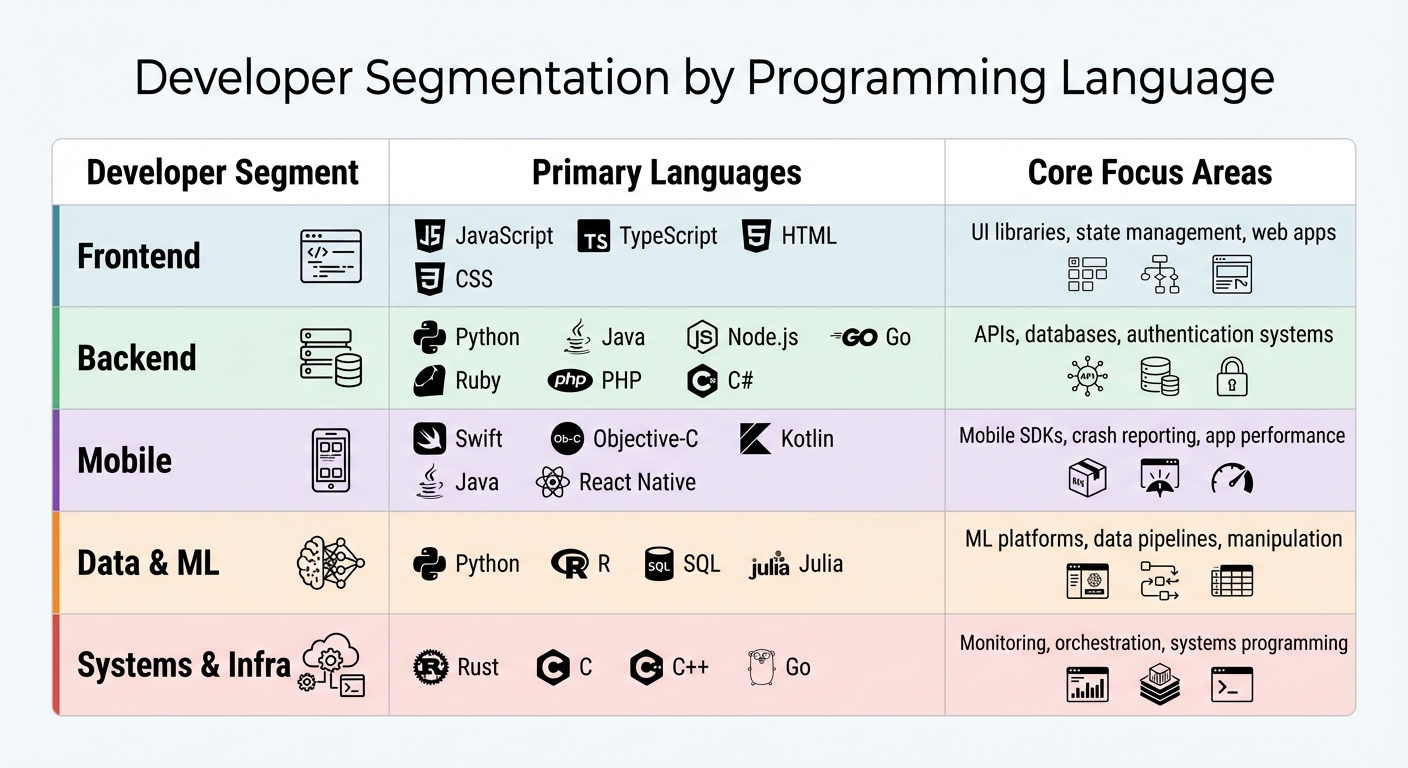 {Developer Segmentation by Programming Language and Role}
Understanding how developers are grouped by programming language and role can help align your product with their specific tools and workflows. For instance, a frontend developer focused on user interfaces will have entirely different needs compared to a systems programmer fine-tuning low-level performance.
Here’s a breakdown of developer roles, their primary languages, and focus areas:
| Developer Segment | Primary Languages | Core Focus Areas |
|---|---|---|
| Frontend | JavaScript, TypeScript, HTML, CSS | UI libraries, state management, web apps |
| Backend | Python, Java, Node.js, Go, Ruby, PHP, C# | APIs, databases, authentication systems |
| Mobile | Swift, Objective-C, Kotlin, Java, React Native | Mobile SDKs, crash reporting, app performance |
| Data & ML | Python, R, SQL, Julia | ML platforms, data pipelines, manipulation |
| Systems & Infra | Rust, C, C++, Go | Monitoring, orchestration, systems programming |
Frontend Developers
Frontend developers rely on JavaScript, TypeScript, HTML, and CSS to create user interfaces and handle interaction challenges. Their work often revolves around UI libraries like React or Vue, state management tools, and ensuring smooth web app performance. Solutions that enhance UI performance or simplify state management will resonate strongly with this audience.
Backend Developers
Backend developers handle the server-side logic that drives applications. They use languages like Python, Java, Node.js, Go, Ruby, PHP, and C# to build APIs, manage databases, and implement authentication systems. If your product improves database scalability, boosts API performance, or simplifies authentication, it’s likely to grab their attention. For example, a tool addressing API rate limiting could appeal to a Go developer working on microservices.
Mobile Developers
Mobile developers work with Swift and Objective-C for iOS, and Kotlin and Java for Android. Those working on cross-platform apps often turn to React Native. These developers need tools like mobile SDKs, crash reporting systems, and performance monitoring solutions. If you’re promoting an iOS SDK, focusing your efforts on Swift and Objective-C developers will yield better results than targeting a broader audience.
Data and Machine Learning Developers
Data and machine learning developers commonly use Python, alongside R, SQL, and Julia, to build machine learning platforms, set up data pipelines, and conduct statistical analysis. They value tools that improve model training speed, streamline data manipulation, and orchestrate pipelines efficiently. Highlighting Python compatibility while also addressing R and Julia users can make your product more appealing to this group.
Systems and Infrastructure Developers
Systems and infrastructure developers work with Rust, C, C++, and Go to tackle low-level performance challenges. Their focus is on monitoring tools, orchestration platforms, and systems programming. They prioritize performance, memory safety, and granular control. If you’re offering solutions like infrastructure monitoring or container orchestration, emphasize how your product aligns with the specific languages they use.
These segments provide a roadmap for crafting targeted campaigns, which can be further explored with daily.dev Ads in the next section.
How to Target Developers by Language with daily.dev Ads
When it comes to connecting with developers, relevance is key. daily.dev Ads lets you fine-tune your approach with in-feed campaigns and language-specific newsletters. These tools help you reach developers based on their programming language preferences, whether you're promoting a Python performance tool or a JavaScript framework.
Using Tech Stack Filters on daily.dev Ads
Tech stack filters allow you to pinpoint developers by the programming languages and frameworks they use. In the daily.dev Ads manager, the Tech Stack section offers over 20 programming languages to choose from. You can further refine your audience by adding frameworks. For instance, you could target JavaScript developers who also work with React and TypeScript, or Python developers using Django.
Here’s how to set it up:
- Log in to the Ads manager.
- Select your primary language in the Tech Stack filter.
- Add related frameworks to narrow your audience. For example, if you're promoting a TypeScript linting tool, you might select JavaScript and TypeScript, then include frameworks like React or Vue.js.
Stick to 2–3 related languages to keep your message focused. Casting too wide a net can dilute your campaign and make it harder to create content that resonates. To refine your targeting even further, combine language filters with options like seniority levels or geographic location. For example, you could target senior Go developers based in the United States.
If you're looking for another way to engage developers, consider language-specific newsletters.
Language-Specific Newsletter Advertising
Newsletters are an excellent way to reach engaged developer communities. daily.dev Ads gives you access to popular language-specific newsletters, including:
- JS Weekly: 180,000 subscribers
- Python Weekly: 200,000 subscribers
- Android Weekly: 80,000 subscribers
- iOS Dev Weekly: 40,000 subscribers
- Ruby Weekly: 30,000 subscribers
- Go Weekly: 15,000 subscribers
Sponsorship costs vary, ranging from $0 to $2,000 per send, depending on the newsletter's audience size.
To sponsor a newsletter, reach out to the curator through daily.dev and share a 50-100 word product description. Keep the tone educational. For example, instead of saying, "Buy our amazing Python tool now!", you could write, "Boost Python performance with our type checker - used by 10,000 developers to cut runtime errors by 40%." Once you finalize the details with the curator, you can monitor metrics like open and click-through rates to gauge performance.
Creative Best Practices for Language Targeting
When it comes to language-specific targeting, crafting ad creative that speaks directly to developers' needs is key. Developers are deeply connected to their chosen programming language and its ecosystem, so generic messaging simply won’t cut it. Your ad creative must resonate on a technical and personal level to turn a passing glance into meaningful engagement.
Show Code in the Target Language
Include a short, 3–5 line snippet of code written in the target language, ensuring it’s syntactically correct and formatted with modern conventions. For example, avoid outdated Python 2 syntax or ES5 JavaScript when trying to reach today’s developers. Use syntax highlighting and developer-friendly fonts to add credibility. The code should offer an "aha moment" - something that makes developers think, "I could use that in my project." Avoid overly generic examples unless your product is aimed at beginners. Instead, focus on examples that address specific challenges or provide immediate value to the language community you're targeting.
Address Language-Specific Pain Points
Every programming language comes with its own set of challenges, and developers are acutely aware of them. A successful ad speaks directly to these pain points. For example:
- Python developers often grapple with performance optimization and type safety.
- JavaScript developers worry about bundle sizes and managing dependencies.
- Go developers value simplicity in concurrency and deployment.
- Rust developers focus on memory safety and compile-time guarantees.
Your ad should clearly explain how your product solves these specific issues. Use precise terminology that matches the language and tools developers use daily. This not only builds trust but also positions your product as a practical solution to their real-world problems.
Align Landing Pages with Ad Language
The journey doesn’t end with the ad. Your landing page should seamlessly continue the conversation started in the ad. If the ad highlights concurrency in Go, the landing page should feature Go code examples, frameworks like Gin or Echo, and documentation tailored to Go developers. Similarly:
- For Python data science developers, showcase integrations with tools like Jupyter notebooks or pandas.
- For JavaScript developers, emphasize npm package availability and compatibility with frameworks like React or Vue.
This alignment ensures a consistent and relevant user experience, eliminating any sense of a "bait and switch." By tailoring both your ad and landing page to the same audience, you create a cohesive experience that builds trust and drives conversions.
Measurement and Optimization by Language
Once you’ve tailored your campaigns to specific languages, the next step is to measure performance effectively. Why? Because without tracking results, you’re essentially flying blind - spending money on underperforming segments while missing out on the ones that deliver real results. Accurate measurement helps you focus on the languages that drive the most conversions.
Track Engagement Metrics by Language
Start by using language-specific UTM parameters for every campaign link. For example, you might use tags like utm_content=python_devs or utm_content=javascript_devs. This makes it easy to break down performance metrics - like click-through rates, sign-up rates, and activation rates - by language in analytics tools like Google Analytics.
But don’t stop at clicks or sign-ups. Define language-specific activation milestones to see which communities actually use your product. For instance, a Python developer’s activation milestone might be importing your library into a Jupyter notebook, while a JavaScript developer’s milestone could involve installing your npm package and running their first build. Tracking these milestones gives you a clearer picture of how different language communities engage with your product. Map out the entire funnel, from ad impressions to meaningful product usage, and analyze it by language.
Once you have this data, you can move on to measuring the value these segments bring over time.
Assess Lifetime Value by Language
To refine your strategy further, calculate the cost per acquisition (CPA) for each language segment and monitor retention and revenue over time. For example, you might find that Go developers stick around 40% longer than PHP developers or that Rust users generate more referrals.
Developers in system-level languages like Rust and Go often represent higher lifetime value because they’re typically working on mission-critical projects with longer lifecycles. In contrast, JavaScript developers might experiment with new frameworks more frequently, leading to shorter engagement periods. Understanding these differences can help you decide where to allocate your marketing budget.
Use this data to double down on the segments that deliver the best returns.
Reallocate Budget for Maximum ROI
After running your campaigns for 30 days, analyze the results and adjust your spending. Shift budget away from high-click, low-activation segments and invest more in the ones with strong engagement and lower CPA. For instance, if Python developers are converting at twice the rate of Ruby developers, consider reallocating 20-30% of your Ruby budget to Python campaigns.
Create a feedback loop between your data and your content strategy. If TypeScript developers show the best ROI, invest in more TypeScript-focused tutorials, documentation, and examples. This not only strengthens your presence in high-performing segments but also creates a snowball effect - better content attracts more users, leading to even better results in those communities.
Common Mistakes in Language Targeting
Even seasoned marketers can stumble when it comes to targeting developers by programming language. These missteps often go unnoticed but can quietly drain budgets and hurt conversion rates. Precision is key when engaging developers, and these common mistakes can undermine that focus.
Targeting Too Many Languages at Once
Trying to target too many programming languages in one campaign can dilute your efforts. When your budget is spread too thin, you fail to achieve the frequency and visibility needed to make an impact within any single developer community. For instance, if you have a $10,000 monthly budget and divide it equally among Python, JavaScript, Java, Go, Rust, Ruby, PHP, C++, Swift, and Kotlin, each language only gets $1,000. That’s not enough to leave a lasting impression.
Instead, concentrate on one or two key languages where your product delivers the most value. Run focused campaigns for about 30 days to measure results, then expand gradually. For example, if you’re promoting a data pipeline tool, allocate 70% of your budget to Python, 20% to Java or Scala, and reserve 10% for testing other languages. This method builds momentum in the communities that matter most, rather than scattering weak signals across many. A focused approach also allows for more tailored messaging, ensuring your ads resonate with the right audience.
Using Generic Creative Messaging
Developers are not a one-size-fits-all group - they have specialized roles and varying technical needs based on their focus, whether it’s AI/ML, systems programming, or frontend development . A generic message like "For Developers" fails to address the specific challenges faced by these distinct groups .
Broad messaging misses the mark entirely. Instead of using vague calls-to-action like "Speed up your development workflow", try something more specific, such as "Optimize your Python data pipeline performance." This kind of targeted messaging immediately signals relevance to your audience. Developers respond better when the ad speaks directly to their language and ecosystem.
The numbers back this up: Python leads with 45.7% of recruiter demand, followed by JavaScript at 41.5% and Java at 39.5% . Each language serves different purposes, so your messaging should reflect these differences to connect with the right audience.
Ignoring Frameworks and Adjacent Languages
Developers don’t just identify with a programming language - they also work within specific frameworks and ecosystems. For example, a JavaScript developer might specialize in React, Vue, or Node.js. If you target "JavaScript" without factoring in these frameworks, you miss the specificity that drives engagement .
Take TypeScript as an example. With a 77.9% year-over-year growth in AI repositories and increasing popularity on GitHub, many JavaScript developers also use TypeScript . Overlooking this segment could mean missing out on a high-value audience. Similarly, Python developers working on data-driven projects often rely on SQL, and backend engineers frequently use Shell scripting .
To maximize your reach, target entire ecosystems rather than just individual languages. For instance, if you’re marketing a frontend tool, consider focusing on JavaScript, TypeScript, and React together, instead of JavaScript alone. For enterprise tools, think about Java alongside Spring Boot and complementary languages like Kotlin. Neglecting frameworks and related languages can leave significant gaps in your targeting strategy. By addressing these pitfalls, you can sharpen your focus and boost ROI.
Conclusion
Reaching developers by their programming language isn’t just smart - it’s what separates successful campaigns from wasted ad spend. When your message aligns with the tools and frameworks developers use every day, you cut through the noise and connect with their technical world. Think about it: a Python developer working on machine learning has completely different priorities than a Swift developer creating iOS apps. Your campaigns need to reflect those differences.
This approach doesn’t just make your ads more relevant - it delivers measurable results. The key lies in three main principles: segmentation, personalization, and measurement. First, identify the developer segments that align with your product. Next, create targeted content that features code snippets and addresses specific challenges for those segments. Finally, track engagement and conversions by language to see which groups deliver the best ROI.
Platforms like daily.dev Ads make this kind of precision possible. With advanced tech stack filters covering 20+ programming languages, you can reach over 1.6 million developers through native in-feed placements and language-specific newsletters. Instead of spreading your budget across a broad, generic audience, you can focus on the exact combination of language, framework, and seniority that aligns with your product.
The best developer marketers know that targeting goes beyond just the primary language. It’s about understanding the full ecosystem. For example, TypeScript developers also work with JavaScript, Python data engineers often use SQL, and React developers identify more with their framework than with JavaScript itself. Allocating your budget wisely - 70% on your primary language, 20% on related communities, and 10% on testing - along with language-specific landing pages and tailored creatives, ensures your campaigns resonate deeply.
Begin with one or two languages where your product shines, measure the ROI over 30 days, and then expand strategically.
FAQs
What’s the best platform for language targeting?
Platforms where developers are actively engaged are ideal for language targeting. Stack Overflow, Reddit, and daily.dev stand out as excellent choices. These platforms offer tools like tag targeting, subreddits, and tech stack filters to help you connect with specific developer communities. Prioritize platforms that match your audience's habits and interests to ensure your efforts resonate effectively.
How do I target JavaScript developers specifically?
To connect with JavaScript developers, center your approach around their preferred tools, frameworks, and platforms. Leverage platform-specific targeting by using tags like [javascript], apply tech stack filters for popular frameworks such as React or Vue, and craft personalized messages that include relevant JavaScript code snippets. Address common challenges they face, like performance optimization or reducing bundle size, and use real-time data to engage developers based on the tools and technologies they're actively using.
Can I target multiple languages in one campaign?
Yes, it’s possible to target several programming languages within one campaign by creating distinct audience segments. Use targeting options provided by platforms - like filtering by language combinations or specific tags - to keep your messaging relevant. This method lets you customize your approach for each group while keeping the campaign streamlined and effective.
How much does it cost?
Developer ad campaigns on daily.dev start with a minimum spend of $5,000. The CPM (cost per thousand impressions) generally falls between $2 and $5, influenced by factors like your targeting choices and how you structure your campaign.
How should creative differ by language?
When creating content for developers, aligning it with the target programming language is key to making it relevant and engaging. This means your ads should reflect the unique needs and characteristics of that language.
For example:
- Python-focused ads: Include Python code snippets and emphasize aspects like performance or type safety.
- JavaScript-focused ads: Highlight frameworks like React or Vue, and address concerns such as user interface design or bundle size.
To take it further, ensure your landing pages mirror the ad’s focus. Use examples and messaging that resonate with the same programming language. This consistency strengthens the connection and keeps your audience engaged.