

Twitter (now X) is a key platform for developers to discuss tech trends, share knowledge, and network professionally. But traditional ads often fail to engage this audience. Why? Developers value precise, technical content that addresses their challenges directly. To connect effectively, focus on these strategies:
- Understand Your Audience: Define the developer type (e.g., software engineers, data scientists) and their skill levels to craft relevant content.
- Behavioral Targeting: Use Twitter's tools to target by interests, skills, or industry-specific keywords like "JavaScript" or "cloud computing."
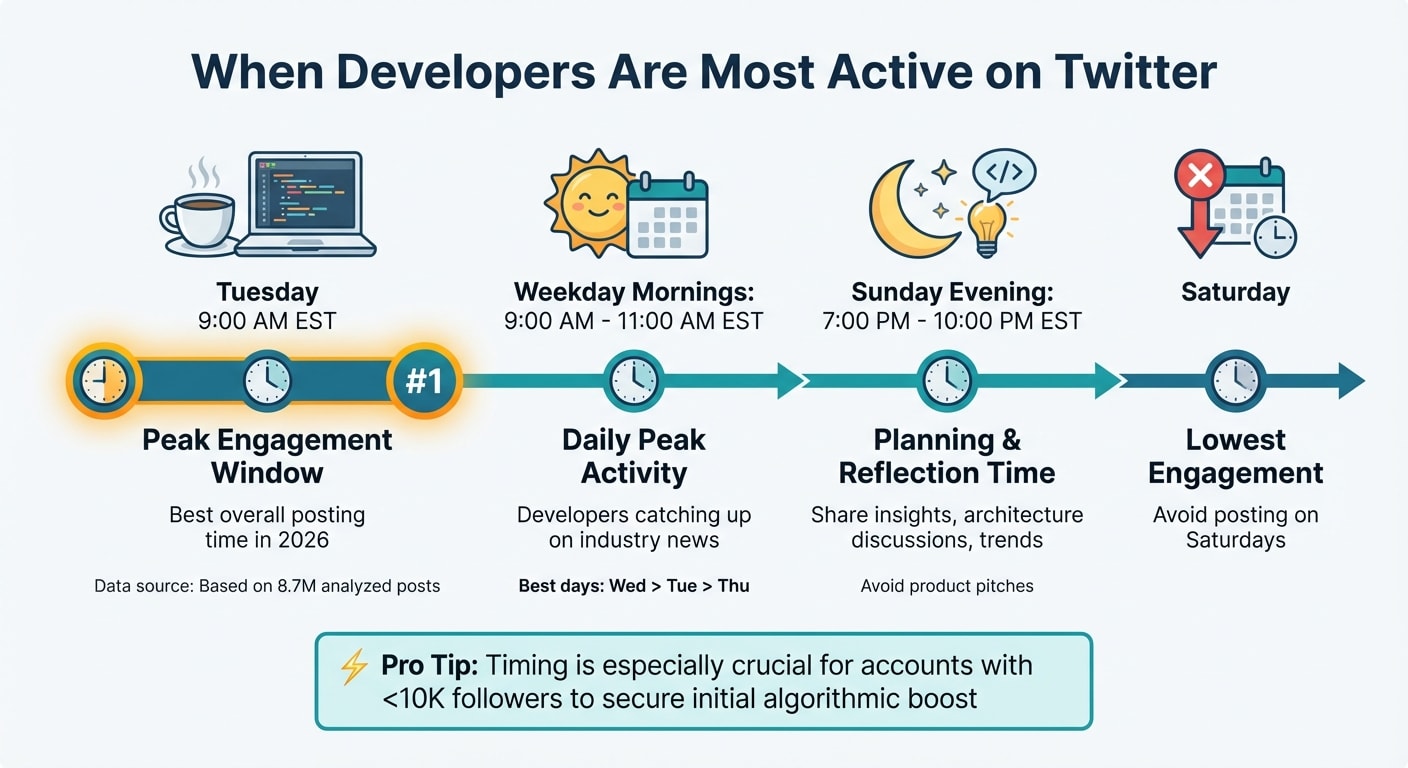
- Timing Matters: Post during peak activity times, such as weekday mornings (9:00 a.m.–11:00 a.m.) or Sunday evenings (7:00 p.m.–10:00 p.m. EST).
- Content Focus: Share technically accurate, practical content like code snippets, tutorials, or solutions to real problems.
- Measure and Optimize: Track metrics like engagement rates and click-through rates. Use A/B testing to refine your approach.
Developers appreciate content that respects their expertise, solves problems, and aligns with their interests. With the right strategy, you can turn passive followers into active participants.
How Developers Use Twitter
Common Developer Activities on Twitter
For developers, Twitter often doubles as a hub for technical exploration and collaboration. They frequently share and discuss topics like artificial intelligence, programming languages, cloud computing, and other cutting-edge technologies. The platform serves as a go-to source for real-time updates on tools, frameworks, and trends.
Developers also use Twitter to exchange resources like technical blogs, coding challenges, and video tutorials - content that helps them tackle problems or pick up new skills. By following industry experts and thought leaders, they stay plugged into best practices and emerging developments. Beyond individual learning, Twitter fosters active technical communities where developers engage in conversations about their work, challenges, and interests. These interactions provide advertisers with a unique opportunity to align their messaging with ongoing technical discussions. Developers' engagement on the platform often reveals their expertise, preferred tools, and current challenges, making it easier to connect with them in meaningful ways.
This dynamic explains why traditional advertising methods often fail to resonate with this audience.
Why Developers Avoid Traditional Ads
Developers tend to have a natural resistance to conventional ads. They’re quick to spot irrelevant or shallow promotions and just as quick to ignore them. Ads that lack depth or disrupt their experience are often dismissed as intrusive.
What works instead? Developers gravitate toward marketing that respects their intelligence and time. They value content that offers practical solutions to real problems, backed by technical accuracy and transparency. Ads that are non-intrusive, privacy-conscious, and genuinely helpful are far more likely to capture their attention. Anything less risks being overlooked entirely.
Identify Your Target Developer Audience
Before diving into your Twitter campaign, it's crucial to pinpoint the exact type of developer you want to reach. A generic approach won’t work - it’ll simply get lost in the noise. Start by defining your ideal developer profile. Are you speaking to software engineers, DevOps specialists, or data scientists? A well-defined segmentation strategy ensures your campaign aligns with behavior-driven targeting methods laid out in this guide.
Target by Role and Experience Level
Segmenting your audience by role and experience helps you craft content that resonates with their specific needs.
Twitter’s targeting tools make it easy to filter by job titles, skills, companies, and professional interests . For instance, if you’re targeting software engineers, DevOps professionals, frontend developers, backend developers, or data scientists, you can tailor your message to match their unique challenges and goals.
Experience level is equally important. A junior developer searching for beginner-level coding tutorials has very different priorities compared to a senior architect evaluating enterprise-level solutions. Twitter allows you to fine-tune your targeting by combining firmographic data with interests or by focusing on followers of influential tech leaders . For example, you might create content aimed at junior developers featuring beginner-friendly tutorials, while offering advanced topics like Kubernetes orchestration for senior professionals. You can also use demographic data, like age ranges that often correlate with experience levels, to estimate audience size and refine your reach in real time.
Target by Technical Skills and Industry
Narrowing your focus further by technical skills and industry sectors can enhance your campaign’s precision.
Use keyword targeting - whether broad, phrase, or exact match - to engage developers discussing specific programming languages and tools . Popular skills like JavaScript, Python, Java, React, Node.js, AWS, and Docker often dominate conversations in the developer community, making them excellent keywords to prioritize.
Industry-specific targeting adds another layer of refinement. Keywords like "fintech development", "healthtech", or "gaming engines" help you zero in on developers active in particular sectors . Pair these with follower targeting, such as focusing on fintech CTOs or gaming engine creators, to connect with developers already immersed in those areas. Finally, A/B testing different targeting criteria is key - ads tailored to specific skills often see 2-3x higher engagement than broader campaigns .
Behavioral Targeting Techniques
Once you've pinpointed your target developer audience, behavioral targeting allows you to connect with them based on their online activities. Instead of focusing only on demographics, pay attention to what developers actually do - the technologies they talk about, the communities they join, and the content they interact with.
Use Interest and Skill-Based Targeting
To capture relevant conversations, leverage three keyword match types: broad, phrase, and exact.
- Broad match captures a wide range of variations and related terms. For instance, if you're promoting a cloud infrastructure tool, "cloud computing" as a broad match would cover diverse discussions.
- Phrase match targets the specific word order with small variations, such as "AWS deployment", to zero in on particular conversations.
- Exact match focuses on the precise keyword, like "Kubernetes orchestration", to engage developers discussing that exact topic.
Interest-based targeting goes a step further by focusing on developers' expertise with specific tools, programming languages, or frameworks. For example, you could target developers actively engaging on Twitter about Python or Docker. This ensures your messaging aligns with their technical needs and challenges .
Additionally, keeping an eye on external developer communities can help refine your approach even more.
Track Developer Community Activity
Developers frequent platforms like Reddit, Stack Overflow, and GitHub to share knowledge, solve problems, and discuss technologies. By monitoring these spaces, you can better align your Twitter campaigns with the issues developers are actively tackling. For example, if you notice GitHub discussions around CI/CD pipelines, you could tailor your messaging to address those specific challenges.
This kind of insight not only strengthens interest-based targeting but also enhances retargeting efforts by validating developers' ongoing discussions .
Retarget Developers Who Engaged Previously
Retargeting is a powerful way to reconnect with developers who have already shown interest. Using Twitter's Custom Audiences, you can retarget developers who visited your website or interacted with your content. For follower-based campaigns, consider adding about 30 usernames and refining the audience further with interest keywords or technical skills. This approach can significantly improve engagement and conversion rates .
Timing and Content Strategies
Timing and well-crafted content are key to running a successful campaign.
Post When Developers Are Most Active
To maximize engagement, post when developers are actively browsing Twitter. Research shows that developers follow consistent activity patterns, with peak engagement occurring at the start of their workday - between 9:00 a.m. and 11:00 a.m. This is when they’re catching up on industry news and settling into their day . Specifically, Tuesday at 9:00 a.m. stands out as the best time to post in 2026, based on data from 8.7 million analyzed posts .
Mid-week days, especially Wednesday, tend to perform best, with Tuesday and Thursday close behind. On the flip side, engagement drops significantly on Saturdays . For accounts with fewer than 10,000 followers, timing becomes even more crucial, as it helps secure the initial algorithmic boost necessary for broader visibility .
Interestingly, there’s another opportunity on Sunday evenings between 7:00 p.m. and 10:00 p.m. EST. During this time, developers and tech founders often use Twitter to share ideas or plan for the week ahead. This window is perfect for posting thought-provoking content like high-level insights, architectural discussions, or reflections on industry trends. Avoid product pitches during this time, as they’re less likely to resonate .
While timing can expand your reach, the quality and relevance of your content are what truly keep developers engaged.
Create Technically Accurate, Practical Content
Developers value accuracy and practical solutions above all else . Your content should address real challenges they face, offering clear explanations, actionable examples, and solutions to complex problems. Even with perfect timing, poorly crafted content won't hold their attention. Instead, focus on providing material that demonstrates a deep understanding of their needs and priorities. This approach ensures your message resonates, regardless of when it’s shared.
Track and Improve Campaign Performance
To make the most of your targeting strategies, you need to consistently track and refine your campaign performance. Without monitoring, it’s easy to miss what’s actually driving success. Start by setting clear goals - like tool downloads or event sign-ups - so you can focus on the metrics that matter.
Key Metrics to Monitor
Pay attention to metrics that reflect genuine developer interest rather than vanity numbers. For example:
- Engagement rates (likes, replies, retweets): These indicate whether your content is connecting with your audience.
- Click-through rates (CTR): This shows if your message is compelling enough to encourage further action. For developer-focused campaigns, a CTR between 0.5% and 2% is a solid benchmark, with ads featuring code snippets or technical visuals often reaching up to 1.8% .
- Conversions: Track actions like tool downloads, free trial sign-ups, and GitHub stars - these demonstrate real intent.
- Cost-per-engagement (CPE) and cost-per-acquisition (CPA): These metrics help ensure your budget is being spent wisely.
Review these metrics on a weekly basis to identify trends and opportunities to optimize your campaign. With this data in hand, you can refine your strategy through systematic testing.
A/B Test Different Approaches
A/B testing is a powerful way to pinpoint what works best in your campaigns. Split your efforts into distinct variants. For example, one test (Test A) could target junior developers using role-specific keywords, while another (Test B) focuses on senior engineers via influencer channels. Run both for 7–14 days with equal budgets to ensure the results are statistically valid. Interestingly, campaigns targeting senior developers often deliver 20% to 30% higher engagement for advanced tools .
Content variations are just as important. Experiment with different headlines (e.g., technical-focused versus benefit-driven), visuals (like code diagrams versus animations), and calls-to-action (e.g., "Try Demo" versus "Download Free"). For instance, one tech company saw a 25% boost in conversions by targeting "cloud computing" keywords instead of follower look-alike audiences . Another achieved a 40% increase in CTR by swapping generic images for technical diagrams in their ads .
To get meaningful results, ensure each test variant reaches at least 1,000 impressions. Additionally, leverage Twitter's optimized targeting feature to automatically extend your reach to similar high-converting audiences .
Conclusion
Connecting with developers on Twitter requires a thoughtful, value-driven strategy that taps into ongoing tech conversations and builds trust through authentic influencer partnerships .
Successful campaigns start by clearly identifying your target developer audience - considering factors like their role, experience level, and technical skills. From there, use behavioral tactics such as interest-based and keyword targeting to fine-tune your outreach and achieve more focused results .
To maximize impact, set specific goals - whether it’s driving tool downloads, event sign-ups, or trial conversions - and continuously refine your approach. Use A/B testing to evaluate targeting methods and creative assets, making adjustments based on real engagement data . This iterative process ensures your campaigns stay effective and relevant.
Equally important is delivering accurate, meaningful content that respects developers' privacy and directly addresses their challenges. This approach can transform passive followers into engaged participants .
For an even broader reach, consider integrating other platforms into your strategy. One option is daily.dev Ads (https://business.daily.dev), which can complement your Twitter efforts with highly targeted messaging in a developer-focused environment.
FAQs
How do I choose the right developer segment to target?
To connect with the right developer audience, start by identifying distinct developer personas. These could include roles like community connectors or open-source enthusiasts, along with factors like their seniority and specific interests. Dive deeper into their experience levels, the tools they rely on, and the platforms they frequent. By tailoring your messaging to these details, you can craft campaigns that align with their needs, boosting both engagement and the impact of your ads.
Which keywords should I target without wasting budget?
To make sure your budget is spent wisely, focus on keywords that resonate with developers and their work. This includes terms tied to programming languages like Python and JavaScript, as well as tools like Docker and Kubernetes. Don't forget frameworks such as React and Vue, or broader tech areas like DevOps and Cloud Computing.
It’s also smart to include keywords that reflect developers' roles or passions, such as API, CI/CD, and Open Source. By zeroing in on these terms, you’ll ensure your campaign stays relevant and reaches the right audience.
How can I track real developer conversions from X ads?
To effectively track developer conversions, focus on monitoring key metrics like conversion rate, click-through rate (CTR), and cost. Utilize ad management tools to measure specific actions developers take, such as sign-ups or downloads.
Real-time performance tracking is essential for optimizing your campaigns. It allows you to adjust budgets, fine-tune targeting, and improve overall results quickly. By leveraging behavioral data and live analytics, you can gain a clearer picture of developer engagement and assess the true effectiveness of your campaigns.