

Developers control $40 billion in software purchases annually, but traditional marketing doesn't work on them. Why? Developers are skeptical, demand evidence, and value technical accuracy over flashy buzzwords. To win their trust, your marketing must focus on practical, detailed, and honest content.
Key takeaways:
- What works: Code examples, detailed documentation, architecture diagrams, and transparent trade-offs.
- What doesn’t: Buzzwords, overselling, gated content, and vague case studies.
- Key roles: Developer advocates and technical marketers bridge the gap between engineering and marketing.
- Proven strategies: Open-source contributions, tutorials that solve problems, and active engagement on platforms like GitHub.
Developers trust actions over words. Show your expertise through technical content, and you'll earn their loyalty over time.
Why Developers Distrust Marketing
Developers often approach marketing with a healthy dose of skepticism. In fact, 96% of developers assume a company is lying before even reading the first sentence . This isn’t just a baseless assumption - it’s a reaction built on years of experience. Over time, they’ve seen countless overhyped promises and buzzword-filled pitches fail to deliver, making distrust their default stance.
This wariness isn’t unique to developers. The broader public also shares this sentiment, with only 4% of people believing that marketing professionals act with integrity . But developers, being naturally analytical and trained to spot flaws, apply their critical thinking to marketing as well. As Adam DuVander puts it:
"A developer's job is to build software workflows... They reverse engineer your marketing automation and pull the ripcord" .
What Developers Hate About Marketing
Certain marketing tactics consistently alienate developers:
Overselling and broken promises: Tutorials that don’t work or ignore real-world complexities quickly erode trust. Developers have dealt with too many products that claim to be transformative but fail to deliver.
Buzzword-heavy language: Words like "revolutionary" or "game-changing" without concrete proof - such as latency data, uptime stats, or performance benchmarks - are red flags. Developers crave specifics, not empty hype.
Gated content: Restricting access to documentation or tutorials behind sign-up forms feels manipulative. It often signals that the product might be unnecessarily complicated or poorly documented.
Pushy sales tactics: Cold LinkedIn messages or vague requests to "chat for 15 minutes" are widely ignored. Similarly, blogs that lack technical depth and feel like generic marketing fluff fail to resonate.
These missteps explain why developers are quick to dismiss brands that don’t demonstrate genuine technical reliability.
How Developers Decide to Trust Brands
To win over developers, brands need to prove their technical credibility first. Trust isn’t handed out freely - it’s earned through what’s often referred to as the Trust Ladder. Developers evaluate brands in a specific order: they look at your code first, then your documentation, followed by your community presence, and only then might they consider your brand . Skipping these steps and jumping straight to branding is a surefire way to lose their attention.
Here’s what matters most to developers:
Technical accuracy: Precise specifications, working code examples, and realistic documentation are essential. A single high-quality tutorial that solves a real problem can outweigh dozens of generic blog posts .
Transparency about limitations: Acknowledging trade-offs, admitting mistakes, and addressing weaknesses builds credibility far more effectively than claiming perfection. Jan van Musscher, Founder of Postiv AI, sums it up well:
"The moment your marketing feels like marketing, you've lost them" .
- Peer recommendations: Developers trust their peers more than any brand message. A suggestion on Reddit, Discord, or Stack Overflow carries far more weight than a polished ad campaign. As van Musscher explains:
"Developers trust peers, not brands. A recommendation from another developer on Reddit carries more weight than a million-dollar ad campaign" .
- Consistency over time: Trust is solidified when documentation is accurate, APIs function as promised, and companies respond honestly to issues. This kind of reliability - more than any flashy marketing effort - is what turns skeptics into loyal advocates.
How to Build Technical Credibility
What Signals Technical Credibility
To earn developers' trust, technical credibility must be built step by step. Developers rely on a structured process - starting with code, moving to documentation, and then evaluating community engagement - to gauge a brand’s technical expertise . Skipping these foundational steps and jumping straight to branding simply doesn’t work.
One of the most visible trust signals is high-quality documentation. It needs to be detailed, easy to search, and directly integrated with workflows like CI/CD pipelines or API integrations . Including working code examples is crucial, as it reassures developers they won’t face unnecessary hurdles when implementing your tool.
Another key indicator is an active GitHub presence. Unlike marketing materials, GitHub repositories let developers evaluate your technical skills firsthand. Open-sourcing tools like client libraries or adapters not only showcases your coding standards but also encourages community collaboration on bug fixes and updates .
Technical blogs are another powerful tool. Blogs that dive into architectural challenges and solutions resonate more with developers than generic product updates. For instance, Cloudflare publishes deep-dive articles on topics like "how to mitigate DDoS at the edge with Rust", naturally positioning their product as a solution. Similarly, being active on platforms like Stack Overflow or engaging on Discord and Slack signals that your brand is part of the developer community, not just a vendor .
The key to all of this? Rigorously accurate content. Whether it’s documentation, blog posts, or tutorials, developers expect materials to be either written or reviewed by actual engineers. As Carl Hughes, Founder of Draft.dev, explains:
"The fastest way to lose a developer's trust is to provide them with a tutorial that doesn't actually work or ignores the real-world complexities of their stack."
These strategies lay the groundwork for credibility. Let’s look at companies that have mastered this approach.
Companies That Get It Right
Some companies have set the bar high when it comes to earning developers' trust.
Stripe is often considered the benchmark for developer-focused marketing . Their documentation is thorough, offering working code samples in multiple programming languages. Every API endpoint is meticulously detailed, complete with request/response examples, error codes, and edge cases.
Vercel has built trust by open-sourcing Next.js, a widely used React framework . By doing so, they’ve allowed developers to inspect and trust their technical expertise, which in turn boosts confidence in their hosting platform.
Cloudflare stands out with its technical blog, which tackles complex infrastructure challenges with deep architectural insights . Instead of merely promoting features, they analyze large-scale internet problems and explain their solutions, solidifying their reputation as technical leaders.
Microsoft takes a different approach through its MVP (Most Valuable Professional) program . This initiative recognizes external engineers who create valuable resources like documentation and tutorials about Microsoft tools. Peer-to-peer content like this carries more weight with developers than traditional corporate messaging.
These companies understand that developers are naturally skeptical - 96% of them assume brands are untrustworthy until proven otherwise . By showcasing technical expertise through verifiable actions, they’ve managed to overcome that skepticism and earn developers’ respect.
Content That Works vs Content That Fails
::: @figure 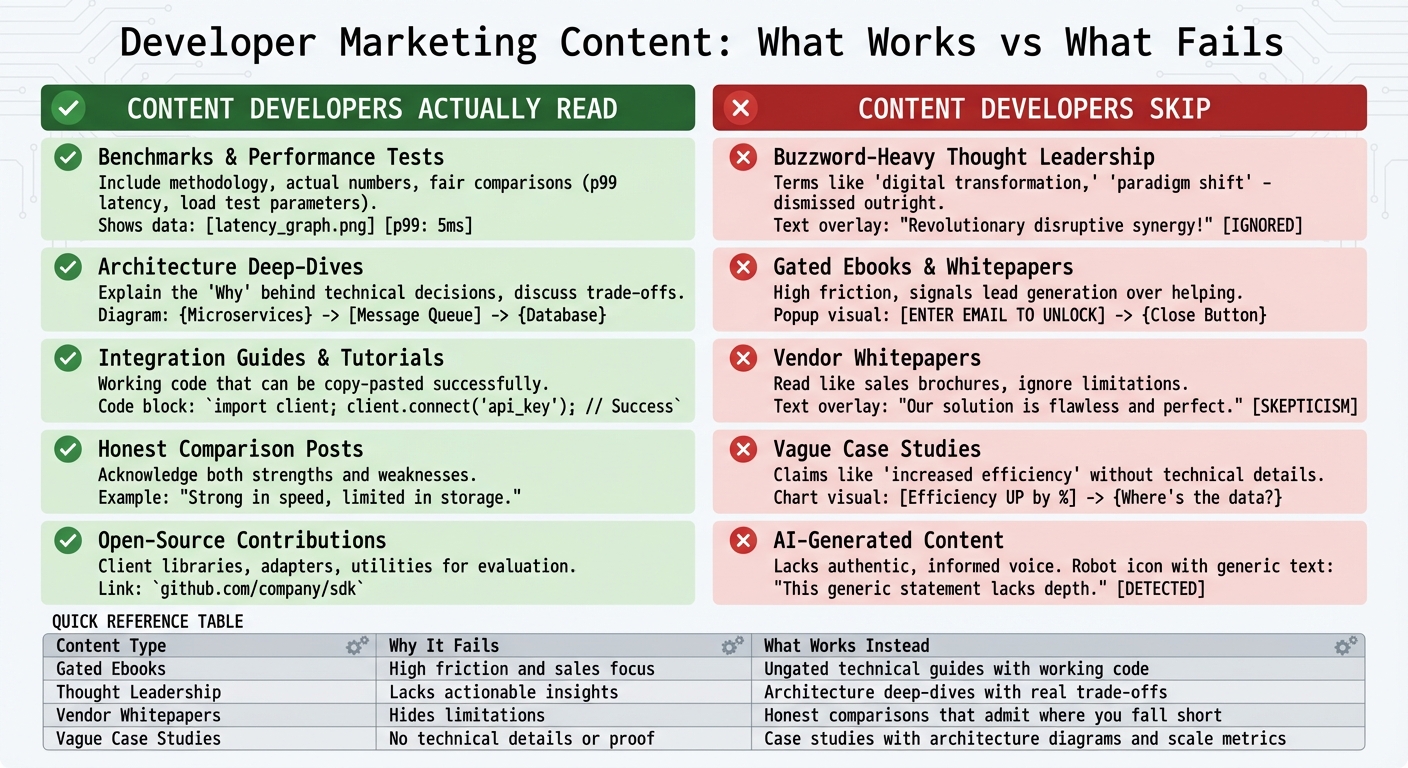 {Developer Marketing Content: What Works vs What Fails}
Content Developers Actually Read
Developers are drawn to content that addresses real-world problems with accuracy and depth. For example, benchmarks and performance tests resonate only when they clearly outline the methodology, share actual numbers, and provide fair comparisons. If you're making benchmark claims, you need to include details like the test environment, workload specifics, and measurable outcomes like p99 latency or load test parameters.
Deep dives into architecture are another big win, especially when they explore the reasoning behind technical decisions. As Carl Hughes, Founder of Draft.dev, puts it:
"A good software tutorial explains the How. A great one explains the Why."
Senior engineers, in particular, value discussions about trade-offs. Whether it's choosing eventual consistency over strong consistency to improve performance or selecting a database for its scalability, these insights help them make informed decisions.
Integration guides and tutorials must deliver what they promise. If a step-by-step guide fails to work when copied and pasted, trust is immediately lost. Similarly, honest comparison posts that acknowledge both strengths and weaknesses build credibility. For instance, admitting that one tool handles real-time updates better while another excels at batch processing shows you're offering genuine advice, not a sales pitch.
Open-source contributions also go a long way in building trust. Tools like client libraries, adapters, or utilities released as open source allow developers to evaluate the code before committing to a paid product . This kind of transparency demonstrates technical expertise and a commitment to the developer community.
In short, developers value content that prioritizes technical depth and avoids unnecessary fluff.
Content Developers Skip
On the flip side, certain types of content consistently fail to connect with developers. By 2026, developers have become highly adept at spotting and ignoring marketing fluff . Buzzword-heavy thought leadership pieces filled with terms like "digital transformation" or "paradigm shift" are dismissed outright. Similarly, content that lacks a technical foundation - or is clearly AI-generated - fails to capture the authentic, informed voice engineers expect .
Gated ebooks and whitepapers are another common misstep. Requiring a form fill to access basic information signals that lead generation matters more than helping developers.
Vendor whitepapers often miss the mark by reading like sales brochures, portraying products as flawless and ignoring their limitations . Case studies can also fall flat when they rely on vague claims like "increased efficiency" without delving into the technical details, architecture, or specific challenges. Developers are far more likely to trust content that shares both the successes and the limitations.
Here's a quick breakdown of what doesn't work and what to do instead:
| Content Type | Why It Fails | What Works Instead |
|---|---|---|
| Gated Ebooks | High friction and sales focus | Ungated technical guides with working code |
| Thought Leadership | Lacks actionable insights | Architecture deep-dives with real trade-offs |
| Vendor Whitepapers | Hides limitations | Honest comparisons that admit where you fall short |
| Vague Case Studies | No technical details or proof | Case studies with architecture diagrams and scale metrics |
Developers reward content that is transparent and technically detailed, while quickly dismissing anything that feels like fluff or overselling.
How to Write for Developers
Be Specific and Honest
When writing for developers, precision is key. Replace vague statements with concrete facts and measurable outcomes. For instance, instead of saying your API is "fast", specify that it delivers 50ms p99 latency. Instead of claiming "high reliability", share that it offers 99.9% uptime and include the terms of your SLA. Developers value specifics because they provide the data needed to determine if a product meets their technical needs.
Honesty about trade-offs also strengthens your credibility. If your solution prioritizes speed but comes at a higher cost, say so. If it's more affordable but slower, be upfront about that too. Acknowledging limitations, such as API rate limits, service constraints, or scenarios where your product isn’t ideal, shows you're offering genuine advice rather than just trying to sell something.
This approach applies to all forms of technical content. Explain why you chose eventual consistency over strong consistency, or why your system is designed for horizontal rather than vertical scaling. Include architecture diagrams, performance benchmarks with clear methodologies, and detailed implementation specifics like storage capacities or API endpoint details. Developers appreciate this level of transparency and technical depth.
Every technical claim you make should be verified. By 2026, many successful technical content teams will have established peer review processes where practicing engineers validate every code snippet and logic flow before publication . This step ensures your content represents real-world experience, not just theoretical knowledge. Once you've nailed the metrics, make sure your language is clear, concise, and free of unnecessary hype.
Skip the Buzzwords
Precision in details is only part of the equation; the words you use also matter. Buzzwords like "revolutionary", "disruptive", or "game-changing" often trigger skepticism among developers. By 2026, developers have built what some experts call a "collective immunity to fluff" after encountering too many overhyped tools that failed to deliver . Using these terms can make it seem like you're prioritizing marketing over substance, which undermines trust before your product even gets a chance.
The solution? Show, don’t tell. Instead of calling your platform "innovative", share your open-source GitHub repositories. Instead of describing your product as "cutting-edge", publish in-depth architecture breakdowns that explain your technical decisions. Replace generic marketing language with specific API features, performance metrics, and working code examples that developers can test for themselves.
Morgane Palomares, Former Marketing Lead at Vercel, sums it up perfectly:
"Developers have a very low tolerance for excessively flashy marketing. Marketing that contains a lot of fluff and words that try to describe things that mean absolutely nothing."
The shift in language is straightforward but impactful. Talk about sharding strategies instead of "scalability solutions." Mention webhook endpoints rather than "seamless integrations." Use latency measurements instead of "performance optimization." This kind of technical accuracy shows you understand the challenges developers face, positioning you as a knowledgeable peer rather than just another vendor.
Working with Developer Advocates
Building technical credibility isn’t just about producing great content - it’s about tapping into the unique expertise of Developer Advocates.
DevRel vs Marketing: Different Goals
Developer Relations (DevRel) and marketing play different, yet complementary, roles. DevRel focuses on fostering long-term trust and engaging with the developer community by offering technical education that’s valuable regardless of whether someone uses your product or not . Marketing, on the other hand, is all about scaling reach, distributing content, and driving conversions by aligning content with the buyer’s journey .
The way each team measures success also differs. Marketing often tracks immediate results like form fills or demo requests. DevRel’s success, however, is more gradual, measured through community sentiment and organic product adoption over time . Christian Heilmann, Principal Technical Evangelist, highlights this challenge:
"Marketing departments have been very good over the years showing impressive numbers. For a developer evangelist, this is tougher as developers hate being measured and don't want to fill out surveys" .
DevRel’s content, crafted by engineers with firsthand experience, naturally resonates with a technical audience and carries built-in credibility . Marketing teams then step in to optimize this content for visibility, aligning it with broader business goals like lead generation .
How DevRel and Marketing Work Together
Despite their differences, combining DevRel and marketing creates a powerful partnership. The best technical marketing teams don’t pick one over the other - they combine DevRel’s technical expertise with marketing’s ability to scale and execute campaigns. DevRel brings the depth and authenticity needed to build trust and credibility, while marketing ensures that content reaches the right audience by managing distribution and budgets .
A practical way to balance these efforts is by following the 70-20-10 rule. Here’s how it works:
- 70% of content focuses purely on technical value, avoiding product mentions.
- 20% is about "building in public", where you share challenges, trade-offs, and lessons learned.
- 10% is reserved for direct product promotion .
DevRel’s role is crucial in creating the 70% technical and 20% transparency-driven content. Their insights ensure that every code snippet and technical explanation passes peer review, reinforcing credibility . Marketing then takes this trusted content and amplifies it through channels like newsletters, conference sponsorships, or targeted ads, ensuring it reaches the right audience effectively.
How to Hire Technical Marketers
Hiring the right technical marketer is essential for maintaining credibility with a developer-focused audience. These professionals need to balance technical expertise with storytelling skills - an uncommon mix. As Steve Olenski, Communications Director at Oracle, aptly states:
"Technical marketers are rare, very rare. Someone who can blend creativity, psychology and branding with code, statistics and math" .
The ideal candidate should combine marketing knowledge with a solid engineering background.
Skills to Look For
Strong technical marketers often have hands-on engineering experience or a deep understanding of software development. They should communicate as equals with developers, not just interpret their ideas . Look for candidates who are comfortable with concepts like APIs, backend and frontend architecture, HTTP protocols, databases, and testing frameworks . As Carl Hughes, Founder of Draft.dev, emphasizes:
"Software engineers can spot a writer who hasn't used a terminal from the first paragraph" .
When reviewing portfolios, prioritize content that dives into technical details, such as tutorials or architecture breakdowns. Avoid candidates who only produce surface-level "what is" articles . The best technical content explains both the "how" and the "why" behind decisions. Jeff Bradford, CEO of Bradford Group, describes it well:
"Good writing is fundamentally good thinking that follows a logical path and is easy for someone to follow" .
Community involvement is another key indicator. Check if the candidate is active on platforms like GitHub, LinkedIn, Hacker News, or Reddit . A history of senior engineering roles or public technical discussions can signal credibility . Keep in mind that in-house technical marketers often demand higher salaries, while freelancers charge based on the complexity of their work .
Warning Signs in Candidates
Spotting red flags early can save time and energy. A solid candidate should have experience with essential developer tools and direct product knowledge . Morgane Palomares, Former Marketing Lead at Vercel, warns:
"Developers have a very low tolerance for cringey marketing. Marketing that contains a lot of fluff and words that try to describe things that mean absolutely nothing" .
Be cautious of samples filled with buzzwords like "revolutionary" or "game-changing" . Writing that lacks primary sources - such as GitHub repositories, technical papers, or benchmarks - is another concern . Also, steer clear of candidates who focus too heavily on short-term metrics like lead form completions, as this approach often falls flat with technical audiences .
When reviewing portfolios, ensure every code snippet is accurate and could withstand a peer review . By identifying these warning signs, you'll be better prepared to evaluate the candidate's technical communication skills during the interview process.
How to Interview and Evaluate
To thoroughly assess a candidate, design an interview process that tests both technical expertise and communication skills. Start with a technical assessment - ask them to read and explain a piece of code. You can also assign them a niche technical topic, such as a specific DevOps tool, and have them articulate its value proposition. This will reveal how well they can simplify complex ideas .
Request a writing sample that explains a technical concept clearly. A practical exercise works even better - ask them to rewrite a technical product's homepage, simplify part of its documentation, or critique its onboarding flow . Look for content that addresses counterarguments and presents balanced reasoning, as this helps build trust with a developer audience .
Review their portfolio to ensure it combines personal experience with data-driven insights and expert references . During the interview, ask them to demonstrate the product, explain its API endpoints, and discuss any limitations . Lastly, conduct reference checks with developers who have worked with the candidate. Find out if their work earned respect and whether they are honest about technical challenges or mistakes. Developers often trust those who share their failures and lessons learned, rather than those who only showcase polished successes .
Advertising to Developers
Paid ads aimed at developers require a completely different mindset compared to standard B2B campaigns. Why? Developers are frequent users of ad blockers and are quick to dismiss exaggerated claims or flashy promises that lack substance . The trick is to meet them where they are - platforms and environments they trust - so your ads feel like helpful content rather than intrusive marketing. And, as we've discussed before, maintaining technical credibility is non-negotiable.
Creating Ads Developers Respect
When it comes to ad visuals and messaging, forget the usual marketing fluff. Developers respect ads that show them something real - like code snippets, architecture diagrams, or product screenshots that immediately demonstrate how your solution works .
Your messaging should zero in on solving specific developer challenges. For instance, instead of saying, "Our platform helps you deploy faster", go for something like, "Resolve Kubernetes concurrency issues in 10 minutes" . It’s all about speaking their language and addressing their pain points directly. Use empowering phrasing like, "You can use this tool to fix X", rather than, "This tool will help you solve X" . Developers can spot generic marketing language a mile away, so swap out vague claims with measurable results. For example, "Reduces API response time from 200ms to 50ms" is far more compelling than "lightning-fast performance" .
When it comes to calls-to-action (CTAs), keep it low-pressure. Phrases like "See the documentation" or "View the open source code" resonate better than aggressive sales pitches . Developers value technical proof over hard sells, and showing respect for their autonomy builds trust.
Targeting and Budget Planning
The best way to reach developers is through platforms they already use, like daily.dev. These platforms allow for precise targeting based on tech stacks (e.g., React, Rust, AWS) and even roles or seniority levels (e.g., Senior Developer, Architect, CTO). This ensures your ads are seen by the right audience - developers who could actually benefit from your tool.
To test and refine your messaging, set aside a monthly budget of $10,000–$20,000. This amount gives you enough data to figure out which claims resonate and which don’t. Keep in mind, though, that developer ads often have a delayed return. In fact, 83% of ad conversions on developer-focused platforms happen without a direct click . A developer might dismiss your ad initially but remember your solution weeks later when they encounter the exact problem it solves.
Measuring What Matters
Once your ads are running, don’t get distracted by vanity metrics like impressions or click-through rates. These don’t tell you much about whether developers are genuinely engaging with your brand. Instead, focus on metrics that matter: qualified traffic from relevant companies, activation rates (e.g., time to first API call or tutorial completion), and community signals like GitHub stars or forum mentions.
It’s also crucial to extend your attribution window to 60–90 days rather than the usual 7–30 days . Developers tend to do their homework - reading documentation, exploring forums, and testing alternatives - before committing to a tool. As Adam DuVander puts it:
"Marketing to developers is not hard. It's just different. The difference is patience."
Pay attention to post-click actions that show real interest. For example, if a developer copies a code snippet from your documentation or forks your GitHub repository, that’s a stronger signal of engagement than a traditional lead form submission. By focusing on these deeper interactions, you’ll get a clearer picture of how your ads are performing.
Conclusion
Marketing to developers isn’t about flashy campaigns or polished sales pitches - it’s about earning trust through technical accuracy, honest communication, and patience. As Adam DuVander aptly says: "Marketing to developers is not hard. It's just different" . The difference lies in prioritizing depth over hype. Developers are quick to spot technical inaccuracies, and nothing erodes trust faster than tutorials that fail in real-world scenarios or oversimplify complex stacks .
The best technical marketing strategies blend the expertise of Developer Relations (DevRel) with the reach of marketing. Developer advocates establish credibility through open-source contributions, in-depth blog posts, and transparent comparisons. Marketing teams then amplify that credibility with targeted, measurable campaigns. These two functions work hand in hand - technical depth alone isn’t enough, and strategic reach without substance falls flat. This combination also extends to how you approach advertising.
For paid advertising, daily.dev Ads provides a way to connect with developers in their natural learning environment. The platform offers precise targeting based on tech stacks, seniority, and programming languages. This avoids aggressive tactics that tend to alienate developers . Instead, your ads become part of their workflow, offering value rather than distraction.
However, even the most strategic content and advertising must address inherent skepticism. A staggering 96% of technical audiences assume a company is lying before they even engage with the content . Overcoming this distrust requires a relentless focus on technical accuracy, transparency about trade-offs, and content that solves real problems. Show your work - include code snippets, architecture diagrams, and performance data. Be upfront about limitations and let developers understand the "how" and "why" behind your solution, not just the "what."
Building trust with developers is a long game, but it pays off. As Carl Hughes puts it: "Content is a compounding asset. The premium you pay today for expert-led content is a fraction of the value it generates over years of trust-building" . Focus on creating technically sound, intelligent content that respects their expertise and provides the proof they need to make informed decisions. This is how you win over developer audiences.
FAQs
What is technical marketing for developers?
Technical marketing for developers is all about clearly and effectively sharing technical information - like specs, features, and implementation steps - with software engineers and technical decision-makers. The focus is on building trust by providing accurate documentation, real code examples, detailed technical content, and straightforward comparisons that resonate with a technically savvy audience.
How can I establish technical credibility quickly?
To build technical credibility swiftly, prioritize clear and current documentation, functional code examples, and active contributions to open source projects. Sharing in-depth technical content - such as detailed analyses, performance benchmarks, and architecture diagrams - helps highlight your expertise and openness. These efforts demonstrate your understanding of developer needs and establish trust through transparency.
How do I hire a technical marketer?
When you're looking to bring a technical marketer on board, focus on candidates who bring a mix of coding expertise, technical writing experience, and active involvement in developer communities like GitHub or Stack Overflow. These qualities often indicate someone who understands both the technical and marketing worlds.
During the interview process, dig deeper into their skills:
- Explain Code: Test their ability to clearly articulate technical concepts, as this is crucial for bridging the gap between developers and non-technical stakeholders.
- Writing Samples: Review examples of their technical writing, such as blog posts or documentation, to gauge how effectively they can communicate complex ideas.
- Portfolio Review: Evaluate their past work to ensure it aligns with the needs of your business.
Don't skip checking references - specifically, ask about how well they are respected by developers. This can give you insight into their credibility and effectiveness in technical environments.
Finally, keep in mind that technical marketers often command higher salaries compared to traditional marketing roles. Their specialized skill set comes with a premium, so be prepared to adjust your budget accordingly.