

Developers prefer video content for learning and evaluating tools. Here's why and how you can use it effectively:
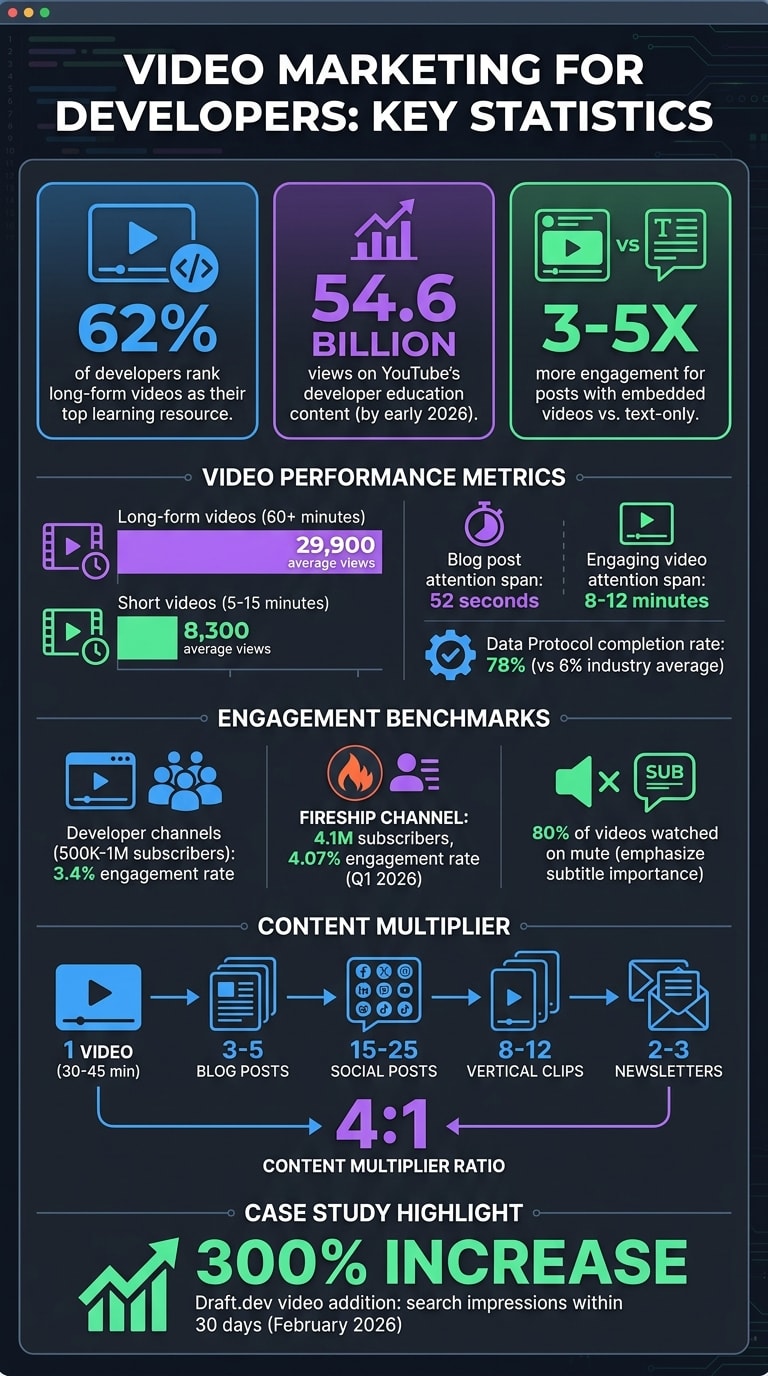
- 62% of developers rank long-form videos as their top learning resource.
- YouTube’s developer education content reached 54.6 billion views by early 2026.
- Posts with embedded videos get 3–5x more engagement than text-only posts.
Key strategies for success:
- Formats that work: Live coding, deep dives, and tool demos resonate most with developers.
- SEO matters: Use specific problem-solving keywords, timestamps, and links to resources.
- Short-form videos: Use platforms like YouTube Shorts to share quick tips and drive traffic to longer content.
- Production basics: Focus on clear audio, readable code, and subtitles - developers value clarity over flashy visuals.
- Measure impact: Track actions like GitHub stars, documentation visits, and trial signups to gauge success.
Takeaway: Developers value practical, no-nonsense content that avoids fluff that solves problems and explains processes clearly. Focus on delivering depth, optimizing for search, and repurposing content across platforms to maximize reach.
Why Developers Watch Video Content
Developers are drawn to video content because it doesn’t just showcase results - it reveals the how. Unlike polished tutorials or static documentation, videos offer a behind-the-scenes look at the coding process. For instance, a quick 30-second demo in VS Code can communicate more than 500 words of text ever could. While blog posts typically hold attention for only 52 seconds, engaging videos manage to capture developers’ focus for 8–12 minutes. This makes video an ideal format for tackling real-world coding challenges, such as solving Docker issues or addressing NPM install errors. By focusing on practical solutions, creators naturally establish trust in their expertise.
But it’s not just about technical clarity - video adds a personal element that static text can’t replicate. Hearing a creator’s voice, watching them troubleshoot, and seeing their workflow builds a sense of credibility and relatability. This personal connection is crucial at every stage of the developer journey, from discovering a new product to diving deep into its technical implementation. Kevin Blanco, Senior DevRel Advocate at Appsmith, highlights the importance of aligning videos with this journey:
"The most important thing is to tailor your videos to the developer journey. For me, the developer journey is like my Bible, and it's always the reference when I have to do a video."
The numbers back this up. Long-form videos (over 60 minutes) average 29,900 views, while shorter videos in the 5–15 minute range still attract a solid 8,300 views. Developers are clearly willing to dedicate time when the content delivers meaningful depth. For example, Data Protocol’s emphasis on solving real problems led to an impressive 78% completion rate, far exceeding the industry average of 6%. This combination of transparency and substance is what sets high-quality technical videos apart, laying the groundwork for deeper engagement as we’ll explore further.
Video Formats That Resonate with Developers
When it comes to developers, the best video formats focus on practicality over entertainment. Developers value content that showcases the actual process, including the challenges and solutions, rather than just the polished end result. Choosing the right formats ensures your efforts are directed where they’ll make the biggest difference.
Live Coding Sessions
Live coding streams offer an unfiltered, real-time look at how problems are tackled. Watching someone code live shows the missteps, debugging, and decision-making that mirror a developer's daily work. This transparency builds trust and fosters a sense of relatability.
Interactive formats like live streams or "Code with Me" sessions go a step further by enabling real-time engagement. Developers can ask questions, propose solutions, or learn collaboratively. These sessions are particularly effective for explaining complex concepts or frameworks, where the how is just as important as the what.
Technical Deep-Dive Videos
For seasoned developers, surface-level content doesn’t cut it. They want videos that dive deep into topics like system architecture, blockchain mechanics, or AI applications. These videos, often 10–15 minutes long, hold attention by delivering substantive technical insights that go beyond the basics.
The secret to success here? Skip the "marketing fluff." Developers value content that focuses on real-world challenges and advanced use cases, helping them make informed decisions about their projects.
Tool Comparisons and Product Demos
When developers are evaluating tools, they want to see real code in action. Videos that feature side-by-side comparisons and product demos with actual implementations help them determine if a tool meets their needs. This format aligns perfectly with the "Evaluation" stage of the developer journey, where detailed feature analysis is key.
Effective demos include screen captures of the tool’s interface and code in use, with links to GitHub repositories for further exploration. Channels like Fireship and Traversy Media excel at this by blending concise explanations with hands-on demonstrations, addressing the specific questions developers have.
Faceless content - like screen-recorded tutorials, algorithm animations, and debugging sessions - also resonates strongly. Developers don’t need a presenter on screen when the code editor, terminal output, and visual aids tell the full story. Plus, these videos are cost-efficient and feel authentic to the audience.
YouTube SEO for Developer Content
Creating engaging developer videos is just the start - YouTube SEO is essential to ensure your content gets discovered. Developers often turn to YouTube as a search engine for technical solutions, not as an entertainment platform. This means your optimization efforts should focus on problem-solving keywords and well-structured metadata that cater to both the algorithm and your audience's specific needs.
Optimizing Titles, Descriptions, and Metadata
Developers search for solutions to precise problems. Your video titles should reflect the exact queries they type into the search bar. For instance, instead of using a generic title like "Working with NPM", opt for something more specific, such as "How to Fix NPM Install Errors in Node.js 18". This approach aligns with their intent and boosts discoverability .
Descriptions are equally important. They should clearly outline the video's key takeaways and include links to helpful resources like GitHub repositories, documentation, or related tools. This not only helps viewers but also gives YouTube's algorithm more context about your video. Adding chapter markers (timestamps) is crucial for technical content. Developers often want to jump straight to the solution for their issue. For example, timestamps like "2:15 - Installing dependencies" or "5:40 - Debugging common errors" improve user experience and help YouTube surface your content for specific sub-topics .
A case study from February 2026 highlights the impact of these strategies. Draft.dev added a 20-minute technical walkthrough video to a four-year-old evergreen article that had dropped to 150 daily impressions. Within 30 days of the update on February 7, search impressions increased by 300% . This demonstrates the growing importance of high-quality metadata and accurate technical content, especially as AI-driven tools like ChatGPT and Perplexity start indexing and recommending video content .
To further engage viewers - especially those watching on mute - include subtitles and use graphic visuals. These elements make your content more accessible and visually appealing. Next, let’s look at how structured playlists and cross-promotion can take your content’s visibility to the next level.
Playlists and Cross-Promotion Tactics
Once your metadata is optimized, playlists can help create logical learning paths that align with how developers approach learning. Instead of random collections, organize playlists like "Full-Stack Development with React and Node" or "MongoDB Crash Course." This not only helps developers follow a structured journey but also signals to YouTube that your channel is focused and authoritative, which can boost your rankings .
Leverage YouTube cards to link directly to external resources mentioned in your videos, such as GitHub repositories, API documentation, or comparison pages. Use end screens to guide viewers toward related long-form tutorials, turning casual viewers into engaged subscribers . For YouTube Shorts, pinned comments can direct viewers to more comprehensive tutorials, transforming a quick 60-second tip into a gateway for deeper engagement.
This strategy has proven effective. Developer education channels with 500,000 to 1 million subscribers achieve an average engagement rate of 3.4% . By structuring playlists to match the developer journey - from Discovery (introductory topics) to Evaluation (tool comparisons) to Building (advanced implementation guides) - you not only serve your audience better but also strengthen your channel’s reputation as a go-to resource for technical content.
Short-Form Video for Developer Awareness
While developers often rely on long-form videos for deep dives into technical topics, platforms like YouTube Shorts and TikTok are perfect for grabbing attention, raising awareness, and guiding viewers to more detailed resources. As Karl Hughes from Draft.dev explains:
"Short-form video is great for reach, but poor at relevance and attribution" .
The secret lies in using these formats wisely to create a bridge between initial interest and more in-depth technical content.
Quick Tips and Common Gotchas
Short-form videos that deliver practical, actionable advice can build on broader awareness. The best-performing content solves a specific problem in 45–75 seconds. Developers don't typically visit these platforms for entertainment - they're looking for useful snippets, like terminal commands or workflow hacks, which they can save for later. This leads to higher save rates compared to general audiences .
Want to grab attention? Challenge traditional coding practices with a "you’ve been doing this wrong" approach. For instance, show how to condense 20 lines of code into just 3 or demonstrate a performance improvement from 2 seconds to 20 milliseconds. These "wow" moments are perfect for encouraging shares and saves .
Don't forget: mobile clarity is crucial. Use at least a 20pt font, stick to high-contrast dark themes, and shoot in 2× resolution before downscaling . Since 80% of videos are watched on mute, add subtitles and highlight cursors to keep the content accessible .
Extracting Clips from Long-Form Content
Repurposing moments from long-form videos into short-form clips is a smart way to extend your reach while reinforcing your technical message. A single 30–45 minute technical video can generate 8–12 vertical clips . The key is finding segments that stand alone, like a quick debugging tip, a keyboard shortcut demo, or a comparison of two coding approaches.
AI tools make this process much faster. Tasks that once took 11–18 hours can now be completed in just 2.5–4 hours with AI-assisted workflows . The process is simple: use AI to transcribe your long-form content, identify high-engagement moments, and extract clips that don’t require additional context.
To drive deeper engagement, include a pinned comment linking to the full tutorial . Fireship, for example, has mastered this approach. With 4.1 million subscribers and a 4.07% engagement rate in Q1 2026 , they use fast-paced Shorts to funnel developers toward their more comprehensive content. Platforms like daily.dev can also help promote these clips to a targeted developer audience.
Production Quality vs. Authenticity
When it comes to creating videos for developers, the focus should be on clarity - both in text and audio. Forget the flashy production styles typical of corporate marketing; overly polished videos with dramatic transitions and cinematic B-roll often miss the mark. Instead, they can feel like hollow marketing efforts that lack real value for a technical audience .
To ensure your content is effective, stick to practical production techniques. For screen recordings, use high-contrast dark themes like Dracula or Night Owl and set the font size to at least 20pt for readability. Record at 2x resolution to keep text sharp, and invest in a good-quality microphone to ensure your technical explanations are crystal clear . These details align with earlier advice about prioritizing mobile-friendly, high-resolution content.
These small but crucial choices can significantly improve viewer retention. For example, straightforward "talking head" videos with minimal effects have been shown to boost search impressions by 300% within just 30 days .
The key to creating authentic and distraction-free content lies in preparation. Spend the majority of your time - around 80% - on scripting and planning your shots. This ensures your technical narrative is both logical and concise . Instead of showing your entire IDE, which can be overwhelming and hard to follow on smaller screens, use tools like callout arrows and zoom-ins to highlight specific code snippets . As Ward puts it:
You need to NOT make it distracting, and you're good to go .
Subtitles are another must-have. They not only make your content more accessible but also help keep viewers engaged. Looking ahead, AI tools will likely handle much of the post-production polish - like cleaning up audio and removing filler words - by 2026, saving you time and effort . This means you can focus on what developers truly value: accuracy, technical depth, and practical solutions to real problems .
Measuring Video Campaign Performance
Developer videos aren't just about views - they're about action. These videos help developers find solutions, evaluate tools, and learn new skills. So, when measuring their success, you need to go beyond traditional metrics. Focus on outcomes like documentation visits, trial signups, GitHub contributions, and community engagement . Just like with detailed content and targeted SEO, tracking these actions ensures your video strategy is driving real technical engagement.
Tracking Developer Actions from Video
The most critical question is: What do developers do after watching your video? To answer this, you can use UTM parameters in video descriptions or pinned comments. These links help you track traffic to key destinations like documentation, trial signup pages, or GitHub repositories . For example, linking to your API authentication documentation with a UTM-tracked URL allows you to monitor click-throughs and dwell time, giving you a clear picture of developer interest .
High-intent actions are particularly telling. Joining Slack channels, starring GitHub repositories, or starting free trials are all strong indicators of engagement. If your combined video and written content drives 20–30% of total signups within six months, you’re on the right track. But if you're seeing less than 10%, it might be time to rethink your topics or distribution strategy . Tools like Google Analytics or HubSpot dashboards can help you track click-through rates from your video CTAs and connect them to conversion events .
View-Through Attribution and Engagement Data
Click-through data is just the beginning. Engagement metrics can reveal whether your content is hitting the mark. Directly attributing conversions to short-form videos can be tricky , so instead, look at metrics like watch time and completion rates. These can show if your content's technical depth aligns with developers' needs. Use tools like YouTube Studio to analyze where viewers drop off. If there’s a spike in drop-offs at a specific point, it might mean your content became too complex or lost its practical focus .
For developer audiences, "saves" are often more telling than completion rates. When a developer bookmarks your video on platforms like YouTube Shorts or TikTok, it signals they plan to revisit it later for reference . A great example: In February 2026, Draft.dev added a 20-minute walkthrough video to a four-year-old technical article that was barely getting 1–2 clicks daily. Within 30 days, search impressions shot up by 300%, showing how video can breathe new life into old content .
Early indicators like social shares and community engagement are also worth tracking. Over time, keep an eye on organic traffic and signups . Embedding videos can significantly boost session durations - by as much as 2.6× - which not only enhances your SEO but also signals high-quality content . As developer marketing increasingly focuses on ROI, make sure your video metrics tie directly to pipeline influence and product adoption, not just brand awareness .
Repurposing Video Across Multiple Channels
Did you know a single 30–45 minute developer video can be transformed into a wealth of content? We're talking about 3–5 blog posts, 15–25 social media posts, 8–12 vertical clips, and 2–3 email newsletters - all from one video recording . That’s a 4:1 content multiplier, meaning you can create 400% more content than if you started each piece from scratch. The secret? A well-structured workflow that squeezes every ounce of value from your recording sessions.
Converting Video to Blog Posts and Social Clips
To get started, use the video transcript as your foundation. Extract the audio with tools like Audacity or FFmpeg, then run it through transcription services like BrassTranscripts. For reference, BrassTranscripts charges $2.50 for files up to 15 minutes and $6.00 for files between 16–120 minutes . Once you’ve got the transcript, AI tools can help turn it into SEO-friendly blog posts, Instagram carousels, or Twitter/X threads. For longer videos, break them down into smaller, topic-focused blog posts - 3 to 5 posts from a 30-minute video is a good target .
For short-form video clips, tools like VidNo and FluxNote make the editing process a breeze. These platforms can transform raw screen recordings into polished YouTube Shorts, handling everything from scripting to uploading . FluxNote even has a free tier that allows you to create one video per month without needing a credit card . When creating coding-focused Shorts, keep the font size at least 20pt and use high-contrast dark themes like Dracula or Night Owl to ensure the code is readable on mobile screens . Each 60–90 second clip should highlight a single "wow moment", such as condensing 20 lines of code into 3, to grab attention and drive engagement.
Transcripts are also a goldmine for identifying long-tail keywords and common audience questions. This information helps enhance your SEO and craft compelling meta-descriptions . To boost engagement, pair each Short with a pinned comment linking to a related long-form tutorial. This strategy turns quick views into deeper audience interactions . For platforms like daily.dev, create ad creatives showcasing your best video moments - clips that highlight real-world coding solutions or performance boosts tend to resonate most with developers.
Multi-Platform Distribution Strategy
Once you’ve repurposed your content, the next step is to ensure it reaches the right audience through a multi-platform distribution strategy. Tailor your approach to match your audience’s habits. For example, LinkedIn is ideal for connecting with CTOs and sharing detailed architecture insights, while TikTok might not be as effective for senior technical roles . Subtitles are crucial for social media, as 80% of videos are watched on mute .
Stagger your content rollout to maintain momentum. For instance, release the main video in Week 1, follow up with the first blog post and email newsletter in Week 2, and wrap up with live Q&A sessions or community discussions in Week 3 .
Embedding YouTube videos (rather than using an on-site player) is a smart move for maximizing Google SEO benefits . To further enhance discoverability, include detailed timestamps, GitHub links, and clear explanations of what viewers will learn . This not only helps with traditional search engines but also improves visibility in AI-driven tools like ChatGPT or Perplexity, which rely on accurate metadata and technical content . By focusing on these details, you ensure your content is both engaging for viewers and optimized for search engines.
Conclusion
Video marketing for developers isn’t about slick corporate productions - it’s about diving into technical details, staying genuine, and catering to how developers prefer to learn. The numbers back this up: 62% of developers favor long-form videos as their go-to learning method, outpacing blogs and documentation . Success lies in giving developers what they value most: live coding sessions that show the debugging process, architecture deep-dives with real code, and honest tool comparisons that skip the marketing fluff.
Technical depth is the backbone of both discoverability and engagement. Leveraging YouTube SEO techniques - like adding detailed timestamps, GitHub links in descriptions, and chapter markers - not only boosts visibility on Google but also ensures your content is properly indexed by AI tools like ChatGPT and Perplexity . For instance, when Draft.dev added a 20-minute walkthrough to a four-year-old blog post in February 2026, they saw a 300% jump in search impressions within just 30 days . That’s the kind of ripple effect video can bring to your content strategy.
Efficiency comes into play with repurposing. A single long-form video can fuel multiple content formats: blog posts, social media snippets, and email highlights. Short clips help build awareness while guiding engaged viewers toward your detailed tutorials. And since 80% of videos are watched on mute , including subtitles isn’t just a nice touch - it’s essential for keeping viewers engaged across platforms.
Beyond repurposing, distribution is where you can extend your reach. A multi-channel strategy, especially on platforms like daily.dev, allows you to connect with developers based on their seniority, programming languages, and technical interests. Whether you’re promoting a new tool, sharing a conference talk, or encouraging trial signups, tailoring your content to each platform ensures it resonates with developers at the right stage of their journey. The secret? Stay technically authentic while aligning your format with the platform’s strengths. By applying these principles, you’ll position your video content to truly engage developers and drive results through daily.dev Ads.
FAQs
How long should a developer video be?
The best length for developer videos varies based on the platform and content type. On YouTube, tutorials, deep dives, or product demos tend to perform well when they’re around 5–15 minutes long. For short-form platforms like YouTube Shorts or TikTok, 45–75 seconds is ideal for quick tips or code snippets. Matching your video’s length to the platform and its purpose is key to keeping viewers engaged and ensuring your message lands effectively.
What should I include in a YouTube video description for developers?
When crafting a YouTube video description for developers, focus on clarity and utility. Start with a brief summary of the video's purpose, making it clear what viewers will gain. Include relevant keywords to help the video appear in search results.
Provide links to code repositories, documentation, or any resources mentioned in the video. Adding timestamps for key sections allows viewers to jump directly to topics of interest, which is especially useful for technical content.
To boost engagement, consider using chapter markers within the video and adding related content cards. Wrap it up with a call-to-action - encourage viewers to subscribe, like the video, or visit your website for more resources. Keep it concise and technical to resonate with a developer audience.
How do I measure ROI from developer videos?
To gauge ROI from developer videos, keep an eye on metrics that link viewer interaction to your business goals. Prioritize conversion data, such as trial signups or traffic driven by video CTAs. Pair this with engagement metrics like view counts, subscriber growth, and watch rates to understand audience interest. Also, track search performance indicators, such as higher impressions or improved rankings, to see how your videos boost awareness and generate leads.