

Want to promote your API to developers? Here's the key: Focus on platforms where developers already spend time solving problems and discovering tools. General ad networks like Google Ads often miss the mark with this audience. Instead, use developer-focused platforms like daily.dev, Stack Overflow, and Reddit. These platforms align with developers' habits, delivering better engagement and conversions.
Key Takeaways:
- daily.dev: Reach 1M+ developers with in-feed ads, email digests, and precise targeting by language or tool preferences. Best for API adoption campaigns.
- Stack Overflow: Place ads directly in Q&A discussions, targeting developers actively solving problems. Ideal for B2B API marketing.
- Reddit: Engage niche developer communities via subreddits. Great for building connections with flexible budgets.
Quick Comparison:
| Platform | Audience Size | Ad Formats | Best For | Cost Structure |
|---|---|---|---|---|
| daily.dev | 1M+ developers | In-feed, post-page, email | API adoption and awareness | CPC: $0.50–$2.00 |
| Stack Overflow | High engagement | Q&A placements, sponsored content | Problem-solving contexts | Custom pricing via sales |
| 443M weekly users | Native ads in subreddits | Niche developer communities | Flexible budgets, CPC: $0.20–$4.00 |
Pro Tip: Developers value technical precision. Use clear, concise ads with code snippets, links to docs, and sandbox access. Track meaningful metrics like API sign-ups and SDK downloads to measure success.
::: @figure 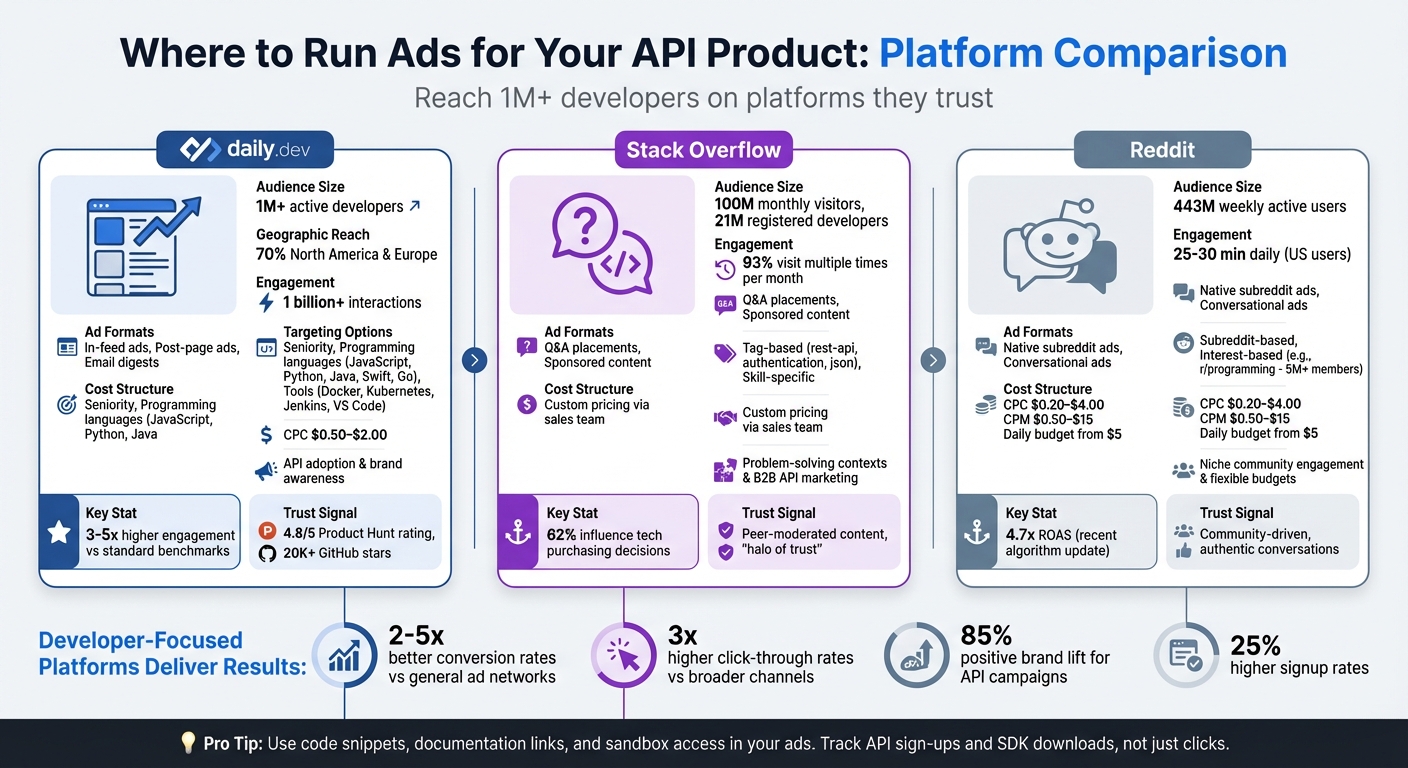 {Developer Ad Platform Comparison: daily.dev vs Stack Overflow vs Reddit}
Why Developer-Focused Platforms Work Best for API Ads
Developer-focused platforms connect with a highly engaged, technical audience in environments they already rely on. When developers participate in trusted technical communities, they’re actively solving problems, researching tools, and evaluating solutions. This makes these platforms a standout choice for advertising APIs compared to general ad networks.
The stats say it all. Developer-focused platforms deliver 2-5x better conversion rates and 3x higher click-through rates compared to broader advertising channels . Why? Developers on these platforms are already in a problem-solving mindset, making API ads feel relevant instead of disruptive. For example, Stack Overflow draws over 100 million monthly visitors, with 21 million registered developers contributing to discussions . Similarly, Reddit’s developer communities, like r/programming with over 5 million members, facilitate millions of daily interactions . These aren’t casual browsers - they’re professionals deeply engaged in technical tasks. This active involvement is what makes these platforms ideal for introducing and evaluating APIs.
How Developers Discover and Evaluate APIs
Developers often come across APIs while searching for solutions on tech forums, exploring curated content feeds, or engaging in online communities . Peer recommendations on platforms like Twitter or Discord also play a big role in raising awareness for new APIs.
Once an API catches their attention, developers dive into documentation to check for clarity, test integration options through free tiers, and gather insights from community feedback about reliability and common challenges . The beauty of developer-focused platforms is that they host this entire process. Ads placed in these spaces align naturally with how developers discover and assess APIs, making them feel like part of the workflow rather than an interruption.
Matching Ad Platforms to Developer Preferences
The way ads are presented matters just as much as where they appear. Developer-focused platforms excel because they integrate ads seamlessly with relevant technical content, catering to developers’ preference for value-driven formats that feel like an extension of forum discussions or curated feeds . In fact, around 80% of developers spend over two hours daily researching tools on these platforms, creating frequent opportunities for meaningful ad engagement .
Trusted spaces like Stack Overflow, with its peer-moderated content, and daily.dev, featuring expert-curated feeds, enhance authenticity and minimize ad fatigue. These platforms also offer behavioral targeting, using real-time developer activity to tailor ads based on programming languages, tech stacks, or professional roles . This level of precision is something general ad networks simply can’t match.
sbb-itb-e54ba74
daily.dev Ads: Targeted Advertising for Developers
daily.dev Ads connects API products with an engaged audience of over 1 million active developers. Unlike broader ad networks, this platform focuses on reaching developers when they’re actively exploring tools, seamlessly integrating ads into curated technical content.
Main Features of daily.dev Ads
The platform offers three native ad placements:
- In-feed ads within personalized content streams
- Post-page ads alongside community discussions
- Tailored digest emails
Advertisers can target audiences based on seniority, technical preferences, programming languages (like JavaScript, Python, Java, Swift, and Go), and tools (such as Docker, Kubernetes, Jenkins, and VS Code). Using real-time behavioral data, daily.dev Ads achieves engagement rates that are 3 to 5 times higher than standard benchmarks .
Campaigns are managed through an intuitive dashboard that tracks metrics like impressions, clicks, CTR, and conversions. The self-serve platform supports CPC rates ranging from $0.50 to $2.00 and includes built-in A/B testing. Additionally, pixel integration links ad spend directly to API activations, making it easier to measure ROI .
Access to Over 1 Million Developers
daily.dev Ads connects with approximately 1 in 50 developers worldwide, with 70% of its audience based in North America and Europe . This community has generated over 1 billion interactions, offering advertisers rich behavioral insights for precise targeting. The desktop-first design ensures ads are seen during work sessions, which is ideal for API evaluations .
The platform’s credibility is reflected in its 4.8/5 rating on Product Hunt (based on over 2,500 reviews) and its 20,000+ GitHub stars, showcasing strong validation from the developer community . This trust is critical, as developers are more likely to engage with ads in environments they respect.
Why Use daily.dev for API Product Ads
The platform’s reach and features translate into tangible results. For example:
- Stripe ran a campaign targeting payment API users, achieving a 4.2% CTR and a 15% conversion rate to sign-ups by highlighting integration tutorials.
- Twilio promoted its messaging API to developers interested in SMS functionality, generating 2,500 qualified leads in one month through in-feed video ads featuring quickstart guides .
These case studies illustrate how aligning ads with developers’ specific tech stacks - whether it’s targeting Node.js experts for a REST API or developers exploring serverless solutions - can drive meaningful engagement.
daily.dev Ads also addresses common developer frustrations with traditional advertising. By eliminating slow-loading third-party tags, intrusive banners, and privacy concerns, the platform fosters a trusted environment. This approach results in an 85% positive brand lift and 25% higher signup rates for API campaigns . The desktop-first focus ensures ads appear during work sessions, further boosting conversion rates .
Additional Platforms for API Advertising
Two platforms that stand out for effectively reaching developers are Stack Overflow and Reddit. Both platforms tap into the natural ways developers engage with technical content, offering opportunities to deliver highly targeted ad experiences. These platforms are backed by trusted developer communities and offer tailored targeting options.
Stack Overflow: Where Developers Solve Problems
Stack Overflow is a go-to resource for developers tackling technical challenges. When searching for tags like "rest-api" or "authentication", developers are in problem-solving mode, making this platform ideal for presenting API solutions at just the right moment.
Consider these stats: 93% of developers visit Stack Overflow multiple times per month, with many returning several times daily . Plus, 62% of developers influence technology purchasing decisions . This combination of frequent engagement and decision-making power makes Stack Overflow a valuable tool for promoting B2B API products.
"Stack Ads solutions enable you to place ads and sponsored content directly within the developer workflow, using precision, skill-based targeting to reach the right technical buyers." – Stack Overflow
Stack Overflow’s tag-based targeting is particularly effective. Advertisers can zero in on developers based on their specific technical interests, such as "rest-api", "authentication", or "json." Ads appear directly within Q&A discussions, where developers are highly engaged. This creates what Stack Overflow refers to as a "halo of trust" , as the platform’s strict moderation and focus on technical accuracy lend credibility to the surrounding content. Pricing is customized and available through their sales team, depending on the campaign’s scope .
Reddit: Engaging Developer Communities
Reddit, on the other hand, thrives on community-driven discussions rather than immediate problem-solving. With 443 million weekly active users and U.S. users spending an average of 25–30 minutes daily on the site , Reddit has become a hub for technical conversations, tool recommendations, and industry insights.
Recent improvements to Reddit’s advertising platform have made it even more appealing. A September 2025 algorithm update boosted the average Return on Ad Spend from 2.3x to 4.7x, while cutting the cost per conversion by 40% . These enhancements make Reddit a strong option for API campaigns, especially when targeting niche subreddits aligned with your technology stack.
Authenticity is crucial on Reddit. Developers tend to be wary of overly polished or traditional ads, so a conversational and transparent tone works best. For example, starting headlines with "Hey r/[subreddit], (Ad) here" signals openness. Ads featuring simple visuals like screenshots or user-generated content also resonate more than stock images .
"The whole game is about joining conversations, not interrupting them. That means your creative needs to be genuine, interesting, and actually add some value." – Sabyr Nurgaliyev
Reddit is also budget-friendly. Campaigns can start with daily budgets as low as $5, though a testing budget of $20–$50 per day for 7–14 days is recommended for reliable performance data . CPMs typically range from $0.50 to $15, with some tech-specific niches as low as $0.20. CPCs generally fall between $0.20 and $4.00 . To optimize campaigns, the Reddit Pixel is a must - it helps track conversions and fine-tune the algorithm to identify successful API sign-ups .
Platform Comparison: Choosing the Right Fit for Your API Ads
When it comes to API advertising, each platform brings its own strengths to the table. Here's a breakdown to help you decide which one suits your goals.
daily.dev Ads offers native ad placements tailored to a developer audience of over 1 million. With precise targeting based on seniority, programming languages, and tools, you can ensure your campaigns reach the right developers. Plus, real-time performance tracking lets you tweak your strategy on the fly.
Stack Overflow stands out as a go-to platform for developers actively searching for solutions. Ads here are integrated into technical discussions, with tag-based targeting to match your API with relevant searches. Pricing is customized through their sales team and depends on the scope of your campaign.
Reddit takes a more community-driven approach. By targeting specific subreddits and interests, you can engage with niche developer groups. The platform's flexible budgeting options and native ad formats make it a great choice for testing campaigns while fostering conversations.
Comparison Table
| Platform | Targeting Precision | Audience Size | Ad Formats | Best For | Cost Structure |
|---|---|---|---|---|---|
| daily.dev Ads | Seniority, languages, tools, interests | 1M+ developers | In-feed, post page, personalized digest | Brand awareness & developer adoption | Custom pricing; real-time tracking |
| Stack Overflow | Tag-based, skill-specific | High engagement | Integrated Q&A placements, sponsored content | Problem-solving contexts & B2B API marketing | Custom pricing via sales team |
| Subreddit and interest-based | Engaged community | Native and conversational ads | Community engagement & niche targeting | Flexible budgeting options |
This table highlights the key features of each platform, from targeting precision to cost flexibility. If your API focuses on solving specific technical problems, Stack Overflow could be your best bet. On the other hand, Reddit is ideal for building connections in niche communities, especially with its adaptable budgeting. For broader developer adoption, daily.dev Ads offers targeted reach and performance insights. Evaluate your API's goals and audience to choose the platform that aligns with your campaign strategy.
Setting Up Your API Ad Campaign
Defining Your Developer Personas
To kick things off, pinpoint the exact technical issue your API addresses. Developers are often categorized by the coding challenges they tackle and the tools they rely on. For instance, if your API enhances database query performance, you’re not just targeting "backend developers" - you're speaking to "backend engineers dealing with slow query speeds in PostgreSQL."
Next, figure out where these developers hang out online. Think about platforms like technical Q&A forums or curated developer feeds where they search for solutions and discover new tools. This step ensures your ad placements align with their intent. Also, consider the type of content they prefer: developers tend to gravitate toward educational, straightforward, and technical material, not flashy marketing jargon.
When measuring success, focus on metrics that show real engagement with your API, such as API calls, SDK downloads, or sign-ups from technical documentation pages. These metrics are far more telling than just click-through rates. Once you’ve nailed down your developer personas, you’re ready to create ad content that directly addresses their technical needs.
Creating Effective Ad Content
When it comes to ad content, clarity and technical precision are key. Developers appreciate concise, practical examples - like a short code snippet that highlights how your API solves a specific problem. For example, a five-line snippet showing authentication or a common use case will resonate more than long-winded marketing copy. Substance trumps style here, so keep your design clean and packed with relevant information.
Make sure your ads include a clear demonstration of how your API addresses a pain point. Use technical language that aligns with their expertise, and link directly to resources like documentation or a sandbox environment. Avoid vague terms like "powerful" or "game-changing"; instead, let your API’s functionality speak for itself. To lower barriers for developers, offer options like free trials, open-source tools, or SDK downloads rather than pushing for immediate sales.
Launching and Optimizing Your Campaign
With your personas defined and your ad content crafted, it’s time to launch and refine your campaign. Start by running A/B tests on your ad creatives. Experiment with different code examples, problem statements, and calls-to-action (CTAs) to see what resonates most with developers. Pay close attention to developer-specific engagement metrics like sign-ups from technical pages, API calls, and SDK downloads - these are far more meaningful than traditional ad metrics.
Leverage real-time API data to monitor your campaign’s performance. Track spend, impressions, and conversions, and use automated bid adjustments to focus on campaigns driving the most API sign-ups or SDK downloads. By automating these adjustments, you can reduce manual effort and scale your campaigns more efficiently. Start with self-serve API access to manage your campaigns, and consider upgrading to advanced tiers if you’re juggling multiple products or client accounts.
Conclusion
Reaching developers through API advertising means speaking their language and respecting their priorities. Traditional ads often miss the mark because developers value technical precision, privacy, and genuine communication. To succeed, you need to meet them where they already are - on platforms that fit naturally into their daily routines and trusted workflows.
Behavior-driven targeting is key to connecting with developers at the exact moments they’re solving problems. This approach works seamlessly with platforms like daily.dev, which provides a trusted space tailored to developers. With over 1 million developers and a desktop-first strategy, daily.dev offers native ad placements that blend smoothly into their feeds, ensuring your ads appear during high-intent sessions when developers are actively evaluating tools. As Nimrod Kramer highlights, daily.dev delivers precisely this kind of focused, desktop-first engagement .
To succeed, you’ll need to combine this targeted approach with a strong foundation: well-defined developer personas, technically rich ad content (complete with code examples), and metrics that track meaningful engagement - like API sign-ups and SDK downloads. Start early to build momentum, refine your messaging with A/B testing, and prioritize education over hard selling. When you pair the right platform with technically sound content, you make it easier for developers to discover and adopt your API naturally.
Key Takeaways
- Leverage daily.dev's developer-first targeting to reach your audience during moments of real engagement.
- Track developer-specific KPIs like API sign-ups, SDK downloads, and cost per acquisition - go beyond impressions and generic click-through rates.
- Focus on technical value by using code snippets, links to detailed documentation, and sandbox access to show how your API solves real problems.
- Choose platforms that prioritize privacy and fit into a developer's workflow, building trust and credibility along the way.
FAQs
Which platform should I start with for my API ads?
When promoting your API, it’s smart to focus on platforms where developers are already active and engaged. For example, daily.dev is a great choice. It offers developer-focused native ads, reaching users during their work hours when they’re in "discovery mode." This makes it easier to capture their interest.
Other platforms like Stack Overflow and Reddit are also worth considering. These spaces are home to technical discussions and niche communities, making them ideal for showcasing your API to an audience that’s already aligned with your product’s purpose.
What should my API ad link to: docs, sandbox, or signup?
When promoting API ads, it's essential to guide developers toward resources that help them understand and use your product effectively. Start by linking to documentation - this is where developers can find technical details, usage instructions, and step-by-step integration guides.
Another great resource is a sandbox environment, where developers can test your API in a practical, hands-on way. This lowers the hurdles to adoption by letting them experiment without risk. Once they're comfortable and ready to take the next step, directing them to a signup page makes sense.
By beginning with documentation or a sandbox, you create a foundation of trust and clarity, making the integration process smoother and more approachable.
What KPIs best measure API ad success?
The best KPIs for gauging the success of API ads emphasize engagement quality and long-term impact over sheer traffic numbers. Metrics like time spent on the landing page, interaction depth, lead quality, and conversion rates are especially insightful. These indicators reveal real developer interest and involvement, providing a better understanding of how effectively the campaign builds trust and encourages API adoption among developers.