

Developer case studies can be a powerful tool to build trust and drive pipeline growth - if done right. Here's the key: focus on technical depth, transparency, and measurable results. Developers are skeptical of marketing fluff, so your case studies need to speak their language: facts, trade-offs, and outcomes.
Key Takeaways:
- Understand developers' mindset: They value technical details, trade-offs, and objective metrics over vague testimonials or promotional language.
- Structure matters: A great case study includes a clear technical problem, step-by-step solutions, and quantifiable results.
- Transparency builds trust: Show what worked, what didn’t, and why. Highlight trade-offs and constraints.
- Make it actionable: Include architecture diagrams, code snippets, and real metrics like latency improvements or cost savings.
- Publish where developers are: Use blogs, community platforms, and newsletters. Repurpose content into social posts, videos, or technical deep dives.
Why it works: Developers respect content that mirrors their decision-making process. By showing your work - like a detailed engineering design document - you can connect with them authentically while also influencing decision-makers.
Pro Tip: Track how case studies impact your pipeline by monitoring metrics like demo requests, deal velocity, and conversion rates. Strong case studies can even shorten sales cycles by 30% or more.
What Makes a Developer Case Study Work
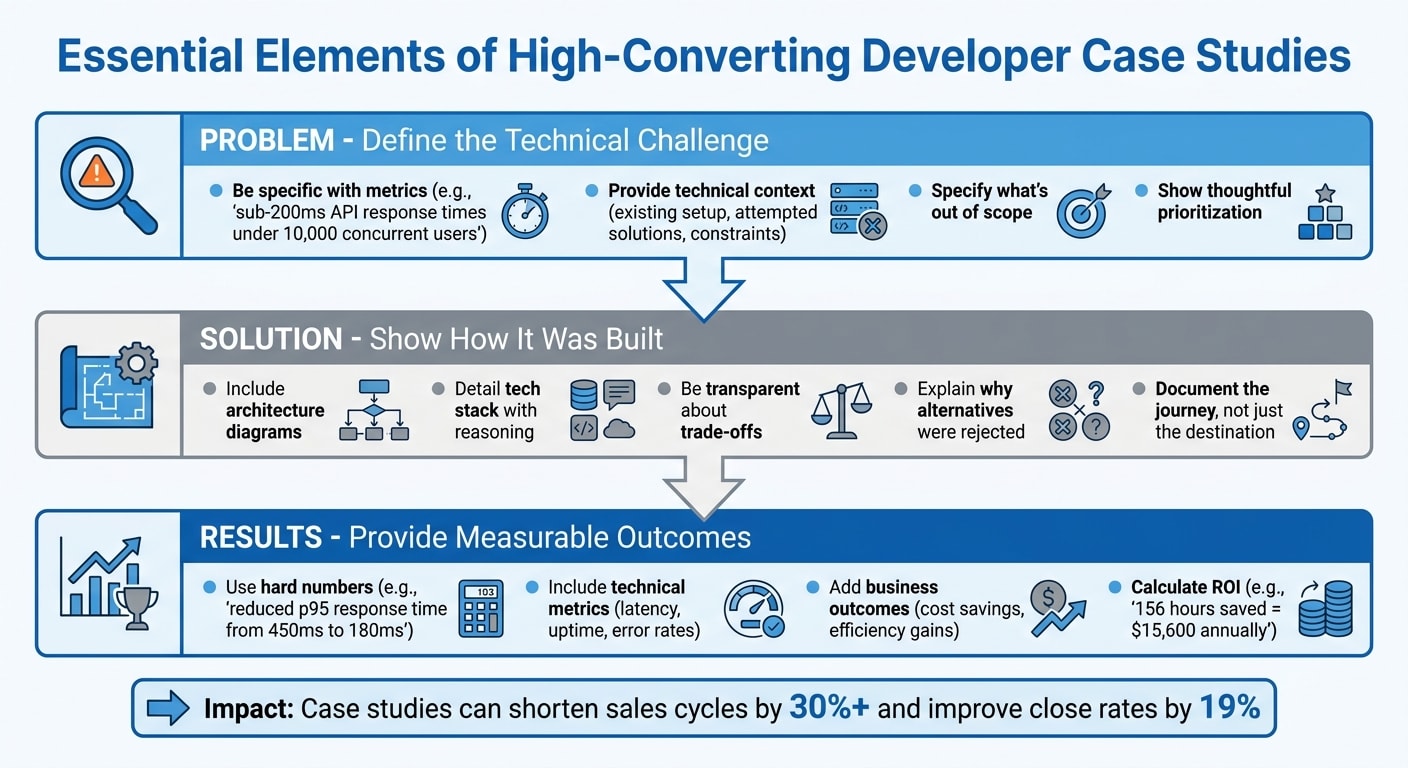
A strong developer case study hinges on three key elements: a well-defined technical problem, a step-by-step implementation breakdown, and measurable results. These components help establish relevance, showcase technical expertise, and provide clear, actionable data .
Think of these elements as the backbone of an engineering design document. Without them, the case study risks sounding like generic marketing content and losing its audience .
Let’s dive into these components, starting with the technical challenge.
Problem: Define the Technical Challenge
Start by outlining the customer’s specific technical challenge. Instead of vague statements like "needed to scale their infrastructure", be precise. For example: "struggled to maintain sub-200ms API response times under 10,000 concurrent users during peak traffic hours" . This level of detail helps readers immediately determine if the case study applies to their own challenges.
Provide technical context to explain why the problem was difficult. What was the existing setup? What solutions had already been attempted? What constraints or requirements shaped the approach? For instance: "The team required ACID compliance for payment processing, eliminating NoSQL options, but their existing PostgreSQL setup couldn’t handle the write volume during flash sales" .
It’s also important to specify what was out of scope. Highlighting what you chose not to address shows thoughtful prioritization. For example: "We focused on optimizing read performance, while real-time analytics was deferred to a later phase" . This level of transparency builds trust and demonstrates professional decision-making.
Solution: Show How It Was Built
The solution section is your chance to showcase how you approach problems, not just the end result . Use architecture diagrams to clearly illustrate data flow, integration points, and system boundaries .
Detail your tech stack and reasoning in a simple, easy-to-read format. For instance, a table might include entries like: "Next.js 14 for server-side rendering to improve SEO performance" or "Redis for session storage and rate limiting" . This not only explains your choices but also helps readers evaluate whether similar tools could solve their own challenges.
Be upfront about trade-offs. For example, if you chose PostgreSQL over MongoDB for ACID compliance, explain how you weighed slower writes against the need for data integrity . Developers appreciate honesty about limitations far more than claims of a flawless solution. Similarly, if you transitioned from one technology to another, explaining why the first option didn’t work adds credibility to your process.
This level of detail sets the stage for the next crucial piece: measurable results.
Results: Provide Measurable Outcomes
Quantified results are what give your case study weight . Swap out vague phrases like "improved performance" with hard numbers: "reduced p95 response time from 450ms to 180ms" or "cut deployment time from 45 minutes to 3 minutes" . These metrics allow decision-makers to calculate ROI and justify investments.
Focus on metrics that matter to engineering leaders, such as latency reductions, uptime improvements, error rate decreases, cost savings, or efficiency gains . For example, if your solution saved developers 3 hours of debugging per week, that’s 156 hours per year. At $100/hour, that translates to $15,600 in annual savings . Breaking down the numbers makes the value crystal clear.
Include both technical and business outcomes. While metrics like "handled 10,000 concurrent users with 99.9% uptime" highlight technical success, pairing them with results like "reduced infrastructure costs by 35%" or "enabled the team to deliver features twice as fast" connects the solution to broader business goals . This dual focus ensures the case study resonates with both engineers and decision-makers alike.
How to Write Developer Case Studies
Developer case studies should highlight your technical decision-making process and the outcomes you achieved. The difference between a case study that engages readers and one that gets overlooked lies in its technical depth, transparency about trade-offs, and measurable results.
Think of your case study as an Architectural Decision Record (ADR). It should document the investigative process, the alternatives you considered, and the reasoning behind your choices. Developers want more than just the final solution - they're interested in the journey, including what didn’t work. Sharing these details builds trust and credibility.
Make sure to balance technical depth with readability. Include code snippets for key implementations and explain your tech stack clearly. Use tables, screenshots, and labeled diagrams to break up dense sections. This approach makes the content more engaging and easier to scan.
What Technical Details to Include
Once your process is documented, focus on the specific technical details that matter most. Be precise and include:
Your tech stack: Go beyond listing tools - explain why you chose each one. For example:
Layer Technology Why We Chose It Frontend Next.js 14 Chosen for SEO Database PostgreSQL ACID compliance for payments Cache Redis Session storage and rate limiting This format helps readers understand your decision-making and evaluate whether these tools might solve their own challenges.
Team and timeline: Provide context like team size (e.g., "3 backend engineers, 1 DevOps engineer") and project duration (e.g., "8 weeks from design to deployment"). This helps others gauge the feasibility of your solution.
Technical challenges: Detail five to ten specific problems you encountered. For the most complex issue, describe your investigation process. For instance: "We noticed p95 latency spiking to 800ms during peak hours. Profiling revealed N+1 queries in our order processing endpoint. We implemented eager loading and added Redis caching, which reduced p95 to 180ms while increasing memory usage by 25%."
Quantified results: Use a metrics table to present outcomes clearly:
Metric Before After Notes Response Time (p95) 450ms 180ms Measured over 30 days Uptime 99.5% 99.9% Outages reduced from 3 to 0.7 per month Concurrent Users 3,000 10,000 Load tested with realistic traffic patterns Deploy Frequency 2/week 15/week Automated CI/CD pipeline Non-goals: Specify what was intentionally left out. For example: "Real-time analytics was deferred to phase 2; we focused on optimizing read performance first." This demonstrates thoughtful scoping and prioritization.
What to Avoid in Developer Case Studies
Developers value precision and honesty, so avoid vague or generic language. For example:
Skip vague testimonials: Phrases like "This tool transformed our workflow" lack impact without specifics. Instead, share measurable benefits, like reducing deployment time from 45 minutes to 3 minutes.
Avoid stock imagery: Use real visuals like architecture diagrams or dashboards to back up your claims.
Don't gate content: Case studies should be easily accessible. Publishing them openly on your blog or documentation site ensures they reach your audience without unnecessary barriers.
Eliminate jargon: Replace phrases like "cutting-edge technologies" with actionable insights. For example, explain how PostgreSQL's JSONB columns enabled flexible data storage while maintaining ACID guarantees.
Focus on relevance: Avoid generic explanations like "What is Agile?" or "Introduction to Microservices." Stick to the specifics of your project, the decisions made, and the lessons learned.
How to Interview Engineering Customers
The depth of your case study depends on the quality of your customer interviews. Treat these interviews as technical deep dives. Focus on extracting details that validate the technical and business impact of the project.
Structure your interview around six key areas:
- Project: What was built.
- Context: Why it mattered.
- Options: Alternatives considered.
- Results: Measurable outcomes.
- How: The path to completion.
- What: Specific features used.
Ask probing "why" questions. For example, if a customer says, "We used PostgreSQL", follow up with: "Why PostgreSQL over MongoDB? What trade-offs did you consider?" This approach uncovers the reasoning behind decisions.
Dive into challenges and debugging processes. Questions like, "What was the hardest technical problem you faced? How did you investigate it? What solution did you implement, and what would you do differently?" reveal the problem-solving process and provide credibility.
Request specific metrics, such as p95 response times or user counts, to showcase technical results. If exact numbers aren’t available, qualitative estimates can still add value.
Finally, ask about scope boundaries. Questions like, "What did you explicitly choose not to build?" demonstrate thoughtful prioritization and help readers understand project constraints.
A great example of this approach comes from Jason Cohen, WP Engine's founder. In 2010, he secured the company’s first 100 customers by engaging WordPress agencies in detailed conversations about their hosting challenges. This focus on solving real problems - rather than relying on "growth hacks" - laid the foundation for trust and credibility. Similarly, investing time in deep, technical discussions will help you create case studies that resonate with developers.
Where and How to Publish Developer Case Studies
Publishing a developer case study is more than just putting it online; it’s about strategically choosing platforms that resonate with technical audiences. By leveraging the right channels, you can ensure your case study gets in front of developers who value actionable insights.
Best Channels for Developer Case Studies
Start with your technical blog or documentation site. For developer tools, documentation often drives better engagement than other content types. Embedding case studies within documentation as real-world examples can show how specific features solve practical problems. This approach helps bridge the gap between basic tutorials and real-world implementation scenarios .
LinkedIn personal profiles outperform company pages by a wide margin. LinkedIn’s algorithm favors personal profiles, allocating 65% of feed distribution to them versus just 5% for company pages . Encourage your engineers and founders to share case studies from their own accounts. A great tip: convert the case study into a document carousel - a step-by-step breakdown - which generates 2-3x more engagement than regular text posts .
Tap into community platforms like Hacker News, Reddit (e.g., r/devops, r/programming), Dev.to, and niche Slack or Discord groups. These platforms are goldmines for reaching technical audiences. Instead of just dropping links, engage honestly in discussions. Share your case study when it directly addresses a question or adds value to an ongoing conversation. Campaigns that follow this approach often see strong engagement .
Consider developer-focused newsletters like Techpresso, JavaScript Weekly, and Console Dev. These newsletters target developers actively seeking technical content. For example, an ad in Techpresso costs about $3,500 and typically generates 400-1,000 clicks . This makes newsletters a cost-effective way to distribute case studies to the right audience.
Optimize your content for AI-powered discovery and traditional search engines. With AI Overviews appearing on 13% of Google queries , structure your case studies with concise summaries (30-60 words) after major headings. These summaries help AI tools like ChatGPT and Perplexity extract and cite your content. Case studies attributed to named engineers are also 3.2x more likely to be referenced by large language models .
Once your case study is live, don’t stop there - repurpose it to maximize its reach.
Repurposing Case Studies into Multiple Formats
Repurposing is key to extending the lifespan and impact of your case study. Nate Matherson, CEO of ContainIQ, demonstrated this by publishing 225 pieces of technical content in just 14 months, resulting in 200,000 monthly visitors by the time of acquisition in 2023 . His success came from smart content repurposing.
Turn the "Solution" section of your case study into a standalone blog post, such as "How we built [feature]." Cross-post it to platforms like Dev.to, Hashnode, and Medium using canonical URLs to maintain SEO for your primary site .
Break down the case study into social media threads. On Twitter/X, focus on technical insights or bold opinions. On LinkedIn, create multiple posts from a single case study, such as the problem statement, architecture decisions, performance results, and lessons learned. As 100Signals aptly notes:
One case study becomes five LinkedIn posts, a newsletter segment, a Reddit answer, and a conference talk outline .
Use visual elements like architecture diagrams and metrics tables as standalone posts. These are highly shareable on LinkedIn and Twitter and can drive traffic back to the full case study. If you have customer interviews, slice them into short video clips (e.g., 90-second snippets) for social media .
Finally, amplify your repurposed content through daily.dev Ads. These ads let you target engineers based on seniority, programming languages, or tools, ensuring your case study reaches the right developers tackling similar challenges.
How to Measure Case Study Impact on Pipeline
Publishing a case study is just the first step. The real value lies in measuring its influence on key metrics like trial signups, demo requests, and closed deals. Without tracking, you can’t fully understand the return on investment (ROI) of your case studies. By analyzing how these materials impact buyer decisions, you highlight their importance and link technical success to measurable business outcomes.
Tracking Case Study Attribution
To gauge the effectiveness of your case studies, monitor how prospects engage with them and their role in conversion paths. For instance, track whether a prospect views a case study before requesting a demo, signing up for a trial, or making a purchase decision . One example showed that Reddit cut its sales cycle in half - from 90 days to 45 - by incorporating case studies into their sales process .
Use your CRM to tag opportunities where case studies were shared during the sales process . Then, compare win rates and deal velocity between deals influenced by case studies and those without. This data provides a clear picture of how these resources contribute to closing deals.
Gather feedback from your sales team about which case studies effectively address objections . Additionally, track when case studies are embedded in proposals or shared during follow-ups in the evaluation phase . As Chris Robino, a SaaS Growth Consultant, emphasizes:
If you can't measure it, you can't improve it. Track the performance of your case studies to justify investment and refine your strategy .
Consider making your case studies ungated to reduce barriers for prospects in the decision-making stage . Ungated content can also generate more engagement data, providing insights across the entire buyer journey.
Beyond tracking attribution, calculating ROI further underscores how case studies impact pipeline velocity and revenue.
Calculating ROI from Developer Case Studies
To measure ROI, focus on metrics that resonate with different stakeholders. CFOs are interested in payback periods and ROI percentages, while sales leaders prioritize metrics like win rates and pipeline growth . For developer audiences, metrics such as latency improvements or uptime gains validate your solution's technical value .
Personalized content, including case studies tailored to specific challenges, can boost revenue by as much as 40% for fast-growing companies . Creating SEO-friendly landing pages for each case study - featuring URLs like "/case-studies/how-client-reduced-latency-by-40-percent" - can help track organic traffic from prospects searching for similar outcomes .
You can also monitor MQL-to-SQL conversion rates for leads who engage with case study content . Send targeted emails featuring case studies and measure click-through rates to trial signup pages . Gainsight, for example, improved its team close rate by 19% in just one quarter and increased forecast accuracy from 74% to 93% by leveraging data insights from conversation intelligence .
Another key metric is deal velocity. Compare how quickly deals close when a case study is part of the buyer journey versus when it isn’t . Case studies have been shown to shorten sales cycles by 30% or more . These strategies ensure that every technical detail in your case study contributes directly to pipeline growth.
For wider reach, amplify your top case studies through platforms like daily.dev Ads. This allows you to target engineers based on their seniority, programming languages, and tools, ensuring your case studies reach developers actively exploring solutions in your space.
Developer Case Study Template and Examples
Building on the earlier discussion about technical case study writing, this section offers a structured template to help developers capture the vital details they need. A well-organized template not only saves time but also aligns with the expectations of a technical audience.
Case Study Template You Can Use
Start with a Project Overview. Include a concise description, links to GitHub or demos, team size, customer role, and timeline. Follow this with Goals & Non-Goals, specifying performance targets and clearly defining the project’s scope. Add a Tech Stack table with columns for Layer, Technology, and the reasoning behind each choice (e.g., "PostgreSQL over MongoDB for ACID transactions"). Use diagrams, such as Mermaid or ER diagrams, to visually represent component connections.
Include a Challenges & Solutions section. Outline 5–10 specific problems encountered, why they were challenging, the solutions implemented, and any trade-offs involved. Add a Best Practices section to highlight security measures (e.g., SQL injection prevention), performance optimizations (e.g., indexing, caching), and observability techniques (e.g., structured logging, error tracking). Wrap it up with Results & Metrics - quantify improvements like p95/p99 latency, throughput, uptime, or cost savings. Instead of embedding lengthy code snippets, link directly to repositories for deeper exploration.
Think like a Staff Engineer: Every decision should answer 'Why this? What were the alternatives? What would you do differently?'
This template serves as a blueprint for crafting effective case studies. Now, let’s see how weak and strong examples differ.
Weak vs. Strong Case Study Examples
The difference between a weak and strong case study often lies in the level of detail and clarity. Strong case studies provide clear reasoning for technical decisions and back them up with evidence. For example, a weak case study might vaguely state, "Built an e-commerce site", without explaining why specific technologies like React or Node were chosen. A strong one, however, could say, "Solved inventory sync across 3 warehouses with 99.9% accuracy" and elaborate: "React was chosen for SEO benefits with Next.js SSR; Node was selected for real-time WebSocket support."
Similarly, weak case studies might simply list tools like "Used PostgreSQL", while strong ones explain the rationale and trade-offs for choosing PostgreSQL over alternatives. For results, weak examples might say, "It works", whereas strong ones quantify the impact: "Reduced checkout time by 40%, handled 10,000 concurrent users."
Take Stripe's Q2 2024 case study as an example of a strong approach. A team of six backend engineers and two SREs migrated tier-1 payment endpoints to Go 1.24 and gRPC 1.60. This reduced p99 latency from 376ms to 89ms (a 76% improvement) and saved $220,000 annually in compute costs by eliminating JSON serialization . They didn’t just claim "better performance" - they detailed the investigation (JSON caused 42% of latency), the solution (Protobuf and connection pooling), and the trade-offs (increased build pipeline complexity).
Jakub Czakon from Markepear emphasizes avoiding vague claims:
Framing it in a 'save 28 minutes every week' is a recipe for losing trust with that dev reader... speak in the currency that devs care about: Wasted time
Instead of generic time savings, show tangible improvements like moving from 2–3 week shipping cycles to daily deployments. Developers immediately understand the significance of such changes. Keep case studies concise - 4–8 pages is ideal. Use tables for benchmark comparisons and link to GitHub for in-depth code analysis. A well-structured, problem-solution-results format builds credibility with technical decision-makers. And when it’s time to amplify your best case studies, platforms like daily.dev Ads let you target engineers by seniority, programming languages, and tools, ensuring your stories reach the right audience.
Conclusion
Developer case studies should highlight technical expertise, thoughtful decision-making, and measurable results. These elements help establish credibility and can speed up the sales process. By focusing on these aspects, you can create content that not only resonates with your audience but also drives meaningful engagement.
Publishing under the names of the actual engineers involved adds an extra layer of authenticity and visibility. Research shows that expert-attributed content is 3.2 times more likely to be cited by large language models (LLMs) . This means using the engineer's name, rather than a generic "Marketing Team" byline, can significantly improve discoverability.
It's essential to track the right metrics. Compare deal velocity for opportunities influenced by case studies versus those that weren't, monitor conversion rates from case study views to demo requests, and measure how much these stories shorten the sales cycle. For example, well-crafted case studies have been shown to reduce sales timelines from 90 days to just 45 days . To maximize impact, include elements like architecture diagrams, quantified results, and clear explanations of trade-offs, then share your case studies on platforms where developers actively seek solutions. Tools like daily.dev Ads allow you to target engineers by seniority, programming language, and tools, ensuring your content reaches the right audience.
With an impressive 844% three-year ROI tied to pipeline growth , these strategies can turn engineering achievements into a steady stream of qualified leads. Use the provided template to structure your next case study and focus on delivering technical depth while optimizing for visibility. By publishing strategically, you can transform real-world engineering successes into tangible business outcomes.
FAQs
How technical should a developer case study be?
A developer case study needs to dive deep into the technical specifics. This means including architecture diagrams, code snippets, detailed explanations of the tech stack, and insights into migration paths or performance benchmarks. Developers are all about the details - they prioritize technical depth over anything that feels like marketing jargon.
To connect with this audience, focus on real-world challenges, the solutions implemented, and the measurable outcomes achieved. Use concrete data and actionable insights to address their technical concerns. Avoid relying on vague testimonials or generic claims; developers want hard numbers and practical examples that they can relate to and apply in their own work.
What metrics should I include in a developer case study?
When showcasing technical achievements, numbers speak louder than words. Metrics like performance benchmarks, scalability enhancements, and measurable outcomes help illustrate the effectiveness of your solutions. Let’s break this down with some key elements to include:
Performance Benchmarks: Highlight improvements in speed, latency, or throughput. For example, reducing API response time from 200ms to 50ms or increasing system throughput by 40% can clearly show progress.
Scalability Enhancements: Mention how the system now supports a higher user load or handles increased data volumes. For instance, scaling a platform from 10,000 to 100,000 concurrent users while maintaining stable performance can be a strong indicator of success.
Measurable Business Outcomes: Include metrics like cost savings, revenue growth, or operational efficiency. For example, cutting infrastructure costs by 25% or automating a process that saved 500 hours of manual work annually makes the impact tangible.
Adding Context for Deeper Understanding
To give these metrics more weight, provide additional details:
Team Size: Was this a solo effort, or did it involve a cross-functional team of 10 engineers? The scope of collaboration can help frame the achievement.
Timeline: Specify how long it took to deliver results. Did you achieve these improvements within a tight three-month deadline, or was it part of a year-long initiative?
Tech Stack: Share the tools and technologies used. For example, "We utilized Kubernetes for container orchestration and PostgreSQL for database management to ensure scalability and reliability."
Highlighting ROI and Efficiency Gains
Ultimately, technical decisions should tie back to business value. Did your solution reduce operational costs by 30%? Increase customer satisfaction scores by 15%? These kinds of results justify the technical choices made and demonstrate their broader impact.
By combining hard data with context and a focus on ROI, you can effectively communicate the success of your technical solutions in a way that resonates with both technical and non-technical audiences.
How do I attribute pipeline impact to a case study?
To measure how case studies influence your pipeline, focus on tracking how views or engagement translate into actions like trial sign-ups or purchases. Leverage analytics tools or unique tracking codes to monitor interactions with your case studies and connect them to different stages of the sales pipeline. This approach allows you to calculate ROI by linking case study consumption to tangible results, such as higher trial conversion rates or completed deals.