

Ad privacy is more than a legal requirement - it’s a trust-building strategy, especially when marketing to developers. Developers are privacy-savvy, quick to spot tracking tactics, and value transparent practices. If they don’t trust your ad privacy measures, they won’t trust your product.
Here’s what you need to know:
- Regulations like GDPR and CCPA/CPRA demand explicit consent for data collection and impose hefty fines for non-compliance. By 2026, 20 U.S. states have privacy laws, with stricter rules for data handling and youth privacy.
- Third-party cookies are nearly obsolete. By 2026, 90% of web traffic avoids them, forcing marketers to adopt alternative strategies.
- Cookieless targeting options like contextual ads, first-party data, and server-side tagging are gaining traction. These methods meet privacy standards while maintaining ad effectiveness.
- Consent management matters. Developers expect granular control, clear opt-out mechanisms, and equal prominence for “Accept” and “Reject” options.
- Platforms like daily.dev Ads lead by example with privacy-first, cookieless frameworks and compliance baked into their systems.
Key takeaway: Respecting privacy isn’t just about avoiding fines - it’s about earning trust. Developers demand precision, transparency, and control. Meeting these expectations can boost engagement and conversions by up to 30%.
Privacy Regulations Affecting Developer Advertising in 2026
GDPR, CCPA, and ePrivacy Requirements
The GDPR applies to any business handling the data of EU/EEA residents, regardless of where the company operates. It requires businesses to obtain clear opt-in consent for non-essential cookies or for using personal data in marketing. Additionally, it enforces a "Privacy by Design" approach, emphasizing data minimization and granting users the "Right to Erasure" under Article 17. A notable example of non-compliance is Meta, which faced a €1.2 billion fine for transferring data to the U.S. illegally .
In California, CCPA/CPRA operates with an opt-out model, allowing businesses to collect data by default as long as they provide a "Do Not Sell or Share My Personal Information" link. The law differentiates between "selling" (monetary exchange) and "sharing" (using data for cross-context behavioral advertising). Businesses are also required to honor Global Privacy Control (GPC) signals. Violations can result in fines of $7,500 per user, per incident .
The ePrivacy Directive in the EU focuses on cookie usage. It mandates explicit consent before placing non-essential tracking cookies on a user's device. This requirement applies at the device level and must be met before GDPR consent rules come into play.
These frameworks continue to shape global privacy standards, while new U.S. state laws add further complexity in 2026.
New Privacy Laws Taking Effect in 2026
By March 2026, 20 U.S. states have adopted comprehensive privacy laws, creating a fragmented compliance landscape. Five states introduced new laws in 2026: Indiana, Kentucky, Nebraska, and Rhode Island on January 1, followed by Arkansas on July 1 .
Most of these laws align with Virginia's opt-out model for targeted advertising and data sales. However, Rhode Island sets a lower applicability threshold, applying to businesses handling data for just 35,000 consumers, compared to the standard 100,000 in other states. Oregon’s Consumer Privacy Act also introduces specific rules for health and geolocation data, which directly affect advertising practices.
Youth privacy is becoming a major focus. Maryland’s 2025 law bans targeted advertising to anyone under 18, even with parental consent. Many of the 2026 laws now require opt-in consent for processing minors' data .
California's DELETE Act, effective January 1, 2026, is another notable addition. It launched the "DROP" platform, allowing residents to submit one-click deletion requests to data brokers. Over 215,000 Californians have already used this tool .
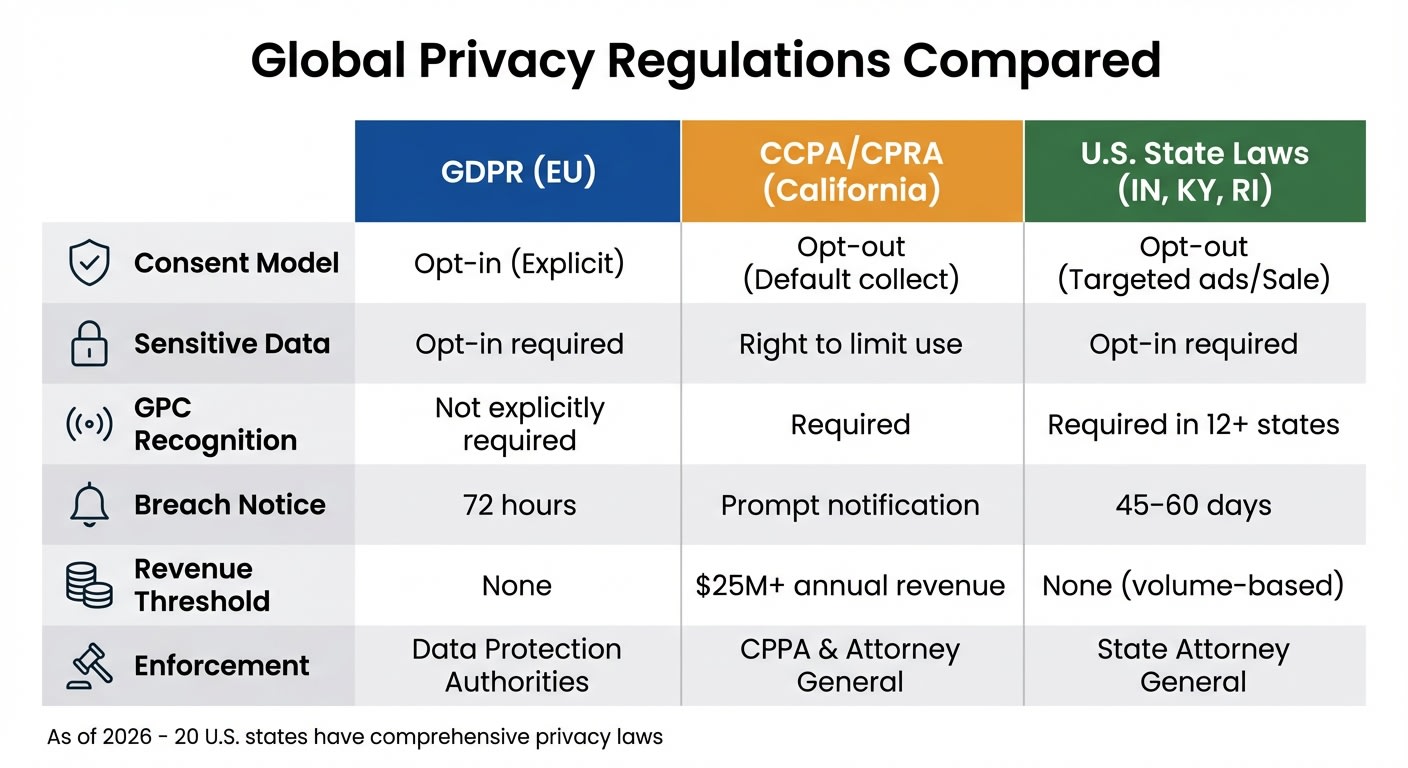
Global Privacy Regulations Compared
| Requirement | GDPR (EU) | CCPA/CPRA (California) | U.S. State Laws (IN, KY, RI) |
|---|---|---|---|
| Consent Model | Opt-in (Explicit) | Opt-out (Default collect) | Opt-out (Targeted ads/Sale) |
| Sensitive Data | Opt-in required | Right to limit use | Opt-in required |
| GPC Recognition | Not explicitly required | Required | Required in 12+ states |
| Breach Notice | 72 hours | Prompt notification | 45–60 days |
| Revenue Threshold | None | $25M+ annual revenue | None (volume-based) |
| Enforcement | Data Protection Authorities | CPPA & Attorney General | State Attorney General |
These contrasting requirements highlight the growing complexity of privacy laws. For example, 12 U.S. states now mandate businesses to recognize Global Privacy Control signals, making universal opt-out detection a technical necessity rather than an optional feature .
Consent Management for Developer Audiences
Providing Detailed Consent Controls
Developers thrive on precision, so offering clear, detailed consent options is essential. Break down consent categories into specific toggles like "Strictly Necessary", "Functional", "Analytics," and "Advertising." This setup allows users to, for example, enable feed personalization while rejecting third-party analytics.
When it comes to legal compliance, buttons for "Accept All" and "Reject All" must share equal prominence. Regulatory bodies, such as France's CNIL, have penalized websites that make the "Accept" button more visually appealing than the "Reject" option. In fact, banners with equally prominent options have seen only about a 6% acceptance rate for all cookies .
"The 'Reject' option must be equally prominent as 'Accept.' GDPR regulators have specifically called out making 'Accept' a big green button and 'Reject' a tiny text link."
- Andreas Hatlem, Developer
To ensure compliance, block non-essential scripts until explicit consent is provided. For instance, adding the attribute type="text/plain" to script tags and including a data-consent-category attribute ensures that analytics or advertising trackers don’t activate prematurely. Additionally, an always-accessible cookie settings widget in the footer allows users to withdraw consent just as easily as they gave it. This is a requirement under both GDPR and CCPA .
By implementing these granular controls, you not only meet legal requirements but also build trust - something developers value deeply. Transparency and precision in consent management are key to earning credibility with this audience.
Implementing Universal Opt-Out Recognition
Beyond granular controls, recognizing broader opt-out mechanisms helps ensure comprehensive privacy protection. One way to achieve this is by supporting Global Privacy Control (GPC) signals. These signals allow users to set browser-level privacy preferences, and when a browser sends the Sec-GPC header, platforms must treat it as a valid "Do Not Sell or Share" request under CCPA/CPRA.
Google Consent Mode v2 provides another layer of control, requiring all consent parameters - such as ad_user_data and ad_personalization - to be set to "denied" before any scripts execute. By configuring gtag('consent', 'default', …) to "denied" for all parameters, platforms can prevent data sharing during page initialization. Even when analytics_storage consent is denied, Google Analytics can still gather insights using cookieless pings and modeled data .
These measures cater to developers' expectations for both technical precision and a commitment to user privacy. By addressing their need for autonomy and transparency, you create a privacy framework that resonates with this highly detail-oriented audience.
Cookieless Advertising for Developers
With the decline of third-party cookies, developers face the challenge of adopting new technical strategies to maintain effective advertising.
How Cookie Phaseout Affects Developer Ads
The end of third-party cookies has reshaped the advertising landscape. In 2025, Chrome introduced a global consent prompt for tracking, and most users opted out, essentially eliminating traditional third-party tracking . This shift has hit developer-focused campaigns particularly hard, making it difficult to track user behavior across sites, manage ad frequency, measure conversions, and implement remarketing strategies .
The numbers paint a clear picture: 82% of digital advertisers anticipated moderate to severe disruptions from cookie deprecation , and 75% of marketers were still reliant on third-party cookies in late 2023 . For developer campaigns, these challenges are even sharper. Cookieless audiences have CPMs that are 30%–60% lower, and 45% of publishers expect steep drops in ad revenue . Smaller developer teams, often lacking extensive first-party data, are struggling to segment audiences and deliver tailored ads effectively .
"If you're a SaaS founder counting on third-party cookies to track your marketing performance, you're building on quicksand." - UseClick Blog
Browser restrictions add another layer of complexity. Safari and Firefox block most third-party cookies, and Safari's Intelligent Tracking Prevention (ITP) limits JavaScript-set cookies to seven days. This can inflate analytics data if users return after a week . Persisting with cookie-based tools or fingerprinting risks hefty fines under GDPR and CCPA .
These shifts demand new approaches to maintain precision in targeting and measurement.
Alternatives to Cookie-Based Targeting
Despite the challenges, 57% of marketers believe that cookieless strategies can match - or even exceed - previous levels of targeting precision with the right tools . Here are three key approaches gaining traction for developer-focused campaigns:
Contextual Targeting
This method has seen a resurgence. Instead of tracking individual browsing behaviors, ads are aligned with the content of the page a user is viewing. For example, a cloud IDE ad might appear on a Python tutorial page. Contextual targeting doesn’t rely on personal data, making it immune to browser blocking . Modern systems use AI to understand the meaning and sentiment of content, ensuring ads reach the right audience in a brand-safe way .
SafeInvest Advisors transitioned to contextual ad placements in premium investment news verticals in 2025. By tailoring creative to match page tone, they achieved a 42% higher conversion rate for qualified leads compared to cookie-based campaigns .
AI-driven contextual strategies have also delivered a 29% average increase in click-through rates as of 2025 .
First-Party Data Collection
First-party data has become the cornerstone of precision targeting. Brands leveraging such data report conversion rates up to 2.5 times higher than those relying on anonymized targeting . The key is offering something valuable in exchange for user data - like exclusive technical content, beta access, or personalized tools.
BigBox Outlets replaced cookie-dependent retargeting with a loyalty-focused first-party data strategy in 2025. By integrating server-side tagging to track in-store and online purchases, they boosted repeat purchase rates by 18% .
Server-Side Tagging and Unified Identifiers
Server-side tagging shifts tracking from the browser to a cloud server, converting third-party tags into first-party signals. This approach bypasses restrictions like Safari’s ITP . Unified ID solutions, such as UID2, use hashed and encrypted email addresses to enable secure cross-site tracking for logged-in users .
EcoWander Agency adopted unified ID solutions with explicit user opt-ins. By using modeled attribution instead of last-click tracking, they improved ROI measurement accuracy by 31% .
| Targeting Method | Data Used | Privacy Compliance | Key Advantage |
|---|---|---|---|
| Contextual | Page content, real-time signals | High (no personal data) | Scalable; immune to browser blocking |
| First-Party Data | CRM, direct site interactions | Very high (consent-based) | 2.5x higher conversion rates |
| Unified IDs (UID2) | Hashed/consented emails | Medium | Cross-domain visibility with user login |
| Server-Side Tagging | First-party cloud server | Medium | Bypasses browser restrictions |
The shift to cookieless advertising requires a technical overhaul. Start by auditing your marketing stack to identify outdated tools relying on third-party cookies. Replace them with privacy-first alternatives and implement server-side analytics for tracking and conversion measurement. Prioritize quality over quantity - smaller but well-verified first-party datasets will outperform massive, unverified third-party data in 2026 .
How daily.dev Ads Handles Privacy
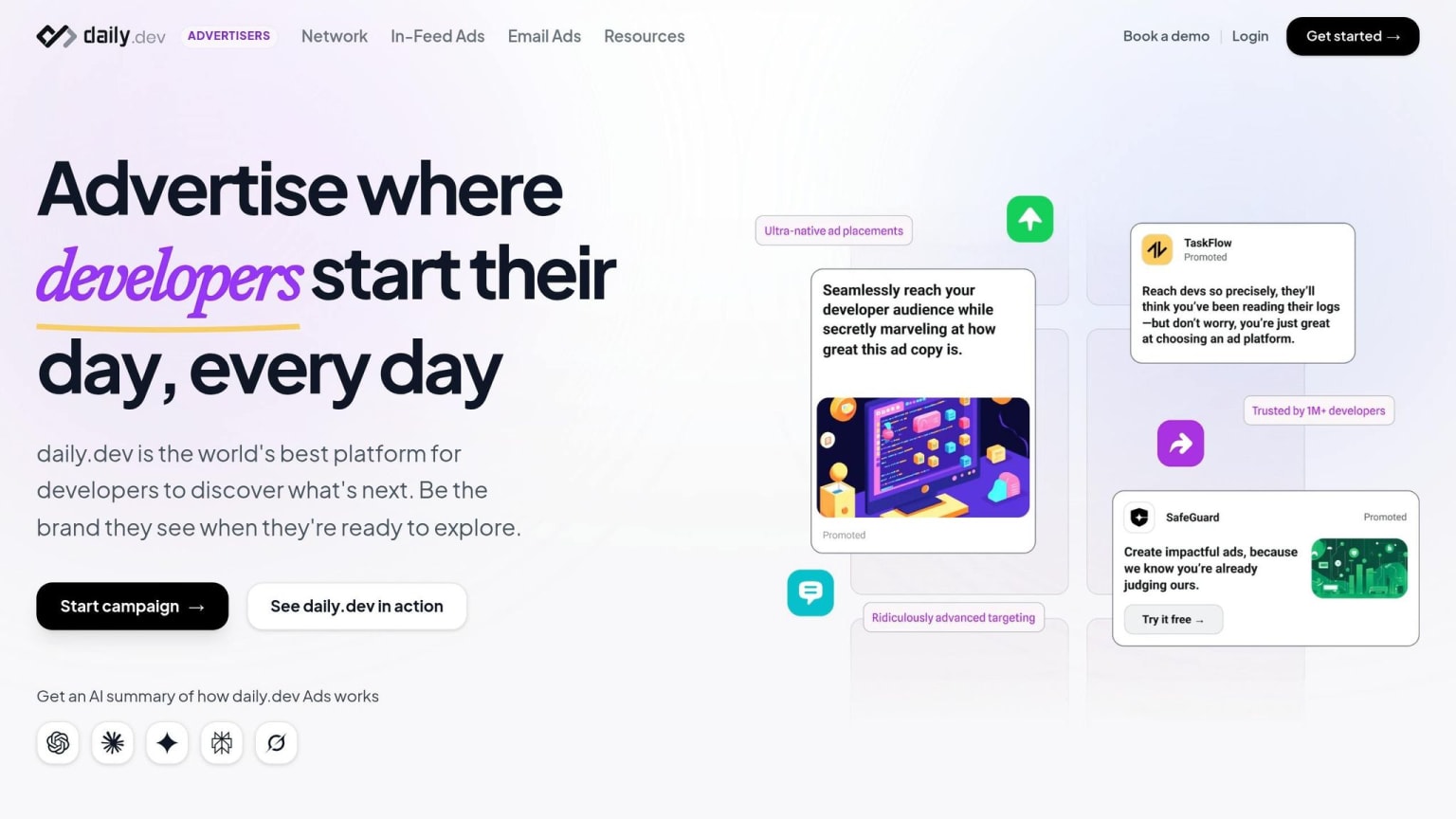
For developers who value precision and privacy, daily.dev Ads sets a high standard for transparency and compliance.
Privacy-Focused Platform Features
daily.dev Ads operates with a cookieless, privacy-first framework tailored for developers. Instead of relying on invasive tracking, it uses contextual targeting based on developer interests - like programming languages, tools, or roles . This ensures accurate ad placement without compromising user privacy through cross-site tracking.
The ads are displayed as native, clearly labeled placements directly within the developer's feed. This design aligns with global privacy standards while respecting the natural workflow of developers. With a focus on desktop-first traffic, the platform caters to how professionals evaluate tools in their workplace . By keeping all targeting data contained within its ecosystem, daily.dev ensures that user information remains secure and is never sold to third-party brokers.
"Your brand appears in a context developers choose every day, not one they skip." - daily.dev
This privacy-first setup works hand-in-hand with strong compliance measures.
Compliance with GDPR, CCPA, and Other Privacy Laws
daily.dev Ads doesn't just prioritize privacy - it embeds regulatory compliance into its core. The platform tracks user consent for specific purposes, including policy versions and consent methods, ensuring users agree to the Privacy Policy and Terms of Service, which includes cookie usage .
Adopting a data minimization approach, daily.dev collects only essential information, such as internal UUIDs and hashed emails, avoiding sensitive personal data. Its privacy-by-design principles ensure compliance is integrated into every aspect of the platform .
The system also supports automated workflows for the right to erasure, allowing users to delete or anonymize their data across databases, analytics, search indices, and third-party services upon request . For Data Subject Access Requests (DSAR), the platform provides detailed, machine-readable reports in JSON or CSV format within 30 days . With GDPR fines exceeding €2.1 billion by 2024 and Meta facing a €1.2 billion penalty for unlawful data transfers , these safeguards protect both advertisers and daily.dev from regulatory risks.
All third-party vendors are bound by Data Processing Agreements, ensuring compliance throughout the data chain. Automated data retention schedules further enhance security by removing data after predefined periods . daily.dev Ads adheres to both GDPR's opt-in requirements and CCPA/CPRA's opt-out model, which can impose fines of up to $7,500 for intentional violations .
This meticulous approach ensures privacy and compliance remain at the heart of daily.dev Ads.
Compliance Audit Checklist for Developer Ads
Steps to Verify Your Compliance
Ensuring ad compliance requires taking a thorough and structured approach. Here's how to get started:
Start by documenting every piece of data you collect, along with its intended purpose for processing . Conduct a technical scan of your domain to identify all active trackers - this often reveals 30–50% more trackers than initially expected .
Check your Consent Management Platform (CMP) to ensure it blocks all non-essential scripts until the user provides consent. Any tracker loading before consent is obtained could lead to immediate liability . Your CMP should allow for granular opt-in under GDPR and opt-out under CCPA, and users must be able to withdraw their consent as easily as they granted it . Make sure the "Accept" and "Reject" buttons on consent banners are visually balanced, ensuring fairness .
Set up automated systems to handle Data Subject Access Requests (DSAR) and erasure requests. These systems should generate machine-readable reports in formats like JSON or CSV within 30 days . For Google Ads in regions like the EEA and UK, verify that Consent Mode v2 is properly configured with "ad_storage" and "ad_user_data" signals .
Additionally, confirm that you have Data Processing Agreements (DPAs) in place with all advertising vendors. This step is critical to minimize regulatory risks, especially considering GDPR fines reached €2.1 billion in 2024, and the French data authority issued a €325 million penalty for cookie-related violations .
"Privacy regulations don't just affect lawyers and compliance officers. Developers make the architectural decisions that determine whether an application is compliant or not." - SCR Security Research Team
Assessing Your Privacy Practices
Take a close look at your database schemas to ensure you're adhering to data minimization principles. For instance, replace names with UUIDs and hash email addresses . These practices align with GDPR Article 25 and reduce your platform's exposure to potential data breaches .
Consider switching to contextual targeting instead of relying on cross-site tracking. By 2025, contextual ads have shown click-through rates within 5–8% of cookie-based behavioral targeting, making them a strong privacy-conscious alternative . If you've moved to server-side tracking, double-check that consent signals are still respected to honor user choices .
Ensure your CMP can detect user locations through IP addresses and apply the correct consent model - opt-in for GDPR regions and opt-out for CCPA. Also, test your consent banner to confirm it doesn't slow down page load times by more than 500 milliseconds . Under CCPA/CPRA, intentional violations can result in fines of $7,500 per user, per incident .
"Compliance and advertising performance are now permanently linked." - Kukie.io Team
Finally, automate the redaction of personally identifiable information (PII) in system logs to maintain security records without exposing sensitive data . Implement mechanisms to flag backups for exclusion during deletion requests . These steps highlight that compliance isn't just a legal requirement - it’s a fundamental part of the architecture that developers shape at every level.
Conclusion
Privacy compliance is about more than just avoiding penalties - it's about earning the trust that developers expect from the platforms they rely on. The hefty fines being enforced make the stakes clear . But beyond the legal risks, the real cost of neglecting privacy is a loss of engagement. Developers expect platforms to handle their data responsibly, and failing to meet those expectations can drive them away.
The move toward a cookieless world is already in motion . Brands that embraced this shift early by focusing on first-party data and contextual targeting have seen tangible results. In fact, companies using privacy-first strategies have reported up to 30% higher conversion rates, thanks to increased consumer trust . This demonstrates that privacy compliance and business performance can go hand in hand - they don't have to be at odds.
These regulations also emphasize the importance of thoughtful technical design. Decisions like how databases are structured or APIs are configured play a critical role in ensuring a platform's compliance from the ground up. Privacy isn’t just a legal requirement; it’s a core part of a platform’s architecture. Features like transparent consent options, clear opt-out mechanisms, and meaningful value exchanges with first-party data foster genuine trust. By aligning technical design with transparent practices, platforms can create a privacy-first approach that resonates with developers and users alike.
Ultimately, the platforms that thrive will be the ones that view privacy as an opportunity rather than a burden. Developers are more likely to engage with brands that respect their preferences, offer straightforward controls, and maintain transparency. This approach not only meets regulatory demands but also builds lasting relationships grounded in trust - laying the groundwork for sustained success in developer marketing.
FAQs
Do I need opt-in consent for analytics in the U.S.?
Yes, under GDPR, opt-in consent is generally required when processing personal data for analytics purposes. On the other hand, the CCPA/CPRA operates on an opt-out model, allowing data collection unless the user actively declines. Despite this difference, it's often a good idea to seek explicit consent for analytics, even in the U.S., to align with privacy best practices and build trust with users.
What replaces third-party cookies for developer ads?
With third-party cookies becoming less reliable, advertisers are turning to alternatives like first-party data collection, server-side tracking, contextual advertising, and cohort-based approaches. These methods allow for targeted advertising that respects privacy regulations while still delivering effective results in a cookieless world.
How do I honor Global Privacy Control (GPC)?
Global Privacy Control (GPC) is a signal that communicates a user’s preference to opt out of data sale or sharing. To comply with this, you need to both detect and honor the GPC signal.
You can identify the signal through the Sec-GPC: 1 HTTP header or by using navigator.globalPrivacyControl in JavaScript. Once detected, adjust your data handling processes to align with the user's preferences.
For example, if a user opts out, ensure their request is acknowledged - this could mean displaying a confirmation message, especially for users in regions like California where such privacy preferences are legally protected.