
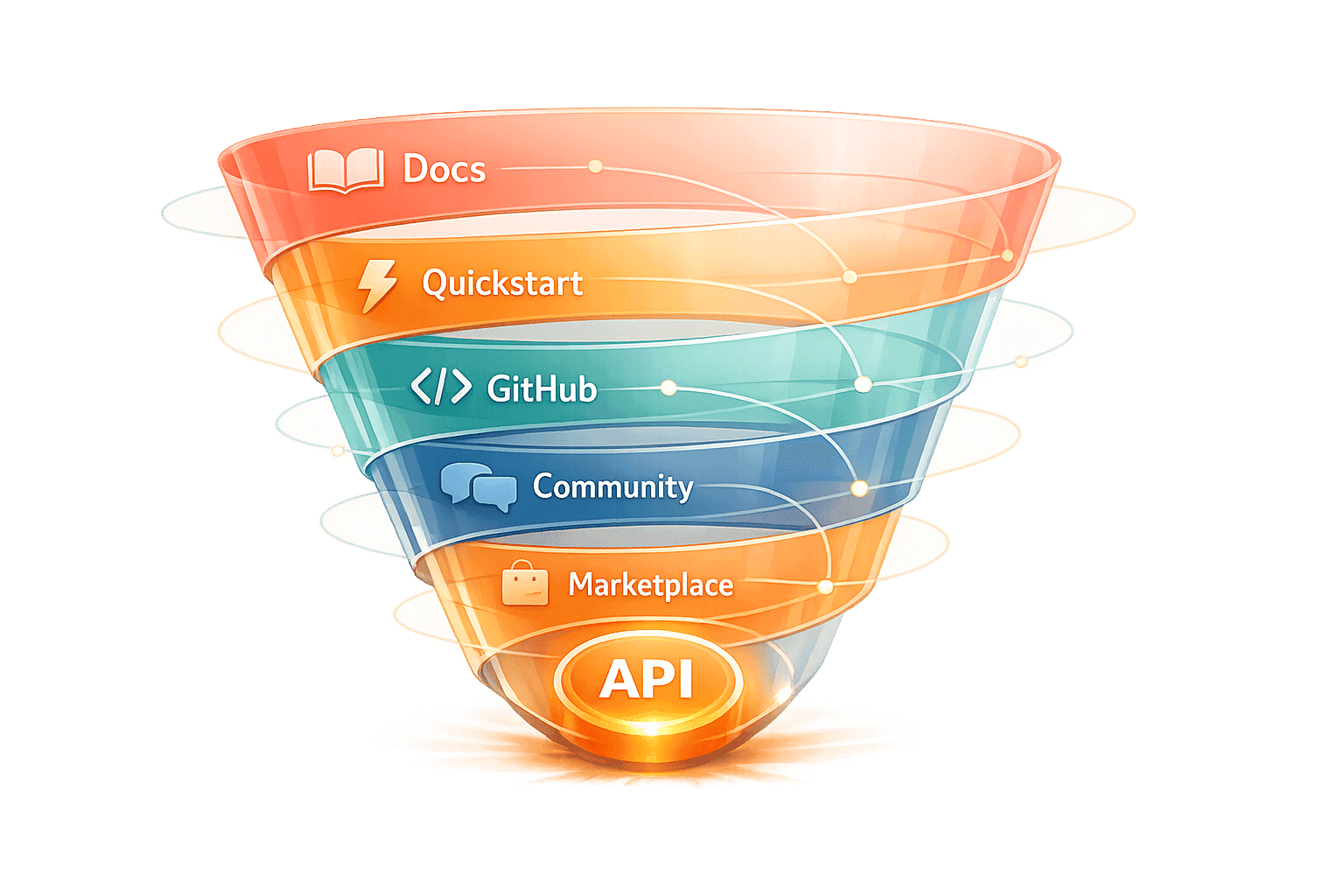
API marketing is not like traditional marketing. Developers want tools that work - fast. Here's what matters most:
- Clear documentation: Developers rely on docs to assess your API. Confusing docs? They’ll leave.
- Quick start: Your API should work in under 5 minutes. Stripe and Twilio do this well with on-page code examples.
- Discovery channels: Developers find APIs via colleagues (68%), GitHub, Stack Overflow, and AI tools like GitHub Copilot. Optimize your presence there.
- Developer-first approach: No sales pitches. Provide sandbox environments, test keys, and error messages that help.
- Measure success: Track activation rates, time-to-first-API-call, and monthly active developers.
Focus on empowering developers with tools and resources that save time and solve problems. Your documentation is your primary marketing tool. Simplify onboarding, provide real-world examples, and make your API easy to find and use.
Why API Marketing Is Different
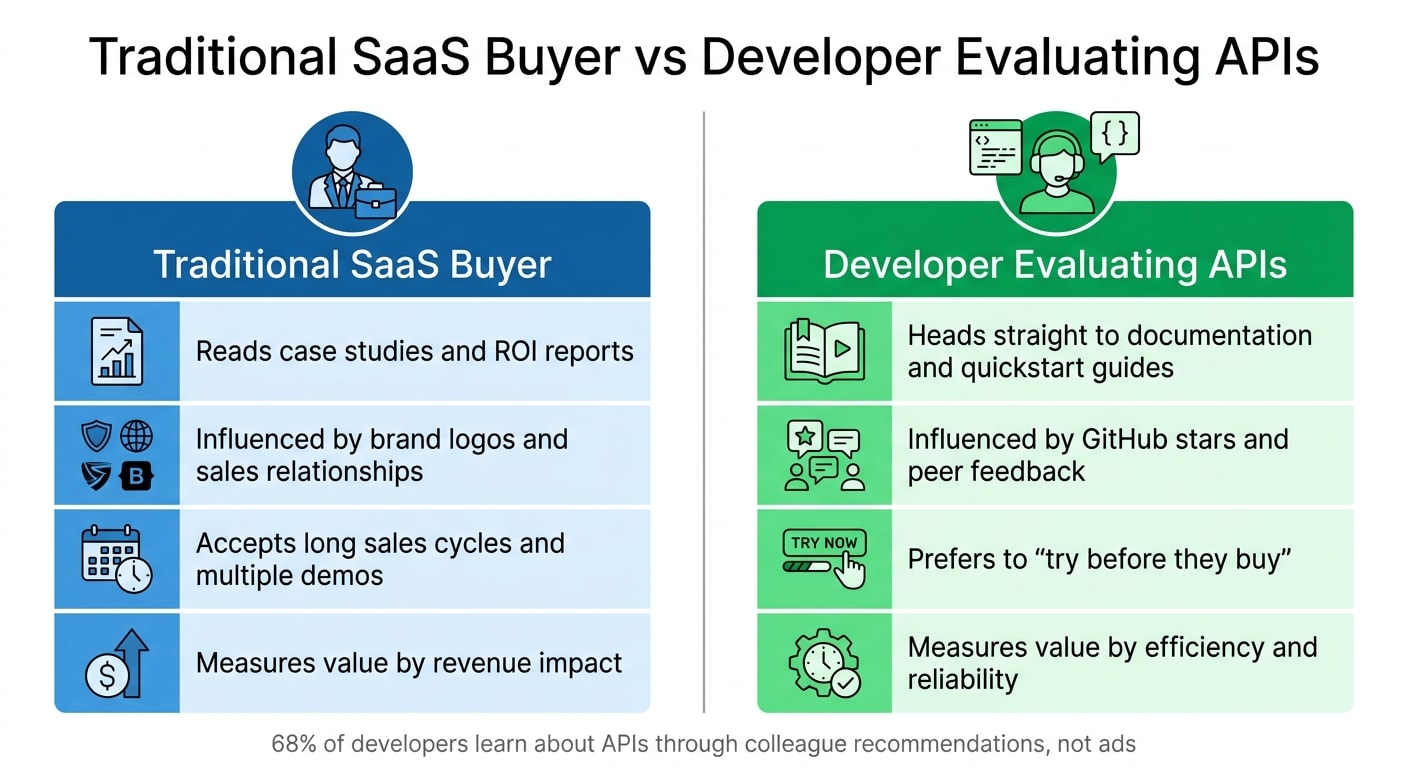
Traditional marketing operates on the idea that buyers need to be persuaded. API marketing, on the other hand, assumes developers want to be empowered. This shift changes everything about how you approach promotion. While business customers might spend time reviewing case studies or scheduling demos, developers dive straight into the quickstart guide, eager to test your API. If they can't make their first API call in a matter of minutes, they'll move on.
How Developers Evaluate APIs
When developers visit your site, their behavior highlights the importance of clear, accessible documentation. 68% of developers learn about new APIs through recommendations from colleagues rather than through ads or SEO . They’re not looking for polished presentations - they want working code that proves your API delivers.
The way developers evaluate APIs is vastly different from traditional software purchasing:
| Traditional SaaS Buyer | Developer Evaluating APIs |
|---|---|
| Reads case studies and ROI reports | Heads straight to documentation and quickstart guides |
| Influenced by brand logos and sales relationships | Influenced by GitHub stars and peer feedback |
| Accepts long sales cycles and multiple demos | Prefers to "try before they buy" |
| Measures value by revenue impact | Measures value by efficiency and reliability |
This comparison shows why developers value hands-on experience over marketing fluff. They trust working code and peer feedback far more than corporate messaging. In fact, 78% of open-source contributors seek recognition and credit, which further emphasizes the importance of community-driven validation . For developers, the real test of your API lies in its usability, not in your sales pitch.
Documentation and Code Come First
Once developers begin evaluating your API, the quality of your documentation becomes the ultimate deciding factor. To developers, poor documentation reflects poorly on the reliability of the API itself. If your docs are unclear, incomplete, or not machine-readable, they’ll assume your API is unreliable .
Keeping your TTFC (Time to First API Call) under five minutes - or better yet, under two - can significantly improve adoption rates . Developers who successfully make an API call during their first session are 10x more likely to stick around as long-term users .
This is why companies like Twilio and OpenAI feature working code examples right on their homepage. They understand that functional code speaks louder than any marketing claim. Additionally, modern developers are increasingly discovering APIs through AI coding assistants like GitHub Copilot and Claude. These tools pull information from structured documentation to suggest APIs, making clear, runnable code even more important . Every well-documented example in your API guides directly contributes to developer trust and adoption.
The API Marketing Funnel
The API marketing funnel operates differently than traditional SaaS funnels. Developers tend to quickly discover, test, and either adopt your API or move on. By understanding each stage of this journey, you can address obstacles and encourage faster adoption.
Discovery: How Developers Find APIs
Developers primarily discover APIs through peer recommendations. A staggering 68% of developers learn about new APIs via word of mouth from colleagues . These conversations often happen in private Slack channels or Discord communities, making your community presence and reputation critical. A strong reputation directly impacts how developers perceive and share your API.
In addition to word of mouth, developers actively search for solutions on platforms like Google, YouTube, Reddit, and Stack Overflow. To stand out, your API needs to appear in these searches with clear, problem-solving content. GitHub is another vital discovery hub, where developers look for sample code, SDKs, and integration examples. To make your API more visible, optimize your repository names, "About" sections, and topic tags .
AI coding assistants such as GitHub Copilot, Claude, and Cursor are also reshaping how developers discover APIs. These tools suggest APIs during coding sessions by pulling from public documentation. To ensure your API is accurately represented, implement an llms.txt file and provide Markdown documentation. Use clear heading structures and error-free code examples to help these tools avoid presenting incorrect information .
Integration marketplaces like Zapier, Salesforce AppExchange, and Shopify App Store are also powerful channels for distribution. These platforms connect with developers directly within their workflows . Similarly, platforms like daily.dev expose your API to developers while they’re consuming technical content. By building a presence on platforms where developers already spend their time - whether GitHub, online communities, or marketplaces - you can position your API effectively.
| Discovery Channel | Strategy for Standing Out |
|---|---|
| AI Assistants | Add llms.txt and structured Markdown documentation |
| GitHub | Optimize repo topics and provide "Hello World" examples |
| Search Engines | Publish "How-to" guides for specific programming problems |
| Communities | Engage through social listening and offer helpful solutions |
| Marketplaces | Build integrations for key platforms like GitHub Actions |
Once developers discover your API, the next step is to impress them with clear documentation and easy testing.
Evaluation: Documentation and Testing
After finding your API, developers immediately turn to your documentation. This stage is about answering the question, "Can this solve my problem?" and guiding them to your Quick Start guide . A successful first API call should happen in under 5 minutes - ideally, less than 2 .
Developers prefer to evaluate silently. Gated content, "Contact Sales" buttons, or requiring a credit card for a free tier can discourage them from moving forward . Instead, your homepage should feature working code examples, such as a simple curl command .
To make testing seamless, offer a sandbox environment that mirrors production. Use distinct test keys (e.g., sk_test_) to minimize errors when transitioning to production . For logged-in users, inject their unique API keys directly into your documentation's code samples, enabling instant copy-pasting .
Error messages play a crucial role during testing. Treat them as an extension of your documentation by including machine-readable error codes, clear explanations, and links to detailed solutions . Add headers like X-RateLimit-Remaining and Retry-After to help developers manage rate limits effectively .
Once developers successfully test your API, focus on providing a smooth onboarding experience to encourage further integration.
Adoption and Expansion: Onboarding and Growth
Adoption occurs when developers integrate your API into their applications. The first 15 minutes are critical - developers often decide within that window whether your API is worth their time . Tracking metrics like "signup to first API call" can help you identify friction points; aim for a time under 300 seconds .
Providing well-maintained, language-specific SDKs tailored to developers' expectations can significantly boost adoption. For example, TypeScript developers expect typed interfaces, while Python developers look for idiomatic naming conventions. Tools like Stainless or APIMatic can help automate the creation and upkeep of these SDKs .
Expansion happens as developers start using more endpoints in your API. This deeper integration creates a reliance on your API, making it harder for them to switch to alternatives . Look for signs of long-term retention, such as daily API calls or the use of high-value endpoints .
Usage-based pricing models align well with the expansion phase. Offering a "pay-as-you-go" option (e.g., $0.001 per API call) lowers barriers to entry while linking your revenue to the success of your users . A generous free tier should allow developers to prototype but not run a full production system, encouraging them to upgrade as their usage grows .
Finally, prioritize hands-on support for your first 20 paying customers. These early interactions can uncover pain points and highlight areas where your documentation or onboarding process needs improvement . This feedback is invaluable for refining your approach before scaling to a larger audience.
Documentation Is Your Primary Marketing Asset
When it comes to APIs, your documentation isn't just a resource - it's your main sales pitch. Developers often bypass flashy marketing pages and dive straight into the docs to see if your API meets their needs. If your documentation is confusing, incomplete, or hard to navigate, they'll assume your API is just as flawed and move on to a competitor .
Good documentation doesn't just help developers understand your API - it also influences how AI coding tools like GitHub Copilot and Claude interact with it. These tools rely on public documentation to generate code suggestions. If your docs are messy or poorly structured, it can lead to AI errors or your API being ignored entirely . With 27% of consumers now using generative AI for at least half of their searches, having machine-readable, well-structured docs is more important than ever .
Beyond clarity, interactive guides and multilingual code samples can turn casual interest into actual usage.
Interactive References and Quickstart Guides
Your documentation shouldn't just inform - it should actively engage developers. A great starting point? Include a live code snippet right on your homepage. For example, a simple curl command that developers can copy and paste immediately is a powerful way to grab attention . If users are logged in, go a step further by embedding their personal API keys directly into the snippets, making it as easy as "copy, paste, run" .
Interactive tools like API explorers with "Try it" buttons make a big difference. These let developers test endpoints and view real responses without needing to set up a local environment. It's a quick way to prove your API's value before they even write any code . Companies like Deepgram have embraced this approach with no-signup sandboxes, allowing developers to test their APIs in just minutes - a tactic that has proven highly effective .
Quickstart guides are another must-have. Focus on delivering a "first success" moment, where developers see a tangible result quickly. Instead of listing endpoints, structure guides around practical use cases like "Add authentication to a React app" or "Process a payment in under 10 lines of code" . This approach shows developers exactly how your API can solve their specific challenges.
Code Samples in Every Major Language
Developers feel more comfortable with your API when they see examples tailored to their preferred languages. At a minimum, provide SDKs and code samples in three major languages, such as cURL, JavaScript/TypeScript, and Python. Make sure your documentation includes easy language toggles for seamless navigation . Each SDK should follow the conventions of its language: for instance, TypeScript users expect typed interfaces, while Python developers prefer idiomatic naming styles.
Tools like Stainless or APIMatic can help you generate SDKs automatically from OpenAPI specs, ensuring your libraries stay up-to-date as your API evolves . Keeping examples current reduces frustration and makes integration smoother. To reinforce trust, maintain a public changelog to show developers that your API is actively supported and improved .
Error handling is another crucial part of your documentation. Instead of vague "400 Bad Request" messages, provide detailed error codes, clear explanations, and links to relevant troubleshooting guides . Transparent headers like X-RateLimit-Remaining and Retry-After can also help developers manage rate limits effectively . These small details make a big difference in creating a smooth developer experience.
Developer Experience Is Marketing
A smooth developer experience can be your most powerful marketing tool. On the flip side, a frustrating experience can sink even the most promising API. Developers often decide within minutes whether your API is worth their time, and that decision hinges on how quickly they can get it working . If their first API call fails or produces unclear errors, chances are they'll walk away without looking back.
The line between an average API and a truly successful API product lies in how well it supports developers . Every interaction - whether it's a helpful error message or clear rate limit documentation - should feel intentional. When developers trust that your API is reliable and that your team has their back, they’re more likely to stick around and even recommend it to others. Let’s dive into how features like precise error messages and transparent rate limits can turn developer frustration into loyalty.
Clear Error Messages and Rate Limits
Error messages are more than just technical feedback - they can be a competitive edge. When a developer hits an error, they need to know exactly what went wrong and how to fix it, without having to reach out for support. Providing detailed documentation for every error code, complete with explanations and actionable steps, empowers developers to troubleshoot on their own . This is even more critical now that AI tools like GitHub Copilot and Claude rely on your documentation to assist developers directly in their IDEs .
Strive for at least 85% of developers successfully making their first API call. If failure rates are high, it’s a clear sign that error messages or documentation need improvement . Regular "friction logs", where someone documents their experience from landing page to first successful API call, can help identify blockers like unclear errors or missing details .
Rate limiting is another area where transparency is key. Use headers such as X-RateLimit-Remaining and Retry-After to help developers manage their usage effectively. Avoid hiding pricing or quota details - developers often associate hidden costs with expensive products . A usage-based pricing model (e.g., "$x per thousand requests") provides predictability and allows developers to scale comfortably . Combine this with a generous free tier that supports real production testing without requiring upfront payment, and you’ll reduce barriers to adoption while earning goodwill .
While clear error handling eases the integration process, maintaining open communication about updates ensures developers stay confident in your platform over the long haul.
Changelogs and Version Updates
For developers building on your API, staying informed about updates is crucial. A public changelog with clearly dated entries - covering new features, bug fixes, and deprecated endpoints - shows that your API is actively maintained and evolving . It’s more than just documentation; it’s a signal that you’re a dependable partner.
A dedicated status page is also invaluable. Use it to share real-time API uptime, incident history, and breaking changes . Transparent communication during outages or updates can save developers hours of confusion and debugging . Some companies even take it a step further by using social media accounts or Discord channels to notify developers where they’re already active .
Another approach to consider is bundling smaller updates into a "Launch Week", where you unveil daily updates over several days . This not only generates buzz but also highlights your commitment to improving the product. Keeping your documentation, SDKs, and changelogs aligned with every release eliminates friction and fosters trust .
Where to Promote Your API
Promoting your API effectively means meeting developers where they already explore and evaluate tools. It’s not enough to just build a great product - developers value technical insights over flashy marketing. Your efforts should focus on platforms where developers naturally discover APIs and tools.
Developer Directories and Marketplaces
Listing your API on well-known directories and marketplaces can instantly connect you with developers actively searching for solutions. Platforms like Salesforce AppExchange, Shopify App Store, Atlassian Marketplace, and Zapier App Directory offer built-in visibility. These platforms allow your API to gain traction through reviews and rankings, giving you a head start in reaching your target audience .
Beyond visibility, these platforms simplify operational complexities. They handle tasks like billing, subscription management, rate limiting, and authentication. This lets your team concentrate on improving the core product while benefiting from the credibility that comes with being associated with these recognized platforms .
There’s also an added SEO perk. By listing your API on these directories, you can generate high-quality backlinks that significantly boost your domain authority. For example, a new API listing could see its domain rating jump from zero to over 30 in just a few weeks, which enhances your organic search rankings for API-related queries .
| Platform Type | Key Examples | Benefit |
|---|---|---|
| Marketplaces | Salesforce AppExchange, Shopify App Store, Zapier | Access to established user bases |
| Communities | Reddit, Hacker News, Stack Overflow, Discord | Build trust through direct engagement |
| Aggregators | daily.dev, dev.to | Broader reach for technical content |
| Search/AI | Google, YouTube, ChatGPT, Claude | Capture active demand and intent |
While directories are great for visibility and credibility, developer communities offer a more personal way to connect with your audience.
Developer Communities and daily.dev
Developer communities are all about trust. Developers gather on platforms like Hacker News, Reddit (especially subreddits like /r/programming), Stack Overflow, and niche Discord or Slack servers. These spaces aren’t for overt promotion - they’re for engaging with developers by solving their problems and sharing expertise.
Using social listening tools like F5Bot, Syften, or Octolens can help you monitor conversations relevant to your API’s niche. For instance, if someone asks about "email verification APIs" or "payment gateway integration", responding with a helpful, non-promotional answer can naturally introduce your API to a receptive audience.
For broader visibility, platforms like daily.dev are invaluable. As a content aggregator with over 1 million developers in its ecosystem, daily.dev allows you to reach the right audience through native ad placements that appear alongside the technical articles and tutorials developers are already consuming.
GitHub is another essential channel. By open-sourcing your SDKs, integration libraries, and sample repositories - and optimizing your repository’s "About" section and tags - you can make your API discoverable to developers actively searching for solutions.
"Developer ecosystems are the highest-leverage distribution channel available to B2B startups today." - Udit.co
The global open API market, valued at $3.66 billion in 2023, is projected to grow to $25.04 billion by 2032, with a compound annual growth rate (CAGR) of 23.83% . Additionally, 68% of developers discover new APIs through word of mouth from colleagues rather than traditional ads or SEO . This highlights the importance of building a strong presence in developer communities to drive adoption.
This strategy pairs perfectly with broader outreach efforts like content marketing, which we’ll cover next.
Content Marketing for APIs
Technical documentation lays the groundwork for credibility, but content marketing steps in to showcase that credibility with practical, attention-grabbing examples. The goal? To speed up developer adoption.
Marketing APIs requires a different approach than traditional SaaS. Developers aren’t interested in case studies or ROI reports - they’re looking for immediate, actionable answers. Think searches like: "how to integrate payment gateway in Python" or "add authentication to a React app." This strategy, called demand capture, focuses on meeting developers exactly where they are and turning their search intent into API adoption .
The key is to guide developers to their "aha moment" as quickly as possible. Stripe nailed this concept by putting a seven-line code snippet on their homepage, enabling developers to process their first payment in just minutes . That’s marketing in action. The faster a developer can make their first API call - ideally under 5 minutes, with 2 minutes being the sweet spot - the better . Of course, this approach hinges on strong documentation and a frictionless developer experience.
"Developers go straight to the documentation and code samples. They want to get their job done quickly and don't want to deal with BS." - Lee Robinson, VP of Developer Experience
Tutorials and Integration Examples
Great tutorials address real-world use cases, not abstract technical details. For example, instead of titling a guide "API Reference: Authentication Endpoints", go with something like "How to Add OAuth Login to Your React App in 10 Minutes." Developers are searching for solutions to immediate problems, not just API specs .
Code examples that developers can copy and paste are non-negotiable. Include working snippets with test credentials directly in your tutorials. This lets developers test your API without the hassle of signing up. Companies like Deepgram take it a step further with interactive playgrounds, allowing developers to try out the API in under 2 minutes .
Your code should always feel native to the language it’s written in. A Python SDK, for instance, should follow Pythonic conventions rather than feeling like a clunky adaptation of a JavaScript library . Developers instantly pick up on awkward SDK implementations, and it can hurt their perception of your API’s quality.
Video content is becoming a must-have. Record technical tutorials and repurpose them into blog posts, social media clips, and even snippets for your documentation. This "content flywheel" approach ensures your content reaches developers across multiple platforms . Platforms like daily.dev can further amplify your reach by placing your tutorials alongside the technical articles developers already consume.
Once you’ve built a strong library of tutorials, comparison content can help highlight your API’s advantages.
Comparison Content and Use Cases
Before committing to an API, developers often compare it to alternatives. That’s why creating comparison content is so effective - it captures developers when they’re already in a decision-making mindset . The trick? Be honest. Developers are quick to spot exaggerated claims, so back up everything with clear code examples or performance metrics .
Show how your API solves common developer pain points. For instance, SendGrid doesn’t just offer email delivery; they position themselves as "email infrastructure so you don’t have to become an email expert" . Similarly, Algolia markets itself as "instant search that would take months to build yourself" . This approach resonates because developers understand the hidden complexity of building these features from scratch.
Integration stories are another powerful tool. Document real-world use cases by outlining the project, context, alternatives considered, results, process, and costs . This kind of detailed breakdown helps developers see exactly how your API fits into their workflow.
Finally, keep an eye on discussions happening in places like Reddit, Hacker News, and Stack Overflow. Join the conversation by offering helpful, non-promotional comparisons . It’s a subtle yet effective way to build trust and awareness.
How to Measure API Marketing Success
Measuring the success of API marketing requires a different approach compared to traditional SaaS metrics. Developers don’t follow the usual path of filling out lead forms. Instead, they dive straight into your documentation and start experimenting. Success here hinges on tracking developer behavior in three key areas: initial activation (are they getting started?), ongoing engagement (are they sticking with it?), and advocacy (are they recommending it?).
Let’s break it down into actionable metrics that reflect these developer-focused goals.
Developer Signups and Time-to-First-API-Call
One of the most critical metrics is Time-to-First-API-Call (TTFC), which measures how quickly a developer can go from signing up to making their first API call. The goal? Keep it under 5 minutes - ideally under 2. For example, Stripe enables developers to complete a successful test charge in under 3 minutes .
Another key metric is the activation rate, which tracks the percentage of developers who make at least one successful API call within 24 hours or 7 days of signing up. An activation rate below 30% suggests significant friction in your onboarding process . Why does this matter? Developers who activate within 24 hours tend to have much better retention rates over 90 days .
Don’t overlook the first-call success rate, which should be above 85% . If too many developers encounter errors on their first attempt, it’s a sign your quickstart documentation needs work.
Active Integrations and API Call Growth
To measure ongoing engagement, track Monthly Active Developers (MAD) - the number of developers actively calling your API each month .
Also, keep an eye on integration abandonment. This includes developers who generate an API key but never make a request or those who stop short of reaching production volume . By instrumenting your funnel to monitor milestones like API key generation, first test call, and sustained usage, you can identify exactly where drop-offs occur and address them.
Growth in the number of API calls per developer is another strong indicator. It shows developers are building deeper integrations, which often means your marketing efforts are resonating with the right audience.
Once developers are activated, keeping them engaged and gathering positive feedback is crucial for long-term success.
Developer NPS and Feedback
The Developer Net Promoter Score (NPS) is an excellent way to gauge how well your API converts initial satisfaction into ongoing advocacy . With 68% of developers discovering new APIs through word-of-mouth , a high NPS can directly fuel organic growth. But keep this separate from business NPS; the developer’s technical experience often differs from the executive’s perspective .
To uncover friction points that metrics might miss, document the full onboarding journey . Regularly talk to developers through exit interviews, community channels, or direct outreach to trial users . These conversations can highlight pain points that data alone can’t reveal.
Finally, monitor the health of your developer community. Metrics like response times in Discord or Slack, helpfulness ratings on documentation pages, and sentiment in forums can provide early warnings of potential issues . These qualitative insights often surface problems before they impact activation or retention rates.
| Metric | Target Benchmark | What It Reveals |
|---|---|---|
| Time-to-First-API-Call | < 5 minutes | Onboarding efficiency and friction points |
| Activation Rate | > 30% | Whether developers can successfully start |
| First-Call Success Rate | > 85% | Quality of quickstart documentation |
| Developer NPS | Track trend | Likelihood of word-of-mouth growth |
Paid Advertising for API Products
When organic discovery alone isn't enough to drive API adoption quickly, targeted paid advertising can step in to boost developer engagement. While organic growth is essential, it often takes time - time that most API companies can't afford to wait. Paid advertising can work for developer tools, but you need to ditch traditional SaaS marketing tactics. Developers tend to reject vague or overly promotional messaging .
The focus should be on demand capture, not brand awareness. Your ads need to appear at the exact moment a developer searches for something like "how to integrate payment gateway in Python" or "SMS API for Node.js" . By showing them how your API solves their specific problem - perhaps with a simple code snippet - you demonstrate immediate value. Below, we'll explore how to effectively use platforms like daily.dev and craft ad campaigns that resonate with developers.
Running Ads on daily.dev
daily.dev is a powerful platform for reaching developers actively looking for new tools. With over 1 million developers using the site, it offers precise targeting options based on seniority, programming languages, and technology preferences. This ensures your API ads are seen by developers who are in "discovery mode." Unlike generic ad networks, daily.dev's native in-feed ads are part of a trusted ecosystem where developers go to stay updated on technical content. This placement helps reduce the skepticism often associated with interruptive advertising.
You can also tailor your ads to specific developer groups. For instance, you might target Python back-end developers or React Native mobile engineers, making sure your API reaches the right audience at the right time.
Best Practices for Developer Ad Campaigns
When creating ads for developers, show, don’t just tell. Use working code snippets that highlight how simple and effective your API is . For example, instead of saying "Powerful payment processing", you could display a snippet like this:
stripe.charges.create({ amount: 2000, currency: 'usd' })
Pair it with a headline like: "Accept payments in 2 lines of code."
Once a developer clicks your ad, direct them to a quickstart guide, not a traditional marketing page . Developers want to dive in immediately, so your landing page should let them generate an API key and make their first API call in under five minutes . A "Contact Sales" form will only slow them down and likely drive them away.
Here are a few additional tips:
- Target problem-based keywords: Focus on search terms like "speech recognition API" or "email validation API" rather than relying solely on your brand name .
- Set up retargeting campaigns: If a developer visits your documentation but hasn't made their first API call, retarget them with ads to re-engage .
- Avoid empty marketing phrases: Skip phrases like "seamlessly integrate" or "unlock potential." Developers prefer direct, technical messaging. Use headlines like, "Add SMS to your Node.js app in under 5 minutes," and link directly to the relevant guide .
Conclusion
API marketing thrives on clear documentation, a seamless developer experience, and targeted, technically focused distribution. Developers judge your API by how quickly they can achieve their goals. If your onboarding process or documentation creates delays or confusion, they’ll likely look elsewhere.
The companies leading the API economy - Stripe, Plaid, and OpenAI - have one thing in common: they prioritize developer experience as a core strength. Features like clear error messages, transparent rate limits, user-friendly SDKs, and hassle-free signup processes make all the difference. These elements not only improve usability but also encourage developers to recommend your API within their networks.
While product quality is critical, distribution plays an equally important role. Developers need to find your API when they’re actively searching for solutions. Being visible on platforms like Google, GitHub, Stack Overflow, or daily.dev can make or break your API’s discoverability. For instance, platforms like daily.dev help reinforce your presence when developers seek efficient API options. Paid advertising can also drive growth, but it works best when tailored to developers - using technical messaging and code-driven landing pages rather than broad brand campaigns.
Finally, tracking the right metrics ensures your marketing efforts are truly effective. Focus on time to first API call, activation rates, API call growth, and developer NPS to measure real engagement. These metrics go beyond surface-level traffic and reveal whether developers are adopting and sticking with your API. With the global API market expected to hit $25.04 billion by 2032 , companies that prioritize effortless integration and visibility will be best positioned to succeed.
FAQs
What’s the fastest way to cut time-to-first-API-call?
To make the onboarding process faster and more efficient, focus on providing clear documentation, quickstart guides, and code samples in popular programming languages. The goal? Get developers to their first API call in under 5 minutes - ideally, in just 2 minutes.
Remove unnecessary hurdles like requiring credit card details upfront. Instead, offer a free tier to encourage exploration without commitment. Also, pay attention to error messages. They should be actionable and easy to understand, helping developers troubleshoot quickly and continue smoothly. A streamlined experience like this can make all the difference for developers diving into your API.
Which channels actually help developers discover an API?
Developers typically find APIs through a mix of search engines, developer communities, and dedicated platforms. Search visibility, especially on Google, is a major factor - if your API isn’t easy to find, it’s easy to miss out on potential users.
Developer communities like Reddit and Slack are also invaluable. These spaces allow developers to share recommendations, discuss tools, and ask questions. Pair this with content marketing efforts like tutorials and use case guides, and you’ve got a powerful way to capture attention.
Finally, resources like developer portals, well-organized documentation, and platforms such as daily.dev make it easier for developers to explore and evaluate APIs efficiently. Having a strong presence in these areas can make all the difference.
What metrics show an API marketing strategy is effective?
Key metrics to track are:
- Time to first API call: Aim for developers to make their first API call within 2-5 minutes. Faster is better.
- Activation rate: Measures how many developers successfully get started with your API.
- Active integrations: Tracks the number of developers actively using your API in their projects.
- API call growth: Indicates the increasing usage of your API over time.
- Developer NPS (Net Promoter Score): Reflects how satisfied developers are with your API and how likely they are to recommend it.
These metrics give a clear picture of how effectively developers are adopting, engaging with, and enjoying your API.