

Developers are key influencers in IT spending, often driving 30%-50% of purchases through "Shadow IT." But they resist traditional marketing tactics like cold emails, gated content, and flashy promises. Why? Developers value proof, utility, and transparency over hype. They prefer self-serve trials, clear documentation, and measurable results.
Key Takeaways:
- What Doesn’t Work: Cold emails (5.4% success rate), gated demos (73% drop-off), vague claims like "revolutionary."
- What Works: Clear metrics (e.g., "P99 latency < 10ms"), open documentation, and hands-on trials.
- Developer Buying Process: Bottom-up adoption starts with individual testing (
npm install) and progresses to team and manager approval. - Metrics to Track: Product-Qualified Leads (PQLs), API usage, and team invites - focus on engagement, not just sign-ups.
To win developers, ditch traditional sales tactics. Focus on solving their problems, offering transparency, and building trust through technical depth.
Why Developers Resist Traditional B2B Marketing
Traditional B2B marketing often thrives on promises, but developers want proof. Most B2B strategies center on "compliance and promise" - pitching ideas to executives who then enforce adoption from the top down. Developers, however, operate differently. They focus on "utility and verification", needing to test tools, confirm they work, and ensure they address specific problems before endorsing them . This disconnect makes traditional approaches less effective. To engage developers, it's crucial to understand their resistance and the bottom-up buying process they prefer.
When developers encounter typical B2B tactics like gated whitepapers, "Book a Demo" buttons, or cold emails, they don’t see value. Instead, they see a data funnel. As Adam DuVander puts it:
Instead of seeing a path to valuable information, they see the CRM or database where their data is headed. They reverse engineer your marketing automation and pull the ripcord .
High usage of ad blockers further highlights this distrust. Only 5.4% of developers discover new products through cold emails . Even more telling, 73% abandon products that require sign-up before testing . The takeaway? Friction kills adoption.
What Developers Reject in Marketing Messages
Developers are quick to dismiss vague claims. Words like "revolutionary", "seamless", or "high-velocity" often trigger skepticism because they lack precision. Engineers are trained to identify edge cases and trade-offs in their work, and they apply the same critical mindset to marketing .
Morgane Palomares, former Marketing Lead at Vercel, explains:
Developers have a very low tolerance for cringey marketing. Marketing that contains a lot of fluff and words that try to describe things that mean absolutely nothing .
So, what resonates instead? Swap adjectives for specifics. For example, instead of saying "blazing fast", provide a measurable claim like "P99 latency < 10ms." Replace "easy to integrate" with a five-minute "Hello World" tutorial. Developers value honesty about what a tool can - and cannot - do. Admitting limitations builds trust far more effectively than overpromising .
For developers, documentation is often more important than your homepage. Detailed, accessible docs act as the real sales page. If they require a login or lack technical depth, developers will leave . Lee Robinson, VP of Product at Vercel, emphasizes this point:
Developers go straight to the documentation and code samples. They're trying to finish the job quickly and don't want to deal with BS .
This focus on technical accuracy and transparency directly influences how developers approach the purchasing process.
How Developers Control B2B Purchasing
Here’s an interesting contradiction: developers usually don’t control the budget, but they hold veto power. If a developer decides your tool doesn’t meet their standards, no amount of executive approval will save the deal . This is because developers drive the bottom-up adoption process that often precedes formal procurement.
The typical workflow looks like this: A developer discovers a tool while solving a specific problem, tests it locally or in a feature branch, and shares it with teammates if it performs well. Only after this initial validation does the tool get presented to an engineering manager, who may then justify the purchase to procurement. This process, often referred to as "Shadow IT", accounts for 30% to 50% of IT spending - tools adopted by developers without prior approval . This bottom-up dynamic is central to developer-led adoption and will be explored further in later sections.
Jakub Czakon, CMO and Dev Marketing Advisor, sums it up well:
My take is that you market to developers and you sell to their boss (or their boss's boss) .
Developers rely on peer recommendations (26%) and community mentions (13.3%), prioritize testing tools in their own environments (23.7%), and value high-quality documentation (19.7%). As a result, traditional methods like sales calls, webinars, and gated content rarely work .
This explains why traditional Marketing Qualified Leads (MQLs) - like email addresses from webinar sign-ups - hold little value in developer marketing. What matters are Product Qualified Leads (PQLs): users who hit API limits, invite teammates, or deploy a tool to production. These behaviors signal genuine adoption, not just casual interest .
The Bottom-Up B2B Developer Buying Process
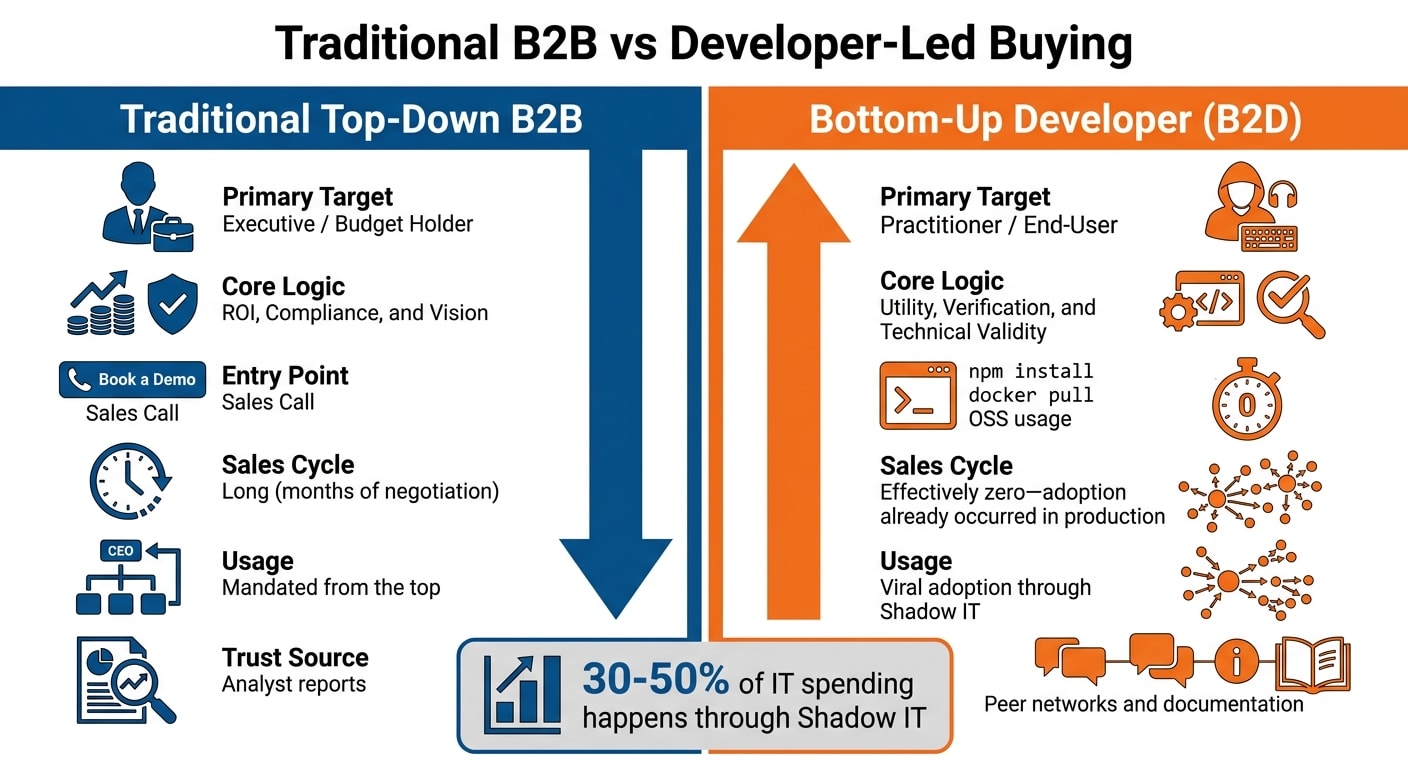
In the traditional B2B sales model, decisions flow from the top down - executives decide on tools, and teams follow suit. But when it comes to developers, this approach flips completely. It all starts with one engineer running a simple command like npm install or docker pull on their local machine. From there, the tool proves its worth directly in production.
Ninad Pathak, Founder of Pathak Ventures, sums this up perfectly:
The user adopts the tool in spite of their company's procurement process, proves it works, and then forces the company to buy it.
This bottom-up process often creates what’s referred to as the "Dark Funnel." Developers can use a tool for weeks - or even months - before the vendor is aware. By the time the procurement team steps in, the tool is often so embedded in workflows that replacing it would cost more than simply purchasing the enterprise license.
This journey unfolds in four key stages.
The 4 Stages of Developer Tool Adoption
The bottom-up buying process follows a clear progression, engaging different stakeholders at each stage. Each step strengthens the tool’s position within the company.
Stage 1: Infection (Individual Discovery)
It all begins when a developer encounters a technical challenge or error. They search for solutions - on Google, Stack Overflow, or GitHub - and stumble upon a tool. After a quick npm install or similar command, they test the tool locally, skipping demos or drawn-out sales calls entirely.
Stage 2: Incubation (Team Evaluation)
Once initial testing is successful, the tool gets committed to a feature branch. At this stage, peers review the pull request, ensuring the tool meets key criteria: active maintenance, compatibility with the build, and thorough documentation. If it clears these hurdles, the tool moves forward; if not, it’s discarded without much fanfare.
Stage 3: Outbreak (Manager Approval)
As the tool progresses to the main branch and enters production, other teams take notice. An engineering manager steps in to assess whether it fits seamlessly into existing processes, like Jira integrations or CI/CD pipelines. For smaller costs (around $500/month), approval often happens quickly via a corporate credit card, bypassing formal procurement.
Stage 4: Ransom (Procurement)
Eventually, as usage grows, the tool hits a limit - whether it’s an API cap, storage restriction, or compliance need like SSO or SOC2. At this point, the tool has become critical to operations. The CTO or VP steps in to sign an enterprise contract because removing the tool would disrupt workflows far more than upgrading the license.
Developer Buying vs Traditional B2B Sales
The differences between these two approaches couldn’t be more striking. Traditional B2B sales hinge on compliance and projections - executives make decisions based on ROI estimates and analyst recommendations. Developer-driven buying, on the other hand, relies on practicality and hands-on validation. Practitioners test tools in real environments, valuing peer feedback over vendor promises.
Here’s a side-by-side comparison of the two models:
| Feature | Traditional Top-Down B2B | Bottom-Up Developer (B2D) |
|---|---|---|
| Primary Target | Executive / Budget Holder | Practitioner / End-User |
| Core Logic | ROI, Compliance, and Vision | Utility, Verification, and Technical Validity |
| Entry Point | "Book a Demo" / Sales Call | npm install / docker pull / OSS usage |
| Sales Cycle | Long (months of negotiation) | Effectively zero - adoption already occurred in production |
| Usage | Mandated from the top | Viral adoption through Shadow IT |
| Trust Source | Analyst reports | Peer networks and documentation |
The bottom line? Traditional B2B sales require months of effort convincing executives to adopt a tool. In the developer-driven model, the tool is often already running in production before the vendor even gets involved. The focus shifts from convincing someone to use the tool to selling them on an upgrade.
Content That Earns Developer Trust
Developers don’t trust flashy sales pitches - they trust code, documentation, and data. When evaluating a B2B tool, engineers often bypass the homepage entirely, heading straight to the docs, GitHub repositories, or benchmark results. That’s why your documentation needs to act as your primary sales page. In fact, during the shortlisting process, 19.7% of developers prioritize high-quality documentation, while 23.7% want the ability to test the tool in their own environment . If your docs are hidden behind a "Book a Demo" button, you’ve likely already lost their interest.
The types of content that resonate most with developers fall into three main categories: technical comparisons backed by real performance data, open source contributions paired with clear pricing, and architecture case studies that detail real-world implementation. All of these focus on technical accuracy rather than marketing fluff. Ninad Pathak, Founder of Pathak Ventures, sums it up well:
Specific claims are verifiable. Verifiable claims build trust.
Let’s explore these three content types in detail.
Technical Comparisons and Performance Data
Developers are naturally skeptical of vague claims like "fast", "scalable", or "robust." What they want are specific, measurable results they can test themselves: metrics like "P99 latency < 10ms" or "starts in 50ms." These kinds of concrete numbers can be reproduced and validated, making them far more persuasive than generic marketing language.
To establish credibility, include benchmarks that highlight trade-offs. For example, if your database excels in read-heavy workloads but struggles with write-heavy ones, be upfront about it. Acknowledging limitations shows honesty and technical expertise. Developers understand that no tool is perfect for every scenario, and pretending otherwise can erode trust.
When presenting performance comparisons, go beyond a simple chart. Share the raw data, test environment specifications, methodology, and even the code used for benchmarks. This transparency allows engineers to verify your results themselves. With 96% of developers assuming company-written content is untrustworthy , openness is key to earning their confidence.
Open Source and Transparent Pricing
Beyond performance data, open source contributions can further establish trust. By open sourcing parts of your product - whether it’s the core tool, an SDK, or internal libraries - you give developers the chance to assess your technical capabilities firsthand. Companies like Supabase and Sentry have successfully used open source to build credibility and drive adoption.
Adam DuVander explains why this approach works:
A developer's job is to build software workflows. Their mental model is different from others. Instead of seeing a path to valuable information, they see the CRM or database where their data is headed. They reverse engineer your marketing automation and pull the ripcord.
Transparency also applies to pricing. If your pricing page says "Contact Sales", developers may assume you’re hiding something. Instead, provide clear details about API limits, usage-based pricing, and a free tier that allows for meaningful testing. Gating pricing behind a sales call doesn’t just create friction - it actively undermines trust. With only 4% of people believing marketing professionals act with integrity , clarity and accessibility are essential.
Architecture Case Studies
While performance data and pricing are important, real implementation stories show how your tool solves actual problems. Generic success stories won’t cut it - developers want detailed technical case studies that explore the "before" and "after" architecture, specific challenges, and how the tool addressed them. Think of these as post-mortem analyses rather than polished marketing pieces.
Effective case studies should include specifics like integration steps, timelines, trade-offs, and any problems encountered during deployment. This level of detail helps engineers assess whether the tool will fit into their infrastructure. Without these insights, they can’t make an informed decision.
Platforms like daily.dev offer an ideal way to share this content, presenting it alongside peer-written technical articles. Instead of interrupting developers with ads, you’re meeting them where they already engage - on GitHub discussions, Stack Overflow threads, and similar spaces. This approach leverages peer networks, which developers trust far more than vendor-created content , further reinforcing your credibility.
Where to Reach Developers
Traditional advertising doesn't resonate with developers. Over 60% of them use ad blockers , and they tend to tune out direct sales pitches. Instead, they gravitate toward spaces where they can learn, solve challenges, and stay updated.
Peer Networks and Internal Channels
Developers often discover tools through word-of-mouth in places like Slack workspaces, Discord servers, and niche forums. These private communities prioritize genuine interaction over blatant promotion. A recommendation from a respected Slack channel or a framework-specific Discord group can carry far more influence than any ad campaign. In fact, peer mentions account for 26% of developer awareness , making these networks a powerful channel for discovery.
However, you can't just dive in and start promoting your product. It’s crucial to spend 4–6 weeks actively participating - answering technical questions and providing real value - before even mentioning your tool . Developers are quick to spot self-promotion, and treating these communities as mere lead-generation platforms can get you shut out. Often, initial interest in a tool stems from informal internal discussions on platforms like Slack.
Now, let’s move to another space where developers naturally seek unbiased technical content.
Developer Content Feeds Like daily.dev
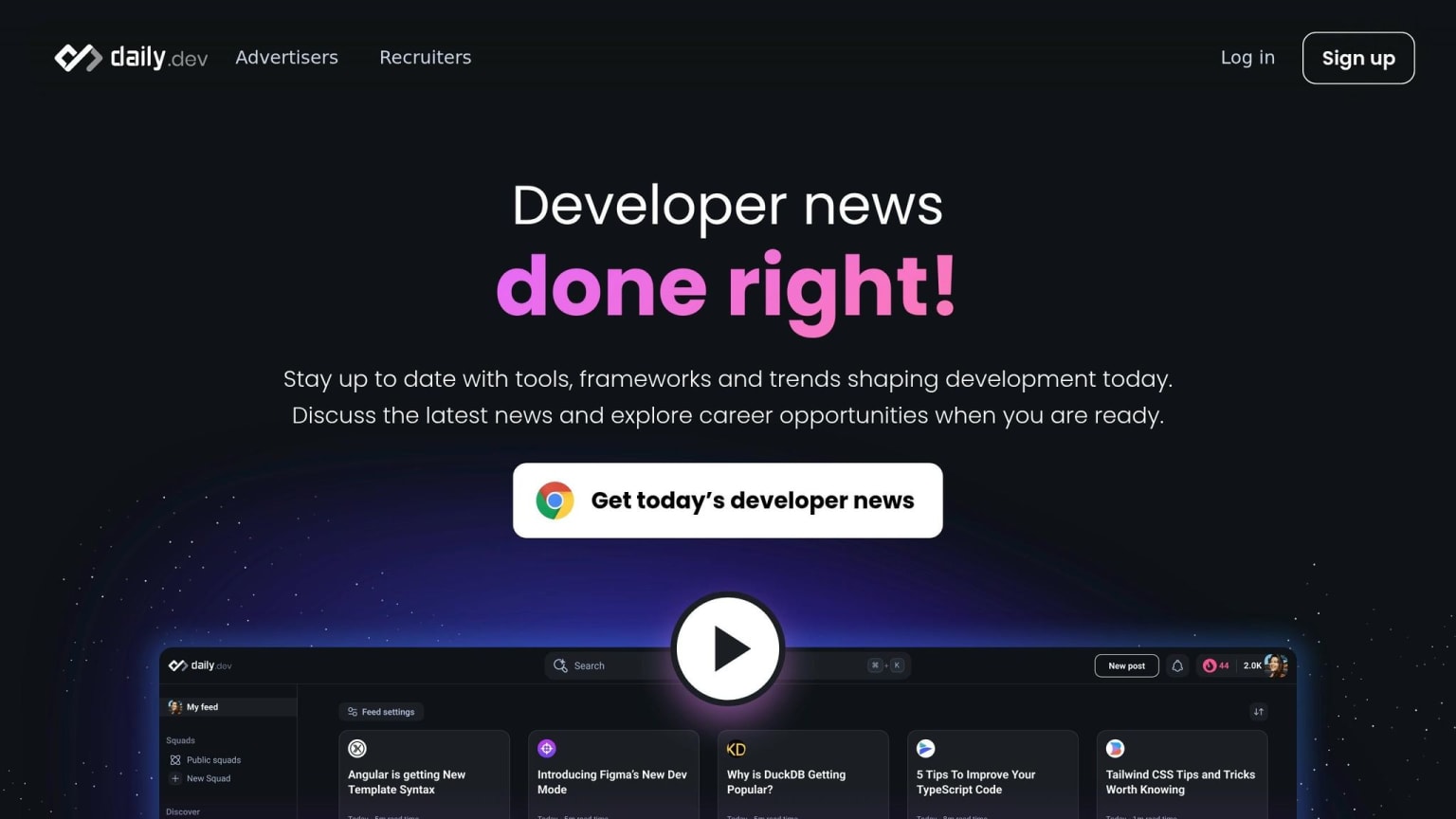
Developers prefer consuming technical content on their own terms, often through curated feeds, newsletters, and platforms delivering high-quality, relevant material. Platforms like daily.dev excel in this area, seamlessly integrating native ads into peer-authored technical content that aligns with their workflows.
Sponsoring newsletters in developer-focused publications can also be highly cost-effective. For example, cost-per-click rates range from $1.70 to $3 , significantly lower than the $5–$15 CPC typical of traditional paid search . A great case study: in April 2026, DigitalOcean partnered with Techpresso - a newsletter boasting 550,000 tech subscribers - and achieved over 1 million impressions at a $1.70 CPC through eight placements that felt informative rather than overly promotional .
Technical Conferences and Talks
In-person engagements offer another way to establish credibility. Speaking at developer events has a far greater impact than simply sponsoring a booth. Developers are more likely to trust individual engineers or founders than faceless corporate brands . A live-coding session, for instance, showcases your ability to solve real problems in real time, which builds trust because it’s observable and authentic.
While the return on investment from conferences might not be immediate, the long-term benefits are significant. Developers who see your expertise at these events may later consider your tool when making decisions. Additionally, with many developers gravitating toward video content, recorded conference talks can continue to provide value long after the event ends .
Preparing Sales Teams to Talk to Developers
Once you've laid the foundation for earning developer trust through content strategies, it's time to arm your sales team with a technical, no-nonsense approach. Forget the old B2B playbook - things like ROI slides, lengthy discovery calls, or buzzwords like "enterprise-grade" are instant turn-offs for developers. Why? Because they've been pitched too many overhyped and underdelivered solutions. It's no wonder only 4% of developers trust marketing professionals to act with integrity .
Adam DuVander sums it up perfectly:
A developer's job is to build software workflows... They reverse engineer your marketing automation and pull the ripcord .
Technical Knowledge Requirements
Your sales reps don’t need to be coders, but they do need enough technical knowledge to hold credible conversations. They should be able to explain how your product works, answer questions like "What are you building?" and point developers to relevant code samples . This means understanding your documentation inside and out.
The key is to ditch the fluff. Instead of saying, "Our platform is incredibly scalable and robust", they should dive into specifics: "Written in Rust, compiles to WASM, starts in 50ms" . Developers are trained to debug systems, and they’ll approach your sales pitch the same way - by looking for hard facts, not vague promises.
Another essential concept is the "trust ladder" developers climb: Code, Documentation, Community, and finally Brand . If your team tries to sell the brand before proving technical competence through code or documentation, they’ll lose every time. Sales conversations need to focus on helping developers solve real problems in their workflows, not pitching grand transformations.
Once your team demonstrates technical expertise, the next step is to provide hands-on demos that allow developers to verify your claims.
Hands-On Demos and POCs
Technical knowledge is just the starting point - actionable, hands-on demonstrations are where trust is built. Instead of relying on "Book a Demo" buttons, offer self-service demo environments. Developers hate gated demos; in fact, 73% will abandon a product if they can’t test it without signing up . Yacine Hmito, Head of Technology at Fabriq, puts it bluntly:
If I see 'Book a demo' or 'Talk to Sales,' I am out .
The goal is to get developers to a functional "hello world" demo in five minutes or less . They don’t want theoretical promises or ROI calculators - they want to see your tool solve a specific problem in their environment. One-click demo environments or video walkthroughs of the actual interface work far better than PowerPoint presentations.
Sales teams should only step in once a Product Qualified Lead (PQL) signal emerges, like a developer hitting 80% of a free-tier limit or inviting teammates to the platform . At this stage, the sales role shifts from "selling" to "assisting." Help developers tackle specific implementation challenges or API limits they’ve encountered while using the product . This approach aligns with the reality that 30% to 50% of IT spending now happens through Shadow IT , where developers test and adopt tools before procurement teams even get involved.
| Traditional B2B Demo | Developer-Centric POC |
|---|---|
| Slide decks and ROI calculators | Documentation and code samples |
| Gated by "Talk to Sales" | Self-serve / One-click |
| Vague claims (e.g., "World-changing") | Specific metrics (e.g., "P99 < 10ms") |
| Lead capture (MQL) | Time to first successful API call |
Finally, be upfront about your tool’s limitations. For example, saying, "We optimized for read-heavy workloads; if you’re write-heavy, use something else" shows honesty. Developers will respect your transparency and are far more likely to trust your team when you’re not overselling what your product can do.
Marketing to Enterprise vs Startup Developers
Once your sales team is prepared to engage technical audiences, it's crucial to adjust your approach based on the size of the company you're targeting.
Selling to startups is a completely different ballgame compared to selling to Fortune 500 engineering teams. For instance, startup developers often have the authority to approve purchases around $500/month without needing additional sign-offs . On the other hand, enterprise developers are just one piece of a much larger procurement puzzle, involving IT, legal, finance, and security teams.
Laura Erdem, Sales Lead at Dreamdata, highlights this distinction:
For enterprise - you don't just sell the product, you sell the value. They want to know who your other customers are and how they fit in with them... For startups - it's very product/features led .
This contrast underscores the importance of maintaining technical credibility while focusing on transparent, value-driven communication with developers.
Enterprise ROI vs Startup Speed
Startups prioritize speed - they need solutions that work right now. Your messaging should emphasize how quickly they can get started, often referred to as "Time to Hello World." If your homepage says "Book a Demo" instead of offering a quick-start guide, you may lose their interest before they even begin .
Enterprise developers, on the other hand, are more concerned with compliance and risk management. They look for features like SOC2, SSO, SAML, audit logs, and proof of vendor reliability . Even if a developer loves your tool, they often can't advocate for it internally without these enterprise-grade features. It's also worth noting that a significant portion of IT spending - 30% to 50% - happens through Shadow IT, where developers adopt tools informally and later push for official procurement once the tool proves its worth .
These differences in priorities also influence how you approach channels and sales cycles.
Channel Selection and Sales Cycles
Developer trust is built on genuine technical value, and your channel strategy needs to reflect that.
For startups, a Product-Led Growth (PLG) approach works best. Developers often discover tools on platforms like GitHub, Stack Overflow, or daily.dev. If your tool solves their problem and offers clear documentation, they're likely to sign up on the spot . Sponsoring newsletters in developer-focused publications can also be effective, with costs ranging from $1.70 to $3.00 per click .
For enterprise customers, the sales process is more complex, often taking 3–6 months . A sales-led strategy is essential, using Account-Based Marketing (ABM), outbound sales, and technical business development representatives (BDRs) to support intricate implementations. You'll need to prepare tailored presentations for multiple stakeholders across departments like marketing, finance, IT, and legal . Ultimately, the decision-maker isn't the developer who loves your tool - it’s the VP of Engineering or CTO who has to justify a contract worth $100,000 or more. This means shifting from a self-serve model to a sales-led approach that addresses the needs of various stakeholders.
Here’s a quick breakdown of the differences:
| Feature | Startup Developers | Enterprise Developers |
|---|---|---|
| Primary Value Prop | Speed of deployment | ROI, compliance, scalability |
| Sales Cycle | Days or weeks | 3–6 months |
| Decision Maker | CEO, Founder, Lead Dev | VP of Engineering, CTO, Procurement |
| Entry Point | Self-serve, free tier | Sales-led demos, POCs |
| Budget Approval | ~$500/month via credit card | $100k+ formal contracts |
The takeaway? Don’t let enterprise deals overshadow your self-serve funnel. As one SaaS analyst observed, long enterprise sales cycles can drain resources and leave your self-serve funnel underdeveloped . The most successful B2B developer tools focus first on bottom-up adoption and later add the enterprise features needed to attract larger organizations.
Metrics for B2B Developer Marketing
Traditional B2B metrics often miss the mark when it comes to measuring the unique dynamics of developer marketing. Metrics like whitepaper downloads or webinar sign-ups fail to reflect actual product adoption or developer advocacy. Instead, success hinges on tracking developer engagement - not just content consumption.
Developer-Qualified Leads and Pipeline
In developer marketing, Marketing-Qualified Leads (MQLs) lose their relevance. A PDF download doesn't equate to genuine interest. Instead, focus on Product-Qualified Leads (PQLs) or Developer-Qualified Leads (DQLs), which center on actual product interaction rather than marketing activities .
As Ninad Pathak points out, interest is only validated through product usage. DQLs are identified by factors like signups from technical domains (e.g., corporate email addresses) and key product milestones. For instance, strong signals include launching five or more instances, inviting three or more colleagues, or nearing 80% of a free-tier limit . When a developer starts diving into advanced features like SSO or compliance documentation, it often signals a shift from experimentation to enterprise consideration.
One critical metric is Time to Hello World - the time it takes a developer to make their first successful API call. If this process takes longer than five minutes, you risk losing their attention before they fully engage . Louis Corneloup, Founder at Dupple, highlights that the team invite rate is a key predictor of paid conversions . When developers bring colleagues into the platform, they've already bought into the product; they just need enterprise features to finalize the purchase.
By analyzing these product usage patterns, you can identify when developers are ready to deepen their engagement or transition into paying customers.
Product Usage and Expansion Revenue
Product behavior can also indicate which accounts are primed for expansion. For example, developers who read your changelog before signing up are twice as likely to convert to paid users compared to those who don’t . Similarly, engagement with documentation is a powerful signal - conversion rates from documentation visitors to free trials range between 3% and 8%, far outpacing typical paid traffic conversion rates .
Metrics like GitHub stars, NPM weekly installs, and package downloads serve as early indicators of developer interest. These "dark funnel" metrics often surface before any formal sales discussions take place . When developers start discussing your tool in Slack channels or on Stack Overflow, they’re already evaluating its potential.
Key triggers for expansion include team invites and approaching usage limits. For instance, when an account hits 80% of its free-tier limit, it’s the perfect moment to suggest a sales-assisted upgrade . While typical free-to-paid conversion rates for developer tools hover between 2% and 6%, accounts with team invites tend to convert at much higher rates. It’s worth noting that 30% to 50% of IT spending now happens through Shadow IT . Developers adopt tools independently, prove their value, and then push for company-wide adoption. To succeed, your metrics need to capture this grassroots motion rather than relying solely on traditional top-down sales approaches.
| Metric Category | Traditional B2B (MQL) | Developer Marketing (DQL/PQL) |
|---|---|---|
| Signal | Content consumption (webinars, PDFs) | Product usage (API calls, instances) |
| Metric | Cost Per Lead (CPL) | Time-to-Value / Activation Rate |
| Conversion Trigger | Sales follow-up | Hitting usage limits, team invites |
| Trust Signal | Analyst reports, Fortune 500 logos | GitHub stars, NPM installs, Discord activity |
Conclusion
B2B developer marketing isn't about flashy presentations or over-the-top promises. It's about earning trust through technical accuracy and demonstrating value in a way that resonates with developers. As Ninad Pathak aptly puts it:
Selling soft-skills software to a VP of Sales is a sociological challenge. Selling infrastructure to a Staff Engineer is a physics challenge .
Developers are meticulous. They test claims through code, explore documentation, and rely on hands-on experimentation to make decisions.
A successful strategy follows a clear sequence: Code, Documentation, Community, Brand . Skipping steps isn’t an option. Your API needs to work seamlessly. Your documentation should guide users to a "Hello World" moment in just minutes. Your community must offer genuine, helpful support - not prepackaged answers. Every interaction either builds trust or damages it. When this foundation is solid, you’ll naturally see meaningful product usage signals emerge.
These signals - like team invites and API calls - are key indicators of bottom-up adoption. In fact, between 30% and 50% of IT spending now originates through Shadow IT , where developers independently adopt tools and later drive their enterprise-wide implementation. Your marketing should embrace this bottom-up momentum rather than resist it.
Traditional B2B approaches - such as gated content, aggressive sales tactics, or vague promises - often alienate developers. As Adam DuVander explains:
A developer's job is to build software workflows... They reverse engineer your marketing automation and pull the ripcord .
Instead, focus on technical clarity, upfront pricing, and honest trade-offs. Be transparent about what your tool doesn’t do well. Share real benchmark data and provide working code examples - no email gatekeeping required.
Companies like Stripe, Vercel, and Supabase exemplify how technical rigor and clear documentation can win over developers. They understand that developers are staking their reputations on the tools they choose. Your role is to minimize that risk through verification, not amplify it with empty promises. Align every touchpoint - whether it's your code, documentation, or community - with the bottom-up approach that developers expect and trust.
FAQs
How can I generate PQLs without gating demos or docs?
One effective way to generate Product-Qualified Leads (PQLs) is by offering interactive demo platforms. These platforms let potential users experience the value of your product firsthand without jumping through technical hoops or dealing with restricted access.
By giving prospects the chance to explore your product directly, you can track their engagement and identify high-intent leads. Instead of relying on traditional methods like gated forms or lengthy qualification processes, this approach uses real product interaction data to pinpoint who’s most likely to convert.
What are the best PQL signals for a developer tool?
When it comes to identifying Product Qualified Leads (PQLs) for a developer tool, a few key behaviors stand out:
- Active product engagement: Regular use of the free tier is a strong indicator of interest. It shows that users are not just signing up but actively exploring what the tool offers.
- Completion of key actions: Actions like making API calls or adopting specific features signal that users are diving deeper into the product's functionality.
- Demonstrated technical proficiency: Contributions to open-source projects or meeting certain technical benchmarks can highlight users with the skills and interest to maximize the tool's potential.
These signals point to users who are not only engaged but likely to expand their use of the product over time.
How do I align sales with bottom-up developer adoption?
To connect sales strategies with a bottom-up developer adoption approach, start by empowering developers to explore and test your product on their own. This means offering self-serve options, free tiers, and clear, accessible documentation. Developers value independence, so providing these resources helps them get hands-on experience.
Build trust by sharing technical content, contributing to open-source projects, and being upfront with transparent data. Once developers see the value of your tool, shift your sales focus to supporting their internal evaluations. This can include offering proof of concepts, demo environments, and demonstrating technical credibility. These efforts help secure buy-in across the organization and pave the way for broader adoption.