

Developers don’t trust ads or buzzwords - they trust products they can test.
Value Summary:
Marketing to developers is unlike traditional B2B marketing. Developers prefer hands-on experiences, clear documentation, and tools that solve their problems without sales pitches. To succeed, focus on these steps:
- Awareness: Use newsletters, open-source tools, and platforms like Discord or GitHub to reach developers. Avoid traditional ads - they block them.
- Consideration: Provide detailed, runnable documentation and tutorials. Developers value technical resources over flashy campaigns.
- Conversion: Simplify onboarding with free tiers, instant sandboxes, and multi-language SDKs. Highlight measurable results to help developers advocate for your tool.
Quick Overview:
- Key Metrics: Documentation engagement, Time to First Value (TTFV), and Product Qualified Leads (PQLs) predict conversions.
- Effective Channels: In-IDE ads, developer newsletters, and native platforms like daily.dev outperform traditional ads.
- PLG Strategy: Developers decide based on product experience. A "hello world" moment within 5 minutes is critical.
Bridge:
Let’s break down how to craft a developer marketing strategy that works, from awareness to conversion.
Full Funnel Developer Marketing Strategy
Developer marketing hinges on a three-stage funnel that aligns with how technical audiences discover, evaluate, and adopt tools. Each stage requires a tailored approach because traditional B2B marketing methods often fail to resonate with developers.
Awareness Stage: Building Trust with Developers
To connect with developers, you need to meet them where they already are - on platforms they trust. Traditional ads don’t cut it here; over 60% of developers block programmatic display ads . Instead, focus on channels that developers actively engage with.
Developer-focused newsletters, for example, are a cost-effective way to reach this audience. Take Techpresso: it has 550,000 subscribers, with 30% working in engineering roles . DigitalOcean leveraged this platform by running eight newsletter placements, generating over 1 million impressions at a $1.70 cost-per-click. For reference, a primary ad spot in Techpresso costs $3,500 and typically drives 400–1,000 clicks .
Open-source tools are another key strategy. Companies like Supabase and LangChain use open-source libraries and SDKs to encourage developers to experiment with their offerings, creating a low-risk entry point that can lead to paid adoption.
Developer Relations (DevRel) teams are pivotal in this stage, acting as a bridge between the product and the community. Instead of relying on traditional sales outreach, these teams focus on publishing tutorials, engaging on platforms like Stack Overflow and Discord, and collaborating with influential developers. As Louis Corneloup from Dupple explains:
"Developers aggressively block ads, ignore cold outreach, and evaluate tools hands-on before talking to sales" .
Platforms like daily.dev also offer high-intent opportunities. With over 1 million developers using the platform, businesses can place native ads that blend seamlessly into technical content, targeting users by seniority, programming language, or specific tools.
When communicating with developers, avoid buzzwords like "enterprise-grade" or "revolutionary." Instead, focus on clear, functional messaging that speaks to their technical needs.
Consideration Stage: Providing Technical Resources
Once developers are aware of your product, they’ll dig deeper to see if it solves their specific challenges. At this stage, technical resources - especially documentation - are your most powerful tools. In fact, documentation is the top factor in developer adoption .
Companies like Stripe, Linear, and Vercel have set the bar by treating documentation as a marketing asset. Their guides include runnable code samples and are designed to get developers up and running quickly. The "15-minute rule" is critical: a "Getting Started" guide should enable developers to achieve a basic implementation in under 15 minutes . And every code example? It should be tested and hosted on platforms like GitHub or CodeSandbox.
As Averi puts it:
"A working code example beats 500 words of explanation" .
Tutorials should go beyond simple API calls. Show developers how to build real features using your tools, providing prerequisites, step-by-step instructions, and full source code. Engineering deep-dives and post-mortems can further establish credibility by showcasing problem-solving skills and transparency.
Honesty matters here. Decision guides that objectively compare your product to others can help developers make informed choices. Metrics like documentation page views often correlate directly with sales pipeline activity , emphasizing the importance of this stage.
Finally, treat your documentation like a product. Update it before releasing new features, audit pages with high "Was this helpful? No" votes, and involve developer advocates to create authentic, community-driven tutorials.
Conversion Stage: Driving Adoption and Growth
By the time developers reach the conversion stage, they’ve likely validated your product’s technical merits. Now, your job is to remove any remaining friction and make adoption as seamless as possible.
A product-led growth (PLG) model with a free tier is the go-to strategy. Developers prefer to test tools in low-risk environments before fully committing. Instant sandbox accounts, automated API key generation, and interactive documentation that allows for real-time testing can significantly improve the onboarding experience.
Multi-language SDKs tailored to your audience’s preferred programming languages reduce integration barriers even further. And while developers are the primary users, decision-makers like senior executives often have the final say. This is where case studies come in. Balance technical specifics with measurable business outcomes like ROI, time savings, or performance benchmarks to help developers advocate for your product internally. Independent security audits and penetration test results can also build trust.
Products that integrate seamlessly into existing workflows - whether through IDEs, CLIs, or platforms like GitHub and Slack - tend to see higher adoption rates. Additionally, listing your product on review platforms like G2, StackShare, and Product Hunt can provide verified feedback that reassures potential users during their transition from consideration to conversion.
Developer Marketing Channels and Cost Analysis
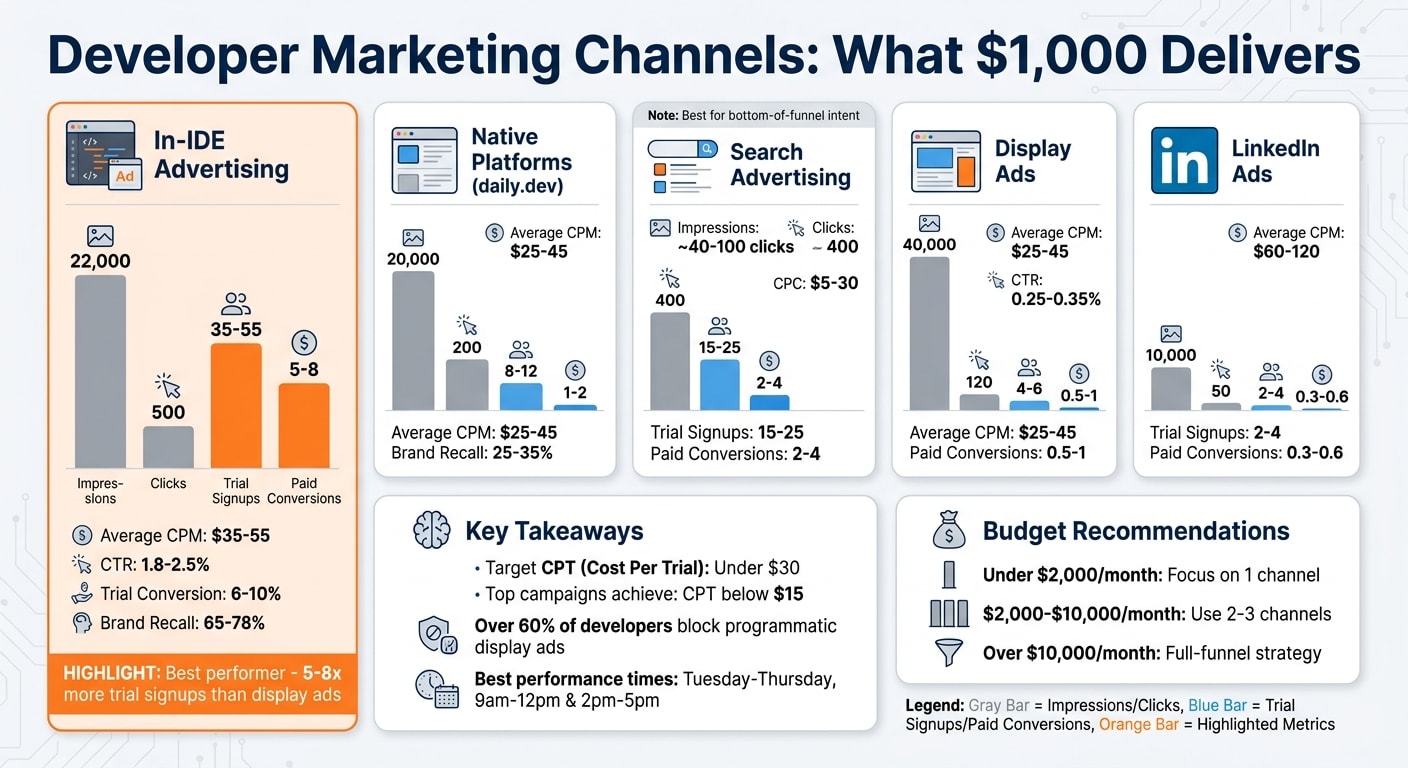
Channel Overview and Targeting Options
When marketing to developers, it’s crucial to focus on the platforms they already use. Each channel serves a specific role in the marketing funnel, helping you allocate resources effectively.
In-IDE advertising integrates seamlessly into developers’ workflows by appearing in widely-used IDEs like Visual Studio Code and JetBrains. These ads reach developers while they’re actively coding, making them contextually relevant. A major bonus? They bypass the 67% of developers who use ad-blockers .
Other effective options include native content platforms and search advertising. Native platforms, such as daily.dev, allow you to advertise with daily.dev within technical content feeds, reaching over 1 million developers. These platforms let you target by seniority, programming language, or tools, ensuring your ads resonate with developers during their learning moments.
Search advertising is perfect for capturing bottom-of-funnel intent. Developers searching for terms like "developer tools" or specific alternatives are actively looking for solutions. However, this precision comes at a cost - expect to pay $15–30 per click . Meanwhile, LinkedIn Ads provide access to decision-makers and senior engineers, though with a CPM ranging from $60 to $120 .
For budgeting, here’s a quick guide:
- Under $2,000/month: Focus on a single channel.
- $2,000–$10,000/month: Spread your budget across two or three channels.
- Over $10,000/month: Invest in a full-funnel strategy .
Below, we’ll dive into the cost metrics and performance benchmarks for these channels.
Cost Comparison and Expected CAC Ranges
Understanding the cost and performance of each channel is critical for maximizing trial signups and conversions. The table below breaks down what $1,000 in ad spend typically delivers across various channels :
| Channel | Impressions | Clicks | Trial Signups | Paid Conversions | Average CPM |
|---|---|---|---|---|---|
| In-IDE | 22,000 | 500 | 35–55 | 5–8 | $35–55 |
| Native (e.g., daily.dev) | 20,000 | 200 | 8–12 | 1–2 | $25–45 |
| Search | ~40–100 clicks | 400 | 15–25 | 2–4 | $5–30 CPC |
| Display | 40,000 | 120 | 4–6 | 0.5–1 | $25–45 |
| 10,000 | 50 | 2–4 | 0.3–0.6 | $60–120 |
In-IDE advertising stands out with 5–8x more trial signups per dollar compared to display ads . Its click-through rate (CTR) of 1.8–2.5% and trial conversion rate of 6–10% far surpass display ads, which average a 0.25–0.35% CTR .
For cost-per-trial (CPT), aim for under $30, with top-performing campaigns achieving CPTs below $15 . Native platforms like daily.dev strike a middle ground between display ads and LinkedIn Ads, making them a solid choice for awareness campaigns. In terms of brand recall, in-IDE ads achieve 65–78%, significantly higher than the 25–35% seen with native ads .
Performance also varies based on the audience. DevOps and SRE professionals, for instance, show higher engagement - averaging a 2.5% CTR and an 11% trial rate. Mobile developers, on the other hand, see a 1.7% CTR and a 6% trial rate . If your product caters to specific tech stacks, consider prioritizing languages like Rust (135 CTR index) or Go (125 CTR index) .
For the best results, schedule campaigns from Tuesday to Thursday, between 9 am–12 pm and 2 pm–5 pm local time. Avoid peak holiday seasons in December and major tech conference weeks, as engagement tends to drop during these periods .
Metrics and KPIs for Developer Marketing Campaigns
Technical Engagement KPIs
Measuring developer engagement requires a different approach compared to traditional B2B marketing. Instead of focusing on metrics like email opens or form submissions, developer marketing relies on product-specific indicators that reflect genuine technical interest.
One key metric is documentation engagement, which often predicts conversion success. For instance, Stripe found that developers who interact with at least five unique documentation pages during their first session are 340% more likely to convert than those who view just one page . To get a clearer picture of engagement, track actions like scroll depth and code copy events, not just page views .
Another critical measure is Time to First Value (TTFV), which shows how quickly developers achieve their first meaningful interaction - like an API call, deployment, or completing a "Hello World" example. Vercel has streamlined its deployment process, enabling developers to reach this milestone in under 60 seconds . For freemium products, a TTFV under 15 minutes is ideal to minimize drop-offs . Benchmarks vary depending on the tool: authentication libraries should aim for 5–15 minutes, framework integrations for 15–45 minutes, and infrastructure tools for 45–90 minutes .
Product Qualified Leads (PQLs) are another vital metric, identifying users who hit specific technical milestones. For example, Datadog considers a PQL to be a user who sends at least 100 monitoring events and remains active for more than seven days. This approach has yielded a 22% PQL-to-paid conversion rate, with PQLs converting 3–5x more effectively than traditional Marketing Qualified Leads (MQLs), as they are based on actual product usage .
Community engagement also plays a role. MongoDB discovered that developers who answer at least one community question within their first 90 days show 65% higher retention and 40% greater usage expansion . Metrics like GitHub stars, Stack Overflow mentions, and community-created tutorials serve as strong indicators of organic advocacy.
These technical KPIs provide a foundation for understanding how developer interactions contribute to larger business goals.
Business Impact Metrics
While technical engagement is essential, connecting these metrics to business outcomes is the ultimate goal. One way to do this is by analyzing trial-to-paid conversion rates. Developer tools typically outperform general SaaS products, with a median trial-to-paid conversion rate of 17%, compared to the 9% SaaS average . PQLs often convert to customers at rates between 15–30% .
Customer Acquisition Cost (CAC) is another important metric. For developer-focused products, CAC includes costs like documentation and community management. For small to medium-sized businesses, CAC generally falls between $200–$800 . Postman improved their CAC accuracy by 40% using a custom attribution model that tracks developer interactions across API documentation, shared collections, and team invites .
Net Dollar Retention (NDR) is a key indicator of a product's long-term success. Unlike traditional SaaS products that rely on seat-based pricing, developer tools often grow through usage-based models - such as increased API calls or data processing. On average, developer tools achieve 110–130% NDR, as usage tends to expand with project growth .
Attribution remains a challenge in developer marketing, as 52% of discovery happens through "dark social" channels like private Slack or Discord groups . To address this, combine server-side tracking (e.g., API calls, product telemetry) with self-reported attribution during signups. Adding a free-text field like "How did you hear about us?" can capture insights from podcasts, peer recommendations, and private communities . Since many developers use ad-blockers, server-side tracking through authenticated API calls is often more reliable than client-side pixels .
"You treat it [developer marketing] as a product and measure ROI at a program level. You optimize activities within the programs but don't report ROI on them." – Jakub Czakon, CMO, Neptune.ai
Lastly, focus on activation rates to gauge product-market fit. A healthy developer activation rate falls between 20–40%, serving as a benchmark for effective onboarding . Instead of traditional Monthly Active Users (MAU), track Monthly Active Developers (MAD) to account for the project-based nature of developer workflows .
Conclusion
Marketing to B2B developers requires a completely different playbook compared to traditional enterprise software approaches. Developers are known to block ads, dismiss cold outreach, and prefer hands-on evaluation of tools long before engaging with a sales team.
Given these preferences, adopting a Product-Led Growth (PLG) approach becomes essential. This strategy hinges on providing exceptional documentation and fostering active Developer Relations.
"Documentation is the highest-converting marketing asset." – Louis Corneloup, Founder at Dupple
To create an effective funnel, focus on technical milestones rather than standard marketing metrics. For example, aim to guide developers to a "hello world" moment within five minutes of using your product. Track key indicators like time-to-first-API-call, team invite rates, and engagement with documentation - these metrics often serve as strong predictors of paid conversions.
Once you've optimized technical engagement, the next step is choosing the right distribution channels. Prioritize platforms and communities where developers naturally spend their time. For example:
- Developer-centric newsletters and podcasts: Engineering newsletters and niche podcasts deliver excellent reach. Sponsorships in tech-focused newsletters like Techpresso can achieve click-through costs of $1.70 to $3.00 CPC - often five to ten times more cost-effective than LinkedIn ads .
- Native placements in trusted ecosystems: Platforms like daily.dev allow you to reach over 1 million developers who are actively consuming technical content, making them ideal for awareness-stage campaigns targeting high-intent audiences.
Leading companies like Stripe, Vercel, and Supabase set the standard for developer marketing by focusing on what developers value most: eliminating unnecessary friction, avoiding over-the-top marketing, and letting the product shine through clear documentation and self-serve experiences. By aligning your strategy with how developers naturally discover, evaluate, and adopt tools, you can build a scalable growth engine tailored to this technical audience.
FAQs
What’s the fastest way to prove value to skeptical developers?
The best way to win over skeptical developers? Give them practical, hands-on resources they can actually use. Think detailed documentation, functional code examples, and relatable real-world use cases. These tools not only highlight clear benefits but also build trust by addressing what developers care about most: solving real problems efficiently.
Which KPIs best predict paid conversion in B2B developer marketing?
When it comes to forecasting paid conversions in B2B developer marketing, certain metrics stand out as essential predictors.
Developer engagement metrics are among the most important. These include things like how often developers make API calls, the number of documentation views, SDK downloads, and sandbox sign-ups. These behaviors show how actively developers are interacting with your tools and resources.
On top of that, product usage indicators play a big role. Metrics like feature activation rates and onboarding completion help paint a picture of how effectively users are adopting and engaging with your product. Together, these metrics provide valuable insights into conversion potential.
How much budget do I need to run a full-funnel developer marketing plan?
When planning a full-funnel developer marketing strategy, your budget will largely depend on the channels you choose and the overall scope of your efforts. To create an effective plan, you’ll need to allocate funds to areas like content creation, community engagement, and targeted campaigns.
Typically, costs can range from a few thousand dollars to tens of thousands per month. This investment should cover all three funnel stages: awareness, consideration, and conversion. The exact amount will vary depending on your specific goals and the approach you take.