

Open source marketing in 2026 is about letting your project shine through its code and community. Developers trust what they can see, test, and contribute to, making transparency and community-driven engagement essential. Here's what you need to know:
- GitHub is your storefront: Your README acts as your landing page, and your community is your sales team.
- AI is reshaping discovery: Tools like GitHub Copilot rely on documentation, while platforms like YouTube and daily.dev are critical for visibility.
- Community is key: Building a welcoming, active community drives adoption and contributions.
- Documentation matters: Clear, actionable documentation is often more effective than ads for attracting users.
- Paid ads can accelerate growth: Platforms like daily.dev allow targeted campaigns to reach developers effectively.
This guide dives into strategies like optimizing GitHub, creating engaging documentation, and balancing organic growth with paid efforts to grow your open source project. Whether you're starting or scaling, these tactics can help you connect with developers and build a thriving community.
Building and Growing Your Open Source Community
Your community is the driving force behind the success of an open source project. Think of it as a funnel: visitors become users, users evolve into contributors, and contributors eventually step up as maintainers. The key is to make the transition at every stage as seamless as possible . This approach lays the groundwork for actionable steps to attract, onboard, and retain contributors.
Start by treating your README file like a landing page. It should grab attention with a hero GIF showcasing your project in action, include a one-sentence value statement, and provide a quick-start guide that actually works on the first try. Add a CONTRIBUTING.md file to outline how people can get involved, and use labels like "good first issue" to guide newcomers toward easy wins . Since documentation is often a potential contributor's first experience with your project, clarity and accessibility here are non-negotiable .
Responding promptly is another critical factor for building loyalty. Contributors who receive code reviews within 48 hours are far more likely to return and contribute again . Acknowledge every issue within 24 hours, even if it’s just to say, “We’re looking into this.” Quick, thoughtful responses create an active and welcoming community hub.
Creating a Welcoming Community Culture
Establishing the right culture begins with setting clear expectations. One of the simplest yet most impactful steps is adopting a Code of Conduct early on. As Fred Schott, co-creator of Astro, explains:
"If you care about outside contributions at all, you should have a code of conduct, regardless of size. It's more about intent."
Choose your communication tools wisely. Start with GitHub Discussions for feature requests and Q&A - it’s publicly indexed and searchable, making it easy for others to find answers. When your community grows to 100+ active users, consider adding Discord or Slack for real-time interactions . Public channels help prevent burnout by reducing the volume of private messages while fostering connections between community members.
Recognition also plays a big role in keeping contributors engaged. Publicly thank contributors in your README, maintain an AUTHORS file, or even create a LinkedIn company page for your project. Chrissy LeMaire, creator of dbatools, took this approach, enabling contributors to list their work on their professional profiles, which even helped some land new jobs . Similarly, the Astro team expanded their maintainer base by updating their core contributor requirements to include roles like documentation and community support .
Onboarding and Retaining Contributors
First impressions matter. A smooth onboarding experience can turn a one-time contributor into a long-term participant. Make sure setup instructions are foolproof and work without a hitch. Use clear issue labels, and instead of fixing simple bugs yourself, leverage them as mentorship opportunities to bring in new contributors .
The team behind AFFiNE offers a great example of personalized engagement. After hitting an initial milestone, then-COO Iris Wei shifted from broad promotion to individual outreach. She invited users who exchanged five or more messages to a 30-minute call. Coupled with weekly releases and a 24-hour response time for issues, this personal touch turned casual users into dedicated contributors .
To further empower contributors, consider transferring ownership. Moving your project to a GitHub Organization can enhance collaboration, while listing frequent contributors in a CONTRIBUTORS file or granting commit access to trusted members can foster a sense of shared responsibility . This sense of ownership often transforms casual participants into long-term maintainers.
Once contributors are onboarded, keeping them engaged is essential for sustained growth.
Maintaining Engagement Over Time
Boosting retention by even 5% can have a bigger impact than a 20% increase in new signups . Regular engagement is the key to keeping your community active and invested. One effective strategy is maintaining a consistent release schedule - weekly or bi-weekly updates work well for most projects. Each release is an opportunity to celebrate progress and recognize contributors.
Hosting bi-weekly office hours can also be a game-changer. These sessions provide newcomers with real-time support for pull requests and a chance to discuss new features . Additionally, tools like F5bot can help you monitor mentions of your project on social media, allowing you to join conversations where they’re already happening .
Another idea is running "Launch Weeks", where you unveil major features daily over the course of a week. Supabase used this approach to great effect, growing to a $5 billion valuation by October 2025 with a community of 430,000+ developers and 1,500+ contributors . These events not only generate buzz but also strengthen community ties.
Leading by example can also make a huge difference. Chrissy LeMaire livestreamed her development process on Twitch, openly sharing her struggles and mistakes. This transparency made the project feel more approachable and encouraged others to contribute. As she put it:
"I show people that it's OK not to know everything and that they don't have to use the most intimidating or complicated tools to be effective."
Ultimately, managing a community in 2026 is less about writing code and more about fostering relationships . Be patient with new users, assume good intentions, and create opportunities for non-code contributions like documentation or community support. Every contributor who shares your project helps amplify its reach, turning your community into your most powerful marketing tool.
Optimizing GitHub for Maximum Visibility
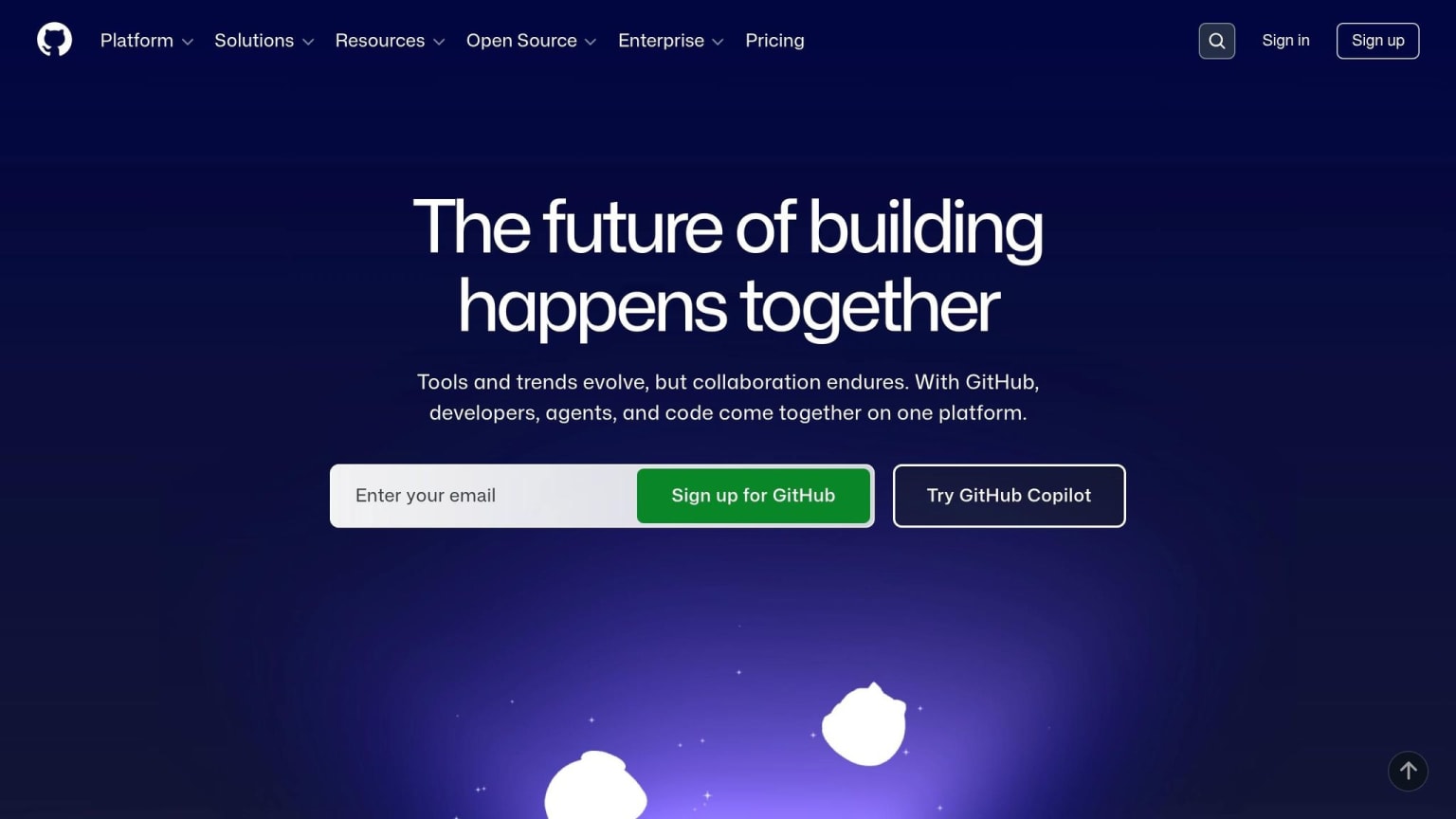
Your GitHub repository is just one among 420 million others vying for attention . The key to standing out lies in making your project easy to discover and understand. If developers can’t quickly grasp what your project offers and why it matters, they’ll move on without a second thought.
Improving Your README and Documentation
Your README is the heart of your repository. As Iris, former COO of AFFiNE, explains:
"Your README is the first thing developers see. If it doesn't answer 'what is this, and why should I care?' in 10 seconds, you've lost them" .
Think of your README as a landing page, not just a technical document. A cluttered or overly technical README can drive away 90% of potential visitors . To make it effective, follow this structure:
- Start with a one-sentence value proposition. Be clear and concise.
- Add a hero GIF or screenshot. Show your project in action right away.
- Explain the problem your project solves. Provide context for why it’s useful.
- Include a quick-start guide. Offer ready-to-use code snippets that developers can copy and paste.
- Highlight key features in bullet points. Make it easy to scan.
- Link to additional resources. Include documentation, FAQs, and community forums.
AFFiNE used this exact approach in 2022, gaining 6,000 stars in their first week and 10,000 stars in just 43 days. Their project even appeared on GitHub Trending 28 times in five months .
Developers are always looking for quick, functional solutions. Postiz founder Nevo scaled his social media scheduling tool to $17,000 in monthly recurring revenue and 5 million downloads by treating his GitHub repository as a marketing tool . Include badges for build status, license, and star count at the top of your README. A simple call-to-action like "⭐ If this is useful, a star helps others find it" can significantly boost your star count .
Don’t forget about your social preview card - the image that appears when your repository link is shared on platforms like Twitter or LinkedIn. A well-designed preview card improves click-through rates . Position your project with phrases like "Open source alternative to [Popular Tool]" to give instant context and appeal .
Using GitHub Features for Growth
GitHub offers several built-in tools to help your project grow. Here’s how to make the most of them:
- Optimize for search. Use relevant keywords in your repository’s "About" section and add one-word GitHub Topics to cover more search terms .
- Leverage GitHub Discussions. Use this feature for Q&A, feature requests, and user showcases. Unlike platforms like Slack or Discord, Discussions are searchable and indexed, making them a valuable resource for future users .
- Implement GitHub Actions. These workflows signal that your project is actively maintained and reliable. They can also include templates and integration examples, which help developers see immediate value .
- Enable GitHub Sponsors. This feature demonstrates community support and project sustainability .
- Tag issues properly. Labels like "good first issue" or "help wanted" make it easier for newcomers to contribute, turning passive followers into active participants .
By using these features strategically, you can boost your repository’s visibility and credibility.
Growing Your GitHub Stars
Star velocity - the speed at which your repository gains stars - is critical for appearing on GitHub’s Trending page. For example, gaining 200 stars in a single day is far more impactful than spreading those stars out over a month . To hit the "All Languages" Trending page, you’ll typically need about 100 stars per day, while language-specific trending pages (e.g., TypeScript or Python) often require just 30–50 stars per day .
Timing is everything. Concentrate your promotional efforts within a 48-hour window to maximize impact. AFFiNE did this by coordinating launches on Reddit, Hacker News, and Product Hunt, earning 10,000 stars in 43 days and appearing on GitHub Trending 28 times . On Reddit, tailoring posts to specific developer communities can lead to a 5–8% star conversion rate, while a strong Product Hunt launch can drive 200–600 stars .
ScrapeGraphAI, for example, reached over 20,000 stars by addressing a specific developer pain point: web scraping dynamic content. Founder Marco Vinciguerra spent 70% of his time helping the community solve general scraping problems and 30% promoting his tool. His advice?
"Your README is probably the most important file in your repo... People star projects they understand and trust" .
Beyond launch strategies, focus on creating long-term discovery channels. Submit pull requests to curated "awesome-*" repositories to gain backlinks and consistent traffic . Tools that generate branded pull requests, like security updates, can expose your project to other developers within their workflows . Lastly, maintain good issue hygiene - acknowledge all issues within 24 hours. Quick response times build trust and encourage adoption .
While stars are a great indicator of interest, they’re not the same as actual usage. Measure true adoption through metrics like downloads, active installations, or API calls. The real goal is to turn those stars into active users and contributors, building a thriving community around your project.
Documentation as a Marketing Tool
In the world of open source projects, documentation isn’t just a necessity - it’s one of the most effective ways to market your product. For developer tools especially, great documentation often drives more signups and adoption than traditional advertising ever could . Why? Because developers judge your project by how well your docs help them solve real problems, not by flashy marketing copy.
A solid "Getting Started" guide can make or break a first impression. Developers should be able to go from zero to a working implementation in 15 minutes or less . If they can’t get a "hello world" up and running in five minutes, or complete a meaningful task with their own data in 30 minutes, you risk losing their interest. It’s all about keeping things efficient and friction-free.
Creating Developer-Focused Documentation
Think of documentation as part of your product, not an afterthought. This means investing in features like search functionality, clear navigation, and versioning . Tools like Sphinx, MkDocs, or ReadTheDocs can help you create professional, user-friendly documentation .
By 2026, your documentation will need to serve two audiences: human developers and AI coding assistants. With over 60% of developers using ad blockers , your docs become the primary way they discover your project organically. At the same time, AI tools like GitHub Copilot rely on documentation to recommend projects. To ensure your project gets noticed, implement llms.txt files and provide markdown versions of your docs so AI assistants can accurately index them . As Prashant Sridharan, a developer marketing expert, puts it:
"The shift from marketing-first to documentation-first is perhaps the most important trend in developer marketing. Your docs are where developers spend their time. They're what AI assistants pull from to help developers" .
Make sure your examples are practical. Replace pseudocode with real, copy-pasteable code snippets that developers can test immediately. The team at Resend famously spent three weeks perfecting their website and README for every week they spent on the library itself . They understood that documentation isn’t just support material - it’s a driver of growth.
Here’s a breakdown of the five key types of documentation to include:
| Documentation Type | Purpose | Target Timeline |
|---|---|---|
| Getting Started Guide | Zero to working implementation | ≤15 minutes |
| API/SDK Reference | Complete endpoint references with examples | Ongoing reference |
| Concept Guides | Explains architecture and mental models | For deeper understanding |
| Tutorials | End-to-end guides for real-world scenarios | 30–60 minutes |
| Troubleshooting/FAQ | Solutions to common errors | Immediate resolution |
Regularly update your documentation to keep it fresh. Conduct monthly audits of pages with negative feedback and make updates after every product release . Turn support tickets into opportunities to improve your FAQ and troubleshooting sections.
Using Documentation to Attract Users
Good documentation builds trust, and trust drives conversions. Developers trust technical documentation far more than they trust marketing copy, ranking it just below peer recommendations in the trust hierarchy .
Optimize your docs for the kinds of technical searches developers are making. For example, queries like "postgres connection pooling node.js" are long-tail keywords that attract users actively looking for solutions. These users are often ready to adopt a new tool if it solves their problem.
Interactive examples are another game-changer. Instead of basic samples, provide guides that help developers accomplish real tasks. Troubleshooting sections that address common errors can also reduce support requests and build confidence in your project.
The typical conversion rate from free open-source users to paid customers ranges from 0.5% to 3% , with developer tools sometimes hitting 2% to 6% . The quality of your documentation plays a huge role in determining where your project falls within that range.
Examples of Effective Documentation
Supabase is a great example of how contributor-focused documentation can strengthen community engagement. Their "SupaSquad" program clearly outlines pathways for contributors like Maintainers, Experts, and Advocates, leading to 71% of pull requests coming from external contributors. They even achieved a median review turnaround time of just three hours . This success stems from treating documentation as a product, making it easy for developers to contribute.
Vercel, on the other hand, built their growth on interactive examples and detailed documentation. Their docs guide developers step-by-step, showing exactly how to deploy projects with copy-pasteable commands and real-world examples. This approach reduced time-to-first-value and turned readers into active users .
Both companies treat documentation as a growth engine, not a cost. They focus on making their docs searchable, easy to navigate, and actionable. By regularly testing their "Getting Started" guides and measuring engagement, they ensure their documentation aligns with developer needs. After all, where developers spend their time is where they make adoption decisions.
These strategies align seamlessly with broader community and GitHub practices, creating a unified and effective framework for open source marketing.
Using Paid Advertising to Accelerate Growth
Organic growth is a cornerstone of open source marketing, but it can take time to build momentum. Paid advertising offers a way to speed things up, working alongside organic strategies to expand your reach.
The Role of Paid Marketing in OSS Growth
Most open source projects don’t need paid ads to earn their first GitHub stars. But if you’re running an open-core business or offering managed hosting, targeted campaigns can connect you with enterprise buyers and decision-makers who prioritize outcomes over code . These ads are especially effective for developers looking for solutions to specific challenges like security compliance, managed infrastructure, or dedicated support.
However, traditional B2B marketing tactics often miss the mark with developers. LinkedIn Ads, cold emails, and gated PDFs tend to be dismissed as irrelevant . Instead, focus on channels developers trust, such as sponsorships in developer-focused newsletters and platforms where engineers spend their time. As Louis Corneloup, Founder at Dupple, explains:
"Generic B2B marketing tactics - LinkedIn Ads, cold email, gated PDFs - fail with developers" .
Typically, the conversion rate from free open-source users to paying customers falls between 0.5% and 3% . Paid campaigns can help push that number higher by targeting users who are already interested in enterprise-level features like SOC 2 compliance, audit logs, or dedicated support . A great example is Cal.com (formerly Calendso), which scaled to millions in ARR by shifting its marketing from "open source scheduling" to three clear outcomes: independence for small teams, control for enterprises, and embeddable scheduling for builders .
Next, let’s explore how daily.dev Ads effectively targets and engages developers.
Reaching Developers with daily.dev Ads
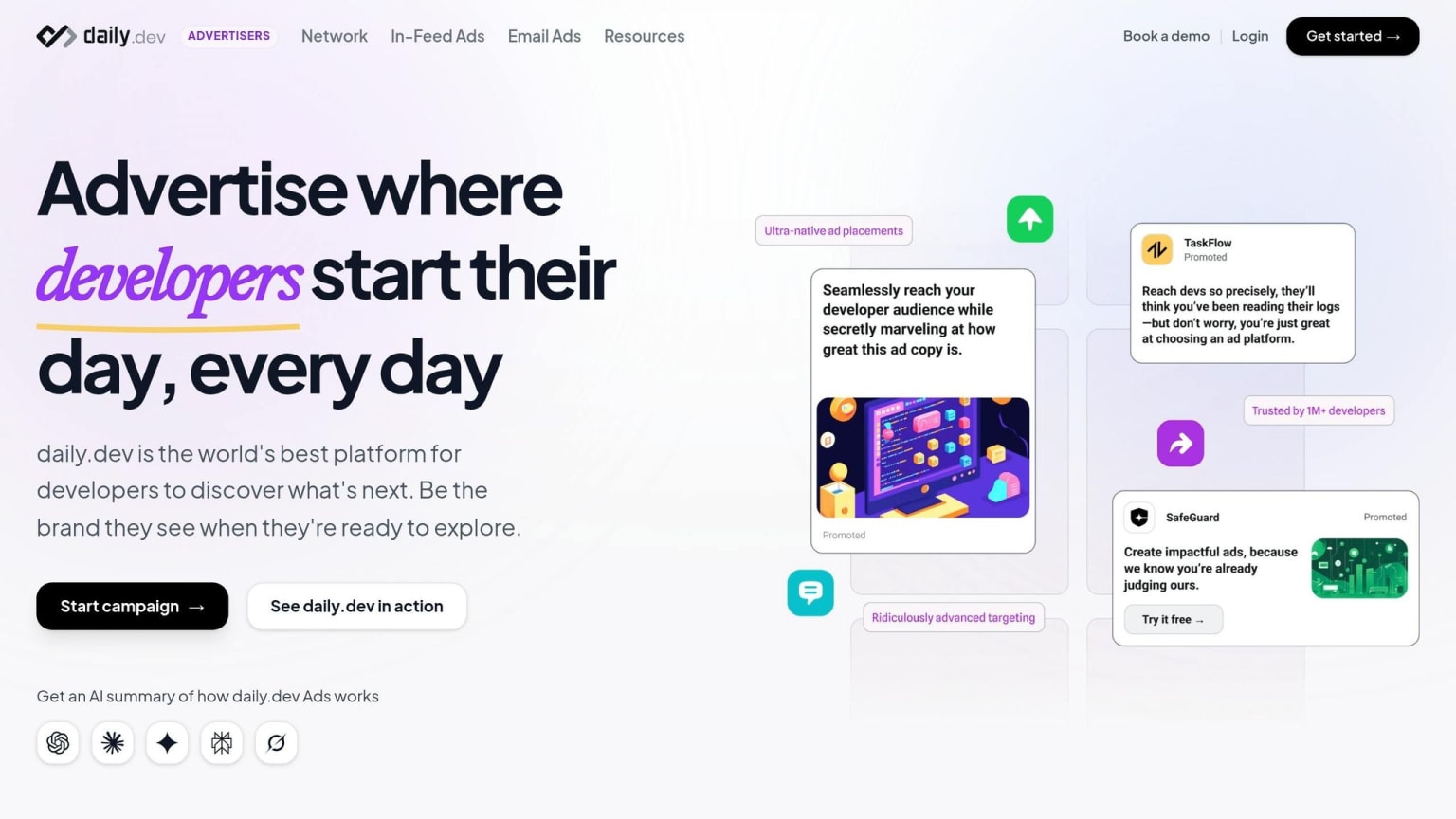
daily.dev Ads offers a direct line to over 1 million developers through native placements that integrate seamlessly into their workflow . The platform provides three ad formats: in-feed, post-page, and email digest ads. Each format allows precise targeting based on programming language, developer role, and tools.
What sets daily.dev apart is its precision. For instance, if you’re promoting a Postgres extension, you can target developers working with databases. If you’re launching a React component library, you can focus on front-end engineers. This level of specificity ensures your ads reach the right audience.
These native ads blend into the developer experience, a critical factor given that over 60% of developers use ad blockers . While traditional display ads may be filtered out, native placements on trusted platforms like daily.dev are visible. For example, in April 2026, DigitalOcean ran a campaign on Techpresso with 4 Primary and 4 Spotlight Ads, achieving over 1,000,000 impressions at a $1.70 CPC while targeting developers and indie founders .
When crafting ad copy, avoid buzzwords like "seamless" or "enterprise-grade." Instead, use a tone that resonates with developers. Highlight technical benefits, include real code snippets, and link to resources like tutorials, benchmarks, or architecture guides rather than generic landing pages .
Measuring ROI of Paid Campaigns
To make the most of your paid campaigns, it’s essential to measure ROI and align your efforts with growth goals. Go beyond GitHub stars by tracking metrics like impressions, click-through rates (CTR), and conversion steps. While you can start with manual tracking, aim to automate data collection as patterns emerge .
For example, a monitoring tool might measure success through integrations with incident response systems, while a data pipeline could track the first automated job running in production.
Developer-focused newsletter ads generally achieve a CPC between $1.70 and $3 . From there, monitor key milestones: how many users complete your "Getting Started" guide (ideally within 15 minutes), deploy to production, and eventually convert to paid plans.
Set up a simple funnel to track user progress: ad impression → click → README view → "Hello World" completion (0–5 minutes) → first self-driven task (5–30 minutes) → production deployment (3–7 days) → sales conversation .
To amplify results, coordinate paid campaigns with organic launches on platforms like Hacker News or Reddit. This can generate a surge in traffic that triggers GitHub’s trending algorithm, which factors in star velocity . By combining paid and organic strategies, you can create a multiplier effect where your ad spend boosts organic reach. These insights complement earlier strategies on community building and GitHub optimization, forming a well-rounded approach to open source growth.
Case Studies: Successful Open Source Marketing
Real-world examples show how open source projects can grow into thriving businesses with the right strategies. Supabase and Vercel provide two distinct approaches that highlight the power of community engagement, documentation, and targeted outreach.
Supabase: Community-Driven Growth
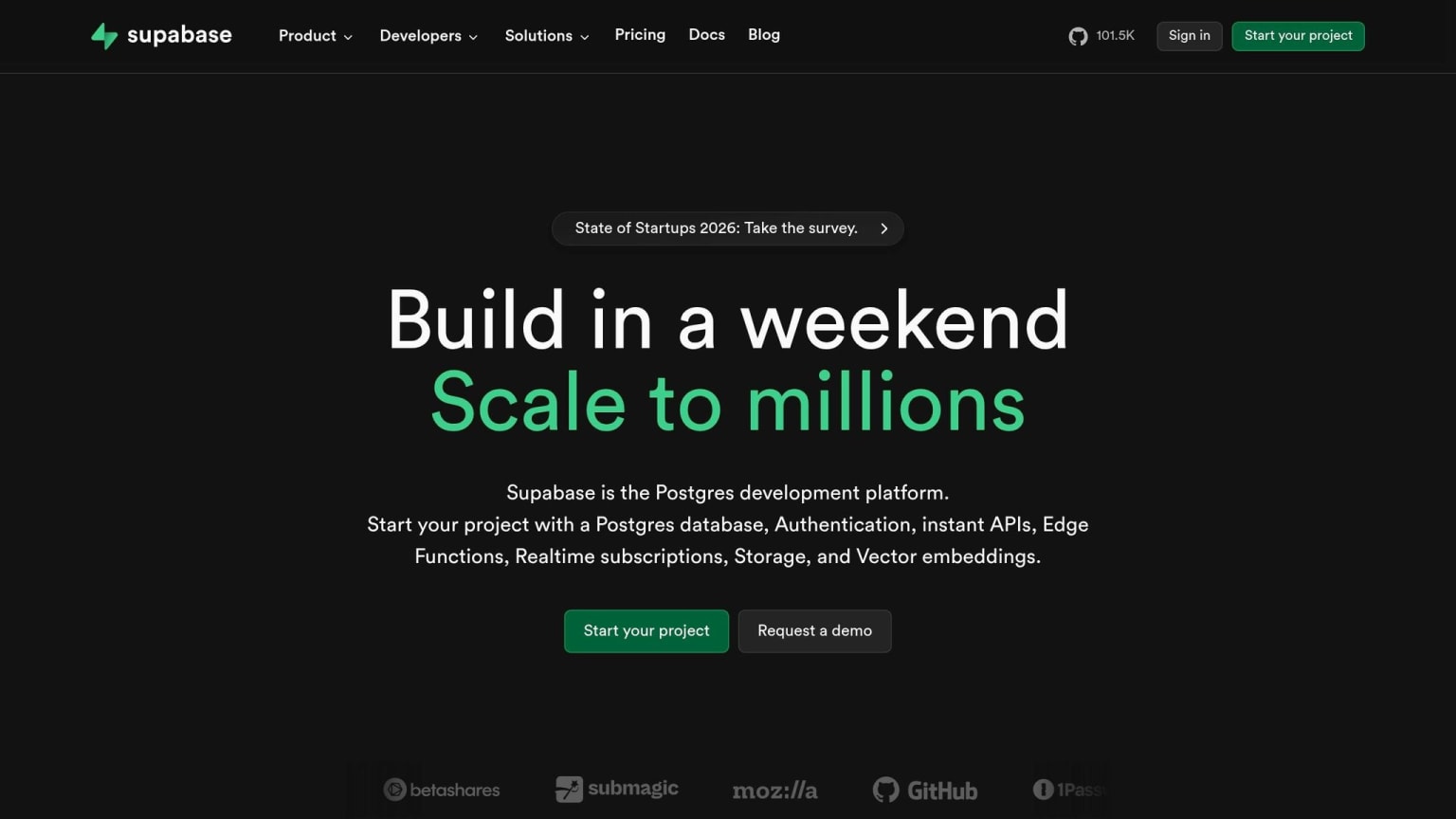
Supabase positioned itself as a direct open source alternative to Firebase, making it easy for developers to instantly grasp its purpose and value . This clear messaging helped the platform expand its user base from 1 million to 4.5 million developers in under a year by October 2025 . Today, it powers millions of databases globally and has earned over 70,000 GitHub stars .
One of Supabase's standout strategies is its "Launch Weeks." These are week-long events held every 3–4 months, where the team unveils a new feature each day. Rory Wilding, Head of Growth at Supabase, explains the impact:
"Launch weeks have been great for both aligning the team and getting traction within the community" .
This approach keeps the community engaged and excited between major updates.
In its early days, Supabase adopted a hands-on approach to growth. Wilding personally reached out to over 3,000 developers on GitHub to gather feedback on what they liked and disliked . This manual effort laid the groundwork for their success. They also focused on a key onboarding metric - database creation - which naturally encouraged users to explore other features like Auth, Storage, and Realtime .
The results are impressive: 55% of the latest Y Combinator batch and more than 1,000 YC companies now rely on Supabase for their backend needs . Their Discord community has grown to over 200,000 members, and user-generated content outpaces company-created content at a 10:1 ratio . This momentum culminated in a $5 billion Series E funding announcement in late 2025 .
Supabase also tailored its approach to serve two distinct user groups: developers familiar with Postgres (focusing on reliability and extensions) and newcomers to databases (providing simplicity and tutorials) . As Aaron Cort, Operating Partner at Craft Ventures, puts it:
"Authenticity and open-source ethos aren't marketing fluff in developer markets - they are the moat" .
While Supabase thrives on its community-first approach, Vercel takes a different path, emphasizing top-notch documentation and targeted paid efforts.
Vercel: Scaling Through Documentation and Ads
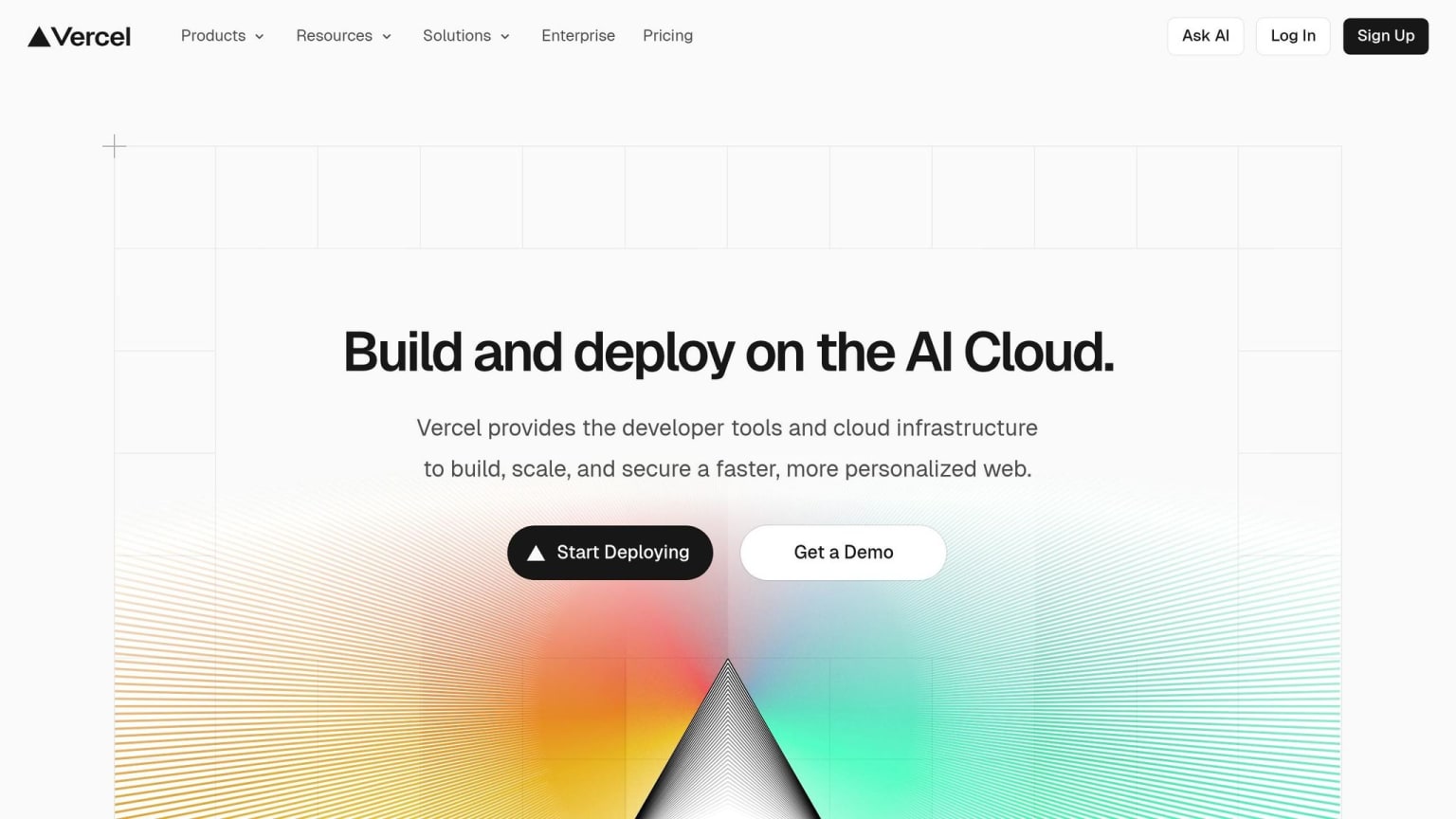
Vercel showcases how exceptional documentation can double as a marketing powerhouse. By leveraging Next.js, they built early interest before monetizing their platform. Addressing core technical challenges allowed them to connect with developers directly at the "terminal" level, long before deploying traditional marketing tactics . Today, Next.js boasts over 120,000 GitHub stars and has been a key driver of Vercel's $2.5 billion-plus valuation .
For Vercel, documentation isn't just a resource - it’s their most effective marketing tool . The Next.js documentation is interactive and packed with runnable examples, designed to lead users straight to signups. Louis Corneloup, Founder at Dupple, highlights this:
"Documentation is the highest-converting marketing asset. Clear docs with runnable examples produce more signups than any ad" .
Vercel’s Product-Led Growth strategy centers on a "wow" moment: users can connect their Git repository and deploy a live site to a global CDN in under a minute . This seamless onboarding experience eliminates friction, letting the product sell itself.
When it comes to paid marketing, Vercel avoids generic channels like LinkedIn or display ads, which over 60% of developers block . Instead, they focus on trusted developer spaces, sponsoring newsletters like JavaScript Weekly and Bytes, and hosting events like Next.js Conf . These targeted efforts yield better results, with newsletter sponsorships achieving a cost-per-click (CPC) of $1.70 to $3.00 - much lower than traditional B2B advertising .
Vercel also stays active on platforms like GitHub, Discord, and Twitter, using direct engagement to turn users into advocates . This balanced approach of community interaction and precise paid marketing creates a growth engine that scales both organically and through targeted amplification.
These case studies highlight a common theme: combining community building, clear documentation, and strategic paid outreach is key to driving open source growth. As Wilding aptly puts it:
"Without a solid product that solves a need for people, it's pretty hard to grow anything" .
Creating Your Open Source Marketing Strategy
When it comes to marketing open source projects, the approach differs significantly from traditional software. As Iris Wei, former COO of AFFiNE, explains:
"Open source marketing is fundamentally different from traditional marketing. The product IS the marketing. GitHub is your storefront, README is your landing page, community is your sales team" .
This section builds on earlier discussions about community and GitHub strategies, showing how these components come together to form a complete marketing plan.
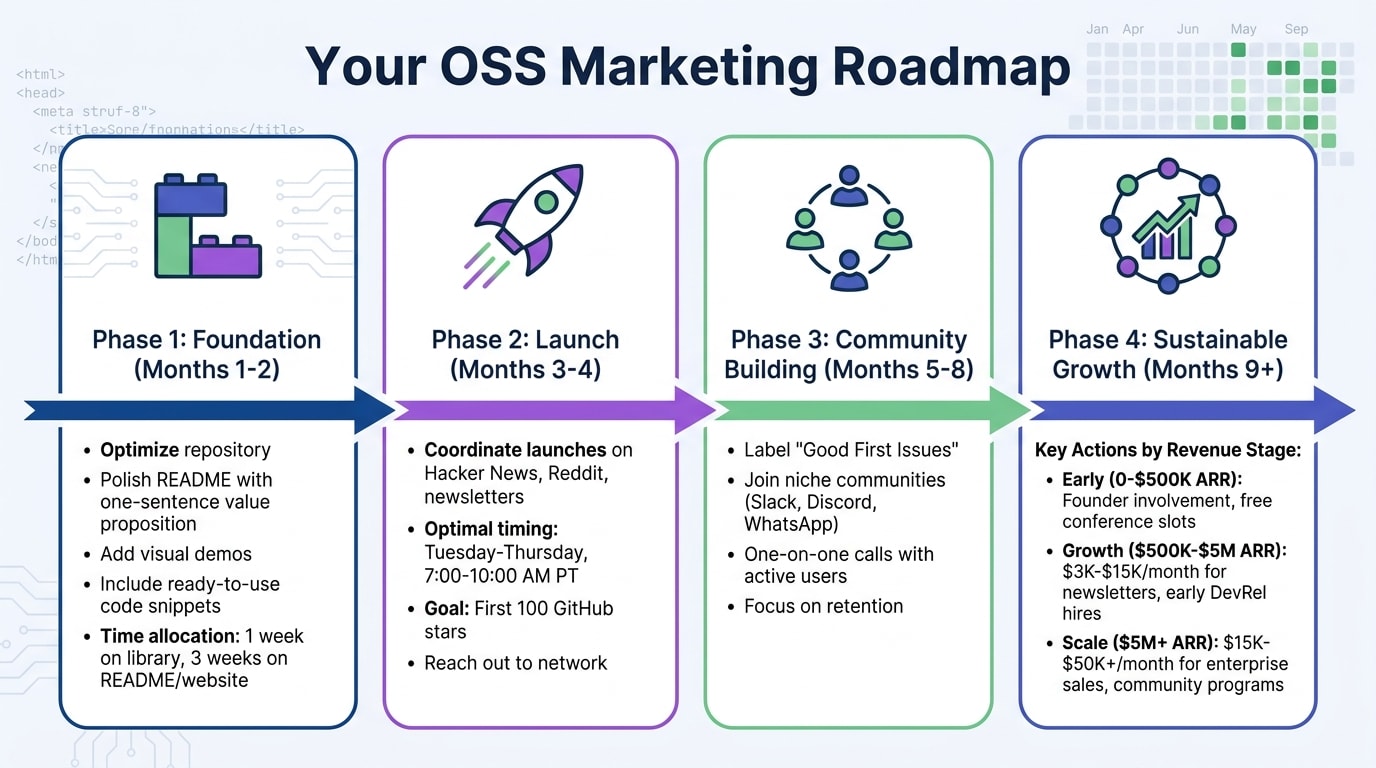
Your OSS Marketing Roadmap
An effective marketing strategy for open source projects unfolds in four key phases, each building on the groundwork laid in documentation, community interaction, and GitHub optimization.
Foundation (Months 1–2): Start by optimizing your repository. Focus on crafting a polished README that clearly communicates your project's value in one sentence, features visual demos, and includes ready-to-use code snippets. Dedicate one week to refining the library and three weeks to improving the README and website .
Launch (Months 3–4): Create initial visibility by coordinating launches on platforms like Hacker News, Reddit, and newsletters. Timing is critical - submit to Hacker News between Tuesday and Thursday, 7:00–10:00 a.m. PT, to maximize exposure . Aim to secure your first 100 GitHub stars by reaching out to friends, colleagues, and others in your network .
Community Building (Months 5–8): Shift your focus to retention. Label tasks as "Good First Issues" to make it easier for newcomers to contribute . Join niche communities on Slack, Discord, or WhatsApp where developers gather . Take the time to connect directly with active users through one-on-one calls to understand their needs - this personal approach often leads to better early monetization compared to automated onboarding .
Sustainable Growth (Months 9+): Integrate your project into the broader ecosystem. Allocate resources based on your revenue stage:
- Early stage (0–$500K ARR): Prioritize founder involvement and secure free speaking slots at conferences.
- Growth stage ($500K–$5M ARR): Budget $3,000–$15,000 per month for newsletter sponsorships and early DevRel hires.
- Scale stage ($5M+ ARR): Invest $15,000–$50,000+ per month in enterprise sales teams and community programs .
With this roadmap in place, the next step is finding the right balance between organic community efforts and targeted paid marketing.
| Metric | Organic Efforts (Community) | Paid Efforts (Ads/Sponsorships) |
|---|---|---|
| Primary Goal | Build trust and credibility | Drive immediate reach and awareness |
| ROI Timeline | Long-term (Months to Years) | Short-term (Days to Weeks) |
| Cost | High time investment, low capital | Low time investment, high capital |
| Developer Trust | High (peer-driven) | Medium to low (ads often face skepticism) |
| Key Channels | GitHub, Reddit, Discord, Hacker News | Newsletters, Ethical Ads, Carbon Ads |
Balancing Organic and Paid Efforts
Organic efforts form the foundation of your strategy, while paid marketing can help amplify your reach. As Louis Corneloup, founder of Dupple, highlights:
"For devtools, docs produce more pipeline than the marketing site" .
Your documentation should include runnable examples that lead directly to signups. Once your project reaches $500K–$5M ARR, consider adding paid campaigns. Avoid traditional display ads since over 60% of developers use ad blockers . Instead, focus on developer-focused newsletters, where ads often achieve a cost-per-click (CPC) of $1.70–$3.00 . For example, DigitalOcean used Techpresso's newsletter to generate over 1 million impressions at a $1.70 CPC .
Platforms like daily.dev offer another effective option, reaching over 1 million developers through native ads that blend seamlessly into their daily content. These ads can be filtered by programming language, tools, and developer seniority to ensure your project reaches the right audience without triggering skepticism.
Coordination is essential. When AFFiNE launched between August and December 2022, they achieved over 60,000 GitHub stars and appeared on GitHub Trending 28 times. This success was driven by organic strategies that preserved data integrity for VC evaluations, ultimately helping them secure over $10M in funding .
Measuring and Improving Over Time
To refine your strategy, track progress using these four categories of metrics:
- Awareness: GitHub stars, repository traffic, and social mentions.
- Engagement: Issues, pull requests, and daily/monthly active users on Discord or Slack.
- Adoption: Downloads, Docker pulls, and weekly active users.
- ROI/Commercial: Conversion rates to paid plans, expansion MRR, and churn rate .
While GitHub stars can boost early credibility, they don’t necessarily reflect active usage. As Iris Wei notes:
"Stars are a launchpad, not a destination. After you've validated that developers find your project interesting, the next job is figuring out which developers, and why" .
Analyzing the geographic distribution of stars can help verify organic growth during VC evaluations. Other key metrics include "time-to-first-contribution" to assess community health, stargazer overlap to identify potential users, and the speed of issue resolution. Retention should be tracked by cohort (30/90/365 days) rather than overall totals to evaluate the impact of recent marketing changes.
Conversion rates from free users to paid customers typically range from 0.5% to 3% . A successful Hacker News launch can drive 10,000 to 100,000 repository visits . For instance, AFFiNE gained 10,000 GitHub stars in just 43 days through well-coordinated organic efforts . Use these benchmarks to gauge your progress and fine-tune your approach quarterly, focusing on metrics that reflect real adoption rather than vanity numbers.
Conclusion
Marketing an open source project in 2026 demands a shift from traditional software promotion strategies. Iris, former COO of AFFiNE, captures this perfectly:
"Open source marketing is fundamentally different from traditional marketing. The product IS the marketing. GitHub is your storefront, README is your landing page, community is your sales team."
The key to success lies in blending organic community engagement with targeted paid strategies. Start by refining your README - it should function like a high-performing landing page. Include a punchy one-line value proposition, clear visuals, and easy-to-follow quick-start instructions . Foster trust by creating educational content that follows the 80/20 rule: focus 80% of your efforts on problem-solving tutorials and 20% on promotional material . In an era where AI has made code more accessible, your brand and distribution channels set you apart .
Once your foundation is set, track meaningful metrics to evaluate your progress. Focus on actionable data like Weekly Active Users, contributor growth, and conversion rates (typically between 0.5% and 3%) . Avoid getting distracted by vanity metrics, such as total GitHub stars. Use this data to fine-tune your approach quarterly, ensuring your project continues to meet developers' needs.
When it’s time to scale, platforms like daily.dev Ads offer a powerful way to grow. They enable you to reach over 1 million developers through targeted, native placements. These campaigns are tailored to technical audiences - filtering by programming language, seniority, and preferred tools - without the hard-sell tactics that often alienate developers.
FAQs
What’s the fastest way to get my first 100 GitHub stars?
To get your first 100 GitHub stars, focus on how you present and promote your repository. Start by making sure your repository is well-organized. This means having a clear description, an engaging README file, and solid documentation that makes your project easy to understand.
Once your repository is polished, actively promote it. Share your project on platforms like Hacker News, Reddit, and social media. Time your launch carefully - coordinate posts across different channels to maximize visibility. Join relevant communities, interact with others, and invite early contributions. These steps can help you build momentum and attract those all-important stars.
What OSS metrics matter most beyond stars?
While star counts on repositories can grab attention, they only scratch the surface when evaluating open source projects. To truly understand a project's vitality, you need to look at contributor activity, project health signals, and adoption indicators.
Contributor activity - like pull requests, commits, and issue triage - offers a window into how actively the project is maintained and how engaged the community is. It’s a clear sign of ongoing development and collaboration.
Project health signals provide insights into the project's stability and operational readiness. These include factors like CI/CD status, how quickly issues are resolved, and the presence of security advisories.
Lastly, adoption indicators - such as download counts, usage in other projects, and community involvement - shed light on how widely the project is used and embraced by others.
When combined, these metrics give a well-rounded view of a project's overall health and growth trajectory.
When should I start using paid ads for an open source project?
When you're ready to dive into paid ads, make sure your project is built on a solid foundation. That means having a well-maintained repository, clear and accessible documentation, and an active, engaged community. Paid ads are most effective when used to amplify your growth beyond organic channels, especially if you already have a clear value proposition, a growing user base, and evidence of demand.
Start small with targeted campaigns. This allows you to test your messaging and refine your approach. The goal is to ensure that paid ads enhance your organic growth strategy rather than replace it. By aligning both efforts, you'll maximize your reach and impact.