

If you're marketing developer tools, the choice between demand generation and lead generation is critical. Here's the quick breakdown:
- Demand Generation: Focuses on building awareness and trust with developers who aren’t actively searching for tools (95% of the market). It’s a long-term play (6–24 months) that uses ungated content like blogs, open-source projects, and tutorials. Success is measured by branded search volume, community engagement, and technical credibility. You can find more expert insights on developer marketing to refine these metrics.
- Lead Generation: Targets developers actively evaluating tools (5% of the market). It’s a short-term strategy (0–90 days) using tactics like targeted developer campaigns, demo requests, and gated content. Metrics include cost per lead (CPL), MQL/SQL volume, and conversion rates.
Key Insight: Developers often avoid traditional lead gen tactics (e.g., gated content, cold outreach) and prefer self-service resources like documentation and code samples. To win their trust, demand gen must come first.
Quick Comparison
| Feature | Demand Generation | Lead Generation |
|---|---|---|
| Goal | Build awareness & trust | Capture buyer intent |
| Audience | 95% not actively buying | 5% actively evaluating |
| Content | Ungated (blogs, docs, open-source) | Gated (demos, whitepapers) |
| Timeline | Long-term (6–24 months) | Short-term (0–90 days) |
| Metrics | Branded search, community trust | CPL, MQL/SQL volume, pipeline |
| Developer View | Educational, low-friction | Often seen as intrusive |
Takeaway: Start with demand gen to build trust and awareness, then integrate lead gen when developers show intent. This ensures your brand is on their radar when they’re ready to buy.
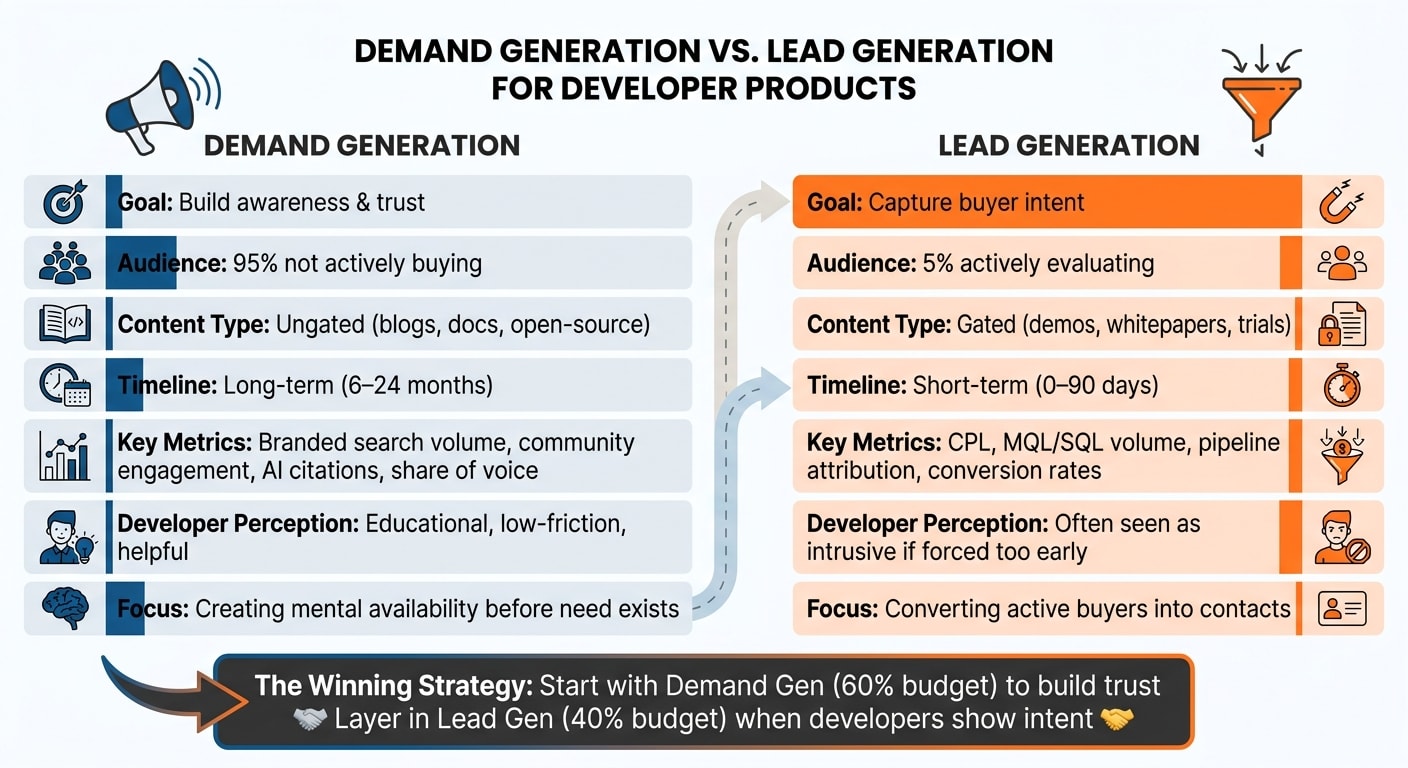
Demand Gen vs Lead Gen: What's the Difference for Developer Products
The difference between demand generation and lead generation boils down to timing and intent. Demand generation focuses on creating awareness among the 95% of developers who aren’t actively searching for tools right now . On the other hand, lead generation targets the 5% who are already looking and ready to evaluate options .
For developer products, this distinction carries extra weight compared to traditional B2B marketing. Developers often research tools months in advance, bookmarking documentation and forming mental shortlists well before budget discussions even start. If your brand isn’t already in their consideration set, you’ve likely lost the opportunity before it even begins.
Let’s break down each approach further.
What is Demand Generation?
Demand generation is all about building awareness and trust before developers have a specific need. It’s about showing up in the spaces where developers naturally spend their time - whether that’s through publishing tutorials, contributing to open source projects, answering questions on forums, or speaking at conferences. Importantly, the content here is ungated to ensure maximum reach and accessibility.
"Demand generation creates the conditions for pipeline. It doesn't produce pipeline directly."
– Dan Pollack, AgencyReview
This strategy focuses on building “mental availability” over a longer timeframe, typically 6–24 months. Success is measured by metrics like branded search volume, community share of voice, and how often your brand is cited in AI-generated content .
What is Lead Generation?
Lead generation, in contrast, is a short-term strategy aimed at capturing buyer intent and converting it into contact information. This might involve demo request forms, gated whitepapers, free trial signups, or webinar registrations. It’s designed to target developers who are actively evaluating solutions, with a typical timeline of 0–90 days from the first touch to pipeline .
The metrics for lead generation are more immediate and straightforward: cost per lead (CPL), the number of marketing qualified leads (MQLs) and sales qualified leads (SQLs), and the percentage of leads that convert into pipeline and revenue .
| Feature | Demand Generation | Lead Generation |
|---|---|---|
| Primary Goal | Build awareness and trust | Capture contact info and intent |
| Target Audience | The 95% not actively buying | The 5% actively in-market |
| Content Type | Ungated blogs, docs, podcasts, community posts | Gated ebooks, demos, trials, webinars |
| Timeline | Long-term (6–24 months) | Short-term (0–90 days) |
| Key Metrics | Branded search, AI citations, share of voice | CPL, MQL/SQL volume, pipeline attribution |
| Developer View | Helpful, educational, low-friction | Intrusive if forced too early |
Why Demand Generation Comes First
One common misstep for developer tool companies is diving straight into lead generation without first establishing demand. As Peter Korpak from 100Signals puts it:
"You can't capture demand that doesn't exist. If a CTO has never encountered your agency's name... no amount of email sequencing will create urgency" .
For developer products, demand generation isn’t just a nice-to-have - it’s the groundwork that makes lead generation effective. While lead generation delivers faster results, it lacks the broad trust and credibility that demand generation builds within the developer community.
Why Traditional Lead Gen Doesn't Work with Developers
Let’s dive into why the usual lead generation tactics often fall flat when it comes to developers. Developers have a unique way of thinking - they’re natural problem-solvers who excel at breaking down and understanding systems. This mindset allows them to quickly see through traditional marketing funnels. As Adam DuVander, Founder of EveryDeveloper, puts it:
"A developer's job is to build software workflows. Their mental model is different from others. Instead of seeing a path to valuable information, they see the CRM or database where their data is headed. They reverse engineer your marketing automation and pull the ripcord."
In the world of developer products, where trust and self-service are everything, traditional tactics like gated content often backfire. Let’s take a closer look at why this happens.
Developers Avoid Gated Content
For developers, putting technical guides or whitepapers behind a form isn’t an invitation to learn - it’s a red flag. They know what comes next: a flood of emails or a sales call they didn’t ask for . To avoid this, many developers turn to burner emails or fake phone numbers to bypass the gate, which might boost MQL (Marketing Qualified Lead) numbers but does nothing to create real sales opportunities .
The skepticism runs deep. Only 4% of people trust content written by companies , and developers are even harder to convince. They prefer open access to practical resources like documentation, code samples, and "Hello World" tutorials over marketing-heavy materials locked behind forms.
Some of the best-known developer tool companies - Vercel, Supabase, Stripe - have caught on to this. They’ve removed barriers to their technical content, focusing instead on making it easy to access and share. This approach works because it prioritizes trust and usability over collecting contact details .
Trust Matters More Than Sales Tactics
What developers care about most is learning and testing tools on their own terms. They’d rather explore self-service resources or hear from peers than sit through a sales demo. Asking for their information before earning their trust is a quick way to lose them .
Trust isn’t just a nice-to-have - it’s critical. Developers who feel pressured by aggressive lead generation tactics are likely to walk away before they’ve even started. On the flip side, trust-focused approaches deliver better results. For example, organic search leads in the developer space close at a rate of 14.6% - that’s over seven times higher than the average close rate for outbound efforts . Trust-building content consistently outshines transactional strategies, proving that when it comes to developers, the long game wins.
How Demand Gen Works for Developer Products
Traditional lead generation often misses the mark with developers. So, what does work? Demand generation for developer products focuses on building trust and awareness before asking for anything in return. It’s a long-term strategy designed to educate developers and establish technical credibility - not to immediately collect contact details.
The idea is straightforward: offer value first, sell later. This approach acknowledges that only about 5% of B2B buyers are actively looking to purchase at any given time . Meanwhile, the other 95% are forming opinions about the tools they’ll eventually choose. Demand generation ensures your product makes it onto their "Day One" shortlist - the small group of vendors that most buyers ultimately consider .
Publish Ungated Technical Content
A key component of demand generation is publishing technical content that builds credibility. The focus here is on providing developers with free, high-quality resources that showcase your expertise. Developers want to evaluate your product’s technical merit without jumping through hoops, so ungated content is crucial .
Clear documentation, runnable code, and practical guides go a long way in winning over developers. Tutorials should be actionable, helping users achieve a "Hello World" result within minutes using step-by-step instructions and code samples . The goal is to solve real problems - not push marketing jargon.
There’s also a broader reason to keep content ungated: AI discovery. Nearly half of enterprise buyers (47%) now start their vendor research using AI tools like ChatGPT or Perplexity instead of traditional search engines . Expert-attributed technical content is 3.2× more likely to be cited by these AI assistants . That means well-structured, freely available articles can directly influence whether AI recommends your product to potential buyers.
It’s also essential to have content authored by named experts - senior engineers, architects, or technical founders - rather than anonymous brand accounts. Research shows that decision-makers find thought leadership 73% more trustworthy than standard marketing materials . Posts from a real engineer with a GitHub profile, sharing a technical deep dive or architectural decision, carry far more weight than generic, branded content .
Participate in Developer Communities
While publishing content on your blog is important, it’s just the beginning. Developers spend their time in communities like Reddit, Hacker News, Stack Overflow, Discord servers, and niche Slack groups. These spaces are where they form their early impressions and vendor shortlists .
The key to succeeding in these communities is authentic participation. Share technical insights, answer questions, and contribute to discussions without immediately promoting your product . Developers can easily spot self-serving content, and spamming links without adding value will only harm your reputation.
"Demand generation creates awareness and trust. Lead generation captures it. Dev agencies that skip demand gen and go straight to capture are trying to harvest a field they never planted."
- Peter Korpak, 100Signals
Open source is another powerful way to connect with developers. Offering open-source libraries, SDKs, or related tools not only demonstrates technical expertise but also creates a natural pathway to your paid products . Metrics like GitHub stars and NPM installs can serve as early indicators of demand, showing that you’re building mindshare even before developers are ready to buy.
This is why Developer Relations (DevRel) teams are becoming more common in place of traditional sales development representatives. DevRel engineers engage by creating tutorials, answering questions on platforms like Stack Overflow, and participating in Discord discussions. This approach builds technical credibility and community trust, often leading to a more qualified pipeline than cold outreach ever could .
Platforms like daily.dev align perfectly with this strategy, delivering your brand’s message directly into the developer content stream. With over 1 million developers consuming technical content on the platform, it’s a way to connect organically - without the friction of traditional ads.
This kind of genuine engagement lays the groundwork for introducing subtle lead capture techniques later in the journey.
When Lead Gen Still Makes Sense for Developer Products
While building trust through demand generation is crucial, lead generation plays a key role when it comes to securing enterprise opportunities. Once trust is established, lead generation steps in to meet the structured demands of enterprise-level evaluations. When a large organization enters the buying window, you need a system to identify them, engage their decision-makers, and guide them through their procurement processes.
For targeting enterprise accounts, structured lead generation tactics aren't just helpful - they're necessary.
Enterprise Sales Cycles
Enterprise deals for developer products aren't simple transactions. These deals typically involve 6 to 10 stakeholders, and in some cases, up to 12 decision-makers . This isn't about a single developer experimenting with a free trial. Instead, it's a coordinated effort involving engineering leads, security teams, procurement, legal, and finance departments. Lead generation provides a framework for navigating these complex dynamics.
Enterprise evaluations often range between $50,000 and $500,000 , requiring formal demonstrations, security checks, and technical proof-of-concepts. Sales teams need more than just a single point of contact - they need intent signals, context, and a way to engage the entire buying committee. Relying on one developer to advocate for your product internally just isn't enough.
Here's a key statistic: the vendor contacted first during a buying cycle wins the deal 84% of the time . Lead generation, fueled by intent data from platforms like Bombora or 6sense, helps you detect when an enterprise account starts researching your product category. This allows your team to act quickly. Waiting for someone to fill out a form? By then, you’re likely too late.
When decision-making involves multiple layers of complexity, formal procurement processes demand a more structured approach.
Procurement-Driven Deals
In procurement-driven sales, capturing leads becomes a critical first step. These deals often require formal proposals, custom contracts, and service-level agreements (SLAs) - things that individual developers can't handle alone. While over 70% of the B2B buying process happens before a sales team gets involved , that final 30% - covering contract negotiations, legal reviews, and procurement approvals - requires direct human involvement.
These types of deals also come with longer timelines, often stretching out over 3 to 6 months. Lead capture through demo requests or trial sign-ups becomes the entry point for sales teams to track and nurture these accounts through the formal RFP (Request for Proposal) process. Without this structure, enterprise deals can easily stall.
"Sales-led motion works only for enterprise tier." - Louis Corneloup, Founder, Dupple
Enterprise buyers generally start their journey with ungated content, community engagement, and peer recommendations. Demand generation builds early trust, while lead generation ensures that trust translates into revenue during the evaluation process.
How to Build a Developer Demand Gen Engine
To earn and maintain developer trust, a well-designed demand generation engine is key. Why? Because while a small group of buyers might be actively shopping, most are still researching. Your goal is to connect with this majority early, so when they’re ready to buy, your product is already top of mind - on their "Day One shortlist."
At its core, the strategy is straightforward: focus on ungated technical content and insights from practitioners. If your content is locked behind forms, you risk alienating developers during their research phase. The companies that win developer loyalty are those that prioritize education over sales.
Create a Content Flywheel
A content flywheel takes one high-effort piece of content and turns it into multiple opportunities to engage across various platforms. Start with something substantial, like a detailed technical case study from an engineer on your team. This isn’t a marketing pitch - it’s an honest breakdown of a real problem your team tackled, complete with code examples and a discussion of trade-offs.
From there, repurpose that case study into multiple formats:
- Share it through 5+ LinkedIn posts from individual team members (personal profiles see 65% feed distribution compared to just 5% for company pages ).
- Feature it in a developer-focused newsletter.
- Spark discussions around it in communities like Reddit or Discord.
Each of these formats connects with developers in different settings, reinforcing your expertise without feeling repetitive.
To measure success, keep an eye on branded search volume in Google Search Console. If developers start searching for "Your Company Name + [use case]", that’s a clear sign your flywheel is gaining momentum. And here’s the kicker: organic search leads generated by this type of content close at a rate of 14.6% - over three times higher than the average close rate for outbound efforts .
This approach doesn’t just build awareness; it lays the groundwork for technical thought leadership, which is essential for building trust with developers.
Build Technical Thought Leadership
In 2024, thought leadership climbed from 20th to 3rd place as a driver of B2B purchase decisions . For developer products, this makes it a non-negotiable. But here’s the thing: generic brand content won’t cut it. Developers trust content created by practitioners, which is 3.2× more likely to be referenced by AI assistants .
Identify 3–5 senior technical leaders on your team to share their expertise under their own names. Encourage them to include concise "answer capsules" (30–60 words) under each heading to make the content AI-friendly. With 47% of enterprise buyers now starting their vendor research through AI assistants , this step ensures your team gets recommended when someone asks, "What’s the best tool for [your category]?"
"Demand generation creates awareness and trust. Lead generation captures it. Dev agencies that skip demand gen and go straight to capture are trying to harvest a field they never planted."
- Peter Korpak, 100Signals
Platforms like daily.dev native ads can amplify this strategy by embedding your brand’s message directly into the developer content stream. This way, instead of interrupting their workflow, you’re seamlessly integrated into their daily learning process.
Next, we’ll dive into how these demand generation strategies can seamlessly connect with effective lead capture tactics.
How to Combine Demand Gen and Lead Gen Without Alienating Developers
To strike a balance between demand generation and lead generation, it's essential to integrate lead capture in a way that respects developers' natural research habits. Lead generation should result from effective demand generation, not the other way around . After all, you can't collect leads if there’s no demand to begin with.
Timing plays a bigger role than the tactics themselves. Research shows that more than 70% of the B2B buyer journey happens before a prospect talks to sales . During this phase, developers are busy gathering information, often forming their "Day One shortlist" of four vendors based on peer recommendations and ungated content . If you disrupt this process with aggressive lead capture, you risk being eliminated from consideration before you even begin.
Add Lead Capture After Building Trust
Start by earning developers' trust. Offer ungated resources like documentation, code samples, and tutorials written by practitioners. When developers show consistent engagement - such as frequently accessing your documentation, searching for specific features, or exploring advanced use cases - that’s your cue to introduce lead capture.
Rather than relying on arbitrary timelines, let behavioral signals guide your lead capture efforts. At this stage, provide high-value resources - think architecture comparison guides, ROI calculators, or advanced training webinars - in exchange for contact information. This approach feels like a fair exchange of value rather than a pushy sales tactic .
Limit gating to specialized content that developers would genuinely perceive as worth the trade. This approach ensures a smooth transition to lead capture while maintaining trust.
Keep Lead Gen Non-Intrusive
Lead capture works best when it blends seamlessly into the developer's workflow. Avoid interrupting their experience with intrusive forms. Instead, use frictionless methods that align with how developers naturally operate .
For example, offer free trials or sandbox environments without asking for a credit card upfront. Platforms like Codesandbox or Replit allow developers to experiment and achieve a "hello world" moment in under five minutes, giving them a low-commitment way to explore your product . Use progressive profiling to collect information gradually over multiple interactions .
When asking for contact details, make it relevant. If a developer downloads your Python SDK, follow up with Python-specific resources or technical support instead of a generic sales email . Place "Get a Demo" calls-to-action (CTAs) on high-intent pages like pricing or enterprise feature sections, while reserving softer CTAs like "Subscribe to Newsletter" or "Read More" for educational blog posts .
Platforms such as daily.dev native ads can help maintain this balance by embedding your brand's message directly into the content developers are already consuming. Instead of interrupting their workflow with pop-ups or forms, you’re building awareness in a space where they’re actively learning. This makes lead capture feel like a natural next step rather than a forced interaction.
"If you are spending 90% on lead gen and 10% on demand gen, you are not just under-investing in brand. You are systematically forfeiting the 95% of your future buyers who are not yet ready to fill out a form." - Peter Vogel, Founder of peppereffect
Which Channels Work for Demand Gen vs Lead Gen
Marketing channels serve different purposes - some are better for building trust over time, while others are designed to capture immediate interest. This distinction is especially important when marketing to developers, who often block ads and ignore unsolicited outreach . Since many developers are future buyers who value trust, your channel strategy should reflect their preferences and habits. Here's how different channels can be leveraged for demand generation and lead generation effectively.
For demand generation, focus on channels where developers naturally engage with technical content. Documentation is a standout option, as it demonstrates your product's real-world value and drives conversions . Similarly, sponsoring developer-focused newsletters like Techpresso offers better cost efficiency than broad ad campaigns . Engaging in community platforms such as Discord, Stack Overflow, or Reddit can also establish credibility and encourage organic interactions over time .
For lead generation, target channels aimed at capturing existing intent. Paid search excels with bottom-funnel keywords when developers are actively seeking solutions . Webinars, especially those with hands-on coding elements, are highly effective for driving registrations when the topic is specific and relevant . Even whitepapers can work, but only if they are deeply technical and provide valuable insights that developers respect.
Some platforms, like daily.dev native ads, bridge the gap between demand and lead generation. These ads integrate your brand message into the developer content stream, raising awareness without disrupting workflows. This approach makes lead capture feel more natural, rather than like a hard sales push.
Channel Comparison Table
| Channel | Demand Gen Effectiveness | Lead Gen Effectiveness | Why It Works (or Doesn't) |
|---|---|---|---|
| Technical Blogs | High | Low | Sharing ungated expertise builds trust, as developers often avoid gated content . |
| Documentation | High | Medium | Clear, runnable examples in docs are a key tool for evaluation and driving signups . |
| Newsletter Sponsorships | High | Medium | Targeted developer newsletters offer better cost efficiency than generic ad campaigns . |
| Community (Discord/Reddit) | High | Low | Builds credibility in "Dark Funnel" spaces, though direct selling is generally unwelcome . |
| Webinars | Medium | High | Educational webinars nurture interest, while specialized demos drive lead capture . |
| Paid Search | Low | High | Works well for capturing bottom-funnel intent but is less effective for awareness . |
| Whitepapers | Low | Medium | Effective only when highly technical; otherwise, they may be met with skepticism . |
| Open Source | High | Low | Encourages early adoption by acting as a top-of-funnel distribution channel . |
How to Measure Demand Gen vs Lead Gen Performance
When it comes to developer products, measuring demand generation (demand gen) and lead generation (lead gen) requires different approaches. These two strategies operate on distinct timelines: demand gen focuses on building long-term awareness, while lead gen is about capturing immediate interest, often within a 0–90 day window. Because of these differences, you can't evaluate both using the same metrics or dashboards.
Interestingly, about 70% of the buyer journey happens in untrackable channels like Slack, podcasts, and peer recommendations . Traditional software-based attribution tools often miss these crucial touchpoints. That's why many companies now rely on self-reported attribution through fields like "How did you hear about us?" - a simple yet effective way to track demand gen impact .
"Demand generation creates the conditions for pipeline. It doesn't produce pipeline directly." - AgencyReview
For developer-focused products, technical engagement signals are key indicators of demand. Metrics like documentation page views, GitHub stars, and NPM package downloads reveal whether developers are actively exploring your product . These signals help paint a clearer picture of how demand gen efforts are performing.
Demand Gen Metrics
To measure demand gen, focus on metrics that show early interest and awareness. Here are some key areas to monitor:
- Branded Search Volume: Tools like Google Search Console can track monthly growth in searches for terms like "[Your Company Name]" or "[Your Company Name] + [use case]." A rise in branded searches suggests your content and community efforts are working to build awareness.
- AI Citation Frequency: With 47% of enterprise buyers now starting their research with AI tools, tracking how often your brand appears in AI-generated results has become crucial . Testing niche-specific queries monthly can help you spot demand growth.
- Content Engagement: Metrics like engagement duration and saves matter more than simple clicks. LinkedIn, for instance, uses a "Depth Score" to prioritize content that holds attention - especially important for technical audiences who need time to digest complex material.
- Documentation Engagement: Page views on technical docs, especially for advanced features, often correlate with future pipeline activity. Additionally, tracking metrics like team invite rates (how often users invite colleagues) can predict future paid conversions for developer tools .
| Metric Category | What to Track | Why It Matters |
|---|---|---|
| Brand Awareness | Branded search volume, AI citations, share of voice | Shows early interest and mental availability before active buying |
| Content Engagement | Dwell time, saves, documentation page views | Indicates serious evaluation by technical practitioners |
| Technical Signals | GitHub stars, NPM installs, package downloads | Reflects direct developer engagement and product interest |
| Community Health | Stack Overflow mentions, Reddit discussions, Discord activity | Captures presence in hard-to-track "dark funnel" channels |
These metrics not only track brand awareness but also highlight the trust developers place in your technical content and resources.
Lead Gen Metrics
While demand gen emphasizes long-term growth, lead gen is all about immediate results. Here’s how to measure its effectiveness:
- Demo Requests and Trial Sign-ups: These are critical lead gen metrics. High-performing campaigns can convert Marketing Qualified Leads (MQLs) to Sales Qualified Leads (SQLs) at rates above 25% . If your conversion rates are lower, you may be targeting low-intent contacts instead of serious prospects.
- Product-Qualified Leads (PQLs): For developer tools, PQLs - based on in-product usage - often outperform traditional form fills. Metrics like "time-to-first-successful-API-call" are strong indicators of signup quality . Developers who quickly integrate your API are likely more valuable than those who simply download a whitepaper.
- Funnel Conversion Rates: Track each stage of the funnel, such as 1.5–3% for visitors to MQLs, 13% for MQLs to SQLs, and 30–45% for SQLs to opportunities . Organic search leads, in particular, close at a rate of 14.6%, which is three times higher than outbound-generated leads .
- Cost Metrics: Keep an eye on cost per lead (CPL) and customer acquisition cost (CAC) across different channels. While paid search can generate leads at a lower upfront cost, these leads may convert less effectively, potentially increasing your overall CAC. For developer tools, free-to-paid conversion rates typically fall between 2% and 6%, with top performers hitting 8% or higher .
"Stop thinking demand gen vs lead gen. Think demand-to-revenue as a system. Optimize the whole system, not just the parts you can easily measure." - AdBid
It’s important to remember that only 5% of B2B buyers are actively in-market at any given time . Lead gen metrics capture this small slice of the audience. Meanwhile, the other 95% often choose from a shortlist of about four vendors - brands that have invested in building demand early in the buyer journey . Balancing demand and lead gen efforts is crucial for achieving sustainable growth over time.
Conclusion: Which Strategy Wins for Developer Products
For developer products, earning trust through education forms the backbone of a successful strategy. As outlined above, the long-term advantages of demand generation become evident. Consider this: only 5% of B2B buyers are actively looking to purchase at any given time . If you focus solely on lead generation, you're competing for a small portion of the market while others are building relationships with the 95% who will buy later.
The 60/40 rule provides a useful guide: dedicate 60% of your budget to building brand awareness and 40% to driving immediate sales . This approach ensures you're reaching potential buyers for the future while also converting those ready to act now.
Here are three key steps to focus on:
- Ungate your technical content and documentation: Developers need to assess your product's technical capabilities upfront. Make this process easy for them.
- Track branded search volume: Use tools like Google Search Console to monitor this as an early indicator of growing awareness.
- Adopt self-reported attribution: Ask, "How did you hear about us?" to capture insights from the 70% of buyer activity happening in less visible spaces like Slack or peer recommendations .
The real challenge isn’t choosing between demand generation and lead generation - it’s about creating a system where demand generation sets the stage for effective lead capture. When combined thoughtfully, this approach builds trust and ensures your pipeline stays healthy. Tools like daily.dev native ads align perfectly with this strategy, embedding your brand naturally into developer-focused content. This way, when developers are ready to buy, they’ll already recognize and trust your name - making lead generation much more effective.
FAQs
How do I know when demand gen is working before revenue shows up?
Tracking early signals can give you valuable insights into the success of your demand generation efforts. Look for signs like a boost in website traffic, higher engagement with your content (such as blog reads or video views), and increased social media interactions or community involvement. Growth in branded search volume and open-source contributions can also indicate that your brand's visibility and trust are on the rise.
Why does this matter? A large portion of the buyer journey happens before direct sales engagement. These metrics help you understand if your strategies are sparking interest and building intent, even if you’re not yet seeing leads or revenue from them.
What should I gate (if anything) for a developer audience?
Developers tend to shy away from gated content like whitepapers or demos. Instead, they gravitate toward freely accessible, practical resources that highlight open-source reliability, community engagement, and hands-on learning opportunities. Prioritize building trust by being transparent and offering educational value, rather than placing barriers on access.
How should I split budget between demand gen and lead gen for my dev tool?
To get the most out of your budget, aim to allocate 70-80% toward demand generation. This means investing in ungated content, engaging with communities, and offering educational resources that build trust. Developers tend to prioritize credibility, so traditional lead generation methods might not resonate as well with them.
The remaining 20-30% of your budget can go toward lead generation strategies, such as demo requests or gated content, which are particularly useful for securing enterprise-level deals. By balancing these approaches, you can effectively boost awareness while still capturing leads - without risking the trust of your developer audience.