

Building a developer community can double revenue growth and improve retention by over 2x for SaaS companies. It’s not just about engagement - it’s a cost-effective, scalable way to drive product adoption, reduce support costs, and create loyal advocates. Here’s what you need to know:
- Why It Works: Communities generate trust through peer advocacy, organic discovery, and faster support resolution.
- Platform Choice: Start with one platform that matches your audience. Discord is great for indie developers, Slack fits enterprise users, and GitHub Discussions works for lasting technical Q&A.
- First 100 Members: Focus on power users and personalized outreach. Early members shape culture and drive long-term success.
- Engagement Strategies: Use targeted channels, regular events, and champion programs to keep members active and contributing.
- Scaling to 10,000 Members: Automate tasks, empower ambassadors, and hire community managers as activity grows.
- Metrics to Track: Monitor active contributors, peer-to-peer support ratios, and retention to measure impact on revenue and adoption.
A strong developer community isn’t just a Slack channel - it’s a growth engine that delivers measurable business results.
Selecting Your Community Platform
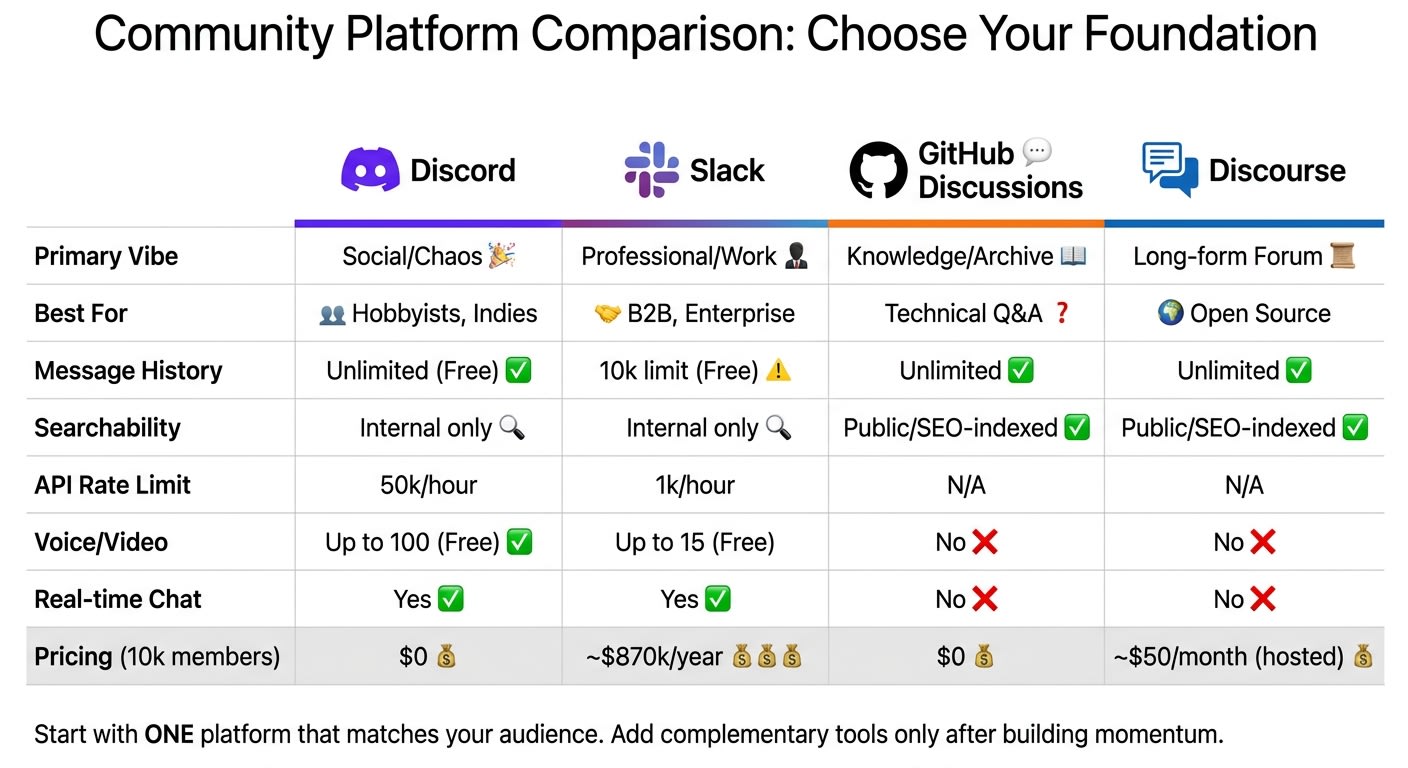
The platform you choose plays a big role in shaping how developers interact, preserving important insights, and driving your community's growth. It’s the foundation for building and scaling an engaged developer community.
At the heart of this decision lies a key tradeoff: real-time chat platforms like Discord and Slack are great for instant engagement and support, but conversations can easily get lost in the scroll. On the other hand, asynchronous platforms like GitHub Discussions and Discourse create lasting, searchable knowledge bases, though they may lack the spontaneous energy that keeps users returning daily. Many successful SaaS communities take a hybrid approach - using GitHub Discussions for long-term answers, Slack for B2B customer support, and Discord for building excitement and energy within the community .
One common mistake? Launching both Discord and Slack at the same time. This "double-platform trap" often splits your community, creating what one strategist calls "half a conversation everywhere" . Instead, start with one primary platform that aligns with your audience, and only add complementary tools once you’ve built enough momentum. Let’s break down the strengths and weaknesses of each platform.
Platform Comparison: Strengths and Weaknesses
Discord thrives as a space for indie developers, hobbyists, and younger engineers. It offers free unlimited message history, voice channels for up to 100 participants, and an API rate limit of 50,000 requests per hour . A noteworthy example: in Q3 2023, freeCodeCamp transitioned their 400,000-member community from Slack to Discord, saving $14,000 annually while boosting their 30-day weekly active contributor retention from 18% to 64%. Weekly office hours on Discord voice channels also increased new contributor signups by 42% .
"Discord is basically a giant digital cafeteria. It's loud, chaotic, full of inside jokes... which, incidentally, is why developers love it." - Amit Ashwini, Founder, DataDab
However, Discord isn’t without its challenges. Maintaining culture demands constant moderation, and its single-level threading can make it tricky to follow detailed technical discussions.
Slack is the go-to platform for B2B SaaS companies, where developers are already active during work hours. It integrates smoothly with tools like Jira and Linear, making it a natural fit for enterprise teams. For example, React’s core team uses Slack Pro (sponsored by Meta) to coordinate with 200,000 community members, using a Slack–GitHub sync bot to improve productivity by 12% .
The downside? Slack’s free tier only keeps the last 10,000 messages, so older conversations disappear unless you upgrade. For a community of 10,000 members, Slack Pro costs about $870,000 per year . Additionally, its API rate limit is much lower than Discord’s, at just 1,000 requests per hour .
GitHub Discussions excels at creating a permanent, searchable repository for technical Q&A. Indexed by search engines, it connects directly to your codebase, issues, and pull requests - making it ideal for complex discussions that need to be preserved beyond fleeting chat threads.
"GitHub Discussions is the only place where the conversations are actually future-proof. It's indexed. It's searchable. It's where the good questions go to outlive the founders." - Amit Ashwini, Founder, DataDab
That said, GitHub Discussions is built for asynchronous communication. It lacks real-time chat and voice capabilities, so it doesn’t capture the lively, social energy that other platforms provide. Instead, it works best as a dependable "knowledge backbone" alongside a more interactive platform.
Discourse and similar forum platforms shine for long-form technical discussions, offering deep customization, trust-building systems, and SEO benefits. Open-source communities often prefer these platforms. However, the interface can feel outdated compared to modern chat apps, and self-hosting may require dedicated developer resources .
Platform Feature Comparison Table
Here’s a quick look at how these platforms stack up:
| Feature | Discord | Slack | GitHub Discussions | Discourse |
|---|---|---|---|---|
| Primary Vibe | Social/Chaos | Professional/Work | Knowledge/Archive | Long-form Forum |
| Best For | Hobbyists, Indies | B2B, Enterprise | Technical Q&A | Open Source |
| Message History | Unlimited (Free) | 10k limit (Free) | Unlimited | Unlimited |
| Searchability | Internal only | Internal only | Public/SEO-indexed | Public/SEO-indexed |
| API Rate Limit | 50k/hour | 1k/hour | N/A | N/A |
| Voice/Video | Up to 100 (Free) | Up to 15 (Free) | No | No |
| Real-time Chat | Yes | Yes | No | No |
| Pricing (10k members) | $0 | ~$870k/year | $0 | ~$50/month (hosted) |
Choose a platform that aligns with where your audience naturally engages. If your focus is enterprise developers active on Slack during work hours, that’s your best bet. If your audience leans toward indie hackers and hobbyists, Discord’s dynamic energy might be perfect. For communities needing lasting, searchable discussions, GitHub Discussions can anchor your efforts . The right platform not only strengthens your community but also encourages organic growth through network effects and advocacy.
Getting Your First 100 Members
Your first 100 members are more than just users - they’re the backbone of your community. This early group sets the tone and culture, shaping the long-term success of your community. In fact, members who join in the first three months have a 3.2x higher Lifetime Value (LTV) compared to those who come aboard after the first year . That’s why your initial focus should be on attracting the right people, not just filling the room.
Finding and Inviting Early Members
Start by identifying your power users - those who already rely heavily on your product. Use internal analytics to spot users with high session frequency or those submitting detailed feature requests. These individuals are already invested in your product’s success and are more likely to engage actively in your community .
Another strategy is to leverage social listening. Platforms like Twitter (X) and LinkedIn are goldmines for finding developers or users discussing your niche or even tagging your product. These vocal advocates are already solving problems that your community can help with, making them ideal members .
For your first 20–30 members, personalized outreach is key. Direct messages (DMs) that frame them as co-founders rather than participants can go a long way. For example, between 2024 and 2026, The Growth Terminal successfully scaled their Slack community from zero to 10,000 members in just 18 months by using personalized LinkedIn messages to recruit the first 100 members. This approach resulted in a 33% Daily Active User (DAU) rate by the 12-month mark .
"The first 100 members determine everything. They set the tone, establish norms, and become your early advocates. Get this wrong and you'll spend months broadcasting into an echo chamber." - The Growth Terminal
Adopt a wave strategy for inviting members. Instead of onboarding everyone at once, invite them in smaller batches of 50–70 people. This approach helps stabilize the community culture before introducing new voices . A Product Hunt launch can also serve as a valuable recruitment tool - include your community link in the description and commit to answering all technical questions in real time to attract high-intent traffic .
Another powerful tactic is conducting 15-minute discovery calls with your first members. Use these calls to understand what they’re looking for in a community and how they can contribute. This personalized approach can convert 3–5x better than generic announcements .
By focusing on these high-quality members early, you’re not only driving engagement but also setting the stage for scaling to thousands. Once this foundation is in place, you can refine your outreach with effective invitation templates.
Community Invite Message Templates
After identifying the right people, your outreach needs to be on point. Here are three templates you can tailor to your audience:
The "Founding Member" Template (for your first 20 members):
"I just launched a community for [niche] and I'd love for you to be one of our founding members. We're keeping it small to start so we can focus on [core problem]."The "Advice" Template (for industry experts):
"Subject: Quick favor – would love your thoughts on something I'm building.
Hi [Name], I've been building a tool that helps [target] [outcome]. Since you know this space so well, I'd love to get your thoughts on whether this is actually useful. Up for a 15-minute call?"The "Problem-Centric" Template (for users with specific pain points):
"Hey [Name], saw your post about [pain point] - I've been building a tool that helps [solve that problem] with less effort. Happy to give you early access if it's relevant - no strings, just curious if it helps."
In 2025, Ivaylo Georgiev, founder of Zovoro.ai, demonstrated the power of this approach by sharing a prototype in small creator Discord servers. Instead of asking for signups, he requested feedback. One post alone generated over 40 signups before the full product was even ready .
For your first 100 members, commit to a 24-hour response time for all questions. This builds trust and shows you’re serious about engaging with them while the community is still manageable . Offer perks like insider access to your product roadmap or private beta features to make membership feel exclusive and valuable .
Keeping Developers Active and Engaged
Keeping a developer community engaged turns passive members into active contributors. It’s worth noting that user-generated content in developer communities performs three times better than company-created content . This makes peer-to-peer interactions a key focus for fostering engagement.
Content Types That Drive Participation
Once your community is up and running, maintaining momentum requires intentional content and structured interactions. Successful communities often use activity-specific channels instead of broad, generic ones. For example, replace channels like #general with more focused spaces such as #showcase, #get-unstuck, or #100-days-of-code . These targeted channels give developers a clear incentive to participate instead of just observing.
A great example of this approach is Replit. From 2023 to 2026, Replit managed a Discord server with over 100,000 members using purpose-driven channels. This strategy contributed to its $1 billion valuation. Replit’s hackathons, which offered $10,000 in prizes, typically attracted 500–1,000 participants and resulted in 200–400 completed projects. The result? A Customer Acquisition Cost (CAC) of just $10–$20 per active user, compared to $1,000–$7,500 with traditional Google Ads .
To sustain engagement, establish a content rhythm so members know when to participate without feeling overwhelmed. For instance, host “Showcase Fridays,” where developers can share their projects, hold biweekly office hours, and send out a Friday digest summarizing key updates and top community questions . These predictable touchpoints keep the community active without demanding constant attention.
While technical discussion channels are essential, casual spaces are equally important for building long-term bonds. Create off-topic channels like #random or #off-topic to encourage informal interactions. These spaces are surprisingly effective - 73% of users who engage weekly in a community stay active for at least 12 months . The personal connections formed in these casual spaces are often the glue that keeps members coming back .
Another way to keep members engaged is by launching a champion program for your most active users. Highlight their contributions with visible roles like @Champion, offer them perks like roadmap voting rights, and provide early access to beta features. Recognizing top contributors not only boosts their engagement but also inspires others to participate more actively . When implementing community-suggested features, publicly credit the members who contributed the ideas - this reinforces the feedback loop and encourages ongoing participation .
Case Studies from Active Developer Communities
Stateshift, led by Mindy Faieta, introduced a "Community-to-Product Framework" in September 2025 for over 240 developer-focused companies. By integrating community elements like peer mentorship and live onboarding directly into the user journey, they achieved a 35% boost in trial-to-paid conversions and a 45% increase in member retention for their clients . Their approach shifted the focus from vanity metrics, like total member count, to meaningful outcomes, such as helping members achieve their first product milestone or “aha moment” . Instead of celebrating 10,000 members, they celebrated 2,000 members who successfully deployed their first project.
Hashnode also excels by blending a "community of practice" with their product. Beyond supporting their blogging platform, they’ve created a space for discussions about technical writing, SEO for developers, and content strategy. This broader focus attracts developers who might not be ready to use their platform yet but will remember the community when they are .
Another underutilized strategy is leveraging interactive documentation to spark community discussions. Add feedback widgets or comment sections to popular documents to turn passive readers into active participants . For example, if someone asks a question in the documentation, invite them to join the community for a deeper conversation.
"Community isn't just cheaper than marketing. It's better. It scales differently. It creates loyalty that marketing never could." - Chris Kernaghan, Owner, We Are Founders
To ensure consistent engagement, maintain a public SLA for timely responses across all support channels . As your community grows, consider automating moderation early with bots like MEE6 or Dyno. These tools can handle spam and routine tasks, freeing up your team to focus on meaningful interactions .
Growing from 1,000 to 10,000 Members
Scaling a community from 1,000 to 10,000 members requires shifting from hands-on efforts to structured systems. This stage is all about automating repetitive tasks, delegating leadership roles, and maintaining quality as the community grows. Building on earlier engagement strategies, implementing automation and ambassador programs becomes critical for managing growth effectively.
Automation for Community Management
Once your community reaches four figures, managing everything manually becomes impossible. Automation is the key to scaling without losing momentum. For instance, The Growth Terminal expanded their Slack community from zero to 10,000 members in just 18 months by introducing automation early. By month 12, they had 2,850 daily active users, achieving a 33% daily active user (DAU) rate. They used automated weekly "Ask Me Anything" sessions and a "Helper" badge system to encourage contributions. Instead of focusing on vanity metrics, they tracked individual engagement and cohort value to predict which members were most likely to become paying customers .
A great starting point is a "First Week Framework." For example:
- Day 1: Send a welcome message.
- Day 2: Share essential resources.
- Day 3: Encourage a specific action.
Integrate webhooks with analytics tools to log community activity directly into your database. This allows you to analyze retention patterns and refine onboarding strategies .
As the volume of messages increases, moderation bots like MEE6, Dyno, or Carl-bot can help filter spam and maintain quality discussions . Encourage threading to keep conversations organized and prevent side discussions from overwhelming the main feed . Additionally, create easy-to-access channels for new members to make their first contributions. For example, Off Grid, an open-source AI app, built a Slack community of 5,500 users in three weeks without ads. Their focus on engagement empowered members to contribute directly to the product roadmap, earning over 900 GitHub stars .
Automation helps streamline operations, but empowering your most active members as ambassadors is what truly drives growth.
Building an Ambassador Program
Reaching 10,000 members means relying on a core group of active participants to take on leadership roles. These ambassadors, or "supernodes", provide peer support, uphold the community culture, and bring in new members. Discord, for example, scaled its early user base through the "Hype Squad" program. They recruited college students and gamers as ambassadors, offering swag and small budgets for events like local tournaments. These ambassadors often brought entire teams of 20–40 people to the platform .
To identify potential ambassadors, look for members who consistently engage early in discussions. Invite them to co-host events or join exclusive channels . Offer perks like special roles, VIP access to events, direct communication with leadership, or early access to beta features. Notion, under the guidance of Ben Lang, prioritized ambassadors with a genuine passion for the product. This strategy helped them grow to over 20 million users and more than 1 million community members between 2020 and 2024 .
Ambassadors can take on tasks like:
- Hosting office hours or live events.
- Creating resources like templates or guides.
- Moderating specific channels.
Track the value of their contributions, focusing on quality over quantity. Research shows that 81.5% of community members become brand advocates when given proper recognition and structure .
When and How to Hire Community Managers
If daily activity surpasses 1,000 users or managing the community takes more than 15 hours per week, it’s time to hire a dedicated community manager. Their role includes enforcing rules, curating content, recognizing contributions, and relaying member feedback . For example, The Growth Terminal hired their first community manager six months in, paying $45,000 annually. This investment helped generate over $150,000 in additional revenue through course conversions .
In the U.S., community manager salaries typically range from $60,000 to $120,000 annually, depending on the company's size and location . Instead of hiring a single person to handle everything, consider contracting specialized tasks - like creating tutorials or managing open-source projects - to skilled contributors . This approach keeps your budget flexible while scaling efficiently.
As the community grows, shift to a tiered model. Let volunteer moderators and ambassadors handle routine tasks, freeing the manager to focus on strategy and business outcomes . Companies with dedicated community teams have reported a 22% increase in growth since 2020, while community-driven support has reduced support tickets by an average of 21% .
Tracking Community Health and Performance
Tracking the right metrics is critical for maintaining a thriving developer community and driving SaaS growth. It’s not about measuring every action but focusing on behaviors that directly impact revenue, adoption, and retention. As Mindy Faieta from Stateshift explains:
"If your developer community is meant to drive adoption, retention, contribution, advocacy, or product expansion, you need better signals... The answer is not tracking more activity. It is tracking the right behavior" .
Interestingly, 87% of community teams still prioritize engagement volume over quality, yet only 23% can link those activities to measurable outcomes like revenue or product trials .
Core Metrics to Monitor
Start by focusing on Monthly Active Contributors (MACs). These are the users who create value - whether through code, content, or solutions - rather than simply consuming information . Another essential metric is the peer-to-peer support ratio, which should ideally be at least 3:1 (community-provided answers to team-provided answers). A strong ratio like this can significantly reduce support costs, with some communities cutting team workloads by as much as 40% .
Contributor retention is another key indicator of community health. In well-functioning communities, 25–40% of first-time contributors return within 90 days, while elite communities see 10–15% of contributors becoming long-term champions active for over a year .
It’s also important to weigh contributions based on their business impact. For example, merged pull requests for core features or documentation updates that reduce support tickets should carry more weight than minor typo fixes. Companies like DigitalOcean and Datadog have effectively used community-created content to simplify complex tasks and boost adoption .
Additionally, track organic advocacy by monitoring unprompted mentions on platforms like Stack Overflow, Reddit, and GitHub. This helps gauge trust within the community. Notably, companies using the "Community-to-Product Framework" between 2025 and 2026 saw a 35% higher trial-to-paid conversion rate and a 42% faster feature adoption rate compared to those relying solely on product onboarding . Community-engaged users also tend to have a 15–30% higher lifetime value and retain at 2.3× the rate of non-members .
All these metrics feed into analytics dashboards, offering a clearer picture of your community’s overall impact.
Analytics Tools and Dashboards
To make these metrics actionable, integrate analytics tools that go beyond basic data. While native analytics can offer a starting point, tools like Common Room combined with Amplitude or Mixpanel can link community activity to business outcomes . Expect to spend between $1,850 and $4,350 per month for a well-rounded analytics stack .
For more tailored insights, build custom dashboards. For example, use Discord webhooks and Supabase Edge Functions to log community events directly into your product database . This setup allows for cohort analysis, comparing activation and churn rates of community-engaged users versus non-engaged users. Another effective strategy is to establish a public reply SLA - aiming for 24-hour response times in support channels to build trust . Also, track time-to-first-success, ensuring developers can move from "interested" to achieving a working result in under 15 minutes .
The impact of these efforts becomes measurable within months. Trial-to-paid conversion rates often see a 15–25% lift within the first three months, while feature adoption can increase by 30–50% after six months . Pay attention to recurring questions from your community; if five developers ask the same thing in a week, it’s likely a product or documentation issue rather than just a support concern .
Conclusion
Growing a developer community from scratch to 10,000 members is no small feat - it’s a commitment that requires time, effort, and a genuine focus on creating value. As Ron Northcutt, Head of Developer Relations at Appsmith, aptly states:
"Prioritizing genuine value over marketing tactics remains the key takeaway in community building... This translates into more than just brand loyalty and fosters a powerful ecosystem" .
This approach means looking beyond quick wins and short-term metrics. Instead of viewing your community as just another lead generation tool, think of it as a long-term investment. Building trust and offering real value - whether through thoughtful engagement or structured onboarding - encourages developers to explore your product and convert on their own terms. Traditional marketing often fails with developers, who are more likely to respond to practical utility, peer recommendations, and direct interaction with product teams .
A thriving community isn’t just an add-on; it’s a crucial part of the developer experience. It works alongside your product, documentation, and content strategies. However, while 87% of communities track growth in membership, only 23% can tie that activity to revenue or product trials . The key is to focus on meaningful outcomes, such as helping members reach important product milestones, rather than chasing vanity metrics.
Patience is essential. Over six to twelve months, you can expect tangible results: trial-to-paid conversion rates improving by 15–25%, support costs dropping by 20–35%, and feature adoption climbing by 30–50% . This is a long game, not a quick sprint, and the rewards come to those who stay consistent and authentic.
Interestingly, the most engaged 20% of your community often drive 80% of the activity . These power users are your champions, and nurturing them is critical. Offer them perks like exclusive access, opportunities to influence your roadmap, and visible roles within the community. By building systems that connect community engagement to product trials, activation, and retention, you can turn your community into a reliable growth engine . Start investing in your top contributors now, and you’ll set the stage for scalable, long-term success.
FAQs
How do I pick one community platform without splitting my users?
When selecting a platform for your community, prioritize one that matches your engagement goals and offers features tailored to your users' needs. Look for options that support scalability, allow for customization, and integrate seamlessly with the tools you already use. This creates a cohesive ecosystem that simplifies management and improves the user experience. Establishing clear community guidelines is also key - it helps maintain order and keeps members engaged in a unified space, avoiding the risk of splitting your community's focus.
What should I focus on in the first 30 days to reach 100 members?
In your first 30 days, concentrate on purposeful growth, tailored outreach, and sparking interaction. Personally reach out to 20–30 relevant individuals - such as loyal customers or key developers - and have brief conversations to learn what drives them. Establish clear rules and offer meaningful experiences, like Q&A sessions or coding challenges, to provide value. Support these initial members to create a welcoming environment that naturally encourages others to join.
How do I prove community ROI in revenue and retention?
To show how a community contributes to revenue and retention, focus on tracking key metrics. Start with engagement rates, member retention, and the quality of contributions to gauge how active and valuable the community is. Another critical metric is support deflection, which measures how much the community helps reduce support inquiries.
You can also assess the community's influence on product adoption by looking at activation rates and feature usage. To directly connect community activity to revenue, monitor metrics like increased customer lifetime value (LTV), higher referral rates, and lower support costs. Tie these numbers to your company’s goals to clearly demonstrate the community's return on investment (ROI).