

Marketing to developers is different. They value practical solutions, technical accuracy, and transparency over flashy ads or gated content. Traditional B2B tactics like form-fills and buzzwords don’t work here - they frustrate developers. Instead, earning trust is key, and it starts with delivering value through technical content, hands-on experiences, and seamless onboarding.
Here’s the playbook:
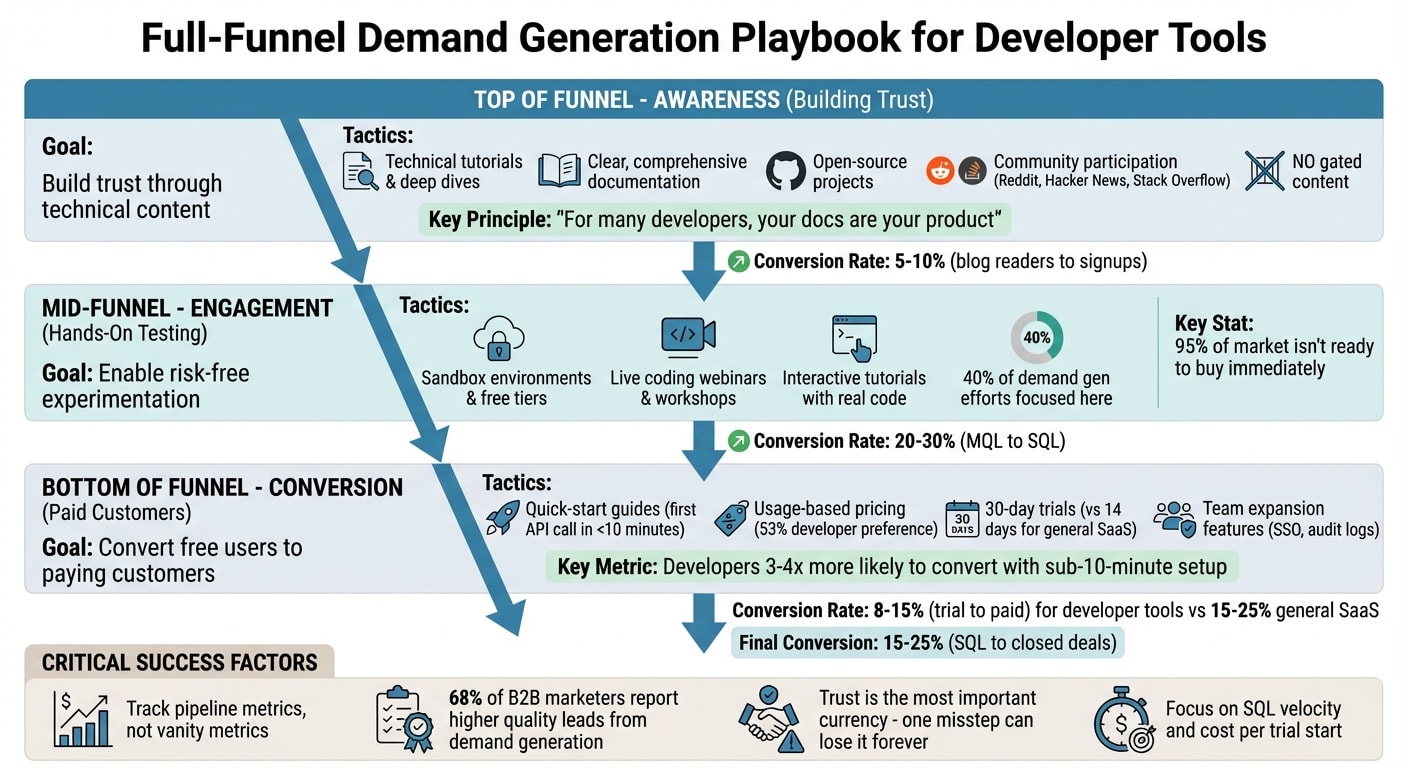
- Top-of-Funnel (Awareness): Build trust with tutorials, technical deep dives, and clear documentation. Avoid gated content - it alienates developers. Open-source projects and participation in developer communities also help establish credibility.
- Mid-Funnel (Engagement): Offer sandboxes and free tiers to let developers test tools without barriers. Host live coding webinars and workshops to demonstrate solutions in action.
- Bottom-of-Funnel (Conversion): Simplify onboarding with quick-start guides and usage-based pricing. Focus on “aha moments” that show immediate value, like successful API calls or integrations.
Track meaningful metrics like trial activations, tutorial completions, and usage thresholds - not vanity metrics like page views. Developers prefer self-service tools and transparent pricing, so align your strategy with their workflows. Trust is your most important asset - lose it, and you lose the audience.
This guide outlines how to attract, engage, and convert developers while respecting their preferences and expertise.
What Demand Generation Means for Developer Products
Demand generation for developer tools isn’t about chasing leads - it’s about creating awareness and trust long before a developer fills out a form. In traditional B2B marketing, companies often gate content behind forms or use lead-scoring tactics to push prospects through a structured sales funnel. But these methods don’t resonate with developers; in fact, they tend to frustrate them.
Developers approach tools differently. As Vo Tu Duc, a Content Strategist, explains, developers operate in a "problem-solving loop" rather than a typical sales funnel . They search for solutions, experiment with tools, and learn by doing. Instead of convincing them to talk to sales, the priority should be providing immediate, technical value. This is why traditional tactics like gating content often fail - they don’t align with how developers work.
When your documentation helps someone debug an issue or your tutorial includes ready-to-use code, you’re building trust. That trust is what leads to product adoption - but only if your technical resources are easily accessible, not hidden behind forms.
Why Developers Reject Gated Content
From a developer’s perspective, gated content feels less like a helpful resource and more like a marketing ploy. When they’re troubleshooting or trying to solve a problem, being asked to fill out forms with details like their job title or company size sends the message that your priority is data collection, not helping them.
Vo Tu Duc captures this sentiment perfectly:
"A developer trying to solve a bug at 2 AM will not fill out a form to download a PDF."
Developers are used to platforms like Stack Overflow, GitHub, and open-source repositories, where technical information is instantly available. Even small barriers, like an email capture form, can disrupt their workflow and damage your credibility before trust is even established.
Gating content also reinforces a negative stereotype: that marketing materials lack technical depth. Developers, being naturally skeptical, often see hidden information as a sign of fluff rather than substance. On the other hand, openly available, detailed technical resources show that you understand their challenges and are serious about solving them. Recognizing these objections helps clarify what developers truly value in content.
What Developers Actually Want
To build trust and encourage product adoption, your content needs to align with what developers are actually looking for: practical, problem-solving resources. Developers don’t care about polished case studies or testimonials from big-name companies - they want technical details. They need to know if your tool can solve their problem, how it works, and what trade-offs they might face.
The best developer content avoids vague claims. Instead of saying your API offers "seamless integration", show the REST endpoints, list the request parameters, and provide the JSON response format. Instead of calling your database "blazingly fast", share your benchmarking process and include code so developers can test it themselves.
Transparency is just as important. Acknowledging where your product might fall short - or even suggesting when an open-source alternative could be a better fit - can go a long way in building credibility. For many developers, documentation is their first interaction with your product. If it’s clear, comprehensive, and accessible, it becomes one of your strongest marketing tools.
Top-of-Funnel: Building Awareness Through Technical Content
When it comes to developers, the key to capturing attention lies in delivering genuine, technical value. This top-of-funnel strategy isn’t about gathering leads. Instead, it’s about solving real problems and establishing trust from the outset. Developers aren’t drawn to flashy marketing - they’re searching for practical solutions to their challenges. That’s why your content should focus on utility, offering effective tutorials, thorough documentation, and deep dives into your engineering decisions.
At this stage, the most impactful content formats are:
- In-depth tutorials that address real-world problems.
- Technical deep dives that explain architectural trade-offs.
- Comprehensive documentation that developers can rely on.
As Vo Tu Duc, a Content Strategist, aptly states:
"For many developers, your docs are your product."
If your API reference is incomplete or your code samples don’t work, you risk losing credibility before developers even give your tool a shot.
Publishing Technical Content That Developers Read
The best tutorials solve specific, real-world challenges. Instead of basic "Hello World" examples, tackle common pain points like fixing CORS errors, optimizing database queries, or seamlessly integrating your API into existing workflows.
Every tutorial should include reliable, copy-pasteable code. Linking to a public GitHub repository with a fully tested project gives developers the chance to explore the solution firsthand. To maintain credibility, ensure all technical content is reviewed by practicing engineers before publishing.
When measuring success, skip vanity metrics like page views or social shares. Instead, focus on engagement metrics like scroll depth or time spent interacting with code blocks. Additionally, optimizing for long-tail search queries (e.g., "how to fix cors error in express") ensures your content aligns with developers’ immediate needs.
By prioritizing these strategies, you set the stage for trust - trust that’s further reinforced when developers can examine your open-source code directly.
Using Open Source to Build Trust
Open-source projects are a powerful trust-building tool. By making your code public, you allow developers to assess it for security, performance, and overall quality. This level of transparency assures them that your tool delivers on its promises.
Open source also removes barriers, giving developers the freedom to explore your tool without needing budget approvals, sales calls, or even a credit card. They can fork your repository, run it locally, and decide for themselves if it fits their needs. Metrics like GitHub stars, forks, and pull requests act as visible proof of your tool’s value.
Additionally, contributing to established open-source projects can boost your visibility and credibility. When your team helps fix bugs or adds features to widely-used libraries, it showcases your technical expertise and positions your company as a respected member of the developer community.
But open-source efforts alone aren’t enough. Active involvement in developer communities is another critical way to build trust.
Participating in Developer Communities
Developers often gather in spaces like Reddit (r/programming, r/devops), Hacker News, Stack Overflow, DEV.to, Hashnode, and various Discord or Slack groups. To engage effectively, adopt a "participate, don’t pitch" mindset. This approach aligns with the transparency principles discussed earlier. Instead of dropping product links without context, focus on sharing insights, answering questions, and linking your content only when it provides a direct solution.
Encourage your engineers and developer advocates to use personal accounts when engaging in these communities. Developers are more likely to trust individuals with expertise than corporate accounts. Building credibility also requires honesty - acknowledging your product’s limitations and discussing technical trade-offs openly. As Vo Tu Duc explains:
"Trust is the single most important currency in the developer community. It's earned through demonstrated expertise and transparency, and it can be irrevocably lost with a single misstep."
Sometimes, admitting that your tool isn’t the best fit for a particular use case can strengthen long-term trust. It positions you as a reliable advisor rather than just another vendor trying to make a sale.
Mid-Funnel: Nurturing Developer Interest
After establishing trust with technical content, the next challenge is to deepen developer engagement by encouraging hands-on interaction. Once developers are aware of your tool, the goal is to turn that curiosity into practical evaluation. But here's the catch: developers aren't fans of traditional sales tactics. They prefer to test tools in realistic, risk-free environments. This stage is all about creating opportunities for developers to explore and experiment on their own terms, without pressure.
The best way to achieve this is by offering a safe space for testing. Developers need environments where they can try out features without risking their production systems or feeling obligated to buy. This aligns with the earlier principle of proving value through usability rather than persuasion.
Running Workshops and Webinars
Workshops and webinars can be powerful tools when they focus on solving specific technical challenges. The most effective sessions are scenario-based and interactive, showing developers exactly how your tool addresses real-world problems. Companies like Postman and Stripe have mastered this approach by hosting workshops that teach broader concepts - like API design or payment integration - while seamlessly demonstrating their products in action.
The format plays a huge role in engagement. Developers gravitate toward live coding sessions over slide-heavy presentations. They want to see actual code in action, watch debugging happen in real time, and ask detailed questions about implementation. To keep the sessions engaging, focus on one key feature and let attendees guide the direction by choosing use cases they find most relevant. This decision-branching approach makes the experience feel more collaborative and less like a one-way demo.
Allocating about 40% of your demand generation efforts to these educational initiatives is a smart move. Why? Because a whopping 95% of your market isn't ready to buy right away . Workshops and webinars bridge the gap between awareness and purchase intent, equipping developers with the knowledge they need to champion your tool within their organizations.
To complement these sessions, provide environments where developers can independently experiment with your product.
Offering Sandbox Environments and Free Tiers
Sandbox environments and free tiers eliminate one of the biggest hurdles to developer adoption: the need for budget approval or managerial sign-off. For example, Twilio’s sandbox allows developers to send test messages and make calls without requiring payment details. Similarly, MongoDB’s free tier offers enough database capacity for small-scale projects and prototypes. These aren’t time-limited trials - they’re ongoing access to essential features that allow developers to build and test real-world solutions.
The most effective sandboxes guide developers toward 2–4 "aha moments" where your tool solves a meaningful problem. To make this happen, use realistic data tailored to your audience's industry - like e-commerce data for retail developers or financial transactions for fintech teams - rather than generic placeholders. Include ready-to-use code snippets and embed documentation directly into the tool to minimize friction. The easier it is to integrate your tool, the more likely developers are to keep exploring.
Postman is a standout example of this approach . Their product-led growth model allowed developers to adopt the tool freely, building trust and proving its value before introducing any sales conversations. As Piyush Agarwal, Co-Founder of Reo.Dev, puts it:
"Postman didn't use traditional sales tactics. Instead, they relied on Product-Led Growth (PLG) - letting developers adopt the product freely before introducing sales at just the right moment" .
Transparency is crucial here. Be upfront about what’s included in your free tier and where the limitations lie. Developers appreciate clear boundaries far more than hidden restrictions designed to push upgrades. When they eventually reach those limits because they’re seeing real value, the transition to a paid plan feels natural rather than forced.
Bottom-of-Funnel: Converting Free Users to Paying Customers
Once developers are actively engaging with your free tier, the focus shifts to turning that engagement into revenue. Developers are quick to abandon tools that waste their time but are willing to pay for those that deliver value and save effort . The key is to make the transition to a paid plan smooth, without relying on artificial urgency.
The best conversions happen when developers quickly experience the benefits of your tool, making the upgrade feel like a logical next step. For context, free trials for developer tools tend to convert at rates of 8–15%, compared to 15–25% for general SaaS products .
Structuring Free Trials That Convert
Speed is everything. Developers who can make their first API call within 10 minutes are 3–4 times more likely to convert . The goal is to get users to that first "aha moment" - whether it's a successful API call, a deployed function, or a working integration - before asking for additional onboarding details.
A code-first onboarding process is critical. Instead of requiring developers to complete lengthy setup steps, provide them with a pre-generated API key immediately after signup - even before email verification. Include copy-and-paste code snippets and sandbox environments preloaded with realistic sample data to ensure a quick and satisfying first experience .
Reducing setup friction is crucial, as 68% of developers abandon tools with overly complex setups . This is why CLI-first onboarding is gaining traction. Tools that can be initialized with a simple terminal command (e.g., npx tool init) are easier to integrate into developers' workflows than multi-step web dashboards .
When it comes to feature gating, the approach should feel educational rather than restrictive. Instead of simply locking advanced features, use prompts to explain their benefits. For example, let users know that production deployments require SSL certificates, which are available in a higher-tier plan .
Developer tools often require longer trial periods - typically 30 days instead of the standard 14 days in SaaS - because of the complexity of integrations and the need for team buy-in .
| Category | Avg Conversion | Typical Trial | Key Challenge |
|---|---|---|---|
| API Platforms | 10–18% | 30 days | Integration setup time |
| Monitoring / APM | 12–20% | 14–30 days | Requires production data to see value |
| Dev Experience (DX) Tools | 15–25% | 14 days | Individual vs team purchase |
| CI/CD Tools | 8–12% | 30 days | Pipeline migration complexity |
| Database / BaaS | 8–15% | 30 days | Data migration barriers |
A well-optimized trial experience lays the groundwork for a pricing strategy that aligns costs with the value delivered.
Pricing Based on Usage
For infrastructure and API tools, usage-based pricing works well because it ties costs directly to the value developers receive. In fact, 53% of developers prefer usage-based models for cloud services, and 34% favor this approach overall . This pricing method eliminates the hesitation of committing to a fixed monthly fee before users fully understand their needs.
Transparency is essential. Developers need real-time insights into their usage to predict costs and avoid unexpected charges. A dashboard showing API calls, storage, or compute usage in real time can provide this clarity . When users approach 80% of their free-tier limits, prompting an upgrade can create a natural conversion opportunity .
The reasons developers upgrade are straightforward: 31% do so to increase usage limits, while 44% upgrade to unlock advanced features . Pricing tiers should reflect these motivations, with clear thresholds for usage and access to enhanced capabilities.
Framing the upgrade as a way to "keep building without interruptions" positions the paid plan as a solution rather than a hurdle.
Expanding from Individual to Team Plans
Once trial experiences and pricing are optimized, it's important to recognize when users are ready to scale to team plans. This transition is one of the most valuable opportunities for developer tools. A clear signal is when a developer invites a collaborator or adds a second user, indicating the tool is shifting from individual use to team-level value . At this point, introducing team-specific features and pricing tiers becomes essential.
Another key signal is when a developer moves from a sandbox environment to production. Actions like connecting a real repository, configuring a custom domain, or deploying code that handles actual traffic show that the tool has become mission-critical . These are ideal moments to present professional plans.
Requests for enterprise features such as Single Sign-On (SSO), audit logs, Service Level Agreements (SLAs), or custom integrations are additional indicators of expansion potential. Behavioral changes - like moving from demo repositories to production-grade ones or setting up integrations with other tools - should trigger targeted outreach from your sales team to address evolving needs effectively .
A three-tier pricing structure works well for this progression:
- Starter Plan: Designed for solo developers.
- Pro Plan: Tailored for growing teams, with collaboration features.
- Enterprise Plan: Focused on custom requirements like SLAs and advanced security.
Offering both monthly (preferred by 43% of developers) and annual billing (preferred by 35%) gives teams the flexibility they need for budgeting .
Channel Mix for Developer Demand Generation
Reaching developers requires a tailored approach to channel strategy. Developers are drawn to niche communities, steer clear of intrusive ads, and place a higher value on peer recommendations than on generic corporate pitches. To succeed, combine content syndication on developer-specific platforms, targeted paid social campaigns, and email newsletters like JavaScript Weekly, Node Weekly, or Golang Weekly, which developers actively subscribe to and trust.
Developers are most responsive when you meet them on their preferred platforms. In fact, Marketo's 2023 research shows that 68% of B2B marketers attribute better lead quality to demand generation strategies, with communities and newsletters playing a key role for developer-focused companies . With a well-structured free-to-paid user journey in place, selecting the right channels is critical. This complements the full-funnel strategy discussed earlier.
Content Syndication and Developer Communities
Using developer-focused platforms to syndicate your content can significantly expand your reach. Take Dev.to, for instance. It’s a thriving hub where developers regularly engage with technical content. By cross-posting your tutorials, how-to guides, or in-depth articles on Dev.to, you can connect with developers who might not visit your website directly.
Another standout platform is daily.dev, which boasts 1 million daily users. It offers native ad placements that seamlessly integrate into personalized developer feeds. Through its daily.dev for Business feature, you can promote technical content, product launches, or webinars in a way that feels natural to the audience. With advanced targeting options, you can tailor campaigns to specific groups - like backend engineers working with Python or frontend developers using React - based on seniority, programming language, or tools.
Developer communities are unique because their users are actively seeking technical insights. This intent-driven behavior makes these platforms ideal for generating awareness at the top of the funnel and nurturing interest through the mid-funnel.
Paid Social and Email Newsletters
Paid social platforms like LinkedIn are powerful tools for reaching developers in a professional setting. LinkedIn’s targeting capabilities - such as job titles (e.g., Software Engineer, DevOps Engineer), company size, and industry - allow you to zero in on either decision-makers or individual contributors evaluating tools. It’s especially effective for promoting mid-funnel content like case studies, webinars, or free-trial offers that require a higher level of engagement.
Twitter (now X) offers a more dynamic environment where developers discuss tools, share opinions, and stay on top of industry trends in real time. Paid campaigns on Twitter can leverage hashtags like #DevTools, #OpenSource, or language-specific tags like #JavaScript to spotlight blog posts, open-source projects, or community events. Developers on Twitter tend to favor authentic, technical content over overly polished corporate messaging, making it a great channel for connecting with this audience.
Email newsletters such as JavaScript Weekly, Node Weekly, or Golang Weekly provide a trusted and curated way to reach developers. These newsletters allow your tool to be showcased directly to an audience actively seeking technical updates. They’re particularly effective for nurturing mid-funnel interest, as engaged readers often share useful content with their teams.
Balancing the Channels
A well-rounded strategy combines the strengths of each channel. Developer communities like daily.dev deliver organic reach and build awareness. Paid social platforms, such as LinkedIn and Twitter, allow for precise audience targeting and campaign scaling. Meanwhile, newsletters offer consistent touchpoints to keep your tool top of mind. Together, these channels create a cohesive strategy that aligns with how developers discover and evaluate new tools. This sets the stage for effective campaign tracking and optimization, which we’ll explore in the next section.
Measuring Demand Generation: Pipeline Metrics vs. Vanity Metrics
Once your channel mix is in place, the next step is measuring what truly drives revenue. For developer demand generation, it’s not enough to track surface-level engagement. Developers interact differently than typical B2B buyers - they explore tools in sandbox environments, research privately in GitHub repositories, and make decisions in Slack channels. Because of this, traditional metrics like page views don’t capture the full picture of demand in this hidden "dark funnel" .
Interestingly, 68% of B2B marketers say demand generation leads to higher quality leads compared to traditional methods . Take one company’s success as an example: by focusing on pipeline metrics instead of vanity numbers, they grew their inbound pipeline from $2 million to $13 million. The key? Prioritizing interactions that actually contribute to revenue .
Pipeline Metrics That Matter
To measure success effectively, focus on metrics that tie directly to revenue. For developer tools, this means tracking Marketing Qualified Leads (MQLs) through actions like completing tutorials, forking GitHub repositories, or sharing API collections - rather than relying on generic form fills. Companies like Vercel use GitHub star counts and signups for their Next.js framework as MQL indicators, while Sales Qualified Leads (SQLs) are based on metrics like exceeding 10 deployments per month .
Another critical metric is influenced opportunities. For instance, Postman tracks when users hit enterprise API call limits after engaging with community content - these interactions account for about 30% of their pipeline value . Multi-touch attribution models can help tag developer-specific activities, such as sandbox logins or webinar code submissions. Setting thresholds, like requiring three or more engagements, ensures more accurate attribution of pipeline influence .
Conversion rates also offer valuable insights into your funnel’s health. For developer tools, common benchmarks include a 5–10% conversion rate from top-of-funnel to MQL (e.g., from blog readers to signups), 20–30% from MQL to SQL, and 15–25% from SQL to closed deals. These rates are often lower than general B2B benchmarks due to the longer evaluation periods developers prefer. For example, Stripe improved its conversion rates by 40% after tracking a 14-day usage threshold . Additionally, monitoring time-to-trial-start and usage-based progression is essential since developers often favor self-service evaluation over sales-assisted approaches.
Why Vanity Metrics Don't Work for Developer Marketing
Metrics like page views, social media likes, and impressions may look impressive but don’t reliably predict revenue when targeting developers. A tutorial could rack up 10,000 views without generating a single trial signup, or a viral tweet might get thousands of likes but fail to produce qualified leads. Developers tend to engage deeply but quietly, often reviewing documentation, cloning repositories, and testing tools without leaving obvious engagement signals.
For example, GitHub initially measured success by counting stars but later shifted to tracking active repository creation. This new metric revealed a 25% correlation with enterprise upsells, something the stars metric never showed . Similarly, Supabase noticed high documentation page views but low conversion rates until they began tracking how often database forks turned into paid queries. This shift uncovered real demand patterns .
In fact, 70% of developer tool marketers now rely on SQL-focused metrics for a clearer ROI picture. Vanity metrics often fail to capture the true influence on the pipeline . By integrating tools like HubSpot or Salesforce CRM with Amplitude for usage analytics - and leveraging GitHub APIs for tracking contributions - marketers can create dashboards with developer-specific KPIs. These might include tutorial completion rates above 50% for MQLs or trials lasting over seven days for SQLs . This focus on pipeline metrics ensures you can identify which campaigns and channels are driving meaningful business outcomes.
How daily.dev for Business Fits Your Demand Gen Stack
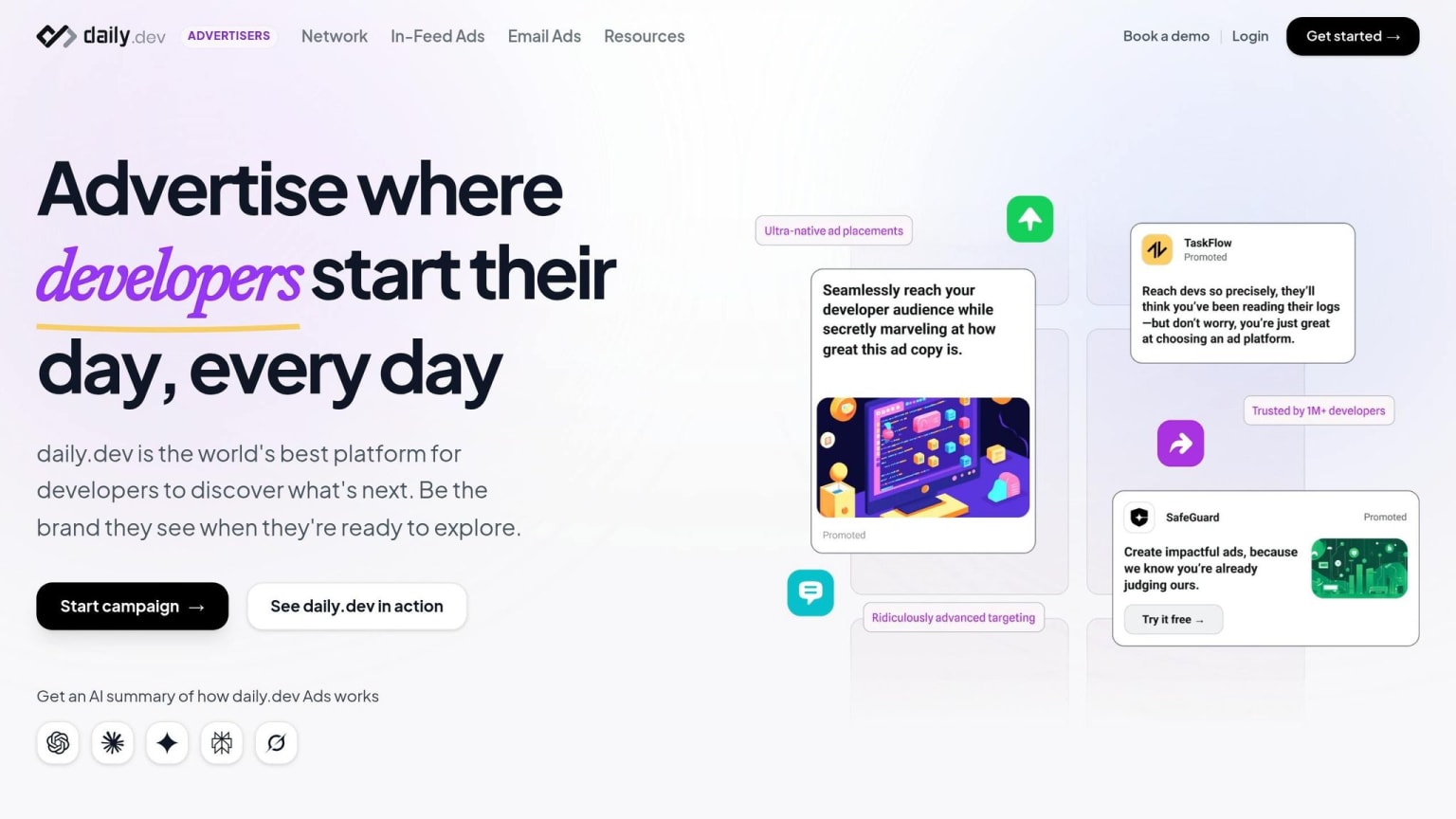
Once you’ve established pipeline metrics, the next step is figuring out how to connect with developers on a large scale. Traditional B2B advertising platforms often fall short when it comes to engaging developers. Why? Engineers tend to avoid conventional marketing channels, frequently using ad blockers and ignoring disruptive messaging. That’s where native advertising within developer-focused spaces becomes essential - and why daily.dev for Business has emerged as a go-to solution for dev tool marketers.
Reaching Developers with Native Ads
daily.dev for Business connects with over 1 million developers through three native ad formats that seamlessly integrate into their daily workflows. Here’s how these formats perform:
- In-feed ads: These appear directly in personalized news feeds, delivering an average click-through rate (CTR) of 1.2%.
- Post-page ads: Displayed after developers finish reading an article, these achieve a 0.8% CTR.
- Digest ads: Delivered via weekly newsletters, these boast a standout CTR of 2.5% .
What makes these formats so effective? Precision targeting based on actual developer behaviors. You can segment your audience by criteria like:
- Programming languages: JavaScript, Python, Rust, and more.
- Seniority levels: From junior developers to senior staff engineers.
- Tech stacks: AWS, Kubernetes, React, and beyond.
- Company size: Tailor campaigns to startups, SMBs, or enterprises.
For example, if you’re promoting a CI/CD tool, you can zero in on senior DevOps engineers engaging with Kubernetes-related content. This ensures your ads reach the right decision-makers - those actively interested in infrastructure automation. Plus, with a desktop-first design, your ads are shown during work hours, increasing their relevance and visibility .
"Developer advertising works when you prioritize technical clarity, native formats, and measurable product actions - not flashy buzzwords."
– Alex Carter
This native advertising strategy doesn’t just capture attention - it also sets the stage for detailed performance tracking.
Tracking Campaign Performance in Real Time
With pipeline metrics in place, daily.dev for Business provides real-time dashboards that turn ad engagement into actionable developer insights. Unlike platforms that focus solely on impressions and clicks, daily.dev digs deeper. It allows you to track and measure outcomes like trial sign-ups, API calls, and activations - metrics that directly impact your pipeline. This means you can calculate cost per trial start or cost per SQL, not just cost per click.
The platform also supports A/B testing, giving you instant feedback on what resonates with developers. For example, you can test whether a tutorial preview outperforms a product demo or compare messaging like “reduce deployment time by 50%” versus “automate your CI/CD pipeline.” Real-time data lets you quickly identify which version drives better engagement, enabling optimizations on a weekly basis rather than waiting for post-campaign reports.
The results? Many companies report 3–5× higher CTRs compared to traditional display ads, with some campaigns achieving up to 10× ROI by focusing on activation metrics instead of vanity numbers .
Whether your goal is awareness, nurturing, or conversion, daily.dev for Business fits seamlessly into every stage of the funnel. By integrating it into your broader demand generation strategy and applying the same pipeline metrics across all channels, you can measure its true impact and maximize its value.
Conclusion
Generating demand for developer tools isn’t about flashy messaging - it’s about earning trust through practical value. The key is simple: focus on technical accuracy, avoid unnecessary marketing jargon, and make sure your content is easily accessible. Developers value tools that solve real problems, and a product’s usefulness will always speak louder than any campaign .
Developers don’t follow a neat, linear journey. They move between problem-solving, evaluation, and mastery as their needs evolve. That’s why your strategy should reflect this reality. Use technical content to capture attention, provide hands-on experiences to engage interest, and ensure a seamless path to conversion. Interactive trials and environments play a crucial role in turning curiosity into commitment. And don’t overlook the details - every piece of content must undergo a thorough technical review by engineers. One broken code example can shatter credibility instantly .
When it comes to tracking success, focus on metrics that directly impact revenue. Instead of chasing vanity numbers, prioritize indicators like SQL velocity (how quickly leads become sales-ready) and the cost per trial start. Companies that clearly define their Ideal Customer Profile (ICP) are 71% more likely to hit or exceed their revenue targets .
Ultimately, trust is the most valuable currency in the developer community . Be upfront about trade-offs, transparent about limitations, and let your engineers take the lead in conversations. Developers remember the tools that solve their problems without unnecessary friction .
FAQs
What’s the fastest way to get developers to their first “aha moment”?
The fastest way to help developers reach their first "aha moment" is by providing hands-on experiences that immediately highlight your product's value. Use tools like sandbox environments, step-by-step tutorials, or interactive workshops that allow them to explore your product in a way that integrates seamlessly into their workflow. Combine these with straightforward and detailed technical documentation to establish trust and show your product’s relevance. Developers are more likely to engage when they see solutions to real-world problems rather than generic marketing pitches.
How do I measure demand gen without relying on page views or clicks?
To gauge real developer interest and adoption, it’s essential to track behaviors that go beyond surface-level interactions. Metrics like API call frequency, documentation views, and SDK implementation rates can paint a clearer picture of how developers are engaging with your platform.
For example, feature activation and onboarding completion are strong indicators of how successfully developers are integrating your tools into their workflows. Additionally, monitoring community engagement - such as activity on GitHub or participation in discussions around technical resources - offers valuable insights into how developers are interacting with and contributing to your ecosystem.
These metrics provide a much richer understanding of developer involvement compared to simple metrics like page views or clicks.
When should I switch a user from self-serve to sales outreach?
Switching a user from self-serve to a sales outreach approach works best when their actions clearly indicate interest. Look for behaviors like diving into technical documentation, experimenting with APIs, or actively assessing your product's features. Instead of relying on static measures of engagement, prioritize dynamic, behavior-driven signals. This approach aligns more effectively with the way developers engage and make decisions.