

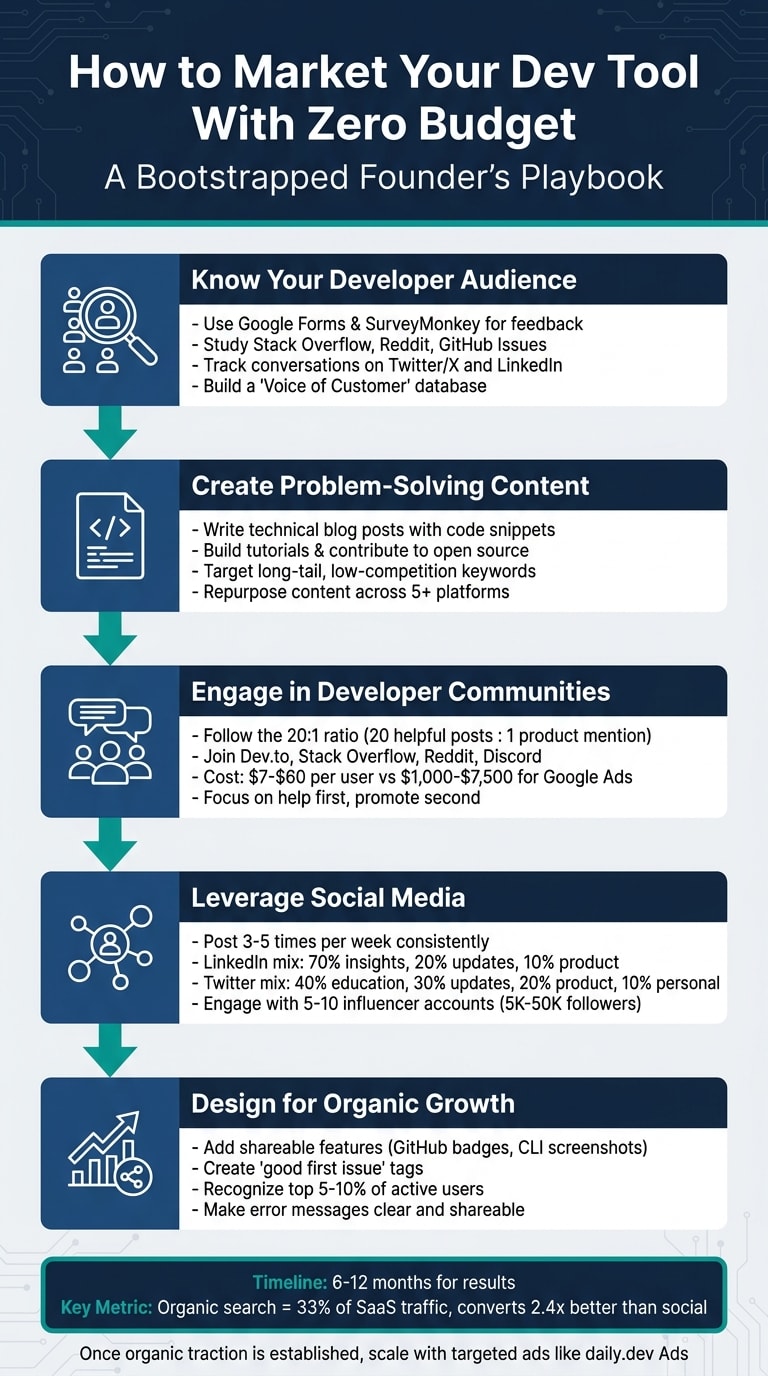
You've built a dev tool, but with no budget, how do you market it? Here's the answer: focus on time over money and leverage trust in individual creators. Developers prefer authentic, helpful content over ads or sales pitches. This guide offers actionable strategies to grow your tool's user base without spending a dime:
- Understand Your Audience: Use free tools like Google Forms, Reddit, and AnswerThePublic to identify developer pain points.
- Create Problem-Solving Content: Write technical blog posts, tutorials, and contribute to open source projects.
- Engage in Developer Communities: Join forums like Stack Overflow, Reddit, and Discord. Help first, mention your product sparingly.
- Leverage Social Media: Share technical insights on Twitter (X) and LinkedIn. Build trust through consistent posting and interaction.
- Design for Organic Growth: Add shareable features to your product, like GitHub badges or "good first issue" tags.
These methods require patience - results may take 6–12 months - but they build lasting growth. Once your organic efforts gain traction, consider scaling with targeted ads like daily.dev Ads for direct access to developers.
Start small: focus on writing technical content, engaging in communities, and optimizing your product for visibility. Consistency and genuine participation are key to zero-budget success.
Know Your Developer Audience Using Free Methods
Understanding your audience is the first step in effective marketing. Before you start writing blog posts or engaging in developer communities, take the time to learn about the challenges developers face, the language they use, and the places they go to find solutions. The good news? You don’t need expensive tools to do this.
Start by building a "Voice of Customer" database. This can be as simple as a spreadsheet where you document the exact words developers use to describe their problems and the workarounds they’ve tried. Avoid paraphrasing - record their phrases verbatim. When your marketing reflects how developers naturally talk about their issues, it connects more effectively. These free strategies set the stage for creating messaging that resonates.
Collect Feedback with Free Survey Tools
Direct feedback beats assumptions every time. Use free tools like Google Forms or SurveyMonkey to test ideas, measure satisfaction, and gather insights from your target audience . Keep it short and focused - developers aren’t likely to spend 15 minutes on a survey. Zero in on one problem per survey and ask open-ended questions like, "What’s the biggest challenge you face when [specific task]?"
Tools like AnswerThePublic can also be helpful. This platform visualizes the exact questions people search for online. For instance, enter topics like "API testing" or "database migration", and it will show you search queries grouped by "how", "why", "what", and more. While the free version limits you to three searches per day, it’s a quick way to uncover common developer pain points .
Once your survey results are in, cross-check them with discussions in developer forums to confirm recurring themes.
Study Developer Forums for Insights
Developers spend a lot of time on platforms like Stack Overflow, Reddit, Hacker News, and GitHub Issues. These forums are treasure troves of information . Instead of just skimming, pay attention to recurring questions and challenges - these often reveal opportunities for your product or tool.
Reddit, in particular, is a valuable resource. Subreddits like r/SaaS and r/selfhosted welcome tool recommendations and often indicate strong interest, whereas r/webdev and r/devops are stricter about promotions but still provide technical insights . Pay attention to highly upvoted comments to understand the preferred tone and technical depth.
"Developers make buying decisions in Reddit threads - not on your landing page."
– Egidijus, Founder, Prowlo
Use the search function on these forums to track how often specific issues come up. If you notice a recurring complaint in one thread, search the subreddit to see if it’s a broader trend. Remember, for every developer posting a question, there are likely dozens - or even hundreds - reading silently .
Track Developer Conversations on Social Media
Social platforms like Twitter (now X) and LinkedIn are hotspots for developers to share frustrations and seek recommendations. Use search tools to find conversations around your niche . For example, look for phrases like "frustrated with [tool name]" or "looking for alternative to [competitor]" to identify developers actively searching for solutions.
Follow influential accounts, such as technical founders or respected engineers in your field, and pay attention to the replies for unfiltered discussions . Save useful exchanges and add relevant quotes to your Voice of Customer database.
GitHub Issues and Gists are also worth monitoring. They provide a window into real-world coding problems and how developers are addressing them . Spend 20–30 minutes daily tracking these conversations to spot trends and emerging needs.
Peer recommendations and community discussions are the top ways developers discover new tools, even outperforming search engines, ads, and social media combined . By understanding how developers communicate and where they talk, you’ll be better equipped to create content and engage with them effectively.
Create Content That Developers Actually Want
To reach developers effectively, your content must address their real-world challenges. Developers are quick to dismiss generic promotions, so the key is to focus on the specific implementation problems they encounter daily. Use insights from customer feedback, forums, and social media to uncover unanswered technical questions that resonate with their needs.
"I would not recommend diving into content creation beyond a simple website until a startup has customers that they can learn from." – Carly Cais, Founder, RevvSpark
Start by creating bottom-of-the-funnel content - articles that directly tackle the problems your tool solves. These types of posts not only convert better but also quickly demonstrate the value of your product. Once you’ve built a strong foundation, expand into educational content to establish yourself as a trusted voice in the developer community. This targeted approach helps you build credibility and trust.
Write Technical Blog Posts That Solve Problems
A good technical blog post provides actionable solutions to developers’ pain points. Instead of pushing your product, focus on delivering practical, step-by-step advice that genuinely helps. This kind of content builds trust and positions you as a helpful resource, not just another company trying to sell something.
Use long-tail, low-competition keywords to target specific, problem-aware searches. For instance, instead of a broad term like "API testing", aim for something more focused, such as "how to automate API testing for microservices." Free keyword tools and discussions on platforms like Reddit or Stack Overflow can help you validate these topics.
Internal resources, like sales FAQs or support tickets, are also goldmines for content ideas. If multiple customers ask the same question, chances are many others are searching for the same answers. Craig Hewitt, founder of Castos, shared how his consistent focus on addressing podcasting challenges led to his site ranking for medium-difficulty keywords (difficulty score of 20) within a month of publishing . This highlights how sustained efforts can yield compounding results over time.
When writing, use clear and technical language that developers appreciate. Avoid marketing jargon and include code snippets, configuration examples, or detailed walkthroughs. And if written posts can’t fully explain a concept, consider creating in-depth tutorials to complement your content.
Build Tutorials and Contribute to Open Source
Tutorials and contributions to open source projects are excellent ways to build credibility within the developer community. By solving problems in a public forum, you position yourself as a peer, which can lead to organic discovery and word-of-mouth recommendations.
Start by identifying popular open source projects in your ecosystem. Look for GitHub issues tagged as "good first issue" or "documentation" and create tutorials that guide developers through these workflows. Host these tutorials on your blog, then republish them on platforms like Dev.to or Hashnode using canonical links to retain SEO value.
For more complex topics, video tutorials can be especially effective. Simple screen recordings with clear narration can make challenging concepts easier to grasp. Tools like OBS Studio are great for creating these videos, which you can upload to YouTube and embed on your blog. This approach caters to developers who prefer visual learning.
Consistency is key. A well-timed, straightforward tutorial often outperforms a delayed, overly polished one. For example, over two years starting in 2024, the founder of Draft.dev transitioned from sporadic blog posts to a structured content strategy. This shift helped attract 12,000 organic visitors per month - a level of traffic that would have cost about $24,000 per month in paid ads .
Reuse Content Across Multiple Formats
Maximize the reach of your content by repurposing it across different formats. This "write once, distribute five times" strategy allows you to extend your impact without stretching your resources.
Start with a technical blog post and adapt it for other platforms once search engines have indexed it. For example:
- Create a Twitter/X thread summarizing the main points.
- Post an overview with a link on Reddit.
- Republish the article on Dev.to or Hashnode using canonical URLs.
- Turn it into a video tutorial for YouTube.
- Share key visuals, like diagrams or code snippets, as standalone images on LinkedIn.
Take Karl Hughes' example: he spent 8 hours writing a 3,400-word article and only 2 hours repurposing it into a Twitter thread, Reddit post, LinkedIn article, and Hacker News submission. These efforts led to the piece being translated by a Chinese publication and even included in Code Nation’s curriculum .
You can also extract visual elements like infographics, code snippets, or statistics to share on social media. Consider creating short video clips summarizing your solution or even pitching your blog post as a conference talk or YouTube tutorial. This multi-format approach ensures you connect with developers who consume content in different ways.
| Content Format | Repurposing Action | Target Platform |
|---|---|---|
| Technical Blog Post | Summary Thread | Twitter/X, Threads |
| Technical Blog Post | Full Republishing (canonical link) | Dev.to, Hashnode, Medium |
| Technical Blog Post | Video Tutorial / Demo | YouTube, Loom |
| Technical Blog Post | Short-form Clips | TikTok, Instagram Reels |
| Technical Blog Post | Image / Infographic | LinkedIn, Instagram |
Organic search accounts for about 33% of total traffic for SaaS companies, with visitors from search converting at 2.4 times the rate of those from social media . Repurposing content not only saves time but also amplifies your reach, making it a powerful tool for zero-budget marketing.
Engage with Free Developer Communities
To connect with developers meaningfully, join the spaces where they naturally gather to share knowledge and solve problems. Instead of bombarding them with ads, focus on building trust by being an active, helpful participant. The goal is to offer value first, allowing your tool to shine when it fits naturally into the conversation.
Start by spending at least a week observing. Pay attention to the discussions, the tone, and what sparks engagement versus what gets ignored or downvoted . Each platform has its own culture, so understanding it is essential.
"Developers are allergic to marketing. Show them an ad and they install an ad blocker. Send them a cold email and they mark it as spam." – Chris Kernaghan, Owner, We Are Founders
The cost benefits of engaging in developer communities can be striking. For instance, community-led growth can cost as little as $7–$60 per paid user through platforms like Discord, compared to $1,000–$7,500 for Google Ads . Replit, a company valued at $1 billion, leveraged community engagement to achieve conversion rates of 8–15% for Discord members, far outpacing the 2–5% seen with paid search ads .
Find the Right Communities for Your Tool
To make the most of your efforts, identify the communities where your ideal customers gather. Use your Ideal Customer Profile (ICP) to pinpoint specific groups - Python developers, for example, often frequent different spaces than PHP developers, and junior engineers have different needs compared to senior engineers .
Seek out communities that encourage members to showcase their work. Platforms with #showcase or #show-and-tell channels are often more open to product discussions than purely theoretical forums . GitHub is a must for establishing technical credibility, while Dev.to is excellent for sharing long-form educational content that performs well in search rankings .
You can also use free tools like F5Bot to monitor mentions of relevant keywords on platforms like Reddit and Hacker News. Set up alerts for phrases like "best API testing tool" or "alternatives to [competitor]" so you can jump into high-intent discussions in real time . This strategy is especially effective given that 72% of tech decision-makers turn to Reddit when researching new software .
Help First, Promote Second
The rule of thumb for community engagement is a 20:1 ratio - contribute 20 helpful posts for every time you mention your product . This approach helps you build credibility and ensures you're seen as a genuine community member, not a spammer.
Focus on answering technical questions, sharing debugging tips, and celebrating others' successes. When your tool is relevant, introduce it as a personal solution rather than a pitch. For example: "I encountered this exact issue last year, which is why I built [tool]. Here's how it handles that specific edge case..." .
Consider the example of Batty, an open-source terminal tool. Between March and April 2026, its founder achieved 14 GitHub stars and 76 crate downloads without spending a dime. They accomplished this by publishing over 25 technical articles on Dev.to and Hashnode and engaging in 68 Twitter replies, prioritizing technical insights over self-promotion .
Focus on meaningful metrics like demo requests and sign-ups rather than vanity stats like upvotes or likes . Community feedback is also a goldmine for market research - the way developers describe their challenges can help refine your product messaging and landing page copy .
Developer Community Comparison
Different platforms cater to different needs. Choose where to invest your time based on your goals and audience.
| Community | Audience Size | Engagement Level | Best Practices |
|---|---|---|---|
| Dev.to | Medium | High | Share tutorials and case studies with code examples |
| Stack Overflow | Large | Medium | Thoroughly answer questions, avoid direct promotion |
| Reddit (r/programming) | Large | High | Engage authentically and provide value first |
| Discord | Medium | Very High | Offer real-time help, use showcase channels, maintain daily presence |
| Hacker News | Large | Medium | Post "Show HN" content with technical depth in the first comment |
For your initial 100 community members, commit to daily engagement. Respond to every question and publicly celebrate user wins . This hands-on approach lays the groundwork for organic growth. In fact, effective community support can reduce developer support tickets by as much as 85%, as Snap Inc.'s Camera Kit SDK team demonstrated during their beta phase .
Use Social Media to Reach Developers for Free
Social media offers bootstrapped founders a direct, cost-free way to connect with developers by sharing genuine, technical content. Platforms like Twitter (X) and LinkedIn are particularly effective because they attract developers who are eager to learn, share insights, and discover new tools.
One key insight? Developers are more inclined to follow individuals than corporate accounts. In 2026, founder-led profiles with real photos and transparent updates outperform polished brand pages when it comes to engaging developer audiences .
"Twitter/X remains the highest-signal social platform for developer products - not because it has the most users, but because the people who matter... are disproportionately active there." – CodeToCash Team
Twitter works best for reaching early adopters through viral threads, while LinkedIn is ideal for engaging B2B decision-makers like CTOs and Engineering Managers. Both platforms complement each other, helping founders connect with different segments of the developer community. Start by optimizing your profiles to make a strong first impression.
Set Up Professional Developer-Friendly Profiles
Your social profile gets judged in seconds, so it needs to convey technical credibility immediately. Use a real photo instead of a company logo - this simple tweak can significantly boost your follow rate, which should ideally fall between 20% and 30% for well-optimized profiles .
For LinkedIn, craft your headline like this: "[Technical Role] at [Company] | [Specific Expertise] | Building [Product]" . This format gives visitors a clear picture of your expertise and current projects. Pin a standout technical post in the "Featured" section to showcase your skills right away.
On Twitter, make sure your bio highlights your technical background and the problem you're addressing. Pin a high-performing thread or a link to a lead magnet at the top of your profile. This pinned content serves as a landing page to convert visitors into followers or email subscribers. Over time, expect about 1% to 3% of your followers to take action .
Once your profiles are set, focus on creating consistent, valuable content that builds trust with your audience.
Post Helpful Content on a Regular Schedule
Consistency is more important than going viral. Many founders give up after a couple of weeks, but organic content takes 6 to 12 months to show results. Stick to posting 3–5 times per week to stay visible on the platforms’ algorithms .
For LinkedIn, use a 70-20-10 content mix:
- 70% technical insights
- 20% build-in-public updates
- 10% product-related posts
On Twitter, try a 40/30/20/10 split:
- 40% educational tips
- 30% build-in-public updates
- 20% product content
- 10% personal opinions
This approach ensures your content delivers value while subtly promoting your product. Include technical details like code snippets, architecture diagrams, or performance benchmarks to grab attention. For example, a hook like "I reduced our AWS bill from $12,000 to $3,000" is far more engaging than a vague claim .
When writing Twitter threads, start with a strong hook that identifies a specific problem. Follow with a clear setup, include 3 to 8 concise tweets with line breaks for readability, and end with a TL;DR summary and a call-to-action. Well-structured threads can generate 3 to 5 times more impressions than single tweets .
Timing also matters. On LinkedIn, post between 7–9 AM or 12–1 PM from Tuesday to Thursday to catch users during pre-work or lunch hours . For Twitter, weekdays between 8–10 AM EST are ideal. Respond to comments within 30–60 minutes to boost reach .
Connect with Developer Influencers
Engaging with influencers is just as critical as posting your own content. Use a "reply-first" strategy by interacting with 5–10 niche accounts on Twitter that have 5,000–50,000 followers. Add thoughtful, technical insights to their posts . On LinkedIn, spend 10 minutes leaving 5 to 8 meaningful comments on other posts before publishing your own. This activity signals to the platform that you’re an active and valuable participant .
A great example of this strategy in action is Tony Dinh, the founder of TypingMind. He shared technical updates on Twitter, such as new features like prompt libraries and folder organization, which appealed to power users. By promoting a "Lifetime Deal" pricing model through these updates, he generated over $100,000 in revenue to fund further development .
Engaging with others’ posts also broadens your reach. A good engagement rate for LinkedIn technical content is between 2% and 5% . Track your performance and adjust based on what resonates with your audience.
These strategies, when combined, help build trust and credibility with developers, ensuring that every interaction leaves a lasting impression.
Design Your Product to Grow Organically
If you're bootstrapping, one of the smartest moves you can make is building growth directly into your product. The idea is simple: when developers use your tool, they inadvertently create opportunities for others to discover it. This strategy, called product-led distribution, transforms every user into a potential promoter .
"The product markets itself by being visible when used." – GrowthPigeon
To make this work, start by identifying your product's "aha moment" - that point where users first realize its real value. For developer tools, this could be something like successfully making an API call, deploying a project, or solving a tricky technical issue. Once you've nailed down this moment, focus on designing features that make sharing as effortless as possible .
Add Features That Users Want to Share
Your product’s value can become its best advertisement if you make sharing part of the experience. For instance, if your tool helps users deploy websites or generate code, consider adding a small "Deployed with [Your Tool]" badge to their projects. This way, every project they create becomes a subtle referral. Another great idea? Make sure your CLI help text is clear and visually appealing - developers love sharing screenshots when helping others, and this can work as free promotion .
Even error messages can be an opportunity. Developers often share error details on platforms like GitHub or forums. If your error messages are clear and helpful, they can act as a form of organic advertising .
You can also boost visibility by creating open-source plugins for popular frameworks and tagging issues with "good first issue" tags. This not only builds trust but also increases your tool's discoverability .
Take AFFiNE, for example. This open-source knowledge tool skyrocketed from 0 to 60,000 GitHub stars between 2024 and 2026. They achieved this by engaging with developer communities and adding a one-click "use this template" feature. Every shared document effectively became a live demo of their product .
Recognize Users Who Recommend Your Tool
Beyond building shareable features, it's essential to acknowledge and reward those who naturally advocate for your tool. Instead of focusing on paid referral programs, prioritize recognizing and supporting your most active users. Identify the top 5–10% of your user base - those who are highly engaged and actively adopting your features - and give them perks like direct access to your team or early beta features. This approach can turn loyal users into passionate advocates without any added cost .
Another effective strategy is to feature user success stories. If someone creates something impressive using your tool, showcase their work on your social media channels. Give them proper credit - it not only boosts their personal brand but also strengthens your product’s credibility .
Keep an eye on communities like Reddit, Discord, and Slack for users who are naturally recommending your product. When you find them, thank them genuinely. Authentic acknowledgment goes a long way .
Finally, pay attention to where your signups are coming from. Around 10% of users typically include an optional note about how they discovered your tool. Use this information to identify word-of-mouth referrals and reach out personally to express your gratitude .
Reach Developers at Scale with daily.dev Ads
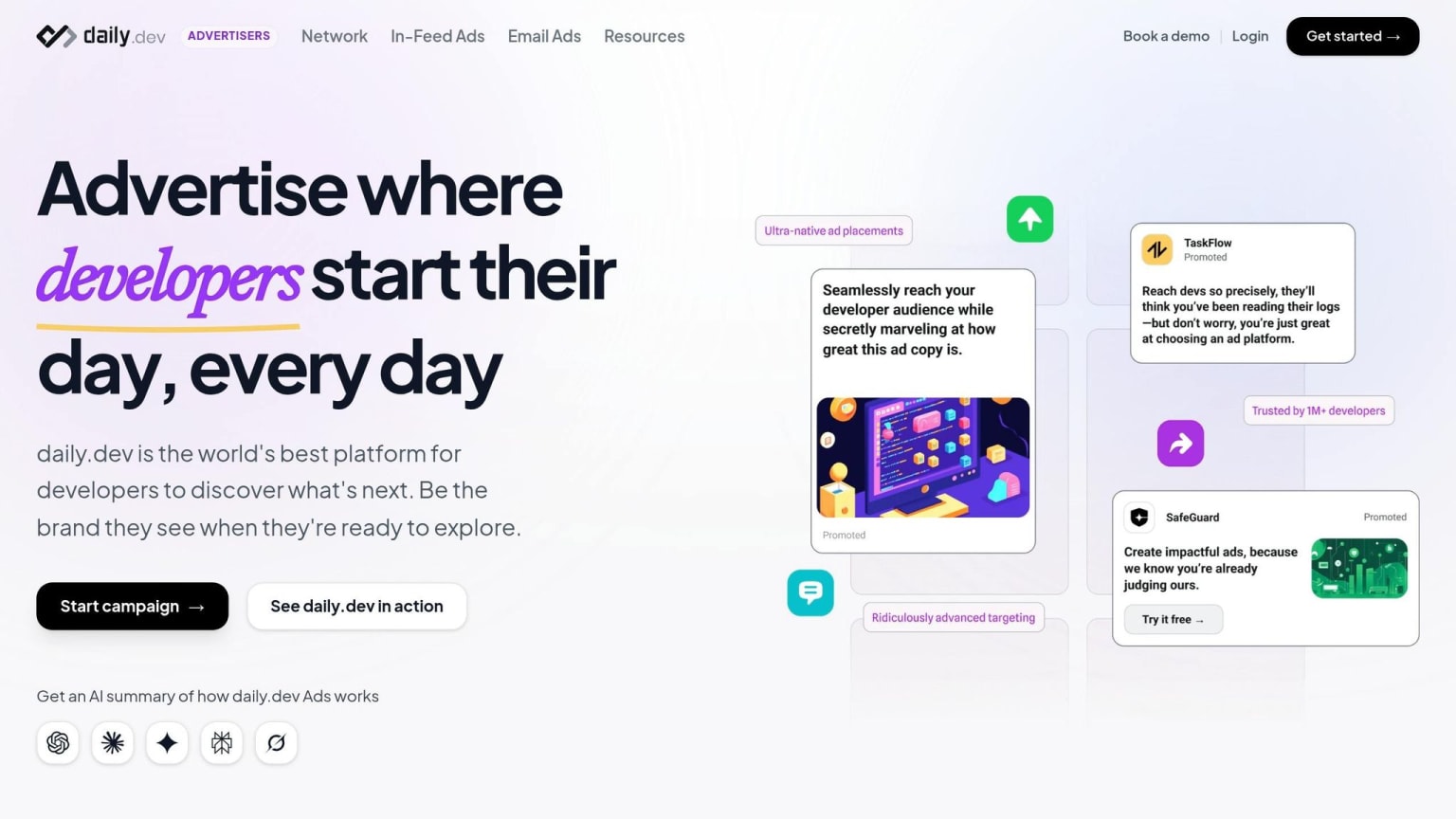
Once you've built a solid organic presence, you might find yourself needing to expand your reach beyond what free methods can achieve. That’s where daily.dev Ads steps in, offering an effective way for bootstrapped founders to connect with developers. Instead of spreading your efforts thin across scattered channels, daily.dev Ads allows you to engage developers directly on a platform they already trust for daily learning and discovery.
With access to over 1 million developers worldwide, daily.dev Ads enables you to target the audience that matters most for your product. These ads blend seamlessly into the developer experience, appearing as part of their regular content consumption. This approach ensures your message feels natural and relevant, creating a more impactful connection.
Use Native Ad Placements for Direct Engagement
daily.dev Ads provides native ad placements - within feeds and post pages - that fit naturally into the platform's content. These placements enhance trust and reduce the risk of your message being ignored. Plus, developers often act as influencers within their teams. Reaching just one developer with a well-placed ad can lead to broader adoption within their organization, sparking organic growth through word-of-mouth.
Target Developers by Skills and Experience
One standout feature of daily.dev Ads is its precise targeting capabilities. You can tailor your ads to reach developers based on their seniority, preferred programming languages, or the tools they use. Whether you’re promoting a debugging tool to Python developers or pitching enterprise solutions to senior engineers, this level of targeting ensures your message resonates with the right audience. By focusing on the developers who stand to gain the most from your product, you can make every advertising dollar count.
Conclusion
Bootstrapped success shows that free marketing can deliver real results. This guide emphasized how genuine engagement and consistent content creation can drive developer adoption. These strategies work because they focus on building trust and offering meaningful value, rather than bombarding developers with promotional noise. While methods like content marketing, community participation, and organic growth might seem slow at first, they yield long-term benefits that often surpass what paid campaigns can achieve.
"The boring answer is the correct answer: show up every day, write something useful, engage genuinely, and let search do the compounding." - Batty, Open Source Developer
The key is starting with the basics: create technical tutorials that address real challenges, participate authentically in developer communities, and optimize your GitHub README as if it were a high-conversion landing page. Consistency is your greatest ally here - regular, steady efforts outperform occasional bursts of activity . These foundational practices pave the way for sustainable growth over time.
Leverage free tools like Google Search Console to track your progress, but understand that results often take 6–12 months to materialize. Organic strategies require patience and persistence, but they build a lasting asset - content that keeps generating leads long after it's published.
Once you've established a solid organic foundation, you can expand your reach with tools like daily.dev Ads. The key is timing your shift from purely organic efforts to targeted paid outreach. Done right, this approach enhances the trust you've built with your audience, rather than undermining it, ensuring that your growth remains authentic and developer-focused.
FAQs
What should I do in my first 30 days of zero-budget marketing?
In the first month, focus on creating a solid base using free and organic strategies. Start by defining your Ideal Customer Profile (ICP) - this helps you understand exactly who you're speaking to. With that clarity, craft a positioning statement that resonates with your target audience.
Dive into content marketing by sharing authentic, founder-led insights on platforms like LinkedIn, Reddit, and Quora. These spaces are great for connecting with potential customers and establishing credibility. Document your journey publicly - this approach not only builds trust but also attracts attention naturally. Finally, tap into your personal network. Whether it’s friends, former colleagues, or industry contacts, their support can kickstart word-of-mouth promotion.
How do I promote in developer communities without getting banned?
To steer clear of bans, prioritize authentic interaction and offering meaningful contributions. Take 1–2 weeks to familiarize yourself with the culture and rules of communities like Reddit or Discord. Observe how members communicate, what topics resonate, and the type of content that gets positive responses.
When you start participating, focus on answering questions, sharing useful resources, and being genuinely helpful. Avoid blatant self-promotion - it’s better to subtly demonstrate how your tool or service addresses specific problems. Building trust is key. For example, on Reddit, accumulating karma by engaging thoughtfully can go a long way in establishing credibility before introducing any promotional content.
Which product features create the most organic sharing for dev tools?
When it comes to getting developers to share your dev tools organically, certain features can make a big difference:
- Useful code snippets: Developers love practical examples they can plug into their projects. Providing snippets that solve common problems or demonstrate key features can encourage sharing.
- Targeted tutorials: Tutorials tailored to specific use cases or audiences help developers see the value of your tool and share it with peers who face similar challenges.
- Building in public: Sharing your development process openly keeps your audience engaged and invested. It also creates opportunities for feedback and word-of-mouth promotion.
- Open-source presence: Being open-source invites contributions from the community. This not only enhances your tool but also increases visibility as developers discuss and recommend it within their networks.