

The way companies advertise to developers is evolving rapidly. By 2026, brands will focus on strategies that respect developers' preferences for privacy, relevance, and technical value. Key trends include:
- AI-driven personalization: Ads tailored to individual developers' interests and project needs.
- Programmatic advertising: Automated ad buying for precise targeting and cost efficiency.
- Native formats: Ads embedded naturally into workflows, like in-feed, post-page, or digest placements.
- Privacy and transparency: Ethical data practices to build trust with developers.
- Real-time analytics: Instant feedback for campaign adjustments and better ROI.
Platforms like daily.dev Ads, with access to over 1,000,000 developers, are leading the way by offering tools that align with developers' needs while maintaining privacy and community focus. The future of developer advertising lies in delivering relevant, respectful, and well-targeted content.
AI-Powered Targeting and Personalization
Artificial intelligence is transforming how brands connect with developers, making campaigns more precise and relevant. Instead of relying on broad, generic outreach, AI helps advertisers pinpoint exactly what a developer needs and delivers the right message at the perfect time.
By analyzing vast amounts of behavioral data - like the programming languages developers use or the types of projects they engage with - AI creates detailed profiles. These profiles allow advertisers to craft messages that resonate on a personal level. Let’s explore how AI fine-tunes targeting and messaging.
How AI Improves Targeting and Messaging
AI is reshaping how brands communicate with developers by aligning messages with their specific technical interests and career stages. For instance, an AI system might notice a developer frequently reading articles about Kubernetes or visiting container orchestration documentation. Using this information, it can tailor messaging to address those interests directly.
Machine learning plays a key role here. It tracks how developers interact across platforms, analyzing which content grabs attention and which gets ignored. AI even generates dynamic content, customizing ad copy, headlines, and technical examples to match individual profiles. For instance, if a developer clicks on an ad for a database management tool, the system learns from that interaction and adjusts future recommendations to align with their preferences.
AI also enables real-time campaign adjustments. If data shows that developers in a certain region respond better to ads highlighting open-source solutions, the system shifts focus accordingly - something traditional advertising methods simply couldn’t achieve.
Predictive analytics is another game-changer. By spotting patterns in how developers explore and adopt new technologies, AI can anticipate their needs. This means reaching developers with solutions they might not even know they’re looking for yet.
Ethical Data Use in AI-Powered Advertising
With AI driving highly personalized campaigns, ethical data practices are more important than ever. Developers are particularly cautious about how their data is collected and used, making trust a critical factor in successful advertising.
Transparency is key. Brands must clearly outline what data is being collected, how it’s used, and the benefits developers gain from sharing it.
Adopting data minimization practices ensures that only relevant information is collected. Instead of hoarding every possible data point, ethical advertisers focus on what’s necessary to improve ad relevance and the developer experience.
Modern consent management goes beyond simple opt-ins. Developers now have more control, allowing them to specify what types of targeting they find helpful and what they’d rather avoid. For example, some might welcome ads about new programming tools but prefer to block recruitment-related content.
To avoid bias, algorithmic fairness ensures AI systems don’t unintentionally exclude certain groups or create uneven opportunities. This means making sure all developers, regardless of background, have equal access to learning about new technologies, job opportunities, or professional growth.
Strong data security measures are non-negotiable. Encryption, secure storage, and regular audits protect sensitive information throughout the AI process, preventing unauthorized access.
Regular algorithm reviews are another safeguard. These audits help identify and resolve potential issues, ensuring that targeting systems work as intended without causing unfair treatment or unintended harm.
Ultimately, the most effective AI-powered advertising platforms earn trust by delivering clear value. When developers see that sharing their preferences leads to more relevant and useful content, they’re more likely to engage with the system. This creates a positive feedback loop: better data leads to better experiences, encouraging more voluntary data sharing. Ethical practices like these will be essential as AI-driven developer advertising continues to evolve.
Programmatic Advertising and Automation Tools
Programmatic advertising takes the hassle out of ad buying by automating the process. Instead of spending time manually negotiating placements and pricing, these platforms rely on algorithms to purchase ad space in real-time, making it a faster and more efficient way to reach developers.
Developers interact with a wide variety of platforms daily - technical documentation sites, coding forums, and even developer news feeds. Programmatic systems analyze where and when developers are most likely to see ads, ensuring your message lands in front of the right audience at the right time.
These platforms go a step further by evaluating user signals like programming language preferences, framework usage, and career stage. When a developer visits a site, the system instantly determines whether they’re a match and bids for the ad placement in milliseconds. This level of precision sets the foundation for the many advantages programmatic advertising offers.
Benefits of Programmatic Advertising
Real-time bidding gives you more control over your budget. Instead of paying fixed rates, you bid on impressions that align with your specific developer audience, ensuring your money is spent effectively.
Cost efficiency eliminates the need for manual negotiations and middlemen, so you only pay market rates based on real-time demand.
Granular audience segmentation allows you to target developers based on detailed metrics like their activity on code repositories, interest in technical content, or participation in industry events. This ensures your ads reach people who are genuinely interested.
Automatic campaign optimization helps improve performance. If your ads perform better on mobile devices at certain times or resonate more with specific groups, the system adjusts budgets and messaging accordingly.
Cross-platform reach ensures your campaign appears consistently across developer-focused websites, mobile apps, and even connected TV platforms, adapting formats seamlessly to fit each channel.
Improved transparency means you’ll know exactly where your ads are running, who’s seeing them, and how much you’re spending. Detailed reporting provides clear insights into the effectiveness of your campaigns.
Comparing Different Automation Approaches
When it comes to programmatic advertising, there are several approaches to consider. Each offers a different balance of control, precision, and complexity, so choosing the right one depends on your goals and resources.
| Approach | Targeting Precision | Scalability | Ease of Integration | Cost Control | Best For |
|---|---|---|---|---|---|
| Real-Time Bidding (RTB) | High – Targets individual impressions | Very High – Broad inventory | Medium – Requires DSP setup | Excellent – Bid-level control | Large campaigns with diverse developer audiences |
| Private Marketplaces | High – Curated developer inventory | Medium – Limited inventory | Easy – Direct integration | Good – Negotiated rates | Premium developer sites and communities |
| Programmatic Direct | Medium – Pre-negotiated audiences | Medium – Fixed inventory | Very Easy – Direct relationships | Fair – Fixed pricing | Specific developer-focused publications |
| Header Bidding | Very High – Multiple demand sources | High – Competitive bidding | Complex – Technical setup | Excellent – Maximizes competition | High-value developer audiences |
Real-Time Bidding (RTB) is ideal for reaching developers across a wide range of sites. It allows for precise targeting based on technical interests and adjusts bids dynamically. However, it does require technical setup and ongoing optimization.
Private Marketplaces offer access to premium, developer-focused inventory that isn’t available on open exchanges. These placements, often on respected sites, come with higher costs and limited scale but provide strong engagement.
Programmatic Direct is a good fit for campaigns targeting specific developer publications. It guarantees ad placements at fixed prices, though it lacks the flexibility of real-time adjustments.
Header Bidding increases your chances of securing valuable impressions by letting multiple demand sources compete for ad space. While effective for high-value audiences, it requires a more advanced technical setup.
The best approach often involves combining methods. For instance, you might use programmatic direct for guaranteed placements on key developer sites while leveraging RTB to expand your reach and fill any gaps. Choosing the right mix ensures your campaign aligns with the expectations and habits of your developer audience.
New Developer Advertising Channels
The way developers encounter advertising is evolving, moving toward native formats that blend effortlessly with the content they’re already engaging with. Unlike traditional banner ads that disrupt the user experience, these newer channels fit naturally into developers’ workflows and the resources they rely on for information. With advanced targeting and automation, these native formats are reshaping how developers interact with advertising.
What makes native advertising effective for developers is its emphasis on offering genuine, relevant content rather than flashy, intrusive messages. Ads that feel like an organic part of trusted platforms tend to foster better engagement while maintaining a seamless user experience.
Native Ads: In-Feed, Post Page, and Digest Ads
In-feed ads are embedded directly into content streams where developers search for updates, tutorials, and industry insights. These ads mimic the design and tone of organic posts, which helps them feel less intrusive. The key to success is ensuring the ad content offers real value to developers, whether they’re just starting out or seasoned professionals.
Post page ads appear alongside or within specific technical content, such as articles on programming languages, tools, or frameworks. Since developers are often in problem-solving mode when reading this type of content, well-placed ads offering relevant solutions can grab attention at the perfect moment.
Digest ads go a step further by appearing in curated email newsletters or personalized content summaries. When these ads highlight tools or resources that align with a developer’s recent interests, they feel more like helpful recommendations than traditional ads.
These native formats are paving the way for specialized platforms tailored specifically for developers.
Using Platforms like daily.dev Ads
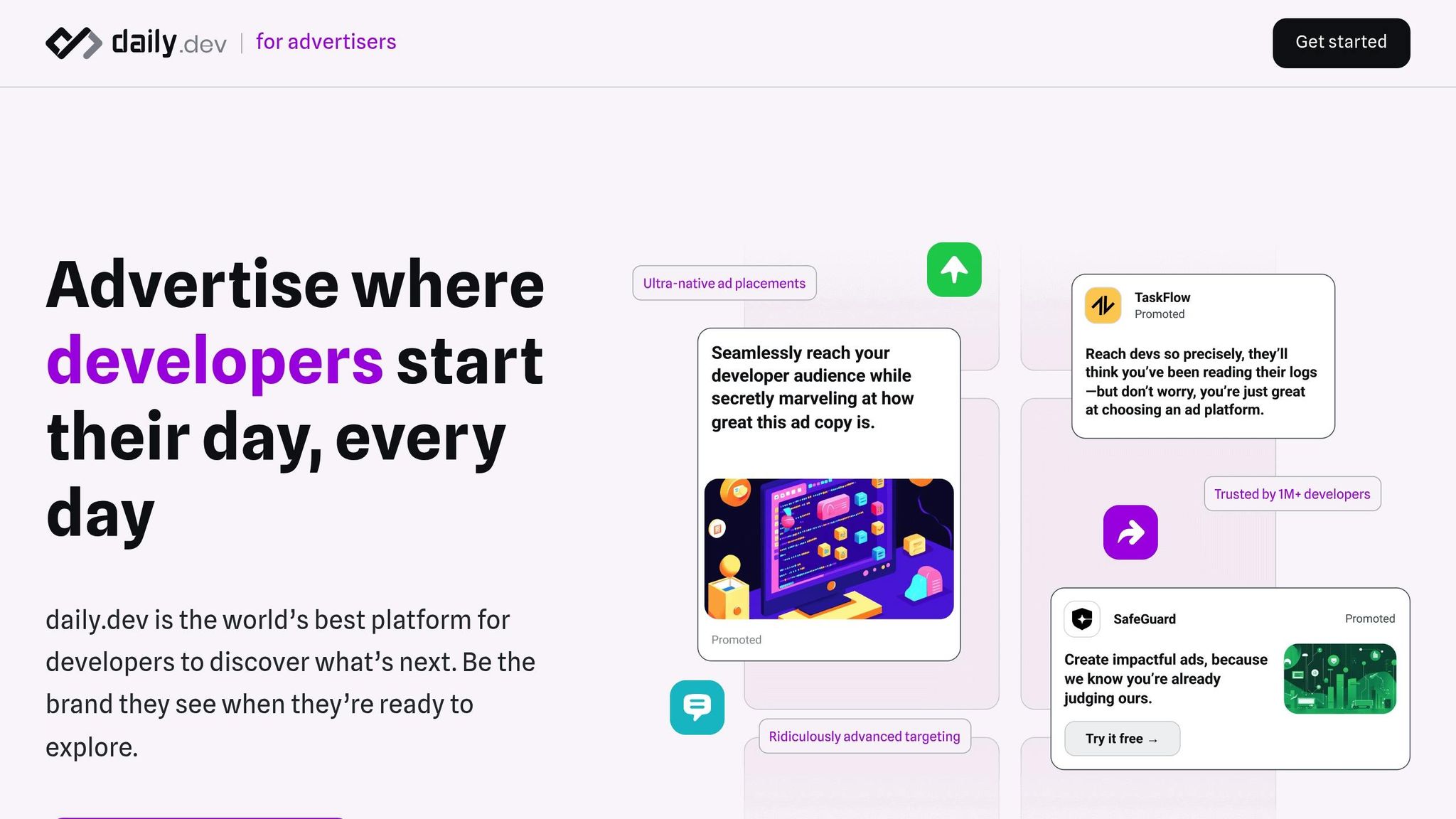
daily.dev Ads is changing the game for developer advertising, reaching over 1,000,000 developers worldwide through a trusted ecosystem built around knowledge sharing and community engagement. The platform’s approach focuses on complementing the developer experience rather than interrupting it.
With precise targeting options, advertisers can reach developers based on factors like their preferred programming languages, level of expertise, or tools they use. For instance, a campaign for a React testing framework can be directed specifically at senior front-end developers, ensuring the message resonates with the right audience.
In-feed placements: Ads are seamlessly integrated into personalized news feeds, where developers discover new technologies and industry updates. These ads benefit from the platform’s tailored content curation, making them feel relevant and engaging.
Post page ads: These appear alongside technical articles or tutorials, ensuring relevance. For example, an ad for a Docker monitoring tool placed next to a guide on containerization best practices feels timely and useful.
Personalized digest ads: Coming soon, these will feature in tailored content summaries based on a developer’s reading habits and interests. By leveraging the trust built through personalized feeds, these ads position products and services as natural extensions of a developer’s learning journey.
daily.dev also prioritizes privacy and fosters a community-oriented environment, making it an ideal space for promoting tools, educational resources, or career opportunities. Developers visit the platform to stay informed, discover new tools, and connect with peers, creating an environment that’s perfect for native advertising.
For advertisers, daily.dev offers real-time performance tracking and expert campaign support, ensuring ads reach the right audience with impactful messaging. This combination of precision, trust, and community focus makes daily.dev a standout platform for reaching developers effectively.
sbb-itb-e54ba74
Data Privacy, Transparency, and Ethics in Developer Advertising
With privacy laws becoming more stringent and third-party cookies on their way out, marketers are facing a new reality where audience insights are harder to come by . These changes are pushing businesses to adopt stricter compliance measures and embrace more transparent practices.
For large organizations, the decline of cookie-based tracking has added layers of complexity to managing customer privacy and securing proper consent . As these challenges grow, businesses must rethink how they approach data collection and user trust.
Key Regulations and Compliance Best Practices
To navigate this evolving landscape, companies need to stay informed about privacy regulations like the General Data Protection Regulation (GDPR) and the California Consumer Privacy Act (CCPA). These frameworks set clear guidelines for how user data should be handled, emphasizing transparency, consent, and accountability. By adhering to these standards, businesses can reduce legal risks while respecting user rights.
Building Trust Through Transparency
Transparency is no longer optional - it’s a cornerstone of building trust with users. Clear communication about how data is collected, stored, and used can make a significant difference in how customers perceive a brand. When companies prioritize openness and ethical practices, they not only comply with regulations but also strengthen their reputation in an increasingly privacy-conscious world.
Measuring Success: Real-Time Analytics and Performance Tracking
Real-time analytics is changing the game for advertisers, especially when it comes to reaching developers. Unlike the old days of waiting weeks for monthly reports, these platforms provide instant feedback on campaign performance. This allows advertisers to tweak their strategies mid-campaign, saving money by avoiding underperforming segments and making adjustments on the fly.
This kind of immediacy is especially useful when targeting developers across multiple channels. With real-time tracking, marketers can pinpoint the best times to engage, fine-tune their ad spend, and adjust messaging based on actual performance data - not just guesses.
Detailed Insights for Campaign Optimization
Modern analytics platforms do much more than track basic metrics like click-through rates or impressions. They offer deeper insights through advanced segmentation, breaking down results by factors like developer roles, programming languages, company sizes, and even geographic regions. This level of detail helps advertisers understand which groups respond best to different types of messaging and creative formats.
Metrics that measure engagement depth are particularly valuable in developer-focused advertising. These include time spent on content, interactions with code examples, and resource downloads. By analyzing these behaviors, advertisers can tailor their content to better align with developers' needs and workflows.
Attribution modeling has also become more advanced, mapping out the entire developer journey - from the first ad view to the final conversion. This holistic perspective sheds light on which touchpoints are most effective and how various channels work together to drive results.
Tools like heat maps and scroll tracking provide additional insights, showing which parts of a landing page grab attention and where users tend to drop off. This data is invaluable for refining both ad creatives and landing pages.
All these insights feed into one ultimate goal: maximizing ROI.
Using Analytics to Drive ROI
With the help of predictive analytics, powered by machine learning, marketers can forecast campaign trends and get recommendations for reallocating budgets. These tools analyze past performance alongside real-time data to uncover patterns that might otherwise go unnoticed.
Automated bidding strategies take things a step further by dynamically adjusting bids based on real-time performance. This ensures ad spend is directed toward high-value opportunities while cutting back on less effective segments.
Cross-channel attribution offers a clearer picture of how different platforms work together to influence developer decisions. By tracking users across multiple touchpoints, advertisers can optimize their media mix and avoid over-investing in platforms that might look successful in isolation but contribute less to overall conversions.
Another powerful tool is real-time A/B testing, which allows advertisers to quickly identify the best-performing ad creatives, landing pages, and targeting strategies. Instead of waiting weeks, winning variations can emerge in just days.
Finally, integrating customer lifetime value (CLV) data with real-time analytics gives advertisers a more complete picture of their campaign’s success. This approach shifts the focus from short-term wins to acquiring high-value developer customers, paving the way for sustainable growth and better long-term returns. These strategies align closely with the evolving trends in developer advertising, ensuring campaigns stay effective and relevant.
Conclusion: Preparing for the Future of Developer Advertising
The landscape of developer advertising is poised for major changes by 2026, driven by advancements in AI targeting, programmatic automation, and native ad formats. These shifts highlight the growing importance of data ethics and transparency in building trust with developer audiences.
To stay ahead, businesses will need to prioritize ethical data practices and leverage real-time analytics to maximize ROI while respecting developers' privacy. Developers are increasingly gravitating toward platforms that not only safeguard their privacy but also offer clear value in return for their engagement.
Platforms like daily.dev Ads are stepping up to meet these expectations. With access to over 1,000,000 developers through personalized feeds and a strong emphasis on community involvement, daily.dev Ads provides a unique opportunity for brands to connect with developers in ways that feel organic and non-intrusive . Its alignment with what developers care about - such as career growth and meaningful engagement - makes it a standout choice for native advertising.
The trends shaping this transformation - from AI-driven personalization to privacy-focused strategies - are redefining how companies can effectively reach developers. Businesses that adapt early by embracing these tools and partnering with developer-centric platforms will be better positioned to thrive in this evolving market.
Ultimately, success in 2026 will depend on delivering targeted, relevant messages while maintaining transparency and trust. The platforms and companies that excel in these areas will set the standard for engaging developer audiences in the years to come.
FAQs
How does AI-driven personalization improve developer advertising?
AI-powered personalization takes developer advertising to the next level by crafting ads that align closely with individual preferences and behaviors. By examining factors like user activity, interests, and engagement patterns, AI ensures that the right message reaches the right audience at the right time.
This method doesn’t just grab attention - it creates a connection. Developers are more likely to engage with ads that feel relevant to their needs, which helps build trust. The result? Higher engagement rates and stronger campaign outcomes.
What ethical factors should be considered when using AI for targeted advertising to developers?
When leveraging AI for targeted advertising aimed at developers, keeping ethical considerations at the forefront is essential. Data privacy should be a top priority - always secure explicit consent before collecting or using personal information, and make sure your practices align with privacy regulations like GDPR or CCPA. It's also crucial to address potential biases in AI algorithms to prevent unfair targeting or the exclusion of specific groups.
Equally important is transparency. Make it clear how AI is being used in your advertising efforts and provide developers with an understanding of why they’re being targeted. Finally, focus on delivering ads that offer genuine value. Respect developers' preferences by steering clear of overly aggressive or irrelevant targeting, ensuring your ads enhance rather than disrupt their experience.
How does programmatic advertising enhance cost efficiency and targeting accuracy for developer audiences?
Programmatic advertising uses AI-powered automation to fine-tune ad performance in real time. It simplifies tasks like bidding, audience targeting, and delivering impressions, helping you make smarter use of your budget.
By processing massive amounts of data, programmatic tools pinpoint the most relevant developer audiences and customize ads to align with their interests. This level of accuracy not only minimizes wasted ad spend but also boosts engagement, making it an effective way to connect with developers.