

Developer advertising in 2026 is defined by four shifts: developers now discover tools inside AI assistants and agent sessions as well as feeds and search, so being cited accurately joined the media plan; native formats (feed cards, sponsored technical content, newsletter slots, product-native placements) are the only ones developers still read; targeting moved to first-party signals such as tech stack and seniority on logged-in developer platforms, with contextual networks as the privacy-safe complement; and proof moved to the advertiser's side, where a pixel with view-through attribution and an incrementality holdout decide renewals. This page sets out each shift with its sources, the channels that work in 2026, where daily.dev Ads fits, and how to improve a campaign now.
What changed in 2026
- AI assistants became a discovery surface with no ad slot. About 80% of respondents to the Stack Overflow Developer Survey 2026 use AI daily, coding assistants and agents are the top use case, and 48% say they trust AI only for low-risk, easily verifiable tasks. Developers ask assistants which tool to use, and the answer comes from cited pages. OpenAI's plan to introduce ads for free ChatGPT users (see our note on it) signals where the surface is heading; for developer tools the practical route today is being cited accurately, which is what daily.dev's Agent Ads (early access) are built for.
- The developer population kept growing and shifting. GitHub's Octoverse 2025 counts over 180 million developers on GitHub, over 36 million of them new in the year, with TypeScript the most-used language by contributors and 4.3 million AI repositories. The audience is larger, younger in tenure and more AI-assisted than the one most media plans were built for.
- Native became the only format that works. Ad blockers, banner blindness and community norms left feed cards, sponsored technical content, newsletter slots and product-native placements as the formats developers read. Programmatic display to developers is the shrinking remainder. See ad blockers and developers.
- Targeting went first-party. With third-party cookies gone, the useful signals are the ones a developer platform observes itself (stack, seniority, topics followed, geography) and the page context a documentation network sees. Cross-site behavioral audiences are gone and were never trusted by this audience. See behavioral vs interest-based targeting.
- Buying moved to scoped, direct deals. Sponsored content with read floors, newsletter slots, monthly product-native sponsorships and homepage sponsorships are bought from the platform or publisher with delivery commitments, and rate cards are shared on request rather than published. See developer ads pricing in 2026.
- Proof moved to the advertiser. Cost per signup, first API call and activation, measured by a pixel with view-through attribution and validated by a holdout, replaced CPM, CPC and CTR as the numbers that decide a renewal. See incrementality for developer campaigns.
New trends in developer advertising
AI visibility as a media line
The "which tool should I use" question is increasingly answered by an assistant from the pages it cites. Advertisers now track share of voice in AI answers alongside impressions, fix the facts assistants get wrong, and buy placements on the pages assistants read. See measuring brand share of voice in AI answers and how to advertise in ChatGPT.
Stack and seniority as the targeting unit
Developer platforms target by the languages, frameworks and tools a developer uses and reads about, and by seniority, rather than by demographics or inferred interests. It is the single biggest lever a developer-native platform offers, and it is privacy-safe because it is first-party. See tech stack targeting.
Sponsored technical content with guarantees
The sponsored article grew up: distribution is guaranteed, a read floor is committed, and the piece is republished canonically to the advertiser's site so the content keeps earning search and AI citations after the campaign. daily.dev calls this Sponsored Content; see sponsored content for developers, how it works.
Product-native placements
Placements inside the product rather than beside it: daily.dev's Engagement Ads (Branded Tags, Keyword Spotlights, Custom Upvotes, Tag Page Takeovers, Stack Placements) and Homepage Sponsorship are sold as monthly or quarterly category sponsorships, built for association over time rather than a one-week burst.
Privacy-first by default
Contextual networks such as EthicalAds and Carbon Ads choose the ad from the page and collect no reader data; logged-in developer platforms target on their own first-party signals. Both satisfy developers' privacy expectations, and both are disclosed. See ethical data use in developer advertising.
Best advertising channels for developers in 2026
| Channel | Developer mode | Targeting | Format | Role | Watch out for |
|---|---|---|---|---|---|
| Developer feed and digest (daily.dev Ads) | Discovery | Stack, seniority, geography, interests | In-Feed Native Ads, Sponsored Content, Engagement Ads, Newsletter Ads, Homepage Sponsorship, Agent Ads | Adoption, launches | Developers only |
| Documentation networks (EthicalAds, Carbon Ads) | Reference | Page context | One unit | Always-on awareness | No behavioral signal |
| Newsletters (TLDR, the stack weeklies) | Routine reading | The newsletter | Sponsorship slot | Predictable reach | Pay per slot |
| Q&A (Stack Overflow Ads) | Problem solving | Tag, topic | Display | Infrastructure awareness | Narrow context |
| Communities (Reddit Ads) | Discussion | Subreddit | Promoted posts | Community awareness | Ad aversion |
| Search (Google Ads) | Searching | Keyword | Search, YouTube | Demand capture | Keyword cost, AI Overviews |
| Professional (LinkedIn Ads) | Career reading | Job title | Sponsored posts, lead forms | Managers and buyers | Price, work mode |
| Video and podcasts | Learning | Channel | Integration, host read | Demos, trust | Production effort |
| AI assistants (Agent Ads, cited pages) | Asking | Prompts | Cited facts | AI visibility | Early access |
The platform-by-platform comparison is in the best developer advertising platforms; the channel map by moment is in top platforms to advertise to developers.
Where daily.dev Ads fits
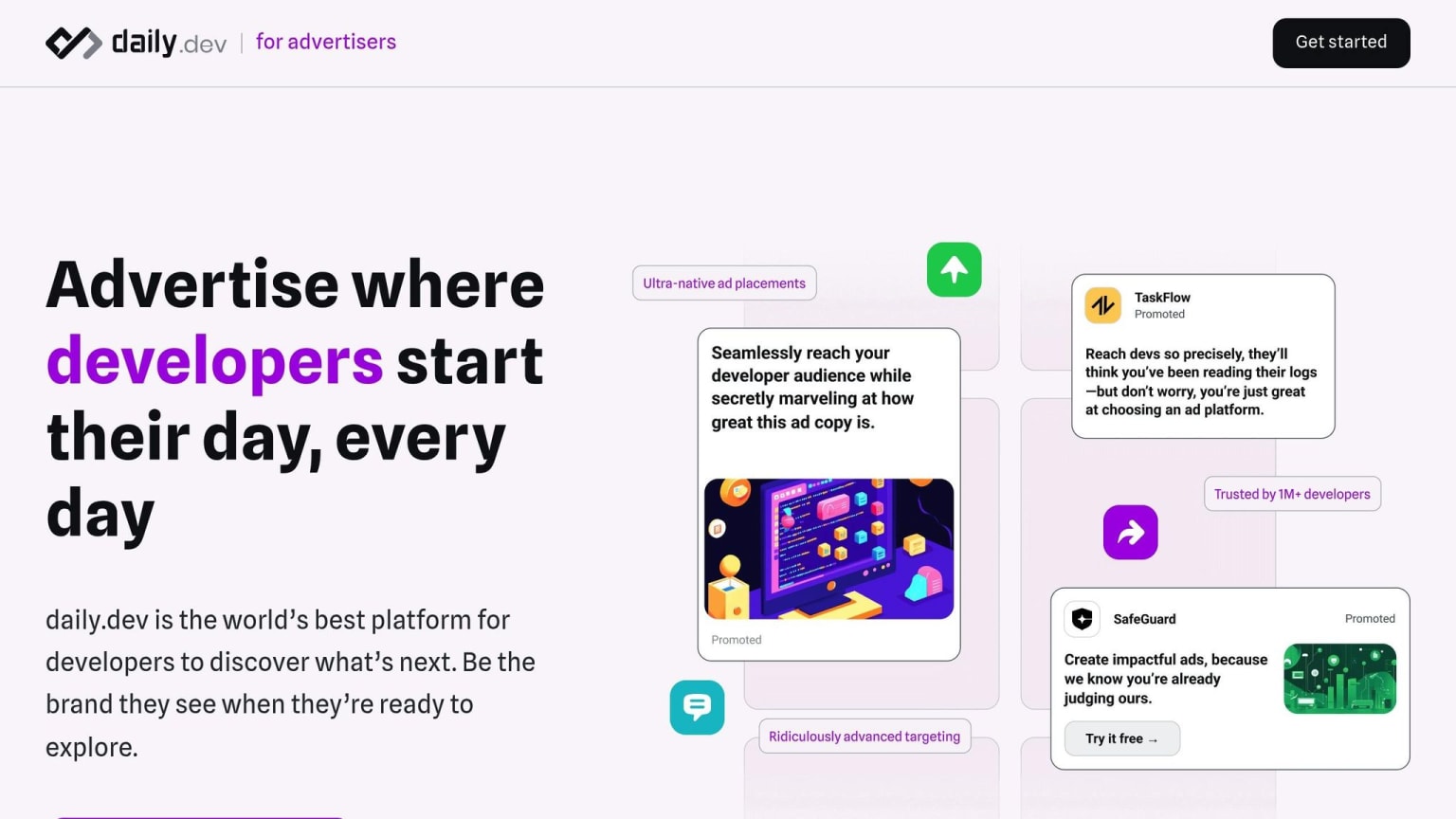
daily.dev is the feed and Digest millions of developers read every day, and daily.dev Ads is built around the 2026 shifts above: native formats only (In-Feed Native Ads, Sponsored Content with a read floor and canonical republishing, Engagement Ads, Newsletter Ads by topical track, Homepage Sponsorship), first-party targeting by stack, seniority, geography and interests, Agent Ads for the AI layer, and one conversion pixel with view-through attribution across every format. Two published results set expectations: Postmark drove 12.8x more new account signups from daily.dev than from Reddit, and context.dev peaked at a 1.27% CTR on In-Feed ads, about three times the industry benchmark. Documentation networks, newsletters, search and LinkedIn are complements; the alternatives hub compares each honestly.
How to improve your developer advertising campaigns in 2026
- Install the pixel and define the product action before buying. Signup, first API call or activation, with view-through on.
- Scope one audience per campaign by stack and seniority, never "developers".
- Write verifiable creative in the product's own words, disclosed, sent to docs or a sandbox. See developer ad creatives that actually work.
- Pair discovery with always-on and capture: a feed placement, a documentation unit, search on category terms.
- Check what AI assistants say about the product monthly and fix the pages they cite.
- Run a holdout and judge on cost per activated user, then move budget to what converts. See how to measure developer ad campaign ROI.
- Time it to the developer calendar. See developer attention has seasons.
Conclusion, developer advertising in 2026
The audience is bigger and more AI-assisted, the formats that work are native and disclosed, the targeting that works is first-party, the buying is scoped and direct, and the proof is on the advertiser's side. Programs built on those five facts grow; programs built on display, third-party audiences and click reports are the ones developers have learned to ignore. A campaign on daily.dev gets scoped through the onboarding form.
FAQs
What is the biggest change in developer advertising in 2026?
AI assistants as a discovery surface. Developers ask ChatGPT, Claude, Perplexity and Google's AI Mode which tool to use, the answer is assembled from cited pages, and there is no ad slot in it, so being cited accurately now sits next to the media plan.
Do developers still respond to ads?
Yes, to native, specific, disclosed placements where they are already evaluating tools: context.dev's In-Feed campaign on daily.dev peaked at a 1.27% CTR. They block and ignore generic display, which is why it has left most developer media plans.
What targeting works for developers now?
First-party signals on developer platforms (tech stack, seniority, topics followed, geography) and page context on documentation networks. Cross-site behavioral audiences are gone with third-party cookies and were never trusted by developers.
How are developer ads priced in 2026?
CPM on feeds and networks, per click on search, per slot on newsletters, and scoped campaigns or monthly sponsorships on developer-native platforms, with rate cards shared on request. Judge every channel on cost per product action rather than CPM.
How do you measure developer advertising in 2026?
With a pixel that attributes signups and activations including view-through, a holdout or geo split to prove incrementality, branded search for awareness, and share of voice in AI answers for the AI layer. Platform click reports are leading indicators only.