

Developers often ignore traditional ads but engage with sponsorships that add value and align with trusted communities. Sponsoring developer groups, open-source projects, or content platforms can drive better engagement, trust, and business outcomes. For instance, Twilio's $500,000 sponsorship of Node.js led to a 28% increase in developer sign-ups and $15M in pipeline revenue. To succeed, focus on:
- Types of Sponsorships: Open-source projects (e.g., GitHub), community platforms (e.g., Discord), and media (e.g., newsletters).
- Evaluation Framework: Use a scorecard to assess audience quality, engagement, ICP alignment, cost efficiency, and scalability.
- Effective Activation: Negotiate for content integration, speaking slots, and data access. Run activities like hackathons, bounties, or exclusive content to engage developers.
- Measuring ROI: Track metrics tied to revenue, like conversion rates and lifetime value, while avoiding vanity metrics.
The key is to invest in partnerships that align with your goals while respecting the community's norms and values.
Types of Developer Community Sponsorships
Developer community sponsorships fall into three main categories, each offering a direct connection to technical audiences. By understanding these options, you can better align your marketing goals and budget with channels that enhance your brand’s credibility. Each type has distinct benefits that shape how you evaluate sponsorship success and negotiate deals.
Open Source Projects
Sponsoring open source projects - typically found on platforms like GitHub - lets your brand contribute to the sustainability of these initiatives while reflecting the community's core values of collaboration and giving back. This kind of sponsorship resonates deeply with developers and fosters trust within the community.
Community Platforms and Groups
Private spaces like Discord and Slack groups offer developers a place to exchange candid insights and recommendations away from public scrutiny. With Discord alone hosting around 200 million monthly active users, these platforms encourage peer-to-peer interactions built on trust. Deals originating from these communities often close twice as fast as traditional leads. As the RevSure team puts it:
Growth is shifting from interruption to participation.
To succeed here, authenticity is key. Avoid automation or intrusive tactics that might alienate the audience.
Media and Content Sponsorships
Newsletters, podcasts, and platforms like daily.dev provide opportunities to embed your brand into the content developers already trust and engage with. This approach ensures ongoing visibility and scalable reach, targeting audiences based on programming languages and experience levels. With cold outreach reply rates dropping below 6%, content sponsorships offer a more effective way to connect with developers where they are most attentive. For example, daily.dev for Business offers native ad placements in its developer feed, reaching over 1 million developers with precise targeting.
How to Evaluate Sponsorship Opportunities
::: @figure 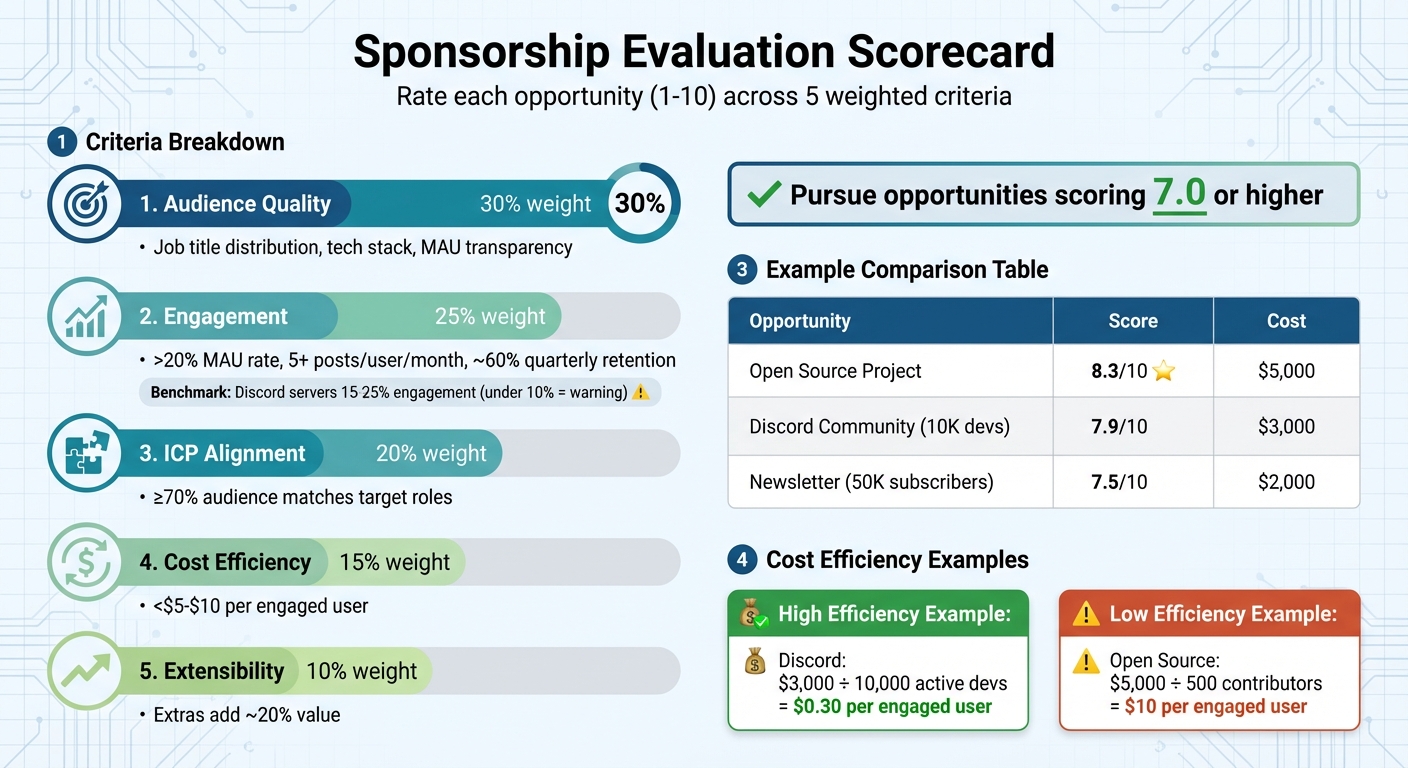 {Developer Sponsorship Evaluation Scorecard Framework}
Developer communities can differ greatly in their potential impact. To make sure you're investing wisely, it's important to have a clear process for evaluating sponsorship opportunities. This helps you identify partnerships that drive results instead of wasting resources on efforts that don't contribute to pipeline growth or brand credibility.
Using a Sponsorship Scorecard
A sponsorship scorecard provides a consistent way to compare different opportunities. Here's how it works: rate each opportunity across five key criteria - audience quality (30%), engagement (25%), ICP alignment (20%), cost efficiency (15%), and extensibility (10%). Assign a score from 1 to 10 for each category, multiply it by its weight, and add up the results to get a final score.
Audience quality reflects how closely the community aligns with your target audience. For example, if you're targeting senior backend engineers in fintech, ask for details like job title distributions, tech stack preferences, and anonymized member profiles. Communities that share monthly active user data show a level of transparency worth noting.
Engagement measures how active the community is. Look for metrics like monthly active user rates above 20%, over five posts per user per month, and quarterly retention rates near 60% . For instance, Discord developer servers often show engagement rates between 15% and 25%. Anything under 10% might suggest a less active group.
ICP alignment compares the community's makeup to your ideal customer profile. A strong fit is when at least 70% of the audience matches your target roles and challenges . For example, a payments API company would get more qualified leads from a Node.js fintech community than a general web development newsletter.
Cost efficiency looks at the cost per engaged developer. Divide the total sponsorship cost by the number of monthly active users. Aim for costs under $5–$10 per engaged user. Extras like speaking slots or data access can bump the value by around 20% . For example, a $3,000 Discord sponsorship reaching 10,000 active developers (about $0.30 per engaged user) could outperform a $5,000 open source project with just 500 contributors (about $10 per engaged user).
Here’s an example of how this might look in practice:
| Opportunity | Audience Quality (1–10) | Engagement (1–10) | ICP Match (1–10) | Cost Efficiency (1–10) | Total Score | Cost |
|---|---|---|---|---|---|---|
| Open Source Project | 9 | 8 | 9 | 7 | 8.3/10 | $5,000 |
| Discord Community (10K devs) | 7 | 9 | 8 | 8 | 7.9/10 | $3,000 |
| Newsletter (50K subscribers) | 8 | 6 | 7 | 9 | 7.5/10 | $2,000 |
Opportunities with scores of 7.0 or higher are generally worth pursuing. Adjust the weights to match your goals - if you're focused on awareness, prioritize reach; for conversions, emphasize ICP alignment .
Reach vs. Influence Tradeoffs
Broad-reach sponsorships are great for building awareness at the top of the funnel. Platforms with over 100,000 developers often offer lower CPMs (around $5–$15) and can help you scale quickly, though conversion rates may be lower . These are ideal for launching new products or entering new markets.
On the flip side, high-influence sponsorships focus on smaller, more engaged communities where trust is stronger. For example, a Slack group of 1,000 senior developers with a 40% engagement rate can drive more meaningful pipeline results than a newsletter with 50,000 casual readers . According to 2022 GitHub sponsor analytics, communities with fewer than 10,000 members can deliver 2.5× better pipeline influence. This makes them a smart choice for high-ticket or complex products where peer recommendations carry weight.
It's not always an either-or decision. Take Stripe, for instance - they leaned into influence by sponsoring small open source projects with 500 core contributors, which led to measurable pipeline results. Meanwhile, Twilio balanced both approaches by using meetups for broad brand exposure (reaching 10,000 attendees) and tracking referral codes at niche hackathons . The key is aligning your strategy with your funnel stage: use reach for awareness and influence for conversions.
These methods give you the tools to evaluate sponsorships and set the foundation for successful partnerships.
Structuring and Activating Sponsorship Deals
What to Negotiate in Sponsorship Packages
Sponsorship deals go far beyond just slapping a logo on a website or event banner. The real opportunity lies in content integration, speaking opportunities, data access, and co-marketing rights . For example, when negotiating content integration, aim for more than just ads - ask for sponsored blog posts or newsletters that highlight how your product solves real-world problems. Stripe, for instance, sponsors open-source projects and integrates tutorials directly into project documentation. This approach fosters genuine engagement rather than just passive impressions .
Speaking opportunities are another powerful tool. Think about securing slots for exclusive AMAs, lightning talks, or panel discussions during virtual events. These sessions allow for direct interaction with your target audience, and you can reuse the content later. GitHub has effectively used developer podcasts for technical deep dives, tailoring topics to their ideal customers and even including post-event lead capture forms to track impact .
When it comes to data, request anonymized analytics to track how people engage with your sponsored content. Look for metrics like click-through rates, engagement levels, or audience demographics. Some platforms, like daily.dev, even offer dashboards that let you measure ROI directly .
Finally, co-marketing rights can help you extend your reach. By working together on campaigns, you can amplify visibility and engagement. Be sure to set clear goals, such as "a 20% increase in qualified leads from community referrals within six months", and include measurable KPIs, timelines, and reporting requirements in your agreements . With these elements in place, you're ready to turn your sponsorship terms into actionable strategies.
Sponsorship Activation Ideas
Once you've nailed down the details, it's time to bring those sponsorships to life with activities that truly engage your audience. Themed hackathons are a great way to encourage product trials. For instance, GitHub’s 2022 sponsorship of the RustConf hackathon offered $10,000 in bounties for Rust-based tools. The result? Over 150 submissions, 25 merged pull requests, and a 40% uptick in GitHub Actions adoption among participants . Similarly, Twilio's 2023 developer bounty program, run in Slack communities, offered $25,000 in prizes for SMS API integrations and generated $500,000 in pipeline influence .
If you're looking for deeper engagement, consider bounty programs for open-source contributions. These could include bug or feature bounties, with rewards ranging from $500 to $10,000 per milestone. Adding leaderboards and branding can further motivate participants. GitHub Sponsors data shows that these programs often see completion rates of 30–50%, boosting code contributions and strengthening community ties . Another idea is hosting 30-day coding challenges or build-along series in platforms like Discord or Slack. These events, which feature weekly milestones, exclusive support channels, and recognition in newsletters, can attract hundreds of submissions .
Exclusive content is another way to build loyalty. Think about offering members-only webinars or early API access, gated behind community sign-ups. Measure success with metrics like sign-up conversion rates (aim for 10–15%) and Net Promoter Scores from post-event surveys . Stripe took this approach at DevRelCon 2024, combining speaking slots with a hackathon. This strategy gave them access to 5,000 attendee profiles, resulting in 12 qualified leads, a 25% brand lift, 300 hackathon participants, and five shipped integrations .
To ensure your activations resonate, collaborate with community leaders to design challenges that feel authentic. Include performance reviews at 30, 60, and 90 days in your agreements to adjust based on early results. Done right, these activations can boost your visibility, strengthen your credibility, and deliver measurable ROI .
sbb-itb-e54ba74
Measuring Sponsorship ROI
Attribution and Performance Metrics
When evaluating sponsorship ROI, skip vanity metrics like total community members or the sheer number of messages exchanged. Instead, focus on metrics tied to revenue and business outcomes. In 2026, a surprising 87% of community teams still prioritize engagement volume over quality, often overlooking metrics that reflect true business impact . A smarter approach is to use cohort analysis: segment users into groups like High, Medium, Low, and None based on their engagement levels. Then, compare these groups in terms of conversion rates, lifetime value (LTV), and churn rates.
To get a full picture of your sponsorship’s effectiveness, integrate your community data with your CRM and product analytics. This allows you to track the entire customer journey, from the first interaction to revenue generation. Studies show that customers who actively engage with a community tend to have 15–30% higher LTV and adopt new features 25–40% faster .
Assign weight to each action based on its actual business impact using a Business Impact Score. For example, a developer who creates a technical tutorial that reduces support tickets should be credited more than someone who corrects a typo. Additionally, track your Peer-to-Peer Support Ratio (aim for 3:1 or higher) to measure the community's ability to solve issues independently . Another key metric to monitor is unprompted advocacy - organic mentions on platforms like Stack Overflow, Reddit, and GitHub. These mentions often signal increased trust and brand recognition.
For timelines, apply the 90-Day Active Contributor Test: this measures the percentage of first-time contributors who return within 90 days to make meaningful contributions. Healthy developer communities typically see return rates of 25–40% . This metric filters out one-time signups and highlights whether the sponsorship is fostering lasting relationships or just driving temporary spikes in activity.
By focusing on these metrics, you can create a solid foundation for improving sponsorship ROI. Up next, we’ll look at how daily.dev for Business simplifies performance tracking.
How daily.dev for Business Tracks Sponsorship Performance
Using the metrics outlined above, daily.dev for Business provides real-time performance tracking through dashboards that connect sponsorship activities directly to measurable business results. Unlike traditional sponsorships that require manual data integration, this platform automates the process, tracking metrics like click-through rates (CTR), engagement levels, and conversions for native ad placements within the developer feed.
What sets daily.dev apart is its precision targeting. You can target specific developer segments based on factors like seniority, programming languages, and tools. This means you’ll know exactly which audience groups are engaging with your sponsored content and how that engagement translates into actions like product trials or demo requests. This detailed data allows you to adjust campaigns on the fly instead of waiting months for results. With CTR benchmarks ranging from 2-3.5%, significantly outperforming generic display ads, you’ll be able to quickly identify successful strategies and scale them effectively .
Common Mistakes in Developer Sponsorships
Being Too Sales-Focused
Developers have a knack for spotting marketing fluff. When sponsorships lean heavily on product demos and sales pitches instead of offering real technical value, the response can be swift - and often negative. According to a 2023 Stack Overflow survey, 62% of developers distrust brands that approach them with overt sales messaging, compared to just 18% for those focusing on value-driven interactions .
"Developers aren't your typical audience - they can smell marketing BS from miles away, and once you lose their trust, it's nearly impossible to win it back." - Nimrod Kramer, CEO, daily.dev
Take Fastly's 2021 sponsorship misstep as an example. Their aggressive email campaigns promoting an open-source project backfired, leading project maintainers to publicly sever ties. The fallout? A 25% drop in GitHub stars for related repositories and a wave of criticism on platforms like Hacker News . The takeaway here is clear: dedicate at least 70% of your sponsorship budget to non-promotional activities like bounties, educational initiatives, or free API credits. Measure success through engagement and community sentiment rather than focusing solely on immediate lead generation .
Ignoring Community Culture
While blatant promotional efforts can alienate developers, failing to respect a community's culture can be just as damaging. Each developer community has its own set of unwritten rules, and ignoring these norms can tarnish your reputation. For instance, a tech company sponsoring a Discord community disregarded a "no ads" rule by plastering banners throughout the server. The result? A 60% drop in membership and public criticism on Twitter that hurt their recruitment efforts .
Before committing to sponsorship, take the time to understand the community's culture. Conduct a "culture audit" by reviewing guidelines, analyzing previous sponsor interactions, and observing how members engage. A simple scorecard can help assess cultural fit (30%), engagement quality (40%), and alignment with your target audience (30%). For instance, open-source communities often value technical contributions and meritocracy, while casual meetup groups might prioritize networking and knowledge exchange. Ignoring these nuances can lead to being blacklisted from future opportunities .
One-Off Campaigns Without Follow-Through
Tone and cultural fit are crucial, but so is consistency. Developers appreciate sustained engagement over fleeting sponsorships. One-off campaigns may offer short-term visibility but rarely build lasting loyalty. Data from developer platforms reveals that one-time sponsors experience 50% lower pipeline influence compared to those with ongoing partnerships . Moreover, 80% of community managers cite a lack of follow-through as the top reason sponsorships fail to deliver long-term results.
Consider Uber's 2019 sponsorship of a Rust community meetup. Despite the initial success, Uber failed to maintain engagement, leaving organizers feeling exploited. Attendance at subsequent events for similar sponsors dropped by 15%, and Uber was eventually barred from future sponsorship slots . Instead, consider a 12-month plan with regular check-ins, feedback loops, and escalating commitments like co-hosted events. A multi-year approach can solidify relationships, as seen with Stripe's consistent support for open-source projects, which led to a 25% increase in brand preference among developers .
Each of these mistakes chips away at the long-term benefits of your sponsorship efforts.
| Mistake | Impact | Avoidance Strategy |
|---|---|---|
| Too Sales-Focused | 62% developer distrust | Focus on utility (e.g., free tools, bounties) |
| Ignoring Culture | Bans and public backlash | Audit guidelines and observe community norms first |
| One-Off Campaigns | 50% lower pipeline influence | Commit to 6–12 month partnerships with regular touchpoints |
Wrapping It Up
Achieving results with developer community sponsorships takes a thoughtful approach. Start by evaluating opportunities with a scorecard that prioritizes audience quality, engagement, and alignment with your ideal customer profile (ICP). Then, structure your deals to go beyond just slapping your logo on something - negotiate for things like content integration, speaking opportunities, and access to valuable data. Finally, activate and measure your efforts with tools like attribution tracking, brand lift studies, and metrics that tie back to your pipeline, leaving vanity numbers behind.
The real difference between sponsorships that succeed and those that flop? Authenticity and consistency. Commit to long-term partnerships that include regular touchpoints and feedback loops, showing you’re genuinely invested in the community.
If you’re a marketing manager looking to scale these efforts without the headache, daily.dev for Business offers a streamlined solution. With native advertising in the developer feed, you can target by seniority, programming languages, and tools while tracking performance in real time. This eliminates the guesswork of evaluating individual communities while maintaining the authentic engagement developers value.
This framework pairs perfectly with daily.dev's performance-focused tools. Build your evaluation scorecard today, and see how daily.dev's network can connect you with over 1 million developers in a way that delivers measurable results. Want to dig deeper into earning developer trust? Don’t miss our guide on how Stripe, Twilio, and GitHub built dev trust.
FAQs
How do I choose the best developer community to sponsor?
When deciding which developer community to sponsor, it's all about finding the right fit for your audience and product. Look for communities that align with your niche, such as open source projects, Slack or Discord groups, or local meetups. These spaces should naturally attract the kind of developers you're aiming to connect with.
Instead of getting distracted by vanity metrics like follower counts, focus on engagement. Are members actively participating? Do they share ideas, collaborate, or ask questions? Authentic interactions matter far more than inflated numbers.
Lastly, think about the partnership potential. Can you integrate your brand into their content or collaborate on co-marketing efforts? The goal is to create a partnership that feels meaningful, drives engagement, and delivers a solid return on investment.
What should I negotiate besides logo placement?
Beyond simply placing your logo, think about negotiating for extras like content integration, speaking opportunities, access to data, and co-marketing initiatives. These additions can help you connect more meaningfully with the developer community and make your sponsorship efforts far more impactful.
How can I prove developer sponsorship ROI to leadership?
To demonstrate the ROI of developer sponsorships, it's essential to focus on measurable results like developer engagement, product adoption, and community impact. Key metrics to track include:
- API usage: How often developers are interacting with your APIs.
- SDK downloads: The number of times your software development kits are being downloaded.
- Onboarding completion rates: The percentage of developers successfully completing the onboarding process.
In addition to these numbers, qualitative insights play a crucial role. Consider factors like community feedback and changes in brand perception to paint a more complete picture. These insights help show how sponsorships contribute to building trust, encouraging product adoption, and aligning with broader business goals.
To make your case even stronger, leverage tools like attribution models and brand lift studies. These can provide deeper evidence of the sponsorship's impact, tying it directly to tangible business outcomes.