

Want your tools on every developer's radar? Here’s the deal: most developers discover tools through peers, communities, and self-service options - not through ads or cold outreach. By the time they’re ready to buy, 95% of B2B buyers already have a shortlist of four vendors. If you’re not on that list, you’re out.
Key Takeaways:
- Demand generation vs. lead generation: Demand generation builds awareness and trust long before developers are ready to buy. Lead generation captures interest when they’re ready to act.
- Developer behavior: Developers prefer hands-on testing, clear documentation, and peer recommendations. Over 60% use ad blockers, and 47% start vendor research with AI tools like ChatGPT.
- Content that works: Tutorials, technical deep dives, and quality documentation drive developer interest. AI visibility and community engagement are key to staying relevant.
- Metrics that matter: Focus on Product Qualified Leads (PQLs), Time to First Value (TTFV), and branded search volume. Traditional lead-gen metrics miss the mark here.
The Bottom Line: Developers trust technical proof over flashy marketing. To win, prioritize authentic, solution-oriented content and meet developers where they already hang out - online communities, GitHub, and AI tools.
1. How Developer Demand Generation Works
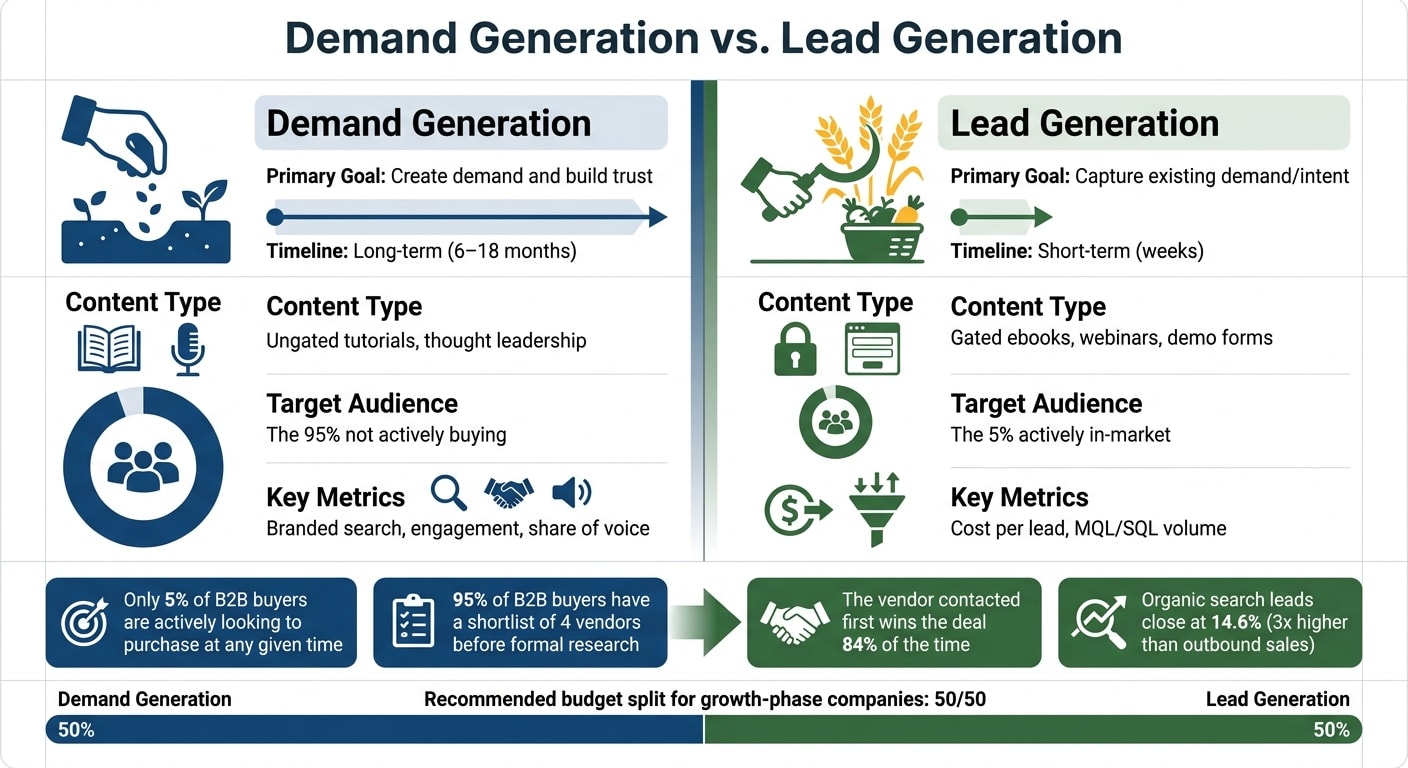
Developer demand generation is a long game, typically unfolding over 6–18 months instead of delivering quick results in a matter of weeks . The aim here is to build awareness and trust so that your product is already on a developer's radar before they even begin a formal evaluation.
Why does this matter? Because only 5% of B2B buyers are actively looking to make a purchase at any given time . Traditional lead generation focuses on competing for this small slice of the market. In contrast, demand generation nurtures the remaining 95% - those who may not be ready to buy now but could in the future. And here’s a key insight: the vendor contacted first wins the deal 84% of the time. Plus, leads from organic search close at a rate of 14.6%, which is more than three times the average for outbound sales .
1.1 Demand Generation vs. Lead Generation
Although demand generation and lead generation are both vital, they play very different roles in your marketing efforts. Demand generation lays the groundwork by creating awareness, building trust, and influencing preferences long before a developer is ready to make a purchase. On the other hand, lead generation focuses on capturing existing interest through tactics like demo requests, gated content, and direct outreach .
Think of demand generation as planting seeds - it involves creating ungated content like tutorials, technical post-mortems, and participating in developer communities. Lead generation, by contrast, is about harvesting the fruits of that effort, using tools like webinars, ebooks, and demo forms to convert interest into actionable leads. If you skip the step of planting awareness, you’re essentially trying to harvest from a field you never prepared.
The metrics also reflect this difference. Demand generation focuses on things like branded search volume, engagement, and visibility in developer communities. Lead generation, meanwhile, zeroes in on metrics like cost per lead and marketing-qualified lead (MQL) volume. For companies in the growth phase, a balanced approach - splitting budgets 50/50 - can help you build a pipeline for the future while still capturing immediate opportunities .
| Feature | Demand Generation | Lead Generation |
|---|---|---|
| Primary Goal | Create demand and build trust | Capture existing demand/intent |
| Timeline | Long-term (6–18 months) | Short-term (weeks) |
| Content Type | Ungated tutorials, thought leadership | Gated ebooks, webinars, demo forms |
| Target Audience | The 95% not actively buying | The 5% actively in-market |
| Key Metrics | Branded search, engagement, share of voice | Cost per lead, MQL/SQL volume |
Next, let’s look at how developers themselves drive this bottom-up approach to adoption.
1.2 How Developers Drive Bottom-Up Adoption
Developers have reshaped the traditional B2B buying process. They often discover tools through peer recommendations, hands-on testing, and integrating new tools into their daily workflows. Once a tool proves its value, developers frequently become internal advocates, championing its broader adoption within their organizations - even if they don’t control the budget .
Elizabeth Epton, Senior Content Marketing Manager at Blues, puts it this way:
"Developers have increasing influence on purchasing decisions, even if they don't hold the budget themselves."
This influence comes from their role as trusted ambassadors. Instead of responding to sales pitches, they generate leads organically through word-of-mouth and technical credibility.
But here’s the catch: developers are quick to dismiss traditional marketing tactics. They prefer hands-on experiences like free trials and APIs, and they trust peer validation - things like GitHub stars, Stack Overflow discussions, or active community engagement - far more than polished vendor case studies . Approaches like cold outreach or gated content can feel like obstacles, creating friction where developers expect smooth, self-service access. As Epton explains:
"Developers can smell a non-technical sales pitch from a mile away, and nothing makes them close a tab faster than buzzwords without substance."
This means successful demand generation for developers requires technical depth. Providing detailed documentation, practical tutorials with real code examples, and insights from engineers builds the kind of authenticity that resonates. In fact, 73% of decision-makers view thought leadership as more trustworthy than standard marketing materials . Additionally, expert-authored content is 3.2 times more likely to be cited by AI models .
This developer-driven process is at the heart of effective demand generation, setting the stage for the targeted strategies and community-focused approaches we’ll explore later.
2. Building Your Developer ICP
Before you can create demand, you need a clear picture of who you're targeting. An Ideal Customer Profile (ICP) tailored for developers is not the same as a traditional B2B profile. Titles like "Software Engineer" or "DevOps Engineer" don’t always reveal the full story about a developer's tool preferences, challenges, or their role in purchasing decisions .
This is a lesson many industry leaders have learned the hard way. Boris Jabes, Co-founder and CEO of Census, shared:
"I didn't think about ICPs whatsoever. However, looking back, that's part of the reason PMF took so much time."
Similarly, Mathilde Collin, Co-founder and CEO of Front, reflected:
"We did not think about ICP. I wish we did earlier on. It's one of my biggest mistakes."
A developer ICP prioritizes technical context over metrics like company size or revenue. You’ll want to understand the coding languages they use, the frameworks they depend on, and the signals they leave on platforms like GitHub or Stack Overflow. This shift from demographics to behavioral insights is what sets successful developer demand generation apart from generic B2B marketing.
Now, let’s break down the key components of an effective Developer ICP.
2.1 What to Include in a Developer ICP
To truly capture how developers work and make decisions, your developer ICP should include these five core elements :
Technical Pain Points: These are the specific challenges developers face daily, like debugging deployment pipelines, managing database migrations, or dealing with unclear API documentation. These aren't broad business issues - they’re tangible workflow bottlenecks.
Desired Outcomes: Developers often aim to grow their skills, stay updated on trends, and use modern tools. If your product can help them achieve these goals, it becomes more than just a solution - it becomes a career asset.
Adoption Blockers: Developers may face hurdles like strict data security policies, compliance requirements, or complicated onboarding processes. Identifying these blockers early allows you to address them in your product design and messaging.
Motivators: What drives developers to push for new tools? It could be reducing repetitive tasks, using cutting-edge technology, or contributing to open-source projects. These motivators can turn individual users into advocates within their teams.
Technology Preferences: Developers’ choices of programming languages (e.g., Python, JavaScript), frameworks (e.g., React, Django), IDEs, and version control systems shape how you reach them and what resonates with them.
2.2 How to Segment Developer Audiences
Once you’ve outlined your ICP, refine your strategy by segmenting your audience based on their role, tech stack, and engagement in developer communities. Here’s how:
By Experience: A junior developer exploring their first API has very different needs compared to a senior engineer managing large-scale, multi-region deployments. Tailoring your approach to their experience level ensures relevance.
By Tech Stack: Developers working with Python have different preferences and community touchpoints than those in the JavaScript ecosystem. Knowing their tech stack helps you decide which newsletters to sponsor, communities to engage with, and examples to provide.
By Community Activity: Developers who actively contribute to GitHub, participate in Stack Overflow discussions, or maintain open-source projects often have more influence than their job titles suggest. Track their activity on platforms like Reddit, Slack groups, and GitHub to identify key players.
By Organizational Traits: A developer at a 50-person startup operates in a very different environment than one at a 5,000-person enterprise. Procurement processes, team structures, and technical needs vary greatly, and understanding these nuances ensures your messaging aligns with their reality.
Ryan Paul Gibson, Founder of Content Lift, explains the value of this behavioral approach:
"Titles are often not a good representation of what people's tasks are or their motivations. A title can be just made up in a business."
3. Content That Creates Developer Demand
When it comes to engaging developers, technical, solution-oriented content is non-negotiable. Developers have a keen sense for authenticity, and they’ll quickly abandon tutorials that feel like thinly veiled product ads. As InfiniteAny Blog puts it:
"Developers can smell a tutorial that is just a product ad, and they will bounce." – InfiniteAny Blog
The most effective content solves real technical challenges. Tutorials that walk through specific problems - like debugging deployment pipelines or setting up OAuth 2.0 - are particularly effective. These guides provide immediate value to developers, even if they don’t end up using your product. Transparent comparisons and detailed experience reports also help build trust and demonstrate your technical expertise.
With the rise of AI-powered research, the quality of your content matters more than ever. By 2026, 47% of enterprise buyers will start vendor research using AI assistants, surpassing Google Search at 43% . Additionally, content written by experts is 3.2× more likely to be cited by large language models compared to generic brand content . This means a well-researched article from your CTO or senior engineer could reach far more developers than dozens of generic blog posts.
Documentation is another powerful tool for generating demand. High-quality docs with runnable "Hello World" examples often outperform paid ads in converting developers. As Louis Corneloup, Founder of Dupple, explains:
"For devtools, documentation is the highest-converting marketing asset. Clear docs with runnable examples produce more signups than any ad."
The secret lies in focusing on time-to-value. Developers should be able to achieve a working result within 5–10 minutes . When they can quickly see the value in your product, they’re more likely to champion it within their teams.
3.1 Technical Content and Thought Leadership
Technical content serves as a cornerstone for building credibility and trust. Tutorials that address specific challenges, architectural decision records that explain technical choices, and posts that share lessons learned from failures all demonstrate expertise.
Thought leadership, authored by founders, CTOs, or senior engineers, provides even greater returns. On average, this type of content generates $14 for every dollar invested, compared to $5 for general content marketing . Developers and technical buyers tend to trust content from experts over that produced by marketing departments. For instance, an in-depth analysis of distributed systems architecture written by your CTO will carry far more weight than a typical company blog post.
Producing high-quality technical content isn’t cheap - it can cost 2–3× more than standard marketing content . However, this investment helps differentiate your brand. As Peter Korpak from 100Signals puts it:
"The competition isn't other experts. It's mediocrity."
To maximize reach, structure your content for AI tools by including concise 30–60 word summaries after major headings and presenting key statistics clearly . This ensures AI assistants can easily cite your work. For example, ContainIQ published 225 high-quality technical articles over 14 months, attracted over 200,000 monthly visitors, and achieved a successful acquisition in 2023 .
3.2 Benchmark Reports and State-of Surveys
Data-driven insights are another way to establish authority. Industry surveys and benchmark reports resonate with developers because they offer personal value - helping them compare their own experiences with global peers. Topics like salary trends, productivity metrics, and tool usage are particularly compelling.
JetBrains’ Developer Ecosystem Survey, which has been running since 2017, is a great example. Their transparent methodology and comprehensive data collection have earned them trust. In their 2024 report, they revealed that 85% of developers regularly use AI tools for coding, while 62% rely on at least one AI assistant . Additionally, 54% of respondents noted they would face a productivity drop of 10% or more without AI tools .
To enhance AI discoverability, include clear statistics and detailed methodology sections in your reports. Sharing these insights on platforms where developers gather - like Reddit, Discord, or Slack - can further amplify your reach. This approach helps position your brand on the "Day One shortlist", the mental list of four vendors that 95% of B2B buyers consider before formal research begins .
3.3 Why Quality Beats Quantity
Developers value depth over volume. A single well-crafted tutorial can signal a well-built product, while a flood of shallow content might suggest the opposite. Only 15% of B2B buyers rate the thought leadership they encounter as "very good" , leaving plenty of room for brands that prioritize quality.
High-quality content also drives higher conversion rates. While generic, high-volume content rarely converts effectively, niche technical pieces often achieve conversion rates of 25% or more by targeting developers with specific needs . Though producing such content costs 2–3× more than standard marketing, it creates a lasting competitive edge that competitors can’t easily replicate.
In 2026, quality becomes even more crucial in the era of AI-driven discovery. Generic SEO content without originality is effectively obsolete . With 73% of developer marketing teams increasing their investments in content marketing and SEO , those who focus on technical depth will stand out. A practical approach is to repurpose your best work: transform a comprehensive technical guide or report into multiple formats - like Twitter threads, LinkedIn posts, or newsletter snippets - to maximize its reach while maintaining its quality.
4. Using Developer Communities and Influencers
Developer communities are not just communication channels - they're spaces where trust is built. According to research, 70% of a developer's buying journey happens in untrackable spaces like private Slack groups, Discord servers, and peer-to-peer conversations . Additionally, with 47% of enterprise buyers now starting vendor research using AI assistants like ChatGPT and Perplexity, it’s crucial to establish credibility in these trusted developer spaces. For instance, a detailed Stack Overflow post from your CTO or a thoughtful GitHub discussion led by a senior engineer can carry far more weight than a dozen generic blog posts. This approach aligns with earlier discussions about creating long-term demand by leveraging peer influence and authentic technical validation.
Let’s dive deeper into how to monitor these community signals for actionable insights.
4.1 Tracking Community Signals
Community signals can help identify where developers are focusing their attention and which tools are gaining traction. For example, GitHub activity provides a clear hierarchy of intent:
- Stars: Indicate awareness and interest for future reference.
- Forks: Suggest active evaluation and experimentation.
- Issues or pull requests: Show deep engagement and problem-solving.
A GitHub star, for instance, represents deliberate interest. Beyond GitHub, other platforms like Hacker News, Reddit programming communities, and curated "Awesome" lists act as powerful discovery tools. Landing on Hacker News' front page or being featured on an "Awesome" list can drive thousands of qualified visits in just a few hours. Moreover, these platforms enhance your AI visibility since language models often rely on them as trusted sources.
Outreach based on these signals is far more effective than traditional cold emails. For example, reaching out to a developer who recently forked your repository with a personalized message can result in reply rates of 15–25%, compared to only 2–5% for generic emails . Timing is key - follow up within 48–72 hours and offer something useful, like a configuration guide or a relevant documentation link, to keep the momentum going.
While tracking signals helps you identify growing interest, collaborating with trusted influencers can amplify your credibility even further.
4.2 Working with Developer Influencers
Developer influencers are practitioners, not traditional marketers. These individuals - senior engineers, architects, and CTOs - build their audiences through tutorials, conference talks, and active participation on platforms like Discord and Stack Overflow . Their technical expertise makes them far more effective at generating trust and pipeline than traditional sales teams.
One effective strategy is forming a Technical Advisory Board (TAB). This board should include influential developers, even those who use competing tools, to provide objective feedback and challenge assumptions. This kind of transparency can significantly boost credibility .
When it comes to distribution, personal profiles often outperform corporate accounts. In 2026, LinkedIn personal accounts captured 65% of feed distribution, while company pages only accounted for 5% . This means that technical breakdowns or insights shared by your founder or technical team will resonate more with developers than identical posts from a corporate page. Encourage your team to share their expertise under their own names to harness this authentic influence.
For external influencers, focus on co-creating content rather than simple sponsorships. Collaborate on projects like joint tutorials or benchmark reports that address real developer problems. One example is Snap Inc.'s Camera Kit team, which hosted regular office hours where developers could share their challenges directly. This approach not only solved real issues but also strengthened advocacy for their tools .
5. Event-Based and Continuous Demand Generation
Developer demand generation thrives on combining event-driven campaigns with always-on initiatives to achieve maximum impact. Event-based efforts, like conferences, hackathons, and webinars, create short bursts of intense engagement. Meanwhile, always-on programs, such as newsletter sponsorships, native ads, and technical content, provide a steady stream of visibility. Research shows that 51% of developer marketing leaders see the highest ROI from community and events, yet 73% are also ramping up investments in content marketing and SEO . This dual focus highlights a key insight: developers require both trust-building interactions and ongoing technical validation throughout their lengthy buying journey, which often spans over 11 months .
These two approaches differ in timing and trust. Events deliver high-trust, high-impact moments - like seeing a senior engineer solve a real-world problem live - that can accelerate leads through the funnel. On the other hand, always-on programs ensure your brand is present in the spaces where 70% of the buyer journey unfolds . With 47% of enterprise buyers now starting vendor research using AI tools , maintaining continuous technical validation across these channels is crucial. As Karl Hughes, Founder of Draft.dev, puts it:
"Awareness isn't enough. Budget holders are asking, 'How does this help us close deals or drive user adoption?'"
Cost structures also differ. Events and webinars average $75 per lead, with conversion rates between 5% and 50% . In contrast, always-on efforts like newsletter sponsorships offer more predictable costs. For example, a Techpresso ad (550,000 subscribers) costs about $3,500 and generates 400–1,000 clicks at a $1.70–$3.00 CPC . DigitalOcean’s eight Techpresso placements led to over 1 million impressions at a similar CPC, outperforming LinkedIn budgets by 5–10x in cost efficiency .
Measuring success requires different timelines. Event campaigns yield quick results, such as MQLs and demo requests, while always-on programs need longer attribution windows. Louis Corneloup, Founder of Dupple, advises:
"If your attribution system only tracks last-click, you're going to underweight newsletter sponsorship every time"
Corneloup recommends a 90-day attribution window for B2B newsletter campaigns, extending to 180 days for enterprise deals, as these campaigns often increase branded search volume by 10–30% . For example, ContainIQ’s consistent content strategy - publishing 225 technical articles in 14 months - helped them reach 200,000 monthly visitors by their 2023 acquisition .
The most effective marketers don’t pick one approach over the other - they layer them. Events act as accelerators for mid-funnel prospects needing technical validation, while always-on programs ensure your brand stays on the "Day One shortlist" that 95% of B2B buyers eventually choose from . Peter Korpak of 100Signals explains it well:
"Demand generation creates awareness and trust. Lead generation captures it. Dev agencies that skip demand gen and go straight to capture are trying to harvest a field they never planted"
Both approaches are essential for sustaining developer engagement.
5.1 Event-Based Demand Campaigns
Events like conferences, hackathons, and webinars create focused opportunities for developers to explore new tools and solutions. These events work because they compress the trust-building process into hours or days. For example, watching a CTO debug a complex system live at KubeCon or building a prototype with your API during a hackathon provides technical validation that no white paper can match.
The ROI from events reflects this intensity. Large conferences (e.g., AWS re:Invent, Google I/O) drive top-of-funnel awareness, while private workshops and meetups validate mid-funnel interest. Companies are increasingly favoring invite-only gatherings over generic regional events to ensure higher-quality interactions and follow-ups .
Hackathons are particularly effective for developer tools. Unlike passive conference sessions, hackathons force participants to actively use your product under time constraints. This not only identifies friction points but also turns successful participants into advocates who share their experiences within their teams and communities.
Webinars strike a balance between in-person events and always-on content. They provide real-time interaction without the cost of travel, making them scalable for global audiences. To stand out in a crowded market, focus on niche technical challenges. For example, a session on "Building Real-Time Data Pipelines with Apache Kafka" will likely engage more developers than a broad overview of data architecture. Recorded webinars can also be repurposed into blog posts, documentation, or social media clips, extending their value.
Timing matters for event-based campaigns. It’s not just about showing up - it’s about creating a coordinated effort. Publish technical content addressing common attendee challenges two weeks before the event, stay active on event communication channels, and follow up within 48–72 hours with personalized outreach. This multi-touch approach captures attention during high-intent phases of evaluation.
5.2 Always-On Awareness Programs
Always-on programs provide the steady visibility that complements event-driven spikes. Newsletter sponsorships, native ads, and regular technical content ensure your brand is consistently present where developers spend their time. This matters because 95% of B2B buyers choose from a "Day One shortlist" of vendors well before active research begins .
Newsletter sponsorships are especially effective for developers since they bypass ad blockers, which over 60% of developers use . Sponsorships in trusted newsletters like Techpresso, TLDR, or Pointer feel more like recommendations than ads. These placements also deliver strong ROI: mid-sized newsletters (100,000–600,000 subscribers) typically cost $1–$3 CPC , far lower than LinkedIn’s $237 per lead for B2B SaaS . Following the "three-campaign rule" helps establish meaningful engagement patterns .
Technical content publishing, while resource-intensive, delivers long-term benefits. For instance, LambdaTest publishes five posts weekly, driving over 1 million monthly visitors . Similarly, ContainIQ’s 225 articles in 14 months helped them reach 200,000 monthly visitors by 2023 . The challenge lies in maintaining quality and relevance. As Mudit Singh, Director of Marketing at LambdaTest, notes:
"We have to refresh content nearly every week, to ensure that past content is still relevant. This is especially true for tutorials"
Although technical content costs 2–3x more than standard marketing content due to the expertise and validation required , it boosts search visibility and recognition by AI tools.
Measuring always-on programs requires patience and precise tracking. Use corporate-domain reports from newsletter publishers to identify which accounts clicked your ads, even without immediate conversions . Track "Assisted Conversions" in Google Analytics 4 to capture early touchpoints in multi-touch journeys . A 10–30% lift in branded search volume during campaigns is a strong indicator of success .
6. Measuring Developer Demand Generation
Tracking developer demand generation requires a distinct approach. A large portion of the developer journey happens in spaces that are difficult to measure - 52% of discovery takes place in private Slack groups, Discord servers, or through word-of-mouth, all of which are invisible to tracking tools . This phenomenon, often referred to as the "dark funnel", means relying solely on last-click attribution misses about 70% of the buyer journey . To counter this, a hybrid measurement framework is essential, blending quantitative multi-touch data with qualitative, self-reported insights.
Switching from Marketing Qualified Leads (MQLs) to Product Qualified Leads (PQLs) redefines what success looks like. PQLs - users who achieve specific technical milestones, like completing an API integration or sending 100 monitoring events - convert at rates 3–5 times higher than traditional form fills . This shift not only improves measurement but also aligns with the technical validation developers prioritize. It's worth noting that 89% of tech companies face challenges in effectively measuring developer-focused go-to-market success . Instead of tracking vanity metrics, focus on activation metrics that predict long-term retention and revenue.
Branded search volume serves as a key indicator: when developers search for terms like "[Your Company] + [Use Case]" on Google, it shows your awareness campaigns are resonating . Additionally, monitoring AI visibility - how often tools like ChatGPT or Perplexity recommend your product for niche-specific queries - can provide early signs of pipeline growth. Considering that 47% of enterprise buyers now begin their vendor research with AI assistants , these signals can forecast growth weeks or even months ahead of deal closures.
Traditional tracking methods face hurdles, as over 60% of developers use ad blockers , making cookie-based tracking less effective. Companies are adopting server-side identification using API keys and authentication tokens to capture meaningful product interactions. This approach emphasizes actions like deploying a first application rather than superficial metrics like banner clicks.
Now, let’s explore the metrics that matter most for developer demand generation.
6.1 Key Metrics for Developer Campaigns
Metrics for developer demand generation differ significantly from standard marketing KPIs. One standout metric is Time to First Value (TTFV), also called "Time to First Hello World." This measures how quickly a developer achieves a working result. For API libraries, the goal is 5–15 minutes; for infrastructure tools, 45–90 minutes . Vercel has set an industry benchmark by optimizing its deployment process to under 60 seconds . TTFV is a strong predictor of long-term retention.
Product Qualified Leads remain the gold standard. Datadog, for instance, defines a PQL as a user who sends at least 100 monitoring events and stays active for seven or more days, achieving a 22% PQL-to-paid conversion rate . This approach highlights the value of developers who integrate your product into their workflow over those who simply download a white paper. Developer-focused companies report trial-to-paid conversion rates of 15–25%, well above the 9% average for general SaaS .
Documentation engagement is another critical metric. Stripe discovered that developers who view five or more unique documentation pages during their first session are 340% more likely to convert than those who view just one page . Pairing this with Monthly Active Developers (MAD) - defined as users completing at least one authenticated API call or code commit within 30 days - provides additional insights .
Community signals also play a vital role in illuminating the dark funnel. Metrics like GitHub stars, npm weekly installs, Stack Overflow mentions, and share of voice on developer platforms offer peer validation. This validation often influences the "Day One shortlist" from which 95% of B2B buyers make their purchasing decisions . Monitoring branded search volume through Google Search Console and testing niche-specific queries monthly in ChatGPT or Perplexity can further measure your AI share of voice .
To fill gaps left by technical tracking, self-reported attribution is invaluable. Adding an open-text field asking, "How did you hear about us?" on signup forms can reveal overlooked discovery sources, such as podcasts or conference interactions. Including a fake option like "Billboards" can even help gauge misclick rates . As Rand Fishkin, Founder of SparkToro, aptly puts it:
"Waste 50% of your budget to get more value from the other 50%."
This counterintuitive advice underscores that some demand generation efforts create value that’s hard to measure directly but essential for long-term growth.
| Stage | Key Metrics to Track |
|---|---|
| Discover | Branded search volume, AI citations, GitHub repo views, Stack Overflow mentions |
| Start | Signups, Documentation depth (pages/session), Quickstart completions |
| Activate | PQLs, Time to First Hello World, API calls made, Integration completion rate |
| Convert | Trial-to-paid conversion rate, Self-serve MRR, Pipeline velocity |
| Scale | Net Dollar Retention (NDR), Team invite rate, Seat expansion |
6.2 Multi-Touch Attribution Models
Attribution models help clarify how different touchpoints contribute to the sales pipeline.
Last-click attribution often fails for developer tools because it ignores the months of technical validation leading up to a purchase decision. A time-decay attribution model, which assigns more weight to recent technical interactions like API integrations or support experiences, offers a more realistic picture . For example, a developer who recently solved a problem using your documentation is more likely to advocate for your tool than someone who read a blog post six months ago.
The Developer Journey Attribution Model distributes weighted credit across five stages: Discovery (15%), Evaluation (25%), Trial (35%), Validation (20%), and Purchase (5%) . This model emphasizes the trial phase, where developers actively build with your product, as the most crucial stage in the decision-making process.
U-shaped and W-shaped models provide additional nuance. In a U-shaped model, 40% of credit is given to the first touch, another 40% to lead creation, and 20% to middle interactions . W-shaped models add an extra anchor for "opportunity creation", making them ideal for long enterprise sales cycles involving multiple stakeholders. These models recognize both the initial awareness efforts and the activation moments that drive pipeline growth.
A major challenge is that 76% of developer-focused companies struggle with multi-touch attribution due to discovery happening on untrackable platforms . A hybrid approach combining quantitative tracking with qualitative insights can bridge this gap. Tools like HockeyStack or Dreamdata (starting at $1,000/month) are recommended once marketing spend exceeds $50,000/month . Supplement this data with quarterly pipeline reviews where Marketing and Sales teams analyze specific customer journeys together .
Other methods include leveraging corporate-domain reports from newsletter publishers to identify engaged accounts and tracking "Assisted Conversions" in Google Analytics 4. Monitoring a 10–30% lift in branded search volume during campaigns can also signal success . Louis Corneloup advises using a 90-day attribution window for B2B campaigns, extending to 180 days for enterprise deals to account for longer sales cycles .
Tracking inbound pipeline as a percentage of total pipeline offers a clear view of whether demand generation efforts are sparking genuine buying intent. As Peter Korpak of 100Signals puts it:
"The attribution is a lie. The demand was real."
While perfect measurement may not be achievable, combining technical content, community engagement, and thought leadership can create lasting results. Even when the exact path to purchase remains unclear, these metrics and attribution models lay the groundwork for a strong demand generation strategy that drives pipeline growth.
Conclusion
Developer demand generation isn’t about quick fixes or bombarding inboxes with unsolicited emails. It’s a long-term strategy rooted in building trust well before any sales discussions take place. Here’s a striking fact: 95% of B2B buyers choose from a "Day One" shortlist of about four vendors - a list shaped by peer recommendations and AI-driven research long before formal outreach begins. If your product doesn’t make it onto that list, no amount of sales effort will create urgency.
Shifting to a developer-focused approach means rethinking everything - your success metrics, budget allocation, and even your definition of marketing itself. Developers value technical credibility and genuine helpfulness over flashy campaigns or high-pressure tactics. This means prioritizing actionable, clear documentation over polished landing pages and offering free, high-quality technical content that earns trust over time.
As Peter Korpak from 100Signals wisely puts it:
"Demand generation creates awareness and trust. Lead generation captures it. Dev agencies that skip demand gen and go straight to capture are trying to harvest a field they never planted."
Companies leading the way in this space understand that 70% of the buyer journey happens in untrackable spaces - like private Slack groups, AI research, or peer discussions. Your job is to provide the technical proof and community signals that influence these hidden moments.
Focus on the essentials:
- Ensure developers can achieve a working "Hello World" in 5 minutes or less.
- Treat your documentation as a key marketing tool, not an afterthought.
- Optimize your content for AI assistants, now used by 47% of enterprise buyers during vendor research.
Keep an eye on branded search volume as an early demand indicator, use self-reported attribution to shed light on the "dark funnel", and encourage your technical team to share their expertise authentically.
In today’s bottom-up buying world, patience and technical authenticity pay off. By consistently delivering high-quality technical content and engaging with the developer community, you’ll build demand - and eventually, the pipeline will follow, even if you can’t track every step of the journey.
FAQs
How do I start developer demand generation with a small team?
If you're working with a small team, focus your efforts on strategies that deliver the most impact. Prioritize thought leadership, community engagement, and event-driven activities to connect with developers effectively.
Here are some practical steps to get started:
- Share valuable content: Contribute to developer hubs like GitHub, Hacker News, and daily.dev. These platforms are great for building trust and visibility within the developer community.
- Participate in events: Take part in hackathons, conferences, and other developer-focused gatherings. These events offer direct opportunities to engage with your audience and showcase your expertise.
- Leverage cost-effective paid channels: Use native ads or sponsor newsletters that cater to developers. These options can help you reach your target audience without stretching your budget.
To ensure your efforts are paying off, track metrics like branded search volume and community growth. These indicators will help you measure success and refine your approach over time.
What content should I publish to create developer demand fastest?
To generate interest among developers swiftly, concentrate on three key areas:
- Thought leadership: Publish benchmark reports or conduct surveys to establish credibility and authority in your field.
- Practical resources: Offer tutorials and quick-start guides that help developers get up to speed with your tools or platform.
- Community engagement: Actively participate on platforms like GitHub or host events to connect directly with the developer community.
These approaches help build trust, demonstrate value, and boost your visibility. Regularly share top-notch content that emphasizes real-world applications and showcases your technical know-how to spark awareness and encourage adoption within developer networks.
How can I measure pipeline impact when most developer discovery is untrackable?
When tracking capabilities are limited, you can gauge pipeline impact by focusing on leading indicators. These include metrics like branded search growth, product engagement (such as API calls or SDK adoption), and community activity (like GitHub contributions or social mentions). Additionally, leveraging multi-touch attribution models that factor in assisted conversions and branded search lift can provide a more complete picture. These approaches help you understand demand generation even when direct tracking isn't fully available.