
In 2026, AI engineers are a key audience for B2B tech companies, but they’re hard to reach. Traditional marketing methods like LinkedIn ads fail with this group, as they prefer technical details over buzzwords. To connect with them effectively, focus on:
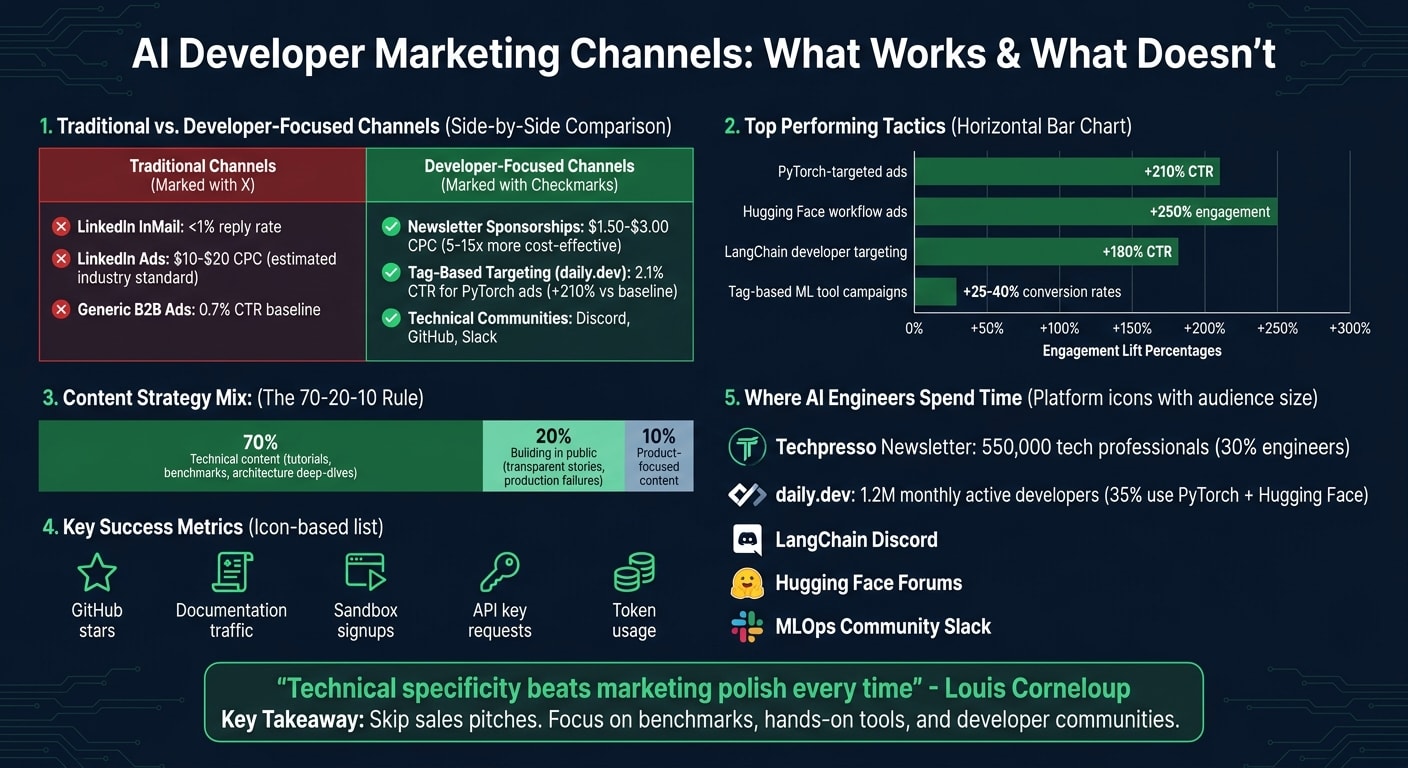
- Content they value: Real benchmarks (e.g., P99 latency, token throughput), step-by-step tutorials, and architecture deep-dives.
- Where they spend time: Discord servers (LangChain, Hugging Face), newsletters (Techpresso, Ben’s Bites), and open-source platforms like GitHub.
- Effective outreach: Newsletter sponsorships ($1.50–$3.00 CPC) and tag-based targeting on developer platforms like daily.dev.
AI engineers care about practical outcomes, not flashy claims. Show them how your product solves their challenges with hands-on tools like sandboxes or deployable examples. Tailor campaigns to specific tools (e.g., LangChain, PyTorch) for higher engagement.
Key takeaway: Skip the sales pitch. Deliver technical, transparent, and actionable content that respects their expertise.
Who Are AI/ML Engineers?
AI/ML engineers stand out as a distinct group with specific needs and goals. By 2026, this community has evolved into four key personas: AI engineers creating LLM applications, traditional ML engineers focused on MLOps and training models, research scientists exploring new possibilities, and data engineers maintaining the infrastructure behind it all . While their objectives differ, they share traits that set them apart from typical software developers.
What Makes AI/ML Engineers Different
One of their defining characteristics? They see deployment as an ongoing process, not a one-and-done task. Unlike traditional developers who might install a tool and move on, AI/ML engineers prioritize systems that learn and adapt. In fact, 66% of engineering leaders value tools that incorporate feedback, and 63% look for solutions that retain context over time . Static systems just don’t cut it for this group.
Their decision-making process reflects this mindset. Rather than obsessing over theoretical benchmarks or accuracy percentages, they focus on practical outcomes like reducing cycle times, minimizing rework, and improving production workflows . When evaluating tools, they’re more interested in metrics like P99 latency, token throughput, and cost per million tokens than flashy claims about being "next-generation."
This pragmatic approach influences how they work. They prefer hands-on evaluations - deployable examples, sandboxes, or even a simple curl command they can test right away . If your product requires a lengthy sales pitch just to try it, you’ve likely lost their interest. Increasingly, they’re opting for external partnerships over in-house builds; external AI deployments reach production 67% of the time, compared to just 33% for internal efforts .
Their choice of tools highlights these priorities. AI engineers working on LLM apps frequently use LangChain and LlamaIndex for orchestration, vLLM and Ollama for inference, and Hugging Face as their go-to model repository . For coding support, they lean on GitHub Copilot, Cursor, Windsurf, and JetBrains AI Assistant . Traditional ML engineers add tools like Weights & Biases for monitoring and tracking. These aren’t just tools - they shape how these engineers approach and solve problems.
Next, let’s look at where these engineers gather online to share knowledge and stay up to date.
Where AI/ML Engineers Spend Their Time Online
Given their hands-on, ever-changing workflows, AI/ML engineers gravitate toward online communities that focus on technical discussions. Platforms like LinkedIn? Not their style. Instead, they’re active in specialized Discord servers and Slack groups, where they can exchange ideas without being bombarded by marketing. Popular spaces include the LangChain Discord, LlamaIndex Discord, MLOps Community Slack, and Hugging Face forums . They also frequent the EleutherAI Discord and Weights & Biases community, where they dive into topics like model architectures and deployment challenges.
To stay informed, they turn to research-focused newsletters and podcasts rather than general tech news. By April 2026, Techpresso reaches 550,000 tech professionals, with 30% in engineering roles . Other favorites include Import AI, Last Week in AI, Ben's Bites, The Rundown AI, Latent Space, and Smol AI . On the podcast front, they listen to Latent Space, ThursdAI, The TWIML AI Podcast, and recordings from events like the AI Engineer World's Fair .
GitHub repositories and open-source frameworks are vital for collaboration and discovery. Engineers evaluate tools by digging into documentation, reviewing commit histories, and testing code - whitepapers and demo videos don’t hold much sway . They’re also using AI-powered search tools like ChatGPT, Perplexity, and Gemini to find benchmarks and architectural insights .
The numbers explain why traditional outreach struggles. LinkedIn InMail campaigns get reply rates below 1% with this audience . On the flip side, newsletter sponsorships deliver CPCs between $1.50 and $3.00, making them 5 to 15 times more cost-effective than Google or LinkedIn ads for reaching technical professionals . For example, in April 2026, ElevenLabs achieved a $1.00 CPC by sponsoring Techpresso, outperforming traditional B2B channels by focusing on developer-focused content rather than generic marketing .
Content That AI Developers Actually Read
When creating content for AI/ML engineers, skip the sales lingo. These professionals can spot generic marketing from a mile away. Overused phrases like "AI-powered" or "next-generation" are red flags that signal low-value content. Instead, aim for the tone of a knowledgeable colleague - technical, detailed, and upfront about trade-offs.
"Technical specificity beats marketing polish every time." - Louis Corneloup, Founder at Dupple and Techpresso
The landscape has shifted dramatically. By 2026, surface-level content like "What is RAG?" holds no appeal. Engineers want the nitty-gritty: real-world performance numbers, scalability challenges, and concrete metrics like P99 latency, tokens-per-second throughput, and cost-per-million-tokens comparisons .
Best Content Formats for AI Developers
Benchmarks are still the go-to for building trust. Engineers value hard data, especially when you’re transparent about both strengths and weaknesses. For example, showing that your tool is slower but more cost-effective in certain scenarios earns credibility far more than blanket superiority claims .
Deep-dives into architecture - like "How We Built X" - should include code snippets, diagrams, and honest accounts of debugging hurdles. Sharing lessons from production failures, including what broke and how you fixed it, resonates with engineers who want actionable insights .
Step-by-step tutorials work best when they’re concise and practical. Provide labeled steps, working code snippets, and even quick-start tools like a curl command or sandbox URL. If your tutorial requires a lengthy demo or sales call, you’ll lose your audience .
To strike the right balance, follow the 70-20-10 content rule: dedicate 70% of your efforts to purely technical content like tutorials and performance insights, 20% to transparent "building in public" stories, and just 10% to product-focused material . This approach keeps your content informative rather than promotional.
Format also matters for discoverability. Engineers increasingly rely on tools like ChatGPT, Perplexity, and Gemini to find technical details . Content structured with tables, checklists, and clearly labeled steps is more likely to be cited by these AI tools, amplifying its reach .
Once you’ve nailed the format, tailoring content to specific machine learning tools can take engagement to the next level.
Creating Content for Specific ML Tools
Focusing on specific frameworks shows you understand your audience’s needs better than generic AI content ever could. For instance:
- LangChain users want integration examples. Show them how your tool fits seamlessly into their workflows with ready-to-use code.
- For PyTorch, offer benchmarks comparing training times, memory usage, and model performance. Be precise - include the PyTorch version, hardware specs, and batch sizes tested. This level of detail sets you apart from vague claims .
- Hugging Face content should highlight integrations with their model hub and transformers library. Engineers evaluating your product will check if it’s listed in the Hugging Face ecosystem, which can drive traffic and validate your tool’s credibility .
- When targeting LangChain or LlamaIndex users, focus on solutions to orchestration challenges. Write about handling context windows, managing token costs, or improving retrieval performance. These are the pain points they face daily .
The trick is to avoid product-centric titles. Instead of "Our New Embedding API", go for something like "How to Reduce Embedding Costs by 60% in LangChain Applications." Engineers search for solutions, not announcements .
Up next, we’ll explore how to fine-tune your approach for specific ML stacks and tools to sharpen your campaigns further.
Targeting by ML Stack and Tools
Focusing on the specific tools developers use daily - like PyTorch, Hugging Face, or LangChain - can make your campaigns far more relevant. Why? Because this approach speaks directly to their needs and workflows. The data supports this: ads targeting developers by their tech stack achieve 3x higher click-through rates (CTR) compared to generic campaigns. For example, PyTorch-related ads average a 2.1% CTR, significantly higher than the 0.7% industry baseline .
AI engineers work in distinct ecosystems. A PyTorch developer optimizing model training has very different priorities than someone using LangChain to build agent workflows. When your ad aligns with their tools, it feels more like a useful resource than a marketing pitch.
Using Tag-Based Targeting for AI Developers
Platforms like daily.dev allow you to target developers based on their specific tools and roles using tags such as #PyTorch + #Senior + #AI infra or #HuggingFace + #LLM. These ads appear directly in personalized feeds, ensuring they reach developers already engaging with technical content .
This precision delivers results. In Q1 2024, Weights & Biases ran a campaign on daily.dev targeting PyTorch users. The campaign featured ads on experiment tracking benchmarks, reaching 50,000 developers. The outcome? A 4.2% CTR and a 28% increase in weekly signups - from 1,200 to 1,536 - resulting in $450,000 in pipeline value . Similarly, LangSmith targeted LangChain developers in October 2023, using tags to focus on agent builders. The campaign achieved a 31% conversion uplift, acquiring 2,100 paid users at a $45 customer acquisition cost, down from a $92 baseline .
Start small by targeting 10,000 PyTorch developers. Once you see a 20%+ engagement lift, expand to combinations like PyTorch + LangChain. With daily.dev’s 1.2 million monthly active developers - 35% of whom use PyTorch and Hugging Face together - you have a solid audience to test and refine your campaigns .
Matching Ads to Developer Workflows
To resonate with developers, tailor your ads to their specific challenges. For Hugging Face users, highlight fine-tuning speed benchmarks. LangChain developers might engage more with ads showcasing debugging tools or multi-step orchestration solutions. For AI infrastructure engineers, focus on scaling capabilities and use real-world examples .
This workflow-specific targeting pays off. Campaigns on tag-based platforms have shown a 25-40% increase in conversion rates when targeting ML tools, based on data from 2024 campaigns reaching over 500,000 AI developers . For instance, Hugging Face users are 2.5x more likely to engage with ads addressing deployment challenges .
Ad format matters just as much as content. Interactive demos and "before/after" benchmarks perform especially well with senior engineers, improving retention rates by 35% . Use UTM parameters to track which workflows drive the best results, so you can refine your strategy.
| ML Stack | Common Workflow Pain Points | CTR Lift |
|---|---|---|
| PyTorch | Model training optimization | +210% |
| Hugging Face | Fine-tuning & deployment | +250% |
| LangChain | Agent orchestration/debugging | +180% |
Running Campaigns That Work
When running campaigns for AI developers, you need a strategy that speaks their language. These professionals value clear, quantifiable metrics - things like latency, token cost, throughput, and model versions - over vague marketing jargon .
Understand your audience. For example, if you're targeting LangChain users, focus on orchestration features. For PyTorch users, highlight training metrics . Instead of lengthy sales calls, offer easy ways for developers to engage: sandbox URLs, curl commands, or deployable examples work far better. Save gated content for truly high-value resources, like raw benchmark datasets or model downloads, rather than generic materials like PDFs or whitepapers.
By tailoring your approach, you’ll create campaigns that resonate and deliver measurable results.
Campaign Examples for AI Developer Marketing
Real-world examples show how to get it right. Anthropic, for instance, adopted a "benchmarks-first" strategy by sharing clear evaluations of their Claude model. They didn’t just highlight successes - they also disclosed areas for improvement, which helped build trust with skeptical AI engineers. Similarly, companies like LangChain and LlamaIndex leveraged open-source contributions to engage their communities before transitioning to enterprise offerings .
On platforms like daily.dev, campaigns targeting AI developers use native ad placements to blend seamlessly with the content developers already engage with. These include:
- In-feed ads for high visibility while users browse.
- Post-page placements for deeper interaction.
- Digest ads integrated into daily briefings.
These strategies align with developers' habits, ensuring your message reaches them in the right context.
Measuring and Improving Campaign Results
Traditional tracking metrics often fall short with this audience. Many AI developers use ad blockers, VPNs, and privacy tools, making it harder to rely on standard methods. Instead, focus on proxy metrics that reflect genuine engagement, such as GitHub stars, documentation traffic, sandbox signups, and API key requests . For newsletter sponsorships targeting AI developers, you can expect an effective CPC between $1.50 and $3.00 .
Adapt your messaging based on real-time data. Louis Corneloup puts it perfectly:
"Technical specificity beats marketing polish every time" .
Pay attention to what resonates - whether it’s a specific metric or a particular feature - and refine your campaigns accordingly. Let the data guide you to connect with AI engineers on their terms.
Conclusion
Connecting with AI developers requires a technical, data-focused approach. These professionals care more about specifics - like latency stats, token costs, and honest benchmarks - than polished marketing language. To make an impact, segment your audience carefully. Whether you're targeting LLM developers or ML infrastructure teams, tailor your content to address their unique needs and challenges.
The best campaigns begin with actions that build trust: release open-source tools, share transparent benchmarks (including trade-offs), and actively participate in technical communities. Once credibility is established, layer in paid outreach through developer-centric newsletters, technical blogs, and platforms like daily.dev, which allow precise targeting by tags.
Give developers the chance to "try before they buy" with hands-on experiences. Share sandbox URLs, curl commands, and deployable code examples. Newsletter sponsorships aimed at AI developers can deliver CPCs as low as $1.50 to $3.00, showing that targeted outreach can achieve results at a fraction of the cost of traditional ad campaigns .
Winning over AI developers isn’t about flashy marketing or wide reach. It’s about meeting them on their terms with content that respects their expertise and time. Highlight metrics that matter - like token efficiency or PyTorch training performance - and let your success indicators reflect developer engagement, such as GitHub stars, documentation visits, or sandbox usage, instead of relying on outdated lead-gen forms.
FAQs
What should I track instead of leads when marketing to AI engineers?
Focusing on engagement metrics is crucial for understanding how AI engineers connect with your brand and content. Metrics like interactions with technical content, participation in developer communities, and platform-specific activity provide valuable insights. Key indicators to watch include newsletter open rates, forum discussions, and responses to benchmarks or case studies. These numbers offer a clearer picture of how your audience is engaging with your materials.
How do I create benchmarks AI developers will actually trust?
To establish benchmarks that AI developers can rely on, it's essential to focus on practical and transparent evaluation methods. Standard benchmarks often fall short, so developers tend to favor real-world testing to gauge performance. Emphasize metrics that showcase measurable outcomes, such as improved efficiency, reliability, or growth. Trust is built when benchmarks align closely with actual performance, rather than depending only on standardized metrics, which might not fully represent practical effectiveness or accuracy.
How do I target AI developers by their ML stack using daily.dev Ads?
daily.dev Ads offers powerful audience filtering tools that let you zero in on AI developers based on their specific skills, tools, and behaviors. For instance, you can filter by popular frameworks like PyTorch, Hugging Face, and LangChain to ensure your ads are seen by the right professionals.
By creating custom audiences tailored to their activity and the tools they use, your ads can directly reach AI engineers who are most likely to engage with your message. This level of precision not only boosts engagement but also helps maximize your campaign's ROI.