

Developers in 2026 discover tools differently than before. Traditional ads and cold emails don’t work. Instead, developers prefer tools integrated into their workflows, like IDEs, GitHub, or AI assistants. To succeed, focus on these strategies:
- Build trust through technical content: High-quality documentation, blogs, and tutorials with runnable code samples are key. Over 50% of developer searches are for code examples or explanations.
- Leverage community platforms: Developers frequent GitHub, Stack Overflow, Reddit, and Discord. Engage by solving problems, sharing insights, and contributing to open-source projects.
- Optimize for AI and curated feeds: Platforms like daily.dev and AI assistants (e.g., ChatGPT) are critical for discovery. Ads or content tailored to developer workflows perform better.
- Invest in newsletters and events: Newsletters like TLDR and conferences like KubeCon have high ROI. Over 60% of teams report community efforts as their best-performing strategy.
- Avoid traditional marketing speak: Developers value clear, technical communication over buzzwords or sales pitches.
Developers evaluate tools based on usability, community validation, and technical credibility. Focus on meeting them where they already work and providing immediate, practical value.
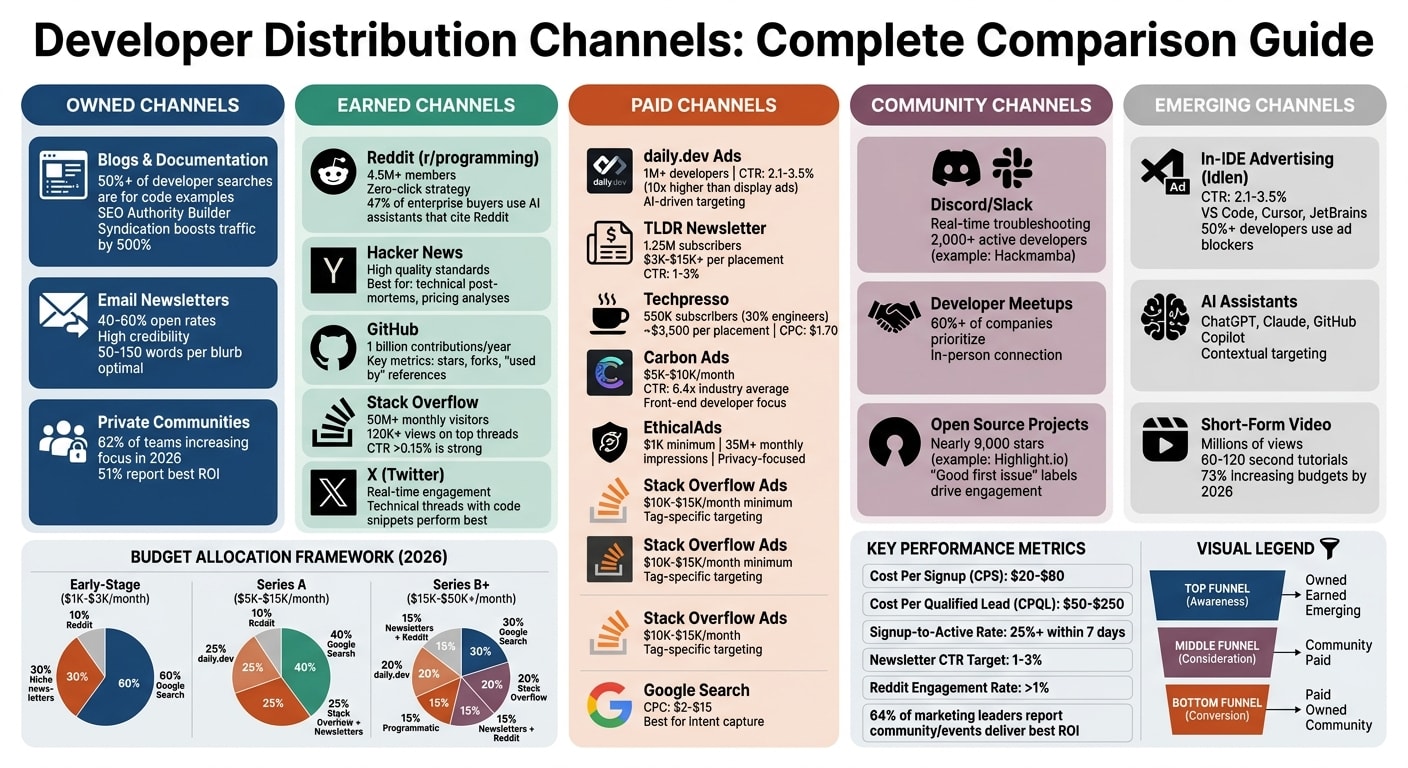
Owned Channels: Distribution You Control
Owned channels give you the power to manage your content and its timing, creating a reliable way to connect with developers over the long term. Unlike paid ads or the unpredictability of social media algorithms, tools like blogs, documentation, newsletters, and private communities allow you to build lasting relationships by consistently delivering valuable technical content.
Blogs and Technical Documentation
Solid technical documentation is non-negotiable - no amount of clever distribution can make up for weak content . With over 50% of developer search queries focused on code samples or explanations , your blog and documentation pages are often the first stop for developers exploring your tool.
To maximize impact, always publish original content on your own domain before sharing it on third-party platforms . This practice solidifies your website's SEO authority. After waiting 2–10 days for indexing, you can republish on platforms like In Plain English, DEV.to, or Hashnode using rel=canonical tags to retain SEO benefits . This method boosts traffic to your site by up to 500%, and syndicated posts often see 85% higher engagement compared to single-platform publishing .
Structure your content for quick access. Start with a "TL;DR" summary and wrap up with a troubleshooting section . Tutorials should include runnable code examples, copy-pasteable snippets, and clear architecture diagrams . Developers value efficiency, so ensure your landing pages link directly to documentation, sandboxes, or free tiers - don’t force them through gated demo forms .
Collaborate with subject matter experts to create content that speaks to experienced developers . Build trust with social proof like GitHub stars, npm download counts, or "used by" mentions . When syndicating content, tailor headlines and intros for each platform - adjustments for sites like Reddit or LinkedIn can improve performance by 40–60% . This approach positions your tool as a go-to resource for developers while expanding your reach.
To complement your blog and documentation, newsletters and private communities provide more personalized engagement options.
Email Newsletters and Private Communities
Direct communication channels like newsletters are a great way to build trust with developers. With open rates between 40% and 60% , newsletters are one of the most effective tools you can use. Unlike social media or ads, they represent a deliberate choice by developers to stay connected, which carries more credibility .
Focus on delivering high-value content. Developers appreciate newsletters that cut through the noise with technical insights . Skip the marketing jargon - terms like "seamless" or "revolutionary" don’t resonate . Instead, address specific pain points in your headlines (e.g., "Debug Python memory leaks") and include practical elements like code snippets, terminal screenshots, or product GIFs to showcase solutions quickly .
For product-led newsletters, send a personalized email from a Developer Relations (DevRel) team member within 1–3 days of signup. Include a relevant tutorial and links to documentation, GitHub repositories, or live sandboxes . Keep your emails concise - stick to 50–150 words per blurb to respect your readers’ time .
While newsletters provide curated insights, private communities offer a space for collaboration and support. Platforms like Discord, Slack, or dedicated forums are becoming essential. By 2026, 62% of developer marketing and DevRel teams plan to increase their focus on community and events, and 51% of technical marketing leaders already say these areas deliver the best ROI . Developers are increasingly moving away from broad social platforms to smaller, intentional communities where they can actively help each other .
"The 'post and share' model is over. What works instead: intentional communities where people actually help each other." – Prashant Sridharan, Developer Marketing Expert
Measure success with metrics like Daily Active Members, message volume, questions answered, and response times . Recognize and empower community champions through formal programs to encourage advocacy for your tool . By integrating your community with documentation and support channels, you make it easier for developers to engage . These efforts strengthen your overall strategy by fostering direct, ongoing relationships with your developer audience.
Earned Channels: Getting Organic Reach
Earned channels offer a way to connect with developers organically on platforms they already frequent. However, success here requires more than just showing up - it demands consistent, value-driven participation that earns trust. This approach complements owned channels by extending your reach through credible, community-focused interactions.
Hacker News and Reddit Programming Subreddits
Platforms like Hacker News and Reddit programming communities prioritize meaningful contributions over blatant self-promotion. Developers are quick to spot and dismiss overt marketing, so building trust takes time and genuine effort.
On Reddit, a "zero-click" strategy is often most effective. This means sharing insights directly in your post without requiring readers to click on external links. To establish a presence, create a profile with a clear username (e.g., "name_company"), use your company logo as an avatar, and include a brief bio with a link. Key subreddits to consider include r/programming (with over 4.5 million members), r/webdev, r/devops, r/sre, r/rust, r/golang, and r/Python.
"You don't promote yourself. You use it as a research channel for figuring out what people are talking about and [distribute content] as a good faith community participant."
– Mariya Delano, Content Ambassador, Developer Marketing Alliance
Hacker News, on the other hand, has even stricter standards. Posts that perform well often include technical post-mortems, pricing model analyses, or timely updates on technical topics. For "Show HN" posts, ensure your tool is ready for immediate use, and consider sharing raw data, code samples, or architectural decisions upfront to encourage engagement.
"The standards of quality are super high. You have to put a lot of work into what you publish there. It's easier to rank on Hacker News if you have something interesting to share."
– Alexey Klochai, Founder, Wizard on Demand
In addition to direct traffic, these platforms also enhance visibility through AI-driven recommendations. For example, 47% of enterprise buyers now start vendor research using AI assistants, surpassing Google Search's 43% share. Reddit, which frequently appears in AI-generated overviews and ranks high for technical keywords, plays a major role in boosting "AI visibility."
These platforms lay the groundwork for further credibility-building efforts on repository and Q&A platforms.
GitHub, Stack Overflow, and Product Hunt
GitHub and Stack Overflow are essential spaces where developers evaluate tools before adopting them. On GitHub, developers look at factors like README files, issue activity, and contributor counts to gauge reliability. Stack Overflow, meanwhile, serves as a trusted hub for solving technical problems. Both platforms rank highly in search results for problem-focused queries.
GitHub sees massive activity, with nearly one billion contributions to public repositories in a single year. To stand out, optimize repository names and descriptions with relevant keywords. For example, the "prisma/prisma-examples" repository ranks first for terms like "Prisma examples" and "Prisma migration." Adding "good first issue" labels can encourage community contributions, and maintaining a public roadmap fosters trust. Highlight.io, for instance, reached nearly 9,000 stars by actively curating such labels and turning issues into opportunities for discovery.
On Stack Overflow, focus on providing high-quality, verified answers that link directly to your official documentation. Monitoring and engaging with product-specific tags can help establish technical credibility. For example, Postman's thread on "How to get to request parameters in Postman?" has over 120,000 views, driving consistent traffic to its documentation. Similarly, SendGrid's highly ranked discussions funnel attention to its support resources.
The key here is to address developers' immediate technical challenges rather than pushing features. Success on these platforms relies on thorough and user-friendly documentation.
| Channel | Primary KPIs to Track | Best For |
|---|---|---|
| GitHub | Stars, forks, "used by" references, clones, external PRs | Evaluating credibility and showcasing practical code samples |
| Stack Overflow | Tagged question views, click-through rates to documentation, growth in product tags | Solving high-intent technical issues and troubleshooting |
| Upvotes, comments, referral traffic, post longevity in search | Encouraging authentic peer-to-peer discussion and research |
These efforts can be further amplified through real-time engagement on platforms like X.
X (Twitter) for Developer Audiences
X remains a key platform for developers, engineers, and product managers, offering a space for organic discovery and technical discussions. The focus here is on building credibility first, followed by scaling visibility.
To engage effectively, create technical threads that address specific problems, including code snippets, terminal screenshots, or GIFs. Avoid simply sharing links; instead, provide complete insights directly on the platform. Lead with the problem - such as "debugging flaky CI pipelines" - and use clear, technical language. Conversations should feel like genuine peer-to-peer exchanges, not sales pitches.
"Simply publishing on your blog or tweeting about it is not distributing. Real distribution means delivering value where developers already are so your work can be discovered, trusted, and shared."
– Hackmamba
Developers value substance and technical depth over polished marketing content. By prioritizing authenticity, X can become a long-term asset for growing your organic reach.
Paid Channels: Advertising to Developers
Paid advertising aimed at developers requires a precise and thoughtful approach. Developers tend to reject generic marketing tactics or landing pages that demand unnecessary form fills. Instead, successful strategies focus on delivering content that is relevant and technically meaningful, avoiding sales-heavy language. These paid channels complement owned and earned efforts, rounding out a robust multi-channel strategy.
daily.dev Ads: Native Developer Advertising
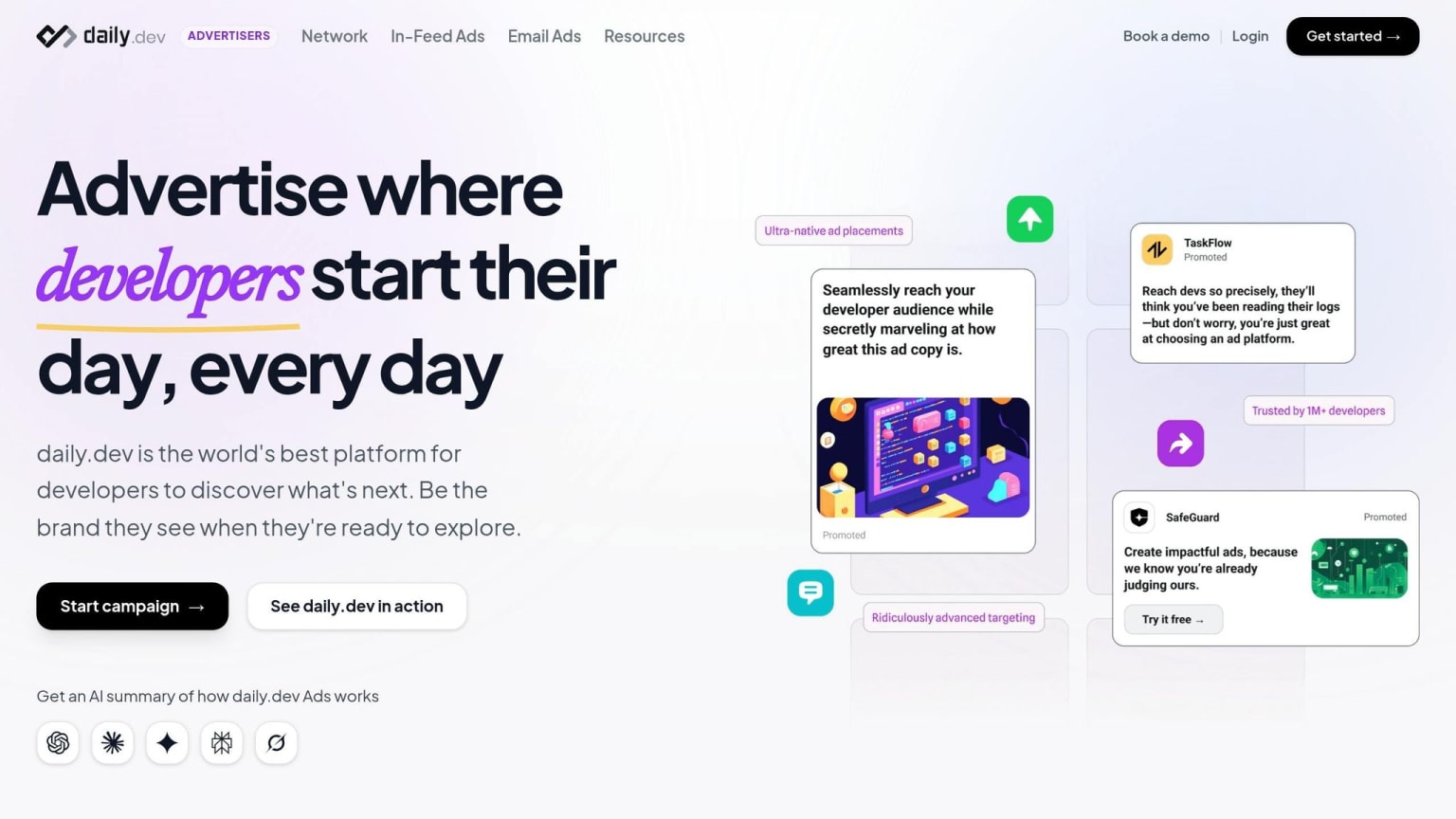
daily.dev Ads offers native advertising to over 1 million developers through a personalized content discovery platform. Using AI-driven targeting, it matches ads to developers based on their interests, seniority, programming languages, and tool preferences. Ad placements include in-feed cards, post-article ads, and email digest sponsorships, all designed to blend seamlessly into the developer's workflow.
What sets daily.dev apart is its contextual relevance - ads are placed within environments where developers are already engaging with technical material. This leads to higher interaction rates compared to traditional banner ads. Marketers can also track performance in real time, optimizing campaigns based on signups, trial activations, and pipeline growth. For developer tools in a product-led growth phase, these native ads - featuring elements like code snippets, terminal screenshots, or product GIFs - are especially effective. The platform’s hyper-targeting capabilities allow campaigns to zero in on specific groups, such as Kubernetes users, React developers, or DevOps engineers.
Newsletter Sponsorships and Podcast Advertising
Developer newsletters offer a trusted channel for reaching technical audiences. For instance, the TLDR newsletter, with over 1.25 million subscribers, is a proven way to engage engineers who actively opt into its curated content. Sponsorships in newsletters like TLDR or Techpresso (which has around 550,000 subscribers, 30% of whom are engineers) generate millions of impressions and thousands of clicks from engaged readers.
Costs for newsletter sponsorships vary widely. High-subscriber newsletters like TLDR or Techpresso typically charge between $3,000 and $15,000+ per placement. For example, DigitalOcean used Techpresso for eight placements, achieving over 1 million impressions at an average cost-per-click of $1.70. Niche newsletters targeting specific technologies, such as JavaScript Weekly or Rust Weekly, are more affordable, ranging from $100 to $2,000 per placement.
Podcasts also provide an effective way to connect with developers. Shows like Software Engineering Daily and The Changelog attract engaged listeners during commutes or work sessions. Ads read by hosts in a conversational tone tend to perform better, especially when the product being promoted ties directly to the episode’s topic. Cost-per-click rates for newsletter sponsorships and podcast ads generally fall between $1.70 and $3.00, offering a cost-effective alternative to traditional platforms.
In addition to digital placements, in-person events and specialized ad networks offer further opportunities for engaging developers.
Conference Sponsorships and Developer Ad Networks
Sponsoring conferences provides visibility at events where developers gather to learn and connect. Events like KubeCon, React Summit, or AWS re:Invent offer a range of sponsorship options, from booth spaces to keynote integrations. However, the real value often comes from follow-up activities, such as technical workshops, live demos, or exclusive swag that resonates with developers.
Developer ad networks are another effective avenue. These networks, like Carbon Ads, place non-intrusive ads on documentation sites and open-source platforms. Carbon Ads, which primarily targets front-end developers, reports click-through rates up to 6.4 times higher than industry averages. Its contextual targeting avoids behavioral tracking and is often allowed through ad blockers. Campaigns on Carbon Ads typically require a monthly budget of $5,000 to $10,000.
EthicalAds, another developer-focused network, delivers over 35 million impressions monthly on documentation and open-source sites. Campaigns start at a $1,000 minimum, with discounts available for higher spending tiers. For more targeted outreach, Stack Overflow offers tag-specific advertising, enabling brands to connect with developers solving problems related to specific technologies like Kubernetes or React. This option, however, usually requires a minimum spend of $10,000 to $15,000 per month.
| Channel | Typical Cost | Best For | Expected Reach |
|---|---|---|---|
| daily.dev Ads | Varies by campaign | Driving signups and PLG activations | 1M+ developers |
| TLDR Newsletter | $3,000–$15,000+ per placement | Broad brand building | 1.25M+ subscribers |
| Techpresso | ~$3,500 per placement | High-intent tech audience | ~550K subscribers |
| Carbon Ads | $5,000–$10,000/month | Front-end developers | Contextual reach |
| EthicalAds | $1,000 minimum | Privacy-conscious open-source developers | 35M+ monthly impressions |
| Stack Overflow | $10,000–$15,000/month | Technology-specific targeting | 50M+ monthly visitors |
To make the most of paid channels, allocate your budget strategically based on the funnel stage. Google Search ads, with CPCs ranging from $2 to $15, excel at capturing existing demand. Meanwhile, newsletters and contextual ad networks help build broader awareness. A suggested 2026 budget framework includes: 50% for intent capture (e.g., Search), 25% for mid-funnel efforts (e.g., Stack Overflow or daily.dev), 15% for top-of-funnel awareness (e.g., newsletters or Carbon Ads), and 10% for testing new channels.
Community Channels: Where Developers Gather
Community channels stand apart from paid ads - they thrive on genuine technical engagement. Developers come to these spaces to solve problems, learn from one another, and collaborate. The key rule? Be authentic and contribute meaningfully before even thinking about promotion. The brands that succeed here rely on DevRel teams to answer questions and share code, not salespeople pushing demos.
Discord Servers and Slack Communities
Platforms like Discord and Slack have become the go-to spaces for real-time problem-solving during developers' workdays. Communities such as the LangChain Discord and Rust community servers attract thousands of developers who exchange code, troubleshoot issues, and discuss technical architectures. These platforms provide the instant feedback developers crave, unlike slower, asynchronous forums.
To engage effectively, focus on offering real value - share technical insights, provide code examples, and join discussions on trending topics. Avoid overt promotion. Think of these platforms as an opportunity to understand developer needs while contributing as a helpful member of the community.
Take Hackmamba's Discord, for example. With over 2,000 active developers, they’ve built trust by focusing on technical workshops and creating spaces where developers can help each other solve specific challenges. Instead of spamming product announcements, they prioritize authentic interactions. This "no-promo" strategy fosters trust, which eventually leads developers to consider their tools when they encounter a relevant problem. This kind of engagement also lays the groundwork for deeper relationships through in-person interactions.
Developer Meetups and Open Source Projects
While real-time discussions are great, in-person events and open source contributions take things to the next level. These interactions not only build technical credibility but also create connections that digital spaces can’t replicate. It's no surprise that over 60% of developer-focused companies now prioritize meetups, hackathons, and conferences as core strategies .
For instance, Vercel’s Next.js Conf in October 2024 brought together more than 1,000 developers in San Francisco, with tens of thousands joining online. The event prioritized community-driven workshops over product pitches, and the recorded sessions continue to attract engagement on YouTube .
Open source projects are another powerful way to build trust and visibility. Highlight.io, for example, grew to nearly 9,000 GitHub stars by actively maintaining its repository. They used "good first issue" labels and linked their public roadmap directly to GitHub issues, making it easy for new contributors to get involved . GitHub itself reported nearly one billion contributions to public repositories in a single year, underscoring its importance as a discovery platform for developer tools .
To maximize your GitHub presence, treat your repository like a landing page. Keep dependencies updated, respond to issues quickly, and provide clear documentation with runnable examples. A neglected or outdated repository can harm your reputation faster than having no presence at all . When contributing to other projects, focus on solving actual problems rather than sneaking in promotional mentions - developers can easily spot insincere contributions.
Here’s a quick breakdown of how these community channels serve different purposes:
| Channel Type | Primary Use Case | Engagement Approach |
|---|---|---|
| Discord/Slack | Real-time troubleshooting and networking | Provide technical help; avoid product pitches |
| Reddit Subreddits | Research and peer discussions | Share actionable insights; host AMAs |
| GitHub | Code evaluation and contribution | Keep repos active; use "good first issue" labels |
| Developer Meetups | In-person learning and connection | Host workshops; focus on technical value |
Emerging Channels: New Ways to Reach Developers
Emerging channels are transforming how brands connect with developers by integrating directly into the tools they use daily. Developers now spend more time in workflow environments - like IDEs, AI assistants, and personalized content feeds - than on platforms like LinkedIn or Twitter. This shift opens up fresh advertising opportunities, placing messages right where developers are already working. These new channels complement traditional methods, offering a way to engage developers in their natural workspaces and reinforcing a multi-channel approach.
AI Assistants and Developer Feed Platforms
In-IDE advertising platforms, such as Idlen, have introduced ads directly into tools like VS Code, Cursor, JetBrains, and AI assistants like ChatGPT, Claude, and GitHub Copilot. These ads appear during idle moments - like when AI generates a response, during long builds, or while deployments are running. The result? Click-through rates between 2.1% and 3.5%, which is 10 times higher than standard display ads .
The effectiveness lies in contextual targeting. Instead of relying on browsing history, these platforms identify the tech stack a developer is currently using. For instance, a JavaScript developer working in VS Code might see ads for frontend tools, while GitHub Copilot users could encounter promotions for AI-based testing tools. This precision is especially crucial given that over 50% of developers use ad blockers .
Feed-based platforms like daily.dev have also become go-to destinations for discovering technical content. With over 1 million active users, daily.dev curates technical articles into personalized feeds, using AI to optimize campaigns in real time based on engagement metrics . Its native in-feed ads blend seamlessly with organic content, making them feel more relevant and less intrusive.
AI-powered search is another game-changer for tool discovery. For example, Reddit is now the second most-cited domain in Google AI Overviews , meaning technical discussions from subreddits frequently appear in AI-generated search results. This makes authentic participation in Reddit threads - like answering questions or sharing code snippets - more valuable for long-term visibility. These advancements pave the way for other engaging formats, including short-form video, which is explored next.
Short-Form Video for Technical Content
Short-form video is quickly becoming a favorite tool for developers to evaluate frameworks and tools. Influencers like Jeff Delaney (Fireship) and Theo Browne (t3.gg) have mastered this format, creating concise videos - often under two minutes - that explain complex technologies to millions of viewers . Fireship’s "100 Seconds of Code" series is a standout example, breaking down intricate topics into easy-to-digest segments that fit into developers' busy schedules.
What sets these videos apart is their focus on real production workflows rather than overly polished demos. Developers appreciate seeing how a database handles edge cases or how a framework performs under pressure. This transparency builds trust far more effectively than traditional product pitches.
While 73% of developer marketing teams plan to increase their content marketing budgets by 2026 , video remains a newer, less proven strategy for many. Some teams struggle to achieve immediate returns compared to established channels. The most effective approach? Treat short-form video as a top-of-funnel tool that directs developers to deeper resources, such as documentation or GitHub repositories .
| Channel Type | Primary Format | Reach Potential | Key Advantage |
|---|---|---|---|
| In-IDE Advertising | Sidebar cards, notifications | 500,000+ developers | 10x higher CTR than display ads |
| daily.dev | Native in-feed cards | 1M+ developers | AI-optimized for conversions |
| Short-Form Video | 60–120 second tutorials | Millions of views | Highlights real workflows |
| AI Search Discovery | Reddit/Stack Overflow answers | Unlimited organic reach | Appears in AI-generated results |
Building Your Multi-Channel Distribution Plan
Creating a multi-channel plan involves combining insights from owned, earned, paid, and community channels into a unified strategy. The key? Focus on the platforms where your developers already spend their time. Your decisions should be guided by your budget, product stage, and target audience. For instance, a seed-stage API tool aimed at frontend developers will need a very different approach than an enterprise observability platform targeting engineering managers. Below, we’ll explore how to allocate budgets effectively as your product matures.
Budget Allocation by Product Stage
The way you divide your budget should evolve with your product’s stage, starting with capturing intent before building brand recognition.
Early-Stage Products (Pre-Seed/Seed): If your monthly budget is between $1,000–$3,000, focus on intent-driven channels. Allocate about 60% to Google Search to attract developers actively seeking solutions. Around 30% can go to niche newsletter sponsorships like JavaScript Weekly or Data Elixir, and the remaining 10% to Reddit, where you can engage with communities open to trying new tools.
Series A Stage: With a larger budget of $5,000–$15,000 per month, aim for a balanced approach. Spend approximately 40% on Google Search, 25% on platforms like daily.dev, where developers discover tools during their regular browsing, 25% split between Stack Overflow and newsletters, and 10% on Reddit. A great example here is CircleCI, whose self-serve demo strategy reduced their cost-per-lead by 65% .
Series B and Beyond: With budgets ranging from $15,000 to $50,000 or more, diversification becomes key. Dedicate around 30% to Google Search - since most high-intent queries will already be captured - 20% to daily.dev’s contextual feed ads, 20% to Stack Overflow (though note the $10,000/month minimum), 15% to programmatic platforms, and 15% across newsletters and Reddit. It’s worth noting that 64% of marketing leaders say community and events deliver the best ROI .
Once your budget is set, the next step is customizing your channel strategy to meet the specific preferences of your developer personas.
Matching Channels to Developer Personas
Different developer groups gravitate to different platforms, and your strategy should reflect that. Below are some targeted tactics for reaching key personas:
Frontend Engineers: These developers often gather on Reddit communities like r/reactjs, subscribe to newsletters like Bytes, and use platforms like daily.dev to stay updated on frameworks. When crafting your messaging, focus on their tech stacks; for example, emphasize tools that integrate seamlessly with VS Code for React developers.
DevOps and Platform Engineers: This group relies heavily on Stack Overflow for troubleshooting Kubernetes and Terraform issues, stays informed through newsletters like TLDR, and uses specialized documentation sites. Privacy-focused ad platforms like EthicalAds can work well here, especially since over half of developers use ad blockers .
Data and ML Engineers: These developers tend to cluster in Python-focused communities and newsletters such as Data Elixir. Tailoring your presence in these spaces can help you connect with this audience effectively.
Engineering Managers: Unlike other developers, this group is less active on technical forums. They’re more reachable through LinkedIn and curated newsletters like Pragmatic Engineer. Forrest Herlick, Growth Marketing Manager at Paragon, highlights the value of newsletters like TLDR for reaching this audience:
"TLDR allows us to connect with engineers who aren't on social media… Our CTO reads TLDR but doesn't scroll LinkedIn" .
The takeaway? Understanding where your audience spends their time - and tailoring your strategy accordingly - is essential for success.
Measuring Channel Performance and ROI
To measure success in developer marketing, you need a multi-touch attribution strategy. Developers rarely convert after just one interaction. They might explore a GitHub repository, see a Stack Overflow answer, or come across a mention in a newsletter - each playing a role in their decision-making process. Because of this, relying on last-click attribution simply doesn’t cut it.
Key Metrics for Each Channel Type
Different channels demand different metrics to measure their effectiveness:
- GitHub: Keep an eye on stars, forks, and "used by" references to assess organic growth and adoption.
- Stack Overflow: Track views on tagged questions and click-through rates to your documentation. A click-through rate above 0.15% is a strong indicator of engagement .
- Reddit: Monitor upvotes, comments, and engagement rates. Aim for rates above 1% .
- Paid Channels: Focus on conversion-related metrics. Cost Per Signup (CPS) should range between $20 and $80 for most developer tools, while Cost Per Qualified Lead (CPQL) typically falls between $50 and $250 . Additionally, strive for a Signup-to-Active rate of at least 25% within 7 days .
- Newsletter Sponsorships: Target click rates between 1–3% .
- daily.dev Contextual Feed Ads: These ads often achieve click-through rates of 2.1–3.5%, which is around 10 times higher than standard display ads .
By focusing on these metrics, you can better understand each channel's role in driving developer engagement and conversions.
Solving Attribution Problems
Developers interact with content in ways that often evade traditional tracking methods. This creates what marketers call the "dark funnel", where private conversations on Discord, podcast mentions, and word-of-mouth recommendations influence decisions but don’t appear in analytics. Add to this the fact that over 50% of engineers use ad blockers , and it’s clear why pixel-based tracking can’t be your only solution.
Here are some tactics to address these attribution challenges:
- Use UTM parameters on all links to track where traffic originates .
- Include a post-signup survey with questions like “How did you hear about us?” to gather direct insights .
- Conduct 14-day holdout tests by pausing one channel and observing the impact on signups .
- Evaluate return on ad spend (ROAS) over a 90-day period to account for the longer evaluation cycles typical of developers .
These approaches help bridge the gaps in attribution, giving you a clearer picture of how your efforts influence developer decisions over time.
Conclusion: Selecting Your Developer Distribution Channels
Reaching developers effectively requires a careful balance of authenticity, reach, and return on investment (ROI). A proven strategy is to "Build organically first, then amplify." Start by establishing credibility on platforms like GitHub, Stack Overflow, and Reddit. Once you've built that foundation, scale your efforts with paid options like newsletters, native ad networks such as daily.dev, and partnerships with creators . This approach aligns with your product's stage and available resources, setting the stage for consistent growth.
Your choice of channels should match both your product's development phase and your budget. For smaller budgets, focus on organic growth through compounding efforts. Larger budgets, on the other hand, allow for broader amplification. The 70/20/10 rule is a helpful guide: dedicate 70% of your budget to proven channels, 20% to emerging ones, and 10% to experimental opportunities .
It's also important to align your distribution efforts with the stages of your marketing funnel. Instead of chasing channel popularity, focus on how each channel supports your funnel goals. For example, Google Search is ideal for bottom-of-funnel developers actively seeking solutions. Stack Overflow or daily.dev can engage developers in the middle of the funnel as they evaluate options. Meanwhile, newsletters and community sponsorships are great for top-of-funnel visibility and brand awareness .
"TLDR allows us to connect with engineers who aren't on social media…Our CTO reads TLDR but doesn't scroll LinkedIn" .
Developers often engage with content where they work - whether in IDEs, documentation pages, or command-line outputs. These are high-impact touchpoints. With over 50% of engineers using ad-blockers , strategies that focus on privacy-first contextual targeting outperform traditional ads. Contextual placement - ads that align with what developers are reading or building - delivers better results than behavioral tracking.
Whether you're using owned, earned, paid, or community channels, every choice should enhance your technical credibility and organic reach. Community engagement and quality content consistently yield the highest ROI. In fact, 64% of marketing leaders report that community and events provide the best outcomes, and 73% of teams plan to increase investments in these areas by 2026 . Your distribution strategy should reflect this balance: build an authentic presence where developers naturally gather, while maintaining the technical content that ensures long-term organic discovery. By applying these principles alongside a detailed channel guide, you can create a strategy that resonates with your developer audience.
FAQs
Which channels work best for my developer persona?
When targeting developers, the key is to meet them where they feel most comfortable and engaged. Developers often value authenticity, technical depth, and reliable engagement over flashy, traditional advertisements. Here's how you can connect with them effectively:
Go where trust is built: Platforms like Stack Overflow, Reddit, and GitHub are ideal for organic outreach. These spaces are already trusted by developers for their technical discussions and problem-solving communities. Sharing helpful, technical content here can establish credibility.
Leverage paid opportunities: Channels like daily.dev Ads, newsletters, and conference sponsorships allow for precise targeting at scale. These options are particularly effective for reaching niche developer audiences.
Engage in community spaces: Platforms such as Discord and Slack foster direct, authentic interactions. By participating in or creating communities on these platforms, you can build meaningful connections with developers while amplifying your reach.
A balanced approach that combines organic efforts, paid campaigns, and community involvement will help you create authentic connections while expanding your reach.
How much should I spend at each product stage?
In 2026, how you allocate your budget will hinge on your product's goals and stage of development. If you're working with an early-stage product, it makes sense to prioritize owned channels (like blogs or documentation) and earned channels (such as GitHub or Reddit). These are great for building trust and driving organic growth.
As your product matures, you’ll want to shift more of your focus - and budget - toward paid channels (like ads or sponsorships) to scale your reach. At the same time, investing in community channels (like Slack or Discord) becomes critical to encourage retention and turn users into advocates. The key is maintaining balance and consistently measuring what works best across all these channels.
How do I measure ROI with the dark funnel?
Measuring ROI in the dark funnel means focusing on those subtle, indirect touchpoints that often fly under the radar of traditional tracking methods. Think about things like participating in online communities, engaging with content, or the power of word-of-mouth recommendations. These actions may not show up in standard attribution models but still play a big role in driving conversions.
To get a better understanding, you can use multi-touch attribution models. These models help you evaluate how different activities contribute to your results. On top of that, advanced analytics tools can track things like brand awareness, content shares, and mentions. By analyzing these organic interactions, you can gain a more complete view of how your marketing efforts are making an impact.