
Developers are hard to impress with emails. They delete sales pitches, ignore buzzwords, and spot insincerity instantly. But emails that provide value - like changelogs, technical guides, or documentation updates - get their attention. Here’s how you can make your email marketing work for developers:
- Avoid fluff and sales talk. Developers trust specific, clear, and technical content.
- Focus on value. Share updates, tutorials, or problem-solving guides that help them directly.
- Use formats they prefer. Curated links, technical deep-dives, and changelog summaries perform best.
- Craft strong subject lines. Be clear, specific, and concise to boost open rates.
- Segment your audience. Tailor content based on experience, tools, or programming languages.
- Measure success beyond open rates. Track clicks, replies, and product usage for better insights.
The key? Write like a peer, not a marketer. Developers respond to honest, no-nonsense communication that respects their time and technical expertise.
Why Most Marketing Emails Fail with Developers
Developers have a finely tuned radar for spotting inauthentic communication. After years of being bombarded with disingenuous pitches, they've developed what many call a "BS detector." Once triggered, your email is destined for the trash - often before the second paragraph.
So, what makes these emails miss the mark? They often share a few glaring flaws. Generic sales pitches like "just checking in" scream time-waster and are dismissed immediately. Overloaded marketing language - think buzzwords like "AI-powered synergy platforms" - feels hollow and lacks the precision developers expect. And if your email forces them into high-friction sales funnels with "Request a Demo" buttons before they can even explore your product, you're practically pushing them toward self-serve alternatives.
But here's the thing: it's not just about a deleted email. Trust is everything in developer marketing. If you exaggerate your product's capabilities, developers will put your claims to the test. And when they find the gaps, they won't hesitate to call you out on platforms like Reddit or Hacker News.
"Developers aren't your typical audience - they can smell marketing BS from miles away, and once you lose their trust, it's nearly impossible to win it back." - Nimrod Kramer, daily.dev
Engagement metrics paint a clear picture: developers only engage with content that offers real value. They gravitate toward things that help them directly, like changelogs, technical deep-dives, or documentation updates. Anything that feels like it's pushing an agenda? Ignored.
To succeed, you need to change your approach. Speak to developers as a peer, not a vendor. Replace vague phrases like "improved performance" with specific, measurable claims - something like "API response times reduced by 40%." Instead of leading with promotional fluff, focus on delivering tutorials, release notes, or post-mortems. Better yet, back up your claims with code snippets, benchmarks, or technical breakdowns. If your email even hints that the writer doesn’t understand the technical context, you've lost your audience.
These challenges highlight why newsletters tailored to developers' needs are so crucial.
Developer Newsletter Formats: Curated Links, Technical Deep-Dives, Changelog Digests
Developers have different preferences for consuming information, depending on what they’re working on. A senior engineer fixing a production bug might need quick, actionable resources, while a mid-level developer exploring a new framework could benefit from detailed guides. Meanwhile, a product user may just want to know what’s new in the latest update. To cater to these varied needs, three newsletter formats stand out. Let’s break them down.
Curated Links Newsletters
This format provides a collection of 5–15 carefully chosen links, each accompanied by brief commentary. Why does this work? Developers appreciate when experts help them cut through the noise of constant updates in tools and best practices. For instance, TLDR, a daily tech digest, boasts over 1,250,000 subscribers, and JavaScript Weekly has built a loyal audience of 180,162 subscribers in its niche .
The most effective curated newsletters feel personal - plain white backgrounds, simple black text, and minimal styling. Developers prefer descriptive inline text links over flashy buttons. As Sequenzy explains, “Developer audiences click text links more than styled buttons. 'Read the full post: [link]' outperforms a big orange 'Read More' button” . These newsletters generally achieve open rates of 30%–50% and click-through rates of 5%–15%. Plus, they’re efficient - producing one takes just 2–3 hours per week, compared to the 5–10 hours needed for original content newsletters .
To maximize impact, put the best links at the top for easy scanning. Also, double-check the plain-text version since many developers disable HTML. This straightforward style resonates with developers’ preference for clear, direct communication.
Technical Deep-Dives Newsletters
This format focuses on in-depth tutorials, case studies, and problem-solving guides, showcasing technical expertise. Content like engineering "war stories", honest benchmarks, design trade-offs, and post-mortems builds trust and credibility. Developers value this kind of transparency and insight.
Accuracy is non-negotiable. Code snippets must be tested and up-to-date - a single error can damage trust. Keep code examples short (under 10 lines) and format them properly with <pre> and <code> tags. For longer snippets, link to GitHub or Gists . Tailor the complexity of your content to your audience; sending beginner-level tutorials to experienced developers will only lead to unsubscribes.
“The ones that communicate like technical peers - even if the writer isn’t a developer themselves - build genuinely engaged audiences.”
- Sequenzy
After technical deep dives, the next format - changelog digests - keeps users informed about product updates in a concise, actionable way.
Changelog Digests Newsletters
These newsletters focus on product updates, highlighting new features, fixes, and improvements. They often outperform promotional emails in open and click-through rates because they’re directly relevant to the user’s workflow . Changelogs can reduce support requests by explaining changes upfront and encourage users to adopt new features they might otherwise miss .
Make breaking changes stand out by prefixing them with “Breaking:” to catch users' attention before they upgrade . Organize updates into categories like "New", "Improved", and "Fixed" for clarity. Use benefit-driven headlines - “Export to CSV” is clearer and more engaging than “Enhanced data portability” .
Subject lines should be under 50 characters to avoid being cut off on mobile devices. Consistency is key - stick to a regular schedule, whether weekly or monthly, to build a routine for readers . For visual updates, include screenshots or GIFs, and link directly to relevant GitHub issues or pull requests for those who want more technical details .
Email Subject Lines That Developers Open: Data and Examples
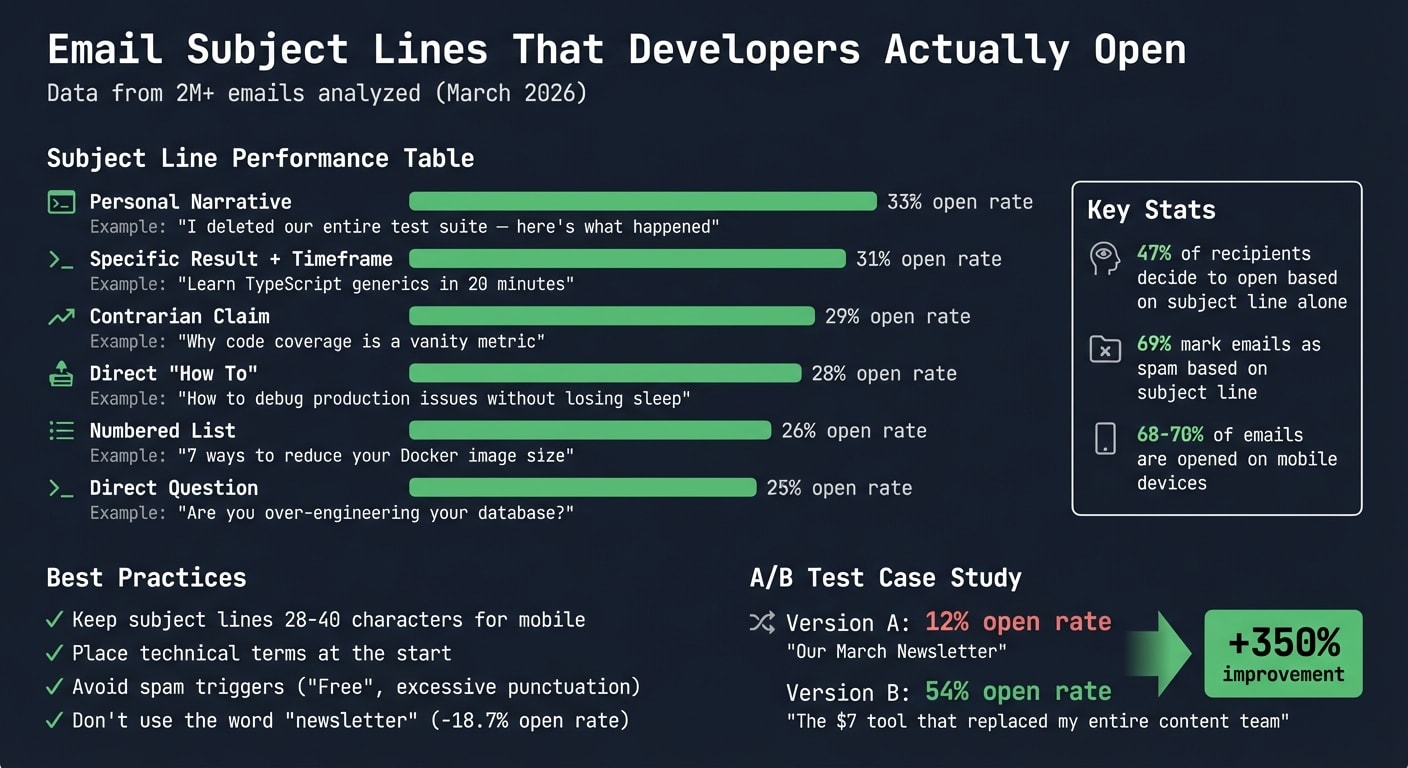
Your subject line plays a huge role in whether your email gets opened. In fact, research shows that 47% of recipients decide to open an email based on the subject line alone, while 69% mark emails as spam for the same reason . When targeting developers, clarity and straightforwardness are key.
Take the February 2026 A/B test by WEDGE Method Dev as an example. Version A, with the subject line "Our March Newsletter", only managed a 12% open rate. But Version B, "The $7 tool that replaced my entire content team", saw a massive 54% open rate . This comparison shows how adding specificity and a touch of intrigue can make all the difference.
Belal Zahran analyzed 2 million emails in March 2026 and identified subject line patterns that resonate with developers. For instance:
- Personal narratives like "I deleted our entire test suite - here's what happened" saw a 33% open rate.
- Time-specific results such as "Learn TypeScript generics in 20 minutes" achieved a 31% open rate.
- Direct how-to formats like "How to debug production issues without losing sleep" hit 28% .
"Your subject line is a promise. The email body is the delivery on that promise. The best email marketers make small, specific promises in the subject line and over-deliver in the body." - Belal Zahran
Keep subject lines between 28–40 characters to cater to mobile users, who account for 68–70% of email opens . Place important technical terms at the start - "AWS billing optimization" outperforms "Optimization strategies for AWS billing." Avoid spam triggers like "Free" or excessive punctuation, and steer clear of words like "newsletter", which can reduce open rates by 18.7% .
Here’s a quick breakdown of subject line formulas and their average open rates:
| Subject Line Formula | Example | Avg. Open Rate |
|---|---|---|
| Personal Narrative | "I deleted our entire test suite - here's what happened" | 33% |
| Specific Result + Timeframe | "Learn TypeScript generics in 20 minutes" | 31% |
| Contrarian Claim | "Why code coverage is a vanity metric" | 29% |
| Direct "How To" | "How to debug production issues without losing sleep" | 28% |
| Numbered List | "7 ways to reduce your Docker image size" | 26% |
| Direct Question | "Are you over-engineering your database?" | 25% |
These insights set the stage for crafting effective drip sequences tailored to developer onboarding.
Drip Sequences for Developer Onboarding
When crafting onboarding sequences for developers, think of them as technical documentation with a bit of personality - definitely not as marketing fluff. The primary goal? Help developers hit their first meaningful milestone fast. That could mean a successful API call, executing a working CLI command, or getting data flowing through your system.
Focus on content first. Start your onboarding emails by delivering the essentials: the API key and a ready-to-run code snippet. Developers often judge your product by how quickly they can get that first successful run . For example, PostHog's Marketing Lead, Joe Martin, refined their onboarding process over a year, going through seven versions. By version 6.0, half of the emails came from Martin's personal address, written with a "sassy and anarchic" tone. This approach led to a 52% open rate, a 3.1% click-through rate, and only a 0.3% unsubscribe rate .
Timing matters more than a rigid schedule. Tailor your outreach based on user activity. If a developer hasn’t made their first API call within 24 hours, send an email addressing the top five setup issues based on support tickets. On the flip side, if they’re already engaged, follow up with advanced guides or tips to take their usage to the next level. Hygraph (formerly GraphCMS) ditched flashy HTML templates in favor of plain text emails. Their simple three-email sequence - spanning seven days - started with a Day 1 welcome from the CEO, followed by a casual check-in on Day 3, and a first-week recap on Day 7. This stripped-down approach achieved an 80% open rate on Day 1 and a 30% reply rate . Keeping it straightforward and relevant builds trust quickly.
"The email that helps them get their first successful API call in five minutes builds more trust than any amount of marketing copy." - Sequenzy
Don’t overdo it. After the initial 48-hour window, space out your emails to about one per week. This conservative cadence helps avoid spam flags and ensures you’re not overwhelming your audience. Be transparent about the frequency - let them know upfront that they’ll receive one email a week for six weeks . Always send emails from a real person, like a founder or an engineering lead, and keep the format simple. Plain text emails are less likely to raise eyebrows and foster a more genuine connection .
When done right, well-timed onboarding sequences can deliver impressive results. Expect open rates between 40–60% and click-through rates of 4–6%. Personalized sequences, in particular, can boost activation rates by 27% compared to generic email blasts .
Product Update Emails: The Art of the Changelog Email
Changelog emails play a key role in developer-focused marketing, helping maintain trust and engagement through clear, benefit-driven updates. The trick? Focus on how updates impact users, not the technical effort behind them. For example, instead of saying, "Refactored the query engine", go with "Reports now load 3x faster" . Developers care about what they can now achieve, not the behind-the-scenes effort it took to make it happen. This user-focused approach is at the heart of effective developer communications.
Structure Matters
Getting the structure right is essential. Always start with breaking changes, clearly labeled with a "Breaking:" tag, and provide detailed migration steps . After that, include:
- Key highlights
- Brief API changes (keep code snippets under 10 lines)
- Bug fixes
This setup ensures developers can quickly identify what’s relevant to them. Use monospace fonts for code references, and include visuals for UI changes - these can increase engagement by up to 5x .
Timing Boosts Impact
Timing can make all the difference. Take Railway, for example: their 222 weekly changelogs reached 115,000 readers with open rates around 50% . Their process? Engineers log updates in an internal Slack channel throughout the week, and the team sends out the email every Friday morning via Customer.io. For teams with less frequent releases, monthly digests are a better fit - grouping minor updates helps avoid overwhelming inboxes while still showing active product maintenance .
Precision in Segmentation
Targeting the right audience is just as important as the content itself. For example, only send Node.js updates to developers actively using Node.js . If a new feature was built based on user feedback, close the loop by notifying those specific users with a "You asked, we built it" message . While open rates typically range between 15–25%, remember that actual readership is often higher since many developers use email clients that block tracking pixels. Click-through rates generally fall between 3–7% .
This thoughtful segmentation not only ensures relevance but also lays the groundwork for more advanced audience targeting strategies. For those looking to scale these efforts, you can reach developers at scale through specialized advertising platforms.
Segmentation Strategies for Developer Audiences
Knowing where developers stand in their technical journey can make or break your engagement efforts. Sending beginner-level API tips to seasoned developers? That’s a fast track to an unsubscribe button . The secret lies in segmenting your audience based on actionable technical insights - not just demographic data.
Start by tracking integration depth. There’s a world of difference between a developer testing one API call and another handling 10,000 production requests daily . Your messaging should reflect this: trial users will appreciate quick-start guides and beginner resources, while seasoned power users value advanced optimization tips and early access to features. Similarly, role-based segmentation matters - a solo developer exploring a hobby project has vastly different needs than an engineering manager overseeing a production system serving millions .
Another key factor? Developers’ preferred programming language. By analyzing SDK downloads, signup details, or even GitHub profiles, you can customize content. For example, a Python developer is far more likely to engage with Python-specific code snippets than Java examples. This level of relevance often drives click rates between 5–10%, as developers can directly copy and implement the provided code .
"For developers, relevance often means topic or technology, not just name." - Sunil Sandhu, Founder, Circuit
Comparing Segmentation Approaches
Here’s a quick breakdown of common segmentation methods and their impact:
| Segmentation Type | How to Implement | Expected Engagement Impact |
|---|---|---|
| Seniority / Experience | Use API call tracking and role data from signups. | High engagement for detailed content; prevents unsubscribes. |
| Programming Language | Analyze SDK downloads or GitHub activity. | 5–10% click rates for tailored, copy-paste-ready snippets . |
| Tool / Stack Preference | Segment by backend, frontend, or DevOps functions. | Increases relevance by eliminating unnecessary info. |
| Engagement Level | Monitor activity (e.g., dormant vs. active users). | Boosts activation; 30–45% open rates for milestone updates . |
The real magic happens when you combine these layers. For instance, targeting backend developers actively using Node.js with performance optimization tips specific to Node.js transforms your email from generic to indispensable. By aligning your outreach with developers’ exact needs, you’re not just sending emails - you’re delivering solutions.
Measuring Email Effectiveness Beyond Open Rates
When it comes to developer email marketing, relying on open rates alone can lead to inaccurate conclusions. Why? Many developers use privacy-focused email clients that block tracking pixels or strip out HTML, which skews these metrics. While reported open rates typically fall between 15–25%, the actual readership could be 40–60% higher.
"Open rates for developer audiences are notoriously misleading. Many developers use clients that block tracking pixels or strip HTML. Your reported open rates might be 40-60% lower than actual readership." – Sequenzy
To get a clearer picture of engagement, focus on metrics beyond open rates. Click-through rates - generally between 3–7% - offer a better sense of interest. Additionally, tracking time-on-site can help distinguish between quick clicks and meaningful engagement with your content.
The ultimate indicator of success, however, lies in conversions tied to product usage. For instance, if a changelog email leads to a noticeable increase in API calls or an onboarding email results in a first successful integration, you’ve directly demonstrated the email’s impact on your business. Reply rates can also be revealing. Developers are known for ignoring generic marketing emails, so a higher reply rate often signals that your message struck the right technical tone.
Lastly, keep a close eye on unsubscribe rates. These can highlight whether your content is resonating or being dismissed as irrelevant. For example, if your weekly newsletter retains subscribers but product update emails lead to a wave of unsubscribes, you’ll know exactly where adjustments are needed.
Now, let’s look at how combining email with feed advertising can strengthen multi-touch campaigns on daily.dev.
Combining Email with Feed Advertising on daily.dev for Multi-Touch Campaigns
Relying solely on email to reach developers has its limitations. Not every developer checks their inbox regularly, which means your message might not always land. But when you combine email with daily.dev's in-feed advertising, you create multiple opportunities to connect with developers where they naturally spend their time.
In-feed ads go beyond email by providing a seamless, native experience within the content developers are already consuming. By using your segmentation strategy, these ads can directly target specific developer groups. On daily.dev, in-feed ads appear alongside technical articles and resources, making them a natural extension of your email campaigns. When coordinated effectively, this dual-channel approach amplifies your message. For example, changelog emails and technical updates can be reinforced with in-feed ads, ensuring your audience consistently engages with your content.
To avoid redundancy, tailor your messaging across channels. If your email announces a new API endpoint, use your in-feed ad to highlight a practical use case or integration example. This way, both channels provide value from different perspectives, focusing on supporting developers rather than simply driving conversions .
Tracking unified metrics across these channels is essential. For instance, clicks to technical documentation - whether from an email or an in-feed ad - indicate genuine interest. Monitoring how users move from initial API exploration to full production implementation can help gauge the effectiveness of your messaging .
This multi-touch strategy ensures you're present on the platforms developers prefer. Some developers value detailed email updates they can revisit, while others discover tools organically through in-feed ads as they browse industry content. By maintaining thoughtful communication across both spaces, you increase the likelihood of your message resonating without overwhelming your audience.
Conclusion
Developer email marketing thrives when you approach developers as equals in the technical space. Every email - whether it's a changelog, tutorial, or onboarding sequence - becomes a test of your technical credibility. Errors in code examples or overly promotional content can quickly erode trust.
Instead of fixating on traditional metrics like open rates (which are often skewed by privacy-focused email clients), prioritize actionable data like click-through rates, API usage, and the time it takes for users to make their first API call. These metrics offer a clearer picture of your value.
Timing and segmentation play a huge role in breaking through the noise. Use event-driven emails triggered by specific product actions, such as a first API call or an error spike, rather than relying only on scheduled campaigns . For breaking changes, provide at least 30 days' notice, followed by reminders at 14 and 3 days . Include copy-pasteable code snippets in your emails, and keep your calls-to-action clear and focused on benefits.
To maximize impact, integrate email with other touchpoints. While some developers check their inbox daily, others may let unread messages pile up. Pairing email with in-feed advertising on platforms like daily.dev ensures broader reach without overwhelming your audience. For example, an email announcing a new feature could be complemented by an in-feed ad showcasing its practical use case - meeting developers where they already are.
The key is to send fewer, but more meaningful emails. By delivering technical depth, respecting developers' time, and focusing on metrics that matter, your emails can become a trusted resource rather than just another message to ignore. When your strategy aligns with developers' technical needs, you build lasting trust and close the loop from engagement to loyalty.
FAQs
What should I send developers before asking for a demo?
When reaching out to developers, the key is to provide technical, value-packed content that resonates with their interests and challenges. Developers appreciate content that respects their time while offering practical insights or solutions.
Some effective types of content to include are:
- Tutorials: Share step-by-step guides or examples that help them solve specific problems or learn new skills.
- Product Updates: Highlight relevant updates or features that could make their work easier or more efficient.
- Problem-Solving Insights: Offer actionable advice or unique approaches to common challenges they face.
The goal is to make your email relevant and respectful. By delivering content that genuinely helps them, you build trust and credibility. Only after establishing that trust should you consider asking for something, like scheduling a demo. This approach ensures your outreach feels helpful rather than intrusive.
How do I segment developer emails without creepy tracking?
To segment developer emails in a way that respects privacy, stick to methods that prioritize user consent and transparency. Use first-party data collected during signups or through voluntary actions, like when users specify their job role or preferred technology stack. Additionally, pay attention to engagement signals, such as clicks on specific types of content. This approach ensures your segmentation aligns with their explicit interests, steering clear of invasive tracking that could come across as intrusive.
What’s the best way to measure impact if open rates are unreliable?
When open rates fall short in reliability, shift your attention to developer engagement metrics. Look at indicators that reflect genuine interaction, like the number of API calls, documentation views, SDK downloads, or actual product usage. These metrics offer a more accurate view of technical adoption and the overall impact of your efforts.