

Want to get the most out of your developer event investments? Conferences and sponsorships are expensive, but they can deliver measurable results if planned correctly. Here's how you can ensure your event marketing efforts translate into real outcomes, like product signups, SDK downloads, and qualified leads:
- Focus on behavioral ROI: Track meaningful actions (e.g., API interactions) instead of superficial metrics like badge scans.
- Choose the right events: Align event audiences with your developer profile, factoring in programming focus, industry relevance, and seniority levels.
- Optimize sponsorships: Match sponsorship tiers (Bronze, Silver, Gold, Platinum) to your goals, and negotiate for benefits that drive engagement.
- Pre-event preparation: Use email, social media, and targeted ads to promote your presence, schedule meetings, and build anticipation with technical content teasers.
- Engage on-site: Run live demos, host workshops, and offer practical swag. Use lightning talks to provide quick, focused insights.
- Follow up effectively: Segment leads, act quickly (within 48 hours), and personalize outreach to convert interest into long-term engagement.
- Measure ROI: Track cost per lead, pipeline impact, and attendee actions post-event. Focus on developer behavior, not just attendance numbers.
Key takeaway: Every dollar spent on events should drive measurable outcomes. This means combining thoughtful pre-event planning, engaging on-site tactics, and precise follow-up strategies to maximize ROI.
How to Choose the Right Developer Events
Developer events come in all shapes and sizes. What works wonders for one company might not hit the mark for another. Picking the right event is the first step toward driving meaningful engagement and seeing measurable returns. The trick? Aligning the event’s audience with your target developer profile.
Before signing up for sponsorship, weigh the event against six key factors: programming language focus, cloud compatibility, company size, industry relevance, engineering discipline, and developer experience level . For example, if you’re rolling out a Python-based data tool, PyCon could be a great fit. This event draws over 2,000 participants, many of whom are senior developers . On the flip side, it might not be ideal for reaching less experienced developers or those working outside the Python ecosystem.
Here’s how you can align developer events with your audience and goals.
Match Events to Your Developer Audience
Start by digging into the event’s Call for Proposals (CFP) and reviewing past session topics. Look for sessions that align with your product’s focus, whether it’s AI/ML, DevOps, security, cloud-native development, or mobile platforms .
"As a technical organization, your main conference goal should be making strong, meaningful connections. If you judge them on lead counts, customers, or other short-term metrics, you'll find events tough to justify." - Adam DuVander, EveryDeveloper
Be cautious about “multi-community events” that cater to a variety of distinct groups. Even if an event boasts a huge attendance, only a fraction of the audience might align with your technical focus. Make sure the sub-communities present match your target developer persona .
Consider Event Size and Location
Beyond audience alignment, the size and location of an event matter. Take global conferences like WeAreDevelopers World Congress, which hosts over 10,000 attendees and 500+ speakers. These offer the scale to connect with both hands-on developers and decision-makers like CTOs and engineering managers . Many of these large events also have regional editions, letting you fine-tune your messaging for specific markets.
On the other hand, smaller meetups or niche events provide opportunities for deeper technical engagement and valuable feedback. If you’re in the early stages of testing product-market fit or gathering user insights, these smaller gatherings might deliver more impact than a massive conference. However, keep in mind that managing multiple smaller events can demand more operational resources.
"The larger the event, the less targeted it will be... large expos will likely have a lower percentage of the right developers for your product." - Adam DuVander, EveryDeveloper
Target the Right Developer Seniority Levels
Different events attract developers with varying levels of experience. Some focus on junior developers eager to expand their skills, while others - like PyCon - draw senior engineers, architects, and technical leads who influence key technology decisions and budgets .
If your goal is to drive product adoption, focus on events that attract hands-on developers who can integrate your API or SDK. For enterprise-level solutions, look for opportunities to connect with CTOs, VPs of Engineering, and architects who oversee standardization and funding decisions. These roles are critical throughout the decision-making process, from evaluation to purchase .
Finally, ensure your event presence includes knowledgeable staff. Developer advocates, solutions engineers, and product managers who can engage in detailed technical conversations will resonate far more with developers than a booth manned solely by sales reps. Developers value expertise and genuine interactions over promotional pitches .
Understanding Sponsorship Tiers and Benefits
::: @figure 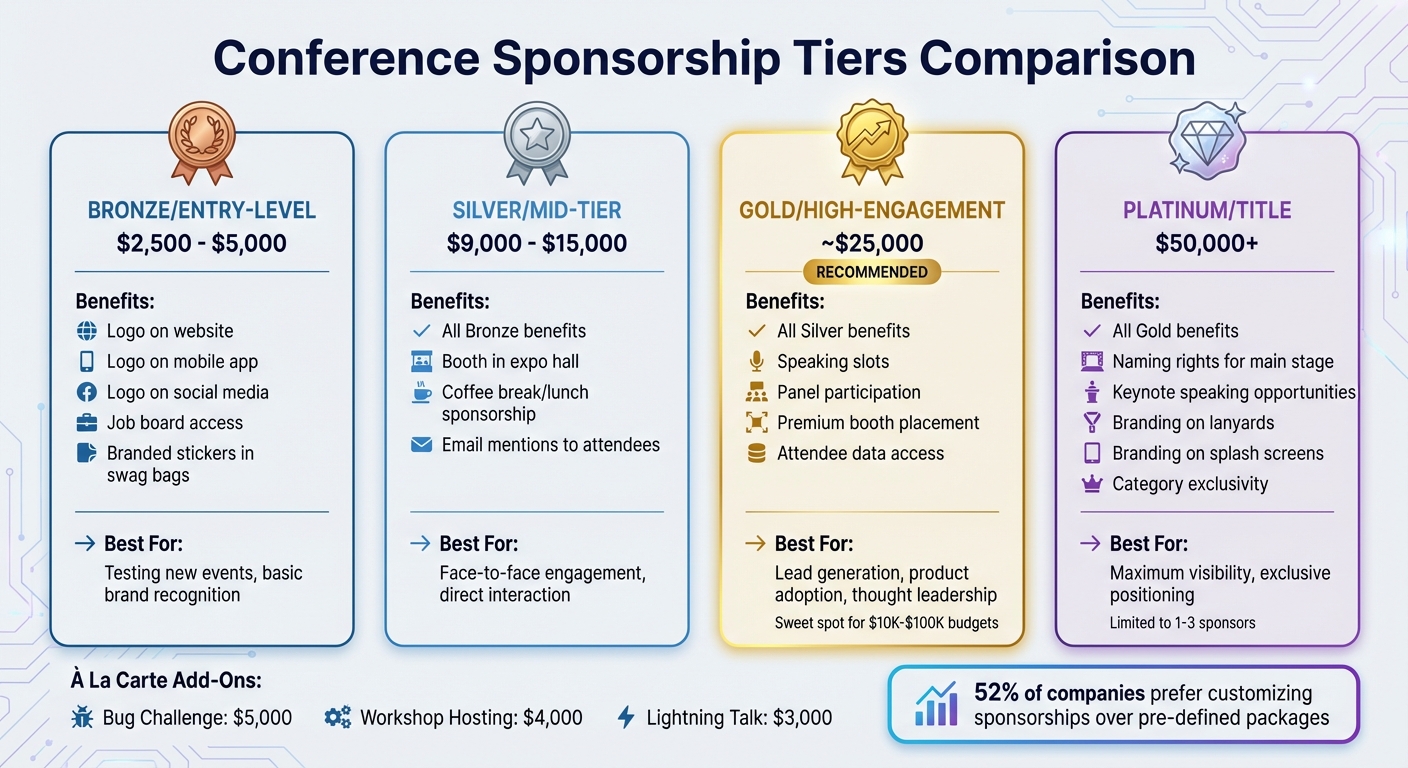 {Developer Conference Sponsorship Tiers: Benefits and Pricing Comparison}
Once you've identified the right event, the next step is to align your sponsorship choice with your goals, focusing on measurable outcomes. Developer conferences often categorize sponsorships into tiers - Bronze, Silver, Gold, and Platinum (or Title) - to simplify partnership options based on investment levels and visibility . Each tier offers a different level of impact, ranging from passive exposure (like logo placements) to active engagement through speaking opportunities and workshops .
The key is to prioritize outcomes over visibility. Lower tiers are great for building brand awareness, while higher tiers are geared toward deeper engagement, lead generation, and establishing thought leadership . As Aniqa Iqbal from Remo puts it:
"A logo on a wall is forgettable. Outcomes are not."
Here’s a closer look at what each sponsorship tier typically includes.
What Each Sponsorship Tier Includes
Bronze or Entry-Level: Starting at $2,500 to $5,000, this tier typically includes logo placements on the event website, mobile app, and social media, along with perks like access to the job board or branded stickers in attendee swag bags . It's ideal for companies testing a new event or seeking basic brand recognition without a large investment.
Silver or Mid-Tier: Priced between $9,000 and $15,000, Silver packages often include a booth in the expo hall, sponsorship of coffee breaks or lunch sessions, and mentions in email communications to attendees . This tier allows for more direct interaction with attendees, making it a solid choice for face-to-face engagement.
Gold or High-Engagement: At around $25,000, Gold sponsorships typically offer speaking slots, panel participation, premium booth placement (often near high-traffic areas like the main stage), and access to attendee data for lead capture . For businesses with budgets between $10,000 and $100,000, this tier strikes a balance between visibility and meaningful interaction.
Platinum or Title: These packages, starting at $50,000 or more, provide exclusivity and high-profile benefits like naming rights for the main stage, keynote speaking opportunities, and branding on lanyards or splash screens . Often limited to just one sponsor per category, Platinum sponsorships ensure maximum visibility and exclusivity .
Many events also offer à la carte options to enhance your sponsorship. For example, you could sponsor a Bug Challenge for $5,000, host a workshop for $4,000, or deliver a lightning talk for $3,000 . These add-ons are perfect for showcasing technical expertise and engaging attendees on a deeper level.
Additionally, hybrid and virtual events now include features like virtual booths, branded networking tables, and logo placements in session recordings . These digital elements extend your reach beyond the event, offering long-term benefits.
Selecting a Sponsorship Package Within Budget
Choosing the right tier isn’t just about the price tag - it’s about aligning the package with your specific business goals. For instance:
- If brand awareness is your primary aim, Bronze or Silver tiers are sufficient.
- For lead generation or product adoption, Gold offers the speaking slots, premium booth placement, and attendee data access needed for measurable results .
For budgets between $10,000 and $100,000, Gold often provides the best mix of visibility and engagement. Higher-tier sponsorships are typically limited (often just 1–3 slots), ensuring your brand stands out . If you’re investing $50,000 or more, securing category exclusivity is essential.
"Event sponsorship in 2026 no longer rewards visibility, it rewards value." - Zainab Asad, Remo
Audience quality matters just as much as quantity. Instead of focusing solely on registration numbers, assess the event’s attendee demographics. A smaller event with 500 senior developers may deliver better ROI than a massive expo with 5,000 attendees, where only a small percentage aligns with your target audience .
Interestingly, 52% of companies now prefer customizing their sponsorships by selecting individual options rather than sticking to pre-defined packages . If the standard tiers don’t align with your needs, don’t hesitate to ask for tailored solutions.
How to Negotiate Extra Sponsorship Benefits
Sponsorship tiers are just starting points - they’re not set in stone. The most successful sponsors treat these packages as frameworks and negotiate to maximize value.
Start by scheduling a discovery call with the event organizer before signing any agreement. Use this opportunity to explain your goals - whether it’s lead generation, thought leadership, or launching a new product - and explore ways to customize the package to meet your objectives .
As a veteran from the IEG Sponsorship Report explains:
"The sponsors who spend the most are the ones who feel the proposal was written specifically for them. Personalization isn't a nice-to-have - it's the difference between a $10K package and a $100K partnership."
Negotiate to swap less relevant benefits for high-impact options. For instance, if your focus is digital engagement, ask to replace a physical booth with an extra email blast or a dedicated breakout session . Every adjustment should support your goal of converting engagement into measurable results.
Consider negotiating for enhanced data access. Post-event reports with detailed attendee demographics, session engagement, and lead data are invaluable for proving ROI and planning future sponsorships .
If budget is a constraint, explore in-kind contributions. Offering services like event platforms, media coverage, or venue space can help offset costs while securing higher-tier benefits .
Finally, secure the first right of refusal for premium assets at the next event. Negotiating these rights within two weeks of the current event ensures you lock in high-value opportunities before they’re available to others .
Pre-Event Marketing to Drive Booth Traffic
Securing a sponsorship is just the first step. To make the most of your investment, pre-event marketing is essential for turning that sponsorship into real engagement. Done right, it can boost booth traffic and increase meeting conversions.
Combining email outreach, social media promotion, and targeted digital ads is a smart way to connect with developers where they already spend their time. Did you know that over 75% of event organizers say email marketing is their most effective tool, with 45% of ticket sales coming directly from email campaigns? The secret lies in segmentation - tailoring your messages to specific attendee personas instead of sending generic announcements like, "Come see us at booth 47." For example, if you're targeting senior engineers, focus on architecture deep dives or technical workshops rather than surface-level product features.
Promote Your Event Presence Across Channels
Start promoting your conference presence about 3–4 weeks before the event, and be sure to use multiple channels. While email is king, your message needs to offer value. Instead of just sharing your booth number, explain what attendees will gain - like live demos, exclusive content, or hands-on workshops.
On social media, highlight the people and technical expertise attendees can expect to find at your booth. Developers care more about expertise than flashy promotions, so focus your posts on the engineers or technical leaders they’ll meet . If you’re hosting a workshop or talk, share sneak peeks or short video clips of the technical content to build anticipation.
For even broader reach, consider targeted advertising on daily.dev. This platform lets you zero in on developers based on seniority, programming languages, and specific technologies. It’s a great way to connect with developers who might not be on your email list but are attending the conference. Use these ads to spotlight key sessions, booth activities, or links for scheduling meetings directly in their feeds.
Schedule Meetings Before the Event
One of the smartest moves you can make before the event is pre-scheduling meetings with key prospects. Tools that sync with Google, Outlook, and Apple calendars make this process seamless, allowing attendees to book time with just a few clicks . You can customize meeting parameters, such as duration (15- or 30-minute slots), buffer times, and specific locations like your booth or nearby meeting spaces .
To further reduce no-shows, personally reach out to high-value prospects to confirm their appointments. This extra step not only ensures their attendance but also maximizes your team’s time by focusing on qualified leads.
Platforms like Calendly, Doodle, or Acuity Scheduling integrate with CRM systems, making it easy to track who’s scheduled a meeting and follow up after the event . Most of these tools also allow you to set up automated reminders - sent via email or SMS - 24 hours and one hour before the meeting, helping to minimize last-minute cancellations .
Use Content Teasers to Build Interest
Content teasers are a great way to generate excitement and give attendees a reason to visit your booth. The best teasers focus on technical depth rather than just product features. Short videos showcasing architecture deep dives, blog posts explaining the technical challenges your demo addresses, or social media posts emphasizing your speakers’ expertise tend to perform much better than generic promotional content.
Take GitHub’s first public demo of GitHub Copilot at the WeAreDevelopers World Congress, which drew in over 10,000 developers . Or consider Stack Overflow’s launch of OverflowAI at a major developer conference, which they used to drive both product awareness and adoption . Christina Schaireiter from WeAreDevelopers sums it up perfectly:
"Architecture deep dives (e.g. live demos) help companies establish credibility and authority, which directly influences product perception, developer trust, and employer branding."
When creating teasers, think about your target audience. For DevOps engineers, focus on platform engineering or infrastructure automation. For tech leads or CTOs, highlight strategic topics like AI implementation or architecture decisions. Your goal is to show that your booth offers real technical value - not just another sales pitch.
With these steps, your team will be well-prepared to turn pre-event momentum into meaningful on-site engagement. Every conversation at your booth will build on the excitement you’ve created beforehand, setting the stage for a successful event.
On-Site Tactics That Engage Developers
When the conference begins, all the buzz you created beforehand needs to translate into meaningful booth engagement. The difference between a crowded booth and an empty one often lies in how well you craft the on-site experience. Developers aren’t interested in flashy sales pitches - they want depth, technical insights, and hands-on interaction. Bridging your pre-event strategy with thoughtful on-site tactics is key to keeping developers engaged.
Today, sponsors are looking for more than just visibility or foot traffic. As Bizzabo notes:
"They expect proof. Pipeline clarity. Revenue impact."
This means your booth needs to prioritize high-value technical conversations over mere aesthetics. With 23% of sponsors citing poor booth traffic as a major challenge , creating an engaging experience is critical.
Run Live Demos and Hands-On Workshops
Live demos are a powerful way to give developers an authentic look at your product while allowing them to interact with it firsthand. This kind of real-time experience is nearly impossible to replicate online .
Tailor your demos to your audience. For newcomers or those unfamiliar with your product, a step-by-step walkthrough can provide a solid introduction. For more experienced attendees, offer branching demos that let them explore specific features or advanced use cases. When targeting stakeholders ready for in-depth evaluations, showcase multi-feature overviews that highlight your product’s full potential .
These interactions don’t just engage attendees - they also provide valuable feedback that can help refine your product. Consider using digital check-in kiosks to track attendance at mini-sessions or workshops . Recording these interactions in your CRM can also help measure their impact on your sales pipeline .
Once you’ve captured attention with interactive demos, shift gears to leave attendees with something memorable.
Give Away Swag Developers Actually Want
Let’s be honest: not all swag is worth keeping. Developers aren’t going to be impressed by generic pens or flimsy tote bags. Instead, focus on items that are practical and resonate with their interests - think mechanical keyboards, USB-C hubs, portable chargers, or even tech-focused books.
Quality over quantity is the rule here. A thoughtfully designed technical t-shirt or a premium sticker pack can leave a lasting impression far longer than a bag full of forgettable freebies. With 30% of sponsors emphasizing lead quality as their top ROI metric , investing in meaningful swag can pay off.
But swag alone isn’t enough. To truly stand out, you need to offer engaging content.
Host Lightning Talks and Short Sessions
Lightning talks - quick, focused presentations lasting 5–15 minutes - are perfect for busy environments where attendees have limited time. These sessions let you showcase technical expertise without requiring a big time commitment.
Focus these talks on solving specific problems, sharing architecture insights, or highlighting innovative approaches to common challenges. Avoid slipping into product pitches disguised as technical talks - developers can spot these from a mile away and will tune out. Instead, aim to address “micro-moments” in the attendee journey by offering precise, relevant insights .
Personalization can make a big difference here. Companies that tailor experiences report 37% higher engagement rates . For example, if your audience includes DevOps engineers, focus on infrastructure automation. If you’re speaking to tech leads, highlight architecture patterns or tools that boost team productivity. Every interaction at your booth is a chance to create content - capture live testimonials or demos to share on social media and other digital platforms in real time .
As The MTM Agency puts it:
"Events should be the backbone of an always-on, account-led strategy, especially for high-trust B2B brands."
Post-Event Follow-Up That Converts Leads
Event follow-up can make or break your success. At a conference, attendees might get scanned up to 17 times by various booths. And if you wait too long? Response rates drop by 80% after just 48 hours. Speed and personalization are non-negotiable.
Michael Gabrielle Colayco from Stateshift sums it up perfectly:
"The real question behind developer event ROI is much simpler. What did developers do after the event ended?"
The goal isn't just to collect names for a drip campaign. It's to turn those conversations into meaningful actions - like account signups, API tests, or technical demos. Your follow-up is where you bridge the gap between initial interest and long-term engagement.
Segment Leads for Personalized Follow-Up
Not all leads are created equal. Instead of relying solely on badge scans, segment leads based on post-event behavior. For instance, a developer diving into your API is a much hotter lead than someone grabbing swag.
Real-time tracking is key here. Use a simple two-person system at your booth: one person engages attendees while the other logs details - like pain points, budgets, and decision-makers - directly into your CRM.
At the end of each day, rank your leads by priority. The best teams convert 18–25% of their top-tier leads into booked discovery calls within two weeks. High-priority leads deserve immediate, tailored outreach - not a generic email days later.
Stripe nailed this approach at a 2026 developer meetup. They tracked attendees who created accounts and tested their API using a dedicated event link. This allowed them to measure ROI based on actual usage, not just attendance numbers.
By segmenting effectively, you can turn badge scans into truly qualified leads.
Turn Badge Scans Into Qualified Leads
Conversations at your booth are golden opportunities to qualify leads. Ask questions like, "When are you evaluating solutions?" to gauge urgency. Always confirm a specific next step, such as, "I'll send the ROI calculator by Tuesday", to set the stage for follow-up.
For top leads, act fast. Send a LinkedIn voice message or text the same night to stay fresh in their minds. Within 24 hours, follow up referencing the exact issue or demo you discussed. Avoid generic emails - they’ll get lost in the noise.
Take a page from Vercel’s playbook. At a 2026 meetup on frontend performance, they used a unique QR code that led attendees to a custom landing page. From there, attendees could immediately create a free account and deploy an example project. This let Vercel’s team track how many attendees moved from passive listeners to active users.
When to Follow Up After the Event
Timing matters. The first 48 hours are critical for engagement. For Tier 1 leads, reach out the same night or next morning. Tier 2 leads should hear from you within 48 hours, and your message should be personalized to reference your conversation.
What about high-value leads who go quiet? After two weeks, try a creative touch like a 60-second personalized Loom video or even a handwritten note. These small, thoughtful gestures can make you stand out from the sea of vendor emails.
Not every lead will convert immediately. Some connections may take weeks or even months to develop into opportunities. For these, set up a long-term nurture plan. Offer valuable resources like extended trials, cloud credits, or in-depth workshops to keep them engaged.
As Jodi Whitehead from Bizzabo puts it:
"Sponsors are not asking for more metrics. They are asking for meaningful metrics."
With a solid follow-up strategy, you can measure the real impact of your event efforts and keep the momentum going with ongoing digital campaigns.
How to Measure Event ROI
When it comes to validating your event strategy, measuring ROI isn't just a nice-to-have - it's a must. Yet, many event organizers still struggle to provide concrete numbers. Here's a startling stat: only 23% of event marketers measure ROI accurately. Even more surprising? 65% of event sponsors skip ROI measurement altogether. If you're investing anywhere between $10,000 and $100,000 on developer events, you need a clear plan to prove the value of that spend.
The trick lies in tracking developer behavior, not just attendance numbers. Badge scans are fine, but they don’t tell the full story. What really matters is what happens after the event - things like developers signing up for accounts, downloading your SDK, or joining your community. These actions reveal actual engagement and help connect your pre- and post-event strategies to measurable outcomes.
To measure ROI effectively, focus on four key areas:
- Direct financial metrics: Think Cost Per Registration, Cost Per Attendee, and Revenue Per Attendee.
- Marketing performance: Channel attribution and referral rates are key here.
- Engagement quality: Use tools like Net Promoter Score (NPS) and lead quality scores.
- Long-term impact: Metrics like pipeline influenced and Customer Acquisition Cost (CAC) comparisons come into play here.
Remember, B2B event ROI often unfolds over several months - typically 3 to 6 months. So, instead of relying solely on immediate conversions, extend your measurement window to cover the full sales cycle. It's worth noting that event-driven deals are often 30% to 50% larger than standard inbound leads.
Calculate Cost Per Lead
Start with a straightforward calculation: divide your total event investment by the number of developers who took a meaningful action. Your total investment should include everything - sponsorships, travel, booth setup, swag, and staff time. As for leads, focus on specific actions like API tests, SDK downloads, or account signups.
Here’s an example: one API conference used unique event links to directly attribute signups to the event. You can replicate this by using event-specific QR codes or short links tied to your CRM.
Once you have your Cost Per Lead (CPL), compare it across events and channels. For context, paid LinkedIn ads for event registrations typically range from $120 to $720 per lead. On the other hand, attendee advocacy programs can lower this to $18 to $60 per lead. Sometimes, a smaller, targeted event with higher conversion rates can deliver better returns than a large-scale, costly conference.
But don't stop at lead volume. Evaluate lead quality too - look at factors like job title, company size, and engagement depth. This approach ensures you're measuring meaningful outcomes, not just headcounts.
Track Pipeline Generated From Events
Once you’ve nailed down lead costs, shift your focus to revenue. This involves two key metrics:
- Attributable Revenue: Revenue directly linked to an event lead.
- Incremental Revenue: Additional revenue that wouldn’t exist without the event sponsorship.
Many sponsors aim for a minimum ROI of 2:1, with some targeting 3:1 or even 4:1. To calculate ROI, use this formula:
((Attributable Revenue - Cost) / Cost) x 100.
For example, if you spent $50,000 on a conference and brought in $150,000 in attributable revenue, your ROI would be 200%.
To benchmark event performance, compare your Customer Acquisition Cost (CAC) across different marketing channels:
| Marketing Channel | CAC Range |
|---|---|
| Events | $600 – $2,400 |
| Content Marketing | $240 – $960 |
| Paid Search | $360 – $1,800 |
| Outbound Sales | $1,200 – $6,000 |
Setting baselines before the event - using historical sales data and brand perception metrics - can help you isolate the event's impact. This makes it easier to show incremental value to your finance team.
Measure Brand Awareness Impact
Quantifying brand awareness can be tricky, but it’s a crucial part of event ROI. Start with your Net Promoter Score (NPS). Ask attendees one simple question: How likely are you to recommend our product to a colleague? An NPS above 50 is strong, and anything over 70 is outstanding for events. Send this quick survey right after the event while the experience is still fresh.
Next, look at your Share Rate - the percentage of attendees who promote the event or its content within their networks. High-performing events often hit a Share Rate of 20% or more. Social mentions and shares during the event can also give you a sense of brand visibility and sentiment.
To go beyond awareness, use event-specific QR codes to track deeper engagement. For instance, measure how many attendees sign up for your newsletter or join your developer community.
Lastly, calculate the Content Value of your event. This includes assets like recorded sessions, speaker interviews, and attendee testimonials. These materials not only enrich your ROI calculations but also provide long-term value as reusable content.
Combining Events With Ongoing Digital Advertising
Developer events are great for building personal connections, but their true value lies in what happens beyond the conference. Savvy marketing teams know how to stretch the impact of these events by combining in-person sponsorships with ongoing digital advertising. This strategy transforms a short-lived conference into a months-long engagement plan, amplifying efforts before, during, and after the event.
Let’s say you invest $50,000 in a booth. That gets you swag, live demos, and speaking opportunities. But what about the developers who don’t attend the event or simply walk past your booth? This is where digital advertising bridges the gap, reaching developers in their everyday spaces - whether they’re reading technical blogs or catching up on industry news.
Platforms like daily.dev Ads are purpose-built for running developer-focused campaigns that complement your event presence . Before the event, targeted ads can promote your sessions and encourage booth appointments. During the event, ads help maintain visibility for those unable to attend in person. Afterward, you can retarget attendees with demo videos, workshop recordings, or other follow-up content. This ensures your event investment extends beyond badge scans, nurturing potential leads without overwhelming them with spam.
The key to making this work is precise targeting. With daily.dev, you can reach developers based on their seniority, preferred programming languages, or the tools they use - criteria you likely considered when selecting the event. For instance, if you sponsored an AI-focused conference, you could run ads aimed at mid-level developers interested in AI ethics, machine learning frameworks, or specific tech stacks. This creates a seamless connection between your event efforts and your digital campaigns, guiding developers from initial interest to meaningful engagement.
To maximize results, allocate 20–30% of your event budget to digital advertising. For a $50,000 sponsorship, this means setting aside $10,000–$15,000 for campaigns before, during, and after the event. Measure your ROI by tracking metrics like cost per lead, pipeline growth from event attendees who also saw your ads, and increased brand awareness among your target audience. By integrating these channels, you transform one-off interactions into a continuous engagement cycle, making event ROI easier to measure and more impactful. This multi-touch strategy ensures your efforts don’t stop at the booth but continue to drive value long after the event wraps up.
FAQs
What should I track as 'behavioral ROI' after a conference?
To gauge behavioral ROI after a conference, focus on tracking metrics that reveal attendee interest and interaction. These include engagement rates, click-throughs, the quality of comments, and specific actions like registrations or content downloads. By analyzing these indicators, you can better understand how attendee behavior ties into future pipeline opportunities and overall levels of engagement.
How do I choose the right sponsorship tier for my $10K–$100K budget?
To determine the best sponsorship tier for a budget between $10,000 and $100,000, start by assessing what each tier includes. Look at benefits like booth traffic, speaking opportunities, access to attendee lists, and brand visibility.
If your goal is broad brand awareness, higher tiers usually offer more exposure and engagement opportunities. On the other hand, if you're aiming for more focused outreach, lower tiers that emphasize booth traffic or workshop sponsorships might deliver better value for your money.
Keep your decision data-driven by tracking metrics such as cost per lead and pipeline generated to evaluate the return on investment (ROI).
How can I attribute signups and pipeline to a specific event?
To link signups and pipeline to an event, leverage tools like UTM parameters, promo codes, and referral links to track attendee behavior. Pay attention to onsite interactions, including badge scans, booth visits, and activity participation, to collect valuable data. By combining these approaches, you can pinpoint how many signups and the pipeline value stemmed from the event, making it easier to measure ROI with greater accuracy and clarity.