

In the developer-driven economy, your documentation is your product. Companies like Stripe, Vercel, and Supabase have proven that great Developer Experience (DX) isn't just about making life easier for developers - it's a direct path to business growth. Here's why DX matters:
- First impressions count: Developers often skip marketing pages and go straight to documentation. Poor docs? They leave.
- Time-to-Hello-World (TTHW): Faster onboarding means higher adoption. Stripe’s instant API test examples helped them grow to an $80 billion valuation.
- Interactive docs drive adoption: 68% of developers who successfully run a code example integrate the product into production.
- Lower support costs: 80% of Stripe’s integrations happen without contacting support.
DX isn't just about clean code or APIs - it’s about creating a frictionless journey from discovery to integration. Companies that prioritize DX reduce acquisition costs, shorten sales cycles, and turn developers into advocates.
Key takeaway: Treat your documentation as a sales tool, not an afterthought. Make it easy, fast, and rewarding for developers to succeed with your product.
::: @figure 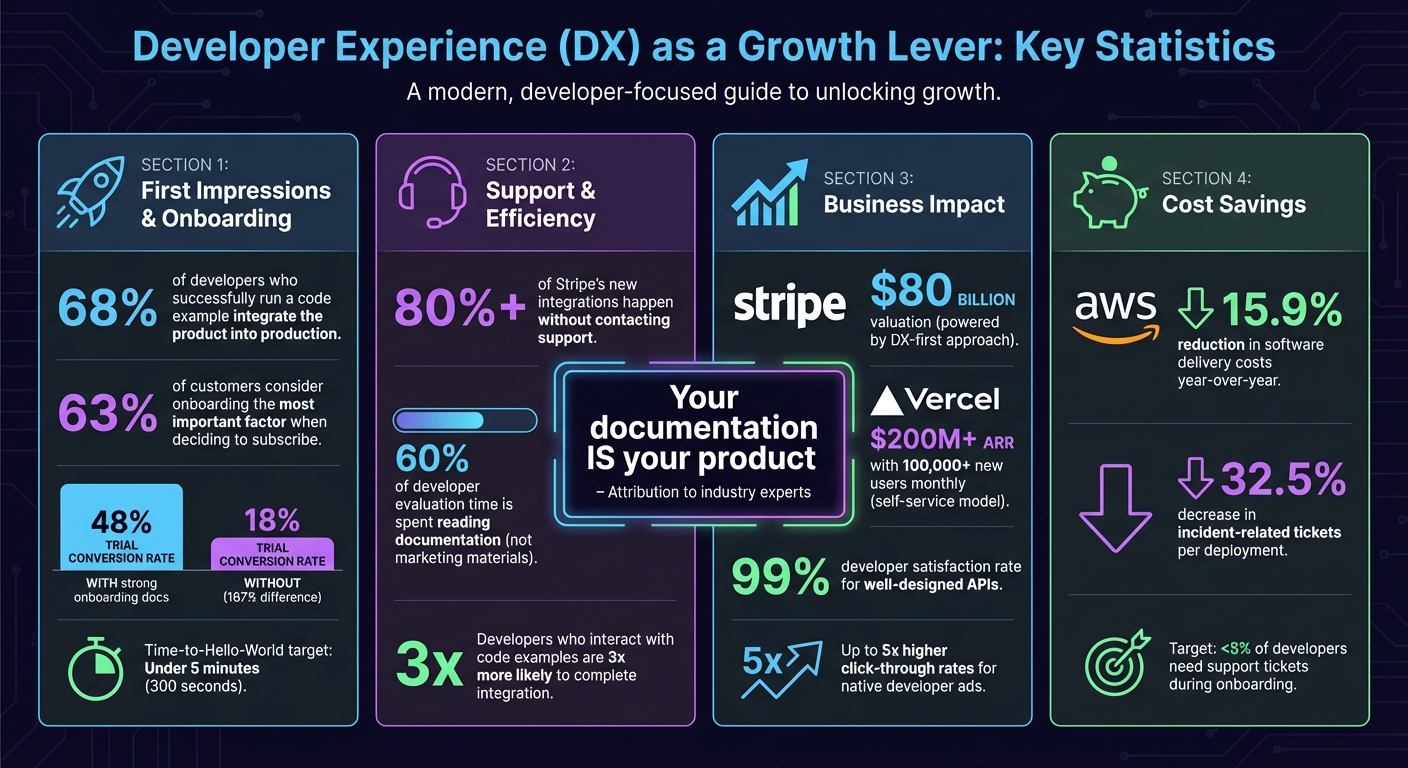 {Developer Experience Impact: Key Statistics on DX-Driven Growth}
What Developer Experience (DX) Means and Why It Drives Growth
Developer Experience (DX) goes far beyond clean code or sleek interfaces. It’s about the entire journey a developer takes - from discovering your tool to successfully integrating it into production. For companies targeting developers, DX boils down to three key areas: documentation quality, API design, and usability signals. These factors are what determine whether developers pick your product over others - and whether they recommend it to their peers.
Let’s start with documentation. According to Ninad Pathak, Marketing Strategist:
"For a developer tool, the documentation is the product. The code functionality is merely the implementation detail" .
Developers form opinions fast - often within seconds - based on how clear and well-designed your documentation is . Features like clean typography, syntax highlighting, and dark mode aren’t just aesthetic; they communicate that your code is modern and properly maintained. On the flip side, poorly designed documentation can give the impression of outdated or neglected software, no matter how good your code actually is. A critical metric here is Time to Hello World (TTHW).
Time to Hello World (TTHW) measures the time it takes a developer to go from discovering your tool to making their first successful API call. It’s a defining DX metric. Reducing TTHW from hours to minutes - or even seconds - can drastically shorten the sales cycle. The payoff? Companies like Stripe aim for 80% or more of new integrations to happen without developers ever needing to contact support . When developers can get started independently, your product scales without adding extra support overhead.
But DX isn’t just about speed. A well-thought-out API design plays a quiet yet crucial role in making developers’ lives easier. Intuitive APIs are almost self-explanatory, letting developers predict endpoint behavior without constantly checking the documentation. As Kris Carter, Founder of Segment8, puts it:
"If you can't explain it clearly in docs, your API design has problems" .
Take Twilio as an example. Their error-handling system links every unique error code to a "more_info" URL, which provides detailed fixes and examples. This approach turns potential roadblocks into learning opportunities, building trust along the way .
The business case for great DX is undeniable. Interactive documentation - where developers can test APIs directly in the docs - has been shown to make users 3x more likely to complete an integration . At Stripe’s 2023 Partner Summit, they shared that 68% of developers who successfully run a code example in their documentation go on to integrate the product into production . These numbers underline how improving independent developer success translates into real revenue growth.
sbb-itb-e54ba74
How Strong DX Creates Organic Word-of-Mouth
When a strong developer experience (DX) turns users into advocates, it creates a ripple effect that fuels organic growth. Companies like Stripe, Vercel, and Supabase have mastered this by designing their DX to generate enthusiasm and loyalty, transforming satisfied users into vocal supporters.
"For developer products, documentation IS the demo" .
This simple yet powerful idea - that documentation isn't just a resource but a marketing tool - sets apart companies that thrive on word-of-mouth from those stuck in endless ad cycles. Developers spend around 60% of their product evaluation time reading documentation instead of marketing materials . That means exceptional docs can do the heavy lifting, turning successful integrations into a natural marketing engine.
Stripe: Developer-Centric Payment Tools
Stripe completely changed the game in the payments industry by making integration effortless. While competitors like PayPal required developers to jump through hoops - signing up for sandbox accounts, waiting for verification, and sifting through clunky PDF manuals - Stripe offered a simple curl command right on their documentation homepage. This command returned a JSON object instantly, cutting the sales cycle from days to mere seconds .
At Stripe's 2023 Partner Summit, they highlighted how developers who successfully ran code examples in their docs were far more likely to proceed with production integration . This wasn't a happy accident - it was the result of treating documentation as a product in itself. Stripe’s docs include language-specific tabs for nine programming languages, interactive API explorers, and automated testing to ensure every code snippet works flawlessly .
The results speak for themselves. Stripe’s focus on intuitive documentation helped them reach an $80 billion valuation, with 80% of new integrations requiring zero contact with support . As Axel Aigret, CEO of StorytoDoc, put it:
"Stripe and Twilio didn't out-market their competition. They out-documented them" .
Vercel: Frictionless Deployment Experience
Vercel followed a similar path by eliminating pain points in app deployment. Founder Guillermo Rauch identified a major issue with WordPress: despite massive investments, launching new apps remained a hassle . Vercel addressed this by offering zero-config deployments and intuitive defaults. Developers didn’t have to wrestle with bundlers like Webpack or Babel - the platform simply worked.
By November 2025, Vercel surpassed $200 million in annual recurring revenue (ARR) and was adding over 100,000 new users monthly through a self-service model . Instead of relying on traditional sales teams, Vercel hired "Product Advocates" with technical backgrounds to assist developers. These advocates monitored signals like repeated visits to performance docs or starter kit downloads, reaching out with engineering help instead of sales pitches .
Vercel also kept Next.js, their open-source framework, entirely free. This built trust and encouraged adoption. When developers needed to scale, Vercel’s paid platform became the obvious next step, creating a virtuous cycle where open-source adoption drove platform growth.
Supabase: Open Source and Developer-First
Supabase took a community-driven approach by combining official documentation with user-generated tutorials. While their core docs covered essential features, they linked to community-created guides for frameworks like SvelteKit and Flutter . This strategy allowed them to offer a wide range of integration resources without having to create every guide themselves.
Their open-source model fostered loyalty. Developers could inspect the code, contribute improvements, and see their ideas implemented. This transparency and collaboration turned users into enthusiastic advocates. Supabase’s success shows how a developer-first mindset and strong community engagement can drive sustainable growth through word-of-mouth.
| Company | Primary DX Hook | Code Strategy | Support Model |
|---|---|---|---|
| Stripe | Beautiful, interactive API docs | Copy-pasteable with test keys | Community forums & API explorers |
| Vercel | Zero-config Next.js deployment | Starter kits for e-commerce/SaaS | Technical "Product Advocates" |
| Supabase | Open-source & community guides | Community-contributed templates | Linking to community tutorials |
What ties these companies together? They empower developers to succeed on their own. When a product is so well-designed that developers can integrate it without needing extra help, those developers naturally become its biggest champions.
Documentation as Marketing: Your Docs Are Your Sales Page
In today's developer-driven market, documentation often takes center stage, even outshining traditional marketing pages. Developers frequently skip over flashy sales content and dive straight into the docs to evaluate a product. As Kris Carter, Founder of Segment8, aptly says:
"For developer products, documentation IS the demo."
This means your documentation isn't just a support tool - it's a key part of your sales strategy. A well-crafted developer experience (DX) not only simplifies integration but also acts as a direct sales channel.
When documentation is designed to be a sales tool, it empowers developers to onboard themselves, cutting down on the need for support. The data backs this up: 68% of developers who interact with a code example end up integrating the product. This shows how interactive documentation can guide developers through the onboarding process, effectively functioning as a dynamic sales page.
Great documentation doesn't just drive adoption; it also saves on support costs. Take Stripe, for example - over 80% of their new integrations are completed without any direct support intervention. By enabling developers to troubleshoot on their own, you not only build trust but also speed up their workflow. Twilio takes this a step further by embedding documentation links directly into error messages. For instance, an error like "Error 20003: Invalid phone number" comes with a link to a solution, turning potential frustrations into learning opportunities.
The presentation of your documentation also matters. Clean, modern design - complete with thoughtful features like dark mode - sends a strong message about the quality of your product. On the flip side, outdated layouts, broken links, or incomplete code snippets can raise red flags about legacy systems or potential security issues.
To turn your documentation into a conversion powerhouse, focus on creating outcome-driven guides. Instead of generic titles like "Using the Messages API", go for something actionable like "Send your first SMS in 5 minutes". Provide ready-to-use code snippets with live test keys so developers can see results immediately, without needing to replace placeholders. Add interactive features like "Try It" buttons or API playgrounds, allowing developers to test endpoints directly in the browser without setting up a local environment. And treat your docs like code: use CI/CD to test every snippet automatically. If a code example fails, the deployment should halt to prevent outdated or broken documentation from going live.
This shift - viewing documentation as a conversion tool - naturally leads into the idea of APIs that sell themselves, a topic we'll delve into next.
API Design That Markets Itself
Great documentation might get developers through the door, but it’s your API design that keeps them around. A thoughtfully designed API reduces the learning curve and essentially "markets itself." Developers not only adopt it but also recommend it and build on it without needing constant support. In short, a strong design builds on the trust created by solid documentation.
Think of documentation as the invitation and API design as the reason developers stay. Predictability is the cornerstone here - cleverness can often backfire. Take Stripe, for example. Their API design follows consistent response structures and adheres to standard REST conventions, like using predictable endpoints such as GET /charges and POST /charges. This consistency makes the API intuitive, helping Stripe achieve a 99% developer satisfaction rate and convert developers into paying customers three times more effectively than the industry average .
Even small design choices can make a big difference. Instead of random UUIDs like 550e8400-e29b..., Stripe uses human-readable, prefixed IDs such as ch_3MqZ... for charges or cus_abc... for customers. This makes debugging faster and prevents confusion from mixing up object types.
Error handling is another critical area. A generic error message like "Invalid Request" leaves developers frustrated, while a well-crafted error response builds trust. Effective APIs provide actionable details: a programmatic error code, a clear human-readable message, the specific parameter causing the issue, and even a link to troubleshooting documentation. This approach gives developers a clear path to resolve problems quickly.
Technical features that reduce friction can also set your API apart. For example:
- Idempotency keys prevent duplicate charges during network hiccups.
- Expandable objects (e.g.,
?expand[]=customer) allow developers to fetch related data in a single call. - Date-based versioning (via headers like
Stripe-Version: 2024-10-28) ensures the API evolves without breaking existing integrations.
These thoughtful design choices transform an API from something developers simply use into something they actively advocate for.
Time-to-Value: Reducing Friction from Signup to First Success
Time-to-value (TTV) - often referred to as "Time to Hello World" - measures how quickly a user can go from landing on your platform to making a successful API call. It's one of the most critical metrics in developer marketing.
Here's why it matters: companies with strong onboarding documentation see a 48% trial conversion rate compared to just 18% for those without it - a staggering 167% difference . Even more compelling, 63% of customers say the onboarding experience is the most important factor when deciding whether to subscribe to a service .
"63% of customers consider the onboarding period when deciding to subscribe. Not your features. Not your price. Your onboarding" .
– Axel Aigret, CEO of StorytoDoc
Stripe is a standout example of how reducing friction can drive success. By offering a single curl command that delivers a JSON response in seconds, Stripe made onboarding seamless, contributing to its growth to a $65B+ valuation. Compare that to PayPal's old process: requiring developers to sign up for a sandbox, wait for verification, and navigate SOAP/XML credentials - a process that could take hours or even days . Stripe's approach? Place a working command front and center, making onboarding instant and intuitive.
Streamlining Onboarding Processes
The biggest mistake many companies make? Creating unnecessary hurdles for developers before they can test the product. 68% of developers abandon the process when faced with barriers like mandatory account creation, credit card requirements, or lengthy verifications .
To keep developers engaged, eliminate these roadblocks. Steps like waiting for account verification, configuring IAM roles, downloading large SDKs, or setting up complex environments should all be avoided. Instead, offer public test keys that work immediately, no strings attached. Aim for a "signup to first API call" time of under 5 minutes (300 seconds) with at least an 85% success rate .
Amazon Web Services (AWS) provides a great case study here. By simplifying their build and test processes and leveraging AI to address developer questions, AWS reduced software delivery costs by 15.9% year-over-year and cut incident-related tickets per deployment by 32.5% since 2022 . These improvements also led to an 18.3% annual increase in weekly production deployments per developer by 2024 .
Guided Tutorials and Quickstart Templates
Once you've removed the initial barriers, the next step is guiding developers with clear, actionable tutorials. The best tutorials are opinionated - they tell developers exactly what to do, reducing decision fatigue and speeding up implementation. Include runnable code snippets with enough context to show where and how the code fits into a larger project .
Offer copy-paste examples in popular languages like Python, JavaScript, and PHP, tailored to practical use cases rather than isolated syntax demonstrations . Interactive API explorers and pre-built templates are also incredibly effective, allowing developers to see real responses without leaving their browser .
"A developer who has a great first experience is your most valuable marketing channel" .
– Prashant Sridharan
The goal should be to minimize friction so effectively that fewer than 5% of developers need to create a support ticket during onboarding . When developers can move seamlessly from signup to implementation without needing assistance, you've created a user experience that not only keeps them satisfied but also turns them into advocates for your platform. A smooth onboarding process isn't just about satisfaction - it strengthens your overall developer experience and marketing efforts. For more expert insights on developer marketing, explore our latest industry trends and case studies.
Measuring DX: Developer Satisfaction Scores and Time-to-Hello-World
Understanding Developer Experience (DX) is about identifying friction points and improving them to create a smoother journey for developers.
One key metric in this process is Time-to-Hello-World (TTHW). This measures how long it takes a developer to achieve their first successful milestone with your product - whether that’s making an API call, deploying a project, or seeing a working output. By using funnel analytics, you can track the time from account creation to that first successful action. If developers consistently take more than 5 minutes to reach this milestone, it’s a clear sign that something is creating unnecessary friction .
Another tool for evaluating DX is the DX Index Rating, which scores your product across 13 criteria, such as self-service options and interactive documentation. Missing critical elements - like enabling automatic access instead of requiring demo scheduling - can lead to drop-offs in engagement .
To further assess DX, you can measure the Task Success Rate by observing how effectively developers complete essential actions, even through small usability studies. Similarly, the Activation Rate reflects the percentage of new users completing meaningful tasks within a set timeframe .
Pay attention to inferred intent signals, which are subtle behavioral patterns that suggest developers may be encountering obstacles. For example, if developers frequently visit security documentation, clone starter kits, or repeatedly return to dashboards without progressing, it could indicate areas of friction. Companies like Vercel, which surpassed $200 million in ARR by 2025, use these signals effectively. They employ Product Advocates - technical experts who help developers overcome challenges rather than focusing on sales pitches. This approach helped one company increase booked meetings by 20% .
As EveryDeveloper puts it:
"I define Developer Experience as 'every interaction a developer has with your company, service, and product.'"
To audit your own DX, track which documentation links get the most clicks and analyze how long visitors stay on "getting started" pages. Feedback widgets can also highlight sections that receive negative responses, signaling areas where design or content needs improvement .
Marketing Your DX Advantage
Once you've established a strong developer experience (DX), the next step is making it shine. The goal? Show developers what makes your product stand out. Use interactive documentation, clear metrics, and testimonials from real developers to tell your story. Companies like Stripe, Vercel, and Supabase have mastered this by focusing on a self-service approach. For example, Stripe revealed in 2023 that 68% of developers who ran a code example in their docs ended up integrating the service into production . That’s a powerful conversion rate achieved without direct intervention - just great tools and a seamless experience.
Numbers speak louder than words, so use them to demonstrate how your DX saves time and reduces effort. Metrics like “Send your first SMS in 5 minutes” or “Deploy in 60 seconds” immediately show value. Stripe’s success is a great example, with 80%+ of new integrations happening without any need for support contact . These figures don’t just highlight efficiency - they build trust by proving your product respects developers’ time and simplifies their work.
Real-world success stories can amplify this message. Take Fluree, for instance. Kevin Doubleday, their Communications Director, shared that using intent data to target engineering teams at the right moment led to a 30% month-over-month increase in product sign-ups . Similarly, Unstructured saw a 20% increase in booked meetings within just one month by tracking developer behavior, such as visits to documentation and GitHub activity. Even more impressive, 40% of their total deal pipeline came from accounts identified through these signals .
Interactive tools can also be game-changers. Offer live documentation walkthroughs with ready-to-use code snippets and test API keys. Twilio takes this a step further by turning error messages into learning opportunities. Their API error responses include a “more_info” link that directs developers to detailed pages with explanations and working code examples . This approach transforms potential frustration into a clear sign of your commitment to developer support.
Advertising Your DX Story on daily.dev
Once you've built a strong developer experience (DX), the next step is getting it in front of the right audience. daily.dev Ads offers a way to connect with over 1 million developers worldwide. These are developers who already rely on daily.dev for tech news and resources, making it an ideal platform to share your DX story. By placing your message where developers naturally seek information, you can seamlessly transition from organic growth to a focused, measurable advertising strategy.
The platform leverages your existing DX success to drive engagement, boasting up to 5x higher click-through rates compared to traditional ads targeting developers. This is thanks to native ad formats that integrate smoothly with organic content, making your message feel more like a useful resource than a sales pitch .
Using Native Ad Placements
In-feed ads and post page ads are the two key native ad formats available. In-feed ads appear directly in developers' personalized news feeds as sponsored posts, while post page ads are placed contextually on individual article pages. These formats allow you to showcase specific DX features in a natural way. For instance, an in-feed ad might highlight, "Deploy your first Postgres DB in 2 minutes." This approach results in 3-4x higher viewability compared to standard display ads .
Real-world results back this up. Some companies have seen a 15% increase in signups by targeting specific developer segments with in-feed ads. Others have reported achieving 4x ROI by tracking developer signups through these placements . These native formats amplify your message, ensuring it resonates with the audience.
Precision Targeting for Developer Audiences
Reaching the right developers is just as important as crafting the perfect ad. daily.dev allows you to target specific segments based on factors like seniority, programming language, tech stack, company size, or geographic location. For example, if you're promoting a payment API, you can target senior developers already familiar with similar tools, which can lead to 20-30% higher conversion rates .
This level of precision is key because developers' priorities vary widely. A junior developer might focus on clear documentation and easy-to-follow tutorials, while a senior engineer might care more about API performance and integration flexibility. By tailoring your message to the unique needs of each segment, you can turn your DX strengths into measurable growth.
Conclusion
Investing in developer experience (DX) goes beyond simply keeping developers happy - it’s about creating a reliable engine for growth. Take Stripe’s game-changing move in 2011 as an example. By cutting integration time from hours to seconds, they not only revolutionized the process but also positioned themselves as a market leader. That innovation helped propel them to a $65 billion valuation, showing how outstanding DX can fuel market share growth .
Here’s the takeaway: treat your documentation as a core marketing tool. Build APIs that feel natural from the first interaction, and use metrics like “time-to-hello-world” to measure your success. Ninad Pathak puts it perfectly:
"For a developer tool, the documentation is the product. The code functionality is merely the implementation detail" .
When 68% of developers who successfully run a code example end up integrating your product into production , every effort to improve DX translates into measurable growth. A strong DX isn’t just a technical asset - it’s a strategic advantage.
But let’s be clear: great DX alone won’t carry the day. Once you’ve refined your developer experience, you need to make sure developers know about it. That’s where daily.dev Ads comes in. With access to over 1 million developers, this platform allows you to showcase your DX improvements exactly where they’ll have the most impact. Its native ad formats and precise targeting - based on seniority, tech stack, and interests - ensure your message reaches the right audience, turning your DX investment into tangible business results.
FAQs
How do I measure Time-to-Hello-World (TTHW) for my product?
To calculate Time-to-Hello-World (TTHW), start by tracking the time it takes for a developer to move from their first interaction with your product - like signing up or beginning onboarding - to completing their first meaningful action, such as deploying an app or making an API call. Capture timestamps for critical events along the way. By analyzing the time gaps, you can pinpoint areas causing delays, refine the onboarding process, and enhance the overall developer experience.
What makes documentation convert developers into users?
Documentation plays a crucial role in turning developers into active users. By offering clear, precise, and actionable guidance, it helps developers grasp and integrate your product with ease. This minimizes obstacles, establishes trust, and accelerates their path to success - making your tools not only easier to adopt but also more likely to be recommended.
Which DX improvements usually drive growth the fastest?
Streamlining developer experience (DX) can lead to rapid growth by cutting down time-to-value and removing obstacles. Simplifying onboarding - such as helping developers make their first API call without hassle - can build trust and drive adoption. Elements like clear documentation, intuitive workflows, and reducing setup complexity are key to achieving this. For example, Stripe’s straightforward code snippets and Vercel’s effortless deployment process show how these strategies can create a smooth, rewarding experience. These improvements naturally encourage growth by making the developer journey as frictionless as possible.