

Developers don’t respond to traditional marketing. Instead, they trust peer recommendations (78%) and rely on "dark social" spaces (52%) like Slack or Discord for tool discovery. Success with developers hinges on three key approaches:
- Product-Led Growth: Focus on a seamless experience. Developers should reach their first "aha moment" in under 15 minutes.
- Community-Led Growth: Build trust through active communities. Examples like Supabase show how community-driven efforts can scale rapidly.
- Sales-Assisted Growth: Engage decision-makers after developers validate your product.
Key strategies include pre-launch awareness (open-source contributions, early access programs), targeted launch announcements (Hacker News, GitHub), and post-launch efforts (strong documentation, active community engagement). Metrics like Time to First Value (under 15 minutes), activation rates (20–40%), and retention benchmarks (40–60% in the first week) are critical for measuring success.
Developers value documentation and peer trust over flashy marketing. Build credibility early, meet them where they are, and turn users into advocates for sustained growth.
How Developer GTM Differs from Traditional B2B
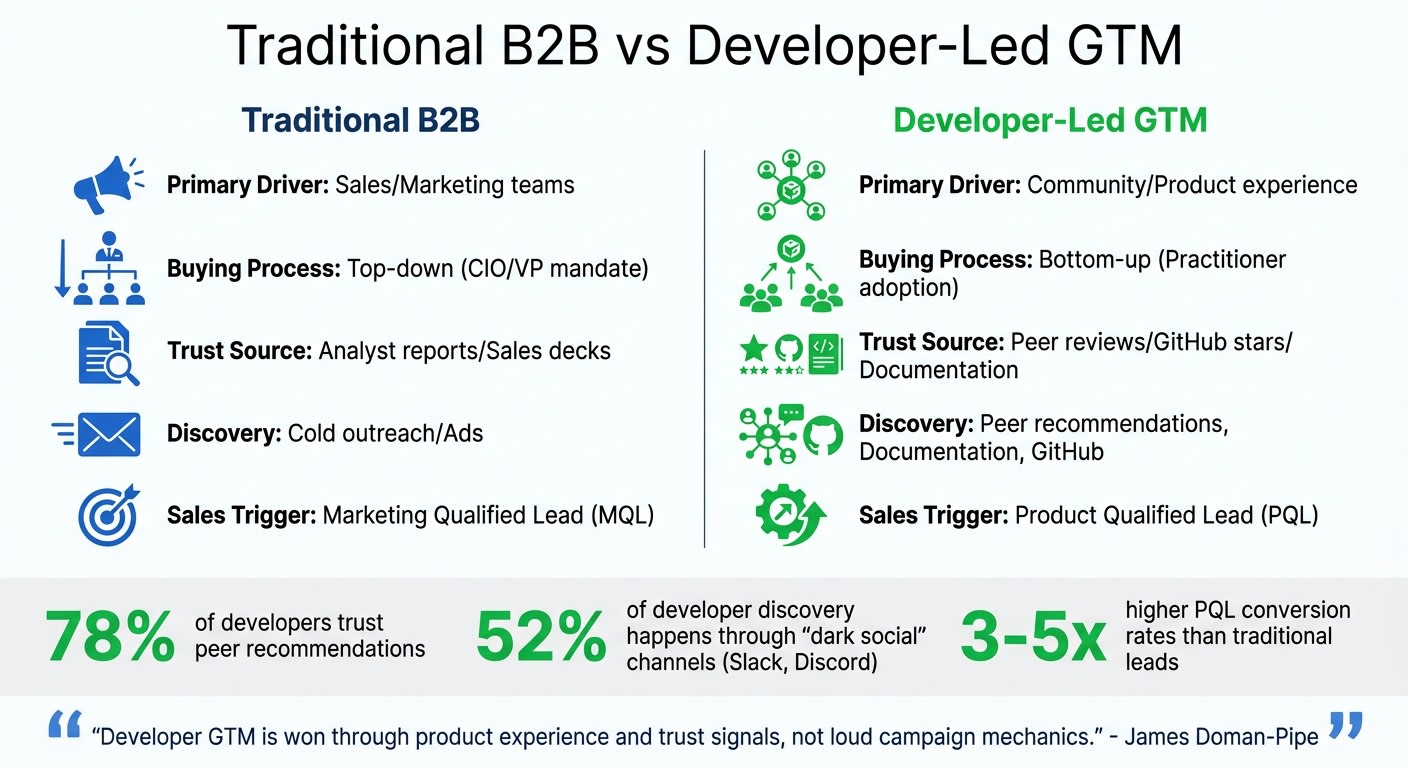
In traditional B2B sales, decisions often start at the top. A CIO or similar executive typically identifies a need, mandates a purchase, and then the tools trickle down to the team. But with developers, it's a completely different story. They prefer to take matters into their own hands - discovering, testing, and validating tools independently before even bringing up the idea of a budget request . Thanks to cloud-native and API-first models, developers can dive in without waiting for procurement approval. They can spin up an API, experiment with it, and prove its value - all before their manager even hears about it.
Bottom-Up Adoption
Developers are not fans of being "sold to." Cold emails? Ignored. Gated whitepapers? Annoying. A sales demo before they've had a chance to try the product? That's a no-go .
Instead, they rely on hands-on testing to validate tools. Documentation becomes more important than flashy marketing. Developers will often judge your tool by how quickly they can get it up and running - ideally within 15 minutes. If your "Hello World" example takes longer than that, they'll likely move on to a competitor . While executives may hold the purse strings, they rarely make decisions without their team's technical approval .
This hands-on approach builds trust and positions developers to become powerful advocates for your product.
Community-Driven Validation
When it comes to trust, developers don’t buy into marketing hype - they trust their peers. In fact, 52% of developer discovery happens through unmeasurable "dark social" channels like private Slack groups, Discord communities, and direct messages .
Peer recommendations and community-generated content are key drivers of credibility. A strong developer community can even reduce the strain on support teams, deflecting 40% to 70% of technical support tickets . This isn’t something traditional B2B sales teams can easily replicate.
Take Supabase as an example. Known as an open-source Firebase alternative, they embraced a community-first strategy and grew rapidly. By 2026, they had achieved a $500M+ valuation, 70,000+ GitHub stars, and over 200,000 Discord members. Even more impressive, the volume of community-generated content outpaced their own by a 10:1 ratio .
"Developers are famously skeptical of marketing claims... But they deeply trust peer recommendations." - Idlen
The trust built through these communities doesn’t just attract users - it turns them into advocates.
Developers as Users and Influencers
Developers play a dual role in the adoption process. They’re not just the ones testing tools; they’re also the internal champions who push for adoption. While they may not control the budget, their recommendations often shape the tools their organizations adopt .
This dual role highlights the need to cater to two audiences. Developers require tools that are easy to use, backed by solid documentation and educational resources. Meanwhile, decision-makers like CTOs or VPs are looking for clear ROI, security assurances, and business value. Interestingly, developer tools often see trial-to-paid conversion rates between 15% to 25% - higher than the 10% to 15% average for traditional B2B SaaS . Even small actions, like engaging with five or more documentation pages in a single session, can boost conversion rates by 340% .
| Feature | Traditional B2B | Developer-Led GTM |
|---|---|---|
| Primary Driver | Sales/Marketing teams | Community/Product experience |
| Buying Process | Top-down (CIO/VP mandate) | Bottom-up (Practitioner adoption) |
| Trust Source | Analyst reports/Sales decks | Peer reviews/GitHub stars/Docs |
| Discovery | Cold outreach/Ads | Peer recommendations, Docs, GitHub |
| Sales Trigger | Marketing Qualified Lead (MQL) | Product Qualified Lead (PQL) |
"Developer GTM is won through product experience and trust signals, not loud campaign mechanics." - James Doman-Pipe, Author and PMM Specialist
3 Developer GTM Motions: When to Use Each
Developer adoption thrives on tailored strategies, and these GTM motions offer a roadmap for growth. The secret lies in knowing when to use each approach and how they work together to support your product's stage and audience.
Product-Led Growth focuses on delivering a seamless product experience. Here, developers can onboard themselves and quickly reach their first "aha moment" without needing external help. This approach works best when your product is easy to adopt and provides value fast - ideally within 15 minutes . Take Stripe, for example. It allows developers to create sandbox accounts and access test API keys right after signing up, enabling them to run a test payment in under 5 minutes . The emphasis is on Product Qualified Leads (PQLs) - users who've actively engaged with your product, rather than those who simply downloaded a resource. Datadog defines a PQL as a user who sends at least 100 monitoring events and stays active for over a week, demonstrating how specific usage patterns can signal readiness to convert . Once the product-led strategy gains traction, the next step might involve leveraging community momentum.
Community-Led Growth thrives on trust and word-of-mouth within developer circles. This motion builds long-term loyalty by fostering peer-driven advocacy. Supabase, for instance, positioned itself as an open-source Firebase alternative, building in public and gaining massive traction. By 2026, they achieved a valuation exceeding $500M, earned 70,000+ GitHub stars, and attracted over 200,000 Discord members. Notably, community-generated content outpaced their own by a 10:1 ratio . Similarly, Vercel invested in the Next.js framework before monetizing their platform, eventually reaching a $2.5B+ valuation and over 120,000 GitHub stars . While slower to gain momentum, this approach creates a cycle where developers bring others in through shared experiences. For scaling beyond grassroots adoption, integrating a sales-assisted approach can help.
Sales-Assisted Growth comes into play when targeting larger organizations. Once developers validate your product from the ground up, sales teams can step in to engage key decision-makers like CTOs or VPs of Engineering. These teams address enterprise-level concerns such as security, compliance, and contract negotiations . Typically, sales involvement is triggered by signals like three or more developers from the same organization becoming active users . At this stage, the "Buyer" persona focuses on ROI and risk management, while the "User" persona has already demonstrated the product's technical value .
Combining these strategies - starting with product or community-led approaches and scaling with sales-assisted growth - creates a smooth journey from initial adoption to enterprise-level expansion .
Pre-Launch: Building Awareness Before You Have a Product
Before your product officially enters the market, creating awareness among developers is key to ensuring a smooth launch and long-term growth. Developers tend to trust peer recommendations and rely on hands-on experience, so establishing credibility early - before you even have a finished product - is crucial. Here's how strategies like open-source contributions, early access programs, and community engagement can lay the groundwork for success.
Open Source Contributions
Launching an open-source utility that addresses a problem related to your main product is a smart way to build credibility . Why? Because developers prefer to evaluate high-quality code and experiment with it before making a commitment . Open-source tools make it easy for them to do just that, removing barriers to entry. In fact, developer tools that include open-source components tend to see 45% faster enterprise adoption compared to proprietary-only tools .
By contributing to open source, you can showcase your technical expertise and start building trust within the developer community well before your commercial product goes live. A great way to encourage engagement is by using GitHub's "good-first-issue" labels, which invite developers to contribute and become part of your ecosystem . The key is to address a real, everyday problem that developers face.
Early Access Programs
Inviting a small group of 15–20 developers to test early versions of your product can provide invaluable insights . These early users aren’t just there to give compliments - they’re there to point out flaws, confusion, and areas for improvement. To keep developers engaged, focus on achieving a "Time to First Value" (TTFV) of under 15 minutes . This means users should experience their first "aha moment" quickly, or they might lose interest.
To attract these early adopters, offer meaningful perks like lifetime discounts of 50% . This group can become your most vocal advocates at launch, contributing testimonials, case studies, and word-of-mouth buzz. And since 52% of developers discover new tools through "dark social" channels like private Slack or Discord groups , these early users can help you tap into those hidden networks. Their feedback will also help refine your product before it hits the broader market.
Community Building
To connect with developers, you need to be present where they already spend time - platforms like Reddit, Twitter/X, GitHub Discussions, or daily.dev. Spend 4–6 weeks engaging with these communities by answering questions, sharing insights, and offering value without promoting your product . This approach builds trust and positions you as a helpful resource.
Take it a step further by personally inviting 50–100 community members via email or direct message, setting a friendly tone for future interactions . Choose one primary platform to serve as your "home base" - for example, use Discord for real-time conversations or GitHub Discussions for more flexible, asynchronous communication . By focusing on understanding developers’ pain points, you can ensure that when your product launches, it feels like the natural solution to their problems. This sets the stage for a successful debut and continued growth after launch.
Launch Strategy: Where and How to Announce Your Developer Tool
Once you've wrapped up your pre-launch awareness campaign, it's time to focus on the announcement phase. This step is all about choosing the right channels and timing your launch for maximum impact. Unlike traditional B2B buyers, developers tend to discover new tools through technical communities, peer recommendations, and hands-on testing rather than flashy marketing campaigns . A well-executed announcement can help your developer tool gain traction right from the start, laying the groundwork for future growth.
Best Announcement Channels
To make a splash, you need to announce your tool in spaces where developers already spend their time. These platforms have specific rhythms, so timing your posts is critical. Let’s break down some key channels:
- Hacker News: This is a top choice for launching developer tools. Use the "Show HN" format and link directly to your GitHub repository instead of a marketing page to resonate with the audience .
- Product Hunt: A strong performance here can generate 500–2,000 website visits and 50–300 signups . Keep in mind, though, that only a handful of these visitors - typically 5–10 - might convert into paying customers at first .
- Reddit: For open-source tools, subreddits like r/selfhosted are ideal. Use a conversational tone and include visuals like demo videos or screenshots to engage the community .
- Technical Blogs: Platforms like Dev.to and Medium are excellent for publishing technical content. Posting 1–2 days before your launch can help boost SEO and visibility on Google Discover . Similarly, daily.dev offers a way to reach developers through curated content feeds.
- Integration Directories: Listings on platforms like GitHub Marketplace, VS Code Extension Marketplace, and Vercel Integrations can attract developers who are actively searching for solutions. Focus on describing the problems your tool solves rather than just listing features .
By targeting these channels, you’ll position your tool where developers naturally look for new solutions.
Timing and Coordination
Timing can make or break your launch. Developers tend to be more active at specific times, so syncing your announcements to these periods is essential.
- Hacker News: Post your launch at 8–9am EST to catch peak traffic .
- Product Hunt: Aim to launch on a Tuesday, Wednesday, or Thursday, as these days typically see higher engagement. Rally early support to boost visibility .
Consider adopting a "Launch Week" strategy to keep the momentum going. For instance, Supabase used this approach effectively by hosting quarterly launch events. This tactic helped them grow to over 70,000 GitHub stars and achieve a valuation exceeding $500M in just three years . Each day of your Launch Week can highlight a different feature or use case, creating multiple opportunities for discovery and engagement.
Finally, ensure all your launch materials - like documentation, release notes, and code examples - are polished and ready to go. Developers are quick to form opinions; incomplete or broken materials can turn them away instantly. Coordinating your announcements and materials ensures a smooth and impactful debut.
Post-Launch Growth: Turning Early Adopters into Advocates
Launching your product is just the beginning. The real challenge lies in turning those initial users into long-term advocates. Developers who try your tool in the early days will decide whether to stick with it, recommend it, or move on. Their decision largely depends on how quickly they achieve success, how well-supported they feel, and whether their feedback is valued. A smooth onboarding experience, backed by excellent documentation and strong community support, plays a crucial role in this process.
Documentation and Onboarding
Think of documentation as your product’s handshake - it’s the first impression that can make or break retention. Developers who explore five or more unique documentation pages during their first session are 340% more likely to convert compared to those who visit just one page . Companies like Stripe understand this and treat their documentation with the same care as their core product, even hiring specialized documentation engineers .
Your quickstart guide is the crown jewel of onboarding. Developers should be able to go from curiosity to a working result in under 15 minutes . To achieve this, include ready-to-use code snippets in multiple popular languages, and don’t require complex local setups. Vercel has set the bar high by enabling developers to deploy from a code repository to a live production environment in under 60 seconds .
"In developer-led companies, the documentation is as much the product as the software itself. This is not a marketing claim - it is a literal description of how developers evaluate tools."
- Priya Nair, Partner, Syntract Capital
Your documentation should answer real-world questions like "how to handle webhooks", not just provide an API reference. Use a tiered structure: quick overviews for new users, detailed technical content for advanced implementation, and migration guides for returning users . Monitor metrics like "Discovery to Implementation Time" and search success rates to gauge effectiveness . Community feedback is invaluable - support tickets and questions often highlight gaps in your documentation. Addressing these gaps quickly not only improves the user experience but also fosters deeper engagement, creating a virtuous cycle of improvement and interaction.
Community Engagement
A thriving community can turn your users into loyal advocates. Community members are 2–3 times more likely to convert and churn 40–60% less than those who don’t engage . The goal is to guide users through different levels of involvement - from passive lurkers (who make up 60–70% of members) to active contributors and champions (the top 1–2%) .
Take a page from Snap Inc.'s Camera Kit SDK team, led by Jono Bacon. They introduced regular office hours and a community forum during their beta phase. By nurturing power users in these sessions, they managed to deflect 85% of developer support tickets and discovered that education, not gaming, was the SDK’s primary use case .
Use platforms like Discord for real-time chats and interactive "Show & Tell" events, and GitHub Discussions for more in-depth technical Q&A. Create dedicated #feedback channels to encourage feature suggestions. When you implement a community-requested feature, celebrate it publicly and acknowledge contributors . Weekly changelogs are another great way to build trust - developers value transparency and progress. Avoid vague updates like "bug fixes" and instead write detailed changelogs that explain the technical changes and their impact .
Champion Programs
Champions are your most dedicated users - the top 1–2% who create tutorials, answer questions, and advocate for your tool within their organizations . Recognizing and rewarding these individuals can transform them into powerful promoters.
For example, offering exclusive perks like branded swag, early access to beta features, or a seat on a community advisory board can go a long way. Developers who answer at least one community question within their first 90 days show 65% higher retention rates and 40% greater usage expansion . Encourage contributions by assigning special Discord roles, GitHub labels, or public shoutouts for those who help answer questions or build integrations .
Peer recommendations are incredibly influential - 78% of developers rely on them to discover new tools . Champions are your secret weapon in "dark social" spaces like private Slack or Discord servers, where 52% of developer tool discovery happens . By empowering and celebrating your champions, you create a word-of-mouth engine that drives organic growth.
Channel Strategy: Mapping Developer Discovery Habits
As we move from pre-launch and launch strategies, it's time to align your channel approach with how developers naturally find and evaluate tools. Unlike traditional B2B buyers, developers have their own unique discovery habits. A striking 70% of initial discovery happens through organic technical content, with a large chunk occurring in "dark social" spaces like private Slack groups and Discord servers - channels that are notoriously hard to track . To succeed, your channel strategy must cater to developers' specific awareness stages.
"Developers go straight to the documentation and code samples. They want to get their job done quickly and don't want to deal with BS."
- Lee Robinson, VP of Product
The key is to tailor your approach to each stage of awareness. At the top of the funnel, developers casually browse for trends and inspiration. In the middle, they actively search for solutions to technical problems. And at the bottom, they focus on evaluating implementation details and costs before committing.
Unaware to Problem-Aware Stage
At this stage, developers aren't actively searching for tools. Instead, they're exploring industry communities, reading newsletters, or scrolling through feeds to stay updated on trends. Your goal here is to introduce your tool naturally within these spaces - places where developers are already learning and engaging.
Platforms like daily.dev, Reddit, Hacker News, and technical newsletters are ideal for this early-stage discovery . The key is to create educational content that addresses common pain points without being overly promotional. Think thought leadership articles, technical deep-dives, or industry research that positions your brand as a credible source of knowledge.
Peer recommendations are also incredibly influential - 78% of developers rely on them as a primary discovery channel . Engaging in niche communities and answering specific questions for several weeks before even mentioning your product can establish trust. By doing this, you position your tool as a solution that fits naturally into their workflow, rather than as an intrusive sales pitch .
As developers become aware of their needs, they begin to shift toward platforms where they can evaluate potential solutions.
Solution-Aware to Decision-Ready Stage
Once developers identify a need, they move to high-intent channels to evaluate their options. This is where platforms like GitHub trending repositories, technical blogs, and comparison guides become essential. These channels help developers assess whether your tool meets their technical requirements, how easy it is to implement, and how well it solves their specific problem.
Documentation becomes your most powerful sales tool at this stage. Developers expect quickstart guides, code samples, and API references that allow them to test your tool in under 15 minutes . Clear, concise, and actionable documentation can make or break their decision.
Interactive platforms like GitHub Discussions, Discord support channels, and technical webinars are also invaluable. These spaces allow developers to ask detailed questions and see how your team handles real-world technical challenges. It's worth noting that Product Qualified Leads (PQLs) perform exceptionally well in this space, converting at rates 3–5 times higher than traditional Marketing Qualified Leads (MQLs) for developer-focused products .
Scaling GTM: From Founder-Led to Structured Teams
Moving from founder-led growth to a structured, scalable go-to-market (GTM) strategy is a natural step for developer-focused products. However, timing is everything. Founders should usually aim to drive the first $250,000–$500,000 in ARR themselves before making that crucial first GTM hire . This phase is all about proving product-market fit and gaining a deep understanding of your developer audience.
The shift to structured teams is where many developer tools hit roadblocks. Typical B2B hiring practices don't translate well here. For example, hiring a demand generation specialist to run webinars or gate content can backfire, as these tactics often alienate developers .
Hiring Sequence
Your first hire is pivotal - it sets the tone for your entire GTM approach. For developer-focused products, especially those with freemium or product-led growth (PLG) models, nearly half (49%) of companies hire a Growth Marketer first to build scalable discovery loops . But this isn't your average marketer. They need to grasp the nuances of technical audiences and create content that resonates with developers.
"The first marketing hire for a developer tool should be a developer advocate or a technical writer, not a demand gen specialist." - SaasOpportunities
The hiring order matters. Start with Developer Relations (DevRel) professionals or technical writers. These roles focus on building credibility and creating high-quality documentation - the cornerstone of developer conversions . Their work shortens the time-to-first-value and provides the technical content developers actively seek. Within 6–12 months, consider adding a community manager to scale engagement further . This phased approach ensures every hire contributes to a scalable GTM strategy.
Once you’ve established a repeatable pipeline, bring in 1–2 Business Development Representatives (BDRs) to standardize lead generation. Only after this step should you hire Account Executives (AEs) . Follow the "two AE rule": don’t hire a Head of Sales until at least two AEs are consistently hitting their targets. Hiring leadership too early often leads to failure if product-market fit issues remain unresolved .
A newer role, the GTM Engineer, is also gaining traction. These professionals bridge the gap between RevOps and automation, building systems for AI-driven prospecting and market mapping. Between 2024 and 2025, job openings for this role surged by 205%. By 2026, 1.3% of companies had at least one GTM Engineer, up from under 0.1% in 2023 . Salaries for this role range from $132,000 to $241,000, depending on experience .
Budget Allocation
Once your team is in place, it’s time to allocate resources effectively to sustain growth. For developer tools, budgeting looks different from traditional B2B strategies. Early on, most of your budget should go toward organic community building and documentation. These are key drivers of growth and conversion .
Documentation, in particular, should be treated as a primary marketing channel, not just a support cost. Developers evaluate your tool largely through your documentation, making it a direct driver of conversions. Paid advertising should only come into play after you’ve secured at least 20 organic customers. Without that base, it’s tough to craft effective ad copy .
As your community expands, your budget allocation will evolve. For example:
- With 0–500 community members, allocate about 70% to community-building efforts and 30% to advertising.
- Once your community grows to 2,000–10,000 members, flip this ratio to 40% for community efforts and 60% for advertising, as the community starts to sustain itself .
Understanding customer acquisition costs (CAC) by channel can also guide your investments:
- Organic search and content: $150–$400 per customer
- Paid developer-focused ads: $300–$800 per customer
- Developer conferences and events: $400–$1,200 per customer
- Community and DevRel efforts: $250–$500 per customer
These figures can help you prioritize where to spend as you scale, balancing organic growth with paid strategies to maximize impact.
Measuring GTM Success: Developer-Specific Metrics
When it comes to developer tools, traditional metrics like MQLs fall short. Developers often skip conventional touchpoints, preferring to dive straight into using the product. This makes Product Qualified Leads (PQLs) - users who achieve specific product milestones - a far better measure of success. Why? Because PQLs convert at 3-5x higher rates compared to traditional leads . The focus shifts to tracking actual engagement with your product.
"If you can't draw a line from your work to business outcomes, you don't have a function - you have a hobby." - Jono Bacon, Founder of Devocate
Here’s how you can measure success at each stage of your go-to-market (GTM) strategy, ensuring you stay on track and address issues before they escalate.
Pre-Launch Metrics
Before your product officially launches, your goal is to gauge developer interest and community activity. Some key indicators include:
- GitHub activity: Stars, forks, and pull requests can signal early interest and technical curiosity.
- Documentation engagement: Monitor page views and how long users spend on your technical specs or API docs. Stripe’s analysis of their documentation helped them refine their onboarding process, leading to better results .
- Community engagement: Platforms like Discord or Slack provide valuable insights. Aim for 10-15% Daily Active Users (DAU) in your community channels . The quality of conversations also matters - look for meaningful interactions, not just numbers.
Tracking these signals helps you validate interest and build momentum ahead of launch.
Launch Metrics
On launch day, it’s all about speed and validation. Two critical metrics to watch:
- Time to First Value (TTFV): This measures how quickly users achieve a key milestone, like running their first API call or completing a "Hello World." The best tools, like Stripe or Twilio, deliver value in under 5 minutes, though 15–30 minutes might be acceptable for more complex platforms .
- Activation rate: This is the percentage of signups that reach a meaningful product milestone. A well-optimized onboarding process typically results in a 20–40% activation rate .
Another crucial metric is PQL volume, which reflects how many users meet the criteria for being highly engaged. For example, Datadog defines a PQL as a user who sends at least 100 monitoring events and stays active for 7+ days, achieving a 22% PQL-to-paid conversion rate .
Finally, track your trial-to-paid conversion rate. Developer tools often see conversion rates around 17%, much higher than the 9% average for general SaaS . If your numbers are lower, you might need to revisit your product’s value proposition or pricing.
Post-Launch Metrics
Once your product is live, the focus shifts to retention and growth. Here are the key metrics:
- Monthly Active Developers (MAD): Track engagement through authenticated API calls or code commits.
- Net Dollar Retention (NDR): Target 110–130%, driven by increased usage rather than adding more seats . If NDR drops below 100%, it’s a sign that users aren’t finding ongoing value.
- Retention by cohort: Aim for 40–60% retention in Week 1 following the first integration and 15–25% retention by Month 6 once workflows are established . MongoDB found that developers who answered a community question within their first 90 days had 65% higher retention rates and 40% greater usage expansion .
A thriving developer community can also reduce support costs. Communities that handle 40–70% of technical support tickets can significantly improve efficiency . Key metrics include response times (under 30 minutes is ideal), keeping unanswered questions below 10%, and maintaining strong 30-day member retention at 40% or higher.
Key Metrics Across Stages
Here’s a quick summary of the most important metrics and their benchmarks:
| Stage | Key Metrics | Target Benchmarks |
|---|---|---|
| Pre-Launch | GitHub stars/forks, waitlist signups, documentation page views, Discord DAU | 10–15% DAU |
| Launch | Time to First Value (TTFV), activation rate, PQL volume, trial-to-paid conversion | <15 min TTFV; 20–40% activation; 17% conversion |
| Post-Launch | Monthly Active Developers (MAD), Net Dollar Retention (NDR), API call volume, support deflection rate | 110–130% NDR; 40–70% support deflection |
Ultimately, the difference between vanity metrics and meaningful metrics lies in their connection to revenue. GitHub stars only matter if they lead to trial signups. Documentation views are valuable if they result in activation. Community engagement proves its worth when it drives retention. By focusing on actionable data, you can fine-tune your GTM strategy and fuel revenue growth.
Conclusion
This roadmap ties everything together - starting from pre-launch community efforts to driving growth after launch. A developer-focused go-to-market (GTM) strategy blends three key approaches: product-led, community-led, and sales-assisted. The companies that succeed in this space understand one key reality: peer recommendations are the top driver of developer tool discovery, influencing 78% of decisions . Developers assess tools based on documentation quality and product experience, and adoption happens when they see consistent improvements shaped by their feedback.
This cohesive strategy evolves with your product's lifecycle. Early on, concentrate on building trust through open-source contributions and exclusive early access programs. At launch, meet developers where they’re already active - on platforms like Hacker News, GitHub, technical forums, and discovery hubs like daily.dev. After launch, convert early users into advocates by treating documentation as a core product and establishing feedback loops that shape your roadmap.
To keep your efforts focused, track metrics that matter. For example, Product Qualified Leads (PQLs) convert at rates 3–5x higher than traditional leads . Additionally, monitor Time to First Value (aim for under 15 minutes) and activation rates (target 20–40%) .
"Developer GTM is won through product experience and trust signals, not loud campaign mechanics." - James Doman-Pipe, GTM Specialist
A thriving community is a cornerstone of long-term success. Community-led growth stands out because it provides the strongest defensibility. Members of a community tend to convert faster and are far less likely to churn . While product-led growth offers moderate defensibility and sales-assisted growth ranks lower, community-led growth is in a league of its own . Companies like Supabase and Vercel demonstrate this perfectly. Supabase, for instance, achieved a valuation exceeding $500M in just three years by building transparently and fostering a Discord community of over 200,000 members .
FAQs
What’s the fastest way to get Time to First Value under 15 minutes?
To get Time to First Value (TTFV) under 15 minutes, you need to make the onboarding process as smooth as possible. Start with clear, concise documentation that guides users step-by-step. Ensure your API integrations are quick and easy to implement, so developers can hit the ground running. Use in-product metrics to help users immediately see the value your tool provides. The goal is to eliminate any unnecessary friction at every stage, enabling users to experience value right away.
How do I define a Product Qualified Lead for my dev tool?
A Product Qualified Lead (PQL) for a developer tool refers to a developer or team that has demonstrated significant engagement and seen clear value in your product. These leads stand out because their in-product actions suggest a high likelihood of conversion. Examples of such behaviors include:
- Completing key onboarding steps
- Making frequent API calls
- Building integrations
- Actively using core features
PQLs are a strong indicator that these users are ready for conversion or deeper involvement with your product. This makes them ideal candidates for focused outreach efforts.
When should I add sales to a product-led developer GTM?
When introducing sales to a product-led developer go-to-market (GTM) strategy, timing is everything. Start by focusing on product-led growth (PLG) and building momentum through community-driven adoption. This approach allows developers to explore and self-onboard with minimal friction, creating an organic growth loop. Developers often prefer to test and adopt tools on their own terms, so prioritizing a seamless self-serve experience is key.
Sales becomes a crucial layer once you've gained solid traction and adoption within the developer community. This typically happens when you start targeting high-value or enterprise customers who require tailored solutions, personalized engagement, or more complex onboarding. By this stage, you'll have gathered enough user feedback and validation to refine your product and identify clear opportunities for scaling through targeted sales efforts. This combination of PLG and strategic sales ensures you're meeting the needs of both individual developers and larger organizations effectively.