
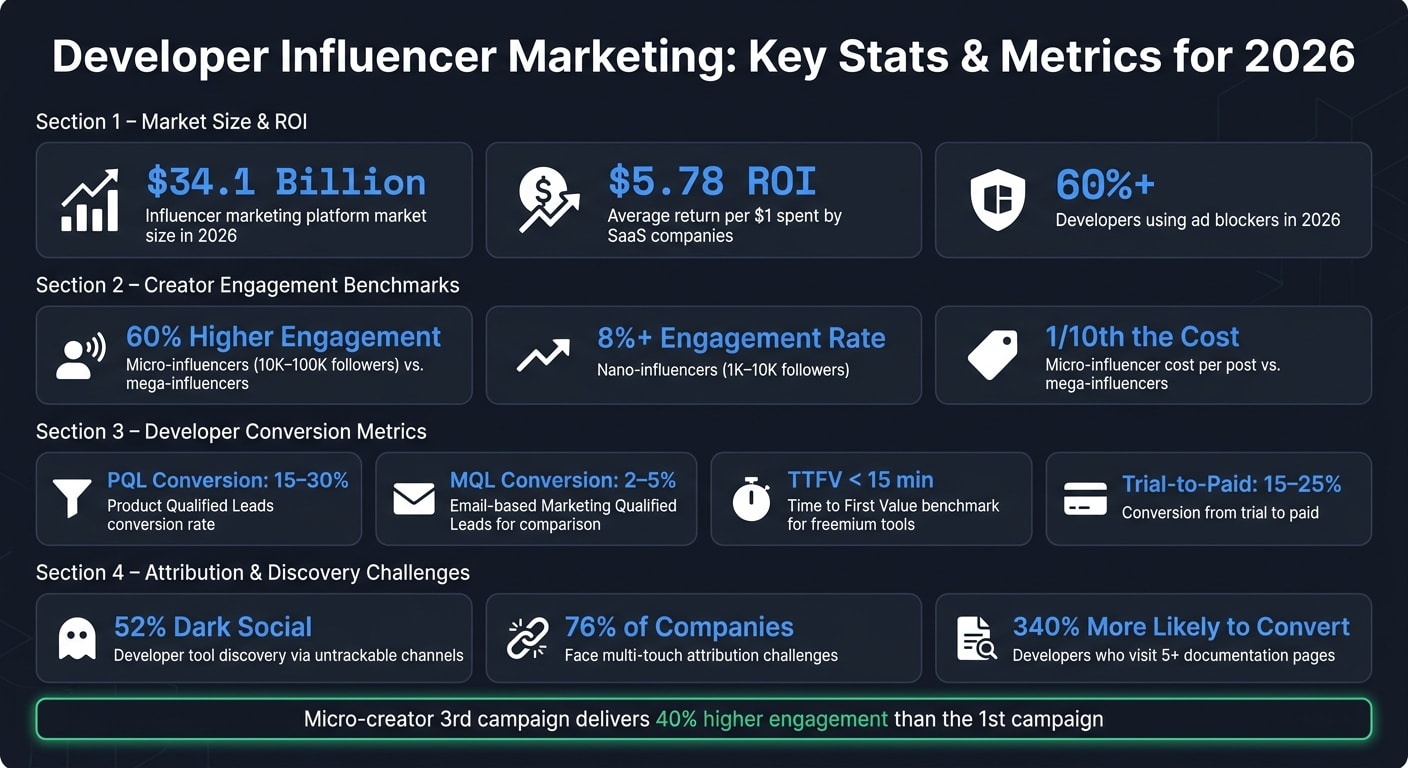
In 2026, reaching developers through ads is harder than ever, with over 60% using ad blockers. Instead, tech content creators - trusted engineers and educators - are key to promoting tools and services. Unlike traditional influencers, their credibility stems from expertise, not follower counts. A Rust developer with 1,000 engaged followers can outperform a general tech influencer with 100,000 passive ones.
Key takeaways:
- Market Growth: The influencer marketing platform market is projected to hit $34.1 billion this year, with SaaS companies earning $5.78 for every $1 spent.
- Developer Preferences: Developers value technical depth over flashy marketing, favoring long-form content like YouTube tutorials and GitHub projects.
- Finding Creators: Tools like Plug.Dev and Selfriq help identify creators based on coding skills, content quality, and community engagement.
- Effective Content: Tutorials, live coding, and screencasts resonate more than polished ads. Metrics like Product Qualified Leads (PQLs) and Monthly Active Developers (MAD) measure success.
- Emerging Trends: Micro-creators (1K–10K followers) and AI-driven tools are reshaping the space, prioritizing niche expertise over broad reach.
To succeed, brands need to partner with creators who are active coders, educators, and community participants, focusing on honest, educational content that solves developer problems.
Understanding Developer Audiences
With the growing influence of tech content creators, understanding developer audiences is essential for creating campaigns that resonate. Developers are naturally skeptical. Their daily work - debugging code, reading documentation, and solving complex problems - has trained them to filter out fluff. This critical mindset extends to marketing. Flashy influencer tactics that rely on lifestyle appeal or polished visuals don’t work here. What developers value is utility: content that genuinely helps them solve problems, created by someone who clearly knows their stuff.
This perspective shifts how campaigns are structured, who brands partner with, and what kind of content is expected.
Why Developers Care About Technical Credibility, Not Popularity
In most influencer-driven industries, a large follower count signals influence. For developers, it’s a different story. What matters is "Proof of Work" - evidence that a creator has built something meaningful, written code, or solved the same challenges developers face every day .
"KOLs have authority, not just reach." - DEV Community
A creator with only 5,000 followers but a proven track record of building functional applications is often more impactful than a lifestyle influencer boasting 500,000 followers . Developers gravitate toward creators whose expertise is backed by real-world accomplishments. As Karl McCarthy, Founder of Yard, put it:
"They [developer evangelists] just can't fake it."
The most effective tech creators excel in three key areas: they write and ship code (Coding), produce educational content (Content), and engage actively in their communities (Community) . Missing any one of these pillars often diminishes credibility in the eyes of developers.
This focus on technical credibility also shapes where developers consume content.
Where Developers Consume Content in 2026
Developers rely on a mix of platforms to gather technical insights, verify credibility, and engage with their peers. Each platform serves a unique purpose, as shown below:
| Platform | Primary Use | Content Type |
|---|---|---|
| YouTube | Discovery and deep learning | Tutorials, software reviews, walkthroughs |
| GitHub | Verifying credibility | Open-source contributions, project stars |
| Dev.to / Hashnode | Technical reading | Long-form blogs, implementation guides |
| Problem-solving | Subreddit discussions (r/SaaS, r/startups) | |
| Discord / Slack | Real-time help | Troubleshooting, direct community engagement |
| Twitter/X & LinkedIn | Industry conversation | Building in public, following thought leaders |
YouTube stands out as the top discovery platform. As McCarthy explained: "I think YouTube is head and shoulders above everything else because you can see what people are reviewing… you can see what their style is like." On the other hand, GitHub is less about social interaction and more about trust verification - developers often check repositories like they would a résumé.
Interestingly, while short-form video dominates the internet at large, developers are leaning back toward long-form content . Adopting complex tools often requires detailed explanations, and a 10-minute walkthrough addressing real-world scenarios consistently outperforms a quick highlight reel for this audience.
How to Find the Right Tech Content Creators
Understanding where developers spend their time is just the starting point. The bigger challenge lies in pinpointing creators who not only hold their trust but can also persuade your target audience to take action.
Assessing Creator Expertise and Audience Fit
To identify creators who genuinely connect with developers, use the Three Cs framework: Coding, Content, and Community . The ideal creator isn’t just technically skilled - they also produce educational content and actively engage with their community. This combination ensures they have the credibility and influence needed to drive developer engagement.
YouTube is a great place to begin your search. As Karl McCarthy, Founder of Yard, explains:
"I think YouTube is head and shoulders above everything else because you can see what people are reviewing…you can see what their style is like."
Once you’ve identified potential creators, head over to GitHub to verify their technical expertise. Look for contributors or maintainers of open-source projects with over 1,000 stars, especially those relevant to your tech stack . A creator’s GitHub profile acts like a technical résumé, validating their skills and experience.
But technical expertise isn’t everything. Engagement quality often outweighs sheer follower numbers. A creator with 1,000 niche followers who actively engage is often more impactful than one with a million passive followers . Dive into their comments - are people asking thoughtful, technical questions, or just leaving emojis? Additionally, request backend analytics to confirm audience demographics and geography. Consistency is another key factor; ensure the creator has posted within the last 3–6 months, as inactive influencers rarely drive results .
Once you have a shortlist, leverage specialized tools to streamline your search further.
Tools and Platforms for Finding Developer Creators
While manual research is helpful, dedicated tools can make the process faster and more efficient. Here are some standout platforms for finding tech content creators:
| Tool | Strengths |
|---|---|
| Plug.Dev | Handles everything from creator discovery to contracts, payments, and reporting . |
| Selfriq | Matches brands with creators based on technical credibility, not just follower counts . |
| CrowdCore | Analyzes content quality, comment tone, and brand-safety risks when vetting creators . |
| Social Blade / Phyllo | Provides enriched data and performance metrics for deeper insights . |
Selfriq boasts a network of over 25,000 active creators, having supported more than 5,000 brands . It’s a strong choice for teams seeking pre-vetted options. Plug.Dev, on the other hand, is ideal for quick-turnaround campaigns, allowing teams to launch within 48 hours and target up to 100,000 engaged developers .
If you’re working with a smaller budget or prefer a hands-on approach, tools like Twitter Advanced Search and Reddit community analysis remain effective for finding niche voices . The key is to prioritize "Creators That Code" - those who combine technical expertise with authentic engagement .
Building Partnerships With Developer Influencers
Finding the right creator is just the beginning. The way you approach them and structure the partnership plays a huge role in whether the collaboration succeeds.
How to Approach and Engage Creators
Cold pitching rarely works. Spend a week or two engaging with a creator's content first - this helps you understand their style, audience, and whether your product aligns with their focus . By doing this, you’ll also get a clearer sense of their audience’s challenges and how your product might solve them.
When you reach out, offer something valuable - early access, free credits, or tools that address known issues . A great example of this is AFFiNE, an open-source productivity tool. Between 2024 and 2026, they gave influential developers early access and allowed them to suggest features. This led to organic promotion through technical blogs and conference talks, ultimately helping the project gain 33,000 GitHub stars .
Cole Stark, CMO at Pieces, explains the importance of this approach:
"I think it's both (inbound vs outbound). You really have to be a good salesman in some aspects."
The best creators to collaborate with are often developers who are already talking about your product or similar tools. These “hand-raisers” are genuinely interested, making their content more authentic and persuasive . Once you’ve built a connection, formalize the partnership with clear terms to ensure everyone’s on the same page.
Setting Fair and Clear Collaboration Terms
After initial engagement, it’s crucial to outline the collaboration in detail. This includes defining deliverables, compensation, and timelines - document everything to avoid confusion and build trust. For example, specify if the creator will produce one video and two social posts, the timeframe for posting, and how many revisions are included .
A common payment structure is 50/50: half upon signing and the rest after publishing . Compensation rates can vary based on the platform and audience size:
| Platform | Rate |
|---|---|
| ~$100 per 10K followers | |
| TikTok | $100–$250 per 10K followers |
| YouTube | $500–$5,000 per 100K subscribers |
| Micro-KOL Sponsored Content | $100–$500 flat fee |
In addition to flat fees, you might offer affiliate commissions. For developer tools, typical rates range from 20–30% for recurring revenue to 30–50% for one-time sales . This approach aligns the creator’s earnings with the success of their content.
Keep the content authentic. Instead of scripting everything, provide key points and brand guidelines but let creators use their own voice . Many tech creators are full-time engineers, so respect their schedules and set realistic deadlines .
Lastly, establish usage rights upfront. If you plan to amplify the content through paid ads or repurpose it for your website or email campaigns, negotiate these terms before signing. Adding them later usually means extra costs . To track performance, assign unique UTM codes or discount codes to each creator from the start .
Structuring Campaigns for Developer Audiences
When it comes to engaging developer audiences, structuring your campaign thoughtfully is essential. This group tends to be wary of polished ad reads or flashy product shoutouts. What resonates instead? Content that educates, demonstrates, and solves real-world problems.
Content Formats That Work Well With Developers
For developers, substance beats style. Formats like unedited screencasts, casual walkthroughs, and unscripted first impressions often outperform slick, highly-produced videos. Why? These formats feel more genuine and relatable .
| Content Format | Best Platform | Primary Goal |
|---|---|---|
| Technical Walkthroughs | YouTube | Education & Conversion |
| Live Coding Sessions | Twitch / YouTube | Community Engagement |
| Short-Form Tips | TikTok / Reels | Brand Awareness |
| Workflow Demos | LinkedIn / Blogs | Trust & Retention |
| Open Source Contributions | GitHub | Technical Credibility |
One format worth adding to your toolkit is software "unboxing." This involves capturing a creator’s first experience with your product. It’s a natural way to showcase authenticity while also doubling as valuable feedback for your engineering team . Think of it as a usability test that’s shared with thousands of developers.
While platforms like TikTok or Reels work well for short-form, top-of-funnel awareness, developers generally prefer long-form content for deeper engagement. Tutorials and workflow demos, for instance, are far more effective at driving conversions and building retention. Developers value detailed, technical content over quick, 60-second overviews .
Once you’ve chosen the right formats, the next step is to set clear and actionable campaign goals.
Defining Campaign Goals and Performance Benchmarks
Your campaign metrics should align with the content format and where developers are in their journey. Trying to measure everything - awareness, conversion, and community growth - at once often leads to confusion and diluted results . Instead, focus on one primary goal, such as trial sign-ups, GitHub stars, or API activations.
When setting benchmarks, use the creator’s recent performance as a guide. Look at the median views from their last 5–10 posts to set realistic expectations. For instance, if their last five videos received 22,000, 18,000, 25,000, 20,000, and 19,000 views, your target should be 20,000 - not the highest number in the range.
Align your goals with the developer's journey:
- Awareness content answers: "What is this?"
- Evaluation content asks: "Does it solve my problem?"
- Activation content focuses on: "How do I build with it?" .
This alignment keeps the campaign focused and makes performance metrics easier to interpret.
Attribution in developer marketing can be tricky. Many developers use ad blockers or strip UTM parameters. As McCarthy humorously puts it:
"I always always think it's funny when you ask a marketer about attribution, and everyone just hides."
To tackle this, supplement digital tracking with direct feedback. Ask new sign-ups how they found you and monitor quarter-over-quarter growth during and after the campaign . Combining self-reported data with trend analysis provides a clearer picture than relying solely on UTM links.
Measuring Success in Developer Influencer Campaigns
Tracking developer campaigns requires a different approach compared to standard influencer marketing. Metrics like impressions and follower counts don’t carry much weight when it comes to engaging technical audiences. What truly matters is whether developers take meaningful technical actions.
Key Metrics for Developer Campaigns
One of the most important metrics is Product Qualified Leads (PQLs). These are users who achieve a technical milestone, such as completing an API integration. PQLs tend to convert at rates 3–5 times higher than traditional Marketing Qualified Leads (MQLs), with conversion rates ranging from 15% to 30% . For context, email-based MQLs typically convert at just 2–5%, making the difference striking.
In addition to PQLs, two other metrics deserve attention: Time to First Value (TTFV) and Monthly Active Developers (MAD).
- TTFV measures how quickly a developer experiences their first "win" with your product. By 2026, the benchmark for freemium tools is under 15 minutes, while trials should aim for under 30 minutes .
- MAD focuses on developers actively engaging with your product, such as making authenticated API calls or committing code within a 30-day period. This filters out passive signups and provides a clearer picture of engagement.
Here’s a quick overview of these key metrics:
| Metric | What It Tracks | 2026 Benchmark |
|---|---|---|
| PQL Conversion Rate | Completion of technical milestones | 15–30% |
| Time to First Value (TTFV) | Speed to first developer "win" | < 15 minutes |
| Monthly Active Developers (MAD) | Authenticated API calls or commits | 30-day window |
| Trial-to-Paid Conversion | ROI from trials | 15–25% |
Another valuable metric is documentation engagement. Developers who visit five or more unique documentation pages are 340% more likely to convert compared to those who don’t . If your campaign drives traffic that bounces without exploring your documentation, it’s a clear signal that adjustments are needed.
Solving Attribution Challenges in Technical Marketing
While tracking technical milestones is essential, accurately attributing these actions can be tricky. About 76% of developer-focused companies face challenges with multi-touch attribution because developers often discover tools through untrackable channels like private Slack groups, Discord servers, or internal wikis . These "dark social" channels account for roughly 52% of developer tool discovery .
"Traditional MQL-based attribution would miss 80% of this journey." - Jono Bacon, Founder, Stateshift
To tackle this, combining multiple attribution methods works best. Server-side tracking through authenticated API calls can bypass ad-blockers and privacy tools that developers frequently use. Pair this with onboarding surveys that ask, "How did you hear about us?" - these surveys boast a 78% completion rate among developers, capturing dark social referrals that tracking pixels often miss .
For multi-touch attribution, a 40/20/40 position-based model is effective. This method assigns 40% of the credit to the first touch (discovery), 20% to middle interactions, and 40% to the last touch (conversion) . Postman, for example, implemented a custom attribution framework to track developer journeys across API documentation, collection shares, and workspace collaborations. This resulted in a 40% improvement in customer acquisition cost (CAC) accuracy , enabling more informed budget decisions.
Emerging Trends in Developer Influencer Marketing
The developer influencer space is evolving rapidly in 2026. Two key factors are steering this transformation: the integration of AI tools reshaping creator workflows and a shift toward smaller, highly specialized voices over broader, well-known influencers.
How AI Tools Are Changing Creator Workflows
AI has become a go-to tool for many tech creators. About half of them use it for brainstorming, drafting content, and fine-tuning their output, while the other half steer clear of it, aiming to maintain a personal touch in their work . Despite AI's growing presence, the human element remains essential.
One area where AI is particularly helpful is Answer Engine Optimization (AEO). AI tools like Google Gemini don't "watch" videos in the traditional sense - they analyze text elements like titles, transcripts, captions, and descriptions. As Finola Austin, VP of Creative & Client Strategy at Linqia, points out:
"AI tools don't truly watch videos, they 'read' them, relying on titles, transcripts, captions, descriptions, and text overlays."
Interestingly, YouTube videos feature in about 30% of AI-generated search summaries . This makes a well-optimized technical walkthrough a valuable asset, as it can appear directly in AI-driven search results, offering free and ongoing visibility. To maximize this opportunity, creators should include detailed transcripts, keyword-rich descriptions, and accurate captions in their videos to boost their SEO.
On the marketing side, 59% of marketers are already leveraging AI to automate processes like finding creators and tracking performance . AI-powered platforms now allow brands to search for creators using simple queries like "SaaS builders using React" or "AI developers in Toronto", making it easier to connect with specialized voices.
"CMOs who use AI to automate the data but focus the human element on creator relationships will outperform those who treat influencers as static billboards." - David Teicher, CEO, Qru Media
These AI-driven efficiencies are paving the way for brands to focus on niche, technically skilled influencers within developer communities.
The Growing Role of Micro-Creators in Niche Developer Communities
With the help of AI, brands are increasingly turning to micro- and nano-creators who bring a highly technical, hands-on approach to their content. The biggest change in developer influencer marketing lies in who brands choose to collaborate with. As metrics evolve to measure technical engagement, the focus is shifting toward creators who combine deep expertise with authentic community involvement.
The statistics back this up. Micro-influencers (10K–100K followers) deliver 60% higher engagement rates than mega-influencers, often at just one-tenth the cost per post . Nano-influencers (1K–10K followers) can achieve engagement rates exceeding 8% . For developer audiences, a creator with 2,000 highly engaged GitHub followers or a respected open-source project often drives more meaningful results - like qualified signups - than a tech personality with a million casual followers.
What makes these smaller creators so effective is the "Builder-Influencer" model. These are developers who share their process openly, showcasing raw code, prototypes, and even failures. This transparency builds trust among peers in a way that polished brand ads simply can't replicate. A 15-minute technical demo by someone who has genuinely used your tool can resonate far more with developers than a scripted promo.
A standout example occurred in late 2024 when Bolt.new hosted a 30-day global hackathon. The event attracted over 130,000 participants and led to the creation of one million new web apps. The campaign heavily featured builder-influencers like Serge from Taylor Labs, who shared daily updates as he developed an AI video editor. The event gained further credibility with judges like Adi Osmani from Google Chrome and Alex Albert from Anthropic, and winners were even spotlighted on a Times Square billboard . This campaign highlighted the importance of technical expertise over raw reach.
"In 2026, the brands that win will be those that stop acting like corporations and start acting like members of the community. Reach is secondary to technical credibility." - Jason Lemkin, Founder, SaaStr
Finding these creators requires more than just scrolling through hashtags. Look for developers who excel in hackathons, maintain popular open-source projects with over 1,000 GitHub stars, or actively participate in technical Discord servers and subreddits. These are the spaces where real influence thrives.
Managing Risk in Developer Influencer Partnerships
Building lasting, impactful relationships with developer influencers requires more than just driving engagement - it also means managing risks effectively. Challenges like technical inaccuracies or creator misconduct can arise, but a solid pre-campaign process can help minimize these risks.
Vetting Creators and Setting Content Approval Processes
Start by auditing a creator’s content from the past 60–90 days. Focus on four key factors: consistent technical depth, steady follower growth (watch for sudden spikes, which could indicate purchased followers), proper use of disclosure tags like #ad or "Paid Partnership", and a clean record free of controversial behavior. It’s not just about raw numbers - engagement quality matters more. A few meaningful technical discussions in the comments are a better indicator of influence than thousands of generic replies.
Here’s a quick breakdown of what to check and why it’s important:
| Vetting Criteria | What to Look For | Red Flag |
|---|---|---|
| Audience Quality | Alignment with your target market's location and language | Sudden follower spikes; shallow, generic comments |
| Technical Depth | Accurate explanations of complex workflows | Overly broad or technically inaccurate content |
| Disclosure Habits | Consistent use of #ad or "Paid Partnership" labels | Missing disclosures in prior sponsored posts |
| Brand Alignment | Content style matching your brand’s voice and niche | Controversial content or heavy competitor saturation |
Once you’ve vetted a creator, follow a structured review process: Contract → Outline Approval → Draft Review → Compliance Check → Final Approval → Live Date. Separate fact-checking and legal compliance from stylistic feedback. Push back on false claims or missing disclosures, but avoid altering the creator’s tone or style.
"Standardize fact-check and compliance review separately from taste review: push back on false claims and missing #ad-style disclosures, not on every cut." - Lessie.ai
To manage financial risk, use a 50/50 payment structure: half upon signing and the rest upon publishing. Include clear contract terms covering usage rights, exclusivity periods, and kill fees in case of early termination. These steps not only reduce risk but also ensure accountability and better campaign outcomes.
With a thorough vetting and approval process in place, the next challenge is maintaining authentic messaging while safeguarding your brand.
Keeping Messaging Genuine While Protecting Your Brand
One of the biggest challenges in developer influencer marketing is balancing brand control with the creator’s authenticity. Over-scripting can hurt performance - developers are quick to spot when a creator is just reciting a corporate script, which can damage trust and engagement.
Instead, provide a "minimum viable brief." This should include one core message, two supporting points, a clear call to action, and a short "Do Not Say" list. Then, let the influencer handle the creative execution.
"Creative freedom is not 'no rules' - it is freedom inside constraints." - Lessie.ai
For U.S. campaigns, the brand is ultimately responsible if a creator fails to disclose sponsored content. Make strict adherence to FTC disclosure guidelines a non-negotiable part of the contract and verify compliance before launch. For global campaigns, stick to the strictest disclosure standards across all markets. Use social listening tools to track developer sentiment in real time, allowing you to address any negative feedback quickly and effectively.
Conclusion: Building Long-Term Impact With Developer Influencer Marketing
Developer influencer marketing thrives when treated as an ongoing program rather than a one-off effort. The brands making a real impact in 2026 are those that establish lasting partnerships, listen to influencer feedback for product development, and allow creators the freedom to share their honest perspectives with their audiences.
"The brands that win are those that treat dev influencers as strategic distribution partners, think cross-platform, and build programs rather than one-off campaigns." - Neill Gernon, Founder, Plug.Dev
This long-term strategy fosters trust and delivers steady progress. For example, a creator's third campaign with a brand often achieves 40% higher engagement compared to their first. Why? Because trust grows over time .
To follow this proven model, consider starting small and scaling strategically. Begin with a pilot phase involving 3–5 creators, then expand by engaging the top performers across multiple campaigns. Over time, amplify your results by incorporating creators into product launches and community initiatives. Treat your most effective creators as true partners - invite them to beta test products, share your roadmap, and use their insights to refine your offerings.
The core principles remain unchanged: authenticity beats perfection, niche expertise matters more than broad reach, and long-term partnerships outperform short-term transactions. By embracing this approach, developer influencer marketing can continue to be a reliable growth channel.
FAQs
How do I tell if a tech creator is a real builder?
To spot a genuine builder, focus on tangible evidence of their technical skills. This could include sharing code, contributing to open-source projects, or showcasing completed real-world projects. Many authentic builders also document their product development process in real time, offering proof of their work through live demos or product launches. Additionally, active participation in developer communities often signals credibility and expertise.
What should I pay a developer influencer in 2026?
In 2026, rates for developer influencers differ based on the platform and audience details. Here's a breakdown of typical CPMs (cost per 1,000 impressions):
- YouTube: $20–$50 per 1,000 subscribers
- Instagram: $10–$25 per 1,000 followers
- TikTok: $5–$15 per 1,000 followers
These rates are influenced by factors such as engagement levels, the niche they cater to, and the overall quality of their content. When negotiating, it's important to consider these variables to ensure fair pay and build strong working relationships.
How do I track results if UTMs don’t work?
If UTMs fall short, there are other ways to measure success. Consider methods like referral traffic analysis, promo codes, or engagement metrics. For instance:
- Use tracking links or codes to pinpoint where your traffic is coming from.
- Assign unique promo codes to influencers, making it easier to track sales directly tied to their efforts.
- Dive into platform analytics to assess clicks, comments, shares, or conversions.
These strategies can help you gauge an influencer's impact, even when UTMs aren’t reliable.