

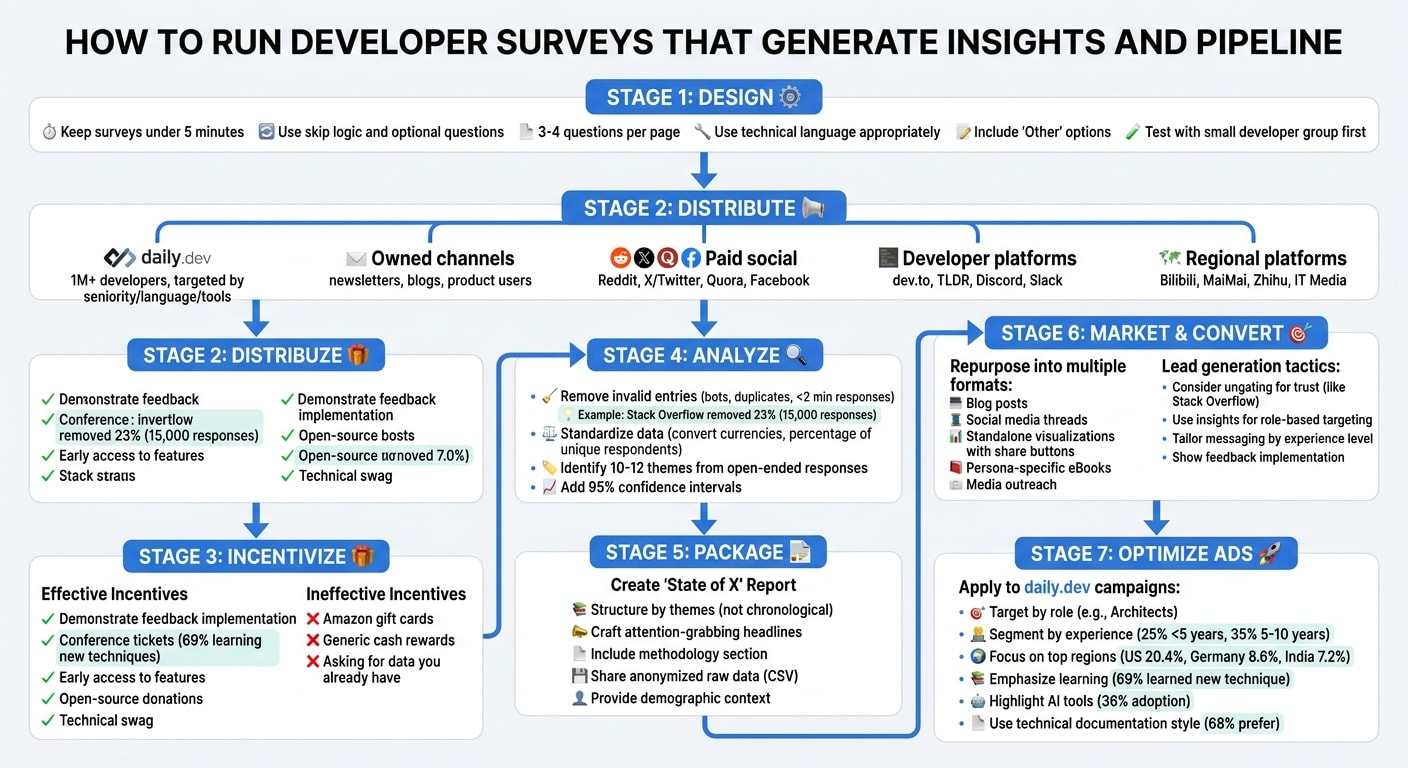
Developer surveys are a powerful way to understand your audience, improve your product, and drive marketing efforts. Here's what you need to know:
- Surveys help gather technical insights for product decisions and provide leads for marketing.
- Developers value data-backed findings and transparent results. Sharing raw data builds trust.
- Short, focused surveys (under 5 minutes) with optional questions work best for technical audiences.
- Use precise, technical language and avoid vague or redundant questions.
- Distribute surveys through trusted platforms (e.g., daily.dev), your own channels, and paid ads.
- Offer incentives developers care about, like early access to features, learning resources, or open-source donations. Avoid generic rewards like gift cards.
- Clean and analyze data carefully, then package findings into a "State of X" report with clear themes and actionable insights.
- Repurpose results into blog posts, social media content, and targeted campaigns. Use findings to refine ad targeting and messaging.
Key takeaway: Developer surveys aren’t just about collecting data - they’re about building trust, improving products, and creating marketing opportunities.
Why Developer Surveys Work as a Marketing Channel
Why Developers Value Data
Developers approach marketing with the same analytical mindset they use in coding. They want evidence-backed insights to guide their decisions on products, tools, and even career moves. Vague claims or flashy promotions don’t cut it. This creates a unique opportunity: publishing original research speaks directly to their preferences.
Trust is key here. As one DevRel agency points out:
Developers value honesty .
Sharing full survey results - including findings that might not paint the rosiest picture - builds credibility. Take JetBrains' 2025 report as an example. They not only published their findings but also provided anonymized raw data for public download, allowing developers to analyze it themselves . This level of openness not only demonstrates technical expertise but also fosters trust. Unlike traditional marketing, this transparency aligns with developers' demand for integrity in data.
Here's a telling stat from JetBrains' 2025 survey: 66% of developers are unsure or don’t believe that current productivity metrics accurately reflect their contributions . This highlights why developers are drawn to research reports - they want benchmarks and validation that go beyond generic marketing claims. By delivering this, developer surveys don’t just build trust; they also fuel targeted marketing and lead generation.
Next, let’s explore how original research doesn’t just build trust but also drives substantial online traffic.
How Original Research Drives Traffic
Original research doesn’t just earn trust - it also generates significant traffic. Survey data serves as a "citation magnet", a term SEO experts use to describe content that naturally attracts backlinks. Allan de Wit from RankYak explains:
Data studies or research reports with fresh statistics... naturally earn backlinks because they deliver unique value .
Fresh, unique findings naturally draw attention from writers, bloggers, and industry professionals.
A prime example is Stack Overflow's survey, which gathered 49,009 responses from 177 countries . The results became a go-to industry benchmark, driving massive site traffic and earning backlinks from tech publications across the globe. To recruit participants, they used onsite messaging, blog posts, and email newsletters. They also maximized distribution by incorporating interactive charts with direct social sharing links for platforms like Twitter/X, Facebook, and LinkedIn .
The secret lies in creating what de Wit calls "linkable assets" - unique statistics that others want to cite in blog posts, presentations, or even forum discussions . Packaging survey results into a dedicated URL with downloadable options (like a PDF report, spreadsheet, or companion blog post) multiplies opportunities for links and shares. This strategy isn’t just about improving SEO - it positions your brand as the go-to authority on specific technical topics.
How to Design Surveys for Technical Audiences
Keep Surveys Under 5 Minutes
When designing surveys for developers, the key is efficiency. Developers value their time, so your survey should be concise and focused on gathering meaningful data. Start by identifying the specific insights you need - your "directional headlines" - and craft questions that directly support those goals . This ensures every question has a clear purpose.
Take Warp's "State of the CLI" survey as an example. They struck a balance between detail and brevity, leading to high completion rates. To maintain quality, they removed 126 responses that were either completed too quickly (under 2 minutes) or had contradictory answers. Their final dataset included 1,374 valid responses .
Avoid redundant or irrelevant questions, often referred to as "lazy" questions, such as repetitive demographic inquiries. Use tools like skip logic to tailor the survey experience. For instance, if a respondent doesn’t use Kubernetes, skip orchestration-related questions altogether . Structure the survey like a conversation: begin with straightforward questions, move into more complex topics, and end with demographics. Keeping each page to 3–4 questions also helps maintain a clean and manageable layout .
Here’s a surprising tip: make questions optional. Warp adopted a "No Forced Questions" policy, which improved the reliability of their data. Forcing answers can lead to random or inaccurate responses, especially on sensitive topics. Leave detailed or niche questions for follow-up interviews and stick to single-select or multi-select formats for the survey itself .
Once your questions are streamlined, refine the language to resonate with your technical audience.
Use Technical Language Appropriately
Using precise technical language not only improves data quality but also boosts your credibility with a developer audience. Developers appreciate clarity over buzzwords. For example, use terms like "official documentation" instead of vague phrases like "first-party knowledge base" . When categorizing tools or technologies, be specific. Groupings like "Infrastructure as Code (IaC)" or "AI-enabled code editing tools" show you understand the field .
Avoid language that might come across as condescending. Developers aren’t "learning to code"; they’re solving complex problems or mastering new technologies. Similarly, don’t assume experienced developers never need documentation. Even seasoned Go developers might revisit commands like go build or go mod .
To ensure accuracy, clarify technical terms that might be misunderstood. For instance, briefly explain the differences between a CLI, shell, and terminal to avoid confusion . Always include an "Other" option in multi-select questions. Developers work with a wide range of niche tools, and forcing them into predefined categories can result in incomplete data .
Steer clear of "double-barreled" questions - those that ask two things at once. These can confuse respondents and lead to unclear results . Before launching your survey, test it with a small group of developers. This step can help identify confusing or poorly worded questions, ensuring better data quality and higher completion rates .
Where to Distribute Your Developer Survey
Promote Your Survey on daily.dev
daily.dev connects you with over 1 million developers who actively engage with technical content. Using the platform's native ad options - like in-feed ads and post page ads - you can place your survey in front of developers while they’re already immersed in their daily reading. This approach is seamless and non-disruptive, meeting developers where they naturally consume content.
What sets daily.dev apart is its targeting capabilities. You can tailor your outreach based on factors like seniority, programming languages, or tools. For instance, if your survey focuses on backend developers using Go or frontend engineers working with React, you can zero in on those specific groups. This level of precision ensures higher-quality responses and minimizes irrelevant participation, reducing the risk of survey fatigue.
While daily.dev offers a focused approach, you can amplify your survey’s reach by exploring additional channels.
Other Distribution Channels
To maximize participation, it’s smart to combine daily.dev with other distribution methods.
Leverage your owned channels first. Tap into your existing developer community through newsletters, blogs, or your product’s user base. Stack Overflow’s experience shows that owned channels often yield strong engagement . Since these audiences already trust you, they’re more likely to respond enthusiastically.
Expand your reach with advertisement campaigns for developers. Platforms like Reddit, X (formerly Twitter), Quora, and Facebook can help you access developers beyond your immediate network. For example, JetBrains gathered 24,534 responses from 194 countries for its 2025 Developer Ecosystem report by running targeted ads across these platforms . Keep in mind, though, that paid campaigns are best used as a complement to your core efforts. They’re particularly effective at reducing sampling bias by bringing in voices from outside your usual audience .
Explore developer-focused platforms and communities. Websites like dev.to and newsletters such as TLDR attract highly engaged technical audiences. For broader international coverage, consider regional platforms like Bilibili, MaiMai, and Zhihu in China, or IT Media in Japan . Additionally, niche communities on Discord servers or Slack groups can provide access to smaller but highly relevant audiences. When using these platforms, post your survey link directly in targeted channels for better engagement.
You can also encourage participants to share your survey by offering personal referral links upon completion. JetBrains uses this strategy to turn respondents into advocates, driving peer-to-peer sharing and increasing visibility .
What Incentives Work for Developers
Incentives Developers Actually Want
If you want developers to engage with your surveys and provide meaningful feedback, focus on incentives that show you’re serious about their input. The most effective way to encourage participation? Prove that their feedback actually drives change. Developers are much more likely to respond when they see that their suggestions have resulted in new features, fixed bugs, or better documentation .
"The single most powerful way to improve your engagement with developers is to have a demonstrable track record of acting on and implementing their feedback." – DevRel Agency
Developers also value opportunities to learn and grow. For example, conference tickets or educational resources resonate well - especially since 69% of developers spent time last year learning new coding techniques . Another great option is offering early access to new features or beta programs, which makes them feel like trusted insiders rather than just another marketing target.
Open-source donations made in their name are another effective incentive. This approach aligns with the community-driven mindset of many developers and shows that you appreciate their role in the broader ecosystem. Similarly, technical swag - like quality development tools, books, or hardware - can be appealing, but only if it’s genuinely useful. Generic branded merchandise? Not so much.
Transparency is also key. When you publish survey results - good and bad - you show honesty and a willingness to act on feedback, which builds trust for future interactions .
Incentives to Avoid
Some incentives just don’t work for developers. Amazon gift cards or generic cash rewards, for example, often fall flat. These options feel transactional and fail to connect with what developers care about. In fact, 89% of tech companies report struggling with traditional sales tactics for this very reason .
Another misstep? Asking for information you already have - like a developer’s location or current product usage. These "lazy" questions can come across as disrespectful of their time and make them question your technical credibility . Even the best incentive won’t make up for a poorly designed survey.
The difference lies in how you approach the relationship. Gift cards represent a one-off transaction, while incentives like early access, recognition, or proof that feedback shapes your product foster ongoing connections. Considering that 72% of product innovations fail to meet customer expectations , showing developers that you’re actively listening and acting on their insights is your most powerful incentive.
Up next, discover how to turn survey results into actionable insights that can drive meaningful improvements.
How to Analyze and Package Survey Results
Turn Data into Insights
The first step in analyzing survey results is ensuring the data is clean. Remove invalid entries like bots, duplicate submissions (cross-check email addresses and IPs), and responses completed in under two minutes. For example, during its 2025 survey, Stack Overflow eliminated around 15,000 responses - roughly 23% of the total - to maintain data quality . Filtering out rapid or contradictory answers ensures the remaining data is reliable .
Next, standardize the data to make it easier to interpret and compare. For instance, convert salary figures into USD using current exchange rates, and for multi-select questions, present results as a percentage of unique respondents rather than total counts. This avoids inflating numbers and keeps the analysis accurate .
Accurate analysis does more than refine insights; it builds trust with detail-oriented audiences, like developers. For open-ended responses, review the text carefully to identify 10–12 recurring themes. These qualitative insights often uncover frustrations or desires that multiple-choice responses might miss. For example, the Go team treats overall satisfaction scores, like a 91% satisfaction rate, as "lagging indicators" but focuses on open-ended feedback to identify "leading indicators" for future improvements .
"Start with the key insights we want to share and reverse-engineer our approach from there. We thought of this as 'what headlines could we create with these questions?'" – Warp
Adding 95% confidence intervals to your charts can further validate your findings. This level of detail shows your audience that you're not cherry-picking data but presenting a thorough and precise analysis .
Once your data is clean, standardized, and analyzed, you're ready to package the findings into a compelling format.
Create a 'State of X' Report
Turn your analyzed data into a well-organized 'State of X' report. Instead of presenting findings in chronological order, structure the report around clear themes. For instance, JetBrains' 2025 report, which surveyed 24,534 developers across 194 countries, was divided into four key sections: Tools and Trends, Artificial Intelligence, Productivity, and Life and Work . This thematic approach makes large datasets easier to navigate and ensures readers can quickly find the information they care about.
Craft attention-grabbing headlines that highlight your most important insights. Instead of something generic like "Developer Preferences", use a headline like "66% of Developers Don't Trust Current Productivity Metrics" to immediately draw readers in . Focus on sharing new or surprising findings .
Transparency is key to earning trust, especially with technical audiences. Include a methodology section detailing how you cleaned the data, adjusted for biases, and weighted responses. For added credibility, consider sharing the anonymized raw dataset as a downloadable CSV file. Companies like Stack Overflow, JetBrains, and the Go team have adopted this practice . For example, JetBrains used a three-stage weighting system to balance their data by geography and programming language usage, and they openly documented the process .
Finally, provide demographic context to help readers understand who participated in the survey. Include details like participants' experience levels, job titles, and geographic distribution. For instance, the 2025 Stack Overflow survey analyzed responses from over 49,000 participants across 177 countries, covering 62 questions and 314 technologies . This context helps readers assess whether the findings are relevant to their own circumstances.
How to Market Your Survey Results
Turn Results into Multiple Content Formats
Once your survey report is finalized, repurpose it into various content formats to connect with developers across multiple platforms. Start with a detailed blog post that highlights your most impactful findings. Then, create standalone visualizations with share buttons for social media. For example, Stack Overflow’s 2025 survey included individual charts with direct sharing options, making it simple for developers to share specific insights with their networks .
You can also tailor your findings into persona-specific eBooks to show how the data applies to different roles. For instance, a report aimed at engineering managers could focus on how these insights can improve team performance . Meanwhile, your comprehensive report can serve as the go-to resource for deeper analysis.
Social media threads are another effective way to break down complex findings into smaller, digestible pieces. Focus on trending topics like AI’s influence on workflows or workplace challenges to spark engagement. With the 2025 Stack Overflow survey covering 314 technologies, there’s plenty of material for creating targeted posts .
These varied content formats not only help you reach a broader audience but also establish your survey as a credible resource within the industry.
Get Media Coverage for Your Survey
To amplify the impact of your survey, use media outreach as part of your strategy. Position your survey as a key annual benchmark by branding it as a "State of X" report. JetBrains provides a great example of this approach, using their recurring, in-depth research to become a trusted reference point for journalists seeking reliable, data-driven insights .
Transparency is key - publish your full methodology and raw data. This allows journalists to independently verify your findings and create their own compelling stories.
"Developers value honesty." – DevRel Agency
When reaching out to the press, focus on findings that go beyond technical details. Stories about AI’s effect on job security, mental health in tech, or workplace discrimination often resonate with a broader audience. Highlight any actionable changes your company has implemented based on survey feedback. This not only shows developers that their input matters but also provides journalists with a stronger narrative angle . By doing so, you enhance your credibility and position your brand as a trusted voice in the industry, which can directly support lead generation efforts.
How to Generate Leads with Developer Surveys
Should You Gate Your Survey Report?
When deciding whether to gate your survey report, you need to balance the goal of capturing leads with the importance of building trust with your audience. Gating - a strategy where users must fill out a form to access content - can help collect emails and show clear marketing results. However, developers are often put off by barriers to accessing educational resources, and requiring a signup could cause them to lose interest .
Ungating, on the other hand, often resonates better with technical audiences. A great example is Stack Overflow, which chose to share its survey results openly. They provided full access to the report and even offered the raw data in CSV format for free. This approach not only reinforced their reputation as a reliable resource for software development insights but also drove a significant amount of organic traffic to their site .
If capturing leads is a priority, consider a more flexible approach. For instance, you could offer the report for free but include subtle calls-to-action, like encouraging readers to subscribe to a newsletter or book a "Discovery Call." Draft.dev took this route with its "2026 Developer Marketing Survey", making it available as a downloadable resource. This strategy attracted over 2,500 subscribers who were interested in B2B tech content, all while keeping the process friction-free .
Once you've chosen your gating strategy, the next step is to use the survey data to fine-tune your conversion efforts.
Use Survey Insights to Drive Conversions
The gating decision determines how accessible your data is, but the real value lies in how you use that data to boost conversions. Survey insights go beyond basic contact information - they can reveal job roles, pain points, and even readiness to buy . This information allows you to create follow-up campaigns that feel personalized and relevant to developers.
For example, include survey questions that identify key decision-makers, such as those managing budgets or evaluating new tools . Then, tailor your outreach based on their roles. CTOs might be more interested in architecture compatibility and long-term scalability, while VPs of Engineering often focus on metrics like sprint velocity or onboarding efficiency . Avoid generic messaging; instead, address the specific challenges highlighted in your survey .
One of the most effective ways to convert leads is by showing that their feedback matters. Developers are more likely to trust your brand if they see that their input has led to tangible improvements, whether it’s fixing bugs, adding new features, or enhancing your product. This approach builds trust far more effectively than a one-size-fits-all sales pitch .
Apply Survey Insights to Your daily.dev Ad Campaigns
Improve Ad Targeting with Survey Data
Survey data offers a clear lens into who developers are, the tools they rely on, and their work environments - making it easier to fine-tune your ad targeting. Instead of relying on guesswork, you can use concrete numbers to allocate your ad budget more effectively.
One approach is role-based targeting. For example, the 2025 Stack Overflow Developer Survey highlights "Architect" as one of the top four professional roles . Architects play a pivotal role in making high-level decisions about system design and tool selection. If your product is geared toward decision-makers, this group should be a key focus. Tailor your messaging to emphasize features like scalability and compatibility with architectural standards.
Another strategy is experience-level segmentation, which allows you to address developers at different career stages. According to the survey, 25% of developers have less than five years of experience, while 35% fall within the 5-10 year range . Early-career developers are often drawn to messaging around skill development and learning opportunities. In contrast, senior developers tend to prioritize tools that enhance efficiency and improve team workflows. Interestingly, only 1 in 25 Architects has less than five years of experience, compared to 1 in 4 for the broader developer population . This suggests that Architects are typically seasoned professionals, requiring more advanced messaging.
Geographic data is another goldmine for optimizing ad spend by region. The survey identifies the United States (20.4%), Germany (8.6%), India (7.2%), the United Kingdom (5.8%), and France (4%) as the top five countries for developers . If your campaign budget is tight, focusing on these regions can help you reach the largest clusters of developers efficiently.
Lastly, align your campaigns with current learning trends. A notable 69% of developers reported learning a new coding language or technique in the past year . Ads that highlight "upskilling" or mastering new tools are likely to resonate. Additionally, with 36% of developers adopting AI-enabled tools over the same period , emphasizing AI integration can give your ad copy a competitive edge.
These insights make it possible to craft campaigns that feel tailored and relevant to developers, increasing the likelihood of engagement.
Write Better Ad Copy from Survey Findings
Once you've nailed down your targeting, the next step is creating ad copy that grabs attention and drives action. Survey findings not only reveal your audience but also guide the tone and language you should use.
Here’s a key takeaway: 68% of developers rely on technical documentation as their primary learning resource . This means developers are more likely to respond to ad copy that mirrors the clarity and detail of documentation. Instead of saying, "Transform your workflow", try something more direct and practical like, "Learn how our API handles rate limiting in production." This approach aligns with the precision developers expect.
For products related to AI, focus on learning and career growth. The survey shows that 52% of developers learning AI use AI-powered tools and applications as their go-to resources . Highlighting your tool as a must-have for staying ahead - like "Master AI implementation patterns used by thousands of developers" - taps into this self-driven learning mindset.
"Understanding developers' roles, daily habits, and motivations are key steps to building an effective advertising strategy."
Since 76% of developers are professionals , your ad copy should skip over basic concepts and lean into advanced technical language. Developers value specificity, so vague promises like "boost productivity" won’t cut it. Instead, focus on measurable benefits or clear use cases.
Finally, let your survey data do some of the heavy lifting by using it as proof points in your ads. Developers trust data-backed claims, so referencing fresh statistics from your research can establish credibility. For instance, a headline like "Survey of 5,000 developers reveals the #1 bottleneck in CI/CD pipelines" positions your brand as an authority while also drawing attention to your product’s relevance .
With these strategies, you can craft ad campaigns that speak directly to developers’ needs and interests, ultimately driving better engagement and results.
Conclusion
Developer surveys are a powerful tool for building credibility, uncovering insights, and creating a steady flow of marketing opportunities. When executed thoughtfully, they can shape product development, fine-tune messaging, and justify marketing budgets. The trick is to treat surveys as an ongoing investment in understanding your audience, rather than a one-time effort.
The best developer surveys have a few things in common: they balance technical depth with lead generation. As one DevRel agency explains, "Developers value honesty" . Sharing complete results - even if they highlight areas where you need to improve - fosters trust and establishes your brand as a genuine partner in the developer community.
But gathering data is just the start. According to Revere Communications, "The single most powerful way to improve your engagement with developers is to have a demonstrable track record of acting on and implementing their feedback." This requires assigning responsibility for survey insights and making them a priority in your product roadmap. Ethical handling of data throughout the process strengthens trust even further. Without meaningful follow-up, even the most well-crafted survey won’t deliver lasting value. Acting on feedback is what transforms insights into real impact.
Once your data is collected, use it to create an engaging 'State of X' report. This report can refine your marketing strategies, sharpen ad copy, and build trust with developers. Whether it’s pinpointing key roles to focus on, identifying regions to target, or addressing specific technical challenges, survey data becomes the backbone of smarter, more targeted marketing efforts.
FAQs
How many responses do I need for reliable survey insights?
When it comes to surveys, there isn’t a one-size-fits-all answer for how many responses you need. The ideal number depends on factors like your survey's purpose, the audience you're targeting, and how confident you want to be in the results. For example, large-scale developer surveys often gather tens of thousands of responses to ensure broad reliability. On the other hand, smaller surveys can still offer useful insights - as long as the sample size aligns with your target population and the level of precision you’re aiming for. Tools like sample size calculators or established methodology guidelines can help you figure out the right number of responses for your specific goals.
Should I gate my “State of X” report to capture leads?
Putting a gate - like a sign-up form - on your “State of X” report might seem like a good way to capture leads. But when it comes to technical audiences, like developers, this approach could backfire.
Studies show that ungated reports often perform better when targeting developers. Why? Developers generally prefer easy, open access to information. If your report is freely available, it’s more likely to be read, shared, and discussed. This not only increases its reach but also boosts its overall impact.
By removing barriers, you’re creating opportunities for greater engagement and long-term connections.
What’s the best way to prevent bots and low-quality responses?
To maintain the quality of developer survey responses and keep bots or low-effort answers at bay, you can apply several techniques:
- Pre-screening questions: Use these to weed out respondents who don't meet your criteria right from the start.
- Digital footprint tracking: Monitor IP addresses, device types, or browser details to identify suspicious activity.
- Limit response attempts: Restrict the number of times a single user can access or submit the survey.
- Reputable panel providers: Partner with trusted providers to source reliable participants.
Other strategies include hiding certain questions using CSS to ensure bots can't "see" them and analyzing response patterns for irregularities. By combining these methods, you can focus on gathering accurate insights from real participants while filtering out noise.