

Developers are tough to market to - they value technical depth over flashy sales tactics and avoid anything that interrupts their workflow. To build trust and generate leads effectively, focus on permission-based strategies that align with how developers evaluate tools. Here's the process:
- Awareness: Reach developers on platforms they already use (GitHub, Stack Overflow) with helpful resources like code samples and templates. Avoid cold emails and generic marketing.
- Engagement: Offer tools and content that solve real problems. Metrics like GitHub stars or documentation visits show interest.
- Nurturing: Use community programs and targeted automation to guide developers without being intrusive.
- Conversion: Make it easy for developers to try your product through free trials, APIs, or sandboxes. Optimize for "Time to First Success" (e.g., completing a quickstart guide).
- Adoption: Track deeper signals like team invites or recurring usage to measure success and encourage wider adoption.
Key metrics include GitHub activity, documentation engagement, API usage, and team adoption signals. Focus on delivering value upfront, respecting developers' time, and building genuine connections to turn interest into long-term adoption.
What Counts as a Developer Lead: Stages and Metrics
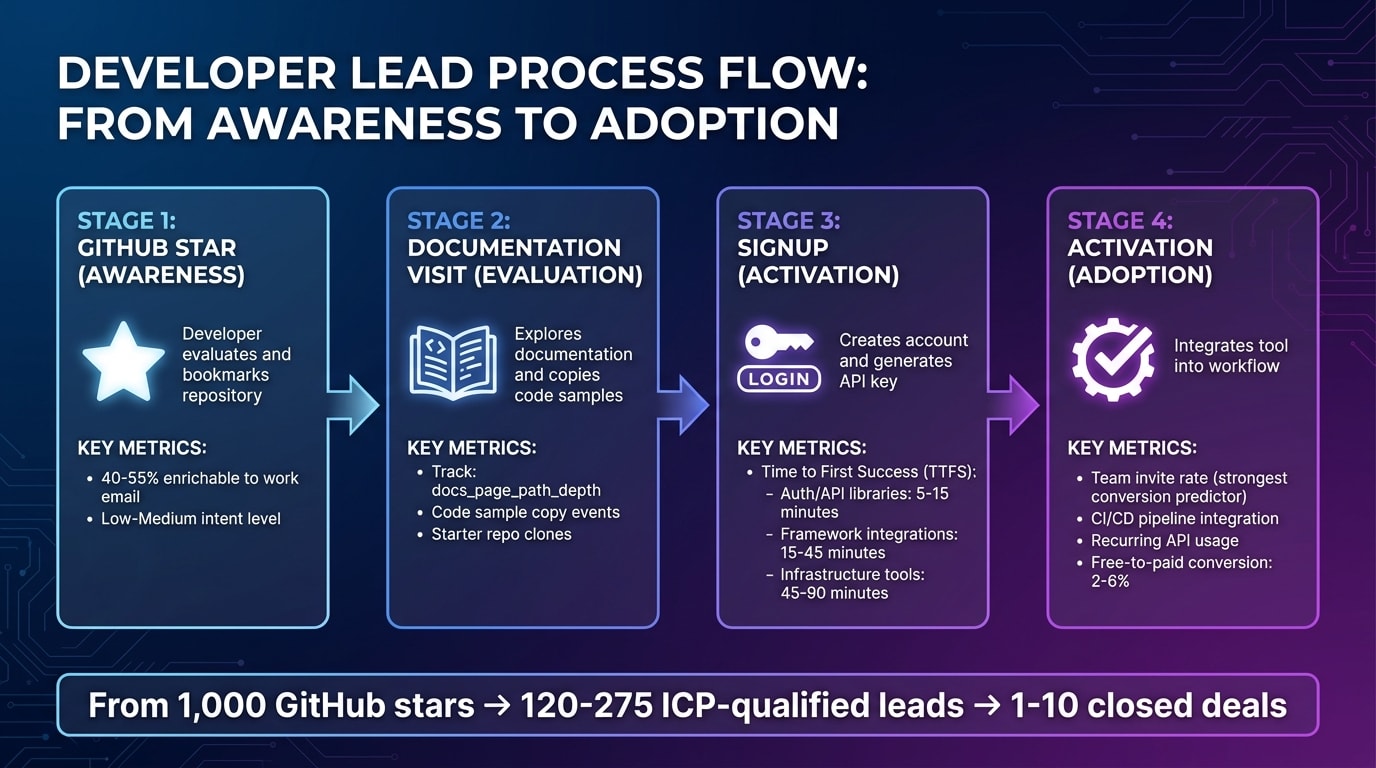
A developer lead is identified by technical intent signals rather than traditional factors like job titles or company size . This approach stands apart from standard B2B leads, which often rely on firmographics and broad outreach - methods that fail to resonate with developers.
The path from initial awareness to active use is well-defined: starting with a GitHub star, progressing to a repository fork, then moving to opened issues, commits, or pull requests . Each step reflects a deeper level of intent and provides clear metrics to measure engagement.
"A GitHub star is a deliberate act: someone found your repository, evaluated whether it was relevant to them, and clicked a button to save it for later reference. That's not random noise. That's intent." - LeadCognition Team
The quality of leads hinges on activation metrics, which indicate whether developers achieve a "first working result", such as creating an API key or completing a quickstart guide . One standout metric for predicting paid conversions is the team invite rate, as it signals a shift from individual testing to team-wide adoption . For every 1,000 GitHub stars, DevTool companies typically see 120–275 ICP-qualified leads and close 1–10 deals .
The 4 Stages of a Developer Lead
The journey from initial interest to active product use can be broken into four distinct stages, each marked by stronger intent signals.
Stage 1: GitHub Star (Awareness)
When a developer stars your repository, it’s a clear sign of intent. They’ve evaluated your tool and deemed it worth tracking .
Stage 2: Documentation Visit (Evaluation)
Next, the developer explores your documentation, moving beyond the repository. Metrics like docs_page_path_depth reveal how far they dive into understanding workflows . Actions like copying code samples show active evaluation.
Stage 3: Signup (Activation)
Here, the developer takes the step of creating an account and generating an API key or installing your SDK. Time to First Success (TTFS) becomes a critical measure. For example:
- Auth and API libraries: 5–15 minutes
- Framework integrations: 15–45 minutes
- Infrastructure tools: 45–90 minutes
Shortening this timeline can significantly boost conversions .
Stage 4: Activation (Adoption)
At this stage, the developer integrates your tool into their workflow. Look for signs like CI/CD pipeline presence, dependency lockfiles, or recurring API usage . This marks the transition from experimentation to active use.
Metrics That Matter for Developer Engagement
Each stage of the funnel has its own set of metrics that help you understand developer behavior and engagement.
Awareness Stage: Track GitHub repository views, Stack Overflow mentions, and documentation page visits. These metrics show your tool is being discovered in developer problem-solving spaces .
Engagement Stage: Focus on actions like copying code samples, cloning starter repositories, and scrolling through documentation. These behaviors signal active evaluation . Personalized outreach to GitHub stargazers performs far better, with reply rates of 15–25%, compared to the 2–5% typical of generic cold emails .
Activation Stage: Key metrics include API key creation, SDK installs, and quickstart completions. The aim is to guide developers to a working "Hello World" within five minutes of signup . Free-tier to paid conversion rates for developer tools generally range between 2% and 6% .
Adoption Stage: The team invite rate is the most telling metric here, as it reflects organizational buy-in and is a strong predictor of paid conversions . Additional metrics include CI/CD pipeline integration and mentions in team communication tools like Slack or Discord .
The table below summarizes the key metrics across each stage:
| Funnel Stage | Key Metrics to Track | What It Signals |
|---|---|---|
| Awareness | GitHub repo views, Stack Overflow mentions, documentation page views | Developers are discovering your tool in problem-solving contexts |
| Engagement | Code sample copies, starter repo clones, documentation depth | Developers are evaluating whether your tool meets their needs |
| Activation | API key creation, SDK installs, Time to First Success (TTFS) | Developers are testing your tool with real code |
| Adoption | Team invite rate, CI/CD integration, recurring API volume | Your tool is now part of their production workflow |
Tracking these metrics at each stage ensures you can measure and optimize developer engagement effectively.
Awareness: Reaching Developers Without Spamming
Traditional advertising often misses the mark with developers. Studies reveal that generic banner ads yield click-through rates of less than 1%, while cold outreach, like unsolicited emails, is frequently ignored . Developers value their time and prefer content that solves real problems instead of interrupting their workflow. Building trust-based awareness means offering helpful insights where developers already spend their time - without pushing for immediate action. This strategy lays the groundwork for using community platforms to create genuine connections.
Using Community Platforms for Organic Reach
Platforms like GitHub and Stack Overflow are goldmines for reaching developers organically. For instance, a well-crafted GitHub repository with demos and a detailed README can drive 5%–20% of referral traffic to your documentation, compared to the meager 0.5%–2% generated by display ads . A great example is Vercel, which gained massive traction by releasing Next.js starter templates on GitHub - pulled millions of times and generating substantial organic awareness .
Stack Overflow and dev.to are equally powerful. A top answer on Stack Overflow can keep delivering over 1,000 visits per month long after it's posted, while technical articles on dev.to often rack up 500–2,000 views in their first week. Companies like Supabase have tapped into these platforms by addressing niche developer questions and linking to their documentation, resulting in a 30% boost in signups. Similarly, HashiCorp's Terraform series, which included architecture diagrams, benchmarks, and debugging tips, drew over 50,000 views and directly contributed to their sales pipeline . The key? Offering practical solutions through code snippets and tutorials, rather than overtly promoting a product.
In addition to organic channels, native sponsored posts can help scale your reach effectively.
How daily.dev Ads Fits Your Top-of-Funnel Strategy
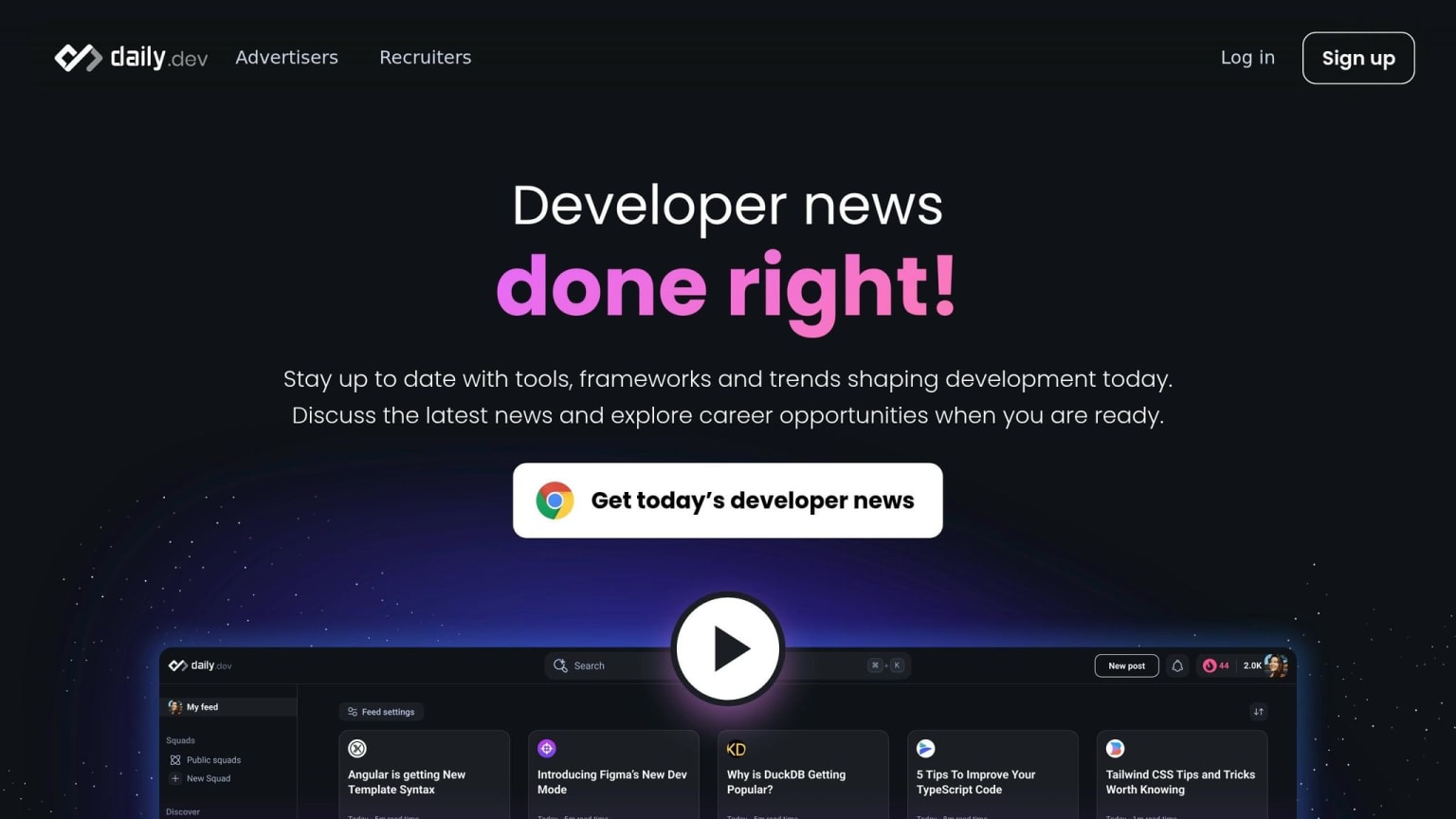
When paired with organic efforts, daily.dev Ads can significantly expand your reach. These ads are delivered as native sponsored posts in personalized content feeds, reaching over 1 million developers. By blending seamlessly with editorial content, they achieve engagement rates 3–5 times higher than traditional ads, with click-through rates ranging from 10%–15% .
daily.dev Ads work best at the awareness stage, driving traffic to ungated resources like blog posts, interactive tools, or architecture guides. For example, a developer might see a sponsored post about optimizing system performance, click through to a detailed article, and then download a benchmark report - turning 5–10% of impressions into qualified leads. Using UTM parameters to track these campaigns can help you measure how they complement organic referrals from platforms like GitHub and Stack Overflow.
Engagement: Content and Tools Developers Actually Want
Once developers know your product exists, the next challenge is getting their consent to engage further. To do this, you need to offer resources that address real-world problems - not just flashy marketing material. These days, most information that used to sit behind paywalls or forms is freely available. If your gated content can be found elsewhere, it creates unnecessary friction and often attracts less knowledgeable buyers . Instead, reserve gating for only the most exclusive, high-value resources.
Gated Content That Developers Will Exchange Their Email For
Developers are willing to share their contact details if the resource offers clear and actionable value. Think about assets like benchmark reports that provide specific performance metrics - data that would otherwise take weeks to gather independently. Other examples include detailed architectural records, technical post-mortems, and case studies that showcase measurable results, like reduced latency or cost savings. These are far more appealing than generic "ultimate guides" .
ROI calculators can also work, but only if they’re backed by transparent and credible data. Developers tend to be skeptical of marketing claims, so calculators need to clearly outline their assumptions and methodologies . Interactive tools, which let developers experience value firsthand, can be particularly effective. These tools often help identify Product Qualified Leads (PQLs), indicating genuine interest in specific features or upgrades .
A good rule of thumb is the 80/20 approach: keep 80% of your content ungated to build trust, and gate only the top 20% that offers premium insights . This strategy not only builds credibility but also streamlines the process of qualifying leads.
When to Gate Content and When to Keep It Free
Documentation should always be ungated. For developers, documentation is one of the most effective marketing tools. It should include runnable examples, which are often more effective at driving signups than traditional advertising . Resources like "Hello world" demos and sandboxes should also be freely available, allowing developers to get hands-on with your product within minutes .
Gated content works best for middle-to-late funnel stages. Resources like webinars, virtual product demos, and detailed white papers are ideal for developers who are actively evaluating their options or nearing a decision . On the other hand, early-stage assets - such as blog posts, tutorials, or basic product overviews - should remain ungated. This ensures maximum reach and helps establish trust. As Atticus Li puts it:
"Gated content generates measurable leads but limits distribution. Ungated content generates unmeasurable influence but maximizes distribution" .
Nurturing Leads: Community Growth and Smart Automation
Once you've captured initial interest, the next step is nurturing developers - guiding them from curiosity to actively exploring your product. This approach avoids rigid sales funnels and instead prioritizes building genuine connections, laying the groundwork for growth driven by your community.
Building Community with Ambassador Programs
Developer communities thrive when they focus on solving shared technical challenges rather than pushing a product. Ambassador programs are a great way to achieve this because they highlight the expertise of experienced developers who actively use your tool. These programs center on authentic engagement, featuring activities like webinars, live coding sessions, and deep technical discussions.
What makes this approach work? Developers value authenticity. They can easily spot the difference between real, unscripted problem-solving and a rehearsed sales pitch. For example, live coding sessions - where engineers create functional projects using your product - foster trust and connection in ways that polished demos simply can’t.
Creating Personalized Journeys Across Channels
Once you’ve established community engagement, automation can refine the developer experience even further. The key is to design automated nurture flows based on specific developer actions, not arbitrary timelines. For instance, if someone downloads a Kubernetes security eBook, follow up with resources tailored to container security rather than sending generic updates.
"Building a B2B lead nurturing strategy isn't about setting up email drips and forgetting them. It's about designing a system that respects your user's time and intelligence." – Michael, Pro Developer & n8n Guru .
Automation should deliver highly relevant, actionable content - like a GitHub Gist or a code snippet - when a developer engages with your material . This approach, often referred to as "value plus", builds trust by offering practical solutions instead of routine check-ins.
Lead scoring can also help identify when it’s time for a human to step in. Assign points based on meaningful actions, such as +3 for visiting documentation, +10 for viewing a pricing page, or +15 for making an API call. When a developer reaches 100 points, your system can alert the DevRel team via Slack or CRM . This ensures that any outreach is informed by the developer’s activity history, enabling your team to provide relevant technical support. By 2026, many DevRel teams are expected to replace traditional Sales Development Representatives (SDRs) in the developer tools space, focusing on tutorials and community engagement rather than cold outreach .
Instead of aggressive calls-to-action, consider a "soft ask" strategy. For example, replace "Book a Demo" with offers like "Whiteboard your architecture with one of our engineers" . This collaborative approach aligns better with how developers evaluate tools, making it easier to build trust and foster meaningful conversations.
Conversion: From Interested Developer to Active User
When a developer expresses genuine interest in your product, it’s a pivotal moment - and one where many companies stumble. Overly aggressive sales tactics or complicated signup processes can quickly derail their journey. The key is to make technical validation as quick and seamless as possible.
Building Effective Content-to-Trial Funnels
Once you’ve captured a developer’s interest, the next step is creating a smooth transition from engaging with your content to trying out your product. Developers typically prefer self-serve signup processes over interacting with a sales team. For most cases, a product-led growth (PLG) strategy is the way to go, with sales teams reserved for enterprise-level accounts . Your funnel should be designed to eliminate unnecessary barriers and focus on showcasing the tool’s value right away.
"For devtools, documentation is the highest-converting marketing asset. Clear docs with runnable examples produce more signups than any ad."
- Louis Corneloup, Founder, Dupple and Techpresso
To make this transition effortless, consider using progressive profiling. Start by collecting the basics - like name and email - during signup. Additional details, such as company size or job role, can be gathered later through smart forms .
Focus on activation metrics like “time-to-first-successful-API-call” or “team invite rate” to measure conversion success. Developer tools typically see free-to-paid conversion rates between 2% and 6% , so ensuring high-quality engagement is critical.
Making Signup as Easy as Possible
Simplify every step of the signup process. Use pre-filled forms and limit the number of required fields to reduce friction. Your landing page should deliver a clear, technically focused message and a design that naturally leads to action.
The first five minutes after signup are crucial. Provide a one-click demo and include copy-pasteable code samples to give developers instant validation of your product’s capabilities . Avoid gating this experience with lengthy forms or requiring a demo request. Instead, make sure a self-serve option is always available. Within the first three days, follow up with a personalized tutorial from your DevRel team tailored to the developer’s specific signup context .
Behavioral triggers can help personalize the onboarding experience. For instance, if a developer encounters issues with a particular SDK feature, automatically offer targeted technical support instead of sending generic messages. Providing relevant code samples, links to documentation, or implementation details fosters trust far more effectively than traditional sales follow-ups.
This approach ensures a seamless journey from initial interest to activation, setting the stage for deeper technical engagement down the line.
Measuring Success: Tracking Your Developer Pipeline
When it comes to permission-based developer lead generation, tracking technical actions is crucial for gauging engagement. Here's the challenge: 89% of tech companies struggle to measure the success of their developer go-to-market strategies effectively . Why? Because developers often discover tools through hard-to-track channels like technical blogs or private Discord communities.
The focus should be on technical actions rather than passive metrics. For instance, a GitHub star shows awareness, but a fork signals active evaluation. Similarly, creating an API key indicates a developer is ready to test your product in their environment. These technical signals turn engagement into actionable insights, shifting the focus from general interest to measurable progress. This approach helps pinpoint specific metrics across the funnel.
Metrics to Monitor at Each Funnel Stage
At the awareness stage, look for discovery signals like GitHub repository views, scroll depth on documentation, and code sample copy events . These actions suggest developers are considering whether your tool fits their needs.
As developers move into evaluation, track deeper interactions. Metrics like how far they navigate through your documentation or the number of starter repository clones can provide insights . The shift to activation often involves actions such as creating an API key, completing CLI/SDK authentication, or finishing a "Quickstart" guide .
One critical metric is Time to First Success (TTFS). For authentication or API libraries, this should ideally fall between 5–15 minutes, while infrastructure tools may take 45–90 minutes . If activation metrics are low, it might be worth revisiting your documentation to ensure it's clear and actionable.
"A signup shows interest. The key is what happens after it. Watch how many signups move to a first working setup, then to returning usage." - Mohammed Tahir, Developer Marketing Specialist
To gauge ongoing usage, track Monthly Active Developers (MAD) - those making authenticated API calls or code commits within a 30-day period . Since many developers use ad-blockers, rely on server-side tracking through authenticated API calls and documentation access logs instead of client-side pixels . This ensures you're capturing the full picture of technical engagement.
Lead Quality Metrics Comparison
Not all developer actions are equally valuable. For developer-focused products, Product Qualified Leads (PQLs) - based on actual product usage - convert at rates 3–5x higher than Marketing Qualified Leads (MQLs) .
| Signal Type | Intent Level | What It Means | Typical Conversion |
|---|---|---|---|
| GitHub Star | Low-Medium | Awareness; bookmarking for later | 40–55% enrichable to work email |
| Repository Fork | High | Active evaluation; testing code locally | 15–25% outreach reply rate |
| Issue/Comment | High | Troubleshooting; addressing a use case | Peak evaluation intent |
| Pull Request | Highest | Adoption; contributing or using a project | Strong conversion signal |
Pay attention to clusters of high-intent signals. For example, if a developer stars your repository and engages with similar ones soon after, they are likely comparing solutions . Reaching out within 24–48 hours can boost reply rates by 3–5x .
In terms of benchmarks, developer tools often see trial-to-paid conversion rates of 15–25%, which is notably higher than traditional SaaS . Strong onboarding experiences typically result in activation rates of 20–40% .
To assess pipeline health, track lead enrichment. Around 40–55% of GitHub stargazers can yield verified work emails, and 60–70% can be linked to LinkedIn profiles . If enrichment rates are low, it might mean you're attracting hobbyists instead of professional developers from target companies.
Retention is another key indicator. Successful developer tools often achieve Week 1 retention rates of 40–60%, reflecting early integration success, and Month 6 retention rates of 15–25%, signaling deeper workflow adoption . These retention metrics show whether developers find ongoing value in your product.
Conclusion: Building Developer Pipelines Based on Trust
Developer lead generation operates differently from traditional B2B marketing. Developers value hands-on experiences over flashy ads or generic marketing tactics. Long-term success depends on earning their trust at every step. Strategies like engaging with community platforms, offering genuinely helpful gated content, or building content-to-trial funnels all prioritize respect for a developer’s time. The key is simple: deliver value first, then ask for a commitment. This approach reinforces the importance of trust throughout your funnel.
Key Takeaways for Developer Lead Generation
Define what a developer lead means for your product. A developer lead can evolve through various stages, from a GitHub star to documentation visits, signups, and eventual activation. Focus on tracking technical actions like documentation views or time-to-first-successful API calls instead of relying on vanity metrics.
Prioritize activation over acquisition. Helping developers achieve a working "hello world" within five minutes is far more impactful than collecting email addresses. Developer Relations teams can play a critical role here by offering personalized tutorials and initiating outreach only after key milestones, such as team invites or integration completions.
Measure meaningful metrics. Metrics like documentation page views often align closely with pipeline growth, while team invite rates are strong indicators of conversion potential. Since free-to-paid conversion rates typically range from 2% to 6%, improving your onboarding process can significantly impact results.
These insights provide a foundation for refining your developer acquisition strategy.
Next Steps for Your Developer Acquisition Strategy
Reevaluate your funnel. Ask yourself if you’re prioritizing permission over attention. Are you gating content unnecessarily, or sending automated communications before developers have truly experienced value?
Leverage trusted platforms. Use channels like daily.dev to integrate your message into a developer’s routine. These platforms provide top-of-funnel awareness by delivering value as part of their daily content flow, rather than interrupting it.
Shifting to a permission-based strategy may take time, but the benefits are undeniable: higher conversion rates, better retention, and a community of developers who advocate for your product because you’ve earned their trust.
FAQs
How do you define a “developer lead” without relying on job titles?
A "developer lead" is someone whose actions show interest and engagement with technical resources. This could include starring projects on GitHub, exploring documentation, or signing up for developer tools. By focusing on behaviors rather than job titles, this approach offers a more precise and respectful way to gauge developer interest.
What should you gate vs keep free to avoid losing developers?
Gate premium, exclusive content like benchmark reports, architecture templates, or ROI calculators - resources that deliver clear, immediate benefits. Meanwhile, keep general or easily accessible materials free to ensure developers stay engaged and your reach remains broad. Balancing these approaches helps build trust with developers while encouraging them to explore your more in-depth offerings.
What intent signals best predict team adoption and paid conversion?
Behavioral signals, such as API usage and documentation visits, provide valuable insights into team adoption and the likelihood of paid conversions. Unlike traditional funnel metrics, developers place a higher emphasis on real-time technical engagement, making these signals a more dependable way to gauge intent.