

Marketing to developers is challenging. Over 60% use ad blockers, and cold emails rarely work. Developers prefer hands-on tools they can test quickly - like achieving a "hello world" in under five minutes - before engaging with sales. This article highlights five companies that successfully navigated these challenges in 2026, sharing strategies, results, and lessons.
Key Takeaways:
- Snyk: Reached 50,000 users by focusing on community-first marketing, GitHub integrations, and targeted developer engagement.
- Cognism: Used account-based marketing (ABM) to shorten sales cycles by 36% and increase win rates by 26%.
- API Company: Grew ARR from $2,300 to $1M in a year with SEO-focused documentation targeting developers' pain points.
- Infrastructure Startup: Boosted trial signups by 60% using native ads for developers on developer-friendly platforms like daily.dev.
- Snyk (Security Tool): Achieved $343.8M ARR by prioritizing developer education and grassroots advocacy.
Common strategies included: clear documentation, intent-based engagement, and leveraging developer-friendly platforms. These examples show how combining developer-first tools with tailored outreach can drive growth and revenue.
Case Study 1: Dev-Tools Startup Reaches 50,000 Users Through Community-First Marketing
Challenge
When Snyk launched in 2015, they entered a crowded market with no brand recognition. Their challenge? Gaining traction with developers who were often skeptical of traditional marketing tactics. By the end of 2015, their free CLI tool had been downloaded 1,000 times, but the team struggled to identify these users or figure out how to effectively engage with them .
Even with early interest, developers didn’t hold the purchasing power needed to drive enterprise deals. Co-founder Guy Podjarny summed it up well: "We opened the floodgates and got a trickle... Developer Adoption ≠ Purchasing Power" . To grow, the team needed to build trust and better understand their audience.
Strategy and Execution
Snyk tackled the problem by introducing GitHub OAuth login, which turned anonymous downloads into identifiable user profiles . This gave them the data to categorize users into four groups: Dormant, Casual, Core, and Progressive .
Instead of casting a wide net, they zeroed in on a specific segment - Node.js developers. To connect with this group, they offered detailed tutorials, actively participated in discussions on platforms like Stack Overflow and GitHub, and created open-source integrations that directly addressed pressing security issues. Their documentation stood out by including runnable code samples that allowed developers to perform vulnerability scans in under 15 minutes .
The team also hired Developer Relations (DevRel) specialists to provide technical support and troubleshoot issues. When developers from target companies showed interest - such as repeatedly viewing documentation or inviting colleagues - DevRel stepped in with helpful resources rather than pushing a hard sell .
This focused approach laid the groundwork for measurable growth and meaningful user engagement.
Results and Key Takeaways
By concentrating on a single developer community, Snyk built credibility that drove adoption. They discovered that only around 5% of Dormant accounts stayed active after 12 months . However, growth took off when users reached key milestones - like inviting teammates - which turned out to be the strongest predictor of conversion .
The main takeaway? Community-driven growth hinges on understanding who your users are and tracking their engagement. Without these insights, scaling becomes nearly impossible. Snyk’s shift to a hybrid go-to-market approach - using developer adoption as proof to win over security leaders and CTOs - was critical for landing enterprise deals. As Piyush Agarwal from Reo.Dev put it: "Offering free tools can build a strong developer base, but knowing your users is non-negotiable for growth" .
Case Study 2: Enterprise Developer Platform Wins Engineering Teams with ABM
Challenge
In 2025, Cognism, a sales intelligence platform, faced a tough hurdle common to enterprise developer tools. While individual developers and small teams embraced their product, breaking into large organizations was a different story. Sales cycles dragged on for months, often involving steering committees with up to 12 decision-makers . Adding to the challenge, 67% of marketing-generated leads were not ready for sales engagement .
Although developers valued the platform's technical features, the ultimate purchasing decisions rested with executives, leaving sales teams stuck. In fact, they spent 60% of their time pursuing prospects who had no real intention of buying . Cognism needed a way to connect with multiple stakeholders - technical champions, procurement teams, and C-suite executives - while avoiding wasted resources on unqualified accounts.
Strategy and Execution
To address this, Cognism adopted a demand-generation and ABM-first strategy in 2025, focusing on high-value accounts with laser precision . Instead of casting a wide net, they honed in on companies showing clear intent signals and created personalized campaigns tailored to each account.
Part of their approach involved offering premium content for free to build credibility with skeptical technical audiences before asking for their contact information . On LinkedIn, they ran hyper-targeted campaigns with messaging customized for different stakeholders: developers received technical documentation and integration guides, procurement teams got ROI calculators, and executives were presented with strategic positioning papers. By embedding marketing resources directly with sales teams, they eliminated the inefficiencies of traditional handoffs, allowing for real-time adjustments .
To engage decision-makers who typically ignored cold outreach, Cognism used proximity-based retargeting. This strategy followed prospects from physical interactions at industry events to their digital spaces . By tailoring content to each role and concern, they ensured every member of the buying committee felt addressed. This multi-threaded approach not only simplified stakeholder engagement but also paved the way for better sales outcomes.
Results and Key Takeaways
Cognism's efforts paid off with a 26% higher win rate, a 36% reduction in sales cycle length, and a 20% increase in qualified opportunities. Leads generated through ABM converted at four times the rate of traditional methods .
The key to success in enterprise deals lies in more than just appealing to developers. As Troy Blanchard from Twilio explained:
"When it's time for someone to consider investing in a system like ours... the engineers lay their marker down. Having someone on the tech side who will advocate for your solution is critical to winning a deal with a decision maker at the CTO or CEO level" .
Cognism's strategy emphasized finding technical champions early and systematically engaging all decision-makers - typically five to twelve - who had a say in the final purchase. This comprehensive approach proved essential in navigating the complexities of enterprise sales.
Case Study 3: API Company Drives Self-Serve Signups with Documentation and Developer SEO
Challenge
At the start of 2025, a web data extraction API company hit a roadblock. Despite having a technically solid product, they were stuck at just $2,300 in monthly recurring revenue. The problem? Developers simply didn’t know the API existed. While their product was capable, their visibility was not.
Developers who were building web scrapers weren’t finding the company’s marketing site because it wasn’t showing up for the technical search queries they relied on when their DIY scraping solutions failed. The team needed to capture developers’ attention right when they were deciding whether to build their own solution or buy one. But traditional advertising wasn’t an option - over 60% of developers block ads . They needed a more organic and helpful way to reach their audience.
Strategy and Execution
To solve this, the company partnered with Enric Baltasar from Nakora to implement a Product-Led SEO strategy focused on what they called "Failure Moments" . Instead of chasing broad keywords like "web scraping API", they honed in on the specific technical problems developers face when their DIY efforts hit a snag - searches like "pagination with Beautiful Soup 4" or "getting blocked by Cloudflare" .
The company turned their documentation into their primary marketing tool. Each guide was designed to walk developers through a specific use case, showing how to use open-source tools until they inevitably hit a limitation. That’s where the API was introduced as the ready-to-use solution . Ross from Greta Agency explained this strategy perfectly:
"Write for the searcher, not the existing user. Ask: what is a developer searching for when they have the problem my product solves?"
To ensure the content resonated, they hired technical experts - not marketers - to write it. These experts spent 1–2 hours per brief mapping out the exact technical details and product integration points . They also made sure the content was ungated and included runnable code samples, allowing developers to make a working API call within 15 minutes .
This highly targeted approach made the API company stand out in a crowded space.
Results and Key Takeaways
The results were nothing short of transformative. Over the course of a year, from January 2025 to January 2026, the company’s annual recurring revenue (ARR) skyrocketed from $2,300 to over $1 million - a 36.23X increase . Their Domain Rating jumped from 27 to 45, and brand trust metrics improved by 66.7% . Even more impressive, documentation traffic became the top source of new signups, outperforming the traditional marketing site .
Louis Corneloup from Dupple highlighted the power of this approach:
"Documentation is the highest-converting marketing asset. Clear docs with runnable examples produce more signups than any ad" .
Case Study 4: Infrastructure Company Scales Trial Signups with Native Ads on daily.dev
Challenge
By mid-2025, a cloud infrastructure startup found itself stuck. Their SEO and social media strategies had maxed out, bringing in around 1,200 trial signups each month. They needed a fresh way to attract qualified traffic. Traditional ads weren't cutting it, and their sales process was slowing things down. Developers who wanted to try the product faced hurdles like sales calls and long procurement cycles, which often led to delays in evaluations .
Adding to the challenge, many developers stayed anonymous, leaving the company without much insight into who was engaging with their product. Without a scalable way to connect with developers directly, growth had hit a wall.
Strategy and Execution
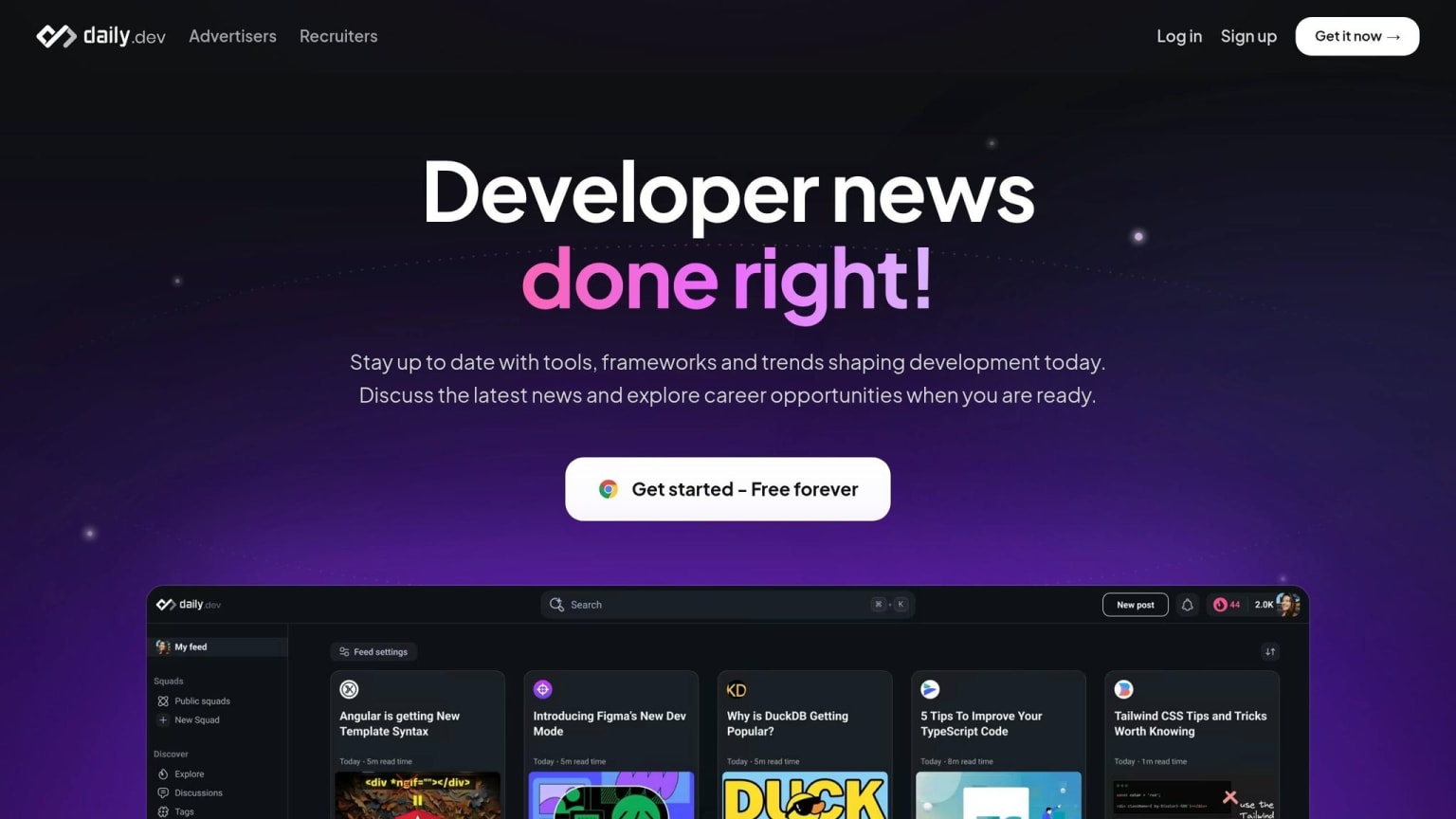
The company decided to try something different: native advertising on daily.dev, a platform where over 1 million developers discover technical content every day. Instead of using disruptive banner ads, they opted for in-feed placements that blended naturally into the developers' content streams .
Their approach was straightforward. They skipped overused buzzwords like "enterprise-grade" and "seamless" and focused on clear, technical messaging. Each ad highlighted a free trial with a strong value proposition, making it easy for developers to test the product without needing to go through sales. The campaign was carefully targeted, considering factors like developer experience level, preferred programming languages, and the tools they used. This ensured the ads were highly relevant to the audience.
By integrating these ads into developers' content feeds, the company presented trial offers in a way that felt natural and helpful.
Results and Key Takeaways
In just six months, monthly trial signups surged by 60%, climbing from 1,200 to 1,920. At the same time, the cost per signup dropped by 34%, and the conversion rate from trial to paid users improved by 22%.
The lesson here is simple: Native ads on platforms developers trust can drive impressive engagement when they're relevant and avoid marketing fluff. Developers care about practical value. By offering a self-serve trial and placing ads within a trusted content environment, the company not only boosted signups but also maintained the credibility that technical audiences expect.
This case highlights how well-placed, non-intrusive native ads can fuel growth while laying the groundwork for future developer-focused strategies.
Case Study 5: Security Tool Wins Market Share Through Developer Education
Challenge
Back in 2015, Snyk entered a security market that was already dominated by big players catering exclusively to CTOs and CIOs. These established tools were designed for audits and enforcement, which often created friction with developers who saw them as more of a hindrance than a help. Snyk faced a tough challenge: how to earn the trust of developers in a space where competitors had long-standing executive connections.
The founders knew they couldn’t rely on the traditional top-down sales model. Instead, they aimed to win over developers first. By gaining grassroots support, they hoped to eventually reach decision-makers, creating a developer-first go-to-market strategy that would encourage widespread adoption.
Strategy and Execution
To tackle this, Snyk shifted its focus from standard sales tactics to directly engaging developers through education. They introduced a free CLI tool specifically for Node.js developers, designed to help identify and fix vulnerabilities like Heartbleed and Shellshock. Instead of pitching compliance, they focused on solving real-world developer problems. Engaging with the Node.js community became a priority, and they actively collected feedback and offered solutions to build trust and credibility .
Documentation became one of their most powerful tools. Snyk created step-by-step tutorials, guides, and copyable code snippets to ensure developers could achieve results - like a "hello world" moment - within minutes . They also reimagined their outreach by replacing traditional sales reps with Developer Relations (DevRel) teams. These teams wrote tutorials, participated in conferences, and answered technical questions on platforms like Stack Overflow and Discord. This approach allowed Snyk to connect with developers in the spaces they already frequented, avoiding the interruptions of traditional sales calls.
By focusing on one specific community and delivering genuine value through education, Snyk cultivated a loyal group of advocates who would go on to promote the tool within their organizations.
Results and Key Takeaways
This approach paid off in a big way. By the end of their first year, Snyk achieved 1,000 developer downloads . More importantly, these developers became internal champions, advocating for the tool within their companies. Fast forward to January 2026, and Snyk had reached an impressive $343.8 million in ARR, serving over 3,000 organizations globally, including major names like Salesforce, Atlassian, and Intuit .
The key takeaway? Education fosters trust, and trust fuels enterprise adoption. Developers are unlikely to recommend tools they haven’t thoroughly tested and understood. By prioritizing high-quality educational content and meaningful community involvement, Snyk transformed individual developers into a powerful sales force, capable of influencing executive-level purchasing decisions. This case demonstrates how a bottom-up, education-first approach can even challenge and surpass well-established competitors.
Common Patterns and Metrics Across All 5 Case Studies
Comparison Table of Strategies and Metrics
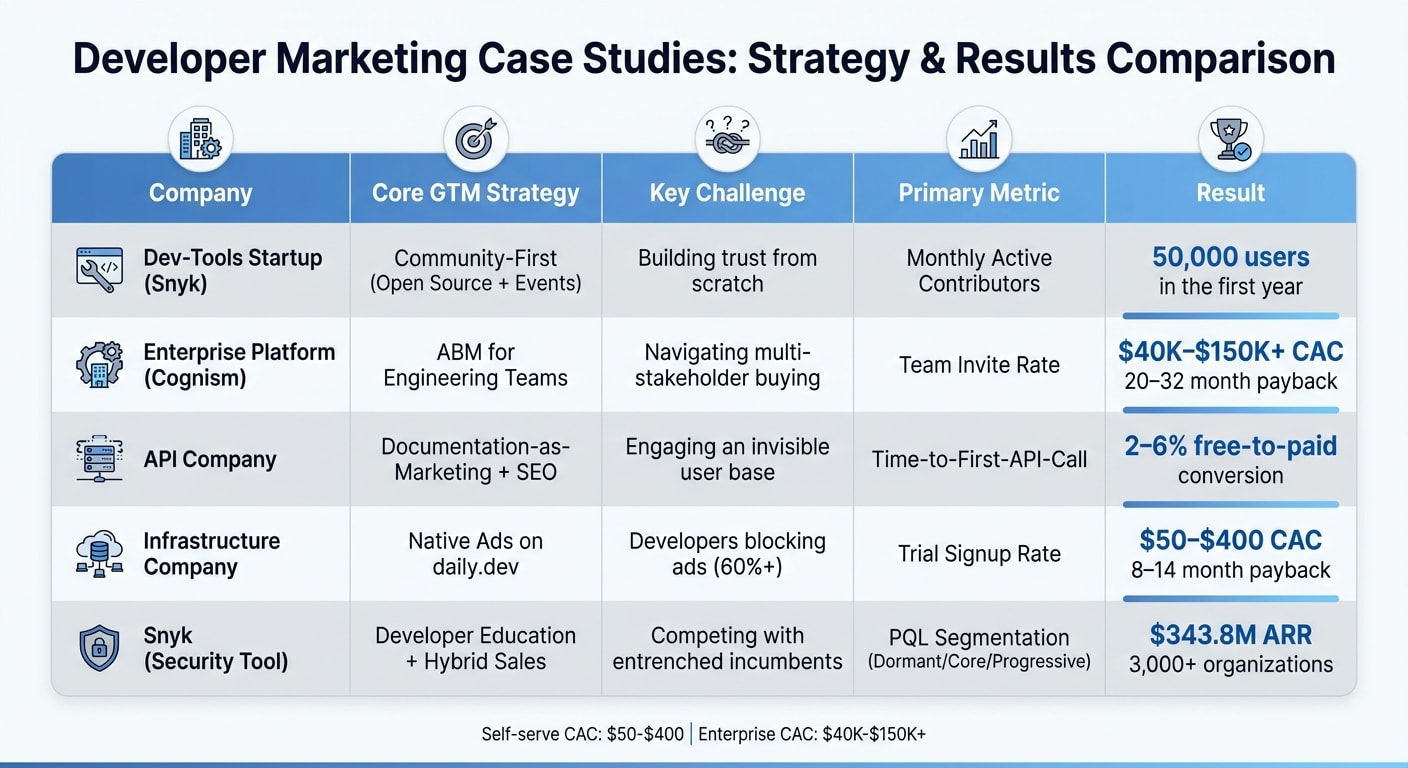
The five companies analyzed faced distinct challenges, yet their strategies shared common threads tailored to their specific markets. These recurring patterns form a practical guide for achieving success in developer-focused go-to-market (GTM) approaches.
| Company | Core GTM Strategy | Key Challenge | Primary Metric | Result |
|---|---|---|---|---|
| Dev-Tools Startup | Community-First (Open Source + Events) | Building trust from scratch | Monthly Active Contributors | 50,000 users in the first year |
| Enterprise Platform | ABM for Engineering Teams | Navigating multi-stakeholder buying | Team Invite Rate | $40K–$150K+ CAC, 20–32 month payback |
| API Company | Documentation-as-Marketing + SEO | Engaging an invisible user base | Time-to-First-API-Call | 2–6% free-to-paid conversion |
| Infrastructure Company | Native Ads on daily.dev | Developers blocking ads (60%+) | Trial Signup Rate | $50–$400 CAC, 8–14 month payback |
| Snyk (Security Tool) | Developer Education + Hybrid Sales | Competing with entrenched incumbents | PQL Segmentation (Dormant/Core/Progressive) | $343.8M ARR, 3,000+ organizations |
Self-serve models produced customer acquisition costs (CAC) ranging from $50 to $400, while enterprise-level deals with multiple stakeholders required significantly higher investments, with CAC ranging from $40,000 to $150,000+ .
Key Patterns
Documentation as a growth driver. Across the board, companies discovered that developer-centric, code-heavy documentation outperformed traditional marketing pages when it came to generating qualified leads . Developers don’t want flashy sales pitches - they want actionable code they can implement right away.
The "Hello World" moment mattered most. Whether it was the dev-tools startup’s open-source CLI or the API company’s code snippets, enabling developers to achieve a working implementation in 5 to 15 minutes became a critical factor for retention. Optimizing this activation phase boosted conversion rates to the higher end of the 2–6% range .
Developer adoption didn’t equal revenue. Guy Podjarny, co-founder of Snyk, reflected on the early days:
"We opened the floodgates and got a trickle" .
Despite initial enthusiasm from developers, revenue lagged because they lacked purchasing authority. The solution? Use developer adoption as a springboard to build a business case, then engage decision-makers like CTOs and security leaders with enterprise-focused features like SSO, compliance tools, and dedicated support.
Behavioral signals beat traditional lead forms. Both the enterprise platform and the infrastructure company shifted from relying on form fills to tracking intent-based behaviors. Metrics like documentation visits, repository clones, team invites, and API calls provided actionable insights. These signals triggered outreach from technical Product Advocates, who approached conversations as helpers rather than cold callers .
Developers avoid traditional advertising. With over 60% of developers blocking display ads , companies like the infrastructure provider found success using native ads on trusted platforms like daily.dev. Twilio’s Direct to Developer campaign on Stack Overflow serves as another example, where some technical articles saw a 10× jump in monthly readership .
Applying These Lessons to Your Developer GTM Strategy
The five case studies highlight one undeniable truth: developers prefer to test tools hands-on before engaging with anyone directly . To align with this preference, make your documentation the centerpiece of your landing page. Take a page from Stripe’s playbook - they built a $95 billion valuation around their promise of "7 lines of code" . The takeaway? Speed matters. Strive to deliver a working implementation in under 15 minutes, whether it’s a successful API call, a deployed app, or a CLI command that delivers results. This quick, hands-on interaction lays the groundwork for tracking engagement through intent signals.
Once the foundation is set, rethink traditional lead forms. Instead, focus on intent-based signals like visits to your documentation, repository clones, or views of your pricing page. Vercel applied this strategy and achieved 100,000 monthly signups, surpassing $200M in ARR by employing technical "Product Advocates" . This method respects the way developers prefer to explore tools, steering clear of gated content that often deters them.
To bridge the gap between adoption and revenue, consider a hybrid model. Guy Podjarny from Snyk shared a cautionary tale:
"We opened the floodgates and got a trickle... Developer Adoption ≠ Purchasing Power" .
Start with bottom-up adoption through free tiers or open-source projects, then target CTOs and security leaders with enterprise-focused features like SSO and compliance tools. This approach ensures you’ve demonstrated internal value before pitching higher-level solutions.
When it comes to reaching developers, invest in channels they actually use. With over 60% of developers blocking display ads , platforms like daily.dev, technical newsletters, and developer podcasts offer better ROI than traditional LinkedIn campaigns. Self-serve customer acquisition costs (CAC) typically range from $50 to $400, with payback periods between 8 and 14 months . Compare that to enterprise deals, which often cost $40,000 to $150,000+ in acquisition expenses, and the efficiency of self-serve models becomes clear.
To refine your strategy further, segment users based on engagement rather than job titles. Snyk’s approach categorized users as Dormant, Casual, Core, or Progressive based on activity frequency . This analysis revealed that Dormant accounts had only a 5% retention rate over 12 months. By focusing resources on Core users who showed consistent activity, they maximized retention efforts. Activation metrics like "time-to-first-API-call" can serve as a strong predictor of long-term retention and help you identify where to focus your efforts .
FAQs
What is a “hello world” moment in developer GTM?
In the world of developer-focused go-to-market (GTM) strategies, a "hello world" moment represents that first, effortless interaction where a developer successfully engages with a product. Think of it as a quick, straightforward setup or demo that confirms everything is working as expected. This moment is more than just a technical milestone - it’s about building trust and proving the product’s worth right from the start. By making this initial experience smooth and satisfying, you set the stage for long-term adoption and success.
What intent signals best predict paid conversion?
When it comes to predicting paid conversions, developer engagement with technical resources stands out as a key indicator. This includes interactions with documentation, reference implementations, and open-source contributions. These actions suggest a strong interest in the product or service.
Another important signal is active involvement in developer communities and events. Participation in these spaces not only shows interest but also builds trust - a critical factor in determining the likelihood of conversion. Together, these behaviors provide valuable insights into conversion potential.
When should you add ABM to a PLG motion?
When scaling enterprise adoption and targeting larger organizations, incorporating Account-Based Marketing (ABM) into your Product-Led Growth (PLG) strategy can make a big difference. ABM is particularly effective once you've already established a solid PLG foundation - showcasing product value to individual developers and earning their trust.
By layering ABM onto your PLG approach, you can:
- Engage enterprise clients with personalized, targeted outreach.
- Drive larger deals by aligning your efforts with the priorities of key decision-makers.
- Deepen integrations and foster long-term relationships at the organizational level.
This approach works best when you're ready to move beyond individual users and focus on unlocking opportunities across entire organizations.