

Reaching developers through ads is tough - over 60% use ad blockers. But newsletters offer a direct, trusted channel to engage with them.
Here’s why newsletter ads work:
- High engagement: Open rates of 45–60% and click-through rates of 3–7%, far better than other ad channels.
- Ad blocker-proof: Delivered directly to inboxes, ensuring 100% viewability.
- Targeted options: From $500 classified ads to $25,000 dedicated sends, there’s flexibility for every budget.
Key strategies for success:
- Choose newsletters with high engagement (open rates above 38%).
- Write technical, value-driven copy that avoids jargon.
- Test and refine subject lines, CTAs, and offers for better results.
- Pair newsletter ads with feed ads (e.g., daily.dev) for multi-touch campaigns.
Developer newsletters are a powerful tool in 2026 for reaching a highly engaged, technical audience. Investing in this channel can drive stronger engagement, higher conversion rates, and measurable ROI.
::: @figure 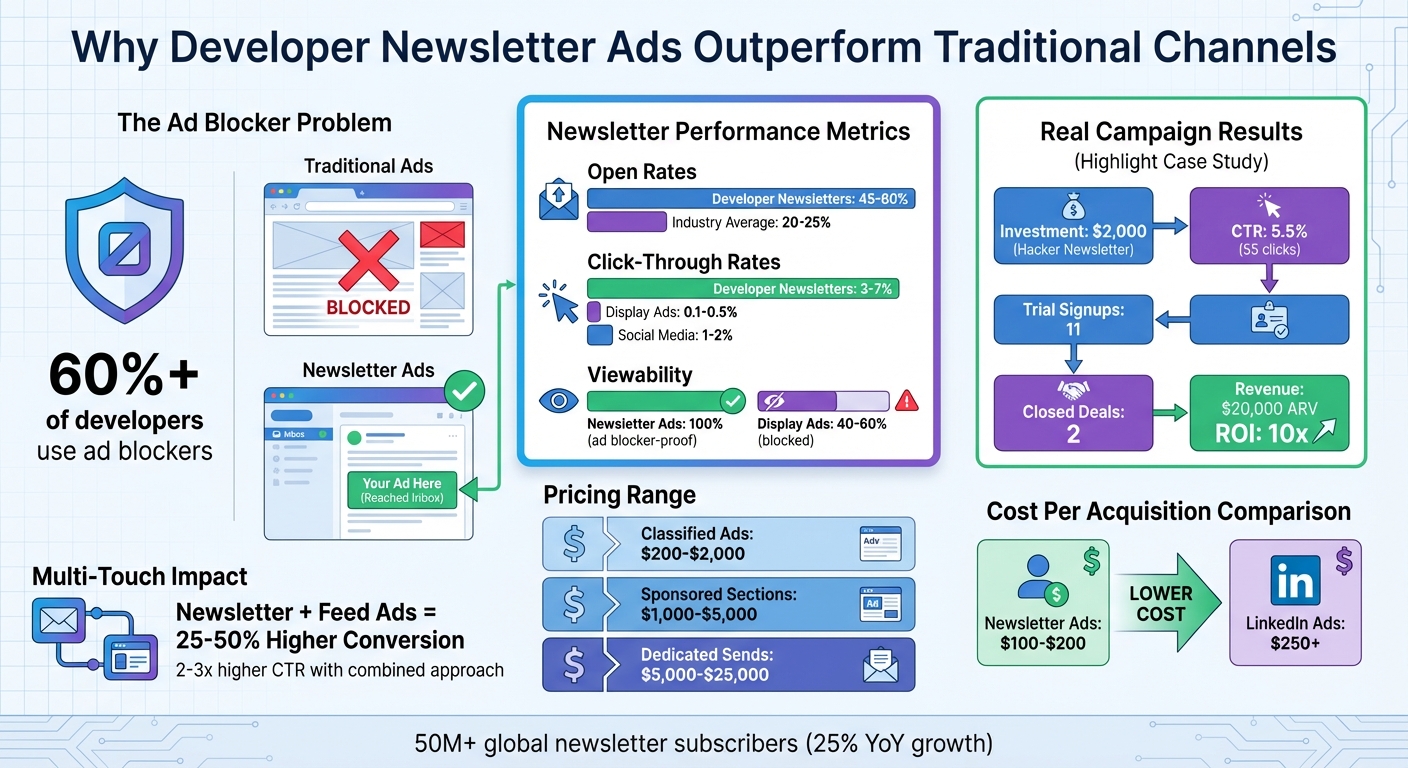 {Developer Newsletter Advertising Performance Metrics and ROI Comparison 2026}
The Developer Newsletter Landscape in 2026
The world of developer newsletters has evolved to offer a variety of formats, each designed to cater to different campaign objectives. Choosing the right format can help you align your goals with your budget, creating opportunities for precise, impactful outreach.
Curated Digests and Community Newsletters
Curated digests are a blend of technical insights, industry updates, and the latest trends, delivered in emails that developers actively subscribe to. Well-known examples include TLDR, DevOps Weekly, and Golang Weekly, which serve niche communities with highly engaged audiences. These newsletters are powerful because they build on the trust subscribers already have in the content. For instance, placing a sponsored blurb in This Week in React ensures your message reaches front-end developers who are already in a learning mindset.
These newsletters offer flexible advertising options, such as:
- Sponsored text blurbs (50–150 words)
- Dedicated email sends
- Smaller classified placements for brand exposure
Pricing varies widely, from about $100 to $2,000 for niche publications and up to $15,000 or more for major digests . For even more precise targeting, platform-specific emails take things a step further by aligning ads with developers' real-time behaviors.
Platform-Specific Emails
Platforms like daily.dev take a more dynamic approach by embedding ads into developers' content-discovery routines. Using AI-driven personalization, daily.dev doesn’t rely on static ad placements. Instead, it matches ads to developers based on what they’re actively engaging with.
With a reach of 1 million active developers, daily.dev uses personalized digest emails and in-feed cards that blend seamlessly with organic content. This approach is particularly effective for driving trial signups, as it connects with developers during moments of active exploration. By focusing on real-time engagement rather than just basic demographics, platforms like this offer a deeper level of targeting .
sbb-itb-e54ba74
Why Newsletter Ads Work for Developers
Developers tend to shy away from traditional ads. They value technical depth over flashy marketing and often use ad blockers to avoid intrusive content . Newsletter advertising, however, takes a different approach - it connects with developers in spaces they’ve already chosen to engage with.
High Engagement Through Opt-In Marketing
Newsletters thrive on a permission-based model, which means developers actively choose to subscribe. Whether it’s DevOps Weekly or Golang Weekly, these newsletters cater to specific technical interests. This opt-in nature ensures that your ad reaches an audience that’s already looking for relevant information, not one being interrupted by unsolicited pitches. Unlike cold calls or display ads, newsletter sponsorships are woven into content that developers trust and value.
Adam Duvander sums it up perfectly:
Look for where developers are already learning and getting their development news. If your sponsorship can feel as naturally helpful as other content from that source, you'll be doing well .
This approach fosters high engagement, making your ad feel like a natural part of the conversation rather than an intrusion.
A Trusted Format Without Ad Blockers
Newsletter ads bypass one of the biggest hurdles in digital advertising: ad blockers. Because they’re integrated into the trusted editorial content of the newsletter, your message isn’t flagged as intrusive or removed. This ensures your ad reliably reaches its audience, even when other formats like banner ads or social media campaigns might be blocked.
The trick is to focus on education rather than outright promotion. Developers appreciate content with real value - think technical deep dives, case studies, or practical insights. When your sponsorship aligns with the newsletter’s tone and provides something genuinely useful, it feels less like marketing and more like a resource they can trust.
Types of Developer Newsletter Ad Placements
Developer newsletters provide an effective way to connect with a highly engaged audience, offering several ad formats tailored to different goals and budgets. Choosing the right placement ensures your message resonates with the audience while aligning with your campaign objectives.
For campaigns that need undivided attention, dedicated sends are a powerful option. These standalone emails focus entirely on your message and are sent to the entire subscriber list. They're perfect for major product launches or time-sensitive promotions. For example, in Q1 2025, Vercel used a dedicated send through TLDR Newsletter to reach over 500,000 subscribers. The results? A 52% open rate, 4.2% click-through rate, and 1,200 signups for their Edge Functions beta. Ultimately, 15% of those signups converted to paid users, generating $450,000 in annual recurring revenue. Costs for dedicated sends range from $5,000 to $25,000, depending on the audience size and quality.
If you're looking for a more integrated approach, sponsored sections and native content integrations might be the way to go. These ads are embedded within the newsletter's regular content, often as highlighted blocks or alongside curated articles. This format builds credibility by blending seamlessly with trusted editorial content. For instance, in October 2024, PostHog sponsored a section in daily.dev's newsletter, reaching 200,000 developers with analytics tips woven into the editorial flow. The campaign achieved a 3.8% click-through rate, 650 trial signups, and added $180,000 to their sales pipeline in just 30 days. Pricing for these placements typically falls between $1,000 and $5,000 per issue, offering a balance between cost and visibility.
For a budget-friendly option, classified listings are a great choice. These short, text-based ads appear in a dedicated section of the newsletter, similar to job boards or community announcements. They're ideal for recruiting, promoting open-source projects, or sharing simple product updates. While click-through rates are lower (around 0.5% to 1.5%), the cost - ranging from $200 to $2,000 per listing - makes them a low-risk way to test new newsletters or target niche audiences. The key here is clarity: you need to convey your value in just a few sentences and a link.
Each format has its strengths, and the right choice depends on your goals, budget, and the audience you want to reach.
Choosing the Right Developer Newsletters for Advertising
When it comes to advertising in newsletters, prioritizing engagement over sheer subscriber numbers is key. A newsletter with 500,000 subscribers might seem impressive, but if the open rate is low, the majority of that audience isn’t seeing your ad.
Evaluating Audience Fit and Metrics
To find the right newsletter, dig into metrics that reflect real engagement. Subscriber count alone doesn’t tell the full story. For profitability, aim for newsletters with an open rate of at least 38% . In fact, niche B2B and tech newsletters often report open rates between 45% and 55%, while some top-performing developer newsletters reach rates as high as 60% .
Click-through rate (CTR) is another critical metric. For newsletter ads, CTRs typically range from 1.5% to 3.5% . Native placements tend to average lower at 0.8% to 1.5%, with top performers hitting 2.5% . Don’t forget to check the Click-to-Open Ratio (CTOR) - a high open rate but a low CTR might mean readers are skimming headlines without engaging further .
"A smaller, active list is always more valuable than a massive, passive one." – Calcix Research Team
To avoid wasting money on "ghost subscribers", ask for verified screenshots of the last three newsletter sends . Also, consider the audience’s influence. For example, 82% of subscribers to major developer newsletters like SitePoint Weekly influence technology purchasing decisions at their companies .
Another tip? Match your ad to the newsletter's technical focus. For instance, Rust-focused newsletters boast a 135% engagement index, while Go-focused ones hit around 125%. Broader tech audiences, like those for Java or C#, tend to hover around 85% . If your product is Rust-based, targeting a Rust-specific newsletter will likely yield better results than a general tech publication.
Once you’ve found the right audience, it’s time to tackle pricing.
Understanding Pricing Models
Developer newsletters typically offer three main pricing models: CPM (Cost Per Mille), CPC (Cost Per Click), and flat-rate sponsorships. Each has its pros and cons depending on your goals.
CPM charges for every 1,000 opens. Rates for developer newsletters usually fall between $35 and $60 per 1,000 opens . This model works well for building brand awareness but can be misleading if engagement is low.
CPC pricing is performance-based - you pay only for clicks. Niche tech newsletters often charge between $6.00 and $12.00 per click . However, for campaigns to remain profitable, keeping CPC below $4.50 is ideal . Keep in mind, not all newsletters offer CPC pricing; larger publications often stick to flat rates.
Flat-rate sponsorships involve a fixed fee per placement. For high-profile newsletters with over 1 million subscribers, rates can range from $3,000 to $15,000+ per placement. Smaller, niche newsletters with 5,000 to 100,000 subscribers typically charge between $100 and $2,000 . This model is predictable but carries the risk of low engagement.
Here’s a quick breakdown of the pricing models:
| Pricing Model | Best For | Average Rate | Key Advantage | Main Risk |
|---|---|---|---|---|
| CPM | Brand awareness | $35–$60 per 1,000 opens | Predictable reach | Doesn’t guarantee engagement |
| CPC | Traffic & engagement | $6.00–$12.00 per click | Pay only for clicks | Vulnerable to click fraud |
| Flat-Rate | Community trust | $100–$15,000+ per placement | High-profile placement | Upfront cost with no performance guarantee |
Some marketers now negotiate hybrid pricing - combining a lower base fee with a performance bonus per click or lead . You can also score discounts of up to 40% by purchasing unsold inventory within 48 hours of a newsletter's send date .
For better ROI, consider multi-issue packages, like a 3- or 5-issue deal. Repeated exposure is crucial - developers often need to see a brand multiple times before taking action . Don’t overlook "Secondary" or "Mid-Roll" placements either; these can deliver up to 30% better ROI by targeting readers who engage with long-form content .
Once you’ve nailed down the right pricing model and audience fit, the next step is creating ad copy that truly connects with developers.
Writing Newsletter Ad Copy That Developers Click
Your ad copy can make or break your campaign. Once you've locked in the right newsletter and pricing, the next step is crafting copy that resonates. Developers are a discerning audience - they've encountered countless tools claiming to be "the next big thing", only to fall short. To win their trust, your copy needs to be precise, technical, and laser-focused on delivering measurable value.
Focus on Technical Specificity and Value
Generic claims won't cut it. Developers respond to specifics, especially when backed by data. For example, instead of saying, "Boost your app's performance", go with something like, "Reduce API latency by 40% with our Rust-based caching layer" . This approach addresses a real problem with a concrete solution.
Highlight outcomes over features. Consider an example from Hacker Newsletter: "Tired of SQL injection vulnerabilities? Our ORM auto-sanitizes queries in Go, Node, and Python - see 99.9% uptime stats." This ad hit a 12% click-through rate by tackling a common pain point directly. Another campaign, "Migrate to GraphQL without schema rewrite: zero-downtime tool for 10k+ LOC backends", drove 25% trial signups by offering a clear, actionable benefit .
Data-driven, real-world examples consistently outperform vague promises. Ads like "Engineers at ScaleAI cut deployment times from 2 hours to 15 minutes using our Kubernetes-native CI/CD tool - try it free" resonate because they combine specific metrics, technical context, and relatable scenarios . This kind of targeted messaging aligns perfectly with how developers think and evaluate solutions.
Avoiding Marketing Jargon
Developers are quick to dismiss anything that feels like empty marketing fluff. Words like "revolutionary", "game-changing", or "leverage" can erode trust faster than you can say "buzzword" . Instead, focus on clarity and practicality. For example, replace "Leverage our revolutionary platform" with "Integrate our API in under 5 minutes with SDKs for React and Vue" . Or swap "Unlock enterprise-grade scalability" for "Handle 1M concurrent users on a $10/month VPS with auto-sharding" .
The numbers speak for themselves: jargon-free ads in developer newsletters typically achieve click-through rates (CTR) of 8–15%, compared to just 2–5% for ads filled with hype . Authentic, value-driven messaging in Hacker Newsletter sponsorships reached an impressive 11.2% CTR in 2025 by prioritizing trust and transparency . In permission-based environments, specificity cuts through ad fatigue, delivering 2–4× higher open-to-click rates. Developers engage more with content that mirrors the direct, problem-solving tone they encounter on platforms like Stack Overflow .
From here, the next step is refining your approach by experimenting with subject lines and calls-to-action (CTAs).
A/B Testing Newsletter Ads
Once your ad copy is ready, it's time to test its individual elements to see what delivers the best results. The trick is to test one variable at a time - whether it's subject lines, CTAs, or offers - so you can pinpoint what’s driving performance. To ensure reliable data, aim for at least 100 clicks per variant.
Testing Subject Lines and CTAs
Subject lines can make or break your open rates. Take Vercel's Q4 2025 campaign in Hacker Newsletter as an example. They tested two subject lines: "Boost Deploy Speed 3x" and "New Vercel Edge Runtime." The first one outperformed, increasing open rates from 22% to 28.2% - a 28% improvement. It also boosted click-through rates from 1.2% to 1.7%, a 41% jump, across five sends to 150,000 subscribers. Thanks to these tweaks, led by Growth Marketer Alex Johnson, the campaign generated 450 trial signups compared to a baseline of 320 .
When it comes to CTAs, being specific often works better. PostHog tested "Try PostHog Free" against "Analyze Events Instantly" in TLDR Newsletter ads in February 2026. The more action-oriented CTA improved click-through rates by 37% (from 0.8% to 1.1%) and increased trial conversions by 22%. Across three campaigns targeting 80,000 developers, these adjustments, managed by Campaign Manager Priya Patel, generated $45,000 in pipeline revenue . You can also experiment with urgency-driven CTAs like "Start free trial now" versus value-focused ones like "Unlock 20% faster builds" and measure their impact on signups, demos, or purchases.
Once you've refined your subject lines and CTAs, it's time to experiment with the types of offers you’re promoting.
Experimenting with Offer Types
Different offers can trigger different responses. For instance, free trials tend to outperform discounts in developer-focused campaigns by 15–25% . Testing the length of trials - 7 days, 14 days, or 30 days - can help you find the balance between attracting signups and converting them to paid users. Longer trials may boost signups but could hurt conversion rates, while shorter trials often convert better but may attract fewer users.
Educational offers like "Free Ebook: 10 API Design Patterns" or "Free Course: Kubernetes Fundamentals" can also be effective lead magnets. While these might not drive as many immediate conversions as product trials, they often attract higher-quality leads who are more likely to stick around. To get meaningful insights, run tests over 2–4 newsletter sends, aiming for 95% confidence intervals. Look beyond trial signups - track trial-to-paid conversion rates too. Some offers might generate a lot of initial interest but result in low retention, while others may bring in fewer leads who become loyal customers. These findings will not only improve your current campaigns but also guide your ad strategies moving forward, setting the stage for the performance measurement methods discussed next.
Measuring Newsletter Ad Performance
Once you've tested and refined your campaigns, it's time to evaluate whether your newsletter ads are delivering meaningful results. Focus on metrics that directly impact your business, rather than surface-level numbers like impressions.
Analyzing Click-Through Rates and Engagement
Building on insights from A/B testing, keep a close eye on click-through rates (CTR) and overall engagement to assess your ad's effectiveness. CTR is a key metric for engagement, and developer newsletters often outperform other channels. Typical CTR benchmarks for newsletters range from 3% to 7%, which is far higher than display ads (0.1–0.5%) or social media feeds (1–2%) . For example, TLDR newsletters average a 4.2% CTR, Hacker Newsletter achieves around 5.1%, and daily.dev emails surpass 6% for tech sponsorships .
While CTR is important, it doesn’t tell the whole story. Dive deeper by analyzing click-to-open rates, which usually fall between 10% and 20%. If your open rates are high but clicks remain low, it could mean your subject line grabs attention, but the ad copy inside needs improvement. To get a fuller picture, track secondary actions like downloads, demo requests, or time spent on your landing page. Tools like Google Analytics can help you measure scroll depth, where rates above 40% indicate strong interest . For precise tracking, embed UTM parameters (e.g., utm_source=newsletter&utm_medium=daily.dev&utm_campaign=jan2026) in your links to monitor performance within your analytics platform.
These metrics provide a solid foundation for tying ad performance to broader business outcomes.
Attributing Pipeline Impact
To understand if your ad drives revenue, the next step is to measure its impact on your sales pipeline. Multi-touch attribution models (e.g., over a 90-day window) can help you see how newsletter ads contribute to conversions over time. Linear and U-shaped attribution models often assign 20–30% credit to newsletters in developer-focused funnels, recognizing that engineers rarely convert on the first interaction .
Use tools like unique landing pages or promo codes (e.g., yourtool.com/newsletter-trial) to track conversions. These approaches often result in a 12% signup-to-trial conversion rate. For example, one SaaS company spent $2,000 on a Hacker Newsletter sponsorship, achieved a 5.5% CTR with 55 clicks, generated 11 trials, and closed 2 deals worth $20,000 in annual contract value, delivering a 10x return on ad spend .
Beyond tracking signups, keep an eye on trial-to-paid conversion rates and cost per acquisition (CPA). Developer newsletter CPAs typically range from $100 to $200, compared to $250+ on LinkedIn . By integrating closed-loop reporting tools like Salesforce or HubSpot, you can uncover that 20–30% of your developer pipeline originates from email campaigns, showcasing the full-funnel impact of your newsletter ads .
Combining Newsletter Advertising with daily.dev Feed Advertising
Pairing developer newsletter ads with daily.dev feed advertising creates a powerful multi-touch strategy, broadening your campaign's reach and impact. By showing up in both a developer's inbox and their daily.dev feed, you increase the chances of moving them through the funnel. In fact, multi-channel campaigns tend to convert 30–50% more effectively compared to single-channel efforts .
Benefits of Multi-Touch Developer Campaigns
Multi-touch campaigns allow you to connect with developers at different moments throughout their day. For example, a developer might read a newsletter sponsorship in the morning and later see a related feed ad in the afternoon. This dual exposure works: combined campaigns on daily.dev have shown 25–40% higher engagement rates. Newsletters often achieve open rates of 35–45%, which can help boost feed ad click-through rates to 1–2% .
"Build trust with developers through consistent educational content, authentic community engagement, and targeted awareness campaigns to stay top-of-mind." - Ivan Dimitrov, daily.dev
To make the most of this approach, keep your messaging consistent across both channels while tailoring the content to fit each format. Use newsletters for detailed, educational content, and design feed ads to be visually engaging and concise.
Synergy Between Newsletters and Feed Ads
Newsletters and feed ads work together by addressing different developer habits. Newsletters provide trusted, opt-in content in a relaxed setting, helping to spark initial interest. On the other hand, daily.dev feed ads offer quick, high-visibility messaging during moments when developers are actively exploring new tools or ideas . When newsletters are used to "prime" the audience, follow-up feed ads can achieve 2–3x higher click-through rates .
Here’s an example: A SaaS company targeting Node.js developers could sponsor a section in a daily.dev newsletter highlighting a new API feature - something like, "Boost your app performance with our 40% faster Node runtime." Later, they could reinforce this message with native feed ads showcasing demo videos during peak browsing hours. Thanks to daily.dev's language targeting, both placements would reach the same audience, creating a seamless and coordinated campaign. This approach not only emphasizes your technical strengths but also aligns perfectly with broader multi-channel strategies .
Conclusion
Developer newsletter advertising stands out as one of the most effective ways to connect with engineers in 2026. With open rates hovering between 40–50% and click-through rates that are 2–5 times higher than social media, newsletters offer permission-based access to highly engaged technical audiences who trust the content they receive. Unlike display ads, newsletter placements avoid ad blockers and reliably reach developers.
The secret to success lies in choosing newsletters that align with your target audience, writing technically specific copy that steers clear of marketing buzzwords, and thoroughly testing your placements. Whether you go for dedicated sends, sponsored sections, or native integrations, the focus should always be on delivering value-first messaging that resonates with developers. Measure success through metrics like click-through rates, trial signups, and pipeline attribution.
To amplify results, consider pairing newsletter advertising with daily.dev feed ads to create multi-touch campaigns. This combination strengthens initial awareness with consistent follow-ups, increasing overall engagement by 25–50% and driving 2–3 times higher click-through rates on subsequent placements .
For best results, allocate 20–30% of your developer advertising budget to newsletters, experiment with feed ad combinations, and continuously refine your approach using developer-centric metrics. With newsletter subscribers growing 25% year-over-year, now surpassing 50 million globally, this channel is an essential addition to your 2026 marketing strategy .
FAQs
How do I pick the right developer newsletters to sponsor?
When selecting developer newsletters, it's important to ensure they align with your target audience. Look at factors like audience fit, open rates, click rates, and pricing models. Verify that the newsletter's performance metrics align with your goals and that its readership includes the developers you're aiming to reach. Prioritize newsletters with high engagement to maximize your impact.
Which newsletter ad format is best for my goal and budget?
The best newsletter ad format depends on what you're aiming to achieve and how much you’re willing to spend. Native ads are a great option if you’re looking for higher engagement and trust. They shine when offering detailed, actionable content, making them ideal for educational or technical topics. On the other hand, banner ads are easier on the budget and work well for quick promotions or creating broad awareness. If your budget can stretch, native ads often deliver better returns on investment.
How should I track ROI from developer newsletter ads?
To evaluate the ROI of developer newsletter ads, keep an eye on metrics like click-through rates (CTR), conversion rates, and costs - whether that's cost per click (CPC) or cost per thousand impressions (CPM). Track the results of your campaigns by measuring actions like sign-ups, downloads, or product adoption. The key is to connect these outcomes directly to your ad efforts for a clear picture of how well they're performing.