

Developers trust recommendations from their peers, making referral programs a powerful way to grow developer-focused tools. Here's why they work and how to make them effective:
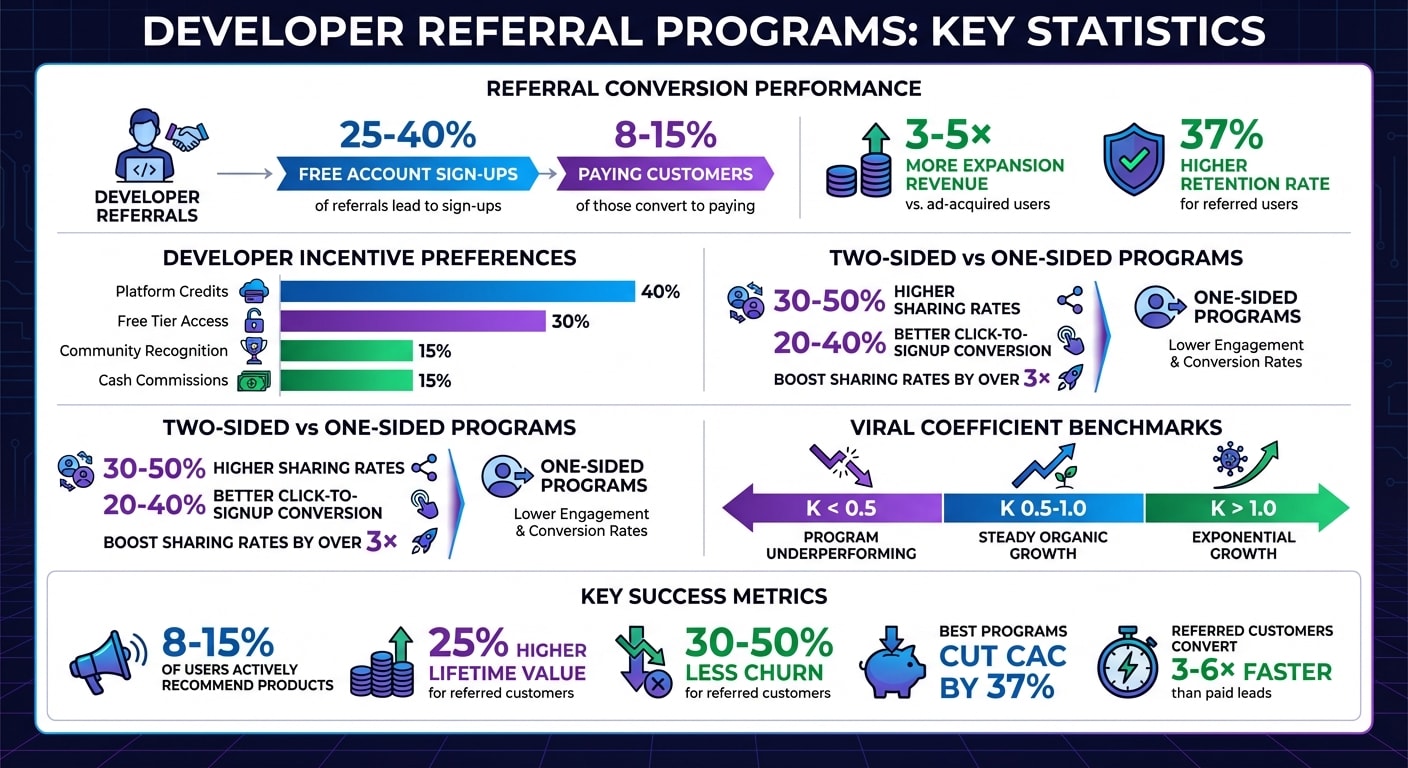
- Peer Influence Matters: Developers share tools naturally through code, tutorials, or forums. Around 25–40% of referrals lead to free sign-ups, and 8–15% of those convert to paying users.
- Better Retention & Revenue: Referred users generate 3–5× more revenue and have a 37% higher retention rate compared to those acquired through ads.
- Incentives That Work: Developers prefer platform credits (40%), free-tier access (30%), and professional perks like early beta access or premium features.
- Two-Sided Rewards Perform Best: Programs that reward both referrers and new users see up to 50% higher participation and better conversion rates.
- Timing is Key: Prompt referrals after milestones like project deployment or successful API calls to maximize engagement.
Referral programs thrive when they align with developers' workflows and offer meaningful rewards. By reducing friction and embedding sharing tools directly into products, companies can turn developers into advocates and scale growth efficiently.
Why Developers Make Strong Referral Sources
Developers bring a unique edge to referrals because they rely on firsthand experience to validate tools. Unlike casual consumers who might recommend a product based on marketing or brand loyalty, developers only advocate for tools they’ve tested and trust. Their referrals often come packed with extras like code samples, documentation links, or even live demos, making them far more actionable and credible.
Here’s the kicker: data shows that 25–40% of developer referrals lead to free account sign-ups, and 8–15% of those convert into paying customers. Even better, these referred users tend to generate 3–5× more expansion revenue compared to users acquired through traditional advertising. Why? Because these users arrive with built-in trust and confidence, making it easier to turn them into loyal, active customers. This underscores how trust and expertise make developer referrals incredibly effective, especially when paired with the influence of community networks.
"The developer experience is your referral program. Every frustrated developer who gives up during onboarding is a lost referral." - GrowSurf
Trust Networks in Developer Communities
Developer referrals thrive within tight-knit professional networks where reputation matters deeply. When a developer recommends a tool, they’re putting their credibility on the line. A solid recommendation can elevate their standing, while a poor one risks damaging it. This natural “quality control” means developers only share tools they genuinely believe will help their peers.
These networks amplify referrals through technical content like blog posts, GitHub repositories, and Stack Overflow answers. For instance, a tutorial showing how to deploy an app or a Stack Overflow answer linking to documentation can act as subtle, yet powerful, endorsements. These recommendations seamlessly integrate into daily workflows, making them feel organic and trustworthy.
Technical Communities and Open Source Contributions
Platforms like GitHub, Stack Overflow, Dev.to, and Hashnode act as hotspots for developer referrals. Every public repository, pull request, or shared code snippet doubles as a live product demo. When a developer uses your API in an open-source project, it’s like putting your tool on display for thousands of their peers to see - offering credibility that traditional ads just can’t match.
Take DigitalOcean, for example. They offered $200 in platform credits to new users through a referral program. Developers used these credits to build real applications, which they then showcased in blog posts and tutorials, creating an ongoing stream of referrals. Similarly, Twilio’s Champions program rewards top advocates with perks like early access and swag, ensuring their API becomes the go-to recommendation when developers share code or teach others.
This ripple effect is immense. Around 8–15% of developer tool users actively recommend products through content creation or code sharing. Each GitHub repository, tutorial, or conference talk becomes a lasting referral source, building a self-sustaining referral engine that grows alongside your user base. These organic endorsements highlight the unmatched scalability of developer referrals, making it clear why tailored incentives are critical to tapping into this audience.
Referral Incentives That Developers Actually Want
Generic rewards like Amazon gift cards often fall flat with developers. Instead, they value incentives that align with their professional lives and contribute to their goals. Offering tailored rewards that integrate seamlessly into their workflow can spark authentic word-of-mouth growth within developer communities. These incentives should deliver practical benefits, reduce barriers, or support causes developers care about.
The numbers tell the story: platform credits lead the pack in developer referral programs, accounting for 40%, followed by free tier access at 30%, community recognition at 15%, and cash commissions also at 15% . Developers lean toward rewards that help them build and experiment without upfront costs, rather than small monetary payouts that feel impersonal.
Credits and Usage-Based Rewards
Platform credits are a top choice because they allow developers to create functional, production-ready applications. By offering credits, companies encourage deeper engagement with their products, which naturally leads to more genuine referrals. For instance, DigitalOcean provides platform credits to both referrers and new users, incentivizing usage rather than just signups . This model feels more like a professional perk than a simple transaction.
The most effective programs tie rewards to meaningful milestones, such as reaching 1,000 API calls, rather than merely rewarding signups. This approach targets users who are more likely to stick around and fully explore the platform .
"A $10 discount might attract a trial user who churns. 1,000 free API calls can get a developer to actually ship something - and come back for more." - Kusum, Developer Marketing Specialist
Not only do credits encourage deeper product adoption, but they also come with minimal costs for the company while offering developers significant value .
In addition to credits, offering premium features or early beta access can further strengthen advocacy.
Premium Features and Early Beta Access
Unlocking premium features or granting early beta access appeals to developers' desire for exclusivity and influence. Perks like extended API limits, priority support, or beta testing opportunities - such as those offered by Twilio's Champions program - create a sense of privilege and connection with the product .
These rewards tap into intrinsic motivation. Developers who are passionate about a product often want to share it with others, driven by a sense of community rather than financial gain. Positioning these rewards as a gesture of appreciation, rather than payment, helps maintain genuine advocacy .
Beyond these professional perks, tangible rewards like swag or donations to open source projects can also build loyalty.
Swag and Open Source Project Donations
Donating to open source projects transforms referrals into acts of goodwill rather than profit-seeking . Allowing developers to choose from a list of tech-focused nonprofits or open source foundations adds a personal and meaningful touch to the reward.
"The ability to direct a $10 donation to a cause they care about can be more motivating because it adds a moral dimension to the referral act." - Refgrow
Hasura successfully combined open source contributions with referral rewards, creating a program that supported both personal and community advocacy . This strategy resonates because developers, who often work within open source ecosystems, appreciate rewards that align with their professional values and tools .
Branded swag can also be effective, especially when it ties into a sense of community identity. Exclusive merchandise from hackathons or "Champion" programs fosters a feeling of belonging and recognition within technical circles . However, it's crucial that the swag is both high-quality and practical - cheap or generic items can undermine the message and feel like an afterthought.
Referral Program Structures: Choosing What Works
Once you've nailed down your incentives, the next step is figuring out how to structure your referral program. This setup - deciding who gets rewarded and how those rewards scale - will play a huge role in determining whether your program drives steady, meaningful growth.
One-Sided vs. Two-Sided Rewards
One-sided programs reward only the person making the referral. They’re straightforward and cost-effective, but they can feel a bit transactional, which might make people less inclined to share.
Two-sided programs, on the other hand, reward both the referrer and the new user. This structure tends to perform much better, as it makes sharing feel more like giving a gift. In fact, two-sided programs can boost sharing rates by over 3x. They also typically see 30–50% higher sharing rates and 20–40% better click-to-signup conversion rates compared to one-sided options.
Take CollabTool, for example. In October 2025, this small project management SaaS company revamped their referral program. They went from a basic "invite friends" button to a two-sided model, offering one month free for the referrer and two weeks free for the referred user. The results? Over four months, their viral coefficient skyrocketed from 0.4 to 1.31. Referrals jumped from 12% to 68% of total signups, and their customer acquisition costs dropped by 74%.
"We launched a basic 'invite friends' button. Got 0.23 viral coefficient - basically nothing. Completely redesigned using... two-sided incentives, aha-moment timing, reduced sharing friction. Three months later we hit 1.31 viral coefficient." - Lisa Park, Head of Growth, CollabTool
For professional affiliates, though, one-sided commissions can still work well. Their referrals are often transactional by nature, so the lack of mutual rewards doesn’t hinder their effectiveness.
This natural balance between rewarding both sides sets the stage for more advanced program structures.
Tiered and Milestone-Based Rewards
Tiered programs take things up a notch by rewarding users as they hit specific referral milestones, like their 1st, 10th, or 25th referral. This approach keeps users engaged by giving them visible progress to work toward.
For instance, a program might offer:
- A $25 credit for the first referral
- Three months of Pro access after 10 referrals
- Exclusive "Champion" status at 25 referrals
Adding visual progress bars - like one that says, "3 of 5 referrals to unlock Pro features" - can make a big difference. These visual cues can increase the likelihood of users reaching their goals by 2.4x compared to simple text-based notifications.
Tiered programs tend to have the highest share rates, reaching up to 61%. However, they do come with a higher risk of fraud, as some users might try to game the system. To counter this, it’s important to tie rewards to meaningful actions, like completing onboarding or deploying a project.
The key is finding the right balance. Start with an easy milestone to encourage participation, then gradually increase rewards as users show genuine interest and advocacy. This way, you keep them motivated without making the goals feel out of reach.
Reducing Friction in the Referral Process
For referral programs to succeed, they need to fit naturally into developers' workflows. Once strong incentives and clear rewards are in place, the next step is to eliminate any unnecessary hurdles in the process.
API-Based Referral Links
Make referrals part of a developer's toolkit by embedding them directly into their code, dashboards, and tools. A REST API with a wide range of endpoints (e.g., 24+ endpoints) allows developers to create unique referral links and track activities like signups or API usage right from their applications .
To ensure accurate tracking, use server-side webhook tracking through payment platforms like Stripe or Paddle. This method avoids relying on client-side JavaScript, which is often blocked or stripped, and ensures consistent attribution. It also works across environments where traditional web analytics fall short, such as CLI tools, IDE extensions, or AI-focused development spaces using Model Context Protocol (MCP) servers .
Additionally, offer referral dashboards that developers can embed within their own apps using embed tokens. This way, users can sign up for referral programs and monitor their rewards without ever leaving the product .
"There are GrowSurf features that if we had to build in-house, we wouldn't have... it's just so easy to implement that makes everyone's lives easier." - Joshua Ip, Software Engineer at MainStreet
In-Product Prompts and Code Snippets
Trigger referral prompts at key moments, like when a developer completes a milestone such as a successful API call or project deployment . Embedding these prompts directly into the product ensures they are seen at the right time, without interrupting the workflow.
Instead of relying on intrusive pop-ups, integrate referral messages naturally. For instance, display a referral command in CLI output after a successful operation (e.g., api-tool --referral), include a message in SDK logs after a completed call, or add "Fork & Refer" badges to shared templates . Since technical content accounts for 50–70% of referrals , making it easy to share in these contexts is key.
Use language that resonates with developers. Skip generic marketing phrases like "Invite friends for $10!" and opt for copy that highlights value, such as "Earn 500 credits when your SDK powers a launch" . Provide simple, one-line code snippets for immediate use, and ensure embeddable widgets support dark mode for a seamless integration into developer dashboards .
Measuring Referral Program Performance
When your referral program is up and running, tracking the right metrics is what separates genuine growth from just handing out free credits. Two key metrics to focus on are your viral coefficient and referral conversion rate. These numbers help you understand whether users are actively bringing in others - and if those new users are sticking around.
Calculating the Viral Coefficient
The viral coefficient (K) is a way to measure how many new users each current user brings to your product. The formula is simple:
K = (% of users who send invites) × (average invites per sender) × (invite conversion rate) .
Here’s how to interpret the results:
- K > 1.0: You’re in exponential growth territory - each user is bringing in more than one new user.
- K between 0.5 and 1.0: You’re seeing steady organic growth, but you might still need other acquisition strategies.
- K < 0.5: Your referral program isn’t pulling its weight .
Take CollabTool as an example. They increased their viral coefficient from 0.4 to 1.31 in just three months. How? By introducing "aha-moment" timing, offering two-sided incentives (like a free month for the referrer and two weeks for the referred), and making the sharing process easier with a two-step flow. These changes led to 68% of their new signups coming from referrals, slashing customer acquisition costs (CAC) by 74% and driving a 273% increase in monthly recurring revenue (MRR) .
"Viral coefficient = (% of users who refer) × (avg invites sent) × (% of invites that convert). Get above 1.0 and growth becomes exponential." - Max Beech, Head of Content, Athenic
Another factor to consider is viral cycle time - the time it takes for a user to sign up, send a referral, and for that referral to convert. For instance, a product with K = 0.9 and a 3-day cycle time might initially grow faster than one with K = 1.2 and a 30-day cycle. However, the latter will eventually surpass it. For developer tools, aim to keep cycle times under 14 days by prompting referrals right after key moments, like a successful API call or project deployment .
| Scenario | % Users Who Send | Avg Invites | Invite Conversion | Viral Coefficient (K) |
|---|---|---|---|---|
| Poor | 10% | 5 | 10% | 0.05 |
| Average | 20% | 6 | 12% | 0.144 |
| Good | 30% | 8 | 15% | 0.360 |
| Viral | 50% | 12 | 18% | 1.080 |
While K measures growth potential, it’s equally important to track how well referrals actually convert.
Tracking Referral Conversion Rates
The referral conversion rate tells you how effective your program is at turning referred leads into active users or paying customers. For developer tools, this often involves two steps:
- Conversion to a free account (usually 25% to 40%).
- Conversion to a paid tier (typically 8% to 15%) .
A critical metric here is "Activated from Referrals", which tracks how many invitees hit meaningful usage milestones - like making an API call or deploying a project - rather than just signing up . After all, a user who creates an account but never engages with your product isn’t a true conversion.
Referred customers tend to bring more value over time. On average, they have a 25% higher lifetime value and churn 30% to 50% less than customers acquired through paid channels . This is often due to a "trust transfer" effect, where the referred user feels more confident in the product. For example, DigitalOcean’s $200 credit offer for 60 days gives developers enough time to build a production-level project, increasing the likelihood of long-term adoption .
Finally, track CAC savings by comparing the cost of acquiring customers through paid ads versus referrals. The best referral programs can cut CAC by 37%, with referred customers converting 3 to 6 times faster than paid leads. High-performing SaaS programs also report 37% higher retention rates and 25% larger deal sizes for referred customers .
Case Studies: Developer Referral Programs That Worked
These examples highlight different strategies that aligned incentives with what developers value most.
Dropbox: Storage-Based Incentives
Dropbox kept things simple with a two-sided incentive program. Both the referrer and the invitee earned 500 MB of permanent storage for Basic accounts (and 1 GB for Plus accounts) . This approach not only created mutual benefits but also led to 35% of daily signups at its peak, with a viral coefficient of 0.35 .
The program made inviting others easy. Users could sync their Gmail, AOL, or Yahoo contacts to send bulk invites . A real-time dashboard allowed users to track referral activity, including signups and app installations, which appealed to developers' preference for data and transparency .
"Instead of 'Invite your friends,' Dropbox framed the referral as 'Get more space.' This simple framing shift demonstrates why copywriting is one of the top marketing skills - context truly beats content." - Dimitris Loukas, Viral Loops
The results were impressive: Dropbox slashed its customer acquisition costs by 60% compared to Google AdWords, where costs ranged from $233–$388 per customer for a $99/year product . Even better, referred customers showed 18% higher retention and spent 25% more on average than those acquired through other methods .
While Dropbox focused on tangible storage rewards, Notion took a different path, emphasizing collaboration.
Notion: Collaboration as a Referral Driver
Notion built its referral program around a collaboration-centric ecosystem, creating a network of over 1,000 partners. These partners are divided into categories like Technology Partners (for integrations), Solutions Partners (for consulting), Startup Partners (for network discounts), and Builders (for creators and founders) .
For developers working on integrations, Notion runs private beta programs. These include dedicated teamspaces with onboarding pages, timelines, and feedback trackers, giving developers a firsthand experience of the platform's capabilities .
The affiliate program offers generous rewards: up to $50 per activated sign-up and 20% of year-one revenue for each referral . Startup partners can provide their networks with 6 months of Notion Business (including Notion AI) for free. Additionally, creators with over 10,000 cumulative followers may qualify for up to 12 months free of Notion's Plus or Business plans .
"I love sharing the tools I build inside of Notion. And Notion's affiliate program lets me get paid doing the things I already wanted to do." - Thomas Frank, Template Creator and Notion Affiliate
Meanwhile, DigitalOcean took a developer-focused approach, offering credit rewards that encouraged deeper engagement with its platform.
DigitalOcean: Credit Rewards for Developers
DigitalOcean’s referral program offers a "Give $200, Get $25" model tailored to developers' workflows . New users receive $200 in credits valid for 60 days, while referrers earn $25 after the new user spends $25 of their own money .
The $200 credit gives developers enough time to build and deploy production-ready applications, encouraging long-term platform adoption . Referrers only earn rewards after the referred user reaches the $25 billing milestone, ensuring that incentives go to active, high-quality users .
To make sharing easy, DigitalOcean provides pre-made HTML and Markdown badges that developers can embed in blog posts, tutorials, or GitHub repositories . The program also caters to specific groups: verified students through GitHub Education receive $200 in credit valid for one year , and open-source projects can qualify for grants ranging from $60 to $20,000 annually, depending on GitHub stars and project impact .
Conclusion
Developer referral programs thrive when they align with how developers naturally share tools - through technical content, peer recommendations, and hands-on experiences. The real foundation lies not just in the incentives but in the overall developer experience. Features like high-quality documentation, streamlined onboarding, and a product that genuinely addresses developer needs create the perfect environment for organic advocacy. When these elements are in place, referral mechanics can deliver even greater results.
The mechanics themselves play a key role. Two-sided incentives make referrals feel more like mutual benefits rather than a sales pitch, while timing the referral ask at the "aha moment" - right after a developer deploys their first project or achieves an important milestone - can increase share rates by 47% compared to generic prompts .
Reducing friction is critical. Features like one-click sharing, contact imports, and API-based referral links make it easier for developers to share without disrupting their workflow. For example, in October 2025, CollabTool reduced their signup fields from 8 to 3, introduced "aha-moment" timing, and implemented two-sided incentives. The result? Over three months, their viral coefficient jumped from 0.4 to 1.31, with referrals driving 68% of total signups .
To assess your program's success, track key metrics like the viral coefficient (aim for above 1.0 to ensure exponential growth), cycle time (keep it under 14 days from signup to referral to conversion), and referral conversion rate. These indicators provide actionable insights to refine both your referral mechanics and overall growth strategy .
For even greater impact, combine your referral program with targeted advertising on daily.dev, where over 1 million developers already engage with technical content. By using precise targeting - based on seniority, programming languages, and tools - you can reach developers most likely to refer others. This dual approach, blending a strong referral program with strategic ad placements, taps into both organic advocacy and targeted outreach, driving growth far beyond the limits of a single channel.
FAQs
How do I prevent referral fraud?
To keep referral fraud at bay, start by establishing clear terms and conditions for your program. This ensures participants understand the rules and consequences of misuse. Set limits to prevent exploitation, such as capping the number of referrals per user or requiring specific actions to qualify for rewards.
Leverage automated fraud detection tools to identify red flags, like multiple accounts linked to the same user. Incorporate identity verification and link analysis to spot patterns that could indicate suspicious behavior.
Focus your program on rewarding meaningful actions - such as completed purchases or verified sign-ups - rather than easily manipulated activities. Finally, make it a habit to monitor for unusual behavior regularly. Keeping a close eye on your program helps you catch and address abuse before it escalates.
What’s the best trigger for asking developers to share?
The best moment to encourage developers to share your product is right after their "aha moment" - that instant when they truly grasp its value. Why? Because this is when their excitement and engagement are at their highest. In fact, timing your ask during this peak can boost share rates by 47%.
How do I track referrals across API, CLI, and billing?
To monitor referrals across API, CLI, and billing processes, consider using server-side conversion tracking with webhook-based solutions. Tools like Refgrow provide features to manage affiliates and track conversions by integrating webhooks with payment systems such as Stripe or Paddle. This method connects referral events to unique user identifiers, allowing precise tracking across API interactions, CLI commands, and billing operations. An API-first design also enables tailored integrations, making data consolidation more efficient.