

DevRel (Developer Relations) is more than just building connections with developers - it's a crucial driver for business growth, especially for companies targeting a technical audience. Traditional marketing methods like ads and cold emails often fail to engage developers. Instead, DevRel focuses on creating trust through technical content, community engagement, and hands-on support.
Key Takeaways:
- What DevRel Does: It bridges developers' needs with your product team while providing resources like documentation, SDKs, and tutorials.
- Why It Works: Developers value peer recommendations, strong documentation, and real-time support over flashy promotions.
- Business Impact: DevRel helps convert developers into product advocates, reduces onboarding friction, and boosts long-term adoption.
- Costs and ROI: Hiring a DevRel pro costs $204K–$391K/year, but ROI grows over time, typically showing results within 12–24 months.
- Metrics to Track: Focus on signups, time-to-value (e.g., "Hello World" in under 15 minutes), community engagement, and revenue influence.
DevRel isn't just about promoting tools - it’s about empowering developers and aligning their success with your company’s growth. By combining technical expertise with community-building efforts, DevRel can transform developers into key decision-makers who champion your product internally.
What Developer Relations Actually Is
Defining Developer Relations
Some marketing leaders mistakenly equate Developer Relations (DevRel) with "developer evangelism" - essentially someone giving talks and posting about your product. But DevRel is far more nuanced than that.
At its core, DevRel is a strategic discipline grounded in four key areas: developer advocacy (acting as a bridge between your company and developers), developer marketing (reaching the right technical audience), developer enablement (providing tools like documentation, SDKs, and tutorials), and developer community (fostering peer-to-peer learning and support) . Unlike the one-way communication of traditional evangelism, DevRel thrives on a two-way feedback loop .
In practice, developer advocates serve as the external face of your company, helping developers succeed with your product while also gathering feedback to inform internal teams . Take Snap Inc.'s Camera Kit DevRel team, for example. Between 2021 and 2024, they analyzed how developers were using their tools and discovered that education - not gaming or retail - was emerging as the dominant use case. This insight directly influenced their product strategy .
DevRel acts as the glue connecting developers with internal teams, ensuring that products are built with developers' needs in mind rather than just being marketed to them. Consider MongoDB: it gained traction against established relational databases not through conventional sales tactics but by building meaningful relationships with developers . This highlights why developers often resist traditional marketing methods.
Why Developers Reject Traditional Marketing
Developers have an uncanny ability to detect marketing fluff - they can spot it a mile away . Ads, cold emails, and generic promotional content are often ignored because developers prioritize tools that demonstrate technical depth, solve real problems, and provide tangible value. According to the 2024 and 2025 Stack Overflow Developer Surveys, developers primarily discover and evaluate tools through documentation, community spaces, and peer recommendations .
For instance, when a developer advocate helps troubleshoot a late-night integration issue on Discord, that personal interaction fosters trust. Compare that to a generic email promising to "transform your workflow" - it’s easy to see why the latter falls flat.
DevRel’s independence from traditional marketing is crucial for building trust. As Angie Jones aptly pointed out, a developer advocate risks losing credibility if they’re seen as merely executing marketing directives . By focusing on value co-creation, DevRel shifts the narrative. This involves "value-in-use" (helping developers succeed with the product) and "co-production" (letting the community shape the ecosystem through feedback). Companies like Stripe have mastered this approach, growing from a $5 billion valuation to $95 billion by prioritizing developers' needs. For Stripe, DevRel wasn’t about pushing products - it was about empowering the people who make technical decisions .
This trust-driven approach positions DevRel as more than just a support function - it becomes a key driver of growth and success.
DevRel as a Growth Engine
Creating Awareness Through Technical Content
DevRel plays a vital role in reaching developers right when they’re coding. Troy Blanchard, Senior Manager at Twilio, summed up their strategy:
"I want people to see Twilio when they are in the act of building something with code" .
This approach revolves around providing practical resources like code samples, documentation, and tutorials that address real-world challenges. Twilio’s success highlights the impact of this method. By strategically distributing content on platforms like Stack Overflow, they achieved a tenfold increase in monthly readership and significantly boosted traffic to their technical assets - doubling or even tripling it .
The key to this success is visibility in developer hubs like GitHub, Stack Overflow, and other technical forums. Instead of relying on generic visuals, landing pages should showcase clear, actionable code examples and a value proposition that’s immediately graspable within a single scroll . This kind of focused, use-case-driven content not only grabs attention but also lays the groundwork for building trust - an essential step toward long-term adoption.
Building Trust Through Credibility
Awareness alone isn’t enough; trust is what turns interest into action. Chris Reddington, a DevRel strategist, captured this dynamic perfectly:
"DevRel advocates in both directions: outward to the community, inward to the product and wider organisation. Teams that earn trust become genuinely influential. Teams that feel like 'promotion in a hoodie' risk losing it" .
This two-way advocacy strengthens credibility by ensuring developer needs are represented within the organization. At the same time, it makes developers more open to exploring your product as a potential solution. However, building this trust doesn’t happen overnight - it typically takes 12 to 24 months to see a meaningful return on investment . But once established, trust becomes a powerful advantage. From there, the focus shifts to smoothing out the onboarding process and accelerating community growth.
Driving Adoption and Growing Communities
With trust in place, the next step is to make adoption as seamless as possible. A critical benchmark here is enabling developers to achieve a functional result in under 15 minutes . Reducing Time-to-Value (TTV) by 30% has been shown to improve conversion rates and contribute directly to revenue growth .
For example, Snap Inc. adjusted its product strategy based on insights from its community-driven support, leading to a notable reduction in support ticket volume .
Active communities also play a pivotal role in driving adoption. DevRel teams contribute to pipeline growth by equipping internal sales teams and solution architects with a deep understanding of the platform . Dave Neary from Ampere Computing explained his approach:
"My responsibility as developer relations is: I want to ensure that you have awareness of what our product or project can do for you so that you are happy using it" .
This blend of knowledge-sharing and user satisfaction creates a ripple effect, driving broader adoption, community expansion, and ultimately, pipeline success.
The DevRel Tech Stack
Technical Content and Developer Storytelling
DevRel teams excel when they focus on creating code-first resources that directly address developers' challenges. This isn't about flashy marketing - it’s about delivering practical solutions that save time. Troy Blanchard from Twilio summed it up perfectly:
"What will move the needle is the code, the stuff we've already created. If you save somebody a dozen hours of development time... now you have their attention" .
Top-performing teams dedicate about 50% of their efforts to producing technical content like tutorials, migration guides, and documentation. Why? Because 63% of developers spend over 30 minutes daily searching for solutions . A great example of this is Twilio’s August 2021 initiative, where they shared technical documentation and video tutorials on Stack Overflow. The result? A notable boost in traffic .
But creating content is just one piece of the puzzle. Engaging directly with the developer community is just as critical.
Community Management and Developer Engagement
Community management transforms casual interest into genuine advocacy, which directly drives growth. Platforms like Discord, Slack, and GitHub Discussions serve as hubs where developers can get real-time support, validate their implementation strategies, and move faster from experimentation to deployment . Snap Inc. offers a great case study here: by introducing community forums and office hours, they managed to deflect 85% of developer support tickets. This not only freed up valuable resources but also provided insights to refine their products .
Successful DevRel teams allocate around 30% of their time to advocacy and engagement efforts . As one DevRel expert put it:
"If you can't draw a line from your work to business outcomes, you don't have a function - you have a hobby." - Built for Devs
Coupled with community engagement, open source contributions and conference participation are key to building trust and credibility.
Open Source Contributions and Conference Speaking
Contributing to open source projects and participating in conferences gives DevRel teams the credibility they need to win over developers. Developers tend to be cautious about new tools, so seeing a team actively involved in projects they already trust - or hearing about a product at a respected conference - can be the validation they need.
Twilio’s strategy highlights how to do this effectively. They built a team of 40 to 50 Developer Evangelists, prioritizing technical skills and determination over prior DevRel experience . This team started small, testing product pitches at local meetups with quick 5-minute demos. Feedback from these sessions helped them refine their approach before scaling up to larger, more prominent conferences . On average, DevRel teams dedicate about 10% of their time to organizing events .
This balanced approach ensures visibility while staying mindful of resources - a critical factor, considering that hiring a single DevRel professional costs between $204,000 and $391,000 annually .
Measuring DevRel Impact
::: @figure 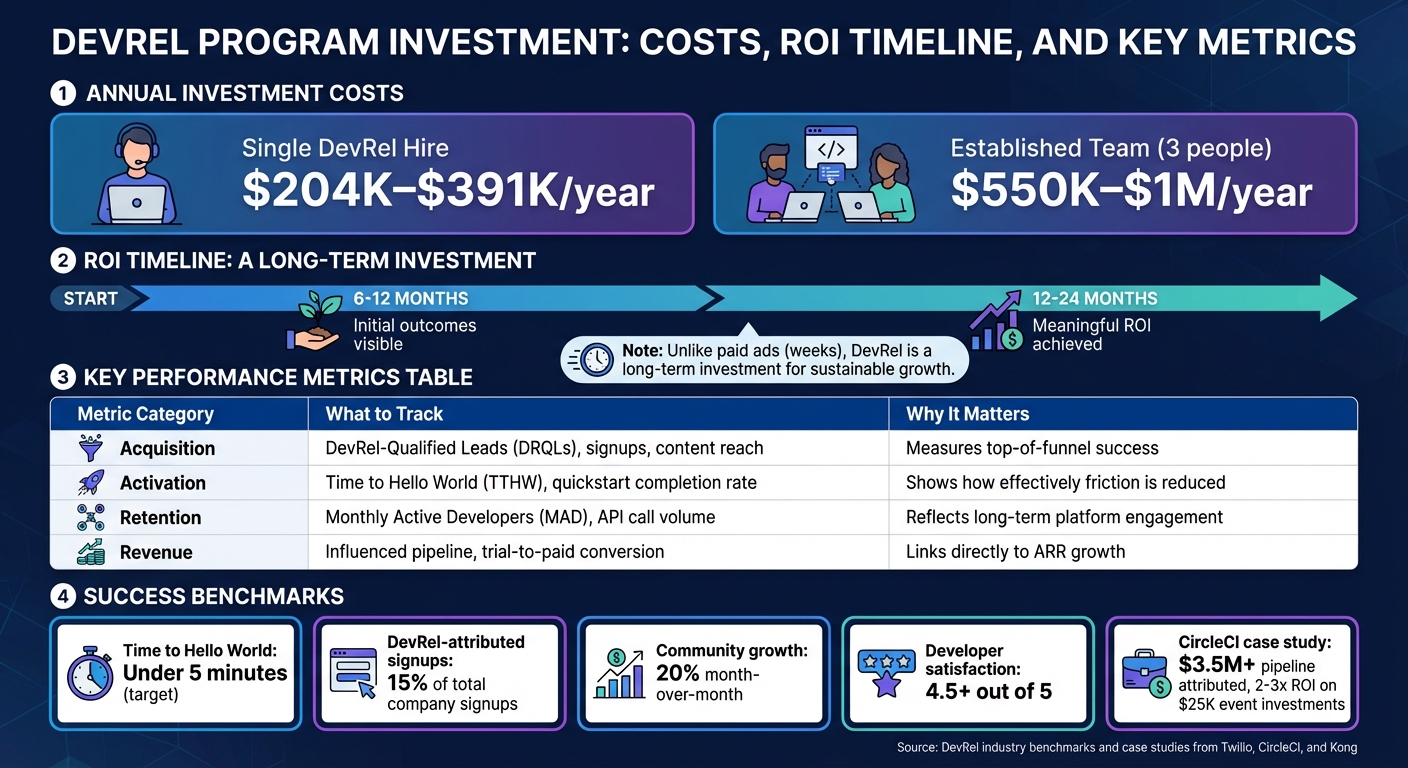 {DevRel Program Costs, ROI Timeline, and Key Performance Metrics}
Key DevRel Metrics
The toughest challenge in running a DevRel program isn’t creating content or building a community - it’s proving its value to the business. Marketing leaders want solid numbers, not just enthusiasm or anecdotes.
Start with a Keystone Metric - often account signups or registrations - and build a framework that ties DevRel activities directly to revenue outcomes .
Here’s what successful teams focus on:
| Metric Category | What to Track | Why It Matters |
|---|---|---|
| Acquisition | DevRel-Qualified Leads (DRQLs), signups, content reach | Measures top-of-funnel success |
| Activation | Time to Hello World (TTHW), quickstart completion rate | Shows how effectively friction is reduced |
| Retention | Monthly Active Developers (MAD), API call volume | Reflects long-term platform engagement |
| Revenue | Influenced pipeline, trial-to-paid conversion | Links directly to ARR growth |
One benchmark to aim for: help developers reach "Hello World" within 5 minutes . While many companies believe their TTHW is around 15 minutes, testing often shows that half of developers never even get there . This gap is where DevRel can make a measurable difference.
Additionally, aim for DevRel-attributed signups to account for 15% of total company signups . Track 20% month-over-month growth in community members and maintain a developer satisfaction score of 4.5 or higher out of 5 .
With these metrics in place, the next hurdle is addressing the challenges of attribution and the longer timelines for DevRel impact.
Attribution Challenges and Long-Term Impact
Measuring DevRel’s direct impact is tricky - and that’s perfectly okay. Unlike paid ads, which can show results in a few weeks, DevRel often takes 6–12 months to show initial outcomes and 12–24 months for meaningful ROI .
Instead of focusing on direct attribution, use an "Influenced" model. Track metrics like "influenced pipeline" and "influenced business" in your CRM to demonstrate value without undermining community trust . As Jeremy Meiss, former Director of DevRel at CircleCI, explains:
"When you put the sale first and the relationship with the developer audience and community second... you're going to see a negative impact on the trust... and that will negatively impact the bottom line for a very long time" .
Kong’s DevRel team serves as a great example. They track the entire developer journey - from signing up for meetups to earning Kong Academy certifications to becoming Kong Champions advocates. By uploading RSVP lists and contribution data into Salesforce, they can identify when open-source or free-tier users convert into paying customers, marking them as "influenced business" .
Reporting ROI to Leadership
Once you’ve defined metrics and tackled attribution, the next step is communicating DevRel’s business impact to leadership. Speak their language. Break down DevRel activities into four categories: Reach (brand visibility), Awareness (educational content consumption), Engagement (activations and interactions), and DevRel-Qualified Leads (DRQLs) .
Assign a monetary value to each category using your Keystone Metric. For example, if one registration is worth $100, you might value Awareness activities at $10 (10%), Engagement at $100 (100%), and a DRQL at $2,500 (25x the registration value) .
CircleCI’s team under Jeremy Meiss provides a clear example of this in action. Between 2020 and 2022, they used Salesforce and Marketo to track how events, workshops, and content contributed to the sales pipeline. By cleaning up event data and routing leads based on developer intent - asking questions like “Would you like our Sales team to contact you?” - they attributed over $3.5 million to the company’s pipeline. Investments of $25,000 in events often resulted in a 2x to 3x ROI within a 6–12 month sales cycle .
Before presenting to executives, always run a plausibility check. If DevRel claims to drive 50% of revenue but only receives 1% of the budget, your valuation model likely needs adjustment .
Building a DevRel Program from Scratch
When You Need DevRel
Developer Relations (DevRel) becomes crucial when your product involves complex integrations or has extended sales cycles that range from 6 to 12 months. In these cases, developers often need to evaluate, test, and secure internal approval before adopting your solution . If your API requires more than just a key and a few lines of code, or if developers need to weigh architectural trade-offs, DevRel can make or break your product's success.
Before jumping into DevRel, ensure you're addressing a real developer problem. A good way to validate this is by creating Technical Advisory Boards (TABs). These boards, consisting of 5–10 key practitioners, can offer honest feedback on your product and how it stacks up against competitors . Another useful approach is running Jobs-to-be-Done workshops to uncover what developers genuinely need to achieve. As Marcos from DevRel Bridge aptly puts it:
"Throwing money at DevRel without a strategy is like hiring a world-class chef and then being surprised when they can't work miracles in a kitchen with no ingredients." – Marcos, DevRel Bridge
Start with internal DevRel efforts. If your engineering team finds your tools frustrating - whether it's due to unclear documentation, long onboarding times, or cryptic error messages - external developers will likely feel the same way . Fix these issues internally first before focusing on growing your developer community.
Once you've confirmed the need for a DevRel program, the next step is to set clear, measurable goals to shape your strategy.
Setting Goals and Defining Success
Before diving into DevRel, pinpoint the business problem you're trying to solve. Are you losing developers during onboarding? Is there low awareness among your target audience? Or do you lack actionable product feedback? Each of these challenges requires a distinct strategy .
Focus on three key metrics to guide your efforts: increasing active users, reducing time-to-value, and measuring revenue influence . A good benchmark is ensuring developers can get a "working thing" up and running in under 15 minutes . Track the time it takes for new users to go from signing up to making their first successful API call - this will reveal how effective your onboarding process is.
Keep in mind that DevRel is a long-term game. It often takes 12 to 18 months to see meaningful results . Leadership needs to view this as a strategic investment, not a quick fix for hitting short-term goals. As one expert wisely cautions:
"If you can't draw a line from your work to business outcomes, you don't have a function - you have a hobby." – Built for Devs
With your goals in place, the next priority is building a team capable of executing your vision.
Hiring and Team Structure
Start by hiring a "player-coach" who can balance hands-on work with strategic planning. Ideally, this person spends about 70% of their time coding, writing, and speaking, and the remaining 30% on planning and strategy . They should be comfortable creating migration guides, delivering keynotes, and shipping sample code, all while maintaining technical credibility.
When Twilio built their DevRel team, they focused on four key traits rather than traditional résumé qualifications: technical confidence (knowing how to find answers), empathy (understanding developers' needs), hustle (spotting high-value opportunities), and resilience (gracefully handling setbacks like live demo failures) . Devin Rader, Twilio's former Director of Developer Evangelism, explained:
"We wanted to hire people who would be a smart person in the room, but didn't think of themselves as the smartest person in the room." – Devin Rader, Former Director of Developer Evangelism, Twilio
Interestingly, prior DevRel experience and social media following were not reliable indicators of success . Instead, Twilio used a live coding presentation - lasting 15 to 20 minutes on a non-company topic - to evaluate candidates' technical skills, storytelling abilities, and composure under pressure .
Budgeting for DevRel is another important consideration. A basic DevRel program with one hire typically costs between $204,000 and $391,000 annually. For a more established team of three, expect to spend between $550,000 and $1,000,000 per year .
Amplifying DevRel with Paid Channels
Using daily.dev for Developer Campaigns
Paid channels take DevRel content to the next level by expanding its reach far beyond what organic efforts can achieve. While organic strategies are great for building trust and authenticity, they often fall short when it comes to connecting with the millions of developers worldwide who might benefit from your product or service .
This is where daily.dev steps in. The platform offers access to over 1 million developers who actively engage with technical content. With ad placements like in-feed and post page ads, your content integrates seamlessly into a developer's daily reading routine. Even better, you can fine-tune your targeting based on factors like seniority, programming languages, and tools, ensuring that your message gets in front of the right developers while avoiding wasted impressions.
What sets paid campaigns apart is their ability to deliver measurable results - clicks, signups, and activations - that directly tie back to revenue. When DevRel is evaluated as a revenue-driving function, it opens the door to increased funding and resources . By combining this precise targeting with clear performance metrics, paid strategies complement your organic efforts and create a more balanced, impactful approach.
Combining Organic and Paid Strategies
Using daily.dev as a foundation, integrating organic and paid strategies can give your content both reach and resonance. A proven method is the "one for them, one for you" model: DevRel teams create valuable organic content, while marketing amplifies it through paid channels . For instance, a developer advocate might write a technical guide addressing a specific challenge, and marketing promotes it on daily.dev to connect with a larger audience of developers who align with your ideal customer profile.
Timing is crucial here. Launching organic content alongside a paid campaign builds momentum, as early readers provide validation while the paid push ensures it gains the visibility it deserves . Companies like Twilio and Stripe have shown that this blend of authentic DevRel content and paid amplification not only strengthens community trust but also delivers tangible business results.
Conclusion
Developer Relations (DevRel) isn’t just a "nice-to-have" - it’s a core revenue driver. Companies that excel with developers recognize DevRel as a two-way bridge: it advocates for developers within the organization while enabling their success outside of it . This creates a powerful feedback loop - better products fuel stronger developer communities, which then contribute to revenue growth. It’s a strategy that turns engagement into tangible business results.
Collaboration is key. DevRel teams must work hand-in-hand with marketing and product teams. By teaming up with marketing, DevRel can amplify genuine content through paid channels, such as daily.dev, combining trust with broader reach. On the product side, reducing time-to-value - a critical metric - directly boosts both conversion rates and retention .
The numbers support this approach. Companies that view DevRel as a long-term investment, rather than a quick fix, see measurable returns. However, achieving meaningful ROI usually requires patience - results often take 12 to 24 months to fully materialize .
What’s next? Define success in clear business terms, such as active users, time-to-value, and pipeline influence, then design your DevRel program around these goals. Focus on authentic engagement, but don’t hesitate to scale your efforts with targeted paid campaigns. With 27 million developers worldwide, the opportunity is massive . When trust and scale come together, DevRel transforms into a true engine for growth.
FAQs
How is DevRel different from developer marketing?
DevRel, or developer relations, stands apart from developer marketing in both scope and approach. While developer marketing zeroes in on educating developers, nurturing community, and encouraging product adoption, DevRel takes things a step further. It blends elements like community management, advocacy, content creation, event coordination, and gathering product feedback into its core activities.
What sets DevRel apart from traditional marketing is its focus on building genuine relationships and trust. It acts as a bridge between developers and products, prioritizing meaningful connections that encourage long-term engagement and growth.
What should I measure to prove DevRel impacts pipeline?
To show how DevRel contributes to the pipeline, keep an eye on key developer engagement metrics, such as API call frequency, GitHub activity, documentation views, SDK implementation rates, feature activation, and onboarding completion. Then, link these metrics to business outcomes like signups, activations, and expansion revenue. The goal is to clearly connect developer actions to measurable business growth, making the results easy to understand and impactful.
When should a company invest in a DevRel hire?
When a company aims to cultivate meaningful connections with developers, boost API usage, and align efforts with its broader growth objectives, it's time to consider hiring a Developer Relations (DevRel) professional. This role is particularly crucial for creating trust and collaboration, moving beyond the idea of developers as merely another target audience for marketing.