

Reaching developers online is tricky. Most use ad-blockers, avoid promotional content, and prefer niche platforms. To succeed, you need a data-driven approach that matches your budget and goals. Here’s a quick breakdown of the best channels:
- Paid Ads: Platforms like Google Ads, Reddit, and Carbon Ads let you target developers directly. Costs range from $2–$20 CPC for Google and $0.20–$1.50 CPC for Reddit. Use these for quick results.
- Organic Content: SEO and technical blogs build long-term trust. Focus on solving real problems with tutorials and precise language. For example, consistent blogging can grow traffic to 150,000+ monthly visitors in a year.
- Community Engagement: Join platforms like Discord, Slack, and GitHub. Contributing to open-source projects or answering Stack Overflow questions builds credibility.
- Social Media: Use platforms like Twitter/X, LinkedIn, and YouTube to amplify your reach. Show how your tool solves problems with visuals like code snippets or GIFs.
Key Tip: Developers hate lengthy forms and flashy ads. Focus on clear, actionable content and tools they can test directly.
Budget Breakdown:
- Low (<$500/month): Google Search, Reddit, GitHub Sponsors.
- Medium ($500–$5,000/month): EthicalAds, newsletters, targeted search.
- High (>$5,000/month): Stack Overflow ads, LinkedIn ABM, major newsletters.
Start with search ads to tap into demand, then build trust through blogs and community efforts. Use data to track performance and refine campaigns. Developers value authenticity, technical depth, and tools they can try without barriers.
Paid Channels: Get Immediate Developer Reach
Paid channels provide a fast track to reaching developers by targeting specific segments without waiting for organic growth. Many platforms now use allowlisting or unconventional ad formats to engage developers, even those who use ad-blockers. The trick lies in choosing platforms where developers are already active and tailoring campaigns to their position in the funnel. Each platform offers distinct benefits depending on your goals.
Google Ads is perfect for capturing bottom-of-funnel intent when developers are actively searching for solutions. Keywords related to developer tools generally have a CPC between $2 and $15, though competitive terms like "CI/CD" can go beyond $20. Optimized landing pages typically see conversion rates of 3–5%. Focus on branded, competitor, and high-intent keywords, and avoid gated content - developers are likely to bounce if faced with lengthy forms. Instead, direct them to documentation, sandboxes, or free-tier signups for better engagement.
Reddit Ads shine in top-to-mid funnel strategies, such as building community validation or launching products. With CPMs ranging from $0.50 to $3.50 and CPCs between $0.20 and $1.50 (minimum daily spend is about $5), Reddit's technical and authentic tone can drive strong engagement. Aim for campaigns that achieve an engagement rate (upvotes and comments) above 1%.
For top-of-funnel awareness, Carbon Ads is an excellent choice. These ads operate on a CPC model with a suggested starting budget of $5,000–$10,000 spread over 60–90 days. A single native ad is placed on select publisher sites like Bootstrap or Laravel, making it ideal for reaching front-end and full-stack developers. With contextual targeting and ad-blocker allowlisting, Carbon Ads report click-through rates up to 6.4× higher than industry averages for display ads. To maintain audience interest, update creative assets every 3–4 weeks.
Adding to the mix, daily.dev Ads is designed for mid-funnel impact, driving signups and building pipelines. The platform connects with 1,000,000 active developers through native placements in content feeds, post pages, and personalized digests. Its AI-driven contextual targeting allows you to focus on specific seniority levels, programming languages, and tools. This precision helps attract early adopters while optimizing for conversions. With real-time performance tracking and expert creative support, daily.dev Ads can significantly boost mid-funnel outcomes.
Organic Channels: Build Long-Term Developer Engagement
Organic channels might take longer to show results compared to paid advertising, but they are key to building lasting trust and driving consistent traffic. The secret lies in creating content that tackles real technical challenges. Developers are more likely to share resources that genuinely improve productivity rather than promotional content. This approach naturally ties into efforts like improving SEO, technical blogging, and engaging on platforms like Stack Overflow.
SEO for developers requires a more tailored strategy. Traditional keyword tools often overlook valuable technical terms because developers represent a smaller sample size in many datasets . To bridge this gap, analyzing GitHub issues, Stack Overflow questions, and support tickets can reveal what developers are actually searching for. While creating technical content can cost 2–3 times more than standard marketing pieces, the payoff is significant. With consistent publishing, it’s possible to attract 10,000 monthly visitors within three months, grow to 50,000 in six months, and exceed 150,000 in a year . For instance, LambdaTest publishes five posts per week and refreshes content regularly to ensure tutorials stay relevant, helping them achieve over 1,000,000 monthly visitors .
Beyond SEO, technical blogging offers a way to deepen engagement by focusing on broader industry challenges rather than just product features.
"Your product is this little thing... if you zoom out and look at the larger context, that's the number one thing I think people miss."
A great example is Earthly.dev, which published a detailed tutorial on AWK, a Unix text-processing tool. This post attracted 60,000 visitors from Hacker News by addressing a topic with high community interest but limited quality resources . Successful technical blogs should include code examples and use precise language, avoiding generic marketing language that developers tend to dismiss . Another example is ContainIQ, which published 225 technical articles over 14 months, reaching over 200,000 monthly visitors before being acquired .
Stack Overflow provides another powerful avenue for engaging developers by addressing their technical questions directly. Optimizing profiles and linking to helpful resources on Stack Overflow allows companies to connect with developers seeking verified, human-curated solutions. The platform remains vital, with many developers relying on it for reliable answers - especially as 35% of visits now focus on fixing problems caused by AI-generated code . Trust in AI tools is declining, with only 29% of developers expecting them to be accurate by 2026, down from 40% in 2024 . Companies like Uber have even created internal Stack Overflow instances to manage institutional knowledge, which also supports AI assistants by providing traceable and accurate answers . Developers particularly value solutions that address architectural fundamentals and debug AI-specific issues, where automated tools often fall short .
Community Channels: Connect with Developers Directly
Engaging with developers through community platforms isn't just about visibility - it's about building trust. By participating authentically in these spaces, your brand can gain credibility that resonates far beyond the immediate community . This foundation of trust can later amplify your reach on broader social platforms.
Discord has emerged as a popular gathering place for developer communities, with servers often centered on specific technologies, frameworks, or projects. A great example is Authentik Security, which uses its Discord #beta-testers channel to gather user feedback and improve its product cycles . The key to success here? Focus on addressing specific technical challenges - like debugging flaky pipelines - rather than promoting product features. Developers are quick to spot (and dismiss) anything that feels like a sales pitch, so meaningful, problem-focused engagement is essential .
Slack, on the other hand, demands a more sustained and personalized approach. Developers value unscripted and knowledgeable responses, which often feel like genuine endorsements rather than marketing attempts .
Open source contributions offer another powerful way to build credibility. By contributing to open source projects, your brand demonstrates its technical expertise and commitment to the community. In 2022 alone, developers launched 52 million GitHub projects and made over 413 million contributions . If you're just getting started, non-code contributions like improving documentation or submitting bug reports can be a great way to build trust before diving deeper . A notable example is Richard Urwin’s color filters for Wireshark, which began as a personal project but ended up resonating with a much larger audience .
"Status is delicately dependent on the critical judgment of peers." – Eric Raymond, Author of The Cathedral and the Bazaar
While the path from community engagement to product adoption may not be direct, it’s incredibly effective. Consistent reliability and a positive presence can establish a reputation that outshines even the most impressive one-off contributions . Over time, this reputation encourages developers to trust your expertise and consider your product when they face challenges it can solve.
Social Channels: Amplify Your Developer Reach
Once you've established trust through organic and community channels, it's time to expand your reach on social platforms. While developers typically spend most of their time in tools like IDEs, documentation, or terminals, they do occasionally turn to platforms like Twitter/X, LinkedIn, or YouTube. However, their focus tends to be on solving specific problems rather than engaging with generic product promotions .
The trick is to show instead of just telling. Visuals like code snippets, terminal screenshots, or GIFs of your product in action can perform up to three times better than lengthy text . Instead of calling your tool "game-changing", demonstrate its value with clear examples, such as "Terraform provider available, 5‑minute setup", or a short snippet solving a real-world issue . Let’s break down how to make the most of these platforms.
Twitter/X
Twitter/X thrives on authenticity and problem-solving. Rather than pushing your product upfront, start with the issue developers face. For example, a post like "Tired of debugging flaky CI pipelines?" followed by a quick demo or GIF can resonate far better than a direct feature announcement. Developers appreciate straightforwardness and technical clarity, so steer clear of overly polished marketing language.
If you're running ad campaigns, keep in mind that creative fatigue tends to set in after 3–4 weeks. To maintain performance, rotate your ad creatives regularly and aim for engagement rates above 1% as a benchmark .
LinkedIn is a powerhouse for B2B developer outreach, offering precise targeting based on job titles. With around 30 million users globally holding software engineering or development roles, you can zero in on positions like DevOps Lead, CTO, or Software Engineer - perfect for account-based marketing efforts .
Sponsored content and document ads work particularly well on LinkedIn. Typical CPM rates range from $33 to $65, with CPC values between $5 and $8. For marketing qualified leads (MQLs), expect costs between $100 and $250 . To keep developers engaged, avoid gated content that requires form fills. Instead, direct them to open-access resources like documentation, interactive sandboxes, or free-tier offerings .
YouTube
YouTube can complement your blog and community efforts with video tutorials and walkthroughs. Developers, however, are notorious for skipping pre-roll ads, so consider partnering with established developer-focused channels for natural integrations. If you're producing your own content, structure it clearly: emphasize the benefit upfront, provide a concise explanation, and close with a specific call-to-action like "View docs" or "Try the playground."
Visual proof is key here. Include a brief GIF or code snippet in the video description to drive conversions more effectively than a long list of features.
Since developer journeys often involve multiple touchpoints, consider using post-signup surveys to ask, "How did you hear about us?" This can help uncover conversions from social channels that might not show up in traditional attribution models .
How to Choose the Right Channel: Budget and Goal Decision Tree
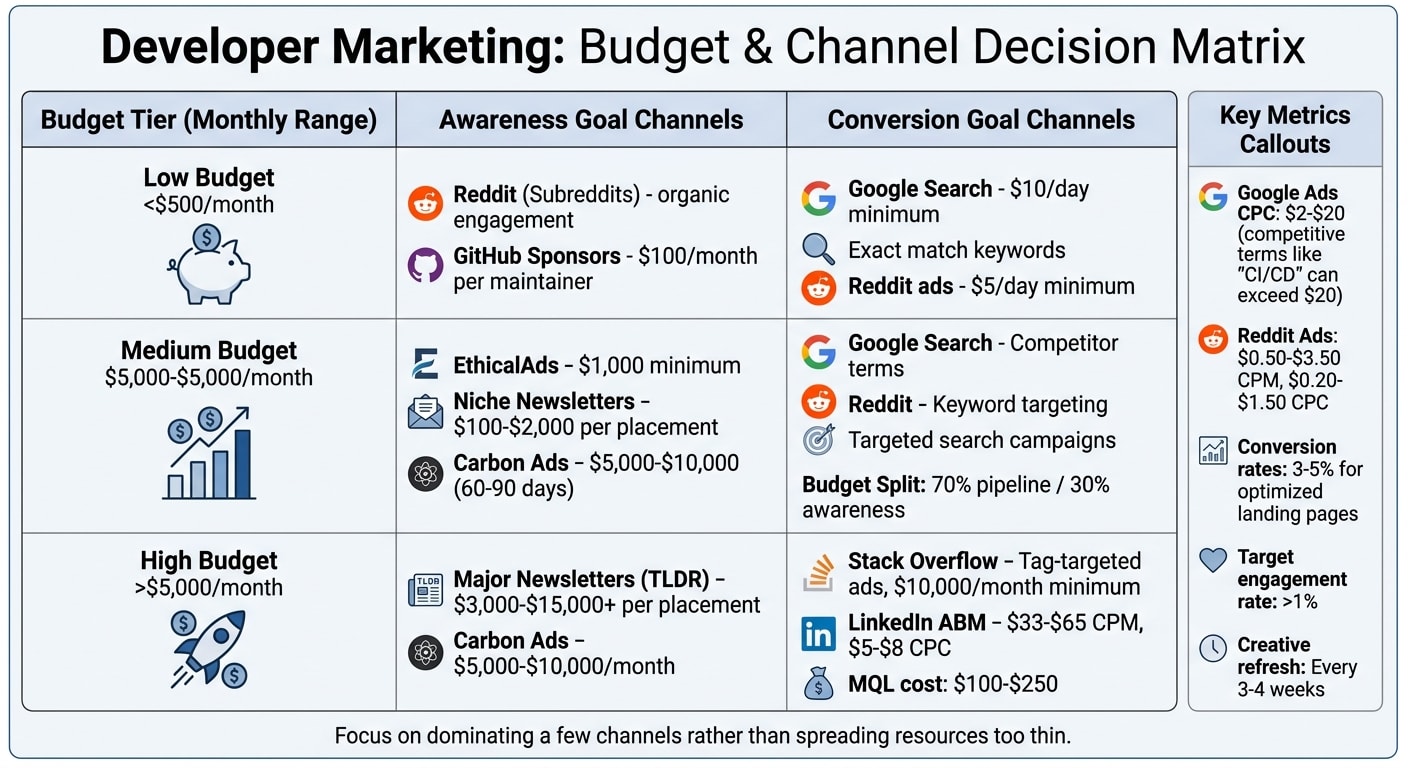
This decision tree is designed to help you align your marketing budget with the most effective channels based on your primary goal - whether you're aiming for awareness or conversions.
Start by identifying your monthly budget and your main objective. Here's how to match your resources to the right channels:
If your budget is under $500 per month, focus on tapping into existing demand. Platforms like Google Search (starting at $10 per day) and Reddit (starting at $5 per day) allow you to target developers actively searching for solutions . For awareness, GitHub Sponsors (starting at $100 per month per maintainer) is a great option, or you can engage organically in relevant subreddits where your audience already participates .
With a mid-range budget of $500 to $5,000 per month, you can broaden your reach with contextual networks and niche newsletters. To drive conversions, prioritize high-intent channels like targeted search campaigns. For awareness, EthicalAds (minimum $1,000) and mid-sized newsletters (ranging from $100 to $2,000 per placement) offer privacy-conscious exposure on technical sites . A good rule of thumb at this stage is to dedicate 70% of your budget to pipeline generation and 30% to brand awareness .
For budgets exceeding $5,000 per month, premium advertising opportunities become available. Channels like Stack Overflow's tag-targeted ads (minimum spend of $10,000 per month) and LinkedIn's account-based marketing tools (CPMs between $33 and $65) enable precise targeting by tech stack or job title . On the awareness side, consider Carbon Ads (recommended budgets between $5,000 and $10,000 per month) or major newsletters like TLDR, which range from $3,000 to $15,000+ per placement .
| Budget Tier | Awareness Goal | Conversion Goal |
|---|---|---|
| Low (<$500/mo) | Reddit (Subreddits), GitHub Sponsors | Google Search (Exact match keywords) |
| Medium ($500–$5,000/mo) | EthicalAds, Niche Newsletters, Carbon Ads | Google Search (Competitor terms), Reddit (Keyword targeting) |
| High (>$5,000/mo) | Major Newsletters (TLDR), Carbon Ads | Stack Overflow (Tag-targeted), LinkedIn (ABM) |
Conclusion
To effectively engage developers online, it's essential to align your budget with the platforms where they actively seek solutions. Paid options like Google Search and in-IDE ads are great for capturing developers with immediate intent, while organic efforts like technical blogs and contributions to Stack Overflow help establish long-term credibility. Social media, on the other hand, can amplify your message to a broader but relevant audience.
A winning strategy starts with capturing existing demand through search. From there, focus on mid-funnel engagement as developers weigh their options, and maintain awareness through newsletters and active participation in communities. As Idlen.io puts it:
"Reach in developer advertising isn't about total impressions - it's about impressions inside the workflow" .
This means prioritizing platforms developers already rely on - like IDEs, documentation hubs, or Stack Overflow - over more general social feeds. Such an approach allows for smarter, data-backed refinements over time.
Data-driven tactics are key to optimizing campaigns. Use UTM tags on every link to track performance, conduct post-signup surveys to uncover hidden signals, and run holdout tests to measure the true impact of each channel . Developers often block traditional ads, making multi-touch attribution critical. For instance, a developer might see an in-IDE ad, read about your tool in a newsletter, and only convert weeks later through a direct search.
Your budget should reflect your company’s growth stage and objectives. Pre-seed startups might focus on Google Search while experimenting with newsletters or Reddit. Series A companies can expand to channels like Stack Overflow and in-IDE placements. The key is to focus - dominating a few channels is often more effective than spreading resources too thin.
When it comes to content, prioritize what resonates with developers: code snippets, terminal screenshots, and interactive sandboxes. Avoid gating content behind lengthy forms, as this can drive away over 80% of your paid traffic . Developers value tools they can test directly, supported by peer reviews and technical depth, rather than flashy marketing . Rotating creative every 3–4 weeks also helps combat audience fatigue and keeps your campaigns fresh.
FAQs
Which channel should I start with to reach developers online?
The best way to begin is by tapping into developer communities and platforms where developers naturally spend their time. Places like Stack Overflow, Reddit, Discord, and niche forums are not only popular but also trusted by developers.
If you're looking for a more direct approach, try daily.dev Ads, which can connect you with over 1 million developers. On a tighter budget? Rely on organic channels such as SEO, technical blogs, and Q&A sites. These methods help you establish trust and improve visibility without breaking the bank.
How do I track conversions when developers use ad-blockers?
Tracking conversions when ad-blockers are in play can be tricky, but server-side tracking offers a solid workaround. Instead of relying on client-side scripts that ad-blockers often disrupt, this approach sends conversion data straight from your server to the advertising platform. Additionally, backend tracking solutions can independently log key actions, such as sales or sign-ups, without depending on scripts running in the user's browser. These methods help maintain accurate attribution and keep your data dependable, even when ad-blockers are involved.
What should my landing page include to convert developers?
To win over developers, your landing page needs to focus on clarity and technical accuracy. Developers value straightforward, no-nonsense content that helps them understand your product's value without unnecessary fluff. Here’s how to make your landing page resonate:
Focus on technical details: Clearly explain how your product addresses specific challenges developers face. Skip the buzzwords and get straight to the point with real-world examples or use cases.
Be transparent: Share what your product can and can’t do. Avoid exaggerated claims - developers appreciate honesty and will trust you more if you’re upfront about limitations.
Include clear CTAs: Make it easy for developers to try your product with free trials, live demos, or sandbox environments. Hands-on experience is often the best way to convert this audience.
Incorporate trust signals: Showcase testimonials, case studies, or logos of companies already using your product. These elements build credibility and show that others have benefited from your solution.
Provide resources: Link to documentation, tutorials, or guides that help developers dive deeper into your product. The more self-service resources you offer, the better.
By addressing these key areas, your landing page can become a powerful tool for converting developers into users.