

Want to grow your open source project? Here's the roadmap:
Open source projects thrive when they follow a structured growth path. The journey typically unfolds in four stages: Launch, Traction, Scale, and Monetization. Each stage has unique goals, challenges, and metrics to track. Skipping steps or monetizing too early often leads to failure.
Key Takeaways:
- Launch: Focus on visibility and reaching 1,000 stars by nailing your README and leveraging platforms like GitHub and Hacker News.
- Traction: Build an engaged contributor base by simplifying contributions and responding quickly to pull requests.
- Scale: Attract enterprise users by prioritizing security, compliance, and governance. Enterprise-ready features like SSO and RBAC are must-haves.
- Monetization: Convert adoption into revenue through models like Open Core or managed services. Metrics like Monthly Recurring Revenue (MRR) and free-to-paid conversion rates (1-5%) are critical.
The bottom line: Success comes from balancing community growth with enterprise needs, all while tracking the right metrics at every stage. Whether you're starting out or scaling up, this guide offers practical steps to move forward.
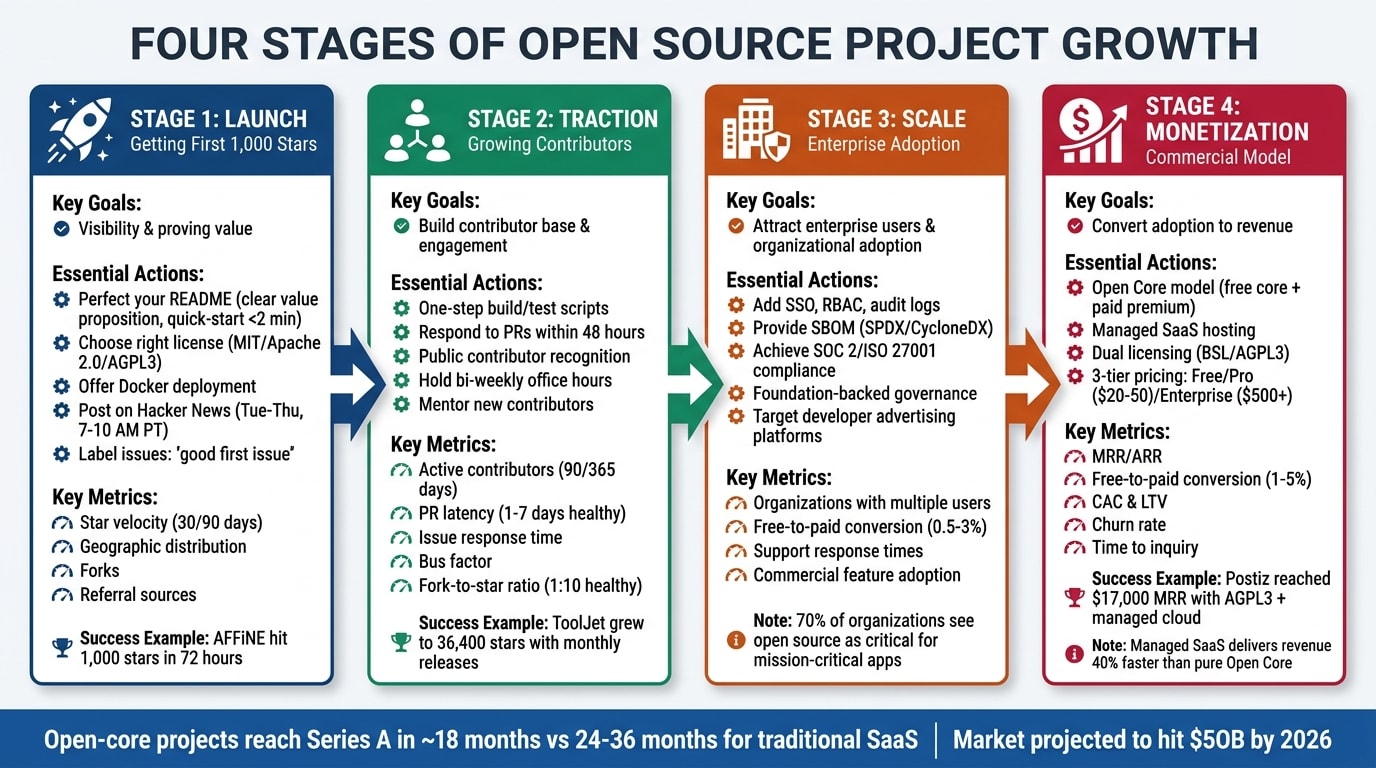
Stage 1: Launch - Getting Your First 1,000 Stars
The launch phase is all about proving that your project solves a real problem for developers. Growth rates may vary, but nailing the essentials and making a strong visibility push can help you gain traction quickly. For instance, AFFiNE hit 1,000 stars in just 72 hours back in August 2022 by using a well-coordinated, multi-channel launch strategy .
Setting Up the Basics
Your README is your first impression. It needs to clearly explain your project’s value in one sentence, include visual examples, and provide a quick-start guide that takes less than two minutes to follow. Beyond that, make sure your repository includes key files like:
CONTRIBUTING.mdfor setup and style guidelines.CODE_OF_CONDUCT.mdto set community expectations.- A license file (MIT, Apache 2.0, or AGPL3 depending on your goals).
Choosing the right license matters. MIT encourages widespread adoption but allows commercial resale. Apache 2.0 adds patent protections often required by enterprises. AGPL3 prevents competitors from forking your code and offering it as a hosted service without giving back . Nevo, the founder of Postiz, scaled their project to $17,000 MRR and 5 million downloads by using an open core model with strategic licensing .
"GitHub is your storefront, README is your landing page, community is your sales team." - Gingiris, Ex-COO of AFFiNE
Make deployment easy by offering a Docker image, allowing users to run your project locally with a single command . ToolJet, for example, saw their stars jump from 10 to 2,000 in just three days by emphasizing the technical advantages of their project and enabling quick testing .
Once your repository is ready, it’s time to focus on getting noticed.
Getting Initial Visibility
Timing matters when posting on platforms like Hacker News. Aim for Tuesdays through Thursdays between 7:00–10:00 AM PT to maximize exposure. A successful post can drive 10,000 to 100,000+ visits to your repository . For example, Eason, the founder of Usertour, built in public on Reddit communities like /r/selfhosted and /r/webdev, which helped the project reach 1,200 stars in three months . This kind of engagement builds not only initial visibility but also a foundation for organic community growth.
Coordinating launch announcements across multiple channels on the same day can boost your chances of appearing on GitHub’s trending list . Stay active during the first 24–48 hours after your launch to keep the momentum going .
Labeling issues with tags like "good first issue" or "help wanted" and providing simple, well-defined tasks can turn curious visitors into contributors . AFFiNE maintained its community engagement by using this approach, appearing on GitHub Trending 28 times between August and December 2022 .
Metrics to Track During Launch
With your repository set up and visibility growing, keep an eye on metrics that show real progress. Key indicators include:
- Star velocity: Track growth over 30 and 90 days to distinguish between short-term spikes and sustained interest .
- Geographic distribution: A balanced spread of stars (e.g., across regions like the US, Europe, and Asia) suggests genuine market interest. AFFiNE’s early distribution - 19% China, 20% US, and 10–15% Europe - helped validate their growth .
- Forks: These often signal deeper interest, as developers fork repositories to experiment with the code .
- Referral sources: Identify where your traffic is coming from to separate casual visitors from potential long-term users.
Analyzing what other repositories your stargazers follow can also help refine your positioning .
"Stars are attention, not proof of product-market fit." - Jordan Vale, Senior SEO Content Strategist
Finally, don’t confuse star counts with actual user engagement. If stars are climbing but demo requests or trial signups aren’t, your messaging might be attracting attention but not driving real action. Zevi Reinitz, Preevy’s marketing lead, used this approach to grow their project to 1,500 stars in 12 weeks - starting with 100 stars from personal networks and then carefully tracking organic growth through content distribution .
Stage 2: Traction - Growing Your Contributor Base
After a successful launch, the next step is turning early interest into a solid contributor base. This stage is all about creating a smooth path for developers to move from casual involvement to becoming regular contributors. Once your project hits 1,000 stars, the focus shifts to building a contributor funnel by removing barriers and encouraging participation.
Making It Easy to Contribute
Simplify the onboarding process with one-step build and test scripts, ideally using Docker. This ensures contributors can set up a complete development environment in less than two minutes.
Mark straightforward tasks with labels like "good first issue" to encourage newcomers. Your CONTRIBUTING.md file should act as a detailed guide, covering setup instructions, coding standards, and steps for submitting pull requests.
Quick responses are key. A Mozilla study found that code reviews completed within 48 hours significantly increased repeat contributions. Even a brief acknowledgment like "review pending" can boost morale. Treat early contributions as opportunities for mentorship, and prioritize merging submissions - even if minor fixes are needed later - over letting pull requests sit idle.
"By giving contributors a place to contribute with very low technical proficiency (documentation, web content markdown, etc), you can greatly reduce those concerns [of not fitting in]." - Mikeal Rogers
Automate where possible. Tools like Netlify or Vercel can generate previews for documentation pull requests, enabling non-technical contributors to verify their work. Ensure your continuous integration (CI) system is reliable; nothing frustrates contributors more than passing local tests only to fail due to unrelated issues in CI.
Once technical hurdles are addressed, the focus shifts to building a strong, engaged community.
Keeping Contributors Engaged
With the contribution process streamlined, the next goal is keeping contributors involved. Recognize their efforts by publicly listing contributors or transitioning to a GitHub Organization. Public acknowledgment fosters a sense of ownership and commitment to the project's success.
Regular feedback sessions can greatly enhance retention and align contributions with the project's goals. Fred Schott, co-creator of Astro, emphasized community building from the start by establishing clear contributor guidelines and a Code of Conduct. This early effort created a welcoming environment that encouraged long-term involvement.
"If you're dismissive of the problems people face, they'll leave. First impressions are important." - Fred Schott, Astro Co-creator
Some projects, like Kubernetes kops, hold bi-weekly office hours to help newcomers with pull requests and discuss features. These sessions give contributors direct access to support and foster a sense of inclusion.
Don’t fix every small bug yourself; instead, use these as opportunities to mentor contributors. Share ownership by documenting decisions, roadmaps, and meeting notes publicly, allowing more people to take part in shaping the project.
Metrics to Track During Traction
Tracking the right metrics helps you gauge progress and identify areas for improvement. Focus on long-term trends by monitoring active contributors over 90-day and 365-day periods. Contributor retention - how many people return after their first pull request - can reveal whether your project feels welcoming and accessible.
Other key metrics include pull request latency (time from submission to merge) and issue response time. Fast, predictable feedback keeps contributors engaged. Also, calculate your bus factor - the number of maintainers whose departure would stall the project - to ensure responsibilities are well-distributed.
| Metric | Healthy Signal | Warning Signal |
|---|---|---|
| Contributor Activity | Steady inflow of pull requests from multiple contributors | One maintainer dominates (>80% commits); few new contributors |
| PR Latency | Reviews and feedback within 1–7 days | Simple pull requests remain unaddressed for weeks |
| CI Health | Main branch stays green; critical paths are well-tested | Frequent build failures; ignored flaky pipelines |
| Issue Triage | Clear labels, priorities, and timely responses | Backlog grows with unresolved issues |
Pay attention to issue triage speed - how quickly bugs are labeled and prioritized - and monitor the ratio of issues closed versus opened to avoid an overwhelming backlog. A persistently failing main branch signals neglected maintenance, which can discourage contributors.
"The best projects treat contribution as a pipeline, not a surprise event." - OpenSources.live
Between 2021 and 2025, ToolJet demonstrated this approach by growing to 36,400 GitHub stars while maintaining a 1:10 fork-to-star ratio and adopting monthly release cycles. This steady growth reflected genuine engagement and helped build credibility with enterprise users.
Stage 3: Scale - Attracting Enterprise Users
Once you've built a strong contributor base, the next step is expanding your project's appeal to enterprise users. This stage is all about shifting your focus - from creating features developers love to addressing the organizational needs enterprises prioritize. While 70% of organizations see open source as critical for mission-critical applications , they require more than just solid code. Meeting these demands sets the stage for commercial success and allows for targeted advertising aimed at decision-makers.
What Enterprises Look For
When enterprises adopt open-source projects, they’re not just looking at functionality - they’re evaluating risk management . To meet their expectations, you’ll need to deliver on key areas like security, compliance, and governance. Features such as Single Sign-On (SSO), Role-Based Access Control (RBAC), and detailed audit logs are must-haves. As Matt Trifiro from COSSA explains:
"Functionality is free, but manageability is paid."
Security is a top priority. Enterprises expect transparency, which means providing a Software Bill of Materials (SBOM) in formats like SPDX or CycloneDX to help track dependencies and vulnerabilities . Tools like Software Composition Analysis (SCA) and Static Application Security Testing (SAST) should be integrated into your CI/CD pipeline . Additionally, having a clear vulnerability disclosure process can build trust with enterprise security teams.
Governance also plays a crucial role. Enterprises tend to prefer Foundation-backed or Corporate-backed governance models, as these offer clear accountability and long-term stability . Given that over 90% of proprietary software now incorporates open-source components, governance has become a major focus for C-suite executives . Aligning your project with compliance standards like SOC 2, ISO 27001, or NIST SP 800-53 can further establish credibility with legal and security teams .
There’s also a pivotal moment when free usage of your tool is no longer enough - when it becomes critical to a business and requires organizational controls . This is where your commercial offering comes in. Paid tiers should address enterprise needs like enhanced access controls, policy enforcement, and flexible deployment options .
Leveraging Developer Advertising Platforms
Once you’ve built enterprise-ready features, targeted advertising becomes essential for scaling. Organic growth through community contributions remains important, but strategic advertising can help enterprises discover your project more quickly. For projects generating $5M+ in annual recurring revenue, platforms like daily.dev Ads can be effective at surfacing leads within large organizations .
At this stage, your messaging should shift. Instead of focusing on technical "how-to" content, emphasize business benefits like security, compliance, and overall cost savings. Tailor your ads to decision-makers, highlighting the features that matter most to enterprises. Developer advertising platforms allow you to target senior developers and engineering leaders based on their roles, the tools they use, and even the programming languages they work with.
These platforms also help identify potential enterprise leads by combining community signals with repeated engagements . The success of these strategies can be measured through adoption metrics that show how well your advertising efforts are resonating with enterprise users.
Metrics to Monitor During the Scale Phase
At this point, your focus should shift to tracking organizational adoption. Key metrics include the number of organizations with multiple active users and repeated engagements from company domains. Conversion rates from free users to paid enterprise customers typically range between 0.5% and 3% .
It’s also important to monitor support response times. Enterprise prospects expect faster, more detailed replies than community users. Additionally, track the time it takes for enterprises to achieve value from self-hosted deployments, as many organizations with strict data residency requirements prefer on-premises solutions . Finally, measure the adoption of your commercial features. If features like SSO, RBAC, or audit logs aren’t being used, it might signal a mismatch between your offering and enterprise pain points.
"The open source product wins the developer. The commercial product wins the organization." - Peter Strauss, Author at GTM.NEWS
Balancing robust community engagement with systematic enterprise adoption is key to long-term success. The goal isn’t to choose between community and commercial priorities - it’s to create a system where both work together to drive growth.
Stage 4: Monetization - Building a Commercial Model
After attracting enterprise users, the next step is figuring out how to turn that interest into revenue. The key is choosing a monetization strategy that keeps the trust of your community while addressing the core challenges enterprises face. These challenges often revolve around reliability, security, and ensuring smooth operations.
Dual Licensing and Managed Services
A popular approach is the Open Core model, where the core product remains free and open-source under a permissive license (like MIT or Apache). However, advanced features - such as SSO, RBAC, and audit logs - are offered under a proprietary license. These premium features are tailored to solve organizational problems rather than individual developer needs.
Managed SaaS hosting is another effective strategy, often delivering revenue 40% faster than a pure Open Core model. By offering services like SRE, backups, and security patches for a subscription or usage-based fee, you provide convenience and peace of mind. A great example is MongoDB Atlas, which generates over 60% of MongoDB's revenue .
Dual licensing also helps protect your work from being forked and monetized by cloud providers without your involvement . Between 2023 and 2025, projects like HashiCorp, Redis, and Elastic transitioned to BSL to combat this issue .
Take Postiz, for instance. By adopting an AGPL3 license, they prevented competitors from hosting their tool without contributing back. At the same time, they offered a managed cloud subscription, attracting agencies and marketing teams that preferred convenience over maintaining a self-hosted setup. This approach helped them reach $17,000 MRR and surpass 5 million downloads .
These licensing strategies set the stage for targeting markets with higher earning potential.
Focusing on High-Value Markets
Choosing the right market segment is just as important as the licensing model. AI infrastructure and AI observability tools - like LangChain, LlamaIndex, Langfuse, and Dify - are thriving by charging fees based on compute hours or data volume . This usage-based pricing aligns well with customer growth and success.
Meanwhile, DevOps and developer tools remain strong contenders for monetization, especially when they become essential to an organization's infrastructure. These tools often follow a three-tier pricing structure: Free (self-hosted), Pro ($20–$50/month), and Enterprise ($500+/month) . For example, Sidekiq charges $95–$179/month for advanced background job processing, while Tailwind UI offers a one-time component kit for $299 .
Interestingly, open-core projects tend to secure Series A funding faster - reaching it in about 18 months, compared to the 24–36 months typical for traditional SaaS . There's also a strong correlation between GitHub stars and funding for commercial open-source projects (r = 0.61), whereas community-only projects show almost no correlation (r = 0.08) .
Metrics to Track During Monetization
At this stage, revenue-focused metrics take center stage. Keep an eye on MRR/ARR and aim for a free-to-paid conversion rate between 1% and 5% . For solo creators, sustainable success often means hitting $50,000–$100,000 in annual revenue .
Other critical metrics include CAC (Customer Acquisition Cost), LTV (Lifetime Value), and churn rate. Additionally, track domain concentration and time to inquiry to gauge how well free users transition into paying customers .
- Domain concentration measures interest from specific organizations. For instance, repeated usage or documentation visits from the same company domain can signal strong interest .
- Time to inquiry tracks how long it takes for a user to go from their first interaction with your repository to making a commercial inquiry. This helps you assess the effectiveness of your "commercial bridge" .
"Usage is not monetization. Community is not monetization. Stars are definitely not monetization." - Peter Strauss, Author at GTM.NEWS
The ultimate goal is to blend the energy of your community with a solid commercial offering. When done right, your open-source project becomes a powerful marketing engine, creating awareness while your commercial product captures the value as it transforms into a business-critical tool.
Metrics and Governance Across All Stages
Building on the metrics tied to specific stages, this section highlights the key indicators and governance milestones that drive the growth of an open source project. Metrics help determine when it’s time to move from one stage to the next. For example, during the launch phase, GitHub stars and visibility take center stage. As the project matures into monetization, the focus shifts to metrics like Monthly Recurring Revenue (MRR) and net retention. Governance evolves in a similar way: a simple README might suffice early on, but as enterprises get involved, they’ll expect formal security policies and transparent decision-making processes.
Stage-by-Stage Metrics Comparison
As your project develops, the focus of your metrics will change - from awareness to adoption and eventually to conversion . Early on, you’ll track GitHub stars, forks, and documentation views. Once you hit the traction stage, you’ll need to measure active contributors over a 90-day period, pull request (PR) latency, and unique downloads. By the time you reach scale, Open Source Qualified Leads (OQLs) - organizations showing consistent activity over 90 days or with multiple users from the same company - become a more accurate predictor of revenue than simply counting stars .
| Growth Stage | Key Metrics (KPIs) | Governance Milestones |
|---|---|---|
| Stage 1: Launch | GitHub stars, unique website views, documentation engagement, social mentions | Documented mission statement, stakeholder map, basic README |
| Stage 2: Traction | Active contributors (90-day), PR latency, issue triage speed, unique downloads | “Good first issue” labels, contributor onboarding guide, mentorship programs |
| Stage 3: Scale | Production deployments, OQLs, security advisory response time | Steering committees, advisory boards, formal conflict resolution paths |
| Stage 4: Monetization | MRR/ARR, free-to-paid conversion rate (1–5%), net revenue retention, churn rate | Legal entity formation (foundation/inc), annual sustainability reports, transparent financial reporting |
This side-by-side comparison underscores how metrics and governance evolve together, laying the groundwork for sustainable growth.
How Governance Enables Growth
Strong governance is a clear signal of stability, especially for enterprises . Projects with a "bus factor" of one or two - where only one or two people are capable of running the project - are seen as too risky for production environments. Successful projects guide contributors from addressing initial issues to becoming full maintainers .
"Health is a risk signal, not a popularity contest." - Jordan Avery, Senior SEO Content Strategist, OpenSources.live
As the project scales, having backup maintainers and clear decision-making processes becomes essential. This ensures the project remains stable even if the original founders step back . Many projects at this stage adopt foundation-backed models like Apache or CNCF, which offer vendor neutrality and institutional trust .
Security governance plays a critical role here. Enterprises don’t interpret silence about vulnerabilities as a sign of safety - it often raises red flags . Formal security policies, vulnerability disclosure processes, and a track record of timely fixes are crucial for building the trust needed for enterprise use.
With 90% of IT leaders already using enterprise open source software and the market expected to hit $50 billion by 2026 , getting governance right is non-negotiable. It’s the backbone of sustainable growth, ensuring that each stage of development builds on a solid foundation.
Conclusion: Building Long-Term Growth
Review of the 4 Stages
Open source projects tend to follow a clear progression through four stages: Launch, Traction, Scale, and Monetization. In the Launch phase, your focus should be on gaining visibility and attracting your first 1,000 stars, which can often be achieved with solid documentation and a simple, one-command quickstart. During Traction, the priority shifts to engaging contributors who actively improve the project and stay involved. Once you reach the Scale stage, the goal is to appeal to enterprise users by showcasing stability, strong security practices, and enterprise-ready deployments. Finally, the Monetization phase is where you turn adoption into revenue, whether through managed services, premium features, or professional support. Each stage builds on the last, guided by a clear, metrics-driven approach.
Why Planning Matters
The ability to transition from a thriving community project to one that generates commercial value hinges on thoughtful planning and strategic alignment. Early decisions about what features remain free and which ones become premium offerings can shape long-term success . Hosted services, for example, can significantly speed up monetization efforts . With the open source services market projected to reach $50 billion by 2026 and 90% of IT leaders already relying on enterprise open source software , the potential is enormous. However, capturing this opportunity requires a focus on metrics and a well-aligned strategy to turn community engagement into a sustainable business model.
What to Do Next
Now it’s time to put this framework into action. Start by identifying which stage your project is currently in. If you’re in the pre-launch phase, prioritize reducing time-to-value by providing a deployable Docker image and a polished README. Once you’ve hit 1,000 stars, shift your energy toward improving the contributor experience, such as streamlining onboarding and minimizing pull request delays. If your project surpasses 10,000 stars or you notice multiple users from the same organization, it’s time to start identifying Open Source Qualified Leads (OQLs) and formalizing a monetization strategy .
To bridge the gap between early attention and revenue, document your open source strategy clearly, align engineering efforts with business goals, and track progress using the metrics outlined in this guide . As your project evolves, regularly revisit and refine your strategy to reflect new insights and changing priorities. This continuous adaptation is key to maintaining momentum and achieving long-term growth.
FAQs
How do I know which growth stage my project is in?
To understand where your project stands in its development, you can use the open source growth strategy framework and evaluate key metrics tied to each stage:
Launch Stage: This is all about gaining initial awareness. A key milestone here is reaching 1,000 GitHub stars, signaling early interest and visibility.
Traction Stage: At this point, the focus shifts to building an active community. Look for signs like increased contributions, pull requests, and growing engagement from developers.
Scale Stage: This stage highlights broader adoption. Indicators include enterprise-level integration and use of your project in production environments.
Monetization Stage: The final stage revolves around generating revenue. This often happens through transitions like offering hosted services or implementing dual licensing models.
By aligning your project's metrics with these stages, you can better understand its current growth phase and plan your next steps effectively.
When should I start adding enterprise features like SSO and RBAC?
When your open-source solution starts catching the eye of enterprise-level organizations, it's time to prioritize features like SSO (Single Sign-On) and RBAC (Role-Based Access Control). These advanced functionalities aren't just nice-to-haves - they're essential to meeting the needs of larger organizations.
Why? Enterprise customers often have strict requirements around security, user management, and compliance. Adding SSO simplifies access for users while enhancing security, and RBAC ensures that permissions are properly managed across teams. By focusing on these features during the scale stage, you can better support enterprise adoption and create a smoother path from open-source usage to paid commercial opportunities.
What’s the best way to monetize without hurting community trust?
To generate revenue from open-source projects while keeping the community's trust intact, it's important to create a clear commercial bridge that aligns openness with income opportunities. Some effective strategies include:
- Introducing paid enterprise features that cater to advanced needs.
- Offering hosted services for convenience and scalability.
- Providing premium support for businesses requiring dedicated assistance.
The key is maintaining transparency about your monetization plans. Paid features should genuinely enhance the experience without alienating or dividing the community. This balance ensures trust remains strong and supports sustainable growth over time.