
Developers are skeptical by nature, often dismissing traditional marketing tactics like vague buzzwords, flashy claims, or pushy sales pitches. To connect with them, focus on technical precision, honest trade-offs, and educational content that respects their expertise. Here’s how:
- Skip the Hype: Replace exaggerated claims with specific, measurable results (e.g., "API latency reduced by 40%").
- Be Transparent: Acknowledge limitations and trade-offs in your product to build credibility.
- Solve Problems: Address developer pain points directly with detailed examples and actionable solutions.
- Use Engineer-Created Content: Developers trust content written by peers - include working code, GitHub links, and real benchmarks.
- Engage in Communities: Participate authentically in forums like GitHub and Stack Overflow without pushing sales.
This approach prioritizes educating over selling, using facts and clarity to gain trust and long-term engagement.
Why Developers Ignore Marketing Hype
Developers are trained to think critically - it's their job to spot inconsistencies, debug problems, and challenge assumptions. This mindset makes them naturally skeptical of marketing claims that lack precision. When they come across promotional content, they analyze every headline, claim, and pitch with a fine-tooth comb.
Marketing messages that skip over technical details immediately raise suspicion. Phrases like "amazing performance" or "revolutionary speed" without explaining how those results are achieved feel hollow - more like buzzwords from a flashy pitch than anything grounded in reality. Developers can easily identify when content lacks depth or fails to address the technical "how" behind a product or solution.
"Traditional advertising approaches fall flat in an ecosystem where authenticity reigns and developers can spot marketing fluff from a mile away." – Nelson Bechem, Software Engineer
This is why exaggerated claims or overly vague headlines are a huge turn-off. If something sounds too good to be true, developers assume it probably is. Flowery language that hides the necessary trade-offs or skips over key technical aspects only pushes them to disengage.
Trust takes a hit when marketing avoids providing tangible proof - like GitHub repositories, interactive demos, or code snippets. With 96% of developers distrusting AI-generated code and only 48% bothering to verify it before use , evidence matters far more than empty promises.
Credibility also falters when marketing relies on sales-heavy tactics, uses generic stock images instead of meaningful architecture diagrams, or mistakes research-driven questions for buying intent. Developers crave technical clarity, not sales pitches. To win their trust, marketing efforts must focus on precision, transparency, and delivering the information developers genuinely value.
Core Principles of Technical Marketing to Developers
When it comes to marketing to developers, you need to take a completely different approach. The strategies that might work for general consumers or enterprise decision-makers often fall short with an audience that spends their days writing and debugging code. To connect with developers, focus on three key principles: be upfront about what your product can't do, align with how developers work, and let technical experts craft your content.
Be Honest About Limitations and Trade-Offs
Developers appreciate honesty. They know no tool is perfect, and every technical decision comes with trade-offs. Acknowledge these openly, and you'll earn their trust. For instance, a database optimized for fast reads might compromise write performance, or a user-friendly framework might lack certain advanced features. Developers understand these trade-offs because they make similar decisions every day.
Sharing not just your successes but also your challenges and failures makes your brand more relatable. Explain the reasoning behind your architectural choices and the compromises you had to make. This kind of transparency resonates with developers, who are used to analyzing tools with a critical eye. It shows you're not just selling a product - you’re speaking their language.
Address Developer Workflows and Pain Points
Start with the problems developers are trying to solve, not your product features. Developers don’t wake up thinking, “I need a DevOps tool.” They wake up frustrated by slow CI/CD pipelines or inefficient workflows. That’s where your messaging should begin.
Focus on how your solution addresses these specific pain points. Instead of talking in abstract terms, get into the details. Show how your product solves real problems with examples like caching strategies, parallelization settings, or even snippets of code. When developers see how your tool fits seamlessly into their workflow, they're far more likely to take notice.
Let Engineers Create Your Content
If you want credibility with developers, let engineers write your content. They naturally avoid vague buzzwords and focus on clear, precise communication - just like they do when collaborating with their peers.
Providing working code is one of the quickest ways to build trust. Share GitHub repositories, interactive demos, or runnable examples. When developers can test your product by running actual code, they’ll evaluate it the same way they would an open-source library. It’s a no-nonsense approach that speaks directly to their needs.
This also ensures your content stays accurate and technically sound. Engineers writing for engineers means the depth and detail developers expect will always be there, without the fluff that could make them skeptical.
These principles lay the groundwork for creating marketing materials that developers will actually engage with. Next, we’ll dive into the specifics of crafting developer-focused ad copy that truly stands out.
Do vs Don't: Writing Ad Copy for Developers
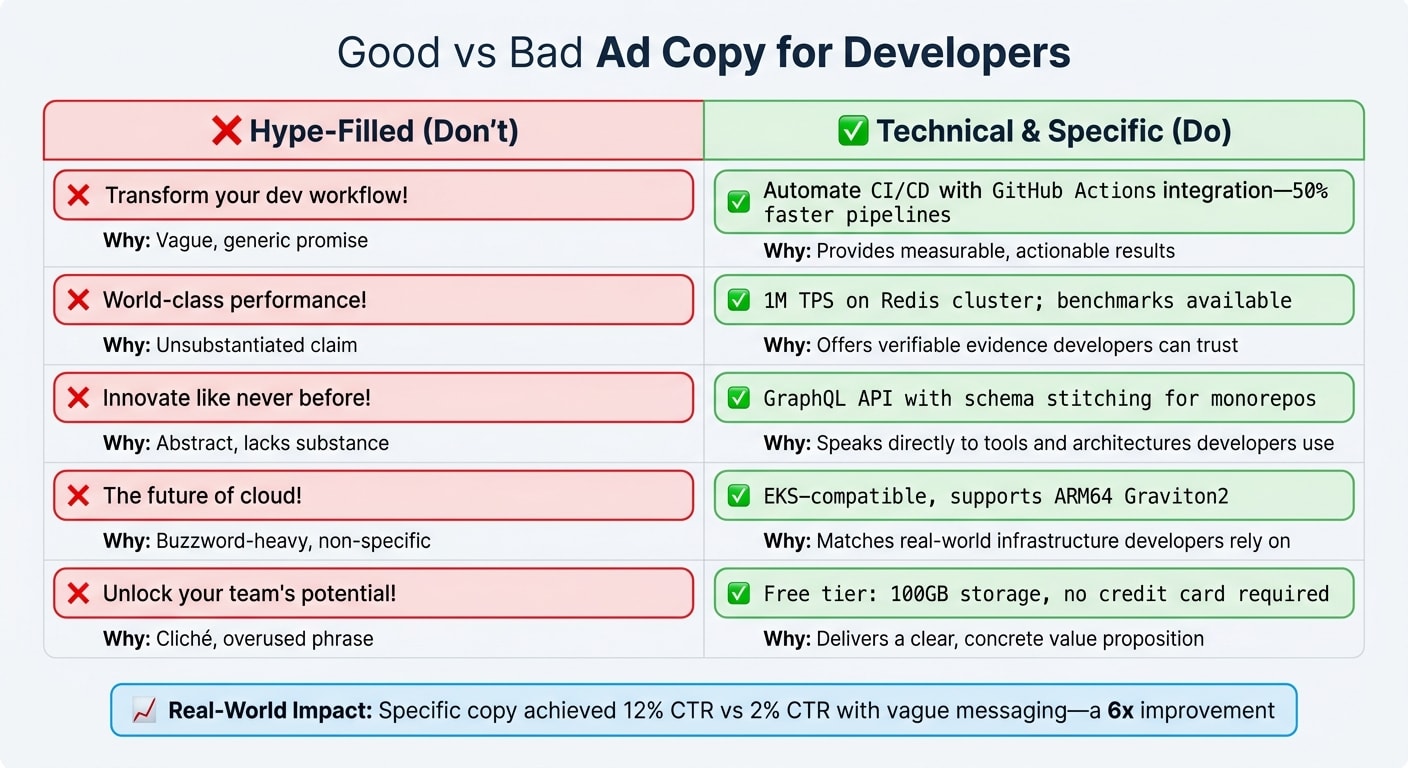
When crafting ad copy for developers, it's crucial to ditch vague promises and focus on hard facts. Developers value numbers, technical details, and proof over flashy buzzwords or exaggerated claims. The best ad copy feels like a natural extension of a technical marketing strategy tailored to this audience.
Effective Messaging: Use Specifics, Not Hype
Think of great developer ad copy as closer to technical documentation than traditional marketing. Instead of saying something generic like "lightning-fast performance", go for specifics: "reduces API latency by 40% in Node.js environments" or "supports 10,000 concurrent connections per instance." These kinds of details help developers assess and compare solutions meaningfully.
You should also include technical context that developers care about. For example, mention the hardware or environment used for testing ("from 5 minutes to 2 minutes on AWS EC2 m5.large"), highlight supported frameworks ("integrates with Express.js v4+"), or note infrastructure compatibility ("EKS-compatible, supports ARM64 Graviton2"). These specifics demonstrate expertise and build credibility.
At the same time, avoid overloading your copy with meaningless adjectives. Precision and clarity win trust every time.
Avoid Empty Buzzwords
Buzzwords like "revolutionary", "disruptive", "next-gen", and "seamless" often trigger skepticism. Instead of vague claims like "world-class performance", show developers measurable results: "1 million transactions per second on Redis cluster - benchmarks available here." Replace phrases like "seamless integration" with something concrete: "zero-config setup via Helm chart."
This approach isn't just about being honest - it's about speaking the language developers use when evaluating tools. They don't describe a library as "game-changing"; they say it cut their build times in half or reduced their bundle size by 40%.
Comparison Table: Good vs Bad Ad Copy
| Hype-Filled (Don't) | Technical & Specific (Do) | Why Do Wins |
|---|---|---|
| Transform your dev workflow! | Automate CI/CD with GitHub Actions integration - 50% faster pipelines | Provides measurable, actionable results |
| World-class performance! | 1M TPS on Redis cluster; benchmarks available | Offers verifiable evidence developers can trust |
| Innovate like never before! | GraphQL API with schema stitching for monorepos | Speaks directly to tools and architectures developers use |
| The future of cloud! | EKS-compatible, supports ARM64 Graviton2 | Matches real-world infrastructure developers rely on |
| Unlock your team's potential! | Free tier: 100GB storage, no credit card required | Delivers a clear, concrete value proposition |
Here’s a real-world example: In a daily.dev campaign, vague copy like "Revolutionize your stack!" only managed a 2% click-through rate (CTR). But when the copy shifted to something specific - "Reduce bundle size 40% with our webpack plugin - benchmarks included" - CTR shot up to 12%. That’s a 6x improvement. Developers pay attention to precision, and they reward it with clicks.
Next, we’ll dive into how real benchmarks and A/B testing can sharpen your messaging even further.
Using Benchmarks and A/B Testing to Improve Results
Show Real Benchmarks and Performance Data
Developers are naturally skeptical of unsubstantiated claims. To earn their trust, share specific performance metrics they can validate. For instance, instead of vague statements, provide concrete data like "p99 latency under 50ms" or "scales to 1M concurrent users at $0.01 per 1,000 API calls." This level of transparency helps distinguish your messaging from the noise developers tend to ignore. Clear, detailed benchmarks demonstrate a commitment to accuracy and technical rigor.
When presenting benchmarks, think about how developers evaluate tools. Replace buzzwords like "enterprise-grade scalability" with measurable outcomes such as "reduced cold starts by 40% compared to AWS Lambda." Always include test environment details - hardware specs, software versions, and methodology. This specificity shows you understand their workflows and aren’t relying on vague marketing language. By combining benchmarks with systematic testing, you build a foundation of trust and credibility.
A/B Testing on daily.dev Ads
A/B testing is a powerful way to understand what resonates with developers. Platforms like daily.dev allow you to experiment with different headlines, visuals, and calls-to-action to identify what drives engagement. The difference between guessing and testing can have a significant impact.
Take Vercel’s Q1 2023 campaign as an example. They tested two ad versions on daily.dev. Version A used generic copy: "Blazing fast deployment." Version B got specific: "Deploy in <1s, 99.99% uptime per independent benchmarks." The result? Version B outperformed Version A with a 47% higher click-through rate (CTR) (2.1% vs. 1.4%) and drove 32% more sign-ups over 30 days across 50,000+ impressions. This added $150,000 in monthly recurring revenue.
Supabase ran a similar test in June 2022 for their Postgres extension. The control ad focused on hype, while the test version showcased pgbench results demonstrating 3x faster query speeds. The test variant boosted conversions by 61% (from 0.8% to 1.3%) across 25,000 impressions, generating 1,200 new projects.
To replicate this success, test elements that developers care about: replace stock images with architecture diagrams, use code snippets instead of generic headlines, or compare CTAs like "See benchmark" versus "Learn more." Run tests for 7-14 days to ensure statistical significance, then scale up the winning elements. Keep refining based on these insights to maintain performance momentum.
Track and Optimize Campaign Performance
Tracking real-time metrics is essential for identifying what works and what doesn’t. Monitor key metrics like CTR, conversion rates, cost per acquisition (CPA), and engagement time on landing pages. For developer-focused campaigns, go a step further by tracking technical signals such as demo sign-ups or GitHub stars from linked repositories.
Check your campaign dashboard daily. If an ad’s CTR falls below 1%, pause it. If ads featuring benchmarks drive 15% higher retention, allocate more budget to those. Set alerts for performance drops and commit to weekly optimizations based on data. Over time, this iterative process pays off - marketers who consistently refine their strategies based on data report 25% ROI increases within a quarter.
Think of your campaigns like code: measure, test, and continuously improve based on real-world feedback.
Building Long-Term Trust with Developer Content Marketing
Create Public Documentation and Tutorials
Documentation isn’t just a resource - it’s a powerful marketing tool. Developers often judge your product by how well you explain it. To win their trust, make your tutorials and guides easily accessible. Avoid asking for emails or credit card details; open access is key. After all, 87% of developers share high-quality tutorials with their peers, turning your content into a natural growth driver.
Focus on tackling real-world problems with technical depth. Developers value content that dives into specifics, like configuring distributed tracing or fine-tuning database queries. Include working code examples, GitHub repositories, and actual configuration files. Skip the surface-level overviews - experienced developers are on the hunt for detailed, step-by-step solutions. For example, you could create tutorials that explore advanced topics like parallelization strategies or caching configurations.
"If you're writing like you're helping a fellow developer solve a problem they're stuck on, you're on the right track." - Nelson Bechem, Software Engineer
Measure success by more than just page views. Look at whether developers are implementing your examples, engaging with your GitHub repositories (e.g., stars, forks, or pull requests), and participating in meaningful discussions in the comments. These indicators show whether your content is genuinely helpful or just generating empty clicks. By prioritizing utility, you’ll naturally foster deeper connections within developer communities.
Participate in Developer Communities
Strong documentation is only the first step. To build trust, you need to engage directly with developers in their own spaces. Platforms like Stack Overflow, GitHub, Discord, and Slack are where developers go to solve problems and share insights. Join these conversations authentically - answer questions, share knowledge, and avoid pushing a sales pitch. Developers trust peer recommendations far more than vendor claims, so your presence in these spaces can make a lasting impact.
Community engagement also amplifies your reach without breaking the bank. By encouraging user-generated content - such as case studies, integration guides, or problem-solving threads - you empower your existing customers to advocate for your product. You can also contribute to the ecosystem by releasing open-source tools like adapters or client libraries that make it easier to integrate your platform. While this approach takes time to pay off, the trust you build will grow exponentially over the long haul.
Have Engineers Write Your Content
Authenticity is the backbone of developer marketing, and no one understands developers better than other developers. Engineers bring a level of technical accuracy and real-world insight that marketing teams might overlook. This kind of precision resonates with developer audiences.
"The most effective content marketing to developers is written by developers." - Draft.dev
Invest in developer advocates or freelance technical writers to create content that speaks directly to your audience. Hiring an in-house developer advocate might cost $120,000–$180,000 annually, while freelance writers typically charge $500–$2,000 per article. Either way, the investment is worth it. Engineer-authored content addresses real pain points and doesn’t shy away from discussing challenges or failures. Developers can spot inauthenticity from a mile away, and they reward honesty with their trust - and eventually, their business.
Conclusion
Marketing to developers hinges on trust, built through transparency and technical precision. Developers have a knack for spotting marketing fluff, so your content must focus on real benchmarks, working code examples, and honest discussions about trade-offs and limitations. By shifting your focus from selling to educating, you create marketing that serves as a long-term resource - something developers will genuinely want to share. The core idea is straightforward: educate first, sell later. Solve real problems with in-depth technical content, using real code and peer-to-peer communication crafted by engineers.
"Let's build trust through transparency, not traffic through tricks." - Nelson Bechem, Software Engineer
Measuring success in this space requires a different mindset. Forget about vanity metrics like page views. Instead, focus on metrics that matter to developers: code usage, GitHub engagement (stars, forks, pull requests), and the quality of technical conversations your content sparks. These indicators reveal whether your content resonates with developers and provides real value. This shift in focus - from superficial metrics to meaningful developer engagement - captures the essence of the strategy outlined here.
FAQs
What counts as a credible benchmark to developers?
When creating benchmarks for developers, ensure they are backed by real-world performance data, detailed technical specifications, and verified use cases. Developers prioritize technical accuracy and actionable insights, so it's crucial to provide code snippets and measurable results rather than relying on generic claims or stock visuals. Steer clear of overpromising - your benchmarks should be transparent, grounded, and easy to verify.
How do you show trade-offs without hurting conversions?
To effectively highlight trade-offs without negatively impacting conversions, focus on transparency. Clearly outline both the advantages and limitations of your product or service. Incorporating technical details and real-world benchmarks can help set accurate expectations. Developers, in particular, appreciate honesty and technical precision, as it establishes trust and credibility. This approach not only strengthens your relationship with your audience but also encourages long-term engagement.
Which metrics matter most for developer marketing?
When it comes to developer marketing, some metrics stand out as crucial: technical accuracy, credibility, peer validation, and real-world performance data. Developers aren't swayed by flashy claims or superficial stats - they care about content that's precise, reliable, and backed by evidence.
To truly connect with this audience, focus on sharing clear and accurate technical details. Build trust by offering information that's not just relevant but also trustworthy. When developers see peer validation and performance data that reflects real-world scenarios, they're far more likely to engage and value what you're offering.