

Hook: Marketing to developers isn't about flashy ads - it’s about embedding your product where they already work.
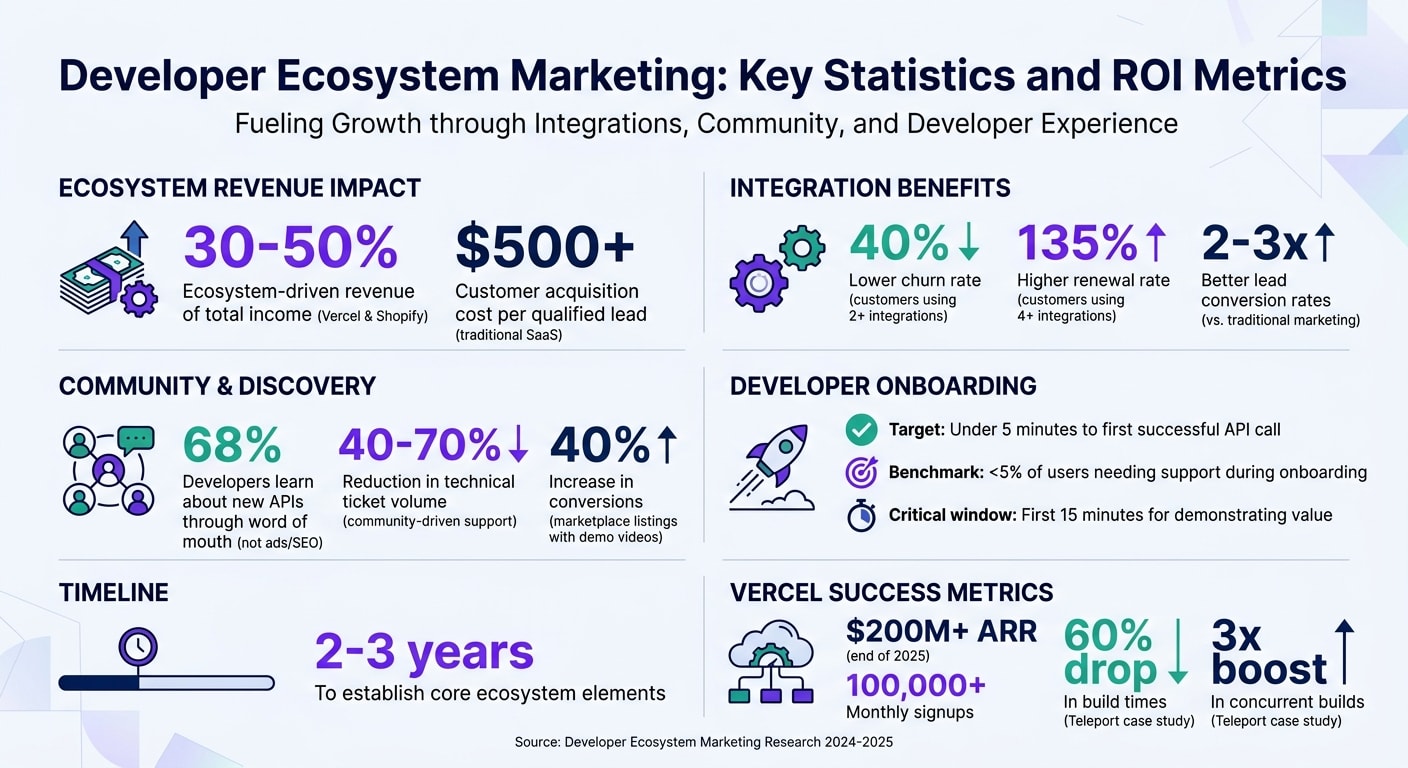
Value Summary: With customer acquisition costs skyrocketing and traditional ads losing effectiveness, developer ecosystem marketing offers a smarter growth strategy. By focusing on integrations, partnerships, and community engagement, you can turn APIs into distribution channels, reduce churn, and drive exponential growth. Companies like Vercel and Shopify have proven this approach works, with ecosystem-driven revenue making up 30–50% of their total income.
Quick Overview:
- Why it works: Developers trust tools they already use, and integrations make switching costly.
- Key benefits: 2–3x better lead conversion rates, 40% lower churn, and compounding growth.
- How to start: Build integrations with key platforms (e.g., GitHub, Zapier), co-market with partners, and engage in developer communities like GitHub and daily.dev.
Bridge: Let’s explore how to implement this strategy and why it’s transforming how companies grow.
Building Integrations to Drive Growth
Integrations are no longer just optional features - they’ve become a crucial way to connect with users by embedding your product into platforms they already rely on . For example, integrating with tools like GitHub Actions or VS Code doesn’t just expand functionality; it weaves your product into the workflows of developers who trust these platforms.
The data supports this approach. Customers who use two or more integrations show a 40% lower churn rate, while those with four or more integrations see a 135% higher renewal rate . Why does this happen? Each integration increases the effort required to switch away from your product, as users would need to reconfigure an entire network of connected tools .
The trick is to focus on the platforms that matter most to your audience. "Tier 1" integrations - those on platforms like GitHub Actions and VS Code - offer the greatest visibility because they align directly with where developers spend their time . Zahid Iqbal, SEO Specialist, explains it well:
"Most B2B platform products die trying to sell alone... Their go to market strategy was not just about selling. It was about embedding."
Let’s dive into three high-impact integrations that can significantly boost your product’s visibility and adoption.
Creating Zapier Integrations for Workflow Automation
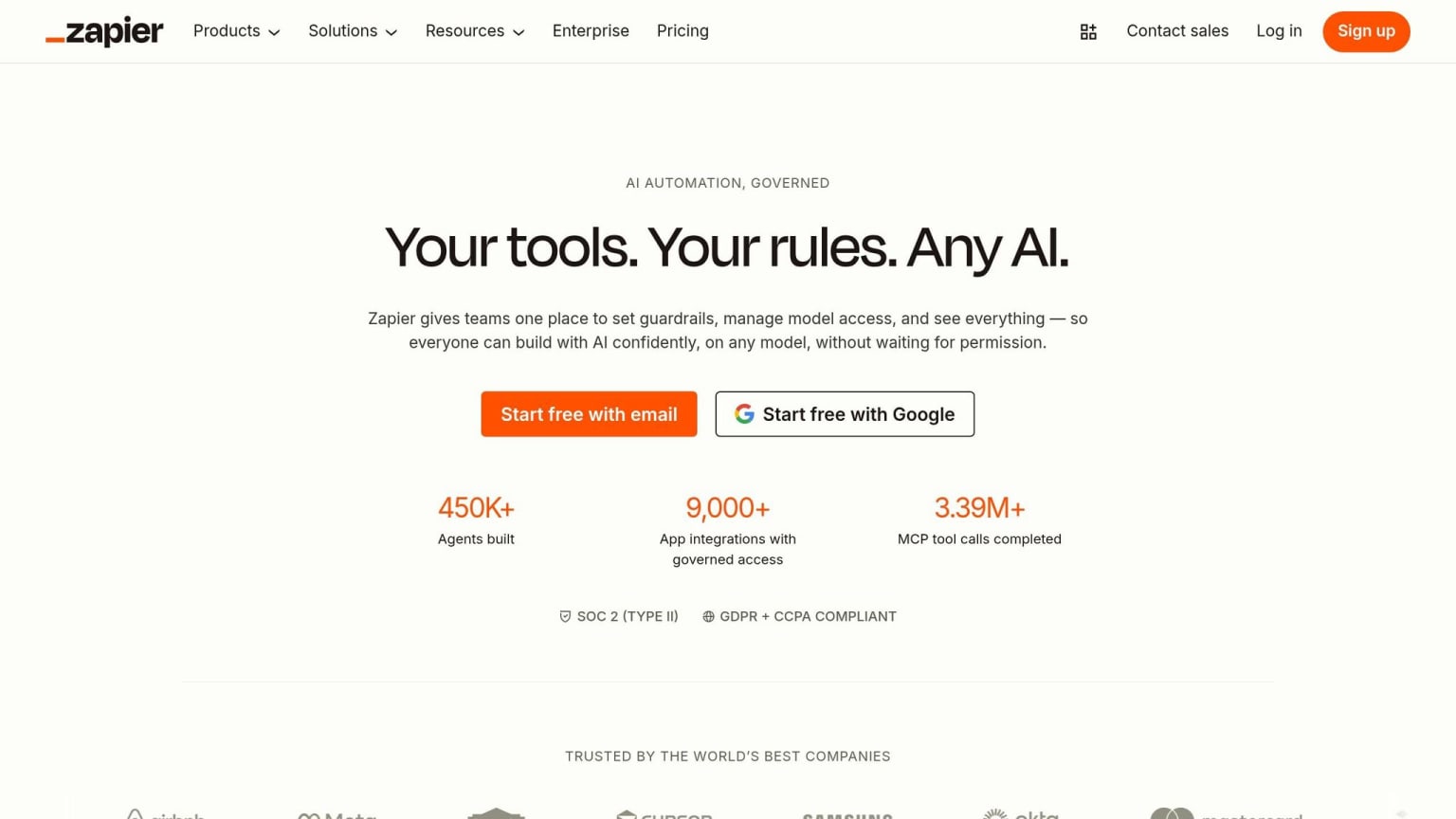
Zapier integrations are perfect for reaching non-technical users who want automation without having to code. By connecting your product to Zapier, you allow users to create workflows (called "Zaps") that automate tasks across thousands of apps .
To make this work effectively, use webhook architecture instead of REST polling. Webhooks enable real-time automation, which platforms like Zapier and Make prioritize for a smoother user experience . For example, when a user links your product to their CRM, email tool, or project management software, your tool becomes a seamless part of their daily operations.
Think of your Zapier marketplace listing as a landing page. Use clear messaging, compelling screenshots, and testimonials to showcase the value of your integration . The first 15 minutes are critical - users need to see immediate value or they’ll move on to a competitor .
Embedding into Developer Workflows with GitHub Actions
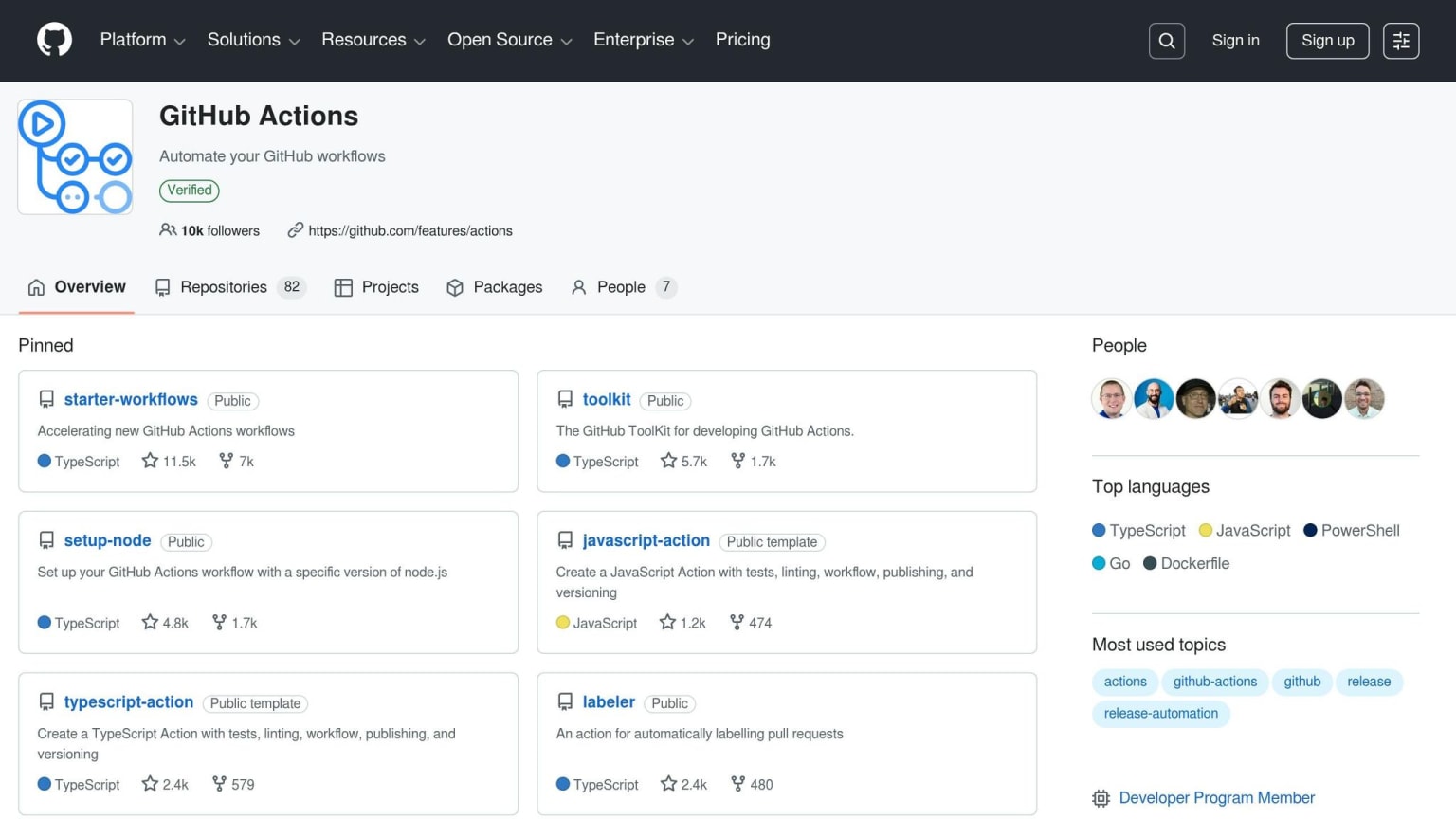
GitHub Actions allow you to integrate directly into developers’ CI/CD pipelines. Whether it’s for automated testing, deployments, or code quality checks, your product becomes a core part of their workflow, used multiple times a day.
This integration offers unparalleled visibility. Each commit, pull request, or deployment becomes a touchpoint, reinforcing your product’s necessity . Plus, discovery happens organically - 68% of developers learn about new APIs through word of mouth, not ads or SEO . When a teammate includes your GitHub Action in their workflow, it acts as a trusted recommendation.
Even better, being part of GitHub’s ecosystem lends your product credibility. Developers are more likely to try tools within trusted platforms, often leading to conversion rates 2–3x higher than traditional marketing efforts .
Building VS Code Extensions for IDE Presence
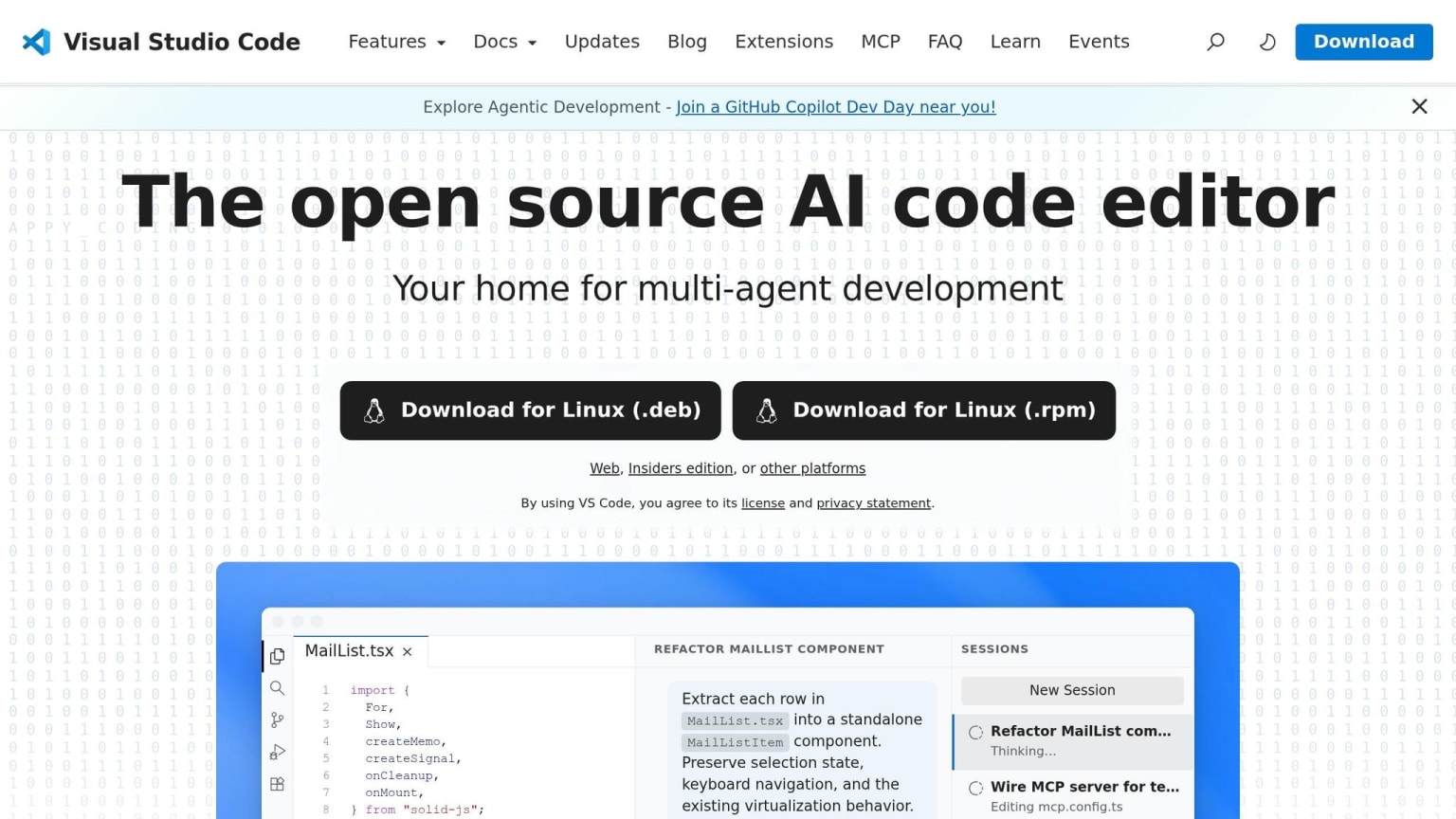
VS Code extensions let you embed your product into the most widely used code editor, making it part of the environment where developers spend hours coding .
To succeed here, focus on time-to-first-value. Developers should be able to go from signup to their first successful API call in under 5 minutes . Provide clear error messages with links to documentation, follow established coding conventions (like TypeScript or Python), and offer sensible defaults with options for customization .
Feedback from the VS Code Marketplace is invaluable. Pay close attention to ratings, reviews, and support tickets - they reveal where users encounter friction. Aim for fewer than 5% of users needing support during onboarding . If you’re above that, it’s time to simplify your integration.
Partner Co-Marketing Strategies
Building integrations is only half the battle - collaborating with established platforms is where the real impact happens. These partnerships don't just add functionality; they allow you to tap into an engaged audience while borrowing the credibility of trusted tools. By working closely with these platforms, you can amplify your reach far beyond what organic efforts alone can achieve.
Partnering with well-known platforms boosts credibility and drives higher-quality leads. Developers who find your product through a trusted partner are already engaged - they’re familiar with the platform, trust it, and are actively looking for tools to streamline their workflows. While integrations drive adoption and reduce churn, co-marketing with partners extends your reach, creating growth opportunities that standalone integrations might not deliver.
Using Marketplace Listings for Exposure
Platforms like GitHub, HubSpot, and Salesforce offer marketplace listings that act as discovery hubs, exposing your product to millions of users - without the need for extra advertising costs . Thanks to these platforms' strong domain authority, your listing might even show up higher in search results than your own website for terms like "[Tool Name] integration" or "[Tool Name] sync."
To make your marketplace listing stand out, treat it like a high-converting landing page. Focus on outcomes rather than features. For example, instead of saying "two-way API integration", highlight the benefits with phrases like "automatically sync deals to your CRM" . Include high-quality visuals and a demo video - data shows that a compelling video can increase conversions from views to installs by around 40% .
Don’t underestimate the power of reviews. Ask users for feedback about two weeks after they activate your integration. Positive reviews not only improve your listing’s ranking but also build trust, creating a feedback loop that increases visibility.
Running Co-Marketing Campaigns with Partners
Effective co-marketing happens when both partners bring something valuable to the table. This often falls into one of three categories: audience swaps (when both partners have similar reach), content creation plus distribution (one creates content, the other promotes it), or product and audience exchanges (offering product perks in return for visibility) .
A great example of this is the recent partnership between Next.js and leading cloud providers. Together, they launched a verified adapter program through joint marketing efforts, which included case studies, co-hosted webinars, and integration highlights within their onboarding processes . This collaboration is a perfect example of a well-coordinated go-to-market strategy.
Before diving into a large-scale campaign, try a smaller 30-day test. For instance, start with something simple like a newsletter mention or a social media post to confirm your partner can deliver on time . Assign clear ownership to specific individuals on both sides to ensure accountability. As DimeADozen.ai puts it:
"Good partnership marketing is specific, bounded, and activated. Bad partnership marketing is vague, open-ended, and nobody's job."
Once you’ve established trust and momentum, you can scale up to more targeted promotional efforts.
Promoting Integrations with daily.dev Ads
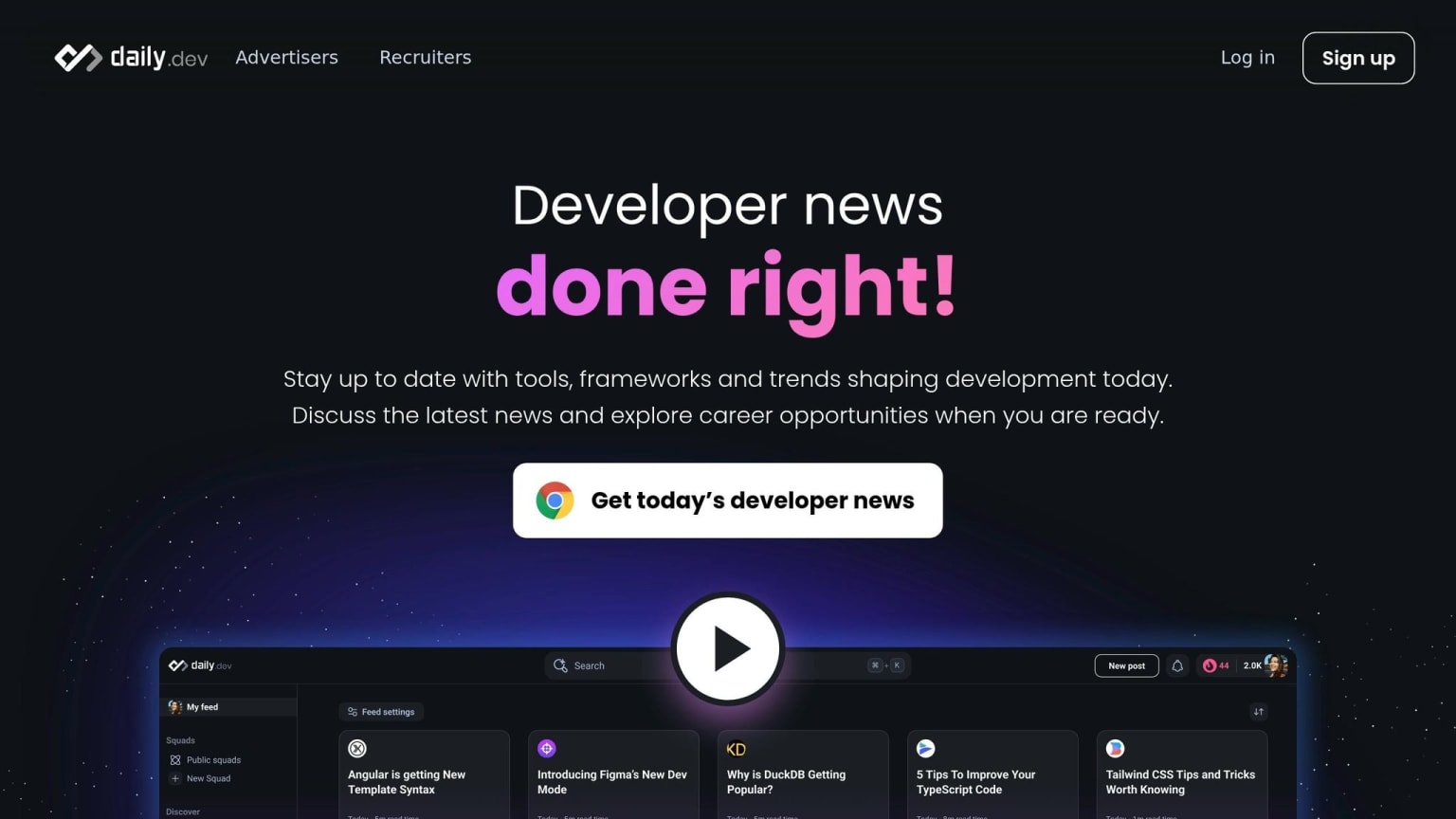
To reach the right developers, daily.dev Ads provides a way to target audiences based on seniority, programming languages, and the tools they use. This ensures your integrations are seen by those who will benefit most.
For example, if you’ve built a GitHub Actions integration, you can target developers working on CI/CD workflows. Similarly, if you’ve created a VS Code extension, you can focus on developers who specialize in languages like TypeScript or Python. daily.dev’s native ad placements - whether in-feed, on post pages, or within personalized digests - blend seamlessly into developers’ daily routines, offering a discovery experience that feels natural and relevant.
Community Cross-Pollination Tactics
Focusing on community engagement enhances trust and encourages organic discovery, making it a key part of any developer ecosystem marketing strategy. While integrations and partnerships draw developers in, genuine community involvement ensures they stay. The best strategies go beyond just building tools - they actively participate in the spaces developers frequent. By contributing value and creating platforms for connection, you can forge meaningful relationships with your audience.
Let’s explore how daily.dev, GitHub, and the VS Code Marketplace successfully engage with their communities.
Engaging within daily.dev Squads and Tags
daily.dev Squads act as niche hubs where developers gather around shared interests like DevTools, AI, or Open Source. These aren’t just forums - they’re discovery platforms where developers share posts, curate content, and dive into technical discussions using Markdown. To increase visibility, make sure Squad metadata includes clear descriptions, compelling images, and accurate categories. Public Squads are automatically listed in the Squads Directory, making them easier to find for developers looking for communities that match their expertise.
The platform also tracks key metrics like total posts, views, upvotes, and awards. A "Top Members" leaderboard highlights the most active participants over a rolling 30-day period, encouraging ongoing engagement. A great way to amplify activity is by cross-posting high-quality content into your Squad and using the Boost feature to reward contributors with community awards (called Cores) .
Beyond daily.dev, GitHub provides another essential space for developer interaction.
Building Momentum through GitHub Community Engagement
GitHub is a trusted, cost-effective platform where developers evaluate tools based on activity, documentation, and responsiveness. The key to thriving here lies in active engagement - participating in discussions, addressing issues, and reviewing pull requests. Think of your GitHub presence as a feedback loop. When developers raise issues or submit pull requests, they’re offering valuable insights into how they use your product and the challenges they face. Responding quickly and transparently builds trust and credibility.
As Ryan Paul Gibson, Founder of Content Lift, explains:
"You want to be really transparent about what your product does and what it cannot do… because people will find it out, and they will share that online."
To make a strong impression, focus on achieving "Speed to Hello World." This means helping developers quickly understand and use your product through interactive demos, SDK trials, and clear, concise documentation . The faster they see value, the more likely they are to become advocates.
Using VS Code Marketplace Feedback Loops
The VS Code Marketplace isn’t just a place to distribute extensions - it’s a space for gathering community feedback. Developers leave reviews, ratings, and questions, all of which can provide actionable insights. These interactions not only guide improvements but also help potential users evaluate your extension. Encourage users to share their experiences and identify those who provide constructive feedback. Engaging with these power users - whether through early access to features or direct communication - can amplify your reach and strengthen your community.
Here’s a quick look at some key platforms and metrics for community engagement:
| Platform | Primary Engagement Method | Key Metric to Track |
|---|---|---|
| daily.dev Squads | Share curated content and spark discussions via Markdown posts | Views, Upvotes, Awards, Top Members (30-day) |
| GitHub | Respond to issues, review pull requests, and maintain clear documentation | Stars, Forks, Issue response time |
| VS Code Marketplace | Gather reviews, engage with Q&A, and iterate based on user feedback | Review ratings and number of reviews |
Vercel/Next.js Case Study: How Ecosystem Marketing Drives Adoption
Vercel and Next.js have built an impressive developer ecosystem by leveraging a powerful cycle: open-source framework → community engagement → product-led growth → enterprise sales . By the end of 2025, Vercel surpassed $200 million in ARR with over 100,000 monthly signups, driven almost entirely by this ecosystem-focused strategy . Their success lies in becoming an integral part of developer workflows, collaborating with partners, and building trust through open standards. Let’s dive into how Vercel uses integrations and partnerships to fuel this growth.
Integration Strategies Driving Adoption
Vercel has mastered the art of seamless onboarding. With features like one-click deployment and the npx create-next-app command, developers can get started effortlessly, gaining immediate value without needing to commit to payments or complex setups .
Another standout feature is automated Preview Deployments for every pull request. This enables real-time collaboration and commenting, which has proven transformative for teams. For example, after adopting this workflow, Teleport reported a 60% drop in build times and a 3x boost in concurrent builds . Their CTO shared:
"Vercel-based Teleport docs and website are a huge success. Our engineers deploy multiple times per day without thinking about it... Vercel unlocked all those workflows and collaboration points for us."
To ensure cross-platform reliability, Next.js introduced the Verified Adapter Program. These adapters must meet specific compatibility standards and remain open-source before being hosted under the official Next.js GitHub organization . This ensures advanced features like streaming and Partial Prerendering work seamlessly on platforms like Cloudflare and AWS. It’s a clear example of how Vercel builds trust and ensures technical consistency across its ecosystem.
Partner Networks Amplifying Reach
Strategic partnerships have played a critical role in Vercel's success. Nearly half of Vercel’s sales and project deliveries involve collaboration with partners . These partners are divided into two key groups: agencies and technology providers.
Vercel also formed an Ecosystem Working Group, bringing together major hosting platforms like Netlify, Cloudflare, AWS, and Google Cloud. This group coordinates framework updates to avoid breaking changes, helping Next.js maintain its position as a leading framework . Fred K Schott, an engineer at Cloudflare, highlighted the importance of this collaboration:
"The official Next.js Adapter API makes that vision real. Developers running Next.js on Cloudflare's global developer platform will now have a shared foundation to build on."
The annual Next.js Conf serves as a key platform for engaging partners. The 2024 event brought together over 35 partner sponsors and reached tens of thousands of developers online . The inaugural conference had an even larger turnout, with over 80,000 registrants . Additionally, Vercel supports its partners with resources like a Partner Learning Portal, technical guides, and a Partner Fund, which allows partners to reinvest referral earnings into joint marketing efforts . This ecosystem-focused approach has clearly been a game-changer for Vercel.
Comparison Table: Vercel/Next.js Tactics vs. General Ecosystem Strategies
Here’s how Vercel/Next.js tactics stack up against broader ecosystem strategies, along with actionable steps for implementation:
| Strategy Component | Vercel/Next.js Tactic | General Ecosystem Strategy | Implementation Steps |
|---|---|---|---|
| Onboarding | Git-provider OAuth + 1-click deployment | Manual CLI configuration or UI forms | Integrate GitHub API, create a zero-config deployment flow, and deliver a "wow" moment in under 60 seconds |
| Collaboration | Automated Preview Deployments with commenting | Staging environments requiring manual setup | Provide unique URLs for each pull request, add visual commenting features, and automatically notify team members |
| Partner Trust | Verified Adapters hosted on the official GitHub organization | Third-party community plugins with varying quality | Develop a compatibility test suite, require open-source code, and host verified integrations under your organization |
| Lead Generation | npx terminal commands and open-source templates |
Gated whitepapers and demo requests | Offer CLI tools that deliver value upfront and provide deployable starter kits for developers to clone |
| Governance | Ecosystem Working Group with public meeting notes | Private partner portals and NDA-restricted roadmaps | Hold regular partner meetings, share roadmap updates early, and publish meeting notes publicly for transparency |
This case study highlights how Vercel’s ecosystem-first strategy has driven growth and adoption, providing a model for others looking to build thriving developer communities.
Conclusion
Building a developer ecosystem isn’t a quick win - it’s a long-term investment that typically takes 2–3 years to establish the core elements . By embedding your product into developer tools, forming strategic partnerships, and nurturing strong communities, you can create a growth engine that sustains itself over time. Unlike traditional paid acquisition, which scales directly with budget and faces rising costs (with customer acquisition costs now surpassing $500 per qualified lead in competitive SaaS markets ), ecosystem-led growth has a compounding effect. Every new integration, partnership, and advocate broadens your reach and strengthens your presence .
The numbers speak for themselves: customers using a product alongside two or more integrated tools experience 40% lower annual churn. Leads sourced through partnerships convert 2–3 times better than inbound leads, and community-driven support can reduce technical ticket volume by 40–70% . These results highlight the importance of adopting an ecosystem-focused strategy.
To reap these benefits, prioritize three key areas: integrations, partnerships, and community engagement. Integrations seamlessly embed your product into essential workflows, partnerships leverage existing trust and credibility, and communities provide a strong layer of support and loyalty . As Gary Gonzalez, Managing Partner at Catchy, aptly states:
"Open developer ecosystems are a necessity for any organization that wants to engage technical services and build technical products" .
Begin with the basics: adopt an API-first mindset, ensure developers can achieve meaningful outcomes within 15 minutes, and focus your efforts on integrating with three to five key tools . From there, expand with co-marketing initiatives and community-building efforts to create a self-sustaining growth loop.
The ecosystem you create today will become your competitive edge tomorrow. While features can be mimicked, a vibrant community and a rich network of integrations are incredibly difficult for competitors to replicate . Start building now, and watch as your ecosystem evolves into a powerful driver of sustainable growth.
FAQs
Which integrations should I build first?
Begin by focusing on integrations that align closely with your product’s core purpose and can enhance both adoption and retention. Tools like Zapier, GitHub Actions, and VS Code extensions are excellent starting points. Why? They seamlessly fit into the workflows developers already rely on.
It's also smart to prioritize widely-used platforms such as Slack or Notion. These are tools many teams actively use, so integrating with them can provide immediate benefits. The key is to make these integrations simple to implement, ensure they deliver clear value right away, and allow them to blend effortlessly into existing processes. This approach can significantly contribute to your product’s growth.
How do I measure ecosystem marketing ROI?
To measure the return on investment (ROI) of ecosystem marketing, focus on a mix of metrics that reflect both developer engagement and business impact. Start by tracking API usage, documentation engagement, and integration success rates - these will give you a clear picture of how well developers are adopting your tools. Pair these with product-related metrics like SDK implementation rates and onboarding completion rates to see how effectively users are integrating your offerings.
Beyond technical adoption, consider broader indicators like community growth, brand awareness, and retention rates. For example, you might notice lower churn among users who have built deeper integrations with your ecosystem. This not only highlights the value of your efforts but also shows how they contribute to business outcomes, such as reducing dependence on paid customer acquisition.
When should I start partner co-marketing?
Start partner co-marketing only after establishing clear Market Development Fund (MDF) programs, well-structured campaign frameworks, and comprehensive enablement resources. These tools empower your partners to efficiently run campaigns and transform funding into a strong sales pipeline. With these elements in place, your ecosystem can become a powerful driver for shared growth.