

Selling developer tools requires a different approach. Developers are skeptical of traditional marketing and sales tactics. They rely on technical merit, hands-on testing, and peer recommendations to choose tools. This makes Account-Based Marketing (ABM) a powerful strategy for targeting developers and turning grassroots product adoption into enterprise-level revenue.
Key Takeaways:
- Developers discover tools independently through platforms like GitHub, Reddit, and Slack, often long before procurement teams get involved.
- Signal-based outreach works best: Actions like GitHub forks or API usage can trigger reply rates of 15–35%, compared to just 5.4% for cold emails.
- ABM bridges the gap: Identify accounts where developers already use your product, then target decision-makers to expand adoption.
- Tailored content is critical: Developers prefer technical demos and clear documentation, while managers focus on ROI and implementation timelines.
- Measure success differently: Focus on account-level engagement, usage signals, and progression through ABM stages instead of traditional leads.
ABM for developer tools succeeds by meeting developers where they are, using technical signals to guide outreach, and aligning the needs of engineers and decision-makers. This strategy transforms developer interest into enterprise wins.
How Developers Buy Tools Differently
Selling to developers isn’t like selling to other B2B audiences. Engineers approach tool evaluation with a focus on technical merit and hands-on testing, leaving little room for flashy sales pitches or brand allure. This shift in priorities requires businesses to rethink their sales strategies, especially when crafting an ABM (Account-Based Marketing) approach for developer tools.
Bottom-Up vs. Top-Down Sales
In most enterprise software sales, the process starts at the top: pitch to executives, secure budget approval, and then introduce the tool to end users. Developer tools, however, flip this script. Engineers lead the charge by discovering, testing, and integrating tools on their own. Once they’re convinced, they advocate for the tool internally. This "land and expand" approach requires patience and a focus on supporting engineers throughout their journey.
Here’s the reality: only 5.4% of developers respond to cold emails . On the other hand, outreach triggered by actionable signals - like GitHub activity or peer recommendations - can achieve reply rates of 15% to 35% . These numbers highlight the importance of a multi-phase ABM strategy tailored specifically to developers, which will be explored further in upcoming sections.
Engineers Evaluate Before Procurement Gets Involved
Engineers don’t rely on sales decks or glossy marketing materials to make decisions. Instead, they assess tools based on documentation quality, source code clarity, and how quickly they can achieve value. As Ayoub Kaddouri aptly states:
In SaaS, the product IS the funnel. Marketing's job is to get developers to the 'Try' stage. The product has to carry them through Adopt, Expand, and Champion.
This means the technical experience must be seamless. Developers expect to accomplish something meaningful - like making an API call or deploying an application - within just five minutes of signing up . If a tool doesn’t deliver, it’s quickly abandoned.
Procurement teams, meanwhile, come into the picture later. Their focus shifts to risk management, budget considerations, and ROI. This creates a unique challenge: aligning the technical needs of developers with the business needs of procurement. The best approach is to empower developer champions with the right resources to make their case internally. These resources might include technical comparisons, security documentation, and ROI calculators .
When you notice multiple engineers from the same company actively using a free tier, it’s a clear signal that the account is ready for a broader, top-down sales effort . At this stage, targeting both developer advocates and procurement teams becomes essential for a successful ABM strategy.
Building Your Target Account List
One of the most common pitfalls in developer ABM is relying on generic firmographic criteria like company size, industry, or revenue. These traditional metrics often fail to capture technical needs. Instead, technical signals tend to provide a much clearer picture of which accounts are worth pursuing .
Signals That Identify High-Value Accounts
High-value accounts often stand out through their technical behaviors. GitHub activity is a prime example. Here’s how it breaks down:
- Stars: Indicate awareness but low intent.
- Forks: Show active experimentation, signaling medium intent.
- Issues or Pull Requests: Reflect a deeper investment, such as reporting bugs or contributing fixes - high intent.
- Production Deploys: Represent the ultimate commitment, showing your tool is already part of their live environment .
Beyond GitHub, job postings can also be a goldmine of insights. For example, if a company is hiring a "Kubernetes Engineer" or mentions specific tools in job descriptions, it’s a clear signal they’re planning to scale their infrastructure . Similarly, discussions in developer communities like Slack, Reddit, Discord, or Stack Overflow often reveal pain points that your tool could address . For more on developer marketing trends, explore our latest industry insights.
To round out the picture, first-party product data is invaluable. Combining external signals with internal data - such as free trial signups, API usage, or visits to documentation pages - can help identify "Product Qualified Accounts." These are companies where multiple developers are actively testing your tool, making them ripe for enterprise-level engagement .
Next, let’s look at how to refine these signals and use them for precise targeting.
Using Developer Data for Better Targeting
Identifying raw technical signals is just the first step. Turning these insights into an actionable ABM strategy requires precision. Since developer signals are often anonymous, identity resolution tools can map them to specific companies with a 60–75% success rate .
To prioritize accounts, you can use a scoring system. For example:
- Assign a Signal Depth Score to actions (e.g., Star = 1, Fork = 3, PR = 5).
- Multiply this by an ICP Fit Score, which factors in company size, funding, and industry.
- Give extra weight to recent activity (e.g., signals from the past week can be multiplied by 1.5) .
This approach has proven effective. In January 2026, Spectro Cloud used it to pinpoint high-value prospects based on GitHub and community activity, generating $1.65 million in new pipeline revenue .
Don’t stop there. Keep an eye on adjacent activity. For instance, if your product is a Python security tool, monitor developers contributing to FastAPI or Flask repositories - they may also be in the market for your solution . Another powerful signal is the "champion mover" effect. When advocates of your tool join new companies, they often bring their influence with them, making them key contacts for procurement .
Reaching Developers and Managers Simultaneously
To succeed with developer ABM (Account-Based Marketing), you need to connect with both technical users and decision-makers at the same time. Developers often champion tools from the ground up, while engineering managers hold the purse strings and make budget decisions. To strike the right balance, your content strategy must resonate with both groups without watering down the message for either audience .
Think of this as running two parallel tracks. For example, while an SDR (Sales Development Representative) sends a tailored email to a Lead DevOps Engineer about a specific technical integration, your marketing team could simultaneously target VPs of Engineering with ads focused on ROI and operational efficiency. This kind of dual-track effort has proven successful in real-world applications.
Take Hightouch, for example. They launched a warehouse-first ABM program that combined enriched account data with AI-driven personalization. By using large language models, they created landing pages with custom headlines and proof points tailored to different personas within the same company. The results? A 47.5% boost in accounts moving to initial engagement and a 20% increase in deals closed .
Content That Resonates with Developers
If there’s one thing developers dislike, it’s a hard sales pitch. What they value instead is clear, actionable technical content. Think hands-on demos, in-depth API documentation, and honest product comparisons that acknowledge both strengths and trade-offs.
"Engineers would rather try something than hear a sales pitch about it. That's why the vast majority of successful engineering-centric companies offer a free tier or trial." - Onfire AI
The best way to engage developers is by addressing their specific pain points. For instance, if someone in a Slack community mentions frustrations with CI/CD tools, reference that exact problem in your outreach. Using technographic data can also help you personalize your message. If you know a prospect’s team uses Kubernetes or Snowflake, tailor your content to show how your solution integrates seamlessly with those tools .
While developers gravitate toward technical content, engineering managers are looking for something different: assurance that the tool is worth the investment.
Content for Engineering Managers
Engineering managers focus on the bigger picture - things like ROI, risk, and implementation timelines. To win them over, offer resources like implementation roadmaps that show how quickly their team can start seeing results, total cost of ownership calculators, and evidence that your tool won’t create new security or compliance headaches. For instance, a fintech engineering manager would be more interested in how other fintech companies solved similar challenges than in generic success stories.
One effective tactic is to set up a Marketing Qualified Account (MQA) threshold. This means waiting until multiple personas within the same account - like an engineer and a director - engage with your content before alerting your sales team. This ensures that outreach happens when both technical and business stakeholders are already interested, which significantly improves the chances of closing the deal .
The key to success is aligning the technical benefits of your product with the business outcomes managers care about. This approach transforms grassroots developer support into enterprise-level wins.
Content for Each Stage of the ABM Funnel
Each stage of the ABM funnel calls for content tailored to the audience's needs. Early on, the focus is on building trust, while later stages emphasize proving value. It's also crucial to understand that developers and their managers engage with information differently at various points in the process.
Awareness: Building Trust from the Start
At the awareness stage, the goal is straightforward: get noticed by developers at your target accounts before they're actively searching for solutions. This isn't the time for a sales pitch. Instead, it's about creating technical content that solves real problems and positions your brand as a trusted resource.
Content like industry research, technical benchmarks, and educational guides works well because it offers practical help without asking for anything in return. For example, if your target audience works with Kubernetes, a detailed guide on optimizing Kubernetes deployments can demonstrate your understanding of their challenges.
"87% of marketers report that ABM outperforms all other marketing investments in terms of ROI." – ITSMA
Platforms such as daily.dev for Business are excellent for this stage, seamlessly integrating your content into developers' daily routines. By showing up in their feeds as they browse technical articles, you become part of their learning process rather than an interruption. Pair this with small-scale ad campaigns targeting employees at your top accounts to build familiarity early.
Another way to stand out is by responding to developer questions in Slack communities, Reddit threads, or Discord servers. Offering a helpful answer to a specific problem makes your outreach feel personal and relevant. Since only 3% to 8% of your potential market is actively buying at any given time , your awareness efforts need to resonate with the broader audience.
Once trust is established, developers naturally move on to comparing tools and exploring options.
Evaluation: Helping Developers Make Informed Comparisons
When developers are aware of your tool, they shift into evaluation mode. At this stage, they want hands-on experience and technical details - not marketing fluff.
Providing sandbox environments or free trials allows developers to test your tool in real-world scenarios. Transparent comparison guides are equally important. For instance, if your target accounts use Jenkins, a guide like "Jenkins vs. [Your Tool]" that openly addresses migration challenges can build trust.
In early 2026, Spectro Cloud teamed up with Onfire to identify developers researching infrastructure solutions. By leveraging intent data, they generated $1.65 million in new pipeline revenue by reaching developers at the right moment . Similarly, Hightouch saw an 82.5% increase in accounts reaching the interest stage by creating account-specific landing pages with tailored headlines .
Once developers are satisfied with the technical fit, the focus shifts to proving the tool’s value to the business.
Procurement: Proving Business Value
The procurement stage bridges technical enthusiasm with financial approval. Here, your content needs to pivot from showcasing technical superiority to demonstrating business impact. Engineering managers and procurement teams care about ROI, risk management, and implementation timelines - key factors that justify scaling from developer-led adoption to enterprise-wide deployment.
Assets like ROI calculators, total cost of ownership analyses, and detailed security documentation become invaluable. For example, fintech companies might need SOC 2 compliance reports, while larger enterprises look for clear vendor risk assessments and implementation plans.
Datadog sets a strong example by monitoring customer usage and reaching out when accounts near capacity limits. This proactive approach builds goodwill and naturally transitions into enterprise-level discussions .
Transparent pricing also plays a big role here. When developers can easily build a business case internally, it speeds up decision-making. Offering annual contract incentives for accounts already using your free tier can also encourage upgrades and streamline the sales process.
Finally, testimonials from industry peers can seal the deal. A CTO from a similar company explaining how they justified the investment to their board holds much more weight than a generic case study. These real-world examples resonate with decision-makers, making the business case even stronger.
Choosing the Right Channels for Developer ABM
When it comes to developer ABM (Account-Based Marketing), the key is stepping away from traditional B2B marketing tactics. Developers aren't hanging out on LinkedIn waiting for sales pitches, and cold emails have minimal impact - only 5.4% of developers discover products this way . Instead, success lies in meeting developers where they already spend their time, whether that's researching solutions or engaging with their peers.
The most effective strategy blends contextual targeting with signal-based outreach. Instead of scattering ads across broad platforms, focus on channels that allow you to engage developers based on what they're actively exploring. For example, if a developer from a target account is reading an article about Kubernetes optimization or API security, that’s the perfect moment to deliver tailored content. This is where platforms like daily.dev for Business shine, offering precise account targeting that aligns with developers' research habits.
How daily.dev for Business Enables Account Targeting
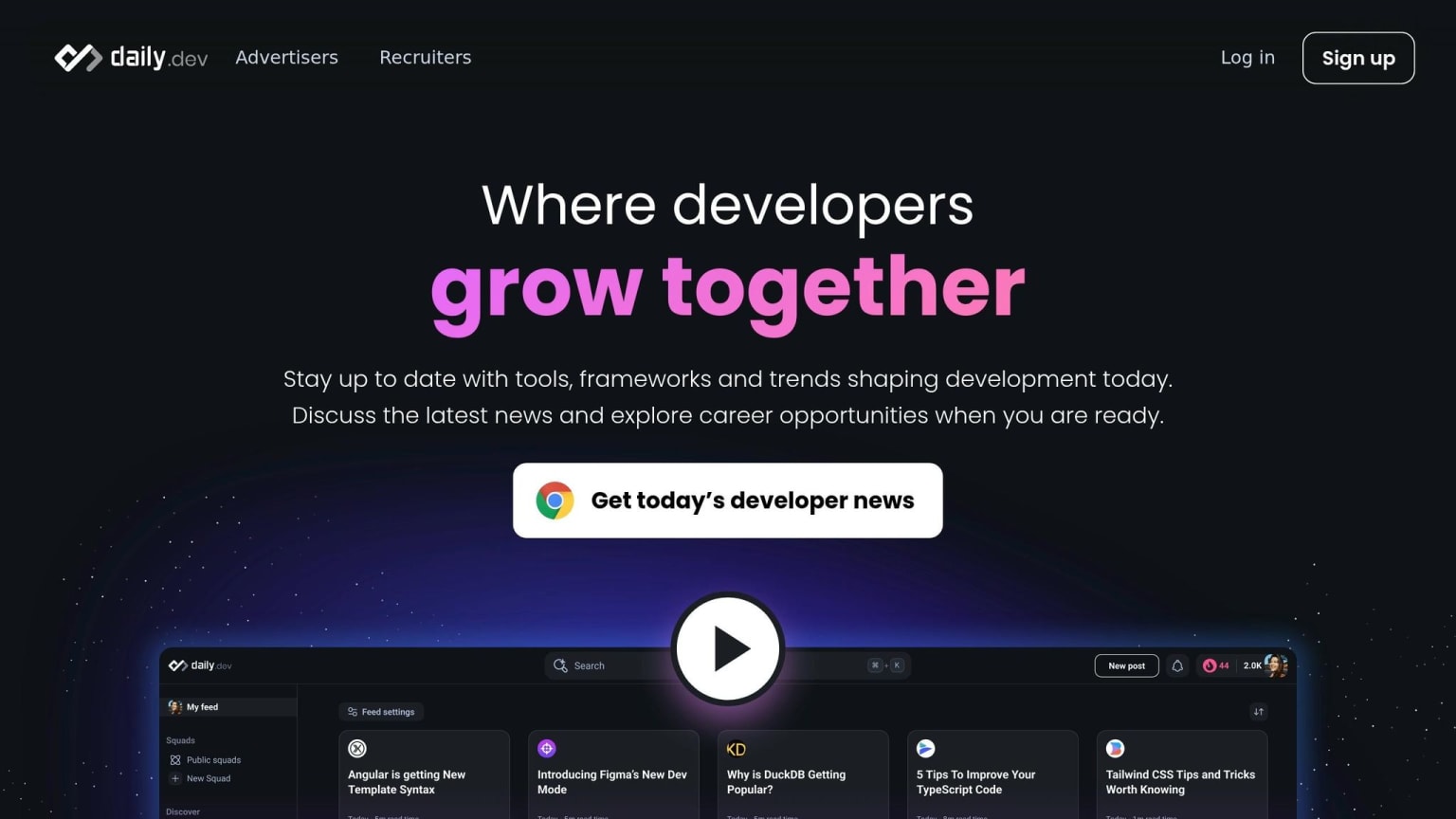
daily.dev for Business is designed to connect with developers in their natural environment - while they're consuming technical news and expanding their skills. The platform uses developer network data and contextual signals to identify which accounts are exploring specific technologies or challenges. It then delivers in-feed ads and digest ads that feel like a natural part of the content experience, not an interruption.
By positioning ads alongside technical articles, you provide value rather than disrupt the experience. Developers appreciate genuine technical insights far more than generic sales messages . For instance, if a developer from your target account is reading an article about microservices architecture, placing your ad there adds value at the exact moment they're open to learning.
daily.dev for Business also enables account-level targeting by analyzing behavioral signals across its network of over 1 million developers. You can refine your targeting by seniority (e.g., senior engineers vs. CTOs), programming languages, or specific tools in their stack. This level of precision ensures your budget is spent on accounts showing real interest, rather than casting a wide net based on demographics. Beyond daily.dev, other channels can further enhance your developer ABM strategy.
Additional Channels That Support Developer ABM
Other channels can complement your efforts to engage developers effectively:
- Email digest ads: These ads appear in curated technical newsletters that developers already trust and read regularly. Unlike cold emails, which have reply rates of just 1-3% , digest ads benefit from the credibility of the publication.
- Sponsored technical content: Developers respond well to content that solves real problems. Think detailed implementation guides, architecture comparisons, or open-source contributions - not thinly disguised product promotions.
- Retargeting campaigns: These are ideal for accounts that have already interacted with your content or visited your documentation. Retargeting them with the next logical step - like a technical comparison after an initial overview - keeps them moving forward.
- "Air cover" ads: These ads aim to build brand familiarity among target accounts. The goal isn't immediate clicks but recognition. When your personalized email lands in their inbox later, they'll already know your company name, which can significantly improve reply rates .
| Channel Type | Best For | Key Advantage |
|---|---|---|
| Contextual in-feed ads | Awareness, early interest | Reaches developers during active research |
| Email digest ads | Nurture, evaluation | Leverages existing publication trust |
| Sponsored content | Evaluation, procurement | Demonstrates technical expertise |
| Retargeting | Moving engaged accounts forward | Targets proven intent |
The main distinction between developer ABM and traditional ABM lies in the emphasis on signal-based outreach. This approach consistently outperforms rigid, scheduled cadences. To succeed, prioritize platforms that surface real-time signals and allow you to act on them quickly, ensuring your message reaches developers at the right time.
Measuring What Matters in Developer ABM
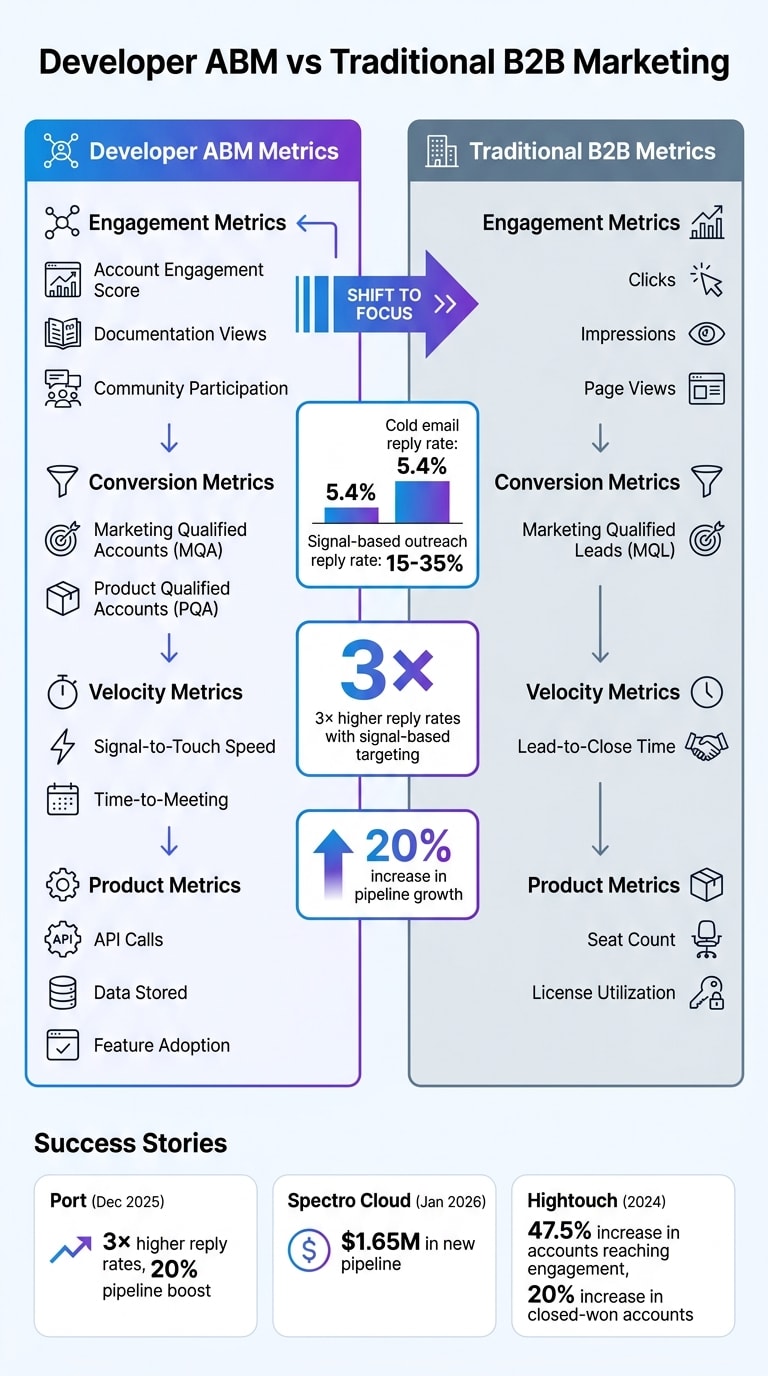
Traditional B2B metrics like MQLs, clicks, and impressions often fail to capture meaningful progress in developer ABM. For instance, just because an engineer downloads a whitepaper doesn’t mean the account is advancing. Developer ABM shifts the focus from individual leads to account-level engagement and tracking progression through specific stages. In this context, measuring account-level signals becomes crucial for aligning grassroots developer adoption with broader enterprise objectives.
Top-performing developer tool companies prioritize responding quickly to technical intent signals. These signals have a short shelf life, and high-performing teams aim to act within 24 hours of receiving them. They also analyze which signals are most likely to lead to meetings and closed deals, ensuring their efforts focus on what truly drives results.
Pipeline Influence and Account Engagement Metrics
Instead of relying on MQLs, redefine success by identifying Marketing Qualified Accounts (MQAs) - accounts that show coordinated interest across multiple stakeholders. For example, an MQA might require a minimum engagement score, involvement from at least one engineer and one director, and visits to high-intent pages like pricing or demo sections .
Track accounts as they move through stages such as Unaware, Aware, Interest, Desire, and Action. Hightouch applied this stage-based framework in 2024 and saw impressive results: a 47.5% increase in accounts reaching the "Aware" stage, an 82.5% rise in accounts progressing to "Interest", a 30% boost in opportunities generated, and a 20% increase in closed-won accounts .
For developer tools, product usage data is a powerful way to measure technical engagement. Metrics like API call volume, data stored, feature adoption (e.g., access control rules), and documentation views for premium features can reveal high-intent behavior. For instance, when developers from target accounts explore migration guides or pricing documentation, these are signals worth close attention.
Here’s a quick comparison of key metrics for developer ABM versus traditional B2B metrics:
| Metric Category | Key Developer ABM Metrics | Traditional B2B Metrics |
|---|---|---|
| Engagement | Account Engagement Score, Documentation Views, Community Participation | Clicks, Impressions, Page Views |
| Conversion | Marketing Qualified Accounts (MQA), Product Qualified Accounts (PQA) | Marketing Qualified Leads (MQL) |
| Velocity | Signal-to-Touch Speed, Time-to-Meeting | Lead-to-Close Time |
| Product | API Calls, Data Stored, Feature Adoption | Seat Count, License Utilization |
Additionally, keep an eye on coverage metrics - what percentage of your target accounts have shown active signals in the last 30, 60, or 90 days? This helps pinpoint gaps in visibility . Using these insights, you can refine your strategy and drive better results.
Using Developer Feedback to Improve Results
A robust feedback loop transforms engagement data into practical improvements. For instance, analyze win rates against specific signals to identify which behaviors - like GitHub activity, event attendance, or community posts - are most likely to lead to revenue. One company implemented signal-based outreach in December 2025, referencing specific developer activities, and achieved 3x higher reply rates along with 20% pipeline growth .
Centralizing all engagement signals - such as website activity, community interactions, and product usage - into a single data repository provides a clear view of account progression . Don’t overlook "dark social" platforms like Slack, Reddit, Discord, and GitHub, where developers often discuss challenges before engaging directly with your website .
Integrating first-party product data with third-party intent signals can help identify Product Qualified Accounts (PQAs). For example, trigger sales outreach when an account hits 80% of a pricing threshold for API calls or when developers explore premium feature documentation . In January 2026, Spectro Cloud used developer-focused intent signals to target high-value accounts, generating $1.65M in new pipeline .
Lastly, set up suppression rules to exclude accounts that have already moved to later stages. This prevents wasted ad spend and avoids overexposing accounts that are actively engaged in sales conversations . By continuously refining these metrics, your ABM strategy stays agile and focused on driving meaningful outcomes.
Conclusion
ABM for developer tools takes a different route compared to traditional methods. Its success isn’t about flashy sales tactics - it’s about earning trust through technical credibility. Developers are quick to spot insincerity and are far more likely to engage with authentic technical value than with high-pressure sales pitches .
Here’s the reality: only 5.4% of developers discover new tools through cold emails . That means your ABM strategy needs to meet them where they already are - on platforms like GitHub, Slack, Discord, and Reddit .
The proof is in the results. Take Port, for instance: their December 2025 shift to signal-based targeting led to 3× higher reply rates and a 20% boost in pipeline growth . Similarly, Spectro Cloud leveraged developer intent signals to generate $1.65M in new pipeline by January 2026 . These successes highlight the importance of treating ABM like a precise query system. By identifying accounts based on behavioral triggers - like GitHub forks or pull requests - and responding within 24 hours, you can engage developers when their interest is at its peak .
"ABM is not about casting a wider net; it's about crafting a specific, high-value API call to a client you already know is a perfect fit."
– Michael, Pro Developer & n8n Guru
The strategy is straightforward: build account lists using developer-specific signals, create content tailored to both engineers and decision-makers, and measure success by tracking account-level engagement rather than MQLs. Tools like daily.dev for Business allow for precise targeting within developer communities. Meanwhile, a stage-based measurement framework - tracking awareness and product usage - can drive serious results. For instance, Hightouch saw a 30% lift in opportunities and a 20% increase in closed-won accounts after adopting this approach .
When it comes to developers, relevance always trumps volume. A well-crafted message that solves a specific technical problem will outperform generic, automated outreach every time . Focus on providing real engineering resources, referencing actual developer activity, and building trust through meaningful value. That’s how you turn grassroots developer interest into enterprise-level success.
FAQs
What signals should trigger ABM outreach to developers?
Key indicators for initiating ABM outreach to developers include GitHub activity, adoption of specific tech stacks, size of the engineering team, and job listings for related roles. These signals highlight accounts where engaging developers can significantly impact adoption and purchasing decisions.
How do I target developers and engineering managers at the same account?
To connect with both developers and engineering managers within the same organization, a multi-threaded approach works best. Tailor your content to meet the specific needs of each persona:
- For developers: Emphasize the technical aspects. Highlight hands-on tools, detailed comparisons, and practical resources that make their work easier and more efficient.
- For engineering managers: Focus on the big picture. Showcase strategic advantages like improved ROI, enhanced security, and long-term value.
By addressing their distinct priorities, you can create messaging that resonates with both groups, ensuring stronger and more effective engagement.
What metrics show developer ABM is effective without relying on MQLs?
When evaluating the success of developer ABM, three key metrics stand out:
Account engagement scores: These scores reveal how actively developers and accounts are interacting with your product, providing a tangible way to measure interest and involvement.
Developer adoption signals: Look for indicators like API usage, SDK downloads, or participation in developer communities. These signals demonstrate how developers are beginning to use your tools or integrate them into their workflows.
Time-to-procurement: This metric tracks how quickly engaged developers and accounts move from initial interaction to becoming paying customers, offering insight into the efficiency of your ABM strategy.
These metrics shift the focus away from traditional MQL-based measurements, offering a more accurate view of how developers and accounts are engaging with your product.