

Developers trust fellow developers more than polished marketing. Advocacy programs leverage this trust by empowering passionate users to share their experiences, provide feedback, and build community connections. These programs are not about offering material rewards but creating meaningful opportunities for developers to contribute, grow, and influence product development.
Key takeaways:
- Identify champions: Look for active contributors in forums, GitHub, or social media.
- Motivate through access and collaboration: Offer beta features, direct feedback channels, and opportunities to connect with teams.
- Structure programs flexibly: Allow champions to contribute in ways that suit their strengths without imposing rigid tasks.
- Measure impact: Track metrics like user adoption, time-to-value, and referral-driven signups to tie advocacy efforts directly to business outcomes.
Finding and Supporting Developer Champions
Developer champions are those standout users who go beyond their own needs to actively help others and shape the future of your product. While most users focus on solving their immediate challenges, champions take it further - they create tutorials, answer tough questions in forums, and even develop third-party libraries that enhance your tool’s functionality .
Characteristics of Developer Champions
Identifying potential champions starts with paying attention to their actions. These are the developers who frequently engage in community spaces like Slack or Discord, build plugins or libraries tied to your tool, submit pull requests, and share their expertise through blog posts . They typically display a mix of technical mastery and a genuine desire to assist others. Often, they’ll first experiment with your tool in personal projects before introducing it at work, signaling authentic interest .
Using data can help uncover champions you might otherwise overlook. Metrics like forum activity, GitHub contributions, and social media mentions can highlight users who are consistently engaged. However, don’t rely solely on champions to step forward themselves. As Luca Buchholz, Global Community Management Lead at Camunda, explains:
Impostor syndrome, where people suffer from chronic self-doubt and are uncertain about their talents and abilities, is real. Some people might never assume to consider themselves as Champions.
Reach out to those exhibiting champion-like behavior, even if they haven’t self-identified. Recognizing these patterns helps underscore that their advocacy stems from genuine enthusiasm, not external incentives.
What Drives Developer Champions
What motivates champions isn’t material rewards - it’s the intrinsic benefits. These include access to key people, career growth through visible expertise, forming strong community connections, and gaining exclusive insights . The chance to influence product development through direct feedback channels often outweighs the appeal of merchandise or financial perks.
To support this intrinsic motivation, focus on fostering autonomy, skill-building, and community . Provide early access to beta features and create private feedback channels to make them feel like insiders. Offer spaces where champions can collaborate with one another and with your engineering team. Let them choose how they contribute - whether it’s through writing code, creating content, or mentoring others - rather than imposing strict guidelines. As Matthew Revell, Founder of Hoopy Limited, cautions:
When you take something people enjoy doing and turn it into work, the research suggests that they stop enjoying it. The intrinsic motivation that made them great contributors in the first place gets replaced by a checklist of obligations.
Instead of setting obligations upfront, recognize their contributions after the fact. Show appreciation through speaking opportunities, guest blog posts, or simply amplifying their voices. Frame participation as a way to help the community, not as a series of tasks. This approach keeps their advocacy authentic while encouraging them to stay engaged.
Creating a Structured Developer Advocacy Program
Building a developer advocacy program is about crafting a framework that empowers passionate individuals to contribute in ways that resonate with them. The focus should be on creating systems that recognize and amplify their efforts, foster connections, and provide meaningful opportunities - without turning their enthusiasm into a checklist of tasks.
Core Elements of an Effective Advocacy Program
A strong program starts by offering tiered membership levels that cater to various engagement styles. Not all champions contribute in the same way - some thrive on writing code and submitting pull requests, while others excel at mentoring or creating tutorials. The program should be flexible enough to embrace these diverse strengths instead of forcing a one-size-fits-all approach.
Private communities are essential for fostering collaboration. Whether through Slack, Discord, or private forums, these spaces give advocates a dedicated environment to connect with each other and your product team. Here, they can share technical insights, collaborate on projects, and discuss product direction without the distractions of broader user channels.
Direct access to your engineering team is another cornerstone. This isn't about gathering random feature requests - it’s about tapping into the expertise of your most engaged developers. When champions see their feedback shaping the product roadmap, it reinforces their importance and shows that their contributions go beyond surface-level acknowledgment.
To support their efforts, champions need access to comprehensive resources. This includes detailed documentation, SDKs, troubleshooting guides, early beta access, and even branded assets for public speaking engagements. These tools empower them to provide technical support, create content, and advocate effectively. Add targeted rewards and recognition to this foundation, and you’ll deepen their commitment even further.
Rewards and Recognition That Maintain Authenticity
Recognition works best when it’s public and merit-based. Shoutouts on social media, blog features highlighting champion projects, and community awards validate expertise without feeling transactional. As Doc-E.ai explains, "Developers trust recommendations from their peers more than traditional marketing messages" . This trust disappears if recognition feels like it’s bought rather than earned.
Professional development opportunities are another excellent way to engage advocates. Offering mentorship programs, technical workshops, or one-on-one sessions with your engineering team aligns with their natural motivations. Giving them speaking opportunities at your events or conferences not only boosts their visibility but also strengthens their relationship with your brand.
Finally, exclusive access is one of the most meaningful rewards. Invitations to product strategy sessions or advisory boards make champions feel like true insiders. The real value here isn’t just in the access - it’s in the sense of belonging and influence it provides. By focusing on intrinsic motivation rather than external incentives, you keep the advocacy authentic and rooted in genuine passion.
Turning User-Generated Content into Marketing Assets
Developer champions produce some of the most trusted and relatable marketing content out there - think tutorials that address real-world challenges, GitHub repositories showcasing practical implementations, and forum discussions that reflect deep product knowledge. The real task lies in transforming these organic contributions into marketing tools that extend your brand's reach while keeping their authentic tone intact.
Using Customer Stories in Marketing
The secret to integrating user-generated content into your marketing is simple: amplify it without altering its essence. Highlight champions' tutorials, projects, or other contributions on your blog, social media, or even a dedicated community gallery. This kind of public acknowledgment not only validates their expertise but also gives you marketing material that feels more genuine than anything created in-house. As Doc-E.ai aptly states:
Developers can sniff out marketing BS from a mile away. But they do trust other developers.
To support this, provide branded assets like logos, templates, or slide decks that champions can use. These tools allow them to maintain their personal voice while ensuring the content has a polished, professional edge. By enhancing their creative process rather than dictating it, you ensure the content stays authentic while your brand benefits from the collaboration.
You can also encourage co-creation efforts. Webinars, guest posts, or speaking opportunities are great ways to partner with champions. These collaborations tap into their technical expertise and credibility while giving them a platform to share their enthusiasm for your product.
Now, let’s look at how to amplify this content even further.
Working with Champions to Expand Content Reach
Creating the content is just the first step - getting it in front of the right audience is equally important. Help your champions by promoting their work through your official channels. A simple retweet or a feature on your blog can dramatically increase its visibility.
Another effective strategy is offering early access to new features or products. This allows champions to create exclusive "first-look" content that builds excitement. It’s a win-win: they get to position themselves as thought leaders, and you gain authentic coverage during a critical launch period. Plus, the feedback generated during beta phases can guide your product development.
Finally, track the impact of champion-created content. Metrics like social reach, engagement, advocate-driven leads, and their influence on product adoption or signups provide valuable insights. This data helps you fine-tune your strategy, identifying what resonates with your audience and which champions are driving the best results - all without pressuring them into content that feels forced or off-brand.
Developer Ambassadors vs. Paid Influencers: When to Use Each
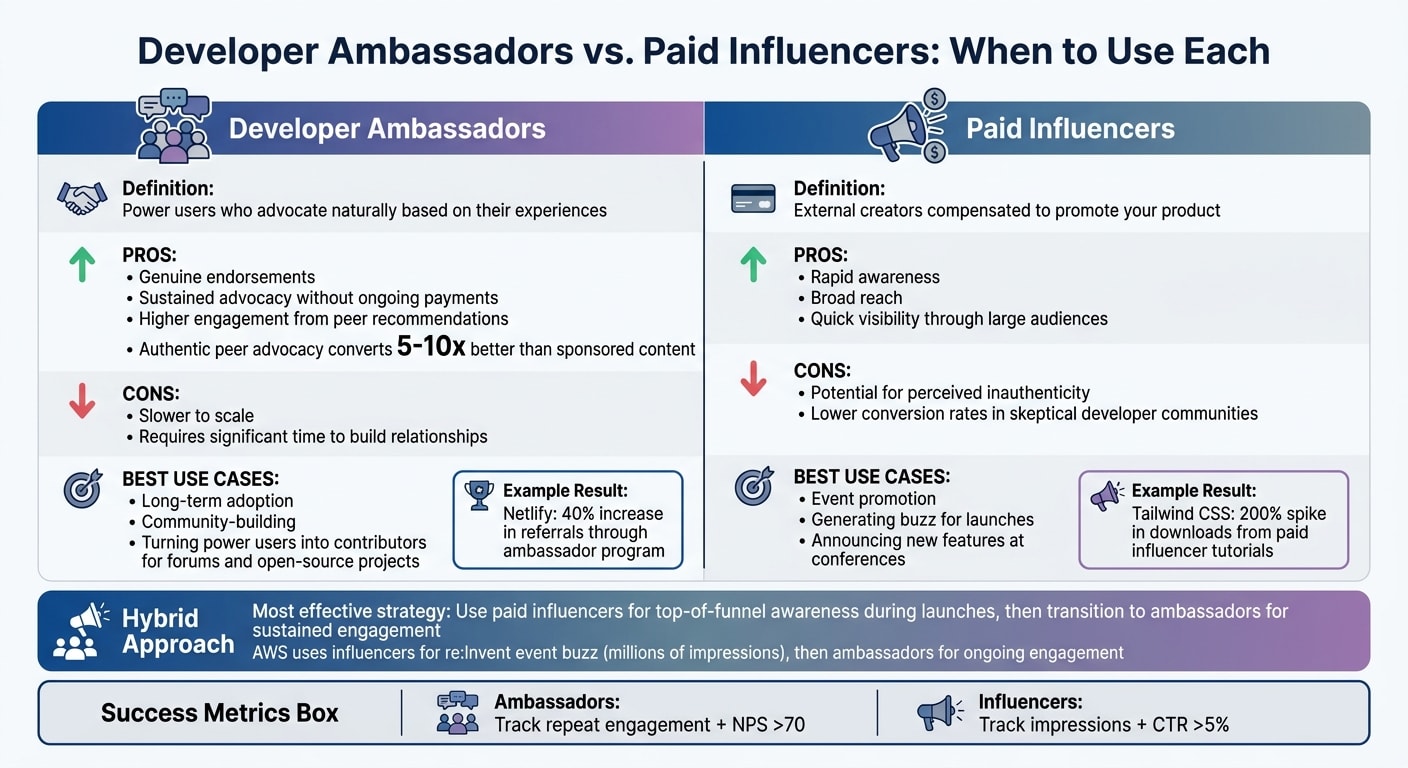
When it comes to promoting developer tools, you have two key strategies to consider: cultivating developer ambassadors who advocate naturally based on their experiences, or partnering with paid influencers who can offer immediate and widespread visibility. Each option has its strengths, and knowing when to use one over the other can significantly impact your marketing success.
Developer ambassadors are typically power users who’ve achieved tangible results with your product. They create valuable content like tutorials, open-source tools, and forum contributions that demonstrate a deep understanding of your tool. For instance, Netlify’s ambassador program empowered users to host meetups and develop plugins, leading to a 40% increase in referrals as these advocates fostered authentic connections within the community.
On the other hand, paid influencers are external creators compensated to promote your product. They bring large, targeted audiences and can generate quick visibility. A great example is Tailwind CSS, which paid prominent Twitter developers to create tutorials, resulting in a 200% spike in downloads. However, this strategy required a shift to ambassadors for long-term engagement, as developers often distrust purely transactional promotions.
The key difference between these approaches lies in the trade-off between authenticity and speed. Ambassadors are excellent for building trust and driving sustained adoption, though they take time to nurture. Paid influencers, meanwhile, are ideal for rapid awareness and reach - perfect for launches or event promotions - but can risk appearing insincere if overused. Research shows that authentic peer advocacy in developer communities converts 5–10 times better than sponsored content, highlighting the importance of balancing these strategies.
Comparing Both Approaches
| Type | Pros | Cons | Best Use Cases |
|---|---|---|---|
| Developer Ambassadors | Genuine endorsements, sustained advocacy without ongoing payments, higher engagement from peer recommendations | Slower to scale, requires significant time to build relationships | Long-term adoption, community-building, turning power users into contributors for forums and open-source projects |
| Paid Influencers | Rapid awareness, broad reach, quick visibility through large audiences | Potential for perceived inauthenticity, lower conversion rates in skeptical developer communities | Event promotion, generating buzz for launches, announcing new features at conferences |
The most effective strategy often involves a mix of both. For instance, you can use paid influencers to create top-of-funnel awareness during a product launch, then transition to ambassadors to maintain engagement and foster deeper connections. AWS exemplifies this hybrid approach, using influencers to drive excitement for events like re:Invent, generating millions of impressions, and then leveraging ambassadors for sustained engagement.
To measure success, track authenticity signals like repeat engagement and Net Promoter Scores above 70 for ambassadors. For influencers, focus on metrics like impressions and click-through rates above 5%. This data will help you determine which approach aligns best with your goals.
Measuring Advocacy Program Results
To gauge whether your advocacy efforts are driving real business growth - or just burning resources - you need to monitor specific, actionable metrics. Focus on three main areas: increasing active developer users, reducing time-to-value (TTV), and demonstrating measurable revenue impact. These metrics go beyond surface-level stats; they reveal whether your advocacy program is truly moving the needle for your business .
"If you can't draw a line from your work to business outcomes, you don't have a function - you have a hobby." - Founder, Built for Devs
Monitoring Performance Metrics
The best way to measure advocacy success is by focusing on metrics that directly influence business outcomes.
One key metric is Time-to-Value (TTV) - the time it takes a developer to achieve their first meaningful success, like making an API call or deploying an integration. By tracking milestones such as signups, first API calls, and production deployments, you can identify areas for improvement. For example, cutting TTV by 30% can increase free-to-paid conversions from 5% to 7%, translating to a 40% revenue boost - all without additional acquisition costs .
Another area to watch is support ticket deflection. Community forums and office hours can drastically reduce the need for support tickets. When Snap introduced their Camera Kit SDK beta, they used these tools to cut support tickets by 85% while also gathering valuable product feedback from the community forum .
Lastly, track content-originated referrals. These often make up 50–70% of developer signups and come from sources like blog posts, tutorials, Stack Overflow answers, and GitHub repositories . By embedding tracking links or referral codes in educational content, you can measure how these efforts contribute to your sales funnel. Developer advocates typically generate an 8–15% referral rate, with 25–40% of referred users signing up for free accounts and 8–15% converting to paying customers .
Connecting Advocacy to Business Results
To truly prove the value of your advocacy program, you need to connect it to revenue growth.
Advocacy programs can drive revenue through bottom-up enterprise adoption. For example, track domain signups to identify when multiple developers from the same company start using your product. Developers who join through referrals often generate 3–5x more expansion revenue than those acquired through paid channels, with acquisition costs as low as $10–$50 per developer compared to $500–$5,000 for enterprise-focused efforts .
The most impactful programs link advocacy touchpoints - like tutorials, community events, and user-generated content - to the sales pipeline and paying customers. Instead of just tracking signups, focus on developer active users (DAU/MAU) - those who complete onboarding and regularly use your product. For example, a Discord community with 10,000 members might seem impressive, but if there’s no connection to product usage, it’s just community management, not business impact .
These metrics underline a critical truth: genuine developer engagement doesn’t just build community - it drives sustainable business growth. By focusing on the right data, you can ensure your advocacy program is a growth driver, not just an expense.
Growing Advocacy Programs While Staying Authentic
Scaling an advocacy program comes with a unique challenge: how do you grow without losing the personal touch that made it successful in the first place? Lauren Buchman captures this perfectly:
Ambassadorship, and getting other people in the developer community to tell your story, is the best growth lever that any developer or technical product can have. It is mana from heaven .
The key is to avoid turning a once-organic program into a rigid corporate marketing tool. To meet this challenge, a structured framework can help scale advocacy while keeping its authenticity intact.
A Framework for Scaling Advocacy
To grow your program without losing its soul, start by valuing each advocate's individual contributions. Transitioning from an informal setup to a more intentional structure requires careful planning. Champions play the role of "micro-distributors", and their impact should be nurtured, not overshadowed .
Use data insights to evaluate how champions' roles evolve. Look for signs of leadership, like mentoring others, contributing technically, or driving community engagement . Once you identify key advocates, keep them engaged with regular communication. Treat them like partners - ask for their feedback and keep them in the loop on product updates .
Support these leaders with resources tailored to their needs. This might include technical tools like SDKs and code examples, marketing materials they can personalize, or professional development opportunities like exclusive workshops or mentorship programs . And don’t forget to celebrate their efforts. Public recognition through blog features, social media highlights, or speaking engagements can amplify not just your brand but theirs as well .
Preserving Authenticity as You Grow
Trust is the foundation of any successful advocacy program, and maintaining it at scale requires prioritizing what truly motivates your advocates. The OSNAP Framework - Ownership, Status, Networking, Access, and Perks - provides a guide for doing just that .
- Ownership: Give advocates a sense of responsibility within the community.
- Status: Offer titles or public recognition that highlight their contributions.
- Networking: Facilitate connections between champions to strengthen their ties.
- Access: Provide direct communication with your product and engineering teams.
- Perks: Only after meeting intrinsic needs, offer swag or exclusive event invitations.
To keep things personal, create program elements that are consistent but adaptable. For example, offer branded templates that advocates can modify to match their style. This approach allows for scalability while preserving the authenticity that makes advocacy powerful .
As Aileen Allen puts it:
Champions multiply the impact of every community investment. They're the connectors, advocates, and translators who tell the company's story better than the company ever could. They're authentic in a way that a brand cannot be .
Promoting Developer Champions Through daily.dev Ads
Once you've established a strong advocacy program, it's time to ensure your champions' voices extend beyond your immediate community. This is where targeted promotion comes into play. Platforms like daily.dev Ads offer a way to amplify content created by your champions, reaching over 1 million developers who are actively exploring new tools and technical insights.
What makes daily.dev Ads stand out is its native advertising approach. Unlike traditional banner ads that developers often overlook, daily.dev's in-feed and post-page ads integrate seamlessly into the content developers are already engaging with. For example, when a champion shares a tutorial, case study, or technical deep dive about your tool, promoting it through daily.dev places their story directly in front of developers searching for relevant solutions.
Using daily.dev Ads to Highlight Champion Content
daily.dev attracts 800,000+ unique monthly visitors, with 70% of them being mid-to-senior level developers who have three or more years of experience. These are the decision-makers who often drive tool adoption within their teams.
- In-feed ads: These ads naturally appear within personalized feeds, achieving click-through rates nearly four times higher than average.
- Post-page ads: These provide full-page visibility after article views, making them perfect for showcasing detailed champion stories.
Both ad formats maintain the authenticity developers value, ensuring the content feels genuine rather than overly promotional.
Reaching the Right Developers with Targeted Ads
Effective promotion isn't just about visibility - it’s about ensuring the right people see your champions’ stories. daily.dev allows you to target specific audiences based on programming languages (e.g., JavaScript, Python, Go), tools and frameworks (e.g., React, Kubernetes, AWS), developer roles, experience levels, and even geographic locations.
For example, if a champion shares insights about using your API in a Node.js microservices architecture, you can target developers who work with Node.js, Docker, and AWS. This layered targeting ensures your message reaches a highly relevant audience, rather than being broadcast to all developers.
daily.dev also uses automated personalization, meaning promoted content appears to users who’ve already shown interest in similar tools or topics. To maximize results, start with a focused campaign around your top champion's most engaging content. Use UTM parameters to track referrals and content views, connecting daily.dev's reach to your advocacy program metrics. Additionally, A/B testing different headlines or champion quotes in your ads can increase engagement by 20-50%, all while keeping the authentic tone that makes champion content resonate.
Conclusion
Developer advocacy programs tap into a level of trust that traditional marketing just can't achieve. Developers naturally gravitate toward real, peer-driven endorsements rather than polished marketing pitches. When your most enthusiastic users share their honest experiences, they create a kind of credibility that no ad campaign can replicate.
The most effective programs understand that true advocates are fueled by their passion for the product. By involving these champions as collaborators - offering them early access to new features, direct communication with your product team, and a voice in shaping your roadmap - you build partnerships that foster sustained growth .
Scaling in a way that feels genuine allows your community to thrive. Champions take on roles like mentoring new users, answering complex technical questions, and creating content that reaches developers you might not otherwise connect with. This approach - often referred to as community-led growth - not only reduces customer acquisition costs but also creates an environment where developers feel appreciated and included .
To measure success, focus on metrics like advocate-driven leads, community engagement levels, and how champion feedback directly influences product development. These data points link advocacy efforts to tangible business outcomes, showing how developer champions actively contribute to growth . This emphasis on organic, passion-driven advocacy highlights the lasting impact these champions can have.
But it doesn't stop there. Amplifying the reach of authentic champion content can take your growth even further. When you're ready to expand beyond your immediate community, platforms like daily.dev Ads can help you share these authentic stories with over 1 million developers. By combining grassroots advocacy with targeted promotion, you create a powerful strategy that builds trust, drives adoption, and scales effectively - all while staying true to your community. This thoughtful amplification ensures that genuine advocacy remains at the heart of your growth, creating a cycle of trust and long-term success.
FAQs
How do I find potential developer champions?
To find developer champions, start by identifying users who display a genuine enthusiasm for your tools. These are the individuals who don’t just use your product - they actively engage with it. Look for those who:
- Offer detailed and thoughtful feedback about your tools.
- Participate in community forums or contribute to open-source projects tied to your product.
- Share their positive experiences with others, whether through blogs, social media, or word of mouth.
Paying attention to their involvement and encouraging their natural passion can transform these users into loyal advocates for your developer tools.
How do I reward advocates without making it transactional?
Recognize advocates by tapping into what truly drives them - passion and a sense of belonging. Publicly acknowledge their efforts, highlight their success stories, and provide them with meaningful ways to connect and contribute within your community. Skip the overly transactional gestures like branded swag; genuine advocacy thrives on deeper, intrinsic motivations rather than material perks.
What metrics prove a developer advocacy program works?
Key metrics to watch include developer engagement (such as community participation and activity on social media), content performance (like user-generated content and developer contributions), community growth, platform adoption rates, and developer satisfaction and retention. These metrics provide a clear picture of how well your program is fostering loyalty and encouraging meaningful interactions.