

Developers are a unique audience. They’re tech-savvy, skeptical of generic content, and rely on trusted sources like GitHub, Reddit, and Hacker News. Marketing to them requires precision, technical depth, and transparency - especially when using AI. Here’s a quick summary of the best strategies for 2026:
- AI in Content Creation: Use AI for repetitive tasks like API documentation templates, release notes, and code comments. Always review outputs for accuracy and relevance.
- Predictive Analytics: Analyze developer activity (e.g., GitHub commits, forks, and issues) to identify high-intent leads. Scoring systems help prioritize outreach.
- Segmentation: Group developers by language, seniority, and behavior. Tailored messaging increases engagement by up to 40%.
- Chatbots: Build bots that connect to live systems and provide accurate, version-specific answers. Escalate complex queries to human experts.
- Ad Campaigns: Use AI to optimize ads in real-time, target developers based on technical attributes, and reduce acquisition costs by 30–50%.
- Transparency: Avoid "AI slop." Developers value honesty and technical accuracy over flashy marketing.
The key? AI should support your strategy - not replace expertise. Focus on delivering value developers can’t find elsewhere, and always maintain trust through technical rigor and clear communication.
AI Tools for Creating Developer Content
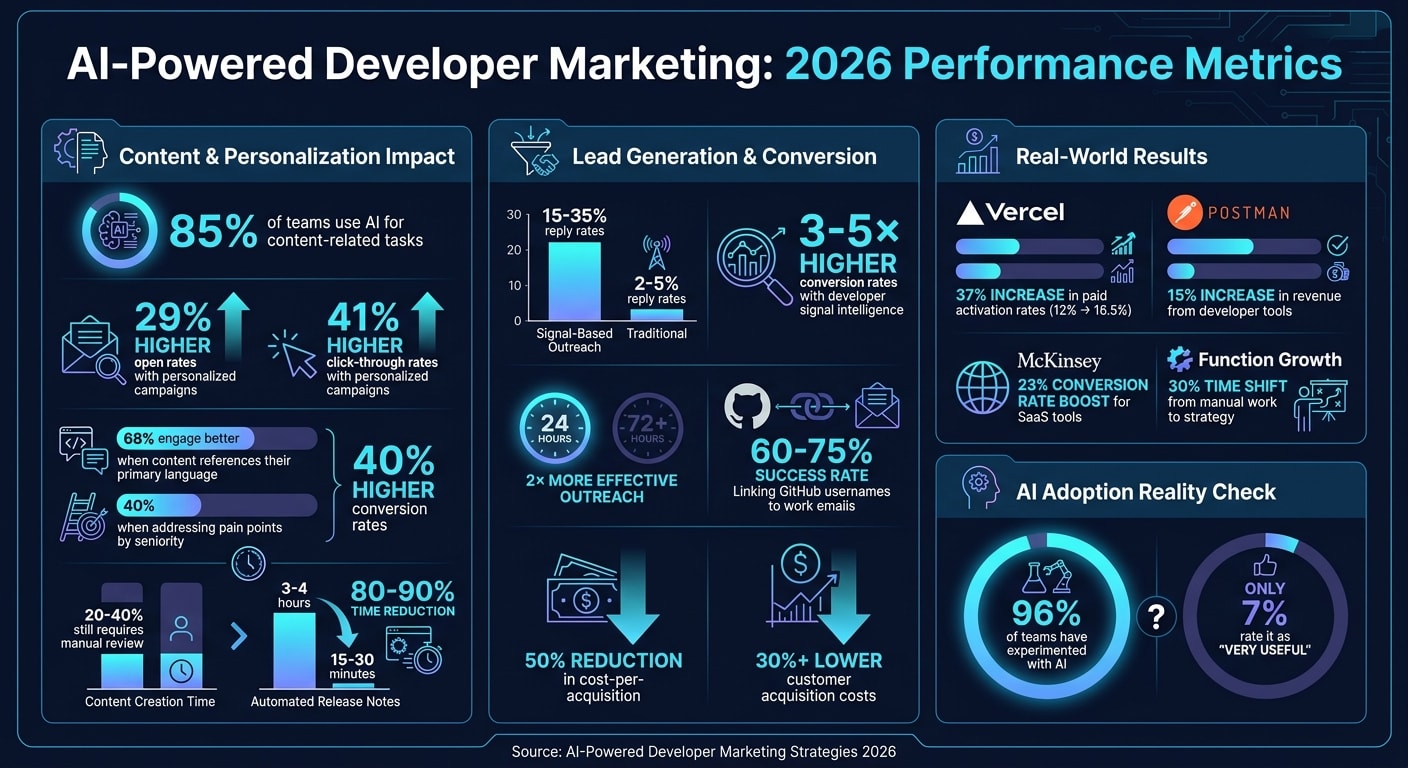
AI can speed up the process of creating technical content, but it still needs human oversight to avoid mistakes that could hurt developer trust. According to data, 85% of teams use AI for content-related tasks . While AI is great at drafting release notes, API documentation templates, and code comments, it can’t replace the expertise of someone who truly understands your product.
A key technique here is Retrieval-Augmented Generation (RAG). This method connects AI-generated content to your actual documentation, commit history, and spec files, ensuring accuracy instead of allowing the AI to "guess" . With RAG, every claim can be traced back to verified sources, significantly reducing errors. Without this approach, developers will spot inaccuracies, which can harm credibility.
Even with AI, manual review still takes up 20-40% of the total time spent on content creation . This isn’t a flaw - it’s intentional. As Avery Cole, Senior Editor & DevTools Strategist, explains:
The goal is augmentation, not replacement: let AI handle scale, and let humans own judgment .
Human expertise is essential to ensure code examples actually work, error messages align with the latest API version, and the tone doesn’t drift into generic marketing language.
When AI Helps and When Humans Must Step In
AI is most effective for structured, repetitive tasks where the format is predictable, and source material is readily available. For example, automating release notes can cut the time needed from 3-4 hours to just 15-30 minutes - a time reduction of 80-90% . Tools like Jasper AI ($49/month) are great for project documentation and READMEs, while Writesonic ($19/month) excels at API documentation and other structured content .
However, AI struggles with tasks that require judgment. It can’t conduct customer interviews to uncover why a feature is important or decide which edge cases to highlight in a tutorial. And while AI can generate code examples, testing those examples manually is essential to maintain developer trust . If a developer tries a sample and it fails, you risk losing credibility.
These limitations make it clear: AI works best for predefined, structured tasks, while humans are needed for nuanced decision-making.
Types of Developer Content AI Can Assist With
AI can be a powerful tool for certain types of developer content, provided its output is reviewed and refined by experts. Here are a few areas where AI shines:
- API documentation templates: AI can create a consistent structure using your OpenAPI spec. Experts should then verify the details and add context, like why specific fields exist.
- Automated code comments and docstrings: Tools like GitHub Copilot can integrate with your IDE to suggest inline logic explanations . Be sure to review all suggestions before committing.
- Release notes and changelogs: AI can pull structured data from Git commits to save time . However, a human touch is needed to translate technical updates into user-friendly language.
- Technical roundup posts: AI can synthesize themes from real discussions on platforms like Reddit, Hacker News, or GitHub, as long as it’s grounded in actual data . This prevents content from feeling generic or irrelevant.
What AI can’t handle well are tasks like original research, customer interviews, verifying edge cases, or crafting a unique technical perspective . These require human expertise and are often what separates high-quality content from generic AI output.
Using Predictive Analytics to Find Developers Ready to Buy
In addition to AI-driven content creation, predictive analytics is now revolutionizing how companies identify developers who are actively exploring tools. By analyzing activity on platforms like GitHub, Stack Overflow, and package repositories, AI can highlight developers who are not just browsing but actively evaluating solutions. This approach, known as developer signal intelligence, tracks specific, identity-linked actions - such as opening issues, forking repositories, or submitting pull requests - to gauge intent more accurately than traditional methods.
However, not all developer activities carry the same weight. For instance, a developer starring 50 repositories might only show casual interest. In contrast, someone who forks your repository, configures files, and raises an issue about deployment clearly signals deeper engagement. As LeadCognition explains:
A developer who stars 50 repos a week is a poor lead. A developer who forks your repo, adds configuration files, and opens an issue about their deployment environment is actively buying .
This signal-based approach to outreach significantly outperforms traditional methods, achieving reply rates of 15–35% compared to the usual 2–5%, and converting leads at rates 3–5 times higher .
How AI Scores Leads Based on Developer Behavior
AI systems assign scores to various GitHub actions, such as 10 points for a pull request, 8 for an issue, 5 for a fork, and 1 for a star . When a lead’s score exceeds 15 points, it often indicates they are ready for immediate sales outreach.
Timing is another crucial factor. AI applies multipliers to recent activities, like doubling the score for actions taken in the last 24 hours or boosting it by 1.5× for actions within the past week. Outreach within 24 hours of a high-intent signal is twice as effective as waiting more than 72 hours . Since intent signals fade quickly, acting promptly is essential.
AI also refines lead scoring by analyzing the content of issues and forum posts for specific keywords. Terms like "SSO", "SAML", "enterprise pricing", "migrate", or "Terraform" receive a 1.3× boost, as they often indicate commercial interest. For instance, a developer asking on Stack Overflow about migrating from a competitor’s tool is signaling clear purchase intent . These methods make it easier to identify valuable leads within the developer community.
Finding High-Value Developers Through Community Activity
Beyond monitoring direct engagement with your repositories, AI expands its scope to track activity within the broader ecosystem. By observing "ecosystem repos" - tools or dependencies related to your product - AI can identify developers who align with your Ideal Customer Profile, even if they haven’t yet interacted with your solution. For example, a database tool provider might track activity on popular ORMs or data pipeline frameworks to find potential users .
AI also identifies "signal clusters", such as a developer starring multiple database-related repositories in a short period or several engineers from the same company engaging with your tool. These patterns often indicate a company-wide evaluation process .
To make outreach more effective, identity resolution tools can link GitHub usernames to verified work emails with a 60–75% success rate for senior engineers. This allows for personalized communication, referencing specific technical issues the developer has raised in an issue or pull request, which significantly boosts engagement .
Pricing for these tools varies widely. LeadCognition, for instance, offers a free tier with 25 unlocks, while its Scale plan costs up to $799 per month . On the higher end, enterprise platforms like Common Room range from $12,000 to $50,000+ annually, and traditional ABM tools like 6sense start at over $50,000 per year . Despite these costs, GitHub intent data is estimated to be 10–100× less expensive than traditional enterprise intent platforms .
Personalizing Messages for Different Developer Segments
Once you've identified developers with high intent, the next step is crafting messaging that truly connects with them. Generic messages simply don’t cut it - developers expect content that speaks directly to their needs and interests. With AI, it’s now possible to customize messaging based on programming languages, experience levels, job roles, and technical interests. This tailored approach lays the foundation for deeper segmentation and more precise content strategies.
According to 2025 data from HubSpot and Stack Overflow, personalized developer campaigns significantly outperformed generic ones, achieving 29% higher open rates and 41% higher click-through rates. Even more striking, 68% of developers engaged better when content referenced their primary programming language. And it makes sense - a Python developer exploring machine learning tools has no interest in reading about JavaScript frameworks.
How to Group Developers for Better Targeting
AI-powered tools can group developers by analyzing data from platforms like GitHub, Stack Overflow, and community interactions. Solutions such as Segment.io and Customer.io use clustering algorithms to identify patterns in developer behavior. For instance, some machine learning models in platforms like HubSpot can classify users as "Python specialists" if 70% of their commits involve Python. This enables targeted content delivery, such as Rust tutorials for systems programmers .
The most effective segmentation combines multiple factors. AI can estimate seniority by analyzing contribution data, allowing for precise targeting like "senior backend engineers working with Go" or "junior frontend developers exploring React." Campaigns that address specific pain points by seniority perform better - 40% higher conversion rates - because juniors get beginner tutorials, while seniors receive advanced guides on architecture .
A great example comes from Vercel in Q4 2025. They used GitHub data to segment users into Next.js frontend developers and Node.js backend developers. By delivering personalized onboarding tutorials to each group, they achieved a 37% increase in activation rates (from 12% to 16.5%) and a 22% boost in paid conversions. This initiative was led by Alex Johnson, Growth PM at Vercel, and detailed in their Growth Blog Case Study from January 2026.
Adapting Content Based on Developer Preferences
Once developers are segmented, the next step is to create adaptive content that evolves with their preferences. AI plays a critical role here, ensuring that messaging aligns with where each developer is in their journey.
With tools like Optimizely and Dynamic Yield, messaging can be adjusted in real-time based on user behavior. For example, if a developer spends time reading React documentation or searches for specific terms, the system can automatically recommend JavaScript-focused resources. Similarly, email platforms such as Persado use AI to analyze past clicks and craft personalized subject lines. A senior DevOps engineer might see an email titled "Master Kubernetes for Senior DevOps", while a junior developer might receive "Kubernetes Basics for Beginners." This level of personalization has been shown to deliver 20-35% higher click-through rates .
A standout case comes from Postman in February 2026. They used AI to segment API developers by seniority and sent tailored API documentation. The junior segment saw 51% higher tutorial completion rates (from 18% to 27%), which contributed to a 15% increase in revenue from developer tools. This project was spearheaded by Maria Lopez, Postman’s DevRel Lead, and highlighted in their 2026 Annual Report.
McKinsey’s B2D Insights from Q1 2026 also revealed that AI-driven segmentation boosts conversion rates by 23% for SaaS tools targeting developers. Transparency is key here - developers appreciate when companies disclose how personalization works and offer opt-out options. This builds trust with an audience that’s already well-versed in AI technologies.
AI Chatbots for Developer Product Marketing
AI chatbots are only as good as their ability to deliver precise, context-aware technical answers. Developers have little patience for vague or inaccurate responses - things like outdated API documentation or incorrect version details can quickly lead them to abandon the chatbot altogether. The secret to success? Build chatbots that connect to live systems and know when to escalate questions to human experts.
Generic AI chatbots often fall short with developers because they lack product-specific knowledge. As Docsie explains:
Generic AI assistants don't understand your business context. They can't distinguish between your product's 'premium tier' and 'enterprise tier' because they don't know your pricing model.
To address this, chatbots must have version-specific intelligence. For example, they need to differentiate between API versions like 2.3 and 3.1. Instead of acting like a basic search tool, they should pull directly from structured documentation. This emphasis on accuracy ensures they integrate smoothly with technical support systems.
Using Chatbots to Support Developer Needs
The most effective chatbots work seamlessly with developer tools and live systems. Solutions like Microsoft Copilot and Google Gemini demonstrate how embedding AI into ecosystems can provide context-aware assistance. For developer products, this might involve connecting the chatbot to tools like Jira for bug tracking, GitHub for real-time API updates, or Salesforce for account-related inquiries. These integrations reinforce the chatbot's credibility by ensuring it delivers relevant and accurate information.
Accuracy starts with proper knowledge mapping. Before launching a chatbot, make sure your documentation is well-organized. For example, separate API references from legal or internal materials, and design the chatbot to ask clear, concise questions - such as gathering project IDs or error descriptions upfront. This reduces the need for repetitive follow-ups.
To maintain transparency, always link answers to source documentation and version control systems so developers can verify the information themselves. And when the chatbot encounters a question it can't handle - like a complex architectural issue or an enterprise-level query - it should escalate the matter to a human expert instead of attempting to "guess." As Docsie puts it:
Your documentation doesn't need another search interface. It needs an AI agent that understands your business, connects to your systems, and makes knowledge accessible when it matters most.
Practical Chatbot Uses for Developer Products
Chatbots can also enhance developer interactions by automating tasks like lead qualification and onboarding. For instance, during product evaluations, chatbots can collect behavioral data to qualify leads. Deploying bots on platforms developers already use - like Telegram or WhatsApp - makes it easier to provide support without requiring new account sign-ups. You can even use segmentation features to group developers based on technical preferences, such as their go-to programming languages or frameworks.
When it comes to onboarding, chatbots can guide developers through setup processes by offering version-specific tutorials and troubleshooting tips. Tools like Intercom Fin can pull data from help desks to resolve tickets, while chatbots are now capable of autonomously handling multi-step workflows. For example, they can trigger Jira tickets or check regulatory compliance databases without constant user input. Docsie's AI-powered platform, which boasts a 4.8-star rating from over 100 reviews as of 2026, shows that developers value thoughtful chatbot solutions .
To ensure your chatbot meets developer expectations, define its role clearly in the prompts. For instance, instruct it with something like, "You are a technical support bot for project management software." Also, make sure it references only the provided databases and avoids generating information on its own. These steps will help establish your chatbot as a trusted tool rather than another source of frustration for developers.
How AI Improves Developer Ad Campaign Performance
AI is reshaping how developers are targeted in advertising by enabling real-time decisions that traditional fixed bid rules simply can't match. Using predictive models, AI analyzes developer behavior, market trends, and intent signals as they occur. This ensures your ad budget focuses on reaching developers actively searching for solutions, not just casual browsers . The ability to optimize in real time also paves the way for fine-tuning creative elements and audience targeting in future campaigns.
The results speak for themselves: AI-driven ad strategies can reduce cost-per-acquisition by 50%, increase lead generation by 50%, and lower customer acquisition costs by over 30% .
Testing Ad Creatives with AI
AI takes the guesswork - and the waiting - out of creative testing. It continuously experiments with ad variations, such as headlines, visuals, and calls-to-action, without requiring manual setup. Instead of waiting weeks for A/B testing results, AI simultaneously evaluates multiple options, identifies the best performers, and reallocates budgets toward those winning combinations.
A great example comes from Function Growth, a marketing agency that embraced an AI-powered analytics tool in 2026. This tool allowed their team to shift up to 30% of their time from manual data handling to more strategic work . Adam Orris, Director of Data and Analytics at Function Growth, shared:
"Improvado transformed our approach to marketing analytics. Its automation capabilities and AI-driven insights allowed us to focus on optimization and strategy, without the need for manual data management."
In addition to refining creative elements, AI enhances audience targeting by understanding the technical profiles of developers.
Targeting Developers Based on Technical Attributes
Reaching developers requires precision. Instead of targeting broad demographic groups, AI identifies developers based on their tech stack, preferred programming languages, researched frameworks, and even the documentation they explore. With intent-triggered bidding, AI adjusts bids dynamically when developers show genuine interest - such as researching APIs or comparing tools - instead of sticking to a fixed schedule .
For instance, in late 2024, LINAK, a mid-market manufacturing company, used ZoomInfo Marketing's AI-driven intent signals to generate $33,000 in quotes in under three weeks. The system quickly detected intent signals and delivered targeted display ads, boosting efficiency and driving results .
AI also reallocates budgets intelligently, shifting resources from underperforming campaigns to high-performing ones with lower CPAs. Platforms like Google and Meta leverage smart bidding to focus on key performance indicators (KPIs) like CPA and ROAS, aligning ad spend with actual business goals rather than vanity metrics . This ensures that ad dollars follow where developer attention is most engaged, minimizing waste and maximizing impact.
Risks and Ethics of AI in Developer Marketing
Developers, especially those skilled in AI tools and large language models, can quickly detect content that lacks authenticity or depth. Nimrod Kramer, CEO of daily.dev, emphasizes this point:
Developers aren't your typical audience - they can smell marketing BS from miles away, and once you lose their trust, it's nearly impossible to win it back .
Content that falls short in technical accuracy or originality risks being dismissed outright, damaging your reputation in the process. For instance, AI-generated phrases like "AI-powered synergy" or generic code snippets that fail to work as intended are immediate red flags. Overhyping your product's capabilities without delivering on those promises? Developers will test it, expose its flaws, and call it out publicly. Rebuilding trust after such missteps is no easy feat.
These risks highlight the critical need for clear, honest communication when engaging with developer audiences through effective developer marketing.
Why Transparency Matters with Developer Audiences
Developers value honesty far more than flashy marketing. Being upfront about your product's limitations earns you more respect than exaggerated claims ever will. Graham Dumpleton, a Developer Advocate, explains:
The problem with AI slop is not that AI generated it. The problem is that nobody designed it with care or purpose .
Transparency involves acknowledging when AI has played a role in content creation and ensuring that all material is reviewed by someone with real expertise in the field. Developers appreciate brands that openly admit when a product is still in beta or has known limitations. On the other hand, they quickly lose respect when marketing promises "game-changing" results that the product can't deliver.
How Developers Spot Low-Quality AI Content
Developers are particularly adept at identifying low-quality AI-generated content . They can quickly discern whether a tutorial was crafted by someone with hands-on experience or by an AI recycling generic advice. Dumpleton highlights:
Developers have become good at spotting this. Most can tell within a few seconds whether something was written by a person with genuine experience or generated to tick a box .
Signs of low-quality content include shallow explanations, repetitive tutorials, and code snippets that fail to address real-world challenges. As Kramer points out:
Developer marketing is about trust. Once you lose it, no amount of paid ads or polished landing pages will bring it back .
To avoid these pitfalls, every AI-assisted piece should include real-world use cases and thoroughly tested code. Without this level of care, your content risks being dismissed as mere marketing fluff. Addressing these challenges is essential for building trust and credibility in your AI-driven developer marketing efforts.
Building Your AI-Powered Developer Marketing Strategy
In 2026, the most effective developer marketing strategies treat AI as a scaffold, not a creator. Charlotte Schmitt, Co-Founder of Octolens, captures this shift perfectly:
The human role shifts from 'write content from scratch' to 'curate, edit, and verify content based on real developer interactions' .
This means AI becomes a tool to speed up processes like ideation, drafting, and synthesizing data. But the final touches - ensuring technical accuracy, maintaining the right tone, and exercising editorial judgment - remain firmly in human hands.
Start with Proprietary Data
A successful strategy begins with proprietary data as the foundation. Instead of relying on generic prompts like "write a blog post about feature flags", use real feedback from platforms like Reddit, Hacker News, or GitHub issues . This ensures your content offers information gain - fresh insights and unique data that aren't already part of the AI's training set. Without this, you'll risk creating content that developers can immediately identify as rehashed or unoriginal. By starting with real-world developer input, you set the stage for authentic, high-quality content that stands out.
The Role of Human Judgment
While 96% of developer marketing teams have experimented with AI, only 7% rate it as "very useful" . Many teams fall into the trap of automating too much, sacrificing authenticity in the process. Prashant Sridharan, author of Picks and Shovels, highlights this key point:
AI is great for accelerating content production. But the human perspective is what makes content memorable .
These findings make it clear: human oversight is essential for turning AI-generated drafts into content that developers trust and value.
Implement a Human-in-the-Loop Workflow
To bridge the gap between automation and authenticity, adopt a human-in-the-loop workflow. Here’s how it works:
- Have technical experts review every piece generated by AI.
- Test code examples to ensure they actually run.
- Remove generic, overused phrases like "unlock the full potential."
- Structure documentation so it’s optimized for AI tools like GitHub Copilot and Claude .
With developers increasingly finding products through AI-driven tools, ensuring your documentation is accurate and AI-friendly is more important than ever.
Build Trust Through Transparency
Rather than focusing on producing large volumes of content, aim to build trust by being transparent and accurate. Use AI to scale your technical insights, but never let it replace the human expertise that developers rely on. This approach works in harmony with earlier methods like predictive analytics and personalized messaging, creating a well-rounded AI-powered marketing strategy that resonates with developers.
FAQs
How do I use RAG to keep AI-generated developer content accurate?
To create reliable AI-generated developer content, Retrieval-Augmented Generation (RAG) is a powerful approach. It works by combining AI with verified, proprietary data sources. Here's how it helps:
- Retrieve trusted information first: Before generating content, the AI pulls relevant materials like technical documentation, code examples, or other dependable data. This ensures the content is grounded in facts.
- Minimize errors: By basing outputs on reliable data, you significantly reduce inaccuracies, which helps maintain audience trust.
- Keep sources up to date: Regularly updating and validating your data ensures the AI works with the most current and accurate information.
This method creates content that developers can rely on, making it both useful and credible.
What developer signals best predict buying intent on GitHub and forums?
Developers' actions on GitHub can reveal a lot about their buying intent. Activities such as forking repositories, starring projects, opening integration issues, creating pull requests, and contributing commits are standout signals. These behaviors demonstrate active engagement and a real interest in a product, making them strong predictors of potential purchase decisions.
How can I personalize without creeping developers out?
To create a meaningful connection without crossing boundaries, center your efforts on understanding developers' specific needs, preferences, and the technical environment they work within. Offer content that is highly relevant and directly addresses their challenges. Be open about how data is used and prioritize respecting their privacy - this approach helps establish trust. Steer clear of being overly invasive or making assumptions that could come across as unwelcome.