
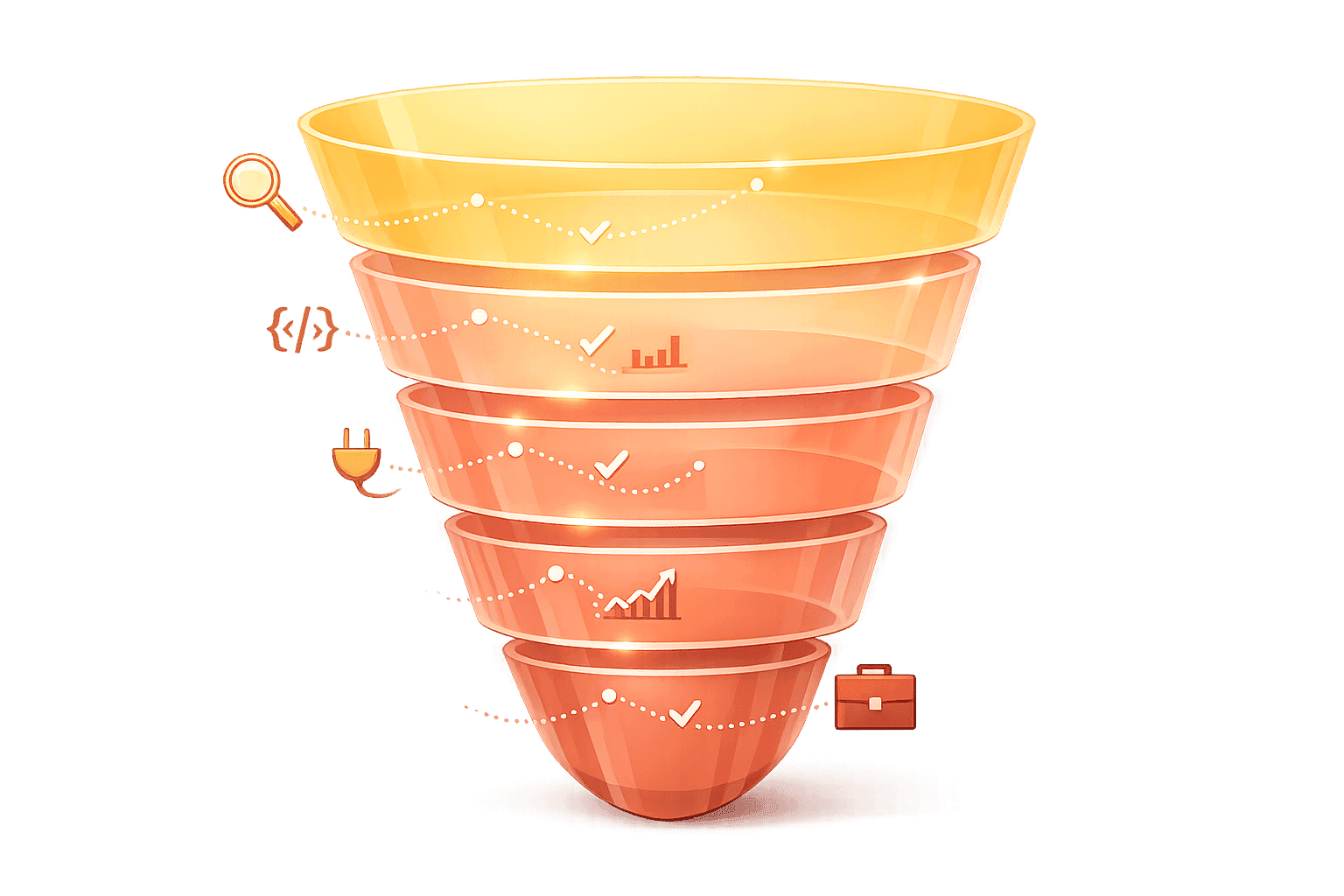
Developers evaluate APIs differently than traditional SaaS buyers. They skip demos, dive straight into the documentation, and start coding immediately. This hands-on approach reshapes the marketing funnel into five stages:
- Discovery: Developers find your API through search, GitHub, or peer recommendations. Visibility in these channels is crucial.
- Evaluation: The first API call is the key milestone. Metrics like "Time to First Hello World" (under 5 minutes is ideal) determine success here.
- Adoption: Moving from testing to production requires trust in reliability, clear documentation, and seamless onboarding.
- Expansion: Growth happens when developers invite teammates or scale usage, signaling deeper integration.
- Enterprise Procurement: Deals with procurement teams focus on compliance, security, and ROI.
To succeed, track metrics like activation rates, error patterns, and team adoption. Optimize for developer experience by simplifying onboarding, improving documentation, and reducing friction at each stage. Stripe, Twilio, and Plaid set the standard by focusing on speed, clarity, and reliability.
This funnel approach transforms casual users into long-term enterprise customers. Start by identifying bottlenecks, refining onboarding, and ensuring your API delivers value from the first interaction.
Understanding the API Marketing Funnel
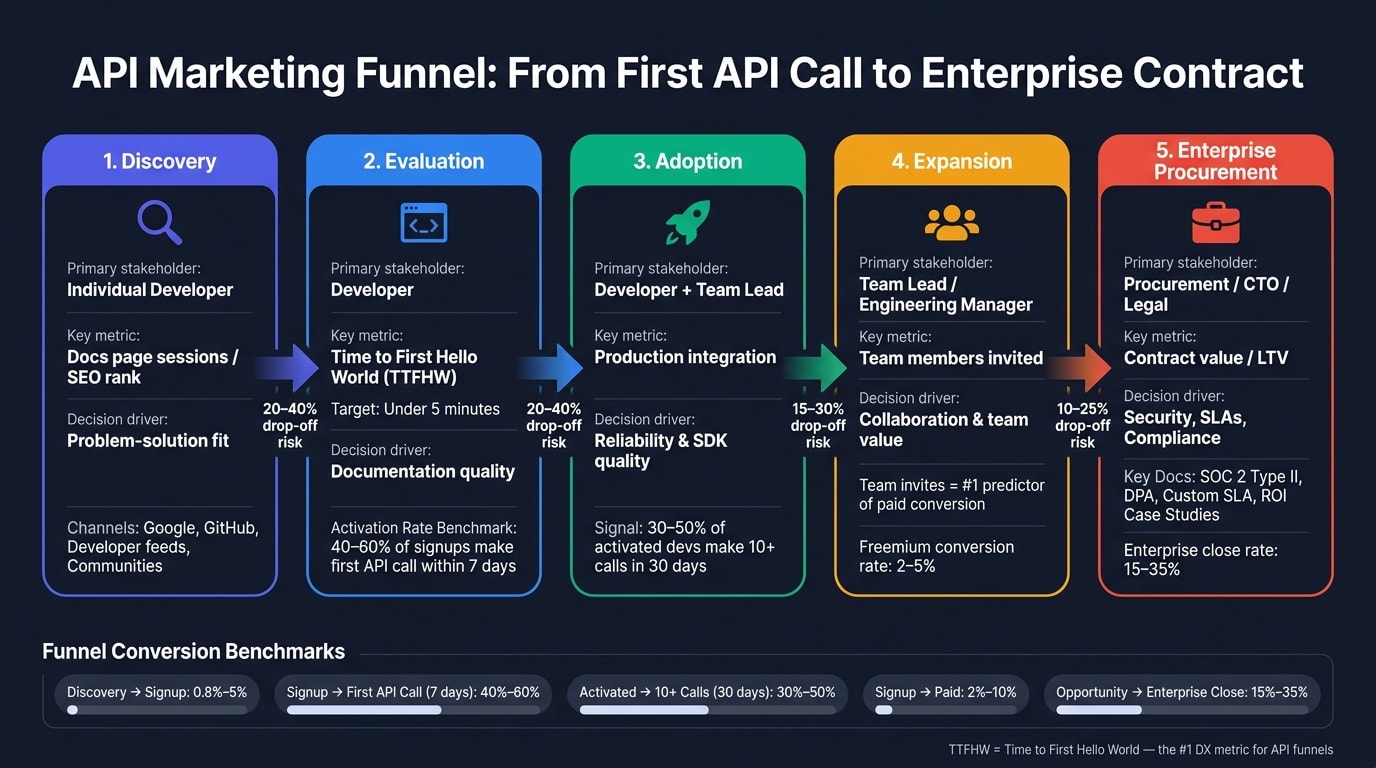
The API marketing funnel breaks down into five stages: Discovery, Evaluation, Adoption, Expansion, and Enterprise Procurement. Unlike traditional SaaS funnels, API funnels are shaped by the roles of the people involved and their specific needs at each stage.
At the Discovery phase, individual developers are your primary audience. They quickly assess your API by reviewing your documentation and determining if it solves their problem. Decisions here happen fast - often in minutes. As usage grows, the focus shifts to team leads and engineering managers during Adoption. These stakeholders prioritize reliability, SDK quality, and whether your API can handle production workloads. By the time you're negotiating an Enterprise Procurement deal, you're engaging with procurement teams, security analysts, and legal professionals - individuals who may never write a line of code but care deeply about compliance, SLAs, and risk management.
This evolution in stakeholders demands tailored marketing strategies for each stage. The messages, channels, and metrics you use must align with the priorities of the decision-makers at that specific point in the funnel.
| Funnel Stage | Primary Stakeholder | Key Metric | Decision Driver |
|---|---|---|---|
| Discovery | Developer | Docs page sessions / SEO rank | Problem-solution fit |
| Evaluation | Developer | Time to First API Call (TTFC) | Documentation quality |
| Adoption | Developer | Production integration | Reliability & SDK quality |
| Expansion | Team Lead | Team members invited | Collaboration & team value |
| Enterprise | Procurement / CTO | Contract value / LTV | Security, SLAs, compliance |
This table highlights the essential metrics and decision drivers at each stage of the funnel. These metrics not only help diagnose issues but also reflect the unique challenges developers and decision-makers face throughout the API adoption process. For example, a strong API funnel typically sees 40–60% of signups making their first API call within 7 days . Falling below this benchmark often points to onboarding issues rather than problems with acquisition channels. Stripe is a standout here, enabling developers to achieve a successful API response in under 3 minutes from signup . This sets a high standard across the industry.
"Increased API adoption is a function of the number of developers who know about your API and how easy it is to build on your API." - Murtza Manzur
Metrics at each stage also help separate operational challenges - like uptime, latency, and error rates - from product and developer experience (DX) issues, such as activation rates or integration abandonment. Performance metrics ensure your API works reliably, while product and DX metrics - like Time to First Hello World (TTFHW), activation rates, and integration abandonment - reveal whether developers can successfully adopt your API. Focusing on the wrong set of metrics can lead to fixing problems that don’t address the real bottlenecks. Monitoring both types of metrics gives you a clear picture of where your funnel might be leaking and how to address it effectively.
Stage 1: Discovery - How Developers Find Your API
Discovery doesn’t usually begin on your marketing homepage. Most developers stumble upon your API while tackling a specific problem - whether through search queries, GitHub repositories, peer suggestions, or posts in their daily tech feeds. Your mission at this stage? Be present exactly where those moments occur.
If your API isn’t visible in the right places, with the right technical cues, developers will move on in seconds.
Channel Breakdown
Each discovery channel operates uniquely and calls for a tailored approach:
Search (Google and YouTube): This is where most intent-driven discovery kicks off. Developers aren’t searching for “top API platforms”; they’re asking things like “how to verify an email with an API” or “best payment API for Node.js.” To capture this high-intent traffic, focus on creating content tailored to “how-to” queries and specific use cases. While organic search can be incredibly effective, it requires consistent effort over time to build visibility.
GitHub: Think of GitHub as a developer’s search engine. When someone’s looking for an SDK or a working integration, your repository’s keyword tags, README clarity, and “Hello World” example will determine whether they engage or scroll past. Social proof matters here - stars and clone counts show that other developers have found your repo useful, which also feeds into the Evaluation stage by signaling initial engagement.
Developer feeds and newsletters: Platforms like daily.dev highlight APIs through curated technical content, making them excellent top-of-funnel opportunities. Developers who frequent these spaces are actively exploring tools and trends. With newsletter CPCs typically ranging from $1.50 to $3.00 , this channel offers a cost-effective way to reach a highly targeted audience compared to broader programmatic ads.
Peer recommendations and communities: Developers trust their peers more than any marketing pitch. Communities on Reddit, Hacker News, Discord, and Slack play a powerful role in discovery. By using tools like Syften or Octolens, you can monitor these platforms for discussions where your API fits naturally - and contribute in a helpful, non-promotional way.
| Channel | What to Optimize | Key Metric |
|---|---|---|
| Search (Google/YouTube) | "How-to" content, use-case keywords | Organic traffic, CTR on how-to terms |
| GitHub | SDK repos, keyword tags, quickstart README | Stars, clones, repository views |
| Developer feeds | Technical content, quickstart guides | Click-through rate, signup conversion |
| Communities | DevRel participation, social listening | Unprompted mentions, sentiment |
Once you’ve established visibility in these channels, the next step is turning that initial interest into active engagement in the Evaluation stage.
How daily.dev Ads Fits Into Discovery
Developers are naturally skeptical of ads - not just because they know how to block them but because they’re quick to tune out anything that feels like a sales pitch.
daily.dev Ads bypasses this by embedding your content into a feed developers already trust for technical news and peer recommendations. With over 1 million developers on the platform, you can target by seniority, programming language, and the tools they use. This means your API reaches backend engineers evaluating payment integrations - not a broad audience that includes non-technical roles.
The key here isn’t pushing your homepage. Instead, promote technical assets like quickstart guides, copy-paste code samples, or integration tutorials. Developers value content that’s immediately useful far more than flashy headlines. The goal is to minimize the Time to First Hello World (TTFHW): the faster a developer can see a working API response, the more likely they are to move forward. A TTFHW exceeding 30 minutes is often a red flag for developer experience and can lead to abandonment .
"Documentation is your homepage... Invest 2-3x what you think the docs need." - Louis Corneloup, Founder at Dupple
Think of discovery ads as a way to distribute your best technical resources - not just a tool for building brand awareness.
Stage 2: Evaluation - From Signup to First API Call
Once you’ve captured a developer’s attention, the next step is turning their curiosity into action - getting them to make that first API call. At this stage, developers typically head straight to your documentation or quickstart guide to start testing. If they hit any roadblocks or delays, chances are they’ll drop off immediately.
Metrics for Evaluation
One of the most important measures here is Time to First Hello World (TTFHW) - how long it takes a developer to successfully get an API response after landing on your site. Ideally, this should take less than 5 minutes. If your API is more complex, 5 to 15 minutes is still acceptable. But if it takes over 30 minutes, you’ve got a serious developer experience issue that could cost you signups .
Another key metric is your activation rate, which tracks the percentage of signups that make their first API call within 7 days. A healthy range is between 40% and 60% . Falling below this range suggests friction somewhere between signup and that first call. Monitoring error logs can help pinpoint the problem. For example:
| Error Type | What It Signals | Fix |
|---|---|---|
| 401/403 (Auth) | Confusing authentication docs or misconfigured keys | Simplify the auth process; add one-click key generation |
| 400/422 (Validation) | Unclear request schema or broken code samples | Provide accurate, copy-paste-ready examples in your docs |
| 429 (Rate Limits) | Trial limits too restrictive for testing | Raise trial quotas; clarify rate-limit guidelines |
By addressing these issues, you’ll reduce friction and keep developers engaged, which is critical to preventing drop-offs.
Why Developers Abandon an API
When your metrics show poor performance, it’s a sign that something in your activation funnel is driving developers away. Friction at any step - signup, API key generation, or making the first call - can cause 20% to 40% of users to abandon the process . The good news? The most common issues are fixable once you identify them.
One major offender is a complicated signup process. Lengthy forms requiring email/password combinations or multiple fields before a developer can even see an API key are a recipe for abandonment. Simplify this by enabling OAuth options like GitHub or Google sign-in, or by using magic links. Ideally, developers should be able to generate an API key within 5 minutes of landing on your site, without needing manual approval for basic access . Stripe sets a great example here: their sandbox environment provides a test API key and working code example almost immediately after signup, allowing developers to test payments and hit that "aha" moment quickly .
Another common frustration is restricted access to documentation. Forcing developers to fill out forms or contact sales just to view your docs is a surefire way to lose them. Documentation should go beyond explaining what an API does - it needs to include working code. Deepgram does this well by offering an interactive playground where developers can test their speech-to-text API in under 2 minutes, no signup required . Similarly, embedding API keys directly into code samples for logged-in users - so they can copy, paste, and run immediately - is a simple but high-impact improvement .
To uncover these friction points in your own process, try conducting a friction log. Have someone unfamiliar with your product start from a Google search and attempt to make their first API call while recording their screen. Pay attention to where they hesitate, backtrack, or get confused - those moments are your roadmap for improvement .
Stage 3: Adoption - From Personal Project to Production
Making a single API call is one thing, but committing to production use is a whole new level of trust. This is where many APIs lose momentum. Between 30% and 50% of developers who reach the activation phase go on to make more than 10 API calls in their first 30 days. That ongoing activity is what separates genuine adoption from mere experimentation .
One of the clearest signs of adoption is when a developer invites a teammate to the project. This simple action - adding someone else - strongly predicts long-term retention and even paid conversions . Other key indicators include setting up a webhook, handling a real customer event, or switching from test API keys to live production keys. These steps show the API is becoming part of the developer’s actual workflow, not just a side project.
How to Support Developers Through Adoption
Once developers have had a smooth evaluation experience, the next step is helping them feel confident enough to deploy in production. A common hurdle here is the "pilot trap", where a prototype works, but production deployment is delayed due to perceived risks .
You can reduce these barriers by:
- Ensuring your sandbox environment closely mirrors production.
- Providing detailed production-readiness documentation. This includes guidance on rate limits (
X-RateLimit-Remaining,Retry-After), idempotency, and webhook retry logic . - Offering cloneable starter kits and reference implementations. These tools cut down on repetitive work and speed up integration .
Additionally, real-time usage dashboards can build trust by giving developers visibility into metrics like request volume, error rates, and latency.
Helping developers transition from pilot projects to production use lays the foundation for broader team adoption in the next phase.
What Stripe, Twilio, and Plaid Do Well
Top API providers like Stripe, Twilio, and Plaid offer great examples of how to instill confidence during the adoption stage.
- Stripe makes it easy to differentiate between testing and production with clear key prefixes (
sk_test_vs.sk_live_). They also retry failed webhooks for up to 72 hours, which reassures developers about the reliability of live deployments . - Twilio uses its TwilioQuest platform to gamify learning. This approach walks developers through real-world scenarios and sample apps, helping them build confidence before committing to production .
- Plaid, operating in the high-stakes world of financial data, focuses heavily on compliance documentation and ensuring their environments are consistent. This gives both developers and security teams the reassurance they need to proceed.
Each of these companies treats the adoption phase as a product challenge, not just a marketing task - and that mindset makes a big difference.
"The best APIs reduce the cost of integration to near zero and then stay out of the developer's way." - apiscout.dev
Stage 4: Expansion - From One Developer to the Whole Team
Getting one developer on board is a great start, but real growth happens when the entire team gets involved. With freemium conversion rates lingering around just 2–5% , expanding usage within active accounts is critical to driving revenue.
This stage often depends on an internal champion - usually the first developer who adopted your API. They play a key role in bringing teammates on board. Their influence, shown through team invites and broader SDK usage, is a strong indicator of both long-term retention and eventual paid conversions.
Metrics for Measuring Expansion
Expansion isn’t just about volume; it’s about how deeply the API integrates into team workflows. Collaboration behaviors often tell the story better than raw usage numbers. Here are the key metrics to track:
| Expansion Metric | What It Tells You |
|---|---|
| Team invites sent | A top predictor of paid conversion and long-term retention |
| Feature breadth | Indicates how embedded the API is across workflows |
| Request volume growth | Shows scaling applications, signaling readiness for higher pricing tiers |
| SDK language diversity | Reflects adoption across multiple teams or tech stacks within the same org |
These metrics help you understand how well your API is spreading within teams and guide decisions around product development and pricing.
How to Drive Broader Adoption
To encourage team-wide adoption, focus on empowering your internal champion and making collaboration effortless.
One powerful approach is providing integration stories. These are real-world examples that showcase why a team chose your API over building their own solution and the results they achieved. These stories make it easy for champions to advocate for your API in conversations with tech leads and managers . They’re far more impactful than just sharing endpoint documentation.
On the product side, consider adding features designed specifically for teams. Think shared API keys, collaborative workspaces, or team-level dashboards - these “team-first” features naturally encourage upgrades from individual plans . Pair these with automated, usage-based email campaigns. For instance, if a developer has been using three endpoints for two months but hasn’t tried webhooks, send them a targeted email explaining how webhooks could enhance their workflow .
Finally, group minor updates into a "Launch Week". Instead of quietly rolling out small changes, bundle them into a single, high-profile announcement. This gives your internal champions something tangible to share in team meetings and sparks renewed interest in your API . It’s an easy way to keep the momentum going and encourage broader adoption.
Stage 5: Enterprise Procurement - When the Buyer Is Not the User
Once your API has gained traction within teams, the next hurdle is enterprise procurement. This stage is about expanding your API's influence from individual developers to entire organizations. At this point, the developer who initially championed your API steps aside, and the decision-making shifts to security teams, legal advisors, and procurement officers. Their priorities? Security, compliance, and business value - far removed from a developer's focus on functionality and ease of use.
"Big orgs want custom SLAs, advanced security, or dedicated support. And may need high-volume, and custom deals on that. So they 'Talk to sales'." - Jakub Czakon, CMO and Dev Marketing Advisor
This shift requires a dual approach: meeting technical expectations while addressing the broader business benefits. Developers might care about saving time and ensuring stability, but procurement teams are laser-focused on revenue impact, operational efficiency, and risk mitigation. To succeed, your strategy must bridge these perspectives, offering technical depth for developers and clear, business-focused materials for decision-makers.
Getting Ready for Enterprise Deals
Once team-wide adoption is secured, your next step is to prepare for the rigorous demands of enterprise procurement. Deals at this level can stall quickly if you're unprepared for the legal, compliance, and security evaluations that come with them. Having the right documentation ready can prevent delays and streamline the process:
| Document | Who Needs It | Why It Matters |
|---|---|---|
| SOC 2 Type II certification | Security & IT teams | Verifies your data handling meets enterprise standards |
| Security questionnaire responses | InfoSec reviewers | Pre-filled responses save review time and build trust |
| Custom SLA terms | Legal & procurement | Outlines uptime guarantees and support expectations |
| ROI case studies | Business buyers & finance | Links developer benefits to measurable financial outcomes |
| Data processing agreement (DPA) | Legal & compliance | Ensures compliance with GDPR/CCPA for regulated customers |
Your pricing model must also evolve to include a clear Enterprise tier. While usage-based pricing works well for smaller teams, enterprise buyers expect a "Talk to Sales" option. This path often includes high-volume discounts, dedicated support, and custom contract terms . Without this option, procurement teams may lose momentum. To keep them engaged, present cost-related data that shows how your API reduces expenses or avoids costly risks. For example, highlight how it eliminates the need for internal infrastructure or simplifies compliance - key concerns, especially since 91% of procurement leaders prioritize cost savings as their top goal .
Metrics at the Enterprise Stage
Tracking the right metrics can sharpen your enterprise strategy. Two key metrics to monitor are:
- Conversion rate: The percentage of technical adopters who progress to signed contracts.
- Procurement cycle duration: The time it takes from a "Talk to Sales" request to a finalized agreement.
Conversion rates at this stage are often in the low single digits, emphasizing the need for a strong top-of-funnel to keep your pipeline robust. Long procurement cycles, on the other hand, often point to issues like missing compliance documentation, unclear SLA terms, or a weak ROI narrative. Even small improvements in reducing cycle time can significantly increase your annual contract value (ACV) across enterprise deals.
Metrics Across the Full API Funnel
To get the most out of your API marketing funnel analysis, tracking metrics consistently across all stages is crucial. Focusing on each stage separately only gives a fragmented view of how developers engage with your API. The real value lies in connecting the dots - identifying where developers drop off and understanding how that impacts revenue.
Benchmark Conversion Rates by Stage
Here are some benchmarks to measure against for 2026:
| Funnel Stage | Key Metric | Benchmark |
|---|---|---|
| Discovery | Docs visitor to signup | 0.8%–5% |
| Activation | Signups making first API call (7 days) | 40%–60% |
| Engagement | Activated developers making >10 calls (30 days) | 30%–50% |
| Monetization | Signups upgrading to paid | 2%–10% |
| Retention | Converted users still active at 90 days | 40%–70% |
| Enterprise close | Opportunities to closed-won | 15%–35% |
These benchmarks are just a starting point. The specifics will vary depending on your API's target audience. For example, a payments API aimed at enterprise fintech firms will have different metrics compared to a weather data API for indie developers. To make these benchmarks actionable, segment them by acquisition channel and cohort. You can also reach developers at scale through targeted community platforms to improve these top-of-funnel metrics. This approach helps you uncover deeper insights into performance trends.
"Time to First Hello World (TTFHW) is your north star DX metric - it determines whether a developer stays or leaves." - API Scout
TTFHW, or the time it takes for a developer to make their first successful 2xx API call after account creation, is the most predictive metric across the funnel. Aim for under 5 minutes for a great experience. For more complex APIs, 5 to 15 minutes is still reasonable.
Setting Up Funnel Tracking
Once benchmarks are in place, the next step is setting up tracking to capture the right signals. Many API teams focus on infrastructure metrics like uptime, latency, and error rates but overlook product-level signals that explain why developers might churn. The solution? Use two separate dashboards: one for engineering on-call and another for product and DevRel teams .
For the product dashboard, make sure to monitor these key events:
- Documentation page visits
- Search queries that yield zero results
- API key generation
- First successful API call
- Request volume exceeding a meaningful threshold (e.g., 100 calls)
Tools like Moesif can provide user-focused API analytics, PostHog is great for tracking onboarding funnel drop-offs, and SigNoz works well for OpenTelemetry-native observability .
Error patterns are another critical diagnostic tool. For instance:
- A spike in
401/403errors often signals confusing authentication documentation. - A spike in
400/422errors usually means your request schema examples are incomplete or incorrect.
These issues don’t show up on latency graphs but can severely impact activation rates. By reviewing these error patterns weekly, along with search queries that return no results, you can create a focused list of fixes to address in each sprint.
Using daily.dev Ads to Speed Up Discovery
When it comes to the Discovery phase, daily.dev Ads can jumpstart engagement by delivering targeted, actionable content directly to developers who are already in a technical mindset. This approach complements organic channels like search, GitHub, and peer communities, creating a more rounded strategy for attracting top-of-funnel interest.
With over 1,000,000 developers worldwide, daily.dev offers precise targeting options. You can tailor campaigns based on programming languages, tools, seniority, and technical interests. For example, a payments API campaign can focus on backend developers using Node.js or Python, while a computer vision API might target those exploring machine learning infrastructure. The platform’s native in-feed, post-page, and personalized digest placements ensure your ads feel natural and lead smoothly to your documentation.
Here’s the key: your ad creative should link directly to a getting-started guide or an interactive sandbox, not a generic marketing page. Combine this with a clear "Get API Key" call-to-action (CTA) embedded within the docs, and you create a streamlined path from ad impression to account creation.
Track Attribution to Maximize Results
Attribution matters. To avoid wasting your budget, tag every campaign with UTM parameters like utm_source=dailydev, utm_medium=paid, and utm_campaign=[campaign-name]. Use analytics to track key metrics, such as API key generation and the first successful 2xx API call . This way, you can measure not just signups but also how many developers become actively engaged.
Based on 2026 benchmarks, a good docs-to-signup conversion rate ranges between 5% and 15%, with 40%–60% of those signups making their first API call within seven days . If your daily.dev campaigns underperform in activation, the issue often lies in onboarding. Error logs, especially spikes in 401 or 403 responses, can reveal where developers are stumbling. These insights allow you to connect your discovery efforts directly to improved funnel performance.
Reduce Friction, Boost ROI
To make the most of daily.dev Ads, run a friction log for this specific traffic source. Trace the developer journey from the moment they click on your ad to their first successful API call. Pinpoint and address any drop-off points immediately. Reducing time to first hello world (TTFHW) for paid traffic can significantly improve your return on investment.
"TTFHW is the moment a developer shifts from 'evaluating' to 'committed.' Every minute added to TTFHW increases the probability of developer abandonment." - API Scout
Conclusion: Building and Running Your API Marketing Funnel
To scale your API effectively, you need to ensure a smooth developer experience at every touchpoint. This process relies on a structured API marketing funnel with five key stages: Discovery, Evaluation, Adoption, Expansion, and Enterprise Procurement. Each stage builds on the previous one, transforming initial interest into long-term enterprise success.
- Discovery: This stage is all about being visible where developers naturally search - places like GitHub, search engines, peer communities, and curated developer platforms.
- Evaluation: The goal here is speed. Developers should reach their first successful API call in under 5 minutes; under 2 minutes is considered outstanding .
- Adoption: This is confirmed when a developer takes the leap and moves their project to production.
- Expansion: A strong indicator of growth is team invites, which are the most reliable predictor of a paid conversion for API products .
- Enterprise Procurement: This stage requires more formal elements like security documentation, clear pricing, and support from a technical champion within the organization.
Any friction in these stages can cause significant drop-offs - up to 20–40% of users. To combat this, track critical milestones such as signups, key generation, first API call, production integration, and team invites. Treat drop-offs as product issues, not just marketing challenges. Addressing these pain points can mean the difference between growth and stagnation.
Take action today: start by creating a systematic friction log. Have someone unfamiliar with your API go from a search to a working API call and time every step. Identify and eliminate delays at each point. Then, implement tools like PostHog or Moesif to monitor your funnel and pinpoint where developers face challenges. By combining detailed technical insights with refined analytics, you’ll establish a measurable and repeatable system for success.
FAQs
What’s the fastest way to lower Time to First Hello World (TTFHW)?
The fastest way to cut down Time to First Hello World (TTFHW) is by streamlining the onboarding process. Here's how:
- Enable one-click API key generation: Make it simple for developers to get started without jumping through hoops.
- Offer an interactive sandbox: Include pre-filled examples so users can experiment with your API right away.
- Provide a quick-start guide: Include clear instructions and copy-paste code samples to help developers make their first API call in just minutes.
These steps remove unnecessary barriers, making it easier for developers to dive in and see results quickly.
Which funnel metrics best predict a paid or enterprise upgrade?
The best indicators for predicting a move to a paid or enterprise plan are sign-up to first API call, active keys, request volume, and team invites. These metrics focus on actual usage and engagement, which strongly suggest a higher chance of conversion to premium plans.
How do I prepare my API for enterprise security and procurement?
Getting your API ready for enterprise use means prioritizing security, compliance, and features that enterprises expect. Here's how you can achieve that:
- Secure API Design: Build your API with security in mind from the start. Use encryption, validate inputs, and follow best practices to minimize vulnerabilities.
- Scalable Authentication: Implement flexible authentication methods like API keys or OAuth to handle various use cases securely.
- Sandbox Environment: Offer a well-documented sandbox environment so developers can test and integrate your API without risk.
Enterprises also look for specific features to meet their operational needs. Make sure your API includes:
- Service Level Agreements (SLAs): Define performance and uptime commitments.
- Single Sign-On (SSO): Allow seamless user authentication across platforms.
- Role-Based Access Control (RBAC): Provide granular control over user permissions.
- Audit Logs: Enable tracking of user activity for compliance and troubleshooting.
Finally, ensure your pricing structure is clear and supports smooth scaling for large users. Transparent pricing and seamless transitions to higher usage tiers will help meet procurement requirements and build trust with enterprise clients.