
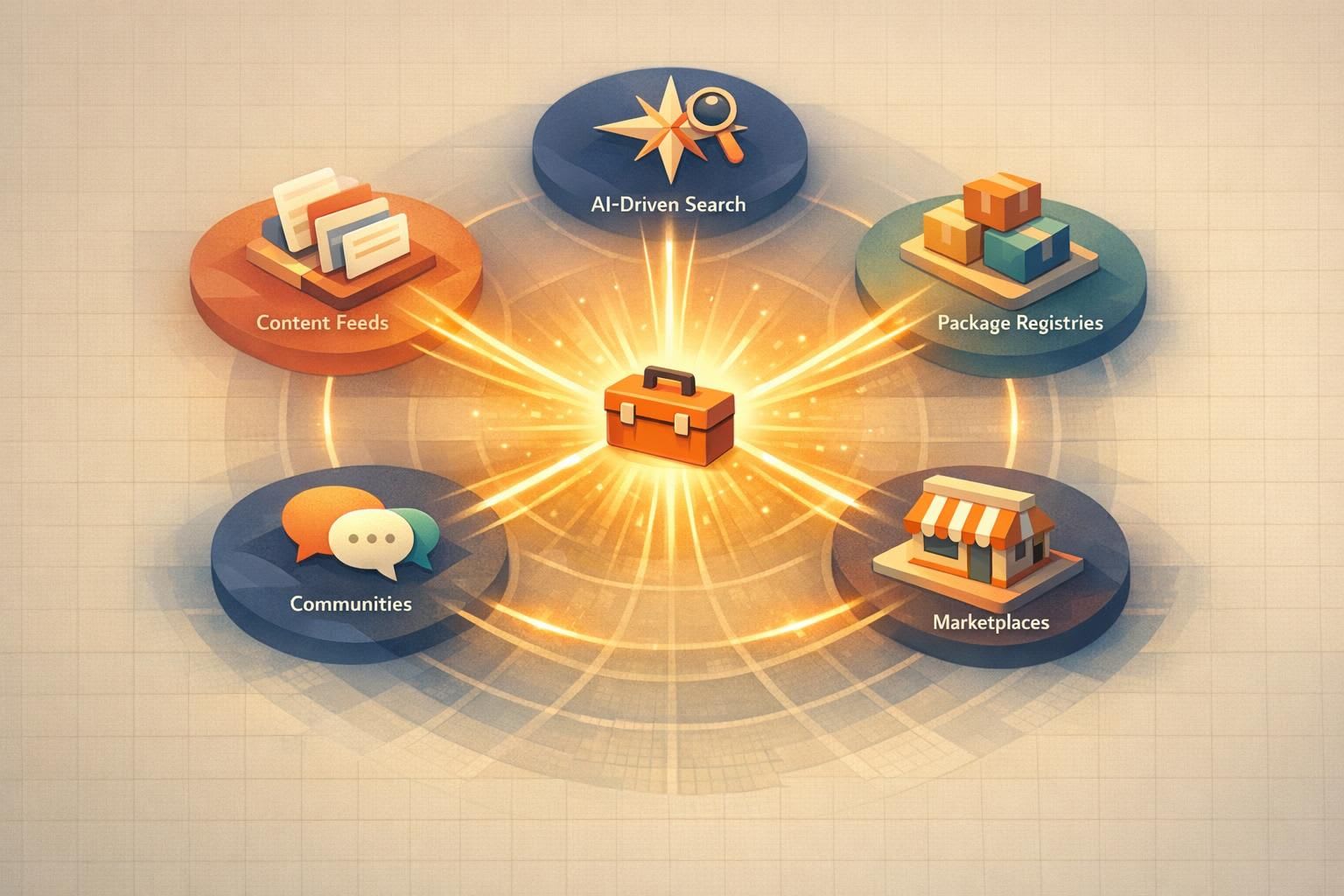
Where do developers find tools? It’s not where you might think. Traditional ads often fail, with over half of developers using ad-blockers. Instead, discovery happens in the spaces developers already frequent - technical content platforms, package registries, IDE marketplaces, and even AI coding assistants. Here’s a breakdown of the key platforms and their strengths:
- Content Platforms (e.g., daily.dev, Dev.to): Ideal for reaching developers early in their journey through technical articles and tutorials. Cost-effective but requires strong content.
- Package Registries (e.g., npm, PyPI): High-intent users discover tools during installs. Great for organic growth but slower to show results.
- Marketplaces & IDEs (e.g., VS Code Marketplace, AWS Marketplace): Perfect for decision-ready users. Frictionless workflows are key.
- Communities (e.g., Reddit, Discord): Build trust through peer recommendations. However, much happens in untrackable "dark social" spaces.
- Search & AI Assistants (e.g., Google, ChatGPT): Capture high-intent searches or appear in AI recommendations. Documentation quality directly impacts visibility.
Quick Comparison:
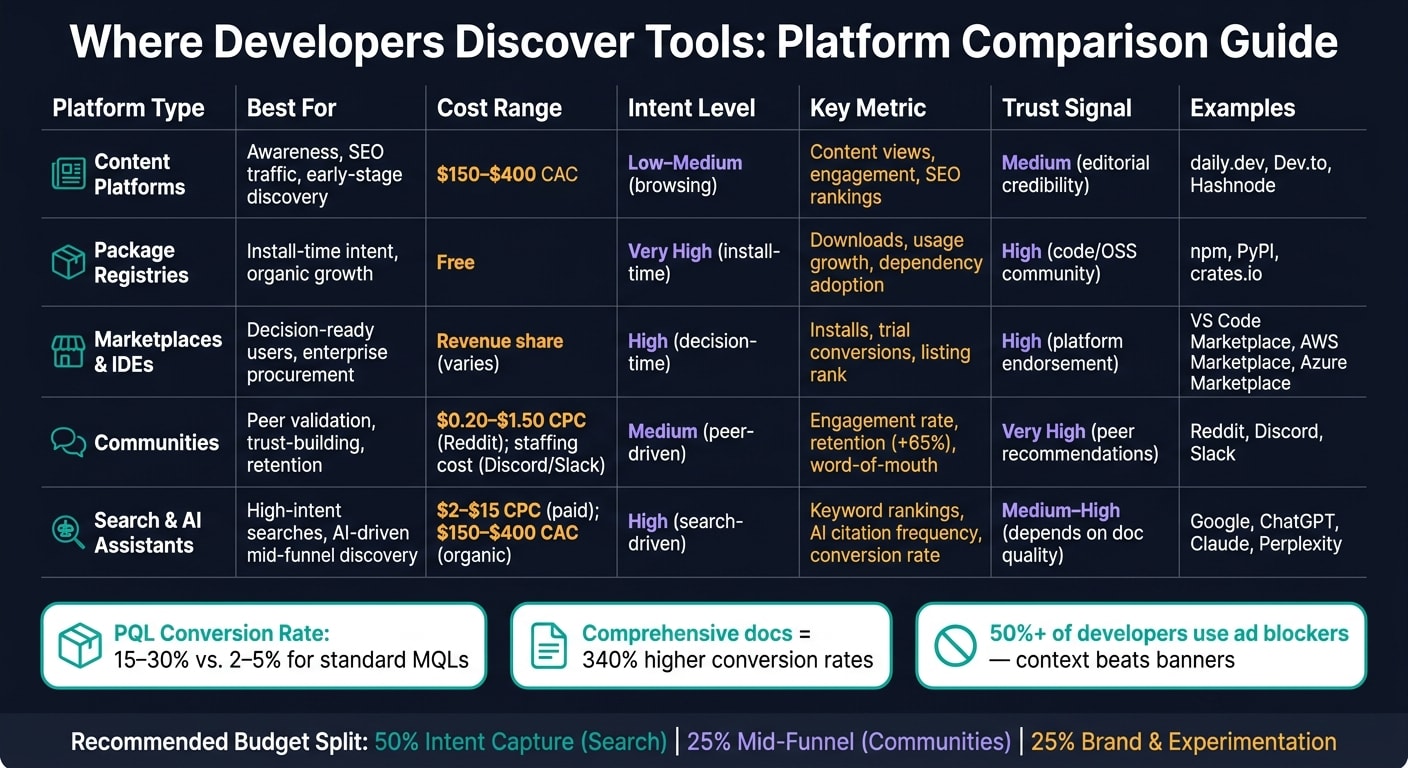
| Platform Type | Best For | Cost Range | Key Metric |
|---|---|---|---|
| Content Platforms | Awareness, SEO traffic | $150–$400 CAC | Content views, engagement |
| Package Registries | Install-time intent | Free | Downloads, usage growth |
| Marketplaces & IDEs | Decision-ready users | Revenue share (varies) | Installs, trial conversions |
| Communities | Peer validation, trust | Staffing/low ad costs | Engagement, retention |
| Search & AI Assistants | High-intent traffic | $2–$15 CPC (Google Ads) | Search rankings, AI mentions |
Key Insight: Developers trust tools they encounter naturally during their workflow. To succeed, focus on solving real problems, maintaining strong documentation, and being present in the platforms they already use.
1. Content Platforms and Feeds
Content feeds are a crucial starting point in any multi-platform strategy, especially when it comes to tool discovery. Why? Because developers are constantly searching for solutions to specific problems. For example, when an engineer types in queries like "how to set up webhook retry logic" or "debugging flaky CI pipelines", they aren't shopping for tools - they're hunting for answers. Tools discovered during this process naturally grab attention because they’re presented in a helpful, relevant context. Let’s dive into some platforms that facilitate this discovery process.
daily.dev curates technical content into personalized feeds for over a million developers. By using AI-driven delivery, it tailors content in real time to boost engagement and conversions . Platforms like this create intent by introducing tools to developers even before they realize they need them.
Other platforms like Dev.to and Hashnode also play a vital role. Dev.to leverages community tagging to highlight content such as tutorials, SDK walkthroughs, and postmortems. Tutorials with accurate tags often attract between 1,500 and 5,000 views, and the best part? Publishing on the platform is free . Meanwhile, Hashnode allows developers to publish content on their own domains while still appearing in a shared community feed, which adds a layer of editorial credibility.
Syndication can further amplify your content’s reach. By publishing on your own domain first and then republishing to other platforms with a rel=canonical tag after 2–10 days, you can protect your SEO while increasing reach by up to 500%. This approach also drives about 85% higher engagement compared to sticking to a single platform .
"Developers don't browse SaaS directories. They don't read Capterra reviews... They scroll daily.dev between meetings." - SaaSCity
Even though attribution can sometimes be tricky, the numbers speak for themselves. Technical content marketing boasts a customer acquisition cost of around $150–$400 per customer . This relatively low cost highlights how valuable content marketing is for promoting developer tools.
2. Package Registries and Code Hubs
Package registries play a unique role in reaching developers, especially when they're ready to take action. Unlike content feeds that catch developers during casual browsing, registries like npm, PyPI, and crates.io connect with them at the exact moment they're installing a tool - when their intent is clear and actionable. Think about it: when an engineer runs npm install or pip install, they're not exploring options; they're making a decision. This makes registries a critical distribution channel, bridging the gap between research and implementation.
"Devs find tools at install-time, not at search-time." - SaaSCity Editorial
This transition from research to installation creates a unique opportunity for technical marketing. For instance, if a popular open-source project lists your package as a dependency, your download numbers can skyrocket without any additional effort. This organic growth can be a game-changer. In fact, developer tools with active open-source components see 45% faster enterprise adoption compared to proprietary tools . Why? Developers often try these libraries for free and then advocate for them within their organizations.
In 2026, another dynamic is reshaping how registries drive discovery: AI-assisted tools. Integrated development environments (IDEs) like Cursor and Claude Code now recommend tools based on training data from READMEs, example directories, and API references. As Joe Karlsson, Developer Advocate at CloudQuery, explains: "Your README, your examples directory, your API reference, and your SDK docs are your LLM marketing." A weak README doesn't just lose human interest - it also reduces visibility in AI-driven recommendations.
Publishing on registries like npm, PyPI, and crates.io is free, but there’s a catch: attribution often lags behind actual usage. It can take 6 to 18 months for developers who discover your tool through a registry to convert to paying customers . This delay can make registry-driven growth seem slow on dashboards, even when it’s quietly driving significant adoption.
Here’s how registries stack up against other distribution channels:
| Feature | Package Registries | Research Directories | Paid Ad Networks |
|---|---|---|---|
| Cost | Free | Free to $500+ | High (CPM/CPC) |
| Intent Level | Very High (install-time) | Medium (research) | Low to Medium |
| Trust Signal | High (code/OSS) | Medium (reviews) | Low (sponsored) |
| AI Visibility | High (training data) | Low | None |
| Maintenance | High (code updates) | Low (profile updates) | Medium (creative) |
To maximize your presence on registries, treat them as a core part of your technical marketing strategy. Use keywords in your package metadata that focus on specific problems (e.g., "Postgres schema diff" instead of "next-gen DB tool"), link directly to your documentation and website, and keep your examples directory up to date. The effort pays off: Product Qualified Leads who engage with tools through registries or trials convert to paying customers at a rate of 15–30%, compared to just 2–5% for standard marketing qualified leads . That conversion gap alone makes the investment worthwhile.
3. Marketplaces and IDE Ecosystems
While package registries engage developers during install-time, marketplaces step in at decision-time - that critical moment when developers are actively searching for tools to integrate into their workflow. Platforms like the VS Code Marketplace, AWS Marketplace, and Azure Marketplace cater to different audiences, but they all share one common priority: eliminating friction. This transition from install-time to decision-time shows how marketplaces complement other discovery methods.
Developers spend an average of 6–8 hours daily in IDEs like VS Code, Cursor, and JetBrains . Extensions and in-IDE placements see click-through rates of 2.1–3.5%, which is about 10 times higher than conventional display ads . However, developers are quick to abandon listings that require demo requests instead of providing immediate, detailed technical documentation. As the Idlen Playbook puts it, "Developers live inside tools, not feeds. The highest-value impressions happen in IDEs, documentation sites, package managers, CLI outputs... not social timelines" .
Marketplace discovery behavior is evolving rapidly. For example, AWS Marketplace now features semantic search, allowing developers to use plain language - like "financial data analysis" - to find solutions, making clear, problem-focused descriptions more effective than keyword-stuffed titles . Additionally, keeping listings updated pays off: listings refreshed in the last 30 days can rank 2–3× higher than those untouched for over 90 days .
Procurement preferences also play a significant role in marketplace performance. On platforms like AWS and Azure Marketplace, buyers favor one-click purchasing options such as "Buy with AWS." These options allow users to apply cloud credits and consolidate billing, streamlining the procurement process and avoiding delays that could last weeks . However, this convenience comes at a cost - platforms take a revenue share, and tracking attribution can be tricky.
| Marketplace | Best Fit | Key Ranking Signal | Procurement Advantage |
|---|---|---|---|
| VS Code Marketplace | Dev tools, extensions, linters | Install count + recency | Direct install, no billing friction |
| AWS Marketplace | Cloud-native, data, infra tools | Semantic search relevance | AWS credits, consolidated billing |
| Azure Marketplace | Enterprise SaaS, DevOps tools | Ratings + update recency | Azure Hybrid Benefit, EA agreements |
Success in marketplaces hinges on a frictionless, developer-first approach. Strong technical documentation matters more than polished marketing copy. Developers prioritize functionality and will often skip directly to your GitHub repo or pricing page . Make sure your "Hello World" experience can be completed in under 5 minutes , and treat your listing description as a concise technical overview rather than a sales pitch.
4. Communities and Social Channels
While marketplaces connect with developers at the point of decision-making, communities engage them earlier - during those moments when they're sharing frustrations or asking peers for recommendations. Unlike the transactional nature of registries and marketplaces, communities thrive on informal, organic interactions. Platforms like Reddit, Discord, and Slack each serve a distinct purpose in this process, and knowing how to approach each one can make all the difference. This early engagement complements the decision-focused influence of marketplaces.
Reddit acts as a broad discovery platform. Subreddits such as r/devops, r/webdev, r/rust, and r/golang are where developers naturally encounter tools while exploring threads about common challenges, like CI/CD issues. Ads targeting these communities are relatively budget-friendly, with CPMs ranging from $0.50 to $3.50 and CPCs from $0.20 to $1.50 . However, developers on Reddit are quick to spot and dismiss insincerity. Messaging that focuses on solving a specific problem (e.g., "Tired of flaky CI pipelines?") consistently outperforms brand-centric pitches. Additionally, linking to a live sandbox is far more effective than directing users to a gated landing page .
Discord and Slack, on the other hand, offer a more intimate and trusted environment. These platforms foster organic conversations and peer validation, often in private, high-trust spaces. Much of the influence here happens through "dark social" channels - interactions that are largely invisible to traditional analytics tools. This makes community-driven discovery a blind spot for many marketing teams.
"The trust level in these [private] spaces is different from public forums. When someone you know is solving similar problems recommends something, that carries real weight." - Geri Mate, Developer Relations Partner
Active participation in these communities pays off. Developers who contribute (even by answering a single question within their first 90 days) exhibit 65% higher retention rates and 40% greater usage expansion compared to those who remain passive .
To succeed in these spaces, your tool needs to stand out visually. On platforms like Discord and Slack, much of the discovery process happens when users share screenshots or visuals in chat threads. If the value of your tool isn’t immediately clear from a single image, you risk missing out on referrals. Quick, technical responses in a single Discord channel can often have more impact than slower engagement across multiple platforms .
| Platform | Cost | Engagement Signal | Best Use Case |
|---|---|---|---|
| $0.20–$1.50 CPC | >1% engagement rate | Launch announcements, community validation | |
| Discord | Staffing/DevRel cost | Real-time collaboration, visual sharing | Technical support, power-user retention |
| Slack | Organic/Staffing cost | 65% higher retention | Internal advocacy, word-of-mouth referrals |
Attribution remains a challenge in these community-driven spaces. Since much of the activity is invisible to analytics, incorporating a simple "How did you hear about us?" survey during onboarding can help uncover which channels are driving signups . By integrating these community platforms into a broader multi-channel strategy, you can effectively engage developers at every stage of their discovery journey.
5. Search and AI Assistants
After exploring marketplaces and communities, it's time to look at how search engines and AI assistants are reshaping the way developers discover tools. These platforms play a major role in both active searches and passive recommendations, offering new ways to connect with engineers.
Google Search remains a cornerstone for developers seeking specific solutions. Instead of directly typing product names, they often use detailed queries like "webhook retry logic Node.js" or "Terraform alternative for small teams". To capture this traffic, your content needs to target these terms through documentation, comparison articles, and integration guides. Organic search combined with technical content marketing typically costs around $150–$400 per customer acquisition (CAC) . On the other hand, paid search is more expensive: Google Search Ads for developer-related keywords range from $2–$15 per click, with a cost per signup or trial landing between $30 and $80 . Notably, Google’s 2025 Smart Bidding updates have boosted conversions for technical campaigns by an average of 19% .
While Google Search is ideal for bottom-of-funnel intent, developers are increasingly turning to AI-driven recommendations for mid-funnel discovery. These tools expand your product's reach by introducing it in contexts where developers may not even be actively searching.
AI assistants like ChatGPT and Claude are becoming essential discovery tools. For instance, 79% of developers use ChatGPT for coding assistance, with 42% relying on it daily . These assistants suggest tools mid-task, based on their training data and structured content, a concept referred to as Generative Engine Optimization (GEO). Keeping your documentation up-to-date is crucial here - if your README hasn’t been refreshed in 18 months, AI tools might overlook or misrepresent your product. Comprehensive, easily accessible documentation is key, as developers who explore five or more documentation pages during their first visit are 340% more likely to convert compared to those who view just one page .
Traditional display ads face a challenge with developers, as over 50% use ad blockers . However, contextual placements like in-IDE integrations and AI assistant recommendations bypass this issue. These channels achieve click-through rates of 2.1–3.5%, which is about 10 times higher than standard display ads .
| Channel | Funnel Stage | Cost Range | Key Metric |
|---|---|---|---|
| Google Search (Organic) | Bottom | $150–$400 CAC | Keyword ranking, doc depth |
| Google Search (Paid) | Bottom | $2–$15 CPC / $30–$80 CPA | Conversion rate >3% |
| AI Assistants (ChatGPT, Claude) | Mid–Bottom | Content investment | LLM citation frequency |
| Stack Overflow | Mid | $10,000–$15,000/month min. | CTR >0.15% |
Pros and Cons by Platform Type
When it comes to developer tool discovery channels, every platform offers its own set of strengths and challenges. The right mix of platforms depends on factors like your budget, the stage of your funnel, and how credible your product appears to a technical audience.
A key thing to remember: developers are quick to tune out anything that feels like a sales pitch. Your content needs to address real problems first before introducing your solution.
Here’s a breakdown of the main benefits and limitations of each platform type, designed to help you align their strengths with your goals.
| Platform Type | Key Strengths | Key Limitations |
|---|---|---|
| Content Platforms (daily.dev, Dev.to, Hashnode) | Lower customer acquisition costs (around $150–$400) ; content feeds improve SEO and AI discovery, ensuring long-term returns; naturally engage developers where they already spend time | Requires strong technical depth; overly promotional content gets ignored; indirect and non-linear conversion paths |
| Package Registries (npm, PyPI, crates.io) | Capture high-intent users during installs; leverage open-source trust; benefit from dependency-driven discovery | Hard to stand out without existing popularity; limited control over how your product is marketed; discovery often trails actual usage |
| Marketplaces & IDE Ecosystems (VS Code, AWS, Azure) | Access purchase-ready users; aligns well with enterprise buying processes; strong endorsement from platform visibility | Extremely competitive; may involve revenue-sharing agreements; organic reach usually stays confined to the ecosystem |
| Communities (Reddit, Discord, Slack) | Peer validation boosts trust and retention by up to 65% ; great for gathering authentic feedback | Roughly 52% of discovery happens via untrackable "dark social" channels ; requires ongoing developer relations efforts; paid promotion options are limited or nonexistent |
| Search & AI Assistants (Google, ChatGPT, Perplexity) | High-intent traffic with clear attribution through analytics; delivers quick, problem-solving insights | Needs frequent content updates; recommendations depend heavily on well-maintained documentation |
The main trade-off across platforms boils down to reach versus measurability. Search engines and AI assistants provide precise data and attribution, making them ideal for tracking performance. On the other hand, communities foster trust and retention, even if much of their influence remains difficult to measure. Content platforms, meanwhile, offer compounding value by boosting both SEO and AI-driven discovery over time, though their conversion paths can be more complex.
"Good data ages better than good writing. I've watched one comparison post stay in the top 10 performers for over a year with zero updates." - Joe Karlsson, Developer Advocate, CloudQuery
Investing in technical content that resonates with developers can deliver impressive results. For example, a single, well-researched comparison or benchmark - rooted in reproducible data rather than marketing jargon - can outperform months of paid campaigns. Use this overview to allocate your resources wisely, balancing reach and measurable outcomes to refine your multi-channel strategy.
Conclusion
There isn’t a single platform that dominates every stage of the developer discovery funnel. Instead, each stage relies on different tools and platforms to do the job. At the top, technical content and feed-based platforms like daily.dev help build awareness among developers who aren’t actively searching yet. In the middle, communities such as Reddit, Discord, and Slack play a key role in peer validation. At the bottom, Google Search becomes the go-to for engineers ready to take action. Each layer plays a specific role in the process.
For most developer marketing teams, a practical budget breakdown looks like this: 50% for intent capture (Google Search), 25% for mid-funnel engagement, and the remaining 25% split between brand-building channels and experimenting with newer platforms. Prioritizing intent capture ensures you’re not spending on awareness campaigns without having the ability to convert those leads.
It’s also worth noting that comprehensive documentation can increase conversion rates by 340% . Additionally, a large portion of developer discovery happens in private channels, which means targeted post-signup surveys are critical to understanding their needs.
The key takeaway? Align your strategy with the developer’s workflow rather than your marketing calendar. Be present in the feeds they browse daily, the documentation they rely on mid-task, and the search results they turn to when they hit a roadblock. By weaving these discovery channels together, you’ll reflect the natural developer workflow - and that’s where trust and adoption are built.
FAQs
Which platform should I prioritize first for my developer tool?
When it comes to promoting your developer tool in 2026, focus on platforms where developers naturally go to discover and engage with tools. Two key areas to target are developer content feeds and community-driven platforms.
Developer Content Feeds
Platforms like daily.dev are incredibly effective for organic discovery. These feeds integrate seamlessly into developers' workflows, offering personalized, relevant content that developers are already looking for. By appearing in these feeds, your tool can gain visibility in a way that feels natural and non-intrusive.
Community-Driven Platforms
Communities on platforms like Discord and Reddit are great for building trust and fostering engagement. Developers often turn to these spaces to share experiences, ask questions, and recommend tools. Being present and active in these communities can help establish credibility and spark meaningful conversations around your product.
Strategy Tip
Start by leveraging organic channels like daily.dev to build awareness. Once you've established some traction, you can explore paid campaigns to reach more specific audiences and amplify your efforts further.
How do I measure attribution across search, registries, and communities?
To understand how different channels contribute to developer engagement, adopt a multi-touch attribution strategy. This approach tracks interactions across search, registries, and communities, offering insights into every touchpoint along the user journey.
Use tools that monitor referral sources, UTM parameters, and in-product usage to connect installs or signups to specific channels. Keep an eye on search queries, referral URLs, and metrics from community platforms like Discord or Reddit to see which channels are driving conversions. Additionally, in-product analytics can provide a clearer picture of how users navigate fragmented discovery paths, ensuring attribution remains accurate.
What documentation changes improve search and AI recommendations fastest?
Clear and detailed documentation, paired with runnable examples, is one of the quickest ways to improve search and AI recommendations. These resources enable AI to better grasp what developers are looking for, leading to more precise and context-aware suggestions.