

Building a developer advocacy program that contributes to revenue requires aligning technical education with clear business goals. Here's how you can create a program that drives measurable results:
- Focus on Business Goals: Avoid vanity metrics like blog post counts or community size. Instead, track metrics tied to revenue, such as product adoption, conversion rates, and pipeline influence.
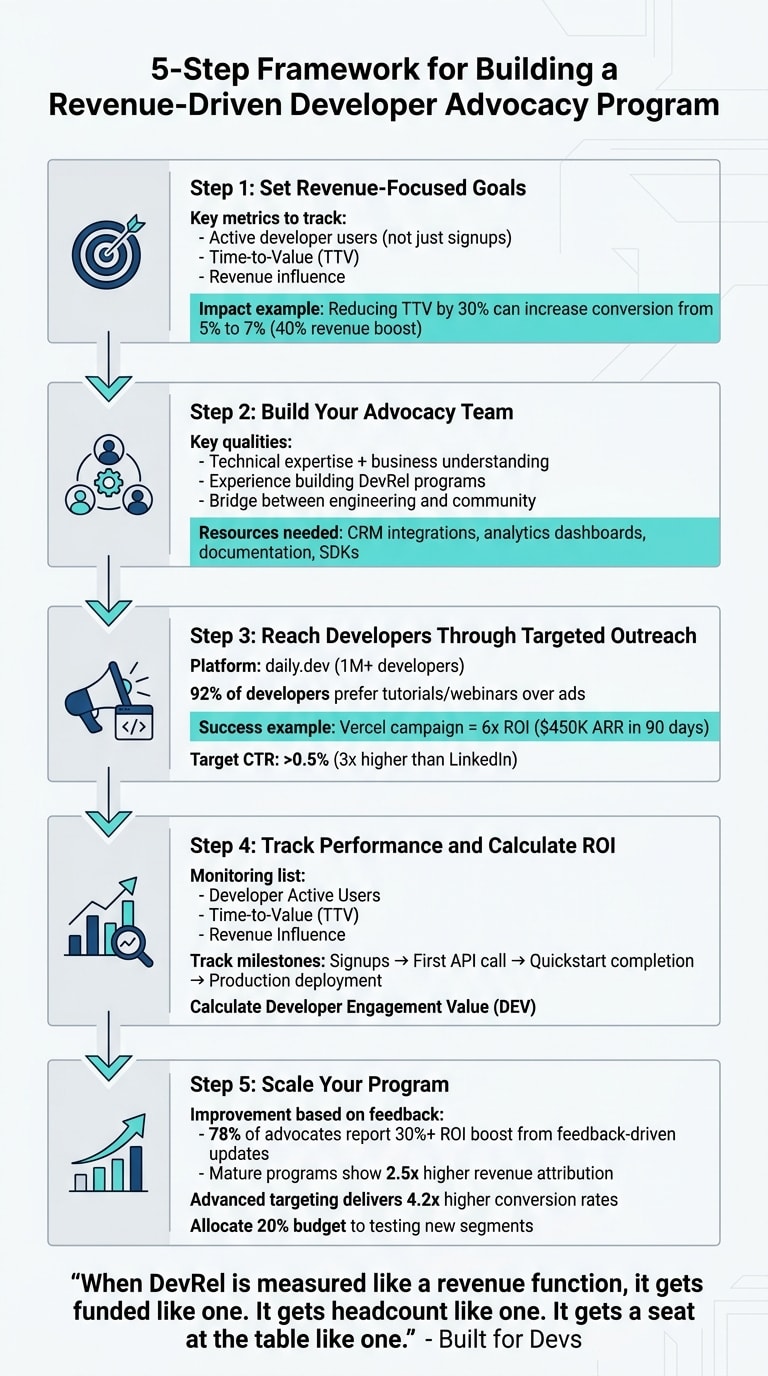
- Set Clear Metrics: Measure active users, time-to-value (TTV), and revenue influence. For example, reducing TTV by 30% can boost free-to-paid conversion rates, increasing revenue without extra acquisition costs.
- Hire the Right Team: Start with experienced advocates who combine technical skills with business understanding. Equip them with tools like CRMs and analytics dashboards to track developer engagement.
- Targeted Outreach: Use platforms like daily.dev to reach developers with precise, value-driven campaigns. For instance, Vercel's campaign targeting Next.js developers achieved a 6x return on investment.
- Educational Content: Developers prefer tutorials, webinars, and guides over ads. Create actionable content, like step-by-step tutorials, to address real challenges and encourage product adoption.
- Track Performance: Monitor key milestones like signups, API calls, and deployments. Use analytics to identify bottlenecks and optimize the developer journey.
- Scale Strategically: Use feedback and analytics to refine your program. Expand reach with smarter targeting and focus on high-converting developer segments.
Step 1: Set Revenue-Focused Goals
Identify Your Business Objectives
When it comes to developer advocacy programs, vanity metrics like the number of blog posts published or the size of your Discord community aren't the best indicators of success. Instead, focus on outcomes that tie directly to revenue. Your advocacy efforts should align with measurable business goals like product adoption, conversion rates, or pipeline influence.
For instance, if your company’s priority is to lower customer acquisition costs, your advocacy program should highlight how technical content and community engagement contribute to reducing those expenses. If the emphasis is on retention, showcase how developer support and education help minimize churn rates.
The key is to rely on data-driven insights. By analyzing real developer interactions and understanding their needs, you can refine your approach based on actual behavior rather than assumptions. Once you’ve clarified your objectives, translate them into specific metrics that connect directly to revenue.
Define Success Metrics
Turn your business goals into measurable metrics that clearly demonstrate revenue impact. Focus on three main areas: increasing active developer users (beyond just signups), shortening time-to-value (TTV), and tracking revenue influence.
Here’s an example: If your current free-to-paid conversion rate is 5%, reducing TTV by 30% could increase that conversion rate to 7%. That’s a 40% revenue boost without spending extra on acquisition. To identify gaps in revenue potential, track key milestones like signups, first API calls, quickstart completions, and production deployments.
Shift your perspective from simply counting developer interactions to measuring outcomes - how many developers adopt your product and continue using it over time.
"When DevRel is measured like a revenue function, it gets funded like one. It gets headcount like one. It gets a seat at the table like one." – Built for Devs
Step 2: Build Your Advocacy Team
Select the Right Advocates
Your first hire is crucial - it sets the foundation for your entire developer advocacy program. If you're starting from scratch, prioritize experience by bringing on a leader who has successfully built a developer relations function before .
The ideal advocates strike a balance between technical expertise and business savvy. As Daniel Bryant points out, advocates should understand how the business generates revenue . This awareness ensures their efforts align with measurable business goals.
Look for individuals who excel at identifying problems, testing new strategies, and tracking success metrics . They should empathize with different engineer personas and know how to translate community feedback into actionable steps. Strong candidates will have a track record of documenting user pain points and contributing to open-source projects, whether by filing issues, improving documentation, or fixing bugs .
"Our role is to act as the bridge between internal engineering teams and our developer community. We also advocate for developers internally." – Wassim Chegham, Senior Developer Advocate at Microsoft
Provide Resources and Support
Once you've assembled the right team, focus on giving them the tools and resources they need to succeed. Establish a formal feedback loop into your product roadmap, ensuring that community insights directly influence development decisions . Provide access to data tools like custom CRM integrations or analytics dashboards to help your advocates identify where developers may encounter challenges during the "Learn" and "Build" phases of your product journey .
Support your team with high-quality resources, including detailed documentation, code samples, starter projects, and SDKs. These materials make it easier for the community to learn and engage with your product . Additionally, create an operational playbook that outlines key processes, such as content planning, budget proposals, outreach strategies, and stakeholder communication .
Above all, protect your advocates' credibility. Never treat them as salespeople with quotas to meet.
"Treating an advocate as a quota-carrying salesperson is the fastest way to destroy their credibility and your program's effectiveness." – Matt Pru from Stackmatix
Step 3: Reach Developers Through Targeted Outreach
With your advocacy team ready, the next move is connecting directly with developers through carefully planned outreach. This method not only ensures you reach the right people but also ties directly into the revenue goals you’ve set.
Use daily.dev Ads for Targeted Campaigns
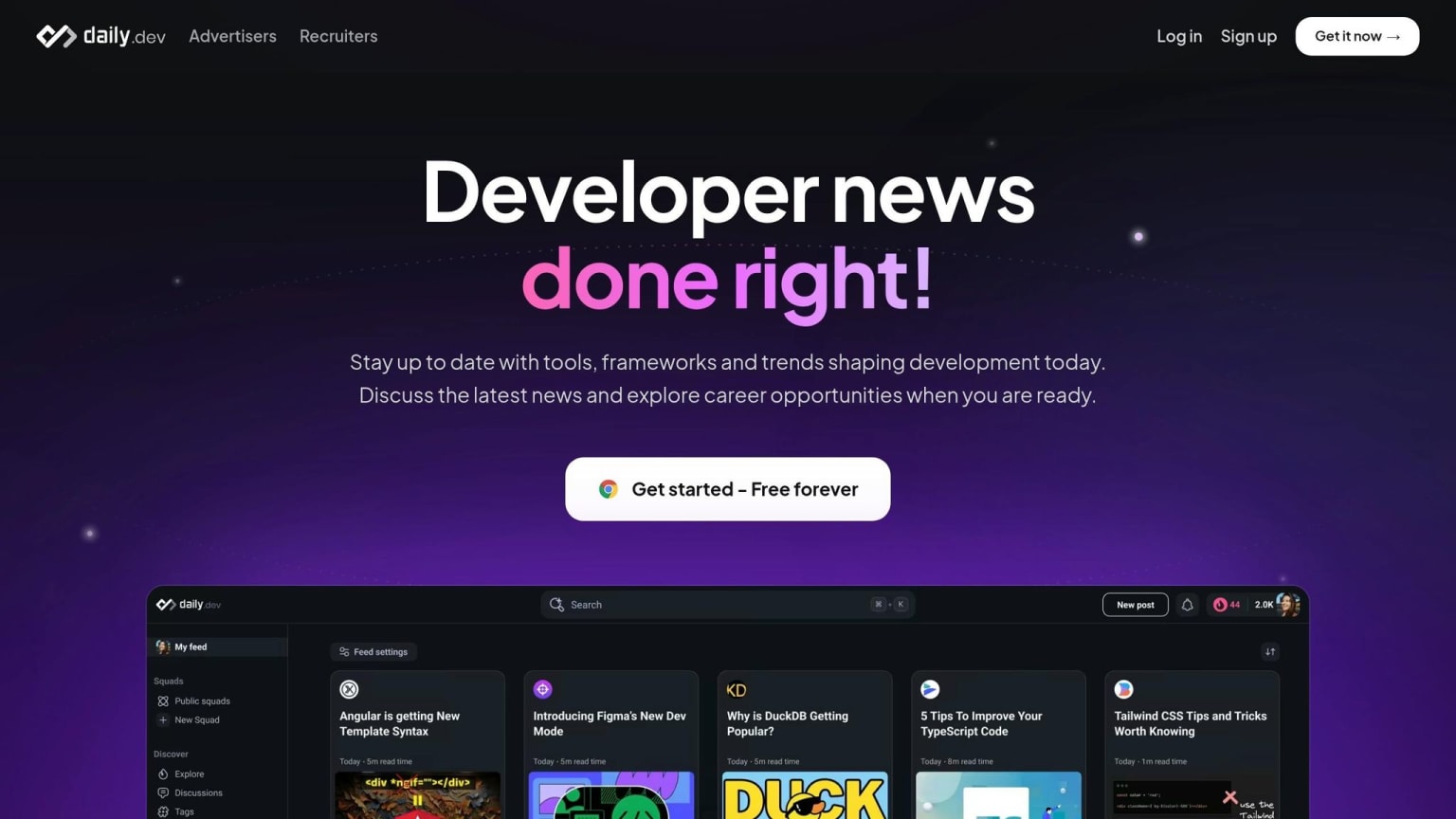
To reach developers effectively, you need to meet them where they already spend time. daily.dev is a trusted platform for over 1 million developers seeking tech news and content. Its advertising tools allow you to zero in on specific audiences based on factors like programming languages (e.g., JavaScript, Python), experience levels, job roles, and company size.
The key to success here is precision targeting combined with messaging that feels genuine. For example, in 2024, Vercel ran a daily.dev campaign aimed at Next.js developers using tutorials titled "How to Deploy Edge Functions in 5 Minutes." The results? The campaign generated 50,000 impressions at $7 CPM, leading to 8,200 clicks. This effort converted 1,500 developers into demo sign-ups, ultimately bringing in $450,000 in annual recurring revenue within just 90 days - a 6x return on investment .
When setting up your campaigns, start with test budgets of $5–10 CPM and focus on value-driven messaging rather than direct sales pitches. Ads that feel like educational resources perform better. For instance, "Boost Your App's Performance with Our Free React Guide" is much more effective than "Try Our React Tool Today." Use A/B testing to experiment with 3–5 headline and image combinations, and monitor click-through rates (CTR) closely. Aim for a CTR above 0.5%, which is about three times higher than what developer campaigns typically achieve on LinkedIn .
Once your ad campaigns are up and running, follow up with content that educates and addresses real developer challenges.
Develop Educational Content
Supporting your outreach with educational content is an excellent way to build trust and drive results. Developers overwhelmingly prefer learning through tutorials, webinars, and blog posts over direct advertisements - 92% of developers favor this approach . The goal here is to solve real problems, not just promote your product.
Create tutorials with clear sections like "Setup", "Implementation", and "Troubleshooting." Include working code samples, step-by-step instructions, prerequisites, and screenshots to make the content practical and actionable. A great example is HashiCorp's Terraform tutorial series, which generated 10,000 downloads. Of those users, 25% converted to paid tiers, bringing in $50,000 in monthly recurring revenue . The success of these tutorials lay in their focus on helping developers achieve specific goals rather than pushing a product.
Distribute your educational content across multiple platforms for maximum reach. Share tutorials on daily.dev, cross-post to dev.to, and promote them in newsletters. For more advanced sections, consider gating content behind email sign-ups to capture leads while still offering valuable free resources. Technical webinars and tutorials typically see 40–60% higher engagement rates among developers compared to standard marketing content . Host 45-minute live sessions on platforms like YouTube Live, complete with a Q&A segment, and provide recordings for developers who prefer on-demand learning.
Step 4: Track Performance and Calculate ROI
Once your campaigns are live, the next step is to demonstrate their impact on revenue. Tracking specific metrics helps confirm that advocacy efforts are driving measurable business results.
Monitor Revenue-Related Metrics
There are three key metrics to focus on, all directly tied to revenue.
- Developer Active Users: Don’t just count signups - track developers who have successfully onboarded and are actively using your product . This gives you a clearer picture of meaningful engagement.
- Time-to-Value (TTV): Measure how long it takes for a developer to go from their first interaction with your product to experiencing their first "aha" moment, such as completing a successful API call.
- Measurable Revenue Influence: Identify how advocacy efforts interact with your sales pipeline and contribute to actual revenue.
"DevRel is a revenue function. Not in the 'we should all be salespeople' sense. In the 'if you can't draw a line from your work to business outcomes, you don't have a function - you have a hobby' sense." - Built for Devs
To make this actionable, track critical developer milestones, such as when they sign up, make their first API call, complete a quickstart guide, or deploy to production . These timestamps help pinpoint where developers encounter obstacles and where revenue opportunities may be slipping away. For example, Snap Inc. implemented a custom tracking system for their Camera Kit SDK and discovered that most live apps were education-focused, not the flashy AR retail experiences they had anticipated. This insight allowed them to adjust their entire AR strategy based on real developer behavior . By combining these metrics with earlier efforts like targeted outreach and educational content, you build a complete framework for revenue-focused advocacy. These metrics also pave the way for evaluating program efficiency in greater depth.
Analyze Data with Analytics Tools
Collecting data is only half the battle - its true value lies in the analysis. Use analytics tools to turn raw data into practical insights. For example, calculating Developer Engagement Value (DEV) can help you assess direct usage and influence. This metric includes revenue generated by developers' usage, their influence on peers and decision-makers, referrals, feedback, contributions, and even skill-building support .
Standard CRMs often fall short when it comes to tracking developer-specific behaviors. Instead, consider using or creating systems that can monitor what developers are building, their use cases, and their progress through your product journey . Link this data to your product roadmap - if multiple developers are stuck on the same issue, that’s a clear friction point costing you revenue . A community-driven support strategy, like hosting office hours or forums, can reduce support tickets while also highlighting areas for product improvement .
Step 5: Scale Your Program
Once you've achieved measurable, revenue-driven results, it's time to scale your advocacy program. The challenge here is growing your reach without sacrificing quality. By focusing on proven metrics and refining your strategies, you can expand your program to connect with more developers while maintaining strong engagement and revenue outcomes. This involves two key steps: improving based on developer feedback and using smarter targeting to expand your reach.
Improve Based on Developer Feedback
Developer feedback is your best ally when it comes to scaling effectively. To gather insights, use tools like post-event surveys, NPS polls (via email or in-app), and discussions on community platforms like Discord or Reddit . Look for patterns in the feedback to understand what works and what might be falling short in your program.
Once you've collected feedback, organize it by themes such as content quality, event relevance, or tool usability. Prioritize addressing issues that directly impact revenue, like trial-to-paid conversion rates or onboarding bottlenecks . For example, in Q2 2024, HashiCorp revamped its developer advocacy program after analyzing feedback from 1,200 Terraform users through annual surveys. By creating new content focused on AI integrations, they boosted paid tier conversions by 45% (from 2.1% to 3.05%), adding $4.7 million in annual recurring revenue. This success was spearheaded by DevRel Manager Armon Dadgar .
To keep the improvement cycle going, establish a continuous feedback loop. Integrate tools like NPS surveys into post-ad interactions on platforms like daily.dev, and set quarterly review cycles to collect data, analyze trends, test changes, and measure results . Companies with mature developer advocacy programs report 2.5 times higher revenue attribution from developer-led deals compared to newer programs . Additionally, 78% of developer advocates say feedback-driven updates boosted their program ROI by over 30% last year .
By refining your program based on this feedback, you'll create a strong foundation for expanding your reach.
Expand Reach with Advanced Targeting
Once your program is fine-tuned, focus on scaling by targeting new audiences more effectively. Use detailed data on tech stacks, job roles, and interests to zero in on high-converting developer segments . Precision targeting can deliver conversion rates that are 4.2 times higher than broader campaigns .
Start by analyzing your existing campaign data to identify top-performing segments. For example, export analytics from the daily.dev dashboard to find patterns - like a 45% conversion rate among full-stack developers in fintech. Use this data to create lookalike audiences, helping you reach similar profiles .
Begin with small test budgets, around $500, to gauge performance before scaling up to $10,000 for successful campaigns . Use A/B testing to refine your ad creatives and headlines, aiming for click-through rates above 2% and conversion rates over 4% . Allocate 20% of your quarterly budget to experimenting with new segments, and scale the successful ones based on performance .
"Scaling DevRel isn't about more headcount; it's about smarter signals from feedback and targeting." – Tim Buntrock, Founder of daily.dev, at DevRelCon Europe 2025
These strategies ensure your program grows strategically, reaching the right developers while maintaining its impact and effectiveness.
Conclusion: Building Revenue-Driven Developer Advocacy
Shifting your mindset is key to creating a developer advocacy program that drives revenue. Developer relations should no longer be seen as a cost center - it’s a function that directly impacts business outcomes. As the Built for Devs framework aptly states:
"If you can't draw a line from your work to business outcomes, you don't have a function - you have a hobby" .
To succeed, focus on metrics that matter: active developer users, shorter time-to-value (TTV), and measurable contributions to revenue.
Start by setting clear, revenue-focused goals that align with your broader business objectives. Build a team that blends technical expertise with strategic thinking. Use platforms like daily.dev to connect with developers where they already are, and treat every interaction - whether it’s a support ticket or a community discussion - as a data point to refine your product and approach. Let the data guide you as you scale.
Remember, adoption is the foundation of engagement. High sign-up numbers mean little if activation rates are low. For example, a million signups with only 2% activation represents a missed opportunity, while cutting TTV by 30% could raise free-to-paid conversion rates from 5% to 7% .
Your mission isn’t just to promote what your product team builds - it’s to ensure they build what developers actually need. By aligning your product strategy with real developer feedback, you create a direct link between community engagement and revenue growth. Developer relations should act as the bridge between your community and your product, driving satisfaction and tangible business results. When DevRel is treated as a revenue-generating function, it earns the resources, influence, and recognition it deserves.
This guide provides a roadmap to build, measure, and expand a developer advocacy program that delivers measurable results. Start with a key metric, validate your progress, and scale from there.
FAQs
How do I prove DevRel impacts revenue?
Tracking the impact of Developer Relations (DevRel) on revenue requires focusing on key metrics. Start with developer adoption rates, community growth, and technical engagement - things like API calls, GitHub activity, and documentation views. These indicators show how effectively developers are interacting with your tools and resources.
Next, tie developer activity directly to revenue by measuring product usage metrics. Look at data like SDK implementation, feature activation, and onboarding completion to understand how developers are integrating your product into their workflows.
Finally, keep an eye on broader KPIs such as activation rates, retention, and long-term engagement. These metrics highlight how DevRel efforts contribute to product adoption and build customer loyalty, which ultimately leads to revenue growth.
What’s the best way to measure time-to-value?
Measuring time-to-value in a developer advocacy program means focusing on how quickly developers start using and benefiting from your tools or services. To do this, track key metrics like activation rates, engagement levels, and the time it takes for developers to complete onboarding or start using core features. These indicators reveal how well your program delivers value and achieves tangible results for developers.
Which onboarding milestones should I track?
When evaluating developer onboarding, it's crucial to focus on specific engagement metrics that reveal how well developers are interacting with your platform. Here are some key areas to track:
- Community participation: Look at activity in forums, attendance at events, and engagement on social media platforms.
- Content consumption: Keep an eye on metrics like documentation views and how frequently developers access SDKs.
- Platform adoption: Measure API call frequency, feature activation rates, and onboarding completion percentages.
Tracking these milestones gives you a clear picture of how developers are progressing through onboarding and how effectively they are engaging with your product or platform.