

Marketing to developers is challenging. Flashy ads and vague promises won’t work; developers demand technical depth, accurate content, and hands-on resources. If your team struggles to create this kind of content or lacks the bandwidth to engage developers effectively, a developer marketing agency can help. These agencies specialize in creating technical content, building developer communities, and running targeted campaigns designed specifically for this audience.
Key signs you need an agency:
- Your engineers are pulled away from core tasks to create content.
- Your technical content lacks depth or credibility.
- Campaigns fail to engage developers or drive meaningful actions (e.g., API usage, GitHub stars).
- You're entering a new developer segment and need expertise in niche communities.
What a good agency does:
- Produces technical content like code tutorials and benchmarks, often written by engineers.
- Engages developers on platforms they trust, such as GitHub, Stack Overflow, and Hacker News.
- Focuses on developer-specific metrics like time-to-first-API-call, SDK installs, and documentation visits.
Costs and options:
- Agencies: $8,000–$28,000/month for a full team and faster execution.
- Freelancers: $2,000–$8,000/project but require more oversight.
- In-house teams: $180,000+/year per hire, ideal for long-term needs.
Hiring the right agency means finding one with technical expertise, a proven track record with developer audiences, and a focus on metrics that matter to your goals. Avoid agencies that rely on generic marketing tactics or lack understanding of developer workflows. Define clear KPIs, maintain a streamlined content approval process, and treat the agency as an extension of your team to see the best results.
Why Developer Marketing is Hard to Outsource
Most agencies simply don’t have the technical expertise to resonate with developers. Traditional B2B marketing tactics - like polished websites, vague calls-to-action, and whitepapers filled with fluff - don’t work for an audience that values functionality and quick access to solutions . When it comes to marketing tools like APIs or infrastructure products, the lack of hands-on technical knowledge becomes glaringly obvious .
This gap is reflected in trust statistics: only 4% of people find editorial content from companies trustworthy, and the same percentage believes advertising professionals act with integrity . Developers, however, are even more skeptical. They’re quick to call out technical inaccuracies on forums like Hacker News and have a low tolerance for what they define as spam - messaging that’s pushy, irrelevant, or filled with fluff . As Nick Moore, a writer specializing in developer-focused content, explains:
"What developers really hate are advertising and spam... the pushiness, the fluffiness, the irrelevance"
.
David Enck, founder of Draft.dev, highlights the issue many companies face when outsourcing developer marketing:
"A lot of clients come to us at Draft.dev after trying a more generalized agency that couldn't find writers with the technical expertise that we have."
.
Getting developer marketing wrong isn’t just a matter of wasted ad spend. It can lead to significant inefficiencies, like in-house engineering teams spending weeks rewriting or correcting content that doesn’t align with developer workflows. Meanwhile, non-technical agencies often don’t know how to engage on the platforms where developers actually spend their time - places like GitHub, Stack Overflow, or trusted developer ecosystems like daily.dev . With over 86,000 advertising agencies in the U.S., very few have the specialized experience needed to market technical products effectively .
The root problem lies in the difference between traditional marketing and what developers expect. Traditional approaches focus on broad brand awareness and high-level messaging. Developers, on the other hand, want tangible evidence - like code samples, benchmarks, and technical proof . Agencies that treat developers as just another audience segment miss the mark, especially since 60% of developers have the authority to approve or reject tools . Milica Maksimovic of Literally.dev puts it bluntly:
"If you've built a product for developers and you're relying on a non-tech marketer to grow it... You're wasting time"
.
Winning over developers requires more than conventional advertising. It’s about offering real utility and technical depth, which is why many companies eventually turn to specialists when their initial attempts fall flat.
Signs Your Team Needs a Developer Marketing Agency
Sometimes, the signs that your team could use outside help are hard to ignore. For instance, if your internal engineers are being pulled away from their core responsibilities to create content, it’s a clear signal something’s off .
Another red flag? If your content lacks the technical depth developers expect. Performance metrics can also paint a telling picture. If it takes weeks to scope and publish a single piece of content, or if your technical posts get called out on platforms like Hacker News for being inaccurate or shallow, it’s time to reevaluate. These are just a few examples of where internal efforts might fall short.
No Technical Content Engine
Developers are quick to lose trust in brands that don’t consistently deliver quality technical content. Without a steady publishing schedule, your brand risks fading into the background. To stay relevant, many successful developer-focused programs aim to publish at least twice a week . If your team struggles to get even one article out in weeks, it’s not just a delay - it’s a missed opportunity to build trust and credibility with your audience.
Here’s the thing: one well-crafted technical post can attract over 10,000 highly targeted readers when it’s structured and distributed effectively . But most in-house teams lack the expertise to create content that genuinely connects with developers. For example, when Fabric, Inc. partnered with a developer marketing agency, they saw a dramatic boost - referral traffic and organic keyword rankings tripled in just weeks. In one standout case, a single technical post that hit the front page of Hacker News generated five demo requests in just one day .
Campaigns Underperforming
Struggling campaigns are another clear sign. Often, this happens because the content doesn’t align with the audience’s needs. Traditional B2B tactics - like vague calls-to-action, gated whitepapers, or overhyped marketing language - can actually turn developers away . To make matters worse, many teams focus on the wrong metrics. For instance, on developer-focused platforms, 83% of ad conversions happen without a direct click, meaning traditional click-through rates don’t tell the whole story .
Ravi Dehar from Gusto shared how outsourcing made a difference:
"Draft.dev really accelerated our developer-focused marketing efforts... without pulling away our internal technical teams to write that content" .
If your campaigns aren’t driving meaningful engagement - like GitHub stars, documentation visits, SDK installs, or API usage - and are instead only racking up empty clicks, it’s a sign you need a team that understands developer-specific metrics .
Launching into a New Developer Segment
Breaking into a new developer segment is no small feat. Developers are far from a monolithic group - web developers, data scientists, and infrastructure engineers all hang out in different online spaces, from specific subreddits to Discord channels and GitHub repositories. Each group has its own tone, preferences, and community norms . Applying a one-size-fits-all approach here just doesn’t work.
Jim Huffman, CEO of GrowthHit, summed it up well:
"A lack of industry nuance, especially in highly regulated spaces like fintech, healthcare, etc., can kill a campaign" .
This is where agencies shine. They bring in a network of vetted engineer–writers who know how to speak to niche audiences - whether it’s container orchestration or microservices . Plus, they know exactly where to find these developers, from niche newsletters to technical publications and curated platforms . With this expertise, agencies can move three times faster than internal teams, who might otherwise spend weeks just trying to figure out the landscape .
What a Good Developer Marketing Agency Does
When your internal team struggles to reach developers effectively, bringing in a specialized agency can make all the difference. A leading developer marketing agency offers tailored services like technical content creation, community engagement, and targeted paid campaigns. These agencies essentially act as an extension of your team, managing everything from strategy to execution with a developer-first mindset.
Technical Content Creation
At the heart of any developer marketing strategy lies technical content. The best agencies employ writers who come from engineering backgrounds - think former CTOs, software developers, or engineers who know how to code. For example, Draft.dev collaborates with over 300 vetted engineer-writers to ensure every piece of content is accurate and resonates with a technical audience . This dev-to-dev approach avoids the marketing fluff that developers easily dismiss.
Take the partnership between Sinch Mailgun and Draft.dev as an example. By focusing on developer-first content, they achieved click-through rates of 20–45% and helped brands like Earthly grow organic reach by 346%. These results came from creating in-depth technical articles that truly connect with engineering audiences . Emily Blitstein from Sinch Mailgun put it best:
"Draft.dev's attention to detail and dedication to aligning content with our brand have significantly impacted our developer-focused content strategy."
Once a solid foundation of technical content is in place, the focus shifts to building authentic developer communities.
Community Building
Engaging with developers means meeting them where they already are - on platforms like GitHub, Stack Overflow, and Slack. A good agency identifies these spaces and designs programs to add real value. This might include managing developer advocacy initiatives, hosting open-source projects, or organizing technical writing challenges to encourage user-generated content. These efforts enhance your community presence without overloading your internal Developer Relations team.
For instance, Stoplight experienced a 30x increase in web traffic after adopting a developer-focused content strategy led by EveryDeveloper . By fostering authentic engagement, agencies create a strong community foundation that supports other marketing efforts.
Paid Acquisition Campaigns
While technical content and community engagement are essential, reaching developers also requires a smart distribution strategy. Top agencies run targeted paid campaigns on platforms developers frequent, such as Carbon Ads, Reddit, LinkedIn, and developer newsletters. They may also seed content in niche spaces like Slack groups and Hacker News.
Some agencies use advanced tactics like Generative Engine Optimization (GEO) to improve content visibility on tools like ChatGPT. For example, Siege Media’s bottom-funnel strategy for Zapier led to an organic traffic boost of over 10 million visitors . Platforms like daily.dev Ads allow for precise targeting that aligns with developer behavior. Importantly, these agencies focus on metrics that matter - such as GitHub stars, API usage, SDK installs, and documentation visits - rather than just click-through rates .
How to Evaluate Developer Marketing Agencies
Choosing the right developer marketing agency means focusing on their technical expertise rather than flashy marketing credentials. With over 86,000 advertising agencies in the U.S., only a small number truly understand the nuances of developer-focused marketing . Instead of being swayed by polished presentations, look for an agency that can break down complex architectures and APIs with ease.
Here’s how to assess them effectively: examine their portfolio, evaluate their technical writing, and gauge their understanding of the developer buying process.
Portfolio of Developer Clients
Start by reviewing the agency's client history. Have they worked with companies in your industry, such as those dealing with APIs, infrastructure tools, or open-source projects? For example, in early 2026, Shorebird teamed up with Draft.dev to ramp up their content production. Under the leadership of Dawn Parzych, the collaboration produced content that ranked on search engines within the first month - showing a clear ability to deliver measurable outcomes . Similarly, Fabric Inc. saw a threefold increase in referral traffic and organic keyword rankings after working with Draft.dev. One standout piece even landed on the front page of Hacker News, generating five demo requests in just one day .
Ask for specific metrics tied to developer-focused goals, like improved documentation usage or demo requests. Agencies that can point to these kinds of results demonstrate a solid grasp of what matters to technical audiences.
Next, take a closer look at the agency’s technical writing to ensure it resonates with developers.
Technical Writing Quality
The quickest way to judge an agency’s capability is to dive into their content. Review 3–5 sample posts or tutorials, paying close attention to elements like code snippets, architecture diagrams, and step-by-step guides. If their writing leans heavily on buzzwords like "innovative solution" or "cutting-edge technology" without providing real technical depth, they’re unlikely to connect with developers .
Draft.dev, for instance, works with over 300 vetted engineer-writers to ensure their content is technically accurate . To test an agency’s abilities, consider asking them to explain your product’s architecture or create a sample tutorial. If they can’t deliver, they won’t earn the trust of your developer audience.
Understanding of Developer Buying Journeys
Developers don’t shop for tools the way traditional B2B buyers do. They find new tools on platforms like GitHub, Stack Overflow, and Hacker News - not through LinkedIn ads or gated whitepapers. A good agency should understand the developer journey: Discover → Evaluate → Adopt → Advocate . During the evaluation process, ask how they plan to distribute your content. If their strategy focuses solely on generic B2B channels, that’s a warning sign.
The right agency will also prioritize metrics that matter to developers, such as documentation usage, time-to-first-successful-API-call, and GitHub engagement - not just website traffic . As marketer Milica Maksimovic puts it:
"You can't sell to developers - you have to earn their attention" .
Make sure to interview the agency’s technical editors or team leads, not just their sales team, to confirm that technical expertise runs throughout the organization .
Here’s a quick comparison to help identify the right agency:
| Indicator | Execution Agency (Red Flag) | Strategic Developer Agency (Green Flag) |
|---|---|---|
| Content Type | Gated whitepapers, generic blogs | Open-source tutorials, engineering deep-dives |
| Channels | General B2B (LinkedIn, Facebook) | GitHub, Stack Overflow, Hacker News |
| Metrics | Clicks, impressions, likes | CAC, LTV, API calls, developer sign-ups |
| Team | Generalist account managers | Former engineers or technical writers |
Agency vs Freelancer vs In-House: Decision Framework
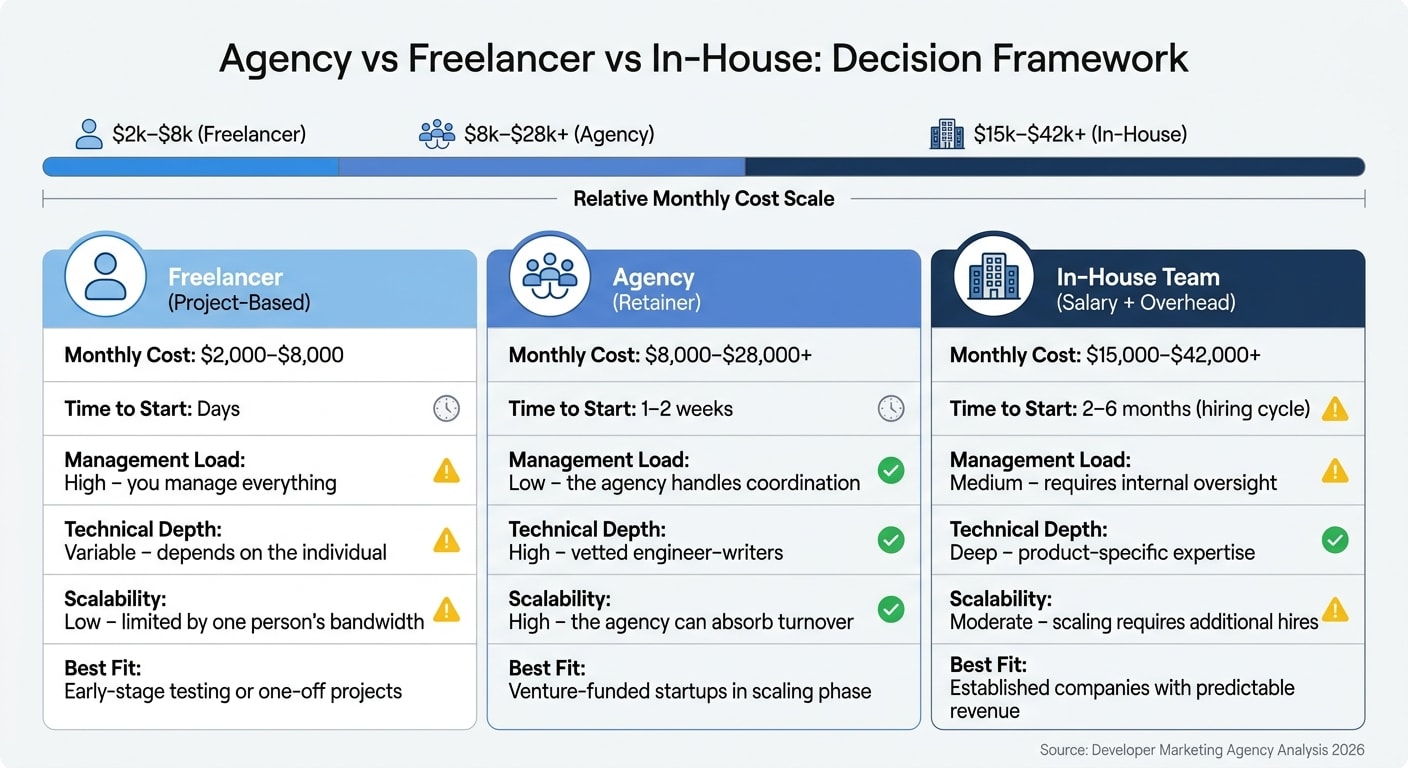
Choosing between an agency, freelancer, or in-house team isn't just about cost - it's about finding the right fit for your company's stage, budget, and ability to manage the process. Each option comes with its own advantages and challenges, so understanding the trade-offs is key.
Agencies offer a quick path to execution with a full team of experts, including technical writers, SEO specialists, and designers. This eliminates the need for a lengthy hiring process. Monthly retainers typically range from $8,000 to $28,000, depending on the agency. For example, Draft.dev starts at around $8,000–$9,000 per month, while enterprise-focused agencies like 310 Creative can charge up to $28,000 monthly for targeted campaigns . One major perk of working with agencies is the reduced management overhead. As Alex Birkett, Co-Founder of Omniscient Digital, explains:
"A good agency will eventually operate mostly autonomously, but during the first few months, it helps to have a dedicated employee who can be the bridge between internal strategy and goal setting and the agency's work."
Freelancers are the most flexible and cost-effective option upfront, charging anywhere from $20 to $90 per hour. However, managing freelancers comes with its own set of challenges. You'll need to recruit, vet, and oversee multiple individuals, which can quickly add to your workload. Plus, freelancer turnover can disrupt ongoing projects, making them better suited for one-off tasks ranging from $2,000 to $5,000 rather than consistent, multi-channel efforts .
In-house teams require the highest upfront investment. When factoring in benefits and overhead, hiring a single specialist can cost between $180,000 and $190,000 annually, while a small team of three can exceed $500,000 per year . The advantage is having a team with deep product knowledge and the ability to maintain long-term brand consistency. However, finding marketers with the right mix of technical expertise and distribution skills - often referred to as "DevRel DNA" - is a significant challenge . Specialized agencies can often execute up to three times faster than in-house teams .
Cost Comparison and Trade-Offs
Here’s a breakdown of how these options compare across key factors:
| Factor | Freelancer (Project-Based) | Agency (Retainer) | In-House Team (Salary + Overhead) |
|---|---|---|---|
| Monthly Cost | $2,000–$8,000 | $8,000–$28,000+ | $15,000–$42,000+ |
| Time to Start | Days | 1–2 weeks | 2–6 months (hiring cycle) |
| Management Load | High – you manage everything | Low – the agency handles coordination | Medium – requires internal oversight |
| Technical Depth | Variable – depends on the individual | High – vetted engineer–writers | Deep – product-specific expertise |
| Scalability | Low – limited by one person's bandwidth | High – the agency can absorb turnover | Moderate – scaling requires additional hires |
| Best Fit | Early-stage testing or one-off projects | Venture-funded startups in scaling phase | Established companies with predictable revenue |
For early-stage companies working with tight budgets, freelancers can be a good way to test specific projects. On the other hand, venture-funded startups often benefit most from agencies, as they can quickly scale efforts and fill gaps that are hard to hire for. Established companies with steady revenue are better suited for building in-house teams, ensuring long-term control over their brand. As Gerald Lombardo from Gr0 points out:
"There are very few full-service agencies out there that do a good job... if you are a startup, recently funded brand, or small-to-medium-sized business, odds are you are better off with a specialized firm."
Even with a great agency, having someone internal who understands your product's technical details is critical. This internal point-person can help bridge the gap between your goals and the agency's execution, ensuring smoother collaboration and better results .
Red Flags to Watch for When Hiring a Developer Marketing Agency
Finding an agency that genuinely understands technical audiences can be tricky. Many claim expertise but fall short, and the wrong choice can do more than waste your budget - it can harm your brand's credibility. Developers are quick to spot inauthenticity, making it essential to choose a partner with true technical insight.
Generic B2B Playbooks
A big red flag? Agencies pitching standard B2B marketing tactics. If their approach revolves around high-level claims or brand awareness campaigns, they likely don’t grasp how developers evaluate tools. As Karl Hughes, Founder of Draft.dev, puts it:
"If you asked a run-of-the-mill writer to work on something complex like 'tips for scaling enterprise Kubernetes clusters,' they might be able to create a high-level piece based on research, but they wouldn't be able to build a demo application" .
Developers don’t engage with vague jargon - they want practical, code-driven insights that prove your tool works. Agencies need to show they can deliver hands-on tutorials, engineering articles, and fully functional demo applications. Another misstep? Misusing distribution channels. Instead of focusing on platforms like GitHub, Stack Overflow, or Hacker News, inexperienced agencies often lean heavily on LinkedIn and press releases .
It’s also crucial that the agency understands the nuances of technical roles.
Lack of Understanding of Developer Roles
If an agency can’t explain the difference between a web developer, a data scientist, and a DevOps engineer - or doesn’t know what a developer advocate does - they’re not the right fit. Test their technical understanding during the discovery call. Ask them to explain your product’s architecture. If they can’t articulate it clearly, they won’t be able to create resonant content .
Karl Hughes offers this advice:
"One of the biggest things to avoid if you're a startup are marketing agencies that say they can do everything for everyone and lack focus" .
Another red flag is when technical know-how is confined to the sales team. If the writers and leads responsible for execution lack hands-on experience, the agency won’t deliver the depth required .
Finally, beware of agencies relying on outdated strategies.
Reliance on Gated Whitepapers
If an agency suggests gated whitepapers as a lead magnet, steer clear. Developers dislike unnecessary friction and are quick to criticize such tactics on platforms like Hacker News . They’re skeptical by nature, often use ad blockers, and expect open access to information. Forcing them to fill out forms for basic resources signals a lack of understanding about their workflow.
The numbers back this up: 83% of ad conversions on platforms like Stack Overflow happen without users clicking ads . Developers prefer open documentation, quick-start "hello-world" guides, and authentic discussions with peers. Agencies clinging to traditional lead capture methods fail to grasp that 60% of developers can independently approve or reject tools, highlighting their significant decision-making power .
Structuring an Engagement with a Developer Marketing Agency
Once you've chosen the right agency, setting up a productive partnership means laying a solid foundation from the start. The most effective collaborations treat the agency as a true extension of your internal team - fully integrated, not just a vendor.
Defining KPIs
Before signing any contracts, make sure to define what success looks like. For developer-focused campaigns, traditional metrics like raw signup numbers won’t cut it. Developers value technical proof, so your KPIs should reflect how they interact with your product. Metrics like documentation usage, time-to-first-successful API call, and code-lab completions are far more telling than homepage visits or generic traffic stats.
Here’s an example: One campaign saw a 346% boost in monthly blog visitors and another drove a 211% increase in trial conversions . The key? They focused on the right metrics - ones that demonstrated meaningful engagement with developers.
Set KPIs around both "Definition of Done" (deliverables like blog posts or videos) and "Definition of Success" (outcomes like higher trial conversions). Developers tend to research extensively before committing, so track conversions and signups over a 60-90 day period instead of expecting instant results . As Jim Huffman, CEO of GrowthHit, wisely says:
"I wish I could guarantee results, but it's a lie. Every business and customer set is different. Instead, we guarantee our process and our output or growth experiments. Usually, the results follow."
Also, keep an eye on community engagement metrics, such as GitHub issues raised, Slack or Discord activity, and forum discussions. Remember, 83% of ad conversions on platforms like Stack Overflow occur without a direct click - developers often recall and search for a brand later when they encounter a specific problem .
With KPIs in place, establish a consistent reporting schedule to monitor progress and adjust your strategy as needed.
Reporting Cadence
Monthly analytics check-ins are essential for evaluating KPIs and fine-tuning your approach. Regular reporting shows your commitment to technical quality and builds trust with developers. For example, in 2023, Hackmamba ran a "Content Sprint" for Neon, a Postgres client. Afterward, they analyzed performance data across distribution channels, delivering ROI metrics that led to a campaign renewal .
Assign an internal point-person to act as the liaison between your team and the agency. This ensures alignment on goals and execution. As Alex Birkett, Co-Founder of Omniscient Digital, explains:
"A good agency will eventually operate mostly autonomously, but during the first few months, it helps to have a dedicated employee who can be the bridge between internal strategy and goal setting and the agency's work, as well as a quality judge to make sure the agency is on the right track."
Plan engagements around quarterly cycles to give strategies like technical content and SEO enough time to show results. Agencies should present a quarterly roadmap for your approval, so you can oversee the big-picture strategy while they handle the day-to-day execution .
Content Approval Workflows
To hit your KPIs, you need an efficient content approval process that balances speed with quality. Begin with a 1-2 week alignment phase to establish goals, messaging, and a content roadmap before production starts .
For technical accuracy, have content reviewed by actual developers and professional technical editors, not just marketing writers. Some agencies maintain networks of hundreds of vetted engineer-writers to ensure content has the necessary technical depth . During the evaluation phase, ask to meet the agency’s team leads or writers to assess their expertise firsthand .
Streamline the workflow so your internal team only needs to attend a kickoff, approve roadmaps, and occasionally review drafts. The agency should handle publishing and distribution. It’s worth noting that technical content can sustain 10-15% visitor-to-signup conversion rates as traffic grows , but only if the approval process doesn’t slow things down.
| Workflow Stage | Internal Role | Agency Role |
|---|---|---|
| Kickoff | Define goals, messaging, and technical requirements | Develop quarterly content roadmap |
| Production | Provide occasional SME feedback on drafts | Write, edit, and fact-check all content |
| Approval | Review roadmaps and final drafts | Incorporate feedback and manage revisions |
| Distribution | Monitor performance metrics | Publish to CMS, distribute across channels |
| Reporting | Attend monthly analytics check-ins | Track KPIs and provide actionable insights |
How Agencies Use daily.dev for Business in Developer Campaigns

Agencies looking to connect with developers know the importance of meeting them where they already spend time - and daily.dev for Business is a perfect example of this. With a thriving ecosystem of over 1 million developers consuming technical content daily, it’s an ideal platform for running targeted campaigns. Below are some ways daily.dev for Business helps agencies create campaigns that are precise, relevant, and impactful.
Account-Level Targeting via Developer Network Data
One of the standout features of daily.dev for Business is its ability to target developers based on their actual behavior. Agencies can segment campaigns by criteria like seniority, preferred programming languages, tools, or even specific interests. For example, you could tailor your campaign to backend engineers working with Kubernetes or frontend developers focused on React.
This level of precision matters because 60% of developers have the authority to approve or reject tools . By targeting specific technical queries - like "Docker container fails to start memory error" - you can deliver messaging that feels relevant and timely. Whether developers are exploring new frameworks or troubleshooting production issues, daily.dev’s network data ensures your tool appears at the right moment, aligning perfectly with their needs.
Native Ad Placements for Developer Audiences
Beyond precise targeting, daily.dev’s native ad placements make your message feel like a natural part of the developer’s content experience. This is essential in an audience that often uses ad blockers and is skeptical of traditional marketing tactics. Native ads blend seamlessly with the platform’s technical content, ensuring your campaign doesn’t disrupt the user experience.
Developers tend to evaluate tools over time, so agencies typically measure success over a 60–90 day window instead of focusing solely on immediate click-through rates . A well-placed ad might not lead to an instant conversion, but it can stick in a developer’s mind, resurfacing later when they encounter a related problem.
For example, instead of saying, "Our tool helps with Kubernetes scaling", try phrasing it as, "You can use this tool to fix Kubernetes concurrency issues" . This approach empowers developers to explore solutions rather than feeling like they’re being sold to. As Matt Palmer aptly puts it:
"Developers are just regular people with real-world problems. If you solve for that, you win" .
By tying ads to actionable resources like tutorials, quickstarts, or code samples, agencies can build trust and provide immediate value. This hands-on approach mirrors how developers naturally evaluate tools - through experimentation and practical use - making it far more effective than relying on gated content like whitepapers.
These strategies ensure campaigns on daily.dev resonate with developers, fostering authentic engagement and long-term results.
Conclusion: Making the Right Choice for Your Developer Marketing Needs
In the fiercely competitive world of developer marketing, authenticity is everything. Picking the right developer marketing agency isn’t just about their marketing credentials - it’s about how well they align with your product’s technical needs. The agency you choose must deeply understand your product’s architecture, communicate in a way that resonates with developers, and create content that genuinely addresses real-world engineering challenges. As Alyssa aptly states:
"Hiring a developer marketing agency is less about marketing credentials and more about technical alignment" .
To find the right fit, take the time to evaluate their ability to grasp complex concepts. Challenge them to explain your product’s core use case or break down a complicated technical issue. Dig into their portfolio for case studies that showcase experience with products like yours - whether it’s API-first tools, infrastructure software, or open-source frameworks. Look for agencies staffed with coder-marketers who are active participants in developer communities. Once you’ve confirmed their technical expertise and reviewed their work, stay alert for warning signs.
Be cautious of generic B2B strategies, gated whitepapers, or cookie-cutter approaches that fail to address the nuances of different developer roles. Don’t forget that 60% of developers have the authority to approve or reject tools . Developers can quickly spot inauthenticity, and a misstep can harm your reputation within the community.
After selecting an agency, focus on measuring their impact. Define success metrics that go beyond surface-level engagement - track SDK installs, API usage, documentation visits, and GitHub stars. Schedule monthly reporting sessions to assess progress and refine your approach. Keep in mind that developer marketing is a long-term effort; conversions often take 60–90 days, not just a few weeks.
The best agencies become an extension of your internal team, combining technical expertise with precise distribution methods to connect with developers where they spend their time. Platforms like daily.dev for Business can amplify these efforts by offering highly targeted native ad placements that speak directly to developer audiences. When paired with such tools, agencies can craft campaigns that truly resonate and deliver results that matter.
FAQs
How long does it take to see results from a developer marketing agency?
It usually takes a few months to see noticeable results when working with a developer marketing agency. Establishing technical credibility, connecting with developer communities, and creating impactful content strategies take time. This process is all about building trust and gaining influence within developer-focused audiences.
What should I ask an agency to prove they can write for developers?
When evaluating an agency's ability to handle technical content, ask them to provide examples of technical pieces they've created. This could include blog posts, whitepapers, case studies, or documentation. Review how well they explain complex concepts - are they breaking things down in a way that's clear and accessible without oversimplifying?
It's also important to gauge their understanding of developer-specific channels and audiences. For instance, do they know how to tailor content for platforms like GitHub, Stack Overflow, or developer forums? Can they adapt their tone and language to resonate with technical professionals who value precision and detail?
Look for clear evidence that they can create content that not only informs but also connects with a technical audience. This will show their expertise in crafting material that aligns with the expectations and interests of developers and other tech-savvy readers.
How do I choose between an agency, a freelancer, and hiring in-house?
Choosing the right option - agency, freelancer, or in-house team - really comes down to what your business needs most.
- In-house teams give you more control and ensure technical alignment, making them a good fit for long-term, ongoing projects.
- Freelancers are a budget-friendly choice when you need specialized skills or help with smaller tasks.
- Agencies are great at scaling efforts, managing complex developer audiences, and steering clear of common issues like coming across as inauthentic.
Think about your company's current stage, available budget, and whether you prioritize scalability or hands-on control. These factors will guide you toward the best decision.