
If I had to sum it up in one line: pick Carbon Ads for clean awareness, BuySellAds for hand-picked publisher placements, and daily.dev Ads for tighter developer targeting.
If you're comparing these platforms in 2026, the choice usually comes down to three things:
- Who you want to reach: developers only, or developers plus designers
- How you want to target: by page topic or by first-party user behavior
- How much setup work you want: one platform vs. site-by-site buying
Here’s the short version:
- Carbon Ads is best for top-of-funnel awareness on curated dev and design sites.
- BuySellAds is best if you want more control over exact publishers and placements.
- daily.dev Ads is best if you want to reach developers only using stack, seniority, and engagement signals.
One point stands out fast: daily.dev starts from $2,000/month, while Carbon Ads and BuySellAds start from $5,000/month in this comparison. And in one cited example, daily.dev hit a 1.27% peak-day CTR, versus a common 0.3%–0.5% text ad range.
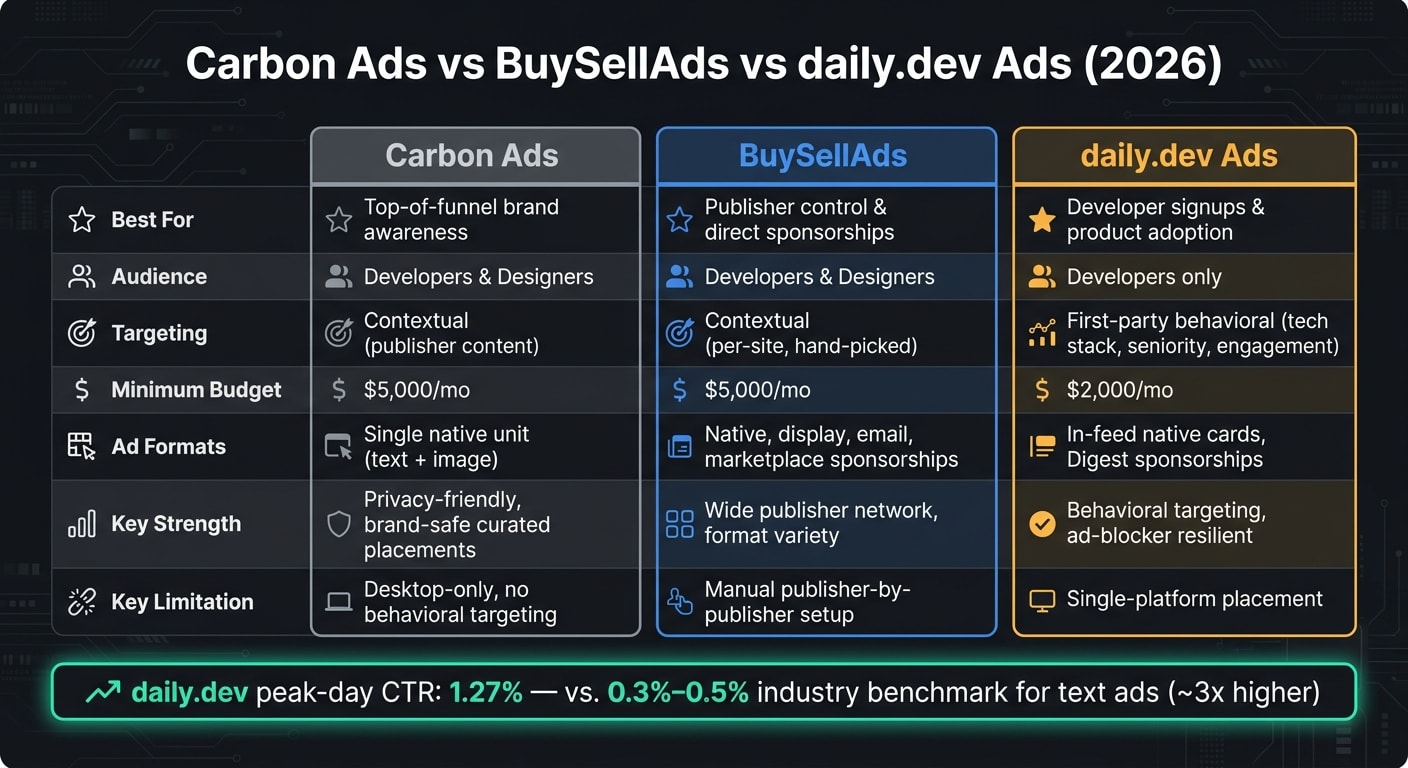
Quick Comparison
| Platform | Best For | Audience | Targeting | Starting Budget | Main Formats |
|---|---|---|---|---|---|
| Carbon Ads | Brand awareness | Developers and designers | Contextual | $5,000/mo | Single native unit |
| BuySellAds | Publisher control | Developers and designers | Contextual, per publisher | $5,000/mo | Native, display, email |
| daily.dev Ads | Signups and product adoption | Developers | First-party behavioral | $2,000/mo | In-feed native, Digest, Engagement |
What I like about this comparison is that the tradeoff is clear: network reach vs. audience precision. If you care more about where the ad appears, Carbon Ads and BuySellAds make more sense. If you care more about who sees the ad, daily.dev Ads is the better fit.
I’d use this guide to match platform choice to campaign goal, budget, and targeting needs without overthinking it.
Carbon Ads
Carbon Ads centers on a single native ad unit that runs across a curated set of developer and design sites. It takes a privacy-first approach, with no cookies and no behavioral tracking.
Where Carbon Ads fits
Carbon makes sense for teams that care more about where an ad appears than how deeply they can slice an audience. It tends to work best for top-of-funnel brand awareness campaigns aimed at developers and designers.
Because the network is privacy-first and less likely to get blocked by ad blockers, it can be a solid pick for teams that want brand-safe placements in a curated setting. Put simply: Carbon is a good match for clean awareness buys, not for fine-grained audience filtering.
Why some buyers look at other options
That same curated publisher list is also the ceiling. Reach can flatten out, especially for teams trying to get more scale. And because delivery is desktop-only, campaigns that need mobile coverage will hit a wall.
Targeting is contextual only. Carbon targets by publisher category, not by user behavior or job title. So if a campaign leans on scale or user-level signals, Carbon doesn't give buyers that kind of control.
That tradeoff is why some teams end up looking at other options with broader reach or tighter targeting.
| Carbon Ads | |
|---|---|
| Strengths | Privacy-friendly, less vulnerable to ad blockers, brand-safe curated placements |
| Limitations | Desktop-only, contextual only, reach-limited on niche segments |
| Best fit | Teams running awareness campaigns across dev and design sites with no behavioral targeting needs |
BuySellAds
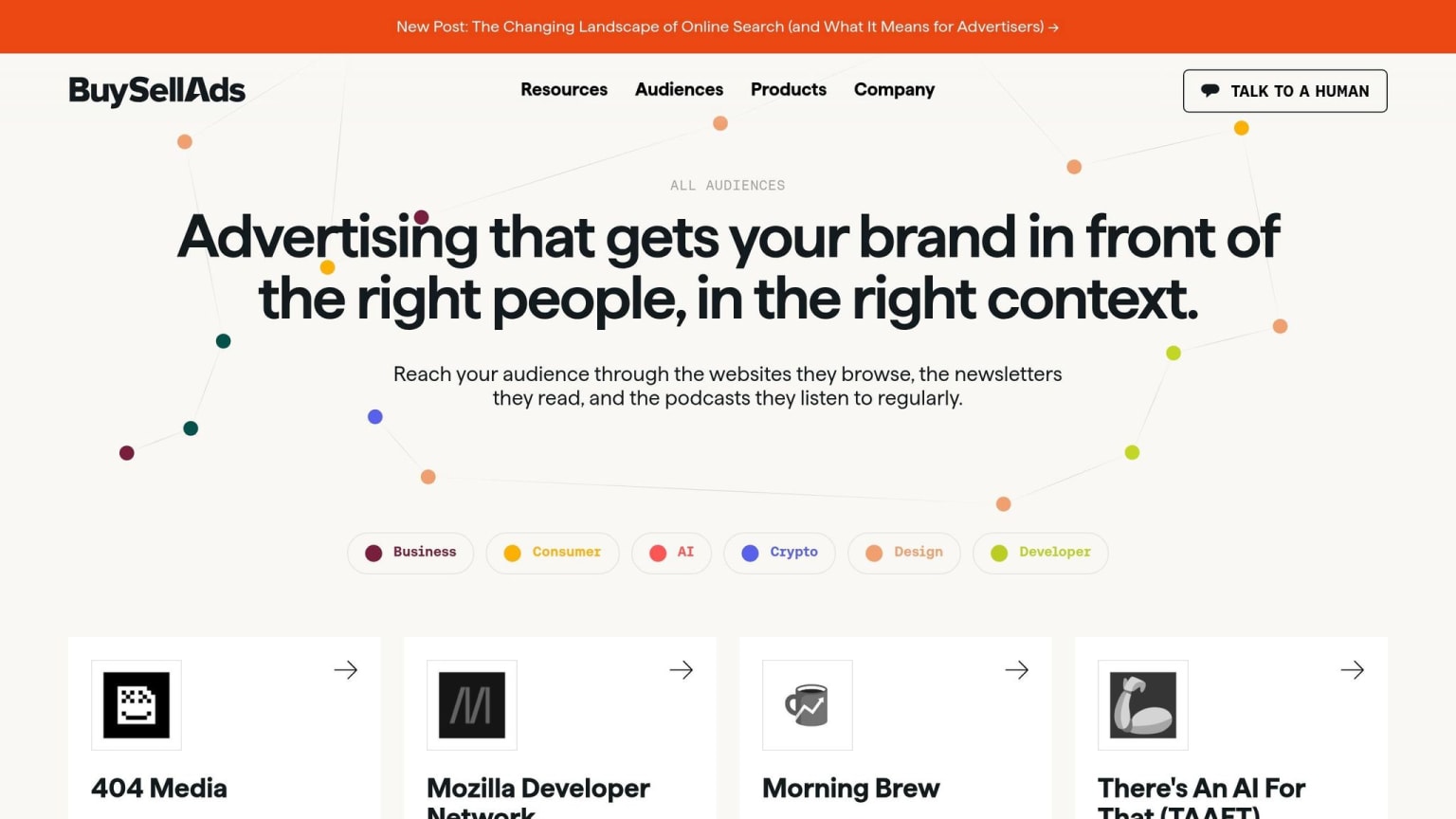
BuySellAds expands the buying model with publisher-by-publisher placement control. BuySellAds (BSA) is a marketplace for buying sponsorships and native placements across independent developer, design, and tech sites, one publisher at a time.
Where BuySellAds fits
BSA makes sense for teams that want more brand visibility across the independent tech web. If the goal is to appear across newsletters, documentation sites, and community blogs on a steady basis, BSA lets buyers build that mix publisher by publisher.
It also supports native units, direct sponsorship placements, and native CPC placements.
That kind of flexibility helps most when placement control matters more than tight audience filtering.
Why some buyers look at other options
The flip side is thinner audience depth. BSA uses contextual signals, so it reaches developers based on page topic and publisher vertical, not user behavior. And because buyers purchase placements publisher by publisher, campaigns can take more time to put together.
If a campaign needs tighter audience filtering, that contextual model can feel limiting.
| BuySellAds | |
|---|---|
| Strengths | Wide publisher network, format variety, hand-picked placement control |
| Limitations | Contextual targeting, publisher-by-publisher setup, attention split across many sites |
| Best fit | Awareness across independent dev and design sites |
daily.dev Ads
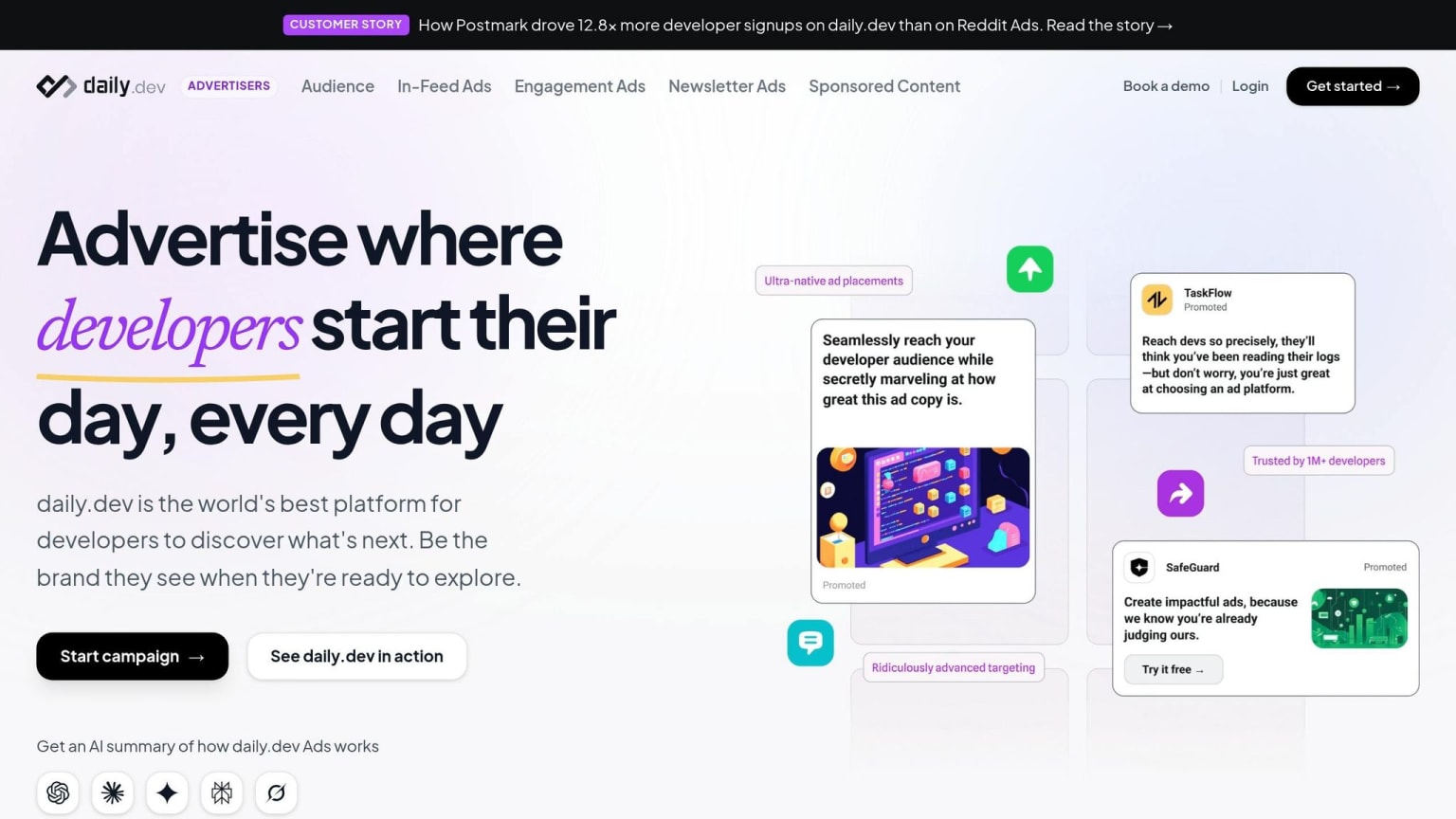
When page-topic targeting isn't enough, daily.dev Ads takes a different route. Instead of buying across a publisher network based on article context, you're buying inside one platform developers already use every day. That matters because the audience signal comes from first-party behavior, not just the topic of the page.
The upside is simple: tighter audience fit. You can reach developers with more precision than you'd get from a scattered publisher buy, while skipping the hassle of buying publisher by publisher.
How the targeting model works
daily.dev uses first-party behavioral data from in-product activity, including stack, seniority, language, and topic engagement. For B2B marketers, that means a more specific developer audience than page-topic targeting alone can offer. You get a closer match on who sees the campaign, without adding a publisher-by-publisher media buy.
Why native formats matter for developer campaigns
Ads on daily.dev appear as sponsored cards inside the feed. Since they live in the same in-feed experience developers are already scrolling through, they feel more natural than standard display units and are less affected by common ad blockers.
That can show up in performance. In September 2025, context.dev hit a 1.27% peak-day CTR across five creative variants. That's about 3x higher than the 0.3%–0.5% benchmark for standard text ads.
There is a tradeoff, though: reach. This is a single-platform placement, not a distributed publisher network. If you need broad scale across many sites, that may be a constraint. But if your goal is to reach developers with precision inside one trusted environment, that's exactly the appeal.
| daily.dev Ads | |
|---|---|
| Strengths | Behavioral targeting by stack and seniority, native in-feed formats, ad-blocker resilience |
| Limitations | Single-platform placement; not a distributed publisher network |
| Best fit | B2B teams driving signups or product adoption among developers in discovery mode |
How to pick the right platform
The table below compares audience precision, placement control, and campaign goal in one quick side-by-side view.
Platform comparison table
| Carbon Ads | BuySellAds | daily.dev Ads | |
|---|---|---|---|
| Audience Type | Developers and designers | Developers and designers | Developers |
| Targeting Model | Contextual (publisher content) | Contextual (per-site, hand-picked) | First-party behavioral (tech stack, seniority) |
| Minimum Budget | From $5,000/mo | From $5,000/mo | From $2,000/mo |
| Ad Formats | Single native unit (text + image) | Marketplace sponsorships, native placements | In-feed native cards, Digest sponsorships |
| Primary Goal | Top-of-funnel awareness | Direct publisher sponsorships | Mid-funnel signups/conversions |
Choosing the right fit for your campaign
Carbon Ads is a good fit when you want a brand-safe presence across curated developer and design sites. You’re buying page context here. In plain English, your ad shows up where the topic on the page already lines up with what you sell.
BuySellAds makes more sense if you want tighter control over where your ads appear. It suits teams that prefer to hand-pick publishers and go after direct publisher sponsorships. The tradeoff is simple: you get more control, but you also take on more manual placement management.
daily.dev Ads shifts the focus from publisher selection to audience precision. It targets developers using first-party behavioral signals like tech stack, seniority, and real-time topic engagement, then serves ads as native cards inside the feed they already scroll. The tradeoff is that you’re buying placement on a single platform, not across a spread of publisher sites.
Use network reach when distribution matters. Use daily.dev Ads when audience fit matters.
FAQs
Which platform is best for awareness vs. signups?
For awareness, broad-reach or one-off placements often work best when you want a fast jump in visibility.
For signups, an always-on, behavior-targeted approach usually works better. If you reach developers in a daily-use feed based on their tech stack and seniority, you’re more likely to hold their attention and send qualified traffic over time.
How much audience targeting control do I actually get?
You get precise audience control based on actual on-platform behavior, not guessed interests or self-reported job titles.
That means you can filter by tech stack, seniority, location, and the exact topics developers actively follow. The result is simple: you reach verified developers while they’re still in discovery mode.
When does a single-platform buy make more sense?
A single-platform buy works best when you want to reach a concentrated developer audience in a feed they check every day, with targeting based on tech stack, seniority, and interests drawn from actual on-platform behavior.
It’s a strong fit for always-on campaigns that you can measure, optimize, and fine-tune over time, instead of juggling scattered placements across several sites.