

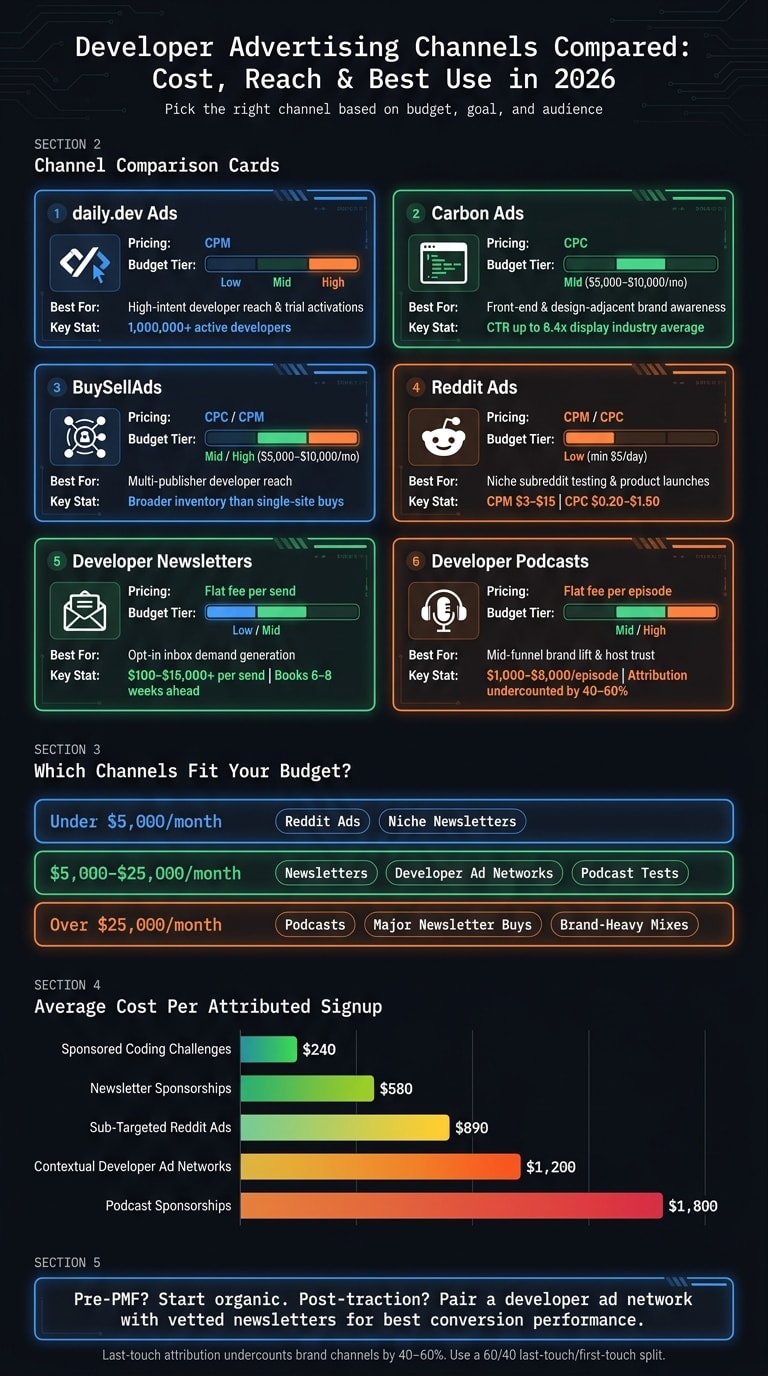
If EthicalAds is not the right fit, I’d shortlist daily.dev, Carbon Ads, BuySellAds, Reddit Ads, developer newsletters, and podcast ads based on budget, targeting, and goal. The main split is simple: use developer ad networks for in-feed or publisher reach, Reddit for niche communities and low-cost tests, newsletters for opt-in inbox reach, and podcasts for brand lift over time.
Here’s the short version:
- daily.dev Ads: best when I want to reach active developers and push trials or signups
- Carbon Ads: best for front-end and design-heavy publisher placements on a CPC model
- BuySellAds: best when I need more publisher reach and newsletter inventory
- Reddit Ads: best for low-budget tests in technical subreddits, with CPMs around $3 to $15
- Developer newsletters: best for opt-in audiences and flat-fee planning, from about $100 to $15,000+ per send
- Developer podcast ads: best for repeat exposure and host trust, often $1,000 to $8,000 per episode
Budget changes the channel mix fast:
- Under $5,000/month: Reddit and niche newsletters
- $5,000 to $25,000/month: newsletters, developer ad networks, and some podcast tests
- Over $25,000/month: brand-heavy mixes with podcasts and large newsletter buys
A few numbers stand out:
- daily.dev reaches 1,000,000+ active developers
- Carbon Ads often asks for $5,000 to $10,000/month
- BuySellAds also tends to start around $5,000 to $10,000/month
- Podcast impact is often undercounted by 40% to 60% in last-click models
Quick Comparison
| Channel | Best for | Pricing | Budget level | Main tradeoff |
|---|---|---|---|---|
| daily.dev Ads | High-intent developer reach | CPM | Low / Mid / High | Needs sharp technical messaging |
| Carbon Ads | Premium publisher awareness | CPC | Mid | Narrower targeting and desktop-only placements |
| BuySellAds | More publisher reach | CPC / CPM | Mid / High | Less targeting control |
| Reddit Ads | Niche community tests | CPM / CPC | Low | Comment risk and skeptical users |
| Developer newsletters | Opt-in demand gen | Flat fee per send | Low / Mid | Inventory can sell out 6 to 8 weeks ahead |
| Developer podcast ads | Mid-funnel brand lift | Flat fee per episode | Mid / High | Hard to measure with direct-response metrics |
| EthicalAds | Privacy-first contextual reach | Contextual ad buy | Varies | Less suited to direct signup goals |
If I had to sum it up in one line: pick EthicalAds for privacy-first reach, daily.dev for activation, Reddit for cheap testing, newsletters for inbox demand gen, and podcasts for brand memory.
1. daily.dev Ads
Audience fit
daily.dev reaches more than 1,000,000 active developers, including a strong share of senior and staff engineers . That matters. These aren’t casual browsers. Many use the platform every day to keep up with stacks, tools, and architecture shifts .
Because of that, the audience tends to be a good match for technical products that need to get in front of people who can spot the difference between fluff and substance.
Targeting model
daily.dev uses AI-driven contextual targeting and delivery optimization based on content preferences and engagement patterns .
In plain English: ads are matched to what developers read and how they interact on the platform, which helps the channel lean toward intent instead of pure volume.
Ad formats
Ads appear as native in-feed cards, which works well for technical offers that need low-friction visibility . They sit inside the reading experience, so the format feels less like a hard interrupt and more like part of the flow.
Creative tends to do best when it opens with a specific engineering pain point and backs it up with technical proof points . Think less “best-in-class platform” and more “cut CI time by 32%” or “debug production issues without adding agent overhead.” That makes the channel a strong fit for awareness and trial-driven engagement .
Put the format and targeting together, and daily.dev is strongest when you care about measurable activation more than broad reach.
Budget fit
Best for teams that want focused reach into high-intent engineers and care more about trial activations than broad reach .
2. Carbon Ads
Carbon Ads makes sense when you want access to premium publisher inventory through a simple contextual buy.
Audience fit
Carbon Ads runs across a curated set of developer and design sites, including Bootstrap, Laravel, Font Awesome, and Dribbble. The audience is heavily technical, with about 90% developers, and it tends to skew toward front-end developers, full-stack engineers, and designers .
That makes Carbon a good match for products tied to front-end work, developer tools, or design-adjacent use cases. It can work especially well for awareness campaigns aimed at technical buyers.
Targeting model
Carbon uses contextual targeting based on publisher category, like front-end, back-end, DevOps, and design. There’s no behavioral tracking, cookies, or retargeting. That keeps the setup simple, but it also means less precise targeting. You can’t target by job title, seniority, or company size, and placements are desktop-only .
If strict privacy controls are a must, this isn’t the cleanest option .
Ad formats
Carbon runs one native text-and-image ad unit per page, so each placement gets exclusive visibility . The ad is styled to blend in with each publisher’s site, which can make it feel less like a standard display ad.
Reported CTRs go up to 6.4x the display industry average, with usual benchmarks around 0.08% to 0.15% . Because the publisher pool is smaller, creative fatigue can show up faster, so refreshes matter more .
Budget fit
Carbon uses CPC pricing, with a suggested starting budget of $5,000 to $10,000 per month for a 60- to 90-day flight . It tends to work best for premium-site awareness with technical readers, not direct conversion lift .
If you need more reach or other buying formats, the next options move beyond premium-site inventory.
3. BuySellAds
BuySellAds gives you access to a broader pool of inventory across developer-focused publishers and newsletter placements. The big draw here is simple: more reach. You get more publisher inventory than a single-site buy, plus newsletter options.
Audience fit
BuySellAds reaches front-end developers, full-stack engineers, and designers across a broader publisher network than a single-site buy. If your product is aimed at those groups and you need more coverage, this is where it can do more than a tighter contextual buy.
Targeting model
BuySellAds uses contextual targeting based on publisher category. It is less privacy-focused than EthicalAds because it relies on a broader publisher network.
Ad formats
BuySellAds supports native text-and-image units across its publisher network, along with newsletter sponsorships through that broader inventory. That mix tends to matter more for awareness than for fast tests.
Budget fit
Plan for $5,000 to $10,000 per month over a 60- to 90-day flight on a CPC model . BuySellAds works best for defined developer segments and larger awareness flights, not small tests. Refresh creative every 3 to 4 weeks to help limit fatigue.
If publisher inventory still feels narrow, the next options trade control for scale.
4. Reddit Ads
Reddit works best when you want to reach specific technical communities, not the masses. Use it when your goal is to get in front of developers where they already talk shop, not when you just want passive ad views. That makes Reddit a strong fit for campaigns built around conversation, product launches, awareness, and early validation.
Audience fit
Reddit hosts some of the most concentrated developer communities on the web. Subreddits like r/dataengineering (240,000+ members as of mid-2026), r/MachineLearning, r/LocalLLaMA, r/programming, r/devops, and r/webdev can put your message in front of niche technical audiences fast .
Targeting model
Start with specific subreddits. Interest and keyword targeting can help, but they should come second. Broad targeting usually burns budget for developer tools .
There’s a catch, though: Reddit users are skeptical. If a paid post feels too polished or too salesy, people will call it out. That means the ad itself needs to lead with substance and clear technical proof . In practice, that often means using:
- Code snippets
- Terminal screenshots
- Live sandboxes
Those tend to land better than marketing-heavy copy .
Ad formats
Reddit supports promoted posts in text, image, video, and carousel formats, along with conversation ads. All of them appear natively in-feed . That native placement helps the ad feel more natural in context.
But there’s another side to that: the comment thread is public. If the ad misses the tone of the subreddit, the thread can turn into a problem for your brand .
Budget fit
Reddit’s minimum daily spend is around $5, so it’s easy to run small tests . Subreddit-targeted campaigns often see CPMs in the $3 to $15 range, while CPCs usually fall between $0.20 and $1.50 .
A smart way to start is to test messaging across 3 to 5 specific subreddits before spending more. And don’t treat comments like an afterthought. On Reddit, community management is part of the media buy.
If you want a channel with less community management, the next options are more hands-off.
5. Developer newsletter sponsorships
If you want direct inbox delivery instead of community-led reach, newsletter sponsorships are the next hands-off option. They land in a developer’s inbox on a flat-fee model.
Audience fit
Senior-engineer newsletters like The Pragmatic Engineer and ByteByteGo line up well with technical buyers. TLDR Dev reaches a broad developer audience, while Data Engineering Weekly and MLOps Community are a better match for niche teams .
Targeting model
Newsletter sponsorships use an opt-in audience. People subscribe to a topic, so the list is filtered before you spend. That makes the channel feel more focused from the start. Email delivery also gets around web ad blockers .
Ad formats
The most common formats are sponsored blurbs, dedicated sends, and logo placements. In most cases, blurbs do best when they sound like they belong in the newsletter. Lead with something technical or immediately useful. Don’t open with a plain product pitch .
Budget fit
Newsletters are a good fit when you want flat-fee buys that are easier to forecast than CPC-driven campaigns. Pricing usually follows a flat-fee model:
- Niche newsletters: $100 to $2,000
- Mid-size publications: $500 to $5,000
- Major sends: $3,000 to $15,000+
Top-tier inventory often books out 6 to 8 weeks ahead, so it helps to map your campaign calendar early .
For broader reach through audio, the next option is developer podcast ads.
6. Developer podcast ads
Podcast ads don’t play by the same rules as most other channels on this list. Their value comes from repeat exposure and the trust people place in the host. So this is a brand-first channel, not a click-first one.
Audience fit
Put your attention on niche, data-only, or specialized shows instead of broad “tech” podcasts . For developer-focused campaigns, Data Engineering Podcast, MLOps Community Podcast, Latent Space, The Data Stack Show, and Software Engineering Daily are all worth a close look .
What matters most here? The episode topic. That’s your main targeting signal. A good show with the wrong topic can miss. A smaller show with the right topic can land much better.
Targeting model
With podcast ads, you’re not just buying airtime. You’re buying access to a show’s audience and the host’s credibility. That’s why host-read mid-rolls tend to work best - they carry the host’s implied endorsement .
One placement usually isn’t enough. Podcasts tend to work better when people hear about you more than once, so it makes sense to run placements over several weeks instead of doing a single test episode .
Ad formats
For developer podcasts, host-read mid-rolls are the standard choice. They feel more natural and usually land better with listeners.
Programmatic ads can help with reach, but they don’t come with the same host trust .
Budget fit
Podcasts are tough to judge with direct-response logic. If you look only at clicks, you’ll miss a lot of the impact. This channel is better measured through assisted reach, not last-click performance.
Attribution is hard here: single-touch models undercount podcast impact by 40% to 60% . One simple fix is to ask new users how they heard about you during onboarding. That can help surface dark-funnel influence that analytics tools often miss .
On pricing, expect to pay $1,000 to $8,000 per episode . In practice, podcast ads usually fit larger teams best, especially when they’re part of a broader mid-funnel mix.
What developer advertising costs in 2026
Once channel fit is clear, budget decides how to launch a successful advertisement campaign for developers.
More than anything else, budget shapes developer advertising strategy. It sets the channels you can test, the pace you can keep, and how much room you have to learn without burning cash. The tiers below show which options start to make sense at each spend level.
Low budget (under $5,000/month) works best for testing channels and running small newsletter buys. Reddit Ads and niche newsletters fit well here, with sponsored sends to vetted lists starting at about $100 per placement .
Mid budget ($5,000–$25,000/month) is where demand generation starts to look realistic. At this level, you can keep multi-channel campaigns running without stretching too thin. That usually means newsletter sponsorships, a developer ad network, and the occasional podcast spot .
High budget (over $25,000/month) is built for large-scale brand awareness. This is where podcast sponsorships and major newsletter placements start to enter the picture . The catch? Attribution gets messier. At this level, single-touch attribution undercounts brand channels by 40% to 60% .
A useful benchmark here is cost per attributed signup. It gives you a cleaner way to compare tradeoffs across channels:
- Sponsored coding challenges: around $240
- Newsletter sponsorships: around $580
- Sub-targeted Reddit Ads: around $890
- Contextual developer ad networks: around $1,200 per signup
- Podcast sponsorships: around $1,800
| Channel | Budget Tier | Pricing Model | Best Fit |
|---|---|---|---|
| daily.dev Ads | Low / Mid / High | CPM | In-feed native reach |
To get started with precise targeting, you can advertise with daily.dev to reach developers by seniority and stack. | Carbon Ads | Mid | CPC | Front-end brand awareness | | BuySellAds | Mid / High | CPC / CPM | Multi-publisher developer reach | | Reddit Ads | Low | CPM / CPC | Community launch and validation | | Newsletters | Low / Mid | Per-Send | Niche technical demand generation | | Podcasts | Mid / High | Per-Episode | Sustained mid-funnel brand presence |
Pros, cons, and final recommendation
Use this summary to pick based on your main goal: privacy, reach, or direct response.
| Channel | Biggest Pro | Biggest Tradeoff |
|---|---|---|
| daily.dev Ads | Active developer audience | Needs strong technical creative |
| Carbon Ads | Single-ad exclusivity on premium sites | Higher budget requirement |
| BuySellAds | Broader multi-publisher developer reach | Less precise targeting |
| Reddit Ads | Low CPM in technical subreddits ($3 to $15) | Skeptical audience and comment risk |
| Developer newsletter sponsorships | Opt-in audience; stronger attributed conversion than display | Limited inventory and 6 to 8 week lead times |
| Developer podcast ads | Deep trust transfer from hosts | Hard to attribute directly |
| EthicalAds | Privacy-first contextual reach | Weaker for direct signups |
If privacy-first contextual reach is still the top priority, EthicalAds is the baseline choice. It fits products aimed at open-source contributors or developers reading technical docs. And its placements are often allowlisted by ad blockers because they don't use tracking cookies. That matters because developer ad-blocker usage is high.
Want a concrete example of how a technical brand handled this choice? See the Postmark story.
The right mix changes with budget and growth stage. Pre-PMF teams should put more energy into organic community presence before going hard on paid channels, since paid traffic can hide product signals . Once you have traction, pairing a developer ad network with vetted newsletters or sponsored coding challenges can improve conversion performance. That's because developer-first ad networks tend to work best for mid-funnel goals .
At higher budgets, podcast sponsorships can help build brand presence over time. Just go in with your eyes open on measurement. Last-touch attribution undercounts brand channels by 40% to 60%, so a 60/40 last-touch/first-touch split is a solid starting point .
For pricing and fit questions, the next section covers the two that come up most often.
FAQs
is EthicalAds worth it?
EthicalAds can be worth it if your main goal is to reach a very specific technical audience through privacy-first, contextual ads.
It costs more than generic display advertising and comes with a $1,000 minimum buy. Still, that tighter placement and developer-heavy audience can make the higher price worth it for niche products.
what does developer advertising cost?
In 2026, developer advertising costs can be all over the map depending on the channel and the audience size you want to reach.
A lot of ad networks use CPM pricing. In the developer space, niche ad networks often fall in the $3 to $12 CPM range.
That said, entry costs aren't always low. Some platforms ask for $15,000 per month or $10,000 per month with a 3-month commitment. Others are more accessible, with $1,000 minimum buys, and many offer volume discounts if you scale up your campaign.