

Developers are a tough audience to reach with ads. They value privacy, use ad blockers, and ignore irrelevant ads. Traditional cookie-based targeting struggles with this group because it relies on outdated tracking methods and historical data. Contextual advertising offers a better solution by focusing on the content developers engage with in real time, rather than tracking their online behavior.
Key takeaways:
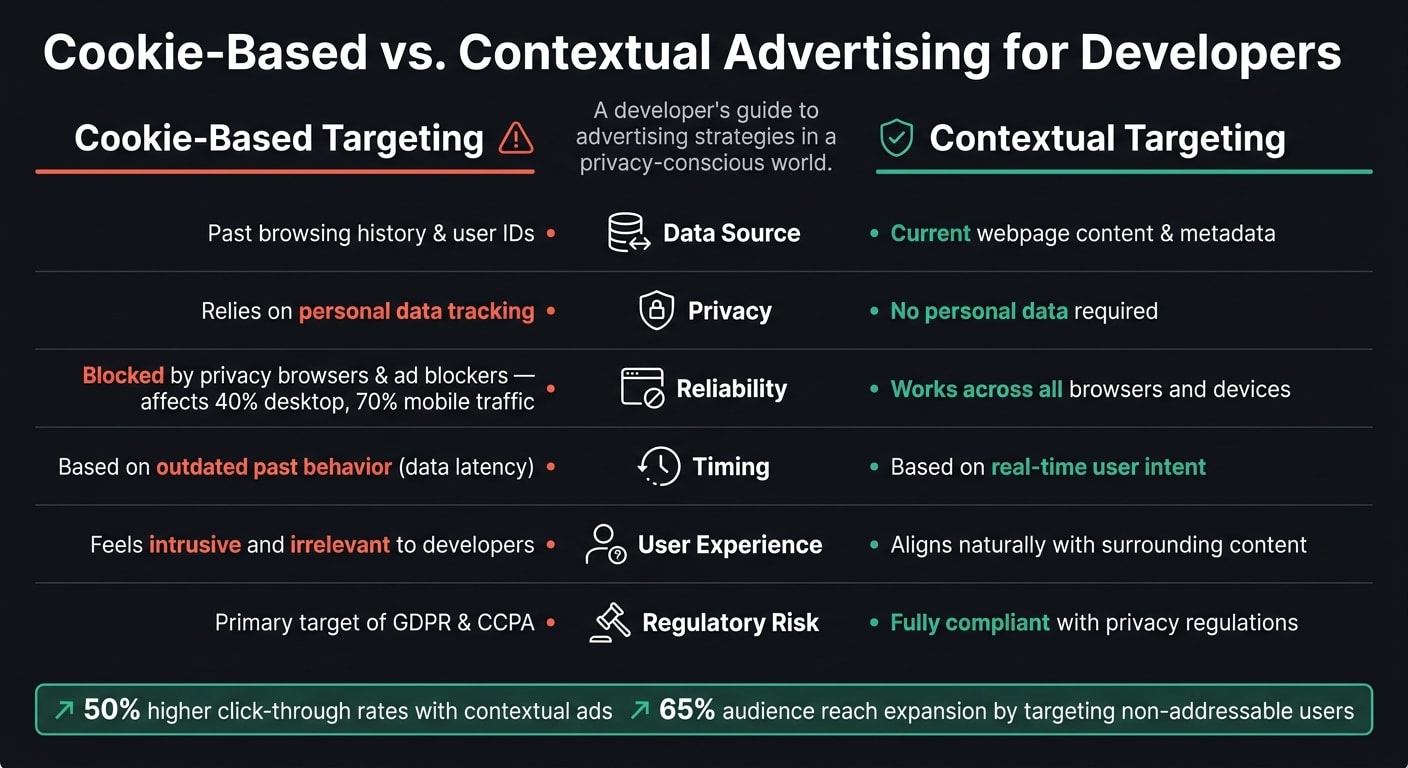
- Cookies are outdated: Privacy regulations (like GDPR) and browser changes (e.g., Chrome’s removal of third-party cookies in 2024) make cookie-based tracking ineffective for over 40% of desktop and 70% of mobile traffic.
- Developers demand relevance: Ads based on old data or intrusive tracking harm trust. Developers prefer ads that align with their current tasks and interests.
- Contextual advertising works: By analyzing webpage content (not personal data), contextual ads match ads to what developers are reading, like showing a Kubernetes tool ad on a Kubernetes tutorial page. This approach respects privacy and increases relevance.
- Better performance: Contextual ads deliver 50% higher click-through rates and comply with privacy laws, making them ideal for developer-focused campaigns.
Bottom line: If you want to connect with developers, ditch cookies and focus on contextual advertising. It’s privacy-friendly, relevant, and effective.
Why Cookie-Based Targeting Falls Short With Developers
How Cookie-Based Targeting Works
Cookie-based targeting operates by placing tracking cookies in a user's browser whenever they visit a website. These cookies monitor browsing habits across various sites, creating a profile that reflects interests, behaviors, and potential purchase intent. Advertisers leverage these profiles to deliver ads on other platforms or to build lookalike audiences - groups of individuals who exhibit similar online behavior to existing customers.
This system also enables retargeting. For instance, if someone visits a product page, cookies flag that interaction, allowing ads related to that product to follow the user across the internet. While this approach works for some audiences, it consistently fails to resonate with developers.
Why Cookies Don't Work Well for Developers
Developers often use browsers that block third-party cookies by default, making them part of the "non-addressable" audience - users who can't be tracked by cookie-based systems . This represents a significant limitation. For example, a consumer packaged goods (CPG) brand discovered it could expand its reach by over 65% simply by focusing on non-addressable audiences .
Another issue is that cookie-based targeting relies on historical data, which can lag behind current intent. Developers might shift focus quickly - from researching Kubernetes to evaluating observability tools, for example. This data latency problem means ads often target outdated behaviors, which not only miss the mark but also suggest the advertiser is out of touch .
Additionally, developers are highly aware of how cross-site tracking works. When ads follow them around the web, it feels more intrusive than helpful. Instead of engaging with the brand, developers may grow skeptical and even distrustful . These challenges highlight the need for contextual strategies that better align with developers' real-time behavior. One effective way to implement this is to advertise where developers start their day on platforms they already trust.
Cookies vs. Context: A Side-by-Side Comparison
The table below illustrates why cookie-based targeting struggles to meet the needs of developer audiences compared to contextual strategies.
| Feature | Cookie-Based Targeting | Contextual Targeting |
|---|---|---|
| Data Source | Past browsing history and user IDs | Current webpage content and metadata |
| Privacy | Relies on personal data tracking | No personal data required |
| Reliability | Blocked by privacy browsers and ad blockers | Works across all browsers and devices |
| Timing | Based on past user behavior | Based on the user's real-time intent |
| User Experience | Can feel intrusive or irrelevant | Aligns naturally with surrounding content |
| Regulatory Risk | Primary target of GDPR and CCPA | Aligns with privacy regulations |
For campaigns aimed at developers, the reliability and timing factors stand out as critical. A method that fails to reach privacy-conscious users - and serves ads based on outdated data - simply isn't effective for this audience. Contextual targeting, on the other hand, offers a more precise and respectful approach.
How Contextual Advertising Works for Developers
The Technology Behind Contextual Advertising
Contextual advertising operates by analyzing the content of a webpage in real time to deliver ads that align with the page's subject matter. For example, if a developer visits a page discussing Kubernetes scaling, the system evaluates the content and displays an ad relevant to that topic. This process relies on Natural Language Processing (NLP) and structured contextual taxonomies to grasp the themes, level of technical detail, and intent behind the content. Contextual taxonomies categorize information into groups like "cloud infrastructure", "DevOps tooling", or "database optimization", ensuring ads for developer tools appear in appropriate contexts. Once a relevant match is identified, Demand-Side Platforms (DSPs) handle the real-time bidding process to place the ad .
"Generative AI and large language models (LLMs) will significantly impact contextual advertising by increasing the personalization of ads... AI can analyze vast amounts of data in real time, and understand nuanced contexts."
Matching Ads to Developer Workflows
Contextual advertising doesn’t just rely on the technology - it also adapts to how developers work. Developers engage in workflows like reading documentation, debugging code, or researching tools, each sending clear signals of intent. For instance, a developer exploring a tutorial on scaling PostgreSQL might be considering infrastructure solutions, while another reading about observability tools could be evaluating monitoring platforms. Contextual ads focus on the content being accessed at that moment, tailoring the advertising to fit seamlessly within the developer's current activity .
This approach also allows for smart "out-of-aisle" placements. For example, an ad for a cloud infrastructure solution might appear alongside a database scaling tutorial because the two topics naturally complement each other . When ads align with the technical context developers are already exploring, they feel like a natural extension of the workflow rather than an interruption. This reinforces the strength of real-time contextual ad placement.
"By aligning ads with the context of what users are already viewing, advertisers can increase ad relevance and deliver non-intrusive experiences that feel natural, not disruptive."
Benefits of Contextual Advertising for Developer Campaigns
Relevance and Timing
Developers are rarely idle when browsing - they're actively seeking solutions. Whether they're diving into PostgreSQL replication guides or comparing Kubernetes deployment tools, they're in problem-solving mode. This is where contextual advertising shines.
Unlike ads that rely on a user’s browsing history, contextual ads align directly with the content on the page. For instance, a database monitoring tool ad placed on a page about query optimization doesn’t just promote a product - it demonstrates an understanding of the developer's immediate challenge. This approach builds trust and avoids the annoyance of irrelevant ads. Plus, it works seamlessly with privacy-focused practices.
"The best ads don't follow people around the internet. They appear in the right place, at the right moment, in the right context."
- AdBid
Privacy and Regulatory Compliance
One of the standout features of contextual advertising is its privacy-first design. It doesn’t rely on cookies, profiles, or personal data. Instead, it targets based on the content of the page, making it a natural fit in today’s privacy-conscious world.
This method bypasses the complexities of regulations like GDPR and CCPA/CPRA, which require consent for personal data collection. Contextual ads stay compliant even on platforms like Safari and Firefox, which block third-party cookies, and on iOS devices impacted by Apple’s App Tracking Transparency rules.
"Contextual isn't a fallback when cookies disappear. It's a primary strategy for relevant, respectful advertising that works in any privacy environment."
- AdBid
Performance and Brand Safety
Contextual advertising doesn’t just check the boxes for relevance and privacy - it also delivers solid results. Studies show that contextual targeting performs within 5–15% of behavioral methods and can even surpass them in some cases . Ads placed in contextually relevant environments also boast 50% higher click-through rates compared to non-contextual placements .
Another key advantage is brand safety. With contextual targeting, advertisers have full control over where their ads appear. You can ensure your campaigns are shown alongside technical content that resonates with developers, while steering clear of unrelated or risky material. This level of control safeguards your brand while keeping your message relevant.
Running Contextual Campaigns With daily.dev Ads

Choosing the Right Developer Contexts
When it comes to contextual advertising, precision is everything - especially for developer-focused campaigns. Broad terms like "JavaScript" or "cloud" might cast a wide net, but they often miss the mark when you're trying to reach developers who genuinely need your product. Instead, focus on specific clusters tied directly to your product's use cases. For example, if you're promoting an error monitoring tool, target contexts like "Node.js debugging", "Python exception handling", "observability with OpenTelemetry," or "logging in production."
Your campaign goals should guide your targeting. If you're running a direct-response campaign (focused on signups, trials, or demo requests), aim for high-intent, task-specific contexts such as "PostgreSQL index tuning" or "k8s ingress configuration." On the other hand, if you're building brand awareness, broader topics like "TypeScript", "DevOps culture," or "frontend performance" can help you stay top-of-mind for developers over time.
What Makes daily.dev Ads Useful for Developer Targeting
daily.dev is designed around how developers consume content - whether it's articles, tutorials, or tool comparisons. Ads on daily.dev blend seamlessly into this content and offer advanced targeting options, ensuring your message reaches the right audience.
You can customize your ad placements based on programming languages (like Go, Rust, Python), frameworks (such as React, Next.js, Spring), topics (e.g., CI/CD, security, observability), and even developer seniority. This level of precision ensures your ads are seen by developers who are not just potential users but are genuinely relevant to your product.
Once you've set up precise targeting and native placements, the next step is to measure how well your campaigns perform.
Measuring Campaign Performance
After launching your targeted placements, measuring effectiveness becomes critical. Don't just stop at click-through rates - dig deeper. Track metrics like trial activations, demo requests, qualified signups, and return visits. These indicators help you understand if your campaign is resonating with the right developers.
Start by testing narrow context clusters before expanding. For instance, if a "TypeScript + testing" cluster outperforms a "JavaScript + testing" cluster in driving trial starts, allocate more budget to the higher-performing option. Use UTM parameters and referral data to pinpoint which topics are converting best, and ensure your landing pages align with the ad's context. For example, a developer clicking on an ad about Kubernetes observability should land on a page specifically tailored to Kubernetes, not a generic product overview.
Here's a quick breakdown of key metrics and how to act on them:
| Metric | Insight | Action |
|---|---|---|
| Click-through rate | Indicates if the ad creative fits the context | Test different headlines and CTAs for each topic cluster |
| Trial/signup rate | Shows how well the landing page matches developer intent | Adjust page content to reflect the ad's specific focus |
| Qualified lead rate | Reveals if the context is attracting the right audience | Refine or expand topic clusters based on lead quality |
| Return visits | Highlights ongoing value for developers | Use this as a gauge for top-of-funnel awareness campaigns |
Conclusion: Why Context Beats Cookies for Developer Advertising
Developers prioritize privacy and are often critical of invasive tracking methods. Cookie-based targeting depends on outdated techniques that many developers actively avoid. On the other hand, contextual ads align with the content being consumed, offering immediate relevance without compromising privacy.
Performance data backs up the effectiveness of this approach. Contextual advertising not only respects user preferences but also delivers results. Studies reveal that these ads generate 50% more clicks and achieve a 30% boost in conversion rates . For example, a well-placed ad for a Kubernetes monitoring tool next to a Kubernetes tutorial feels more like a helpful suggestion than an intrusive distraction. This relevance makes all the difference in engaging developers.
"Contextual advertising has emerged as a sustainable solution that respects user privacy while delivering exceptional campaign performance." - Chandler Hansen, Agility
This privacy-conscious method naturally aligns with regulations like GDPR and CCPA, which further enhances trust among developers. For brands focused on this audience, such transparency is a key factor in building credibility.
FAQs
How do contextual ads know what a page is about?
Contextual ads work by analyzing the content of a webpage - looking at text, keywords, and other elements - using advanced algorithms. This process ensures the ads displayed are directly related to the topic of the page, aligning the advertising with the content the viewer is engaging with.
Will contextual ads still work with ad blockers and cookie restrictions?
Yes, contextual ads remain highly effective, even with the growing use of ad blockers and cookie restrictions. Unlike traditional ads that depend on personal data, contextual advertising focuses on the content of a webpage or app. By targeting based on context rather than user behavior, this approach offers a privacy-friendly solution that continues to perform well, regardless of these modern limitations.
How do I choose the right developer topics to target for my product?
To connect with developers effectively, it's crucial to focus on their interests, challenges, and workflows. Pinpoint topics that resonate with them, such as specific programming languages, frameworks, or tools that align with your product and address their pain points. By understanding developer personas and knowing which platforms they frequent, you can create ads that match their technical preferences. This alignment boosts relevance and engagement, making your campaigns far more impactful.