

Product-led growth (PLG) is now the go-to strategy for scaling developer tools in 2026. Why? Developers prefer hands-on experiences over traditional sales tactics. Here’s the key takeaway: let your product do the selling. PLG companies see 48% higher revenue multiples, and Product Qualified Leads (PQLs) convert 3x better than Marketing Qualified Leads (MQLs).
Here’s the PLG playbook in a nutshell:
- Discovery: Developers find tools through open-source projects, communities (Reddit, Discord), and great documentation - not ads or cold emails.
- Activation: The "10-minute rule" is critical - users should achieve a meaningful result (e.g., first API call) in minutes.
- Expansion: Encourage team adoption through collaboration features and usage-based pricing.
- Enterprise Conversion: Identify PQLs (e.g., hitting usage limits or inviting teammates) and transition them to enterprise plans with tailored solutions.
The secret to success? Focus on self-service onboarding, clear documentation, and data-driven marketing. Companies like GitHub and Cursor have scaled to millions of users and billions in ARR using this approach. If you’re marketing to developers, skip the fluff - technical depth and usability win every time.
The PLG Funnel for Developer Products: Discovery to Procurement
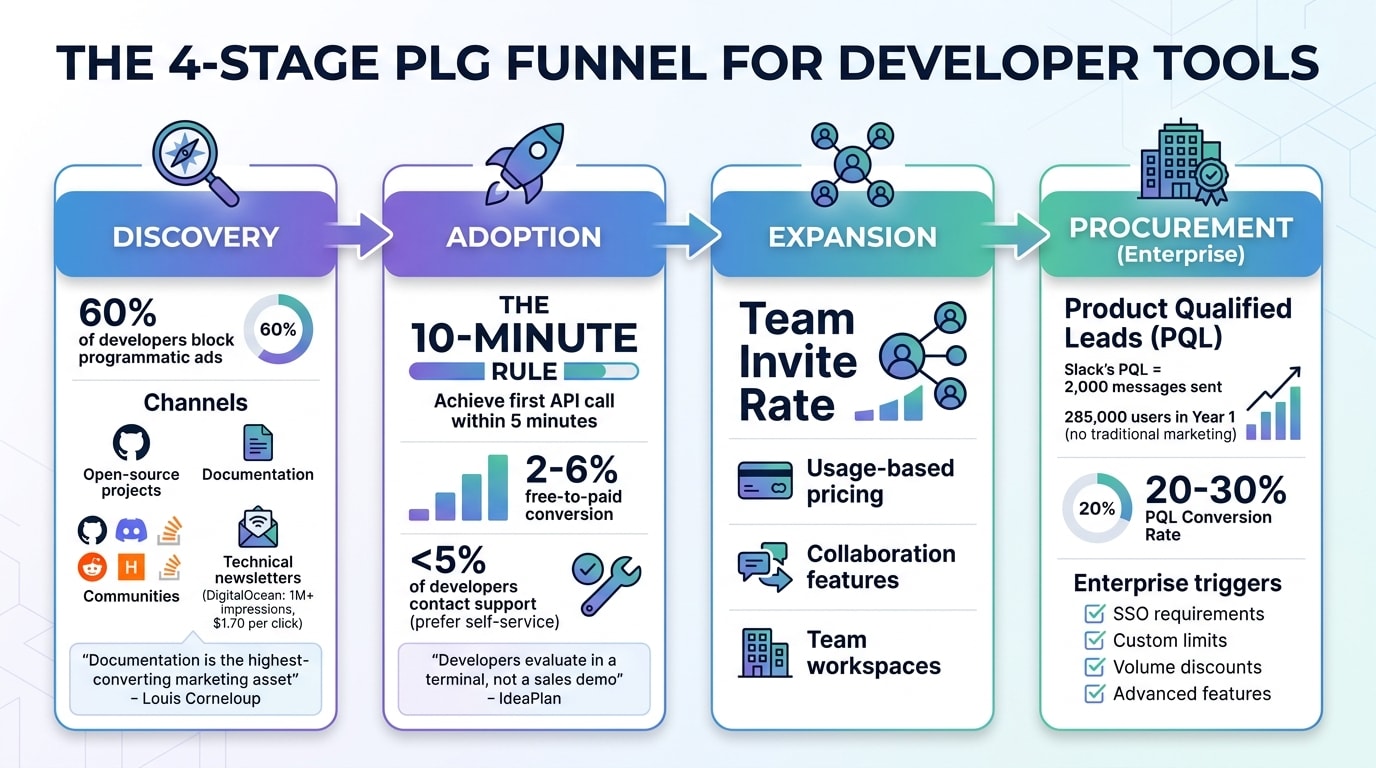
The PLG (Product-Led Growth) funnel for developer tools moves through four key stages: discovery, adoption, expansion, and procurement. Each step plays a distinct role in guiding individual free users toward becoming enterprise-level customers.
Discovery: How Developers Find Your Product
Developers are not fans of traditional marketing methods. Over 60% block programmatic ads and largely ignore cold outreach efforts . Instead, they discover new tools through trusted channels like open-source projects, comprehensive documentation, and active participation in communities on platforms such as Reddit, Discord, Hacker News, and Stack Overflow .
"Documentation is the highest-converting marketing asset. Clear docs with runnable examples produce more signups than any ad."
- Louis Corneloup, Founder at Dupple
Sponsoring technical newsletters is another effective way to reach developers. For instance, in April 2026, DigitalOcean ran eight ads in the Techpresso newsletter, which has 550,000 tech-savvy subscribers. This campaign generated over 1 million impressions at a cost of $1.70 per click . Similarly, daily.dev Ads helps engage developers during their daily learning routines, even before they actively search for solutions.
Once developers discover your product, the next challenge is to make its value immediately clear, encouraging them to take the next step in the funnel.
Adoption: Converting Free Users into Active Users
The 10-minute rule is a game-changer: developers should be able to achieve a basic "Hello World" or complete their first API call within minutes of signing up . Clear and thorough documentation often outperforms traditional demos, reinforcing the preference for self-service exploration.
"Developers will read your API reference before your landing page. They will evaluate your product in a terminal, not a sales demo."
- IdeaPlan
Self-service is key, as fewer than 5% of developers reach out to support; they prefer figuring things out on their own . With free-to-paid conversion rates typically ranging from 2% to 6%, this activation phase is critical for generating revenue .
Once developers are actively using the product, the focus shifts to scaling their engagement - moving from individual use to team adoption.
Expansion and Procurement: Moving to Teams and Enterprise
After activation, the goal is to encourage team collaboration and prepare for enterprise-level integration. Usage-based pricing and collaboration features become essential here. Metrics like the Team Invite Rate are strong indicators of a product’s value and readiness for scaling. When developers invite teammates, it signals a deeper commitment to the tool and opens the door to paid conversions .
Product Qualified Leads (PQLs) are identified when users hit specific usage milestones. For example, Slack’s early PQLs were defined as accounts that sent 2,000 messages. This benchmark helped Slack achieve 285,000 users in its first year, all without spending on traditional marketing . PQLs like this often convert at rates between 20% and 30% .
At the procurement stage, many companies adopt a hybrid "Product-Led Sales" approach. Here, high-engagement accounts - those requiring advanced features like SSO, custom limits, or volume discounts - trigger a sales handoff . This blend of self-serve and sales-driven strategies ensures that enterprise customers get the tailored solutions they need while maximizing revenue potential.
Marketing's Role in PLG: Different Marketing, Not No Marketing
Product-led growth (PLG) doesn’t mean marketing disappears - it just takes on a new shape. Instead of relying on traditional methods like generating Marketing Qualified Leads (MQLs) through whitepaper downloads, PLG marketing zeroes in on product discovery, user engagement, and conversion support. The focus shifts to identifying Product Qualified Leads (PQLs) based on actual in-product activity .
In this model, marketing evolves into growth marketing, working closely with engineering and product teams to fine-tune every stage of the funnel . Traditional sales development roles are replaced by Developer Relations (DevRel) teams, who build trust through tutorials, community engagement, and conference talks. This hands-on, collaborative approach ensures measurable results across the funnel .
"Developers will expect to be shown what's behind the curtain. If the product isn't ready, if the value isn't there, they won't stick around, so do not position a tool as being more than what it is."
- Katie Miller, Director of Developer Marketing, Slack
Unlike conventional B2B marketing, which often highlights broad benefits, PLG marketing prioritizes technical depth. This means creating detailed "how-to" content and showcasing features that enable self-service evaluation . Gated content and lengthy forms are replaced with ungated resources and simple signups, such as social login options or no-credit-card-required trials . Sales teams, meanwhile, pivot from chasing new leads to nurturing existing users, focusing on enterprise expansion once a solid base of developers is established .
Acquisition Channels That Fuel PLG
Developers don’t discover tools through flashy ads - they rely on trusted sources. Some of the most effective acquisition channels include:
- Technical content: Tutorials, API documentation, and guides optimized for organic search.
- Community engagement: Platforms like Hacker News, Reddit, and Discord are hotspots for developer conversations.
- Open-source projects: Releasing core tools on GitHub can build early trust and credibility.
- Marketplace listings: Platforms like AWS Marketplace or GitHub Marketplace serve as high-intent channels for developers actively seeking solutions.
Take Postman, for example. The company grew its user base by offering accessible API documentation and tutorials that ranked well in search results. Similarly, Supabase used GitHub to distribute its open-source product, connecting with developers before introducing monetized features .
For developers, authenticity is key. Marketing fluff doesn’t work here - buzzwords like "enterprise-grade" or "revolutionary" fall flat. Instead, developers respond to precise, technical content that helps them solve problems. In fact, less than 5% of technical users reach out to customer support when stuck; they overwhelmingly prefer self-service documentation .
Building trust within developer communities is equally important. Platforms like Stack Overflow, Dev.to, and Discord allow DevRel teams to engage naturally, offering real help rather than overt promotion . Open-source projects also act as powerful entry points, introducing users to your product in a way that feels organic. And for developers actively searching for tools, marketplace listings on platforms like VS Code Extensions or GitHub Marketplace provide a direct path to discovery .
Using Paid Advertising to Speed Up the Funnel
While organic channels dominate PLG acquisition, paid advertising can complement these efforts when done strategically. The key is to meet developers where they’re already learning and engaging with technical content, avoiding generic ads.
Some examples of high-performing paid channels include:
- Newsletters: Bytes (JavaScript developers), Pointer (engineering leaders), and Pragmatic Engineer (senior engineers) .
- Daily.dev Ads: These ads reach developers during their learning routines, offering a low-friction way to engage developers and introduce solutions.
Paid ads in PLG aren’t about replacing organic efforts - they’re about amplifying them. Use these placements to drive traffic to your best technical resources, like documentation or free-tier signup pages. Conversion rates from paid sources typically hover around 17%, compared to 32% for organic visits, so tracking and optimizing spend is crucial . By focusing on developer-specific channels and maintaining technical credibility, paid advertising can effectively accelerate the PLG funnel without losing trust.
Developer Activation: The 10-Minute Rule
The first 10 minutes of a developer's interaction with your product are critical. This brief window often determines whether they stick around or abandon your tool in favor of something else. Unlike traditional B2B buyers, developers prefer to evaluate products hands-on, typically in a terminal. If they can't achieve a working "Hello World" moment within five minutes, chances are they'll move on. In fact, 74% of customers will switch to another solution if the onboarding process feels too complex .
The goal is to deliver an "aha moment" during that first session - when skepticism turns into confidence. Stripe set the bar high by enabling a functional API call with just three lines of code . Leading developer tools aim for a Time to First API Call (TTFAC) of under five minutes .
But friction in the early steps - like signup, API key generation, or making the first API call - can derail this process . If your documentation lacks runnable examples or API key generation takes too long, developers won't hesitate to try another option.
"If you build it developers will come. And if you build too many barriers to get in, they'll leave." - Jeff Yoshimura, Leader of Community, Marketing, and CS, Snyk
The activation journey follows a tight timeline: Signup (0–5 minutes) → API key generation → First successful API call (within 15 minutes) → Second call in production (within 24 hours) . Your challenge is to design an onboarding flow that enables a developer to make their first successful API call within five minutes of signing up .
Metrics to Track During Activation
To measure whether developers are successfully activating, focus on three key metrics: Time-to-Value (TTV), Activation Rate, and Session Depth.
- Time-to-Value (TTV): This measures how quickly users achieve their first meaningful outcome, like a successful API call or integration. The best tools achieve this in under five minutes .
- Activation Rate: This tracks the percentage of signups that hit key milestones, such as generating an API key or making a successful request. A solid benchmark falls between 20% and 40% .
- Session Depth: This looks at how many meaningful actions developers take during their first session - reading documentation, copying code snippets, generating credentials, or making API calls. Higher session depth often signals stronger engagement and a higher likelihood of retention.
Monitoring error rates during onboarding is also crucial. If API errors exceed 1% during a developer's first session, it may indicate product quality issues that can derail activation . Clear, runnable documentation is essential - confusing or incomplete guides will drive developers to explore alternatives .
"Documentation should be written before code, not after. If you cannot explain the API clearly in docs, the API design is wrong." - IdeaPlan
By keeping these metrics in mind, you can identify areas to refine and improve your onboarding process.
Tactics to Improve Onboarding
To meet the 10-minute rule and boost activation, you need to minimize friction at every step of the onboarding experience. Here’s how:
- Simplify signup: Drop unnecessary barriers like requiring a credit card for free tiers. Offer social login options (e.g., "Sign in with GitHub" or Google) to streamline the first 60 seconds .
- Instant API key generation: Avoid delays like email confirmations or manual approvals. Developers should have their API keys immediately upon signup .
- Provide copy-pasteable code snippets: Make it easy for developers to grab a snippet, paste it into their terminal, and see results right away. Include runnable examples in multiple languages and frameworks to fit their setup .
- Use contextual tooltips: Replace generic walkthroughs with targeted guidance. For instance, if a developer is exploring the API reference, prompt them with instructions for making their first authenticated request .
- Leverage AI for personalization: Tailor the onboarding flow to a developer’s role, company size, or behavior in real time. This can help deliver a more relevant and engaging experience.
- Adopt documentation-first design: If your API is hard to explain, it might be overly complicated. Treat your documentation as a key asset - clear, runnable examples can often drive more signups than your homepage .
From Free Tier to Enterprise: The Expansion Playbook
Once developers are actively using your product, the door to revenue opens. Moving from individual free users to enterprise contracts isn't about pushing aggressive sales tactics. Instead, it’s about recognizing when teams are ready to grow and removing obstacles in their path. Look for key signals: a developer inviting teammates, reaching usage limits, or requesting features like SSO or SOC 2 compliance. These behaviors suggest the team may be ready for enterprise-level adoption. The challenge lies in building systems that identify these signals early and guide users seamlessly - whether through automated in-app prompts or a blend of automation and sales support. Scaling from individual users to enterprise clients becomes the next big growth opportunity, building on the PLG strategies already in place. Let’s dive into how to encourage team adoption and drive enterprise conversions.
Driving Team Adoption with Collaboration Features
One of the strongest indicators that a free account might upgrade to a paid plan is the team invite rate . When one developer finds value in your product, they’ll naturally want to share it with their team. Your job? Make that process as easy as possible. Tools like Postman excel at this by creating viral loops that encourage collaboration. A great example of this approach is GitHub. In 2020, GitHub made core features free for all users, including unlimited collaborators. This move helped grow its developer community from 40 million to 83 million users by 2022 .
You should also keep an eye on accounts where multiple developers from the same corporate domain are using free accounts independently. This situation, often referred to as "API chaos", is a clear signal that it’s time to suggest a consolidated enterprise workspace. Postman leveraged this strategy effectively, turning widespread individual usage into enterprise contracts. The result? They reached 35 million users across 500,000 organizations, including 98% of the Fortune 500 .
Enterprise Conversion: PQLs and Sales Alignment
Once collaborative adoption takes off, the next step is converting these engaged accounts into enterprise contracts. Enter Product-Qualified Leads (PQLs) - users who have demonstrated meaningful value through actual product usage, not just marketing interactions . In developer tools, PQLs are the key signal that it’s time to transition from free accounts to managed enterprise plans. For example, Slack considers a team ready for conversion once it has sent 2,000 team messages - an unmistakable "aha moment" in their journey . For API platforms, similar signals include a successful first API call, team invitations, or hitting free-tier usage limits .
The sales approach here should be consultative. Instead of pushing a generic demo, the outreach might sound like: "I noticed your team is using [the product] extensively. Here’s how the Team plan can simplify your workflow further." Timing is critical - sales reps who engage within four hours of a PQL trigger see conversion rates 2–3 times higher than those who wait 48 hours .
For enterprise deals, shift the conversation from individual productivity to company-wide benefits. Enterprise buyers are typically focused on features like security, SSO, SOC 2 compliance, audit logs, and centralized visibility. Human sales involvement becomes worthwhile when expansion deals exceed $10,000–$15,000 ARR . Use automated alerts to notify sales teams within an hour of an account crossing a PQL threshold. Additionally, gate advanced features like SAML/SSO and permissions management behind enterprise plans, while keeping core functionality free to encourage adoption .
"Enterprise buyers pay for solutions, not just products." - Piyush Agarwal, Co-Founder, Reo.Dev
Between late 2024 and February 2026, Cursor (Anysphere) grew its ARR from $500 million to $2 billion. This growth was fueled by individual developers introducing the tool to their companies, leading corporate revenue to jump from 25% to 60% of the total mix. This example shows how a strong PLG strategy, combined with a well-executed enterprise playbook, can drive massive growth .
Conclusion
The PLG funnel takes us through a journey - from discovery and activation to team expansion and enterprise conversion. Each stage requires tailored marketing and product strategies to succeed. Product-led growth reshapes how marketing connects with developer audiences, relying on a seamless entry point, rapid activation (ideally under five minutes to deliver value), and collaborative loops that transform individual users into team accounts. As companies continue to pour resources into PLG approaches, the growing body of data confirms its effectiveness.
This framework equips marketing leaders to refine every phase of the funnel. Each stage demands specific efforts to drive progress. For example, documentation becomes your most powerful marketing tool, community engagement fosters trust, and open-source contributions expand reach. However, relying solely on organic growth can be slow, particularly during the discovery phase . That’s where targeted advertising steps in - contextual placements in spaces where developers are already exploring and assessing tools can make all the difference.
Platforms like daily.dev Ads speed up your PLG efforts by connecting with developers during their regular learning activities, even before they actively search for solutions. Unlike traditional B2B channels, which can cost 5 to 10 times more per click , ads on developer-centric platforms provide high-quality traffic at a fraction of the expense. These clicks should lead directly to compelling documentation or a signup flow that delivers a "Hello World" moment in just minutes.
Strong activation naturally sets the stage for expansion. Look for key signals such as team invites, users hitting usage limits, or requests for features like SSO. Establishing clear PQL (product-qualified lead) thresholds is essential, and timing is everything - sales reps who respond within four hours are 2-3 times more likely to convert leads compared to those who wait 48 hours .
The strategy is simple: remove barriers, provide immediate value, and let the product do the talking. Use targeted ads to drive discovery, fine-tune onboarding to activate users quickly, and build systems that identify when free users are ready to upgrade. Master these steps, and you'll create a scalable growth engine that seamlessly transitions users from free tiers to enterprise-level customers.
FAQs
When is PLG not enough for dev tools?
PLG (Product-Led Growth) can be incredibly effective for dev tools, but when it comes to scaling within enterprise environments, it might not be enough on its own. Larger organizations often come with complex structures and unique requirements that go beyond what PLG typically addresses.
To meet these challenges, additional strategies are often necessary. These might include targeted sales efforts that focus on identifying and engaging key decision-makers, hybrid go-to-market (GTM) models that blend PLG with traditional sales tactics, and enterprise-specific features designed to support the needs of larger teams, such as advanced security, compliance, and integration capabilities. Combining these approaches can help dev tools adapt and thrive in enterprise settings.
What are the best PQL triggers for a free tier?
When it comes to identifying Product Qualified Leads (PQLs) within a free tier, the focus should be on user engagement and product usage patterns that suggest a readiness to upgrade. Here are some key triggers to watch for:
- Reaching usage milestones: Examples include hitting a certain number of API calls or completing specific projects.
- Activating core features: When users start exploring and using the main features of your product.
- Completing onboarding: Successfully finishing the onboarding process often signals a deeper commitment to the product.
- Consistent usage: Regular, ongoing use of the product is a strong indicator of interest and reliance.
Other important signals include actions like setting up integrations, experimenting with premium features, or hitting value-driven milestones - such as building a prototype. Each of these behaviors points to a user who is likely ready to convert to a paid plan.
How should paid ads support a PLG funnel?
Paid ads play a key role in speeding up a Product-Led Growth (PLG) funnel by attracting developers and helping them explore and try your product. They boost visibility during the discovery stage and guide users toward free tiers or sign-up pages, making onboarding smoother. Additionally, ads can aid in expansion by retargeting existing users or showcasing features tailored for teams or enterprises. For the best outcomes, focus on strategic channels like developer newsletters or sponsoring relevant communities.