

Developing a go-to-market strategy for dev tools is about aligning with how developers discover and adopt products. Here's the key takeaway: developers prefer hands-on evaluation over traditional sales tactics. They skip ads, avoid gated content, and dive straight into documentation to test tools themselves.
To succeed, focus on:
- Clear documentation: The first API call or tutorial must work seamlessly.
- Defined ICP (Ideal Customer Profile): Separate user personas (developers) from buyer personas (CTOs or VPs).
- Community engagement: Build trust in niche spaces like GitHub, Slack, or Reddit before promoting your product.
- Adoption-focused metrics: Track activation rates (e.g., first successful API call) and retention, not just leads.
- Pricing transparency: Offer a free tier or usage-based pricing that scales with value.
Define Your Ideal Customer Profile (ICP)
Creating an Ideal Customer Profile (ICP) for a developer-focused product is a different beast compared to traditional B2B software. A well-defined ICP shapes every part of your go-to-market plan. The key is to distinguish between the User Persona (the engineer testing your tool) and the Buyer Persona (the decision-maker like a CTO or VP). While users are all about solving day-to-day technical headaches, buyers are more concerned with ROI, security compliance (think SOC2), and reducing risks for the business .
Ninad Pathak, Founder of Pathak Ventures, sums it up perfectly:
"Developer is not a job title. It is a catch-all term for a fractured ecosystem of dozens of distinct tribes, warring factions, and incompatible needs."
Your ICP must be laser-focused. If you aim for "all developers", you'll dilute your message and burn through your ad budget. Instead, narrow it down: Which programming languages (Python or Rust)? What infrastructure (AWS or on-prem)? What seniority levels? .
Also, think about the trigger events that push someone to seek your solution. Is it a catastrophic data error or a CI/CD pipeline meltdown at 3 AM? Jakub Czakon, CMO at Neptune.ai, advises ensuring your ICP is actionable for specific strategies like content creation, DevRel activities, paid campaigns, and sales outreach . A good test? Use the Reddit Search Test - check subreddits like r/dataengineering for complaints about the problem you solve. If no one is venting about it, your persona might be off the mark .
Don’t forget about anti-personas - the people you’re not targeting. This saves you from wasting time and money on audiences that won’t convert, like solo hobbyists if your product is built for enterprises, or CTOs too far removed from the code to influence adoption . Specificity is key. When a developer reads your pitch and thinks, "Are they spying on my Jira tickets?" - you’ve nailed it .
Map Developer Personas and Seniority Levels
Seniority shapes the constraints developers face. For example:
- Junior engineers ("hackers") at startups or working on side projects prioritize speed and free tiers, with budgets typically under $50/month.
- Mid-level engineers at scale-ups (50–200 developers) need stability and robust CI/CD features, with budgets ranging from $500 to $5,000/month.
- Enterprise engineers at Fortune 2000 companies focus on security (SOC2/SAML), compliance, and role-based access control, with budgets exceeding $100,000 .
But don’t stop at job titles. Break it down into psychographic segments:
- The Purist hates abstractions and craves full control over infrastructure.
- The Pragmatist is happy to outsource the plumbing and focus on business logic.
- The Resume Builder chases trendy tools to stay marketable .
Knowing these personality types helps you decide which features to emphasize and how to position your product.
Also, track where these personas hang out online. For example, a data engineer might frequent the Data Engineering Podcast, r/dataengineering, and niche Slack groups. Meanwhile, a front-end developer might be active on Twitter, Dev.to, or GitHub Discussions . This insight helps you allocate advertising and community-building efforts more effectively.
Document the Tech Stack
The tech stack is a non-negotiable filter. Your product has to fit seamlessly into a developer’s existing workflow. If you’re building a Python-based tool but targeting Java teams, you’re already out of the game .
Start by identifying the programming languages and frameworks your audience uses. Are they coding in Python for machine learning, JavaScript for front-end, or Rust for systems programming? Then, consider their infrastructure: Are they on AWS, juggling a multi-cloud setup, or sticking with on-prem servers? Each choice refines your ICP and sharpens your message .
Next, figure out the adjacent tools they rely on. For instance, if you’re building an observability platform, do they use Datadog, Prometheus, or custom-built solutions? If it’s a CI/CD tool, what’s their version control system (GitHub or GitLab), containerization preference (Docker or Kubernetes), and deployment method? .
Don’t overlook their primary development environments. Are they coding in VS Code, JetBrains IDEs, or Vim? And where do they collaborate - Slack, Discord, or Microsoft Teams? These details can influence everything from your product’s UI design to your content strategy, like deciding between writing tutorials for VS Code extensions or CLI documentation .
Identify Pain Points and Objectives
Once you’ve mapped out your personas and their tech stacks, it’s time to zero in on their pain points. Developers don’t buy tools - they buy solutions to their problems. Your ICP should pinpoint the technical blockers that frustrate them. As John Pena, CTO and Co-Founder of Correlated, puts it:
"I'm lazy so if a tool sounds like it'll do a tedious job for me then I'm usually keen to try it."
The Jobs to Be Done (JTBD) framework is a great way to frame this: "When [Situation], I want to [Action] so that [Goal]." For example: "When my CI/CD pipeline crashes at 3 AM, I want to identify the root cause in under 5 minutes so I can go back to sleep without waking the whole team" . This approach clarifies the pain point, emotional context, and desired outcome.
Identify the trigger moments that make developers actively search for a solution. Maybe it’s hitting 80% of an API rate limit. These are golden opportunities for targeted ads and outbound sales .
Finally, consider the ripple effect of the problem. Does it only impact the individual developer, or does it spread to other teams like designers, product managers, or security? For infrastructure tools, the size and cost of the existing cloud setup might be a better predictor of a Product Qualified Account than the number of user seats . Understanding this broader impact allows you to tailor your messaging to resonate with both users and decision-makers.
Select Your Beachhead Community
Trying to target "all developers" is a fast track to wasting resources and muddling your message. The most successful developer tool companies focus on one specific community where their product addresses a clear, pressing issue. They establish a strong foothold in that space before branching out. It’s about concentrating your efforts instead of spreading them too thin.
Here’s a key stat to keep in mind: 78% of developers discover new tools through peer recommendations . Word-of-mouth spreads most effectively in close-knit groups where developers share similar challenges and tech stacks. Take Supabase, for example. Between 2020 and 2023, they branded themselves as "the open source Firebase alternative." Instead of appealing to every backend developer, they zeroed in on those frustrated with Firebase’s pricing and vendor lock-in. This focused strategy helped them build a community of 200,000+ Discord members and 70,000+ GitHub stars, driving their valuation past $500M .
Your chosen community should align with your Ideal Customer Profile (ICP), their tech stack, and the problem you’re solving. For instance:
- Infrastructure tools thrive in spaces like Discord and Slack, where engineers collaborate on deployment issues.
- Frontend tools often gain traction on platforms like Twitter/X or subreddits such as r/webdev (2M+ members) and r/reactjs.
- Data tools find their audience in forums like the dbt Slack, where data engineers exchange insights .
Research Developer Communities and Ecosystems
To find the right community, start by mapping where your target developers hang out. Search Reddit for complaints about the specific problem your tool solves. Look for discussions in subreddits like r/programming (4M+ members), r/devops (300K+ members), or niche groups tied to your tech stack . Another great resource? GitHub Issues on competing tools. These can reveal gaps in documentation or features, as well as the communities those frustrated developers frequent .
Different platforms play unique roles in the developer journey:
- Discord is perfect for real-time tech support and engaging early adopters. A healthy Discord community typically has Daily Active Users (DAU) at 10% to 15% of its total membership .
- GitHub Discussions works well for asynchronous collaboration, especially for open-source projects.
- Reddit is ideal for organic discovery and honest peer-to-peer feedback, making it a great place for "AMA" posts and gathering unfiltered input .
Consider Firebase’s early days. Initially a social media startup called Envolve, the founders noticed developers using their chat API as a real-time backend - a use case they hadn’t anticipated. They pivoted to focus solely on that niche, reaching their first 100 users through direct outreach on forums and GitHub . Instead of trying to appeal to everyone, they honed in on a specific need and built from there.
To keep tabs on conversations about your tool, use platforms like Common Room or Orbit. These tools help you monitor mentions and sentiment across various channels, ensuring your community insights stay aligned with your broader go-to-market strategy . Additionally, forming a Technical Advisory Board (TAB) of 5–10 practitioners from your target audience can provide invaluable feedback on your product and positioning. WP Engine founder Jason Cohen used this approach in 2010, securing his first 100 customers by focusing on WordPress agencies and solving their hosting headaches instead of competing in the broader web hosting market .
Once you’ve identified your beachhead community, the next step is earning their trust.
Earn Trust Before Promoting
Developers are quick to spot - and dismiss - overt promotions. Spend at least four to six weeks engaging with your target community by answering technical questions before mentioning your product . Focus on the broader problem space - like deployment strategies or database scaling - rather than your tool specifically. Share useful resources, whether they’re your own or from competitors. This approach builds credibility by showing you understand their challenges.
A great example of this is Snap Inc.’s DevRel team during the Camera Kit SDK beta. They hosted regular "office hours" and created a community forum to build direct relationships with early adopters. By empowering these users to assist others, they managed to deflect 85% of developer support tickets . Their success came from offering personalized help early on - debugging issues over calls, writing custom documentation, and engaging directly to establish trust.
Community-driven support can reduce technical support tickets by 40% to 70% , but only if developers trust your intentions. Tailwind CSS founder Adam Wathan exemplified this by addressing early criticism of his framework head-on. Through detailed technical articles explaining the "utility-first" approach, he built credibility and fostered trust . Being transparent - openly discussing engineering decisions, admitting mistakes, or even acknowledging when a competitor’s tool is better - can transform your role from vendor to peer.
Avoid buzzwords like "revolutionary" or "enterprise-grade" in community interactions. These terms often trigger skepticism among developers. Instead, focus on helping them achieve their "aha" moment - like their first successful API call. Build your community content around these milestones. Interestingly, developers who read a company’s technical changelog before signing up are twice as likely to convert to paid users . Treat transparency not as a bonus, but as a key part of your conversion strategy.
Choose Your GTM Motion: PLG, Sales-Led, or Hybrid
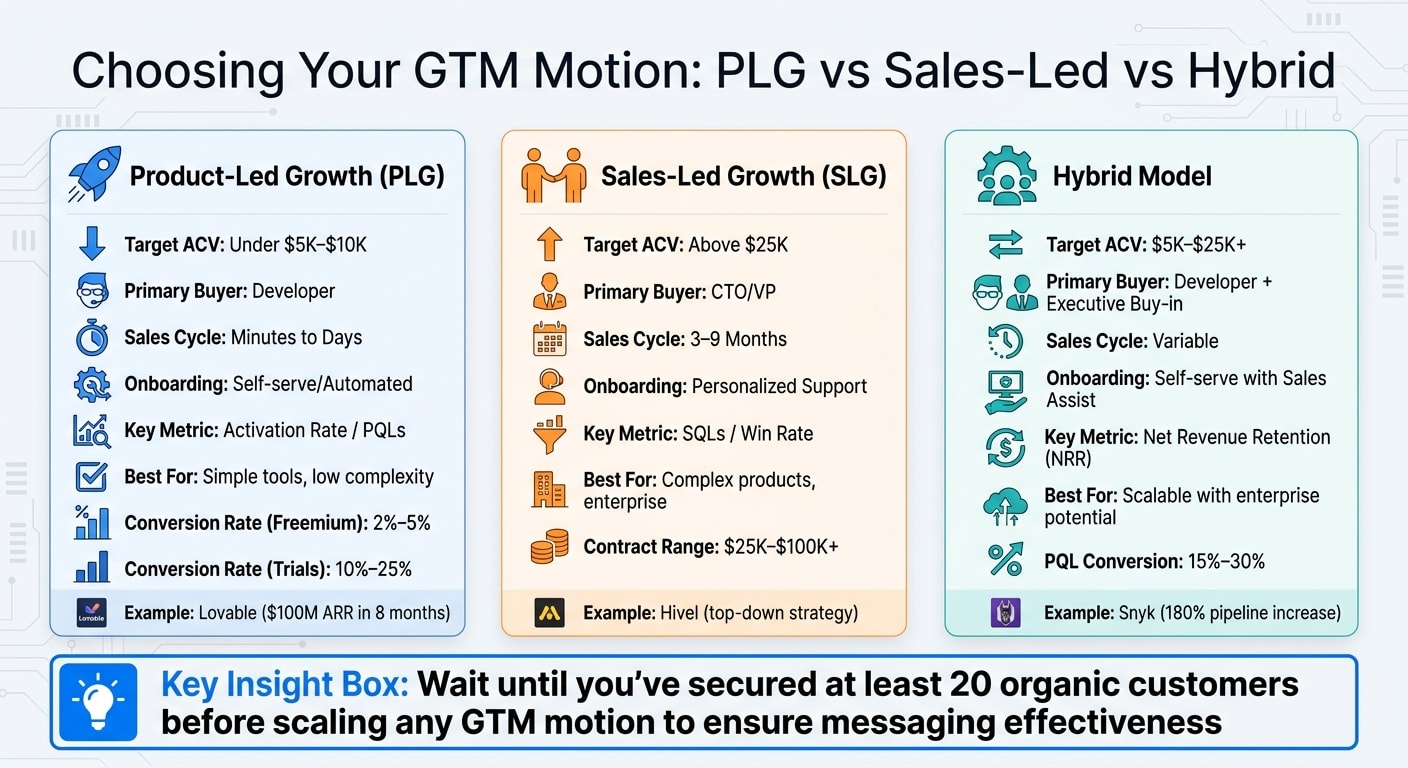
Once your beachhead community is in place, the next step is to choose a Go-to-Market (GTM) motion that fits your product’s complexity and the value it delivers to customers. Your options include Product-Led Growth (PLG), Sales-Led Growth (SLG), or a Hybrid approach. The decision should be based on factors like how complex your product is, the pricing model, and the size of your target customer base. Picking the right motion lays the foundation for your launch plan and pricing strategy.
Here’s a practical way to think about it:
- Use PLG for products with annual contract values (ACVs) below $5,000–$10,000 (typically under $100 per user per month).
- Opt for SLG if ACVs exceed $25,000.
- Go with a Hybrid model for products with ACVs between $5,000 and $25,000+ .
| Feature | Product-Led Growth (PLG) | Sales-Led Growth (SLG) | Hybrid Model |
|---|---|---|---|
| Target ACV | Under $5K–$10K | Above $25K | $5K–$25K+ |
| Primary Buyer | Developer | CTO/VP | Developer + Executive Buy-in |
| Sales Cycle | Minutes to Days | 3–9 Months | Variable |
| Onboarding | Self-serve/Automated | Personalized Support | Self-serve with Sales Assist |
| Key Metric | Activation Rate / PQLs | SQLs / Win Rate | Net Revenue Retention (NRR) |
Before scaling any of these motions, it’s crucial for founders to personally close 20 to 50 deals. This hands-on experience helps you understand the market and refine your messaging. As Semir Jahic, CEO of Salesmotion, wisely points out:
"The most expensive mistake in GTM is scaling a broken motion because every dollar spent amplifies the problem rather than solving it" .
Product-Led Growth (PLG)
In a PLG model, the product does the heavy lifting when it comes to acquiring and expanding users. Developers can sign up, experience its value almost immediately, and upgrade to paid plans without needing to interact with a sales team. This works best for straightforward tools where a single developer can see value quickly, without needing team approval or complex setups .
For example, Lovable, a software development platform, achieved $100M ARR in just eight months in 2025 using a PLG approach . Their success was tied to optimizing "Time to First Value" (TTFV) - the time it takes for a user to experience their first "aha" moment. For freemium products, aim for a TTFV of under 15 minutes; for trials, keep it under 30 minutes .
PLG strategies typically include:
- Self-serve onboarding
- Freemium or trial models
- Transparent pricing
Conversion rates for freemium models hover around 2% to 5%, while time-limited trials see higher rates of 10% to 25% . A growing trend called "reverse trials" offers users full access to premium features for 7 to 14 days before transitioning to a limited free tier.
A great example of PLG success is Jam.dev, which grew 10× to over 100,000 users by focusing on sharing features that encouraged users to promote the product. Ivanha Paz, Founding Marketer at Jam.dev, explained:
"Our sharing features are like rocket fuel for our growth engine" .
However, one common misstep in PLG is underpricing. In the B2B space, low prices can sometimes signal poor quality, so pricing should reflect the value your product delivers.
Sales-Led Approach
A Sales-Led motion relies on building relationships to close deals, making it ideal for complex products that require custom implementation, security reviews, or navigating enterprise procurement processes . If your product impacts multiple teams or involves critical workflows, you’ll likely need a sales team to guide customers through the process.
Take Hivel, for instance. The company embraced a top-down sales strategy because its tool required broad organizational buy-in to deliver value. Founder Sudheer shared:
"If people aren't searching for a solution, you have to knock on doors, explain the problem, and then present the solution" .
This approach is best suited for products with ACVs above $25,000 and sales cycles lasting 3 to 9 months. Onboarding is typically more hands-on, involving personalized support, custom integrations, and dedicated account management. Pricing is often opaque and structured around annual contracts, which can range from $25,000 to over $100,000.
Hybrid Model
The Hybrid Model combines self-serve adoption for individual users with sales support for larger team and enterprise deals. This approach allows companies to capture grassroots momentum through PLG while also securing high-value contracts through SLG .
Snyk is a great example of this strategy in action. Developers can sign up via GitHub and start seeing value immediately, while a 50-person sales team uses product usage data to identify opportunities for expansion. This approach has led to a 180% increase in sales-sourced pipeline and over 200 new opportunities each month .
The key to a successful Hybrid Model is identifying Product Qualified Leads (PQLs) - users who have reached specific usage milestones that align with your ideal customer profile. PQLs typically convert at rates of 15% to 30%, compared to just 2% to 5% for traditional Marketing Qualified Leads (MQLs) .
For example, Slack defines a PQL as a team that has sent 2,000 messages. Once this threshold is reached, the product becomes deeply embedded in the team’s workflow, significantly increasing the likelihood of conversion . Similarly, 55% of Zoom’s customers generating over $100,000 in revenue started with at least one free host , showing how a free tier can pave the way for larger contracts.
Your choice of GTM motion will play a big role in shaping your launch plans and pricing strategies as you move forward.
Plan Your Launch Sequence
Once you've chosen your go-to-market (GTM) strategy, it's time to map out a well-organized launch sequence. This step-by-step approach helps you build momentum, gather feedback, and fine-tune your product before scaling. The aim isn't to go viral overnight but to move methodically from private beta to public launch, and eventually expand through content and paid channels. As Flo Merian, a Product Hunt expert, advises:
"Launch days are hectic. Prep as much content as possible so you can focus on engagement on launch day" .
A typical launch timeline spans 6–8 weeks, starting with audience building and ending with post-launch growth. In weeks 1–2, share updates about your progress and join relevant communities on platforms like Reddit and Discord. Weeks 3–4 are for running a private beta and collecting early feedback. Week 5 is your pre-launch countdown, followed by the launch itself in week 6. From week 7 onward, focus on refining and iterating based on feedback .
Your beta phase is crucial for validating your messaging and avoiding premature launch errors. As InfiniteAny Blog points out:
"The product you have right now is probably sufficient to get your first 10 customers. What you lack is not features. It is distribution" .
This phase is where you learn what resonates with users before scaling your efforts.
Run a Private Beta Program
A private beta isn't just about testing features - it's about confirming that the problem you're solving is important enough for developers to pay for your solution. Start by speaking with 15–20 potential customers to validate this assumption . Then, aim to recruit your "First 10" users - paying customers or active beta testers you know by name. At this stage, the focus is on learning, not scaling .
To attract beta users, offer meaningful incentives. For example, you could provide a lifetime 50% discount or three months free in exchange for detailed engagement and honest feedback . These early adopters often become your strongest advocates during the public launch.
Structure your beta program to guide users through awareness, technical implementation, and migration. Define a clear activation milestone for your product, such as a first API call or database migration, and provide timely support to help users reach it. Activation metrics will complement broader adoption measures discussed later .
Regular feedback loops are essential. Hold monthly beta calls and track feature requests systematically . When you release a highly requested feature, let users know with a direct message like, "You asked for X, we just shipped it" . This shows you're listening and values user input.
Post-beta, capture advocacy by collecting testimonials and highlighting specific metrics, such as "saved 5 hours per week." These trust signals are more persuasive than polished marketing language. As James Doman-Pipe, a GTM specialist, emphasizes:
"Developer GTM is won through product experience and trust signals, not loud campaign mechanics" .
Don't overlook your documentation - it can be a powerful GTM tool. Ensure quickstart guides and troubleshooting resources are ready before the beta ends. Monitor where beta users struggle, whether in Slack or Discord, to identify areas for improvement in your product or messaging .
Once your product and messaging are refined, you're ready to move to a public platform launch.
Launch on Product Hunt and Developer Platforms
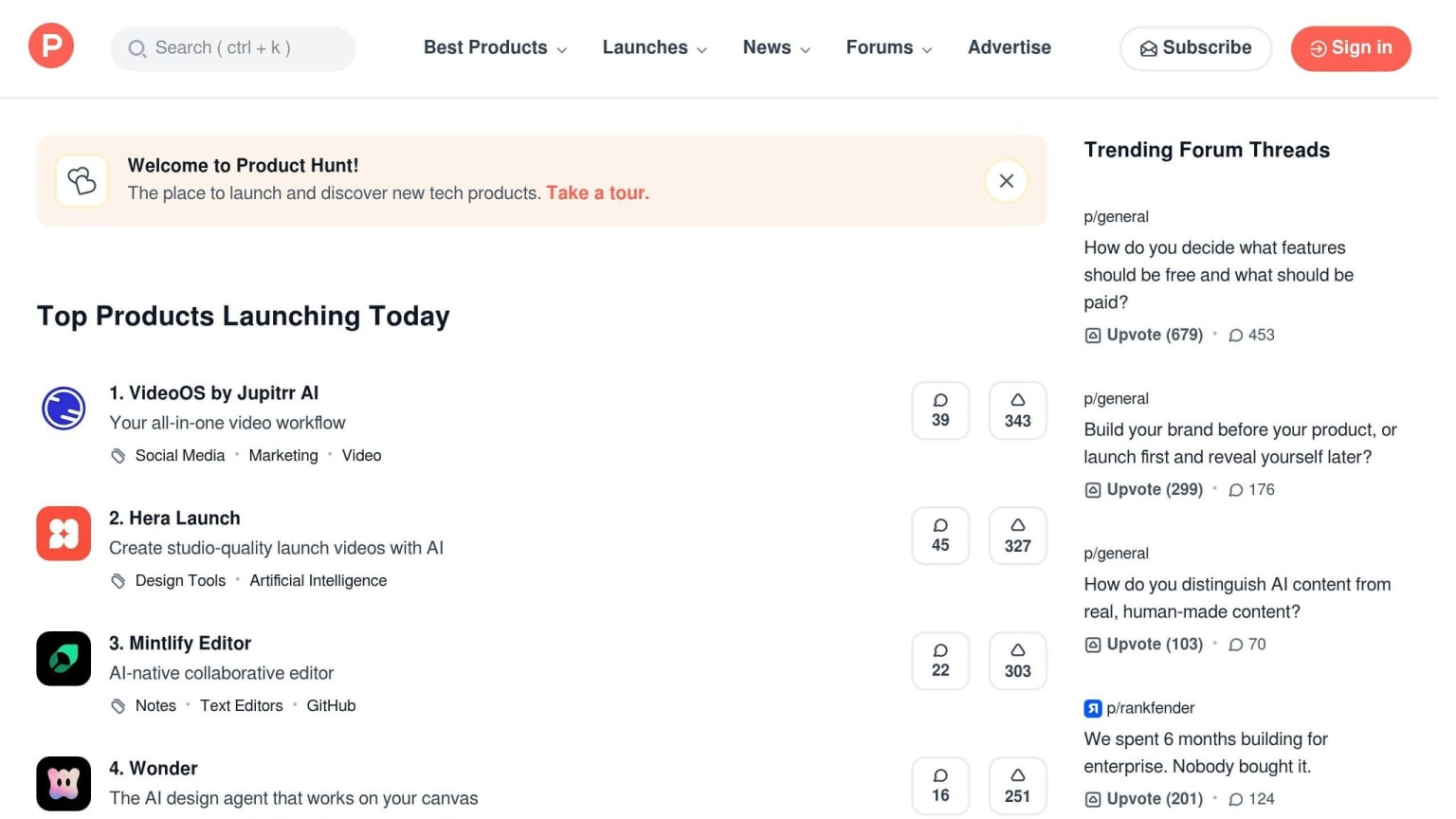
Product Hunt can be a game-changer for developer tools, but preparation is key. A developer-first product that ranks in the Top 4 can attract 1,500–2,000 unique visitors in a single day, while the #1 Product of the Day often sees between 2,000 and 10,000 visitors . Conversion rates from Product Hunt traffic to signups generally fall between 1% and 3% .
Start preparing 3–8 weeks before your launch by engaging with the community - upvote and comment on other launches to build credibility . A week before launch, create a "Coming Soon" teaser page to collect "Notify Me" subscribers .
Timing is everything. Launches reset at 12:01 AM PT, so starting at this time maximizes your 24-hour visibility window . The first four hours are critical because Product Hunt temporarily hides upvote counts and adjusts homepage rankings to ensure fair exposure .
When crafting your maker comment, keep it brief (under 800 characters) and focus on your product’s origin, features, and a clear call-to-action . For developer-focused launches, include technical details like "built with Flutter and Supabase" to build trust with the audience .
Line up 20–50 supporters with established accounts to engage within the first hour of your launch . Quality comments significantly impact the algorithm - one strong comment can be worth as much as 40–50 upvotes . Use your gallery to showcase the product workflow, results, and a short demo video or GIF .
Here are two examples of successful Product Hunt launches:
- Dub.co: Achieved #1 Product of the Day, Week, and Month, gaining 1,085 upvotes and 663 new signups - 8x their daily average. Their teaser page and strategic use of the "Shoutouts" feature played a key role .
- Tally 2.0: Attracted 9,800 homepage visitors and 766 new users on launch day, nearly doubling their weekly signups from 2,300 to 4,400 .
Offering a Product Hunt-exclusive deal, like a 20% lifetime discount, can help convert traffic into paying customers . Adding a "Product of the Day" badge to your website can also boost signups by about 17% .
After a successful public launch, keep the momentum going with consistent content and targeted paid advertising.
Scale with Content and Paid Advertising
Technical content has a compounding effect - it continues to drive organic signups long after it's published, unlike paid ads that stop when the budget runs out . Focus on three types of high-intent content:
- Problem-Solution Tutorials: Step-by-step guides solving specific issues.
- Comparison/Alternative Posts: Target users ready to switch tools.
- Experience Reports: Share building-in-public stories .
Target keywords at the bottom of the funnel, such as "[Competitor] alternatives" or "best [tool category]", as they can convert at rates 5–10x higher than generic content . Look for search terms with 100–1,000 monthly queries - these are easier for early-stage startups to rank for .
Consistency is key. Publishing one high-quality article per week for a year will outperform sporadic bursts of content . Repurpose each article into Twitter threads, Reddit posts, newsletters, and cross-posts on platforms like Dev.to or Hashnode using canonical URLs .
As InfiniteAny Blog notes:
"Developers read documentation for fun... They respect expertise and share useful resources with their networks" .
For paid ads, avoid generic platforms like LinkedIn - over 60% of developers use ad blockers . Instead, focus on developer-specific channels like daily.dev Ads, which reach developers consuming technical content.
Wait until you've secured at least 20 organic customers before running ads to ensure your messaging is effective . When ready, newsletter sponsorships in publications like Techpresso can deliver clicks at a cost-per-click (CPC) of $1.70–$3.00 .
For example, in April 2026, DigitalOcean ran an eight-placement campaign with Techpresso, generating over 1 million impressions and achieving an average CPC of $1.70 .
Track intent signals, such as visits to premium features or pricing pages, for personalized outreach . Documentation page views are another key metric, as they often correlate strongly with sales pipeline activity .
Louis Corneloup, Founder of Dupple, highlights the importance of documentation:
"For devtools, documentation is the highest-converting marketing asset. Clear docs with runnable examples produce more signups than any ad" .
Set Developer-Friendly Pricing
Pricing isn't just about numbers - it's a key part of how your product connects with developers. Developers value clear, upfront pricing and low barriers to entry. If pricing feels hidden or complicated, they’re quick to move on. In fact, 76% of developers say unclear pricing is a major reason they stop evaluating a tool . Your pricing should reflect how developers adopt tools: starting small, testing them in real-world scenarios, and scaling as they find value. A transparent pricing model is essential for turning early adopters into long-term users.
One effective method combines tiered subscriptions with usage-based overages. This approach provides predictability while allowing costs to scale with usage . As Jean-Michel Lemieux, former CTO of Shopify, explains:
"The most successful developer tools companies recognize that pricing is a form of product design. It should align with how developers perceive and extract value" .
Structuring Pricing Tiers
When creating pricing tiers, the "Rule of Three" is a solid framework. Offer three options: a free or starter tier, a professional tier (the sweet spot), and an enterprise tier. A common price ratio is 1 : 2.5 : 8. For example, you might price your tiers at $15, $39, and $99 per month . Highlighting the middle tier as "Most Popular" can help capture 50–70% of signups .
Freemium and Tiered Pricing
Freemium models are especially effective for developer tools. A perpetual free tier acts as a hands-on demo, allowing developers to integrate your tool into their workflow without pressure. Unlike time-limited trials, freemium models often lead to higher conversion rates - 15–28% for top-performing developer tools, compared to an 8% median for B2B SaaS tools .
The key is to offer real value in the free tier while setting clear upgrade triggers. Developers are most likely to upgrade for advanced features (44%) or higher usage limits (31%) . For example, Supabase offers a free tier with generous database space and user limits, then charges $25 per month for its Pro tier, which includes 8GB of database space and 100,000 monthly active users .
Save premium features - like team collaboration, advanced analytics, or integrations - for paid tiers. This lets individual developers explore your tool for free and naturally upgrade as their needs grow. Atlassian, for instance, historically priced entry-level products under $10 to make them easy for developers to expense without management approval, encouraging grassroots adoption .
If you need to raise prices, consider grandfathering existing customers at their current rates for at least 12 months. This can turn a potential churn risk into a loyalty-building opportunity . Defaulting to annual billing with a "2 months free" discount is another effective way to improve cash flow and reduce churn .
Usage-Based Pricing
Usage-based pricing ties costs directly to how much value developers get from your tool. Instead of paying for access, developers pay based on consumption - whether it’s API calls, data usage, or compute resources . This appeals to developers who want to avoid overpaying during early experimentation.
While pure pay-as-you-go pricing, like Twilio's $0.0083 per outbound SMS, minimizes onboarding friction, it can lead to unexpected costs for finance teams. A hybrid model - combining a base subscription with usage-based overages - balances predictability with scalability .
Transparency is non-negotiable. Publish your pricing publicly and provide real-time usage dashboards so developers can track their consumption. As Scaledrone puts it:
"Transparency is a feature. In many cases, it's the feature that wins the deal" .
You can also use rate limits as a pricing tool, offering higher burst limits or priority access in paid tiers . For AI-based tools, consider credit-based pricing to simplify backend complexities. For instance, Intercom charges $0.99 per AI-resolved conversation, directly tying pricing to business outcomes .
Use Paid Developer Advertising Channels
Once you've laid the groundwork with organic efforts, paid advertising channels can help you scale your developer outreach. The key is to meet developers where they already spend their time - within the tools and communities they rely on.
Traditional display ads often fall short due to the widespread use of ad blockers. Instead, developer-specific platforms leverage native ad placements that naturally fit into a developer's workflow. These ads appear in places where developers are actively engaged - like documentation pages or technical newsfeeds - making them far more effective than generic banners.
Advertise on daily.dev Ads
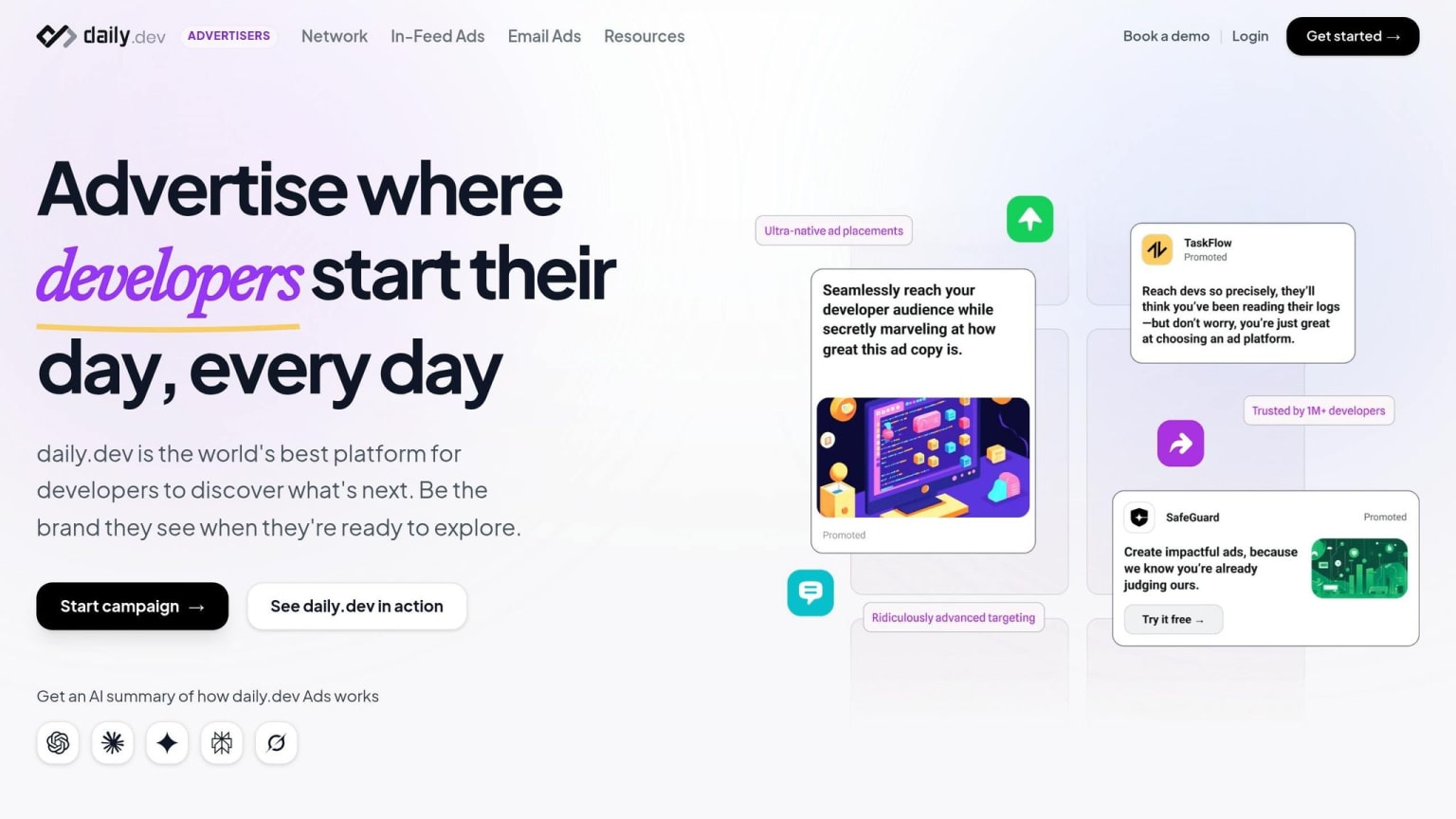
daily.dev connects with over 1 million active developers through its trusted news aggregation platform . With AI-driven budget optimization, the platform ensures your ads target high-conversion segments. You can refine your targeting based on programming languages, seniority levels, and specific interests, ensuring your message resonates with the right audience.
Native ads on daily.dev integrate seamlessly into the feed, linking directly to resources like documentation or interactive demos. This approach reduces friction and drives higher conversion rates. While daily.dev is a strong option, other platforms can complement your strategy and broaden your reach.
Use Other Developer Ad Platforms
In addition to daily.dev, several other platforms provide valuable opportunities to engage developers:
Stack Overflow: With 50 million developers visiting monthly - 40% of whom are based in the U.S. - Stack Overflow offers targeted ads that appear when developers are actively searching for solutions . The platform allows targeting by technology tags, making it highly effective for reaching developers with specific needs. However, it requires a significant investment, with a minimum spend of $10,000 per month for a three-month commitment or $15,000 per month without a long-term agreement.
Carbon Ads: This platform provides native ad placements on design and development blogs. With starting budgets between $5,000 and $10,000 per month , Carbon Ads focuses on contextual targeting rather than intrusive tracking, appealing to privacy-conscious users.
In-IDE Advertising: Platforms like Idlen place ads directly in IDEs, where developers spend much of their time. These ads, shown during idle moments, achieve click-through rates of up to 3.5% . As Idlen explains:
"Developers live inside tools, not feeds. The highest-value impressions happen in IDEs, documentation sites, package managers, CLI outputs, and technical newsletters - not social timelines."
To maximize your impact, tailor your creative assets to fit the developer's environment. Ads featuring code snippets, terminal screenshots, or product GIFs often perform better than standard marketing copy. Refreshing your ad creatives every 3–4 weeks can also help prevent fatigue, especially on platforms with niche developer audiences.
Measure Adoption Metrics Beyond MQLs
Marketing Qualified Leads (MQLs) only scratch the surface when it comes to understanding whether developers truly benefit from your product. For instance, downloading a whitepaper is far from the same as successfully integrating an API into a live project. To go deeper, your metrics need to evolve. Product Qualified Leads (PQLs) focus on users who hit meaningful milestones, like executing code samples or deploying to production . Here's why this matters: PQLs typically convert into paying customers at rates 3-5x higher than MQLs .
A key metric to watch is Time to First Value (TTFV) - how quickly a developer experiences their first "aha moment", such as a successful API call or a working "hello world" program . Ideally, this should happen within 5 minutes, though under 15 minutes is still a strong benchmark for freemium models . For example, Datadog tracks PQLs as users who send at least 100 monitoring events and stay active for 7+ days. This approach has driven a 22% PQL-to-paid conversion rate .
Track Activation and Usage Metrics
Monthly Active Developers (MAD) is another essential metric, focusing on authenticated actions like API calls, code commits, or configuration updates . Since developers often work in sprints rather than daily, it's more insightful to measure these technical actions to gauge engagement.
Documentation engagement is another powerful predictor of success. Stripe’s analytics showed that developers who visit 5 or more unique documentation pages during their first session are 340% more likely to convert compared to those who only visit one page . For onboarding, well-structured experiences often achieve activation rates between 20% and 40%, while trial-to-paid conversion rates hover around 17% for free trials and 5% for freemium models .
Team collaboration is a strong indicator of long-term value. When developers invite teammates to join a platform, it signals deeper engagement. Slack, for instance, found that teams sending 2,000 messages are much more likely to upgrade to paid plans .
Monitor Retention and Word-of-Mouth
Once developers are activated, retention and organic growth become the priorities. Retention benchmarks for developer tools differ from general SaaS products. For instance, successful tools aim for Week 1 retention rates of 40-60% and Month 1 retention rates of 25-40% . Net Dollar Retention (NDR) for developer tools tends to average between 110% and 130%, largely driven by increased usage rather than just adding more users .
Word-of-mouth plays a huge role in driving growth, even though it’s notoriously hard to track. About 52% of developer tool discoveries happen through "dark social" channels like private Slack groups, Discord servers, or direct messages . To get a sense of this, ask developers during onboarding how they heard about your product. These surveys often achieve a 78% completion rate among developers .
Community engagement also impacts retention. MongoDB discovered that developers who answer at least one community question within their first 90 days show 65% higher retention rates and 40% greater usage growth compared to inactive members . Monitoring GitHub activity, from stars to production deployments, can also provide valuable insights . Outreach based on real activity, such as stars, forks, or pull requests, tends to achieve 3-5x higher reply rates than standard cold outreach .
These metrics and insights can help refine your go-to-market strategy and expand your developer tool’s reach effectively.
Conclusion
Creating a successful developer go-to-market strategy starts with understanding how developers discover and evaluate tools. Developers bypass sales pitches and case studies, heading straight to documentation and quickstarts to see if a tool delivers. If that first API call doesn’t work, trust is lost - and no marketing campaign can repair it .
To put these principles into action, focus on the essentials that developers care about most. Documentation is your most powerful conversion tool . Pricing should align with actual usage, and onboarding must deliver value within the first five minutes. Instead of chasing lead volume, track metrics like activation and retention.
"The purchase decision follows the adoption decision - not the other way around." - Priya Nair, Partner at Syntract Capital
Winning in this space requires leaving behind outdated methods and treating your product experience as your strongest marketing channel. Build trust by demonstrating technical expertise and contributing to the community before expecting anything in return.
At the core, successful companies prioritize Time-to-Value, encourage organic distribution, and measure meaningful integration. These are the cornerstones of a strong developer-focused strategy. Everything else takes a back seat.
FAQs
How do I define an ICP for a dev tool without targeting “all developers”?
When crafting an Ideal Customer Profile (ICP) for a developer tool, it’s all about zeroing in on the details that match your product’s strengths. Focus on traits like:
- Company size: Are you targeting startups, mid-sized businesses, or large enterprises?
- Industry: Which industries would gain the most from your tool? For example, SaaS companies, e-commerce platforms, or fintech firms.
- Tech stack: What technologies does your audience already use? Compatibility with their existing tools is key.
- Developer personas: Think about who will use your product - DevOps engineers, software developers, or maybe QA specialists.
By pinpointing the groups that are most likely to embrace and benefit from your tool, you can create messaging that resonates and allocate resources more effectively. This approach keeps your targeting focused, avoiding the pitfalls of being too broad, while setting the stage for a scalable and efficient go-to-market strategy.
When should I use PLG vs sales-led vs a hybrid GTM motion?
Choosing the right approach - product-led growth (PLG), sales-led, or a hybrid GTM motion - depends on your product's nature, target audience, and business objectives.
- PLG is a great fit for products that offer self-serve onboarding, free tiers, and appeal to developers who can adopt tools quickly.
- Sales-led is ideal for more complex offerings or enterprise-level clients who require personalized demos and hands-on engagement.
- Hybrid blends the scalability of PLG with the tailored approach of sales-led strategies, making it perfect for engaging both individual users and larger organizations.
What are the 3 adoption metrics I should track instead of MQLs?
When it comes to understanding developer adoption, focus on these three critical metrics: product engagement, community engagement, and developer-specific attribution signals.
These metrics go beyond traditional marketing-qualified leads (MQLs) by offering a clearer picture of how developers are interacting with your tools, contributing to your community, and advancing through their adoption journey. By keeping a close eye on these areas, you can gain a more accurate and meaningful understanding of developer behavior.