

To connect with developers effectively, you need to meet them where they work - not on social media, but within the tools and platforms they use daily. Traditional ads often fail because:
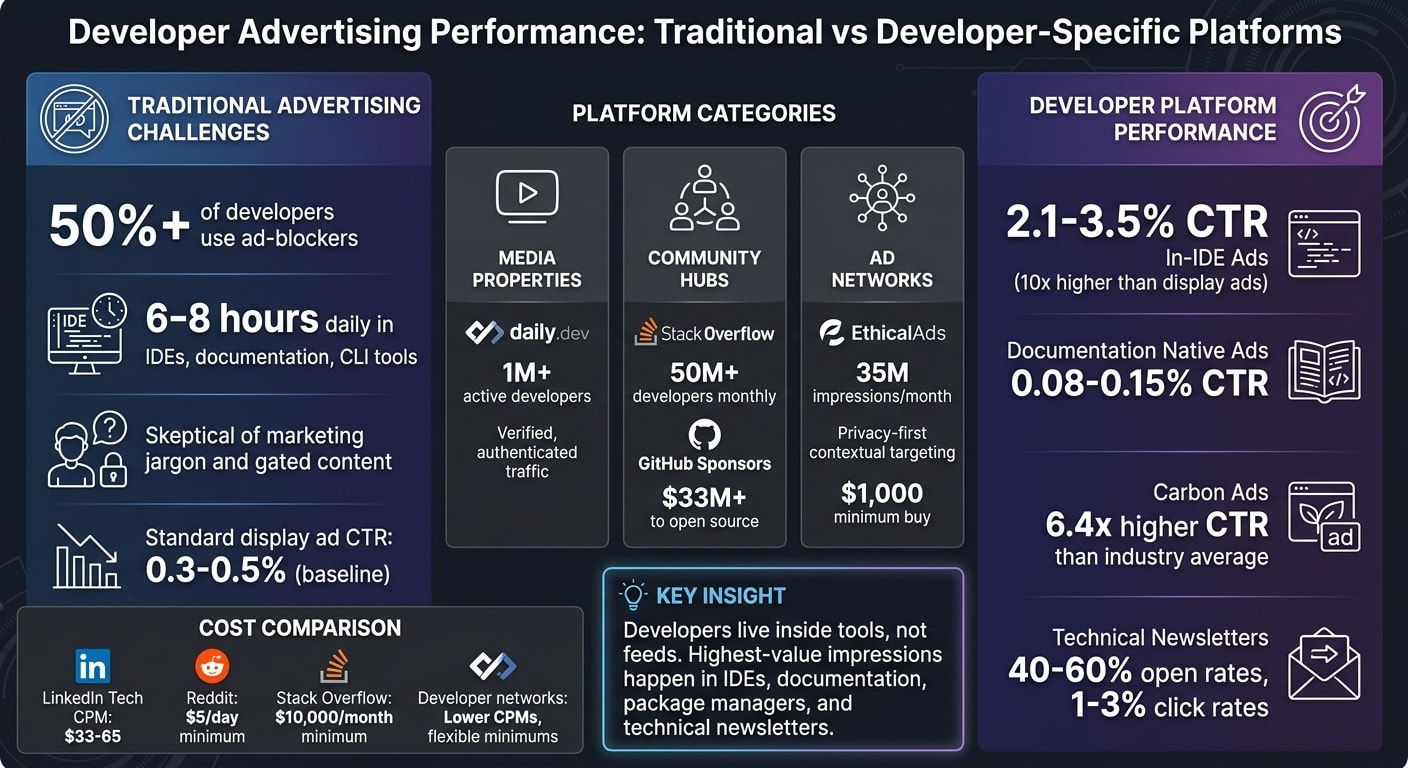
- Developers spend 6–8 hours a day in IDEs, documentation, and CLI tools.
- Over 50% of developers use ad-blockers.
- They are skeptical of marketing jargon and gated content.
Key Takeaways:
- In-Workflow Ads Work Best: Ads embedded in IDEs, documentation, and technical newsletters achieve click-through rates of 2.1–3.5%, far outperforming standard display ads.
- Privacy-First Targeting: Platforms like EthicalAds and daily.dev use contextual targeting (e.g., programming languages, frameworks) instead of behavioral tracking.
- Developer Platforms to Explore:
- Media Properties: Sites like daily.dev attract developers during discovery phases.
- Community Hubs: Stack Overflow and Reddit enable trust-based ad placements.
- Developer-Specific Ad Networks: EthicalAds serves 35M impressions monthly with privacy-conscious targeting.
- Owned Media Is Essential: Documentation, blogs, and GitHub READMEs are prime spaces to engage developers directly.
To succeed, combine paid ads with owned content. Use ads for visibility and owned channels to build trust by offering clear, actionable, and technical value.
What Are Developer Audience Platforms
Developer audience platforms are designed to connect brands with technical users right where they work - directly within their development tools. Unlike traditional ad networks that rely on social media feeds or general web browsing, these platforms embed ads naturally into developers' workflows.
The key distinction lies in workflow integration. Developers spend a lot of their time using professional tools, and these platforms reach them during their most focused moments - when they’re solving problems or exploring new tools. This creates a high level of intent and attention.
Another standout feature is their privacy-first design. Instead of relying on behavioral tracking, these platforms use contextual targeting based on tech stacks and relevant topics. This approach not only bypasses ad blockers but also ensures ads appear precisely when developers are considering new tools. As a result, the ads reach active engineers, not casual web users.
"Developers live inside tools, not feeds. The highest-value impressions happen in IDEs, documentation sites, package managers, CLI outputs, and technical newsletters - not social timelines." - Idlen
These platforms generally fall into three categories: media properties with verified traffic, community hubs for engagement, and ad networks tailored for technical audiences. Let’s dive into each category.
Media Properties with Verified Developer Traffic
Media properties attract developers by publishing technical content such as tutorials, articles, and curated resources. What sets them apart is their verified traffic - authenticated users who log in and actively engage with the content. This verification ensures that brands reach real developers, not bots or casual visitors. For example, platforms like daily.dev use community logins to confirm their audience consists of active, engaged developers.
The effectiveness of these platforms is reflected in their performance metrics. Ads placed within integrated development environments (IDEs) achieve click-through rates of 2.1–3.5%, which is about 10 times higher than traditional display ads. This success comes from targeting developers during their moments of discovery - when they’re exploring new tools, not just completing routine tasks. These platforms also focus on desktop environments, where developers test APIs, deploy code, and evaluate new solutions.
Community Hubs and Developer Engagement
Community hubs bring developers together to ask questions, share knowledge, and discuss tools. These spaces - whether Q&A sites, programming forums, or subreddits - offer more than just ad impressions. They provide a unique opportunity for trust transfer: ads placed within these trusted communities gain an implicit endorsement. As one expert notes:
"Channel selection is a trust decision as much as a reach decision." - Idlen
These hubs also allow for precise targeting through natural segmentation. Developers often organize themselves around specific technologies, like React, Kubernetes, or Python. This makes it easy for brands to connect with the right audience without relying on invasive tracking. For instance, Stack Overflow reaches over 50 million developers monthly, and GitHub Sponsors has directed over $33 million into the open-source ecosystem. These platforms highlight both the scale and the investments brands make to engage technical audiences.
Ad Networks Built for Developers
Developer-focused ad networks specialize in connecting brands with technical users through trusted content placements across multiple sites. Unlike general ad networks, these platforms focus on contextual targeting based on programming languages, frameworks, or technical topics. For example, EthicalAds serves over 35 million developer impressions each month through documentation and open-source sites. Their privacy-friendly approach places ads based on page content rather than tracking individual behavior, addressing developers' concerns while ensuring relevance.
These networks also offer detailed targeting options. Campaigns can be tailored for specific audiences, such as React developers or Kubernetes engineers, ensuring ads reach the right people. Pricing reflects this focused approach. While LinkedIn CPMs in tech average between $33 and $65, developer-specific networks often have lower rates and more flexible minimums. For example, EthicalAds requires a $1,000 minimum buy, and platforms like daily.dev use AI to optimize campaigns in real time based on engagement patterns.
The Developer Audience Landscape in 2026
By 2026, developers have shifted away from traditional social media feeds, opting for tools that integrate seamlessly into their workflows. This transition has reshaped how brands connect with technical audiences, redefining the spaces where developers consume and engage with content.
Where Developers Spend Their Time
Developers now rely on a diverse range of platforms, each serving specific purposes. For instance, content aggregators like daily.dev cater to over 1 million active developers, offering personalized feeds packed with technical articles and resources tailored to their interests . Meanwhile, Q&A communities remain indispensable, with Stack Overflow continuing to attract more than 50 million developers every month . Similarly, Reddit's programming-focused subreddits are thriving, fostering community-driven discussions.
Documentation and open-source platforms have also emerged as prime advertising spaces. EthicalAds, for example, delivers over 35 million developer impressions monthly . GitHub Sponsors has funneled more than $33 million into the open-source ecosystem , providing a unique opportunity for brands to show their support while engaging with developers. Additionally, technical newsletters like TLDR, boasting over 1.2 million subscribers, have become a key touchpoint for reaching developers during their research and learning phases .
A noteworthy trend is the growing popularity of in-IDE advertising. By integrating ads directly into development environments, brands can engage developers during natural pauses like builds, deployments, or while waiting for AI-generated responses.
How Developer Engagement Is Changing
Three major trends are reshaping how developers interact with content. First, AI integration has become the norm. Platforms now engage developers through millions of interactions with coding assistants like GitHub Copilot, ChatGPT, and Claude every month . Second, the rise of privacy-first targeting has replaced traditional behavioral tracking, a shift driven by Google's phase-out of third-party cookies in 2026.
Lastly, developers increasingly gravitate toward platforms where peer validation plays a central role. Whether it's subreddit discussions, GitHub stars, or recommendations in newsletters, developers trust content that comes with endorsements from their peers. These changes call for a more thoughtful approach to choosing the right platforms to reach this audience effectively.
How to Evaluate Developer Audience Platforms
Not all developer platforms are created equal when it comes to traffic quality. Marketing leaders need a clear way to separate platforms with genuine engineering audiences from those padded with students, hobbyists, or even bots. This distinction is critical because developer adoption tends to follow a bottom-up process - individual engineers need to try your tool, find value in it, and advocate for it internally before enterprises make broader decisions . The following framework builds on earlier insights to help you keep your developer engagement strategy focused and effective.
Checking Audience Quality: Real Engineers vs. Bots
Start by evaluating key engagement metrics that align with authentic developer behavior. For example, native ads on documentation sites typically achieve click-through rates between 0.08% and 0.15%, while in-IDE placements can see rates as high as 2.1% to 3.5%. These benchmarks can help you verify whether a platform is reaching real developers. Keep in mind that over 50% of technical users use ad blockers, so platforms claiming 100% reach may be inflated with non-technical audiences or bots. Instead, focus on privacy-respecting platforms that developers trust due to contextual targeting rather than intrusive tracking - these tend to deliver higher-quality traffic.
Another way to confirm authenticity is by analyzing tech stack signals. Platforms that allow targeting by specific programming languages, frameworks, cloud providers, or package managers are likely tracking genuine development activity. Behavioral intent markers, such as starting a new project, deploying code to production, or searching for specific solutions like "Terraform alternative", can also help identify real engineers. Since developers often operate in privacy-heavy environments where tracking is limited, post-signup surveys (e.g., "How did you hear about us?") can provide additional confirmation of authentic engagement. Testing platforms with small budgets - like Reddit's $5 per day minimum versus the $10,000 monthly minimum on Stack Overflow - can help you validate audience quality without risking significant financial resources .
Once you’ve confirmed authentic engagement, you can refine your strategy by leveraging advanced targeting options.
Targeting Options to Consider
The best developer platforms offer robust targeting options to help you reach the right audience. For instance, tech stack targeting allows you to filter by programming languages, frameworks, cloud providers, and package managers, ensuring your message reaches developers who are actually using tools relevant to your product. Professional firmographics, such as job titles (e.g., DevOps Lead, CTO, Architect), seniority levels, company size, and industry, are equally important when you’re aiming to engage decision-makers.
Intent-based targeting focuses on developers actively searching for solutions using specific keywords or technology tags. Contextual targeting, on the other hand, displays ads based on the content developers are currently engaging with - like documentation topics or workflow-related content. With third-party cookies set to disappear by 2026, contextual targeting has become a key method for connecting with privacy-conscious developers.
You can also segment developers by their roles - such as front-end, back-end, DevOps, or data science - to improve conversion rates. Adding elements of social proof, such as GitHub stars, npm download stats, or Docker Hub metrics, can further bolster the credibility of your campaigns. These capabilities allow you to tailor your outreach efforts, reinforcing the bottom-up adoption model that drives developer engagement .
Ad Formats on Developer Platforms
Ad formats play a crucial role in how effectively your message reaches developers within their workflows. Once you've ensured the traffic is genuinely developer-focused, the next step is selecting ad formats that resonate. With over half of developers using ad blockers, traditional display ads often fail to make an impact . Instead, the most effective formats integrate naturally into a developer's routine - whether they're browsing technical content, reading documentation, or actively coding. Here's a breakdown of how different formats engage developers at key points in their workflow.
Native Content and Feed Ads
Native ads fit seamlessly into the content developers are already consuming, bypassing ad blockers and reducing skepticism around advertising. For example, Carbon Ads places a single, unobtrusive native ad per page on technical sites and reports click-through rates (CTR) up to 6.4 times higher than the industry average . Similarly, EthicalAds serves over 35 million developer impressions monthly across documentation and open-source platforms, achieving CTRs between 0.08% and 0.15% - all without relying on tracking cookies .
Feed-based platforms, on the other hand, target developers during moments of discovery rather than when they're focused on solving a specific issue. As Nimrod Kramer from daily.dev explains:
"Intent is everything. A developer searching for 'how to do X' is in a task-focused mindset... Contrast that with a platform where users open the app to see what's new" .
This discovery-driven mindset often leads to better engagement with new tools and resources.
Emerging formats like in-IDE advertising place ads directly within code editors such as VS Code or JetBrains. These ads appear during natural pauses, like builds or deployments, ensuring they reach developers right in their workspace. As Idlen highlights:
"Developers live inside tools, not feeds. The highest-value impressions happen in IDEs, documentation sites, package managers, CLI outputs, and technical newsletters" .
In addition to feed ads, sponsorships and curated content offer more ways to connect with this audience.
Sponsored Posts and Newsletter Placements
Newsletter sponsorships leverage the trust of established technical communities. These newsletters often achieve open rates between 40% and 60%, with click rates ranging from 1% to 3% . Because they are opt-in, newsletters bypass ad blockers and benefit from their credibility. For example, major newsletters like TLDR charge between $3,000 and $15,000+ per placement, while niche newsletters typically range from $100 to $2,000 .
Sponsored posts in developer communities work best when they address specific technical challenges rather than relying on marketing-heavy language. Promoted posts in developer-focused subreddits, for instance, can achieve engagement rates of over 1% when they provide real technical value . With a minimum daily spend of around $5 and cost-per-click (CPC) rates typically between $0.20 and $1.50, these placements are an affordable way to test your messaging . To stand out, focus on solving concrete problems - like "Tired of debugging flaky CI pipelines?" - instead of using generic promotional claims .
Building Your Own Developer Audience
Paid placements can help you get noticed, but owned media channels are what build trust over time. This ties directly into the idea of meeting developers where they naturally work. Your documentation site, technical blog, changelog, and GitHub README are key touchpoints where developers assess your product. As Idlen aptly says:
"Your developer blog, documentation, changelog, and GitHub README are advertising surfaces too" .
What sets these apart is that developers actively seek out these resources when they’re evaluating tools. This makes them far more open to what you’re offering compared to traditional ads.
Owned Media Channels
The best developer content shows value quickly and clearly. Skip the fluff and focus on practical examples. Use code snippets, terminal screenshots, or product GIFs to instantly highlight your product’s benefits. For instance, when developers land on your documentation, make it immediately clear how you can help them solve problems faster. Place calls-to-action directly within the content - like “Join 5,000 teams using [product] - start free” - to catch them while they’re already engaged .
Here’s a key tip: don’t gate your content behind forms. Developers often leave when asked for details like a work email. Instead, guide them toward hands-on resources like your documentation, sandboxes, or free tiers where they can experiment freely . Metrics that matter to engineers - like GitHub stars, npm downloads, or Docker Hub pulls - are far more effective than corporate accolades . Use precise, technical phrasing (e.g., "Terraform provider available, 5-minute setup") to communicate directly and effectively .
Engaging through open source initiatives can further enhance the credibility you build with these owned channels.
Open Source and Community Contributions
Open source involvement is a surefire way to build trust. Developers trust their peers far more than they trust vendors - 10x more, in fact, and 100x more when compared to traditional salespeople . Supporting open source maintainers, through programs like GitHub Sponsors (which has funneled over $33 million into the ecosystem ) or contributing code to widely-used projects, positions you as a collaborator rather than just a marketer.
Active participation in developer communities - like GitHub, Stack Overflow, or technical subreddits - also strengthens your presence. Here, the goal is to be genuinely helpful. Share useful code snippets, troubleshoot specific problems, and only mention your product when it’s a relevant solution . Victor Coisne, VP of Marketing at Strapi, puts it well:
"Developers are 'allergic to some of the marketing tactics.' This is because developers are typically more interested in self-directed learning and solving problems than in being sold to" .
Combining Owned and Paid Strategies
Paid ads and owned content are like two sides of the same coin - they work better together than apart. Imagine this: a developer spots your tool in a feed ad, then dives into your documentation, and finally commits to signing up after reading a technical blog post. Each interaction builds on the previous one, creating a cohesive journey.
The trick is to coordinate your messaging across different channels. For example, if a developer lands on your documentation via a search ad but doesn't take action, you can retarget them with more compelling content - like a benchmark report - through platforms like your daily.dev network or other owned channels. Developers often need multiple touchpoints over weeks to make a decision, so a balanced approach is essential. Consider allocating about 50% of your budget to search ads to capture active demand, with the rest focused on raising awareness in the early stages.
This coordinated strategy ensures you're meeting developers with the right message at the right time in their journey.
Top-of-Funnel Awareness with Paid Ads
Paid ads are perfect for introducing your product to developers who may not even realize they need it. Platforms like daily.dev, which engages over 1 million active developers, are great for this. Their native in-feed ads seamlessly integrate with the content developers already consume, helping you build brand visibility without being intrusive . At this stage, it's all about planting the seed - don’t push for conversions just yet.
You can also use paid sponsorships in niche newsletters or promote your top technical content through ads. Direct developers to your best blog posts or tutorials to spark interest. And don’t forget to keep your ad creative fresh - update it every three to four weeks to avoid audience fatigue, especially since you're targeting a focused, niche group.
Mid- and Bottom-Funnel Nurturing
Once you've captured attention, it's time for your owned content to shine. This is where your documentation, changelogs, and technical blog come into play. These resources are where developers dig deeper, deciding if your tool is worth their time. Treat these assets as more than just informational - they're opportunities to guide action. Include clear calls-to-action, like “Join 5,000 teams using [product] - start free,” directly within your content to encourage the next step.
Conclusion
Reaching developers effectively calls for a tailored approach that differs from standard B2B marketing. Developers gravitate toward tools that fit seamlessly into their workflows and prefer solutions that integrate naturally, rather than disrupt their processes.
Daily.dev offers a way to connect with over 1 million active developers through native in-feed ads placed within a highly engaging discovery platform. This method aligns with how developers work and make decisions, ensuring your message complements rather than interrupts their experience.
To strengthen your outreach, consider combining paid and owned strategies. Use owned media like comprehensive documentation, technical blogs, and open-source contributions to establish credibility. Pair this with targeted paid channels: start by capturing intent through search ads, build awareness with daily.dev’s mid-funnel engagement opportunities, and reinforce your brand over time with privacy-conscious channels. Keep in mind that developers often need multiple touchpoints over several weeks to finalize decisions. Choose platforms that emphasize authentic developer engagement, advanced targeting capabilities, and well-integrated ad formats to maximize your impact.
Daily.dev’s AI-driven optimization stands out by reallocating budgets in real time to the highest-performing segments, making it a strong choice for product-led growth strategies. Unlike traditional ad networks, daily.dev places your message directly within a trusted, content-rich environment where developers are already active and engaged.
The secret to success lies in delivering content with substance - think code snippets, product GIFs, and detailed technical insights. Avoid generic marketing jargon and focus on metrics that matter: cost per signup, trial activations, and pipeline growth. When your messaging is precise and paired with a high-quality platform, you’ll foster meaningful and lasting engagement with the developer community.
FAQs
How can I verify a platform’s audience consists of real engineers?
To ensure a platform's audience genuinely includes engineers, prioritize authentic engagement metrics. Look for signs like active participation, genuine interactions, and verified developer traffic. Steer clear of placing too much trust in demographic claims or sheer traffic numbers, as these can often be deceptive.
Which targeting options matter most for developer ads?
When creating ads for developers, the key targeting options to focus on are technical stack, seniority, programming language, company size, and geographic location. These criteria allow you to fine-tune your audience, making sure your ads resonate with the right people and deliver maximum relevance.
How should I split budget between paid ads and owned content?
To manage your budget effectively, focus first on owned media like documentation sites, open-source communities, and newsletters. These channels help establish trust and build lasting relationships. Then, allocate about 20-30% of your budget to paid ads, such as contextual feed ads, to generate initial awareness.
As your campaigns progress, keep a close eye on performance metrics. Use this data to fine-tune your budget allocation, ensuring your strategy balances awareness, consideration, and conversions while maintaining genuine engagement with developers.