

Developers don’t trust flashy marketing. They trust proof - open-source contributions, clear documentation, and real-world use cases. Building a brand in the developer ecosystem means focusing on transparency, community engagement, and delivering an exceptional developer experience (DX). Here’s the roadmap:
- Trust First: 70% of developers abandon tools due to lack of trust. Metrics like GitHub stars and community endorsements matter more than ads.
- Open Source Wins: Contributing to open-source projects builds credibility. For example, GitHub’s transparency earned loyalty without aggressive sales.
- Developer Experience (DX): Seamless onboarding, clear API docs, and responsive support are non-negotiable. Vercel’s zero-config deployments drove massive adoption.
- Content + Community: Developers need 10+ touchpoints before trusting a tool. Blogs, tutorials, and community engagement are key.
- Measure What Matters: Track GitHub stars, retention rates, and sentiment analysis instead of traditional marketing KPIs.
Building a developer brand takes 2–3 years, starting with credibility (Year 1), deeper engagement (Year 2), and scaling trust (Year 3). Focus on trust, technical transparency, and creating tools developers love to use.
Why Brand Matters More for Developer Tools Than Most B2B Products
Developer tools exist in a space that's quite different from the typical B2B software market. While most business products can rely on polished sales decks and executive pitches, developer tools face a unique challenge - their primary audience, developers, tends to be skeptical of traditional marketing. And honestly, who can blame them? The market is crowded, and flashy marketing doesn't always equal a reliable product.
Developers hold tools to a higher standard because these tools often become critical parts of their workflow. As Nikola Balić, a growth strategist for developer tools, explains, "a developer needs to encounter your product or company at least 10 times" before they even consider it seriously . These interactions could happen through blog posts, GitHub stars, or even recommendations from colleagues. Unlike traditional B2B buyers who might be swayed by a demo or a sales call, developers need multiple, meaningful touchpoints to feel confident in a product.
How Developers Influence Purchasing Decisions
Developers play a unique role in the buying process. In many cases, they’re the ones driving decisions from the ground up. Here’s how it typically works: an individual developer finds a tool they like, starts using it, and then advocates for its adoption within their organization. This bottom-up model means the tool has to earn the trust of both developers and decision-makers.
Developers look for technical validation - things like performance metrics, community endorsements, and examples of real-world integrations. Meanwhile, management focuses on business validation, such as ROI projections, security certifications, and case studies. This dual-layer trust requirement makes it clear why developers need repeated, authentic interactions with a brand. In this context, content marketing tends to be far more effective than paid ads .
Challenges in Building a Developer-Focused Brand
Given these dynamics, branding for developer tools comes with its own set of hurdles. One major issue is bridging the technical credibility gap. If marketing teams don’t fully understand the product or if the documentation isn’t up to par, it’s nearly impossible to create content that resonates . Developers are quick to notice these gaps. In fact, research shows that developers often skim through 80% of a landing page, hunting for key elements like documentation links and code examples . If these aren’t readily available - or worse, poorly executed - trust evaporates almost instantly.
Another challenge is the “invisible” nature of many developer tools. These tools often operate behind the scenes, powering infrastructure, automation, or backend processes. This makes them harder to market using traditional visual strategies. As Nikola Balić puts it:
Developers are always running somewhere. Their attention is overloaded. You have seconds to prove you respect their time and intelligence.
Every interaction, whether it’s a homepage visit or an error message, needs to convey technical expertise and respect for the developer’s skills.
Finally, attribution remains a persistent issue. Developers prioritize trust, so any technical misstep or lack of visibility can quickly undermine confidence. A 2025 analysis revealed that 40% of new signups for one developer tool came from AI recommendations rather than traditional search or ads . This shift highlights the importance of creating content that AI models can reference - something referred to as "mention engineering." Despite these efforts, marketing teams are often the last to get credit for success and the first to shoulder blame when adoption targets fall short .
Core Strategies for Building a Developer Brand
Creating a developer brand requires more than just traditional marketing tactics. Developers tend to value honesty, technical expertise, and proof of skills. Startups looking to gain trust in the developer world can benefit from these proven strategies.
Open Source Contributions: Building Trust Through Action
Open source projects act like a "living resume", showcasing a brand's ability to tackle real-world challenges while letting peers evaluate technical skills firsthand. Take Railly Hugo, an AI Software Engineer at Clerk, as an example. By earning over 2,000 GitHub stars across five repositories, Hugo not only demonstrated his expertise but also opened doors to career opportunities. In November 2025, Bryce Kalow reached out to Hugo after reviewing his open-source project "Elements", a full-stack shadcn registry, allowing Clerk to assess his work even before a formal interview .
Hugo sums it up perfectly:
Building in public maximizes your luck area. Cold-applying minimizes it.
- Railly Hugo, AI Software Engineer at Clerk
In December 2022, Hugo created the "one-hunter-theme" for VS Code after a request from the developer shadcn. When shadcn adopted the theme for the official ui.shadcn.com site, it provided instant validation of Hugo's technical abilities and boosted his reputation within the developer community . Additionally, his participation in hackathons helped him build a network of over 500 developers in Peru, further solidifying his presence in the field. His advice?
Whatever you build at a hackathon, share it. Post about it. Even if your audience is 10 people. That's your online presence, your living CV.
- Railly Hugo, AI Software Engineer at Clerk
Publishing in English is another way to broaden your reach globally . While open source contributions showcase technical skills, sharing these achievements through insights and educational content takes credibility to the next level.
Establishing Credibility Through Technical Thought Leadership
Creating technical content positions a brand as a knowledgeable voice in the developer world. This isn't about promoting products - it's about educating peers, sharing research, and solving actual problems. For instance, Hugo's tools, which simplify tasks like generating themes from base colors, highlight his focus on addressing specific pain points .
As Hugo puts it:
The question is no longer simply 'can you build it?' but 'should you build it - and for whom?'
- Railly Hugo, AI Software Engineer at Clerk
When engaging with technical communities, listening to their needs before offering solutions is key. This approach builds trust and ensures that any shared content resonates with developers seeking meaningful, educational material. While technical content lays the groundwork for trust, a strong visual identity helps make a lasting impression.
Crafting a Visual Identity That Speaks to Developers
Developers often steer clear of the generic corporate B2B look - think blue websites, abstract graphics, and uninspired dashboards. Instead, they prefer branding that feels personal and relatable, often described as having an "indie" vibe. A great example is PostHog, which built its branding around "Max the Hedgehog", a mascot designed by illustrator Lottie Coxon. After 18 iterations, Max became a consistent presence across all brand touchpoints, helping the company grow to over 190,000 teams and reach a $920M valuation .
James Hawkins, CEO of PostHog, highlighted the importance of standing out:
Every competitor we knew about had a blue website, lots and lots of words, yet no information on the pricing page.
- James Hawkins, CEO, PostHog
Successful visual branding aligns with developer preferences. Features like dark mode, high contrast (complementing IDEs), and embedded code snippets convey technical depth and transparency . PostHog's lead designer, Cory, explained their approach:
We aren't the best in the world at being polished, but we can be the best in the world at being ourselves.
- Cory, Lead Designer, PostHog
Investing in design early makes a difference. Many developer-focused companies hire graphic designers as one of their first team members to ensure the brand identity is deeply integrated into the product . A practical test? The "Hacker News Pre-Mortem." If developers on Hacker News would dismiss a design or marketing choice as too corporate or superficial, it's time to rethink it .
Hawkins also warned against following generic trends:
An obviously templated or generic website signals the team behind the product isn't very strong.
- James Hawkins, CEO, PostHog
He added:
The direction of travel for a B2B company is that you get more boring as you get older. Companies put a veneer of 'what should we sound like' at the top and as a result everyone sounds the same and boring and dumbed down.
- James Hawkins, CEO, PostHog
Using Developer Experience (DX) as a Branding Tool
Developer experience (DX) isn't just about creating tools for developers - it's about building trust and loyalty within the developer ecosystem. When DX becomes a defining feature of your brand, every interaction - whether it's through documentation, tools, or support - underscores your commitment to making developers' lives easier.
Making DX a Core Brand Differentiator
DX plays a critical role in shaping how developers perceive your brand. From their first API call to solving complex edge cases, every step of their journey matters. Startups that focus on making workflows faster, simpler, and more intuitive can create a strong competitive edge that’s tough to match.
Think about it: reducing friction is key. Developers should be able to complete a "Hello World" experience in minutes - without wading through endless documentation or navigating tricky configurations. By offering straightforward defaults for tasks like routing, bundling, and scaling, companies allow developers to focus on what truly matters: building great products. This "zero-config" approach not only saves time but also fosters trust and loyalty.
Developers also approach tools differently than traditional buyers. Kevin Van Gundy, Chief Revenue Officer at Vercel, puts it perfectly:
Developers don't follow traditional buying cycles. They prefer to try tools quietly, build something useful, and only talk to someone once they hit a blocker or see clear value. - Kevin Van Gundy, Chief Revenue Officer, Vercel
This behavior highlights the importance of having technical experts - often called Product Advocates - who can step in to resolve issues and provide real-world coding solutions. These principles form the backbone of DX-driven success, and many companies have used this strategy to transform their brands. Let’s explore some examples.
Examples of DX-Driven Branding Success
Take Vercel, for instance. Between 2015 and 2025, Vercel grew from a small side project into a platform generating over $200 million in annual recurring revenue, with more than 100,000 monthly signups through a freemium, self-serve model. Guillermo Rauch, Vercel's founder, created Next.js to tackle the challenges of setting up React for production. By introducing features like zero-config deployments, seamless Git integration, and instant previews for pull requests, Vercel turned developer experience into a powerful distribution strategy. As Rauch explained:
WordPress had invested millions into hosting one application. But launching new apps was still painful. - Guillermo Rauch, Founder, Vercel
Vercel’s success stemmed from keeping its core framework open-source while monetizing the hosting experience. This approach avoided vendor lock-in, which resonated deeply with developers. Disha Agarwal, Head of Marketing at Reo.Dev, summed it up:
Vercel won by obsessing over the details that made developers faster - zero-config deployments, seamless Git workflows, real-time previews. These product choices didn't just delight users - they created stickiness, advocacy, and trust that competitors couldn't easily replicate. - Disha Agarwal, Head of Marketing, Reo.Dev
Another example is Unstructured, which used developer behavior signals - like exploring documentation or cloning repositories - to offer proactive support. This strategy led to a 20% increase in meetings and accounted for 40% of their total deals.
These examples show how a strong focus on DX can do more than improve workflows - it can transform your brand into a trusted ally for developers.
Measuring Brand Awareness and Trust in Developer Communities
Building a developer brand is one thing - figuring out if it’s actually working is another. Unlike traditional B2B marketing, where leads are tracked through a sales funnel, developer branding often grows in community spaces like GitHub, Stack Overflow, Reddit, and Twitter. The metrics that matter here aren’t your typical marketing KPIs. Instead, they provide measurable feedback that validates the trust you've built through technical excellence. These metrics tie directly into the trust-building strategies discussed earlier, creating a bridge between your developer engagement efforts and long-term brand trust.
Key Metrics for Measuring Awareness and Trust
When it comes to awareness, GitHub metrics are your go-to indicators. Keep an eye on stars, forks, and contributors on your repositories. Use the GitHub API to track these weekly, aiming for a 20% month-over-month growth during your first year . Stripe, for example, saw their GitHub stars climb from 1,000 to over 10,000 in their first year - a clear sign of growing visibility .
For trust, Net Promoter Score (NPS) is a reliable metric. Twilio, for instance, maintains an NPS above 70 by consistently gathering developer feedback, which has been linked to their impressive 40% year-over-year increase in API adoption . Quarterly surveys via tools like Typeform can help you gather actionable insights from developers.
Sentiment analysis is another powerful tool to gauge trust. Platforms like Brandwatch or MonkeyLearn analyze mentions across Reddit, Twitter, and Hacker News to measure the balance of positive and negative sentiment. Postman, for example, achieved 80% positive sentiment during their open-source releases, which contributed to a 30% boost in trust scores .
Product adoption metrics also play a big role. Track downloads, active users, and retention rates using tools like Google Analytics or Mixpanel. Vercel’s brand strength is evident in over 1 million weekly deployments paired with an 85% retention rate - a testament to how a strong developer experience builds trust . According to the 2024 Developer Nation Report, 67% of developers switch tools due to a lack of trust, making retention a key indicator of brand health .
Tools and Strategies for Tracking Developer Brand Growth
Centralizing all your data into a single dashboard simplifies tracking. Use Google Analytics 4 to monitor website traffic from developer referrals and measure time-to-value, with a target of under 5 minutes as a proxy for trust . Tools like Ahrefs or SEMrush can monitor keyword rankings for terms like "developer tool branding." Stripe used this strategy to achieve a 50% increase in awareness through organic search .
Feedback loops are essential. Add in-app surveys through platforms like Typeform or NPS tools like Delighted to capture real-time developer sentiment. Daily.dev, for example, uses community polls to track a 20% monthly growth in branded content interactions . Tools like Hotjar or FullStory can also help you identify friction points in the developer experience that might hurt your brand perception .
Social listening is another must. Tools such as Brand24 or Ahrefs can track brand mentions in developer spaces. According to the 2024 State of Developer Ecosystem report, 70% of developer decisions happen in communities like Stack Overflow and Discord, making these platforms critical for monitoring . Additionally, "altmetrics" - like GitHub activity, Reddit discussions, and Hacker News mentions - are becoming increasingly valuable for predicting brand success .
To keep things simple, create a framework with three pillars: Awareness (mentions, searches, GitHub stars), Consideration (engagement rates, adoption metrics), and Trust (sentiment scores, NPS, retention) . Review these metrics quarterly and adjust your strategy based on leading indicators rather than waiting for revenue data to catch up .
From Unknown to Trusted: A Timeline for Developer Brand Building
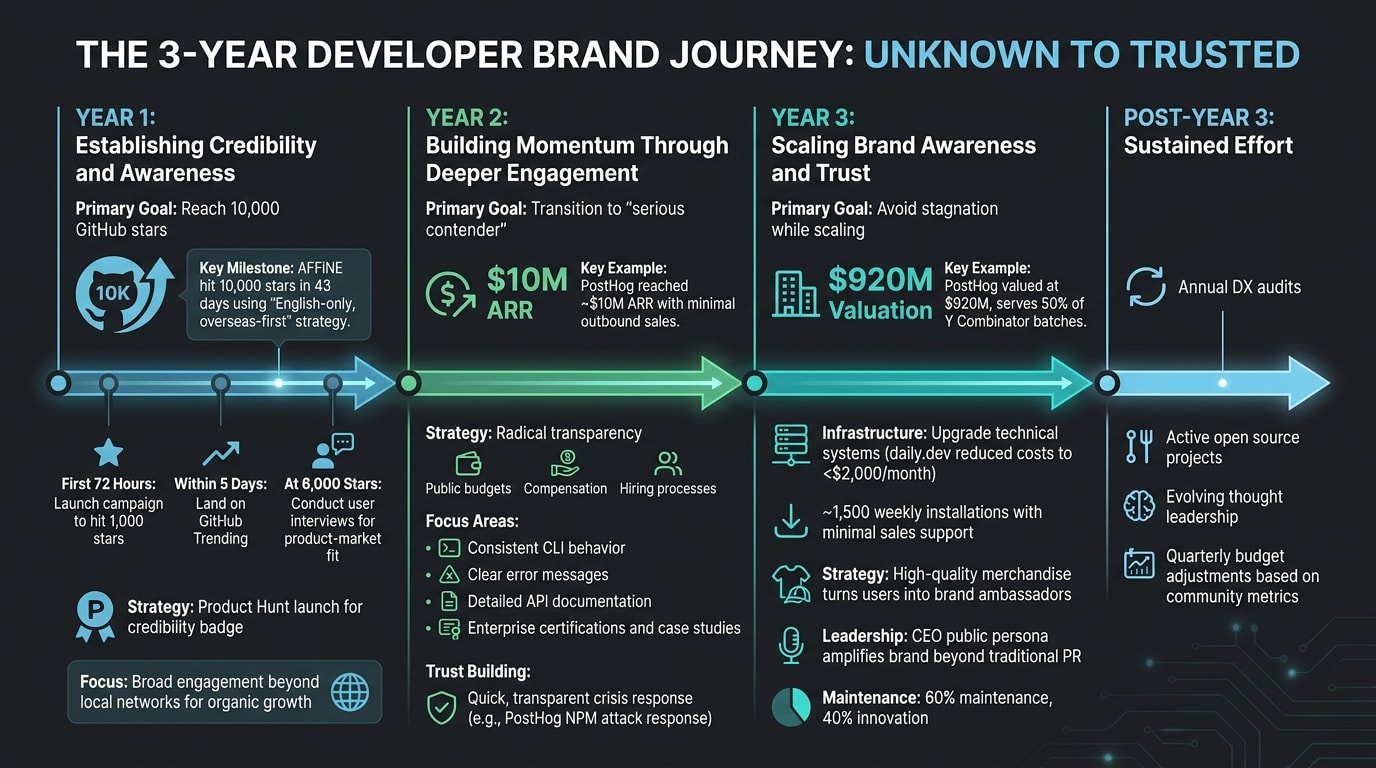
Building a developer brand takes time and deliberate effort. It’s not something that happens overnight. Most successful developer tools need about 2–3 years to evolve from being relatively unknown to becoming trusted names. Each stage of this journey demands a unique approach, with specific milestones to measure progress. Let’s explore what that timeline looks like.
Year 1: Establishing Credibility and Awareness
The first year is all about proving that you’re worth noticing. Your main target? Reaching 10,000 GitHub stars. Take AFFiNE as an example. In August 2022, they launched their open-source project and hit 10,000 stars in just 43 days. Their secret? An "English-only, overseas-first" strategy led by former COO Iris Wei. They focused on clean, organic growth to impress both developers and investors .
The first 72 hours after launch are crucial. A well-coordinated campaign can help you hit 1,000 GitHub stars and land on GitHub Trending within five days . To sustain momentum, aim for broad engagement beyond local networks - this ensures organic growth .
"Sophisticated investors - especially US-based VCs - run scripts on your GitHub data. They check star velocity, geographic distribution, whether growth looks organic." - Iris Wei, former COO at AFFiNE
When you approach 6,000 stars, it’s time to focus on engaging with your early users to refine your product-market fit. For instance, conduct one-on-one interviews with users who interact with you frequently on Discord or GitHub. And while Product Hunt can provide a quick traffic boost, its real value lies in the credibility of earning the "#1 on Product Hunt" badge for your README .
Once you’ve established yourself as credible, the next step is deepening trust and engagement.
Year 2: Building Momentum Through Deeper Engagement
In the second year, your goal is to transition from being just an "interesting project" to a "serious contender." One way to do this is by embracing radical transparency. PostHog is a great example - they reached approximately $10M ARR with minimal outbound sales by making their entire operating system public. This included details like their $150,000 monthly marketing budget, compensation calculators, and hiring processes .
Your developer experience becomes a key part of your brand here. Trust is earned through things like consistent CLI behavior, clear error messages, and detailed API documentation . When PostHog faced an NPM supply chain attack in November 2025, co-founder Tim Glaser responded quickly by posting a transparent timeline and action plan directly on Hacker News. Skipping the usual lawyer-approved PR route helped maintain trust during a critical moment .
As your company grows, you’ll also need to address the concerns of non-developer stakeholders. This might mean securing certifications, offering uptime guarantees, or creating enterprise case studies . These efforts prepare you for scaling both your brand and your technical capabilities in Year 3.
Year 3: Scaling Brand Awareness and Trust
By Year 3, the biggest challenge is avoiding stagnation. PostHog offers a clear example of how to keep things exciting. The company, valued at $920 million, serves about 50% of Y Combinator batches. They’ve managed to avoid the "maturity trap" by staying unconventional. For instance, when they announced their $70M Series D funding in June 2025, they ditched the traditional press release. Instead, they shared a single tweet and a video featuring a hedgehog puppet named Max .
"The direction of travel for a B2B company is that you get more boring as you get older. Companies put a veneer of 'what should we sound like' at the top and as a result everyone sounds the same and boring and dumbed down." - James Hawkins, CEO, PostHog
At this stage, scaling requires infrastructure upgrades. For example, in late 2023, daily.dev revamped its content pipeline by migrating to Temporal and eventually Go. This reduced their memory usage and enabled real-time feed personalization using Tinybird and Clickhouse - all for under $2,000 per month. This shift allowed them to process millions of events with a highly efficient, CTR-driven ranking system .
Another tactic? High-quality merchandise. PostHog, for instance, turned its users into brand ambassadors by gifting personality-driven merch. This strategy helped them generate approximately 1,500 weekly installations with minimal sales support . Finally, a CEO’s public persona can amplify your brand far more than traditional PR. A leadership style that’s opinionated, approachable, and even self-deprecating can resonate deeply with your audience.
Using daily.dev Brand Advertising to Build Awareness in the Developer Ecosystem
daily.dev Ads is a powerful way to expand your developer brand’s presence. After establishing trust through open-source contributions and technical content, this platform helps you connect with a developer-focused audience in a trusted and relevant environment.
Precision Targeting for Developer Audiences
daily.dev Ads allows you to target developers based on specific criteria like programming languages (e.g., JavaScript, Python, Go), seniority levels (from beginners to senior engineers), and tool preferences (such as Docker, Kubernetes, and VS Code). This level of detail ensures your advertising budget is spent reaching the developers most likely to engage with your product. For instance, if you're promoting a DevOps tool, you can focus on mid- to senior-level engineers familiar with cloud infrastructure, who often influence purchasing decisions.
With a reach that includes approximately 1 in 50 developers worldwide, over 20,000 GitHub stars, and a community of more than 11,000 members , daily.dev has earned the trust of major players like Google, Atlassian, and JetBrains. This credibility makes it an excellent platform for targeted campaigns that resonate with developers.
Native Ad Placements for Maximum Visibility
Beyond targeting, daily.dev ensures your ads integrate seamlessly into the user experience. Ads appear as native placements within personalized feeds and digest emails, avoiding the disruptive nature of traditional banners. The platform offers sponsorship opportunities across five digest topics: Web Development, AI and Machine Learning, DevOps and Cloud, Security, and Leadership. This placement strategy ensures your ads reach developers when they’re in a discovery mindset, actively seeking new tools or insights.
Recognizing that developers often evaluate technical products on desktop computers, daily.dev prioritizes desktop traffic. This focus aligns perfectly with how developers prefer to explore documentation, test APIs, or sign up for trials.
Earning Trust with a Trusted Advertising Environment
When your ad appears alongside content from respected industry leaders, it benefits from the credibility of its surroundings. daily.dev Ads has received a 4.8/5 rating on Product Hunt, earned the title of "Product of the Year", and garnered over 2,500 community reviews . This level of trust helps your brand make a stronger impression.
For businesses with niche products or region-specific goals, daily.dev also supports localized campaigns in markets like APAC, EMEA, and LATAM. Whether your goal is to drive product adoption, increase conference attendance, or generate qualified leads, daily.dev Ads ensures your message reaches the right developers at the right time.
Conclusion: Building a Developer Brand That Lasts
Key Takeaways for Effective Developer Branding
Creating a developer brand that endures is a long-term commitment with rewards that grow over time. The best developer tools build their foundation on trust and transparency. Open source contributions further boost this trust, with companies dedicating 20–30% of early marketing budgets to open source projects seeing adoption rates increase by 2–3×. Establishing technical authority through conferences, blogs, and research helps position your brand as a leader, while a strong, developer-focused visual identity reinforces your credibility.
Developer experience (DX) is the cornerstone of your brand. Businesses with top-tier DX enjoy 40% higher retention rates and more organic referrals. When APIs are easy to use and documentation is clear, developers naturally become advocates for your tools. Prioritizing developer trust leads to 3–5× longer customer lifetimes and reduces churn by 50%. Though it may take 2–3 years to see the full benefits, the long-term rewards - such as 4× faster ecosystem integration for those contributing to open source - make the effort worthwhile.
Platforms like daily.dev allow you to connect with developers at the right moment - when they're actively exploring new tools. These platforms can deliver 2–5× higher engagement compared to general social media ads, along with a 15–25% boost in brand recall. To sustain this momentum, it's essential to track progress consistently using metrics like Net Promoter Scores (aiming for scores above 50 in developer communities) and GitHub stars.
With these strategies in place, maintaining your brand's momentum will require constant innovation and adaptability.
The Path Forward: Sustained Effort and Adaptation
Developer ecosystems change quickly, and failing to keep up with evolving DX can leave 80% of dev tools struggling to stay relevant. Once your brand's foundation is secure, the next step is to focus on ongoing engagement and innovation. In Year 1, establish credibility through open source contributions and blogs. In Year 2, deepen engagement by improving DX and participating in conferences. By Year 3, scale your efforts with targeted advertising. After this, shift to a strategy of 60% maintenance and 40% innovation.
Conduct annual DX audits using developer feedback, keep open source projects active, and ensure your thought leadership evolves to address emerging trends like AI and machine learning. Agile iteration is key - neglecting community feedback can result in a 30% decline in trust. Use tools like GitHub Discussions for real-time insights, A/B test your branding, and adjust advertising budgets quarterly based on community metrics. Regularly review NPS scores and awareness surveys to refine your approach, ensuring your brand remains relevant and competitive in a constantly shifting landscape.
FAQs
What’s the fastest way to build trust with developers?
The quickest path to earning developers' trust is through transparency, technical accuracy, and providing genuine value. Developers appreciate clear communication, reliable information, and an active presence on platforms they rely on, like GitHub and Stack Overflow. Regularly offering meaningful content - whether through open-source projects, insightful blog posts, or engaging conference talks - not only builds your credibility but also positions you as a knowledgeable voice in the tech community. This consistent effort lays a strong groundwork for lasting trust.
How do I choose open-source projects that actually boost credibility?
To build trust, align yourself with open-source projects that have active maintainers, engaged contributors, and clear, well-documented objectives. Pay attention to projects showing steady growth - like an increasing number of GitHub stars - which often indicates their credibility and popularity within the developer community. Focus on contributing to projects backed by strong community support and deliberate growth strategies to strengthen your reputation in meaningful ways.
What are the 3 best metrics for tracking developer brand growth?
To understand how your developer brand is evolving, focus on these three critical metrics:
Brand awareness: Gauge how well your brand is known within developer communities. Are developers recognizing your name and associating it with value?
Trust and credibility: Pay attention to developer feedback and engagement. Positive interactions and consistent trust signals can indicate your brand is becoming a reliable presence.
Milestones in recognition and trust: Track progress toward specific goals that reflect increasing recognition and trust within the developer ecosystem.
These metrics offer a solid framework for assessing how your brand is connecting with developers and growing over time.